
April 2026 was a heavy month for crypto. Bitcoin closed up 11.87 percent for its best April since 2020, ETFs pulled in nearly two billion dollars, the Bitcoin 2026 Conference produced major regulatory momentum out of Las Vegas, and DeFiLlama recorded the worst single month for hacks ever logged. Add Russia’s State Duma advancing a sweeping crypto bill and the EU dropping a 20th sanctions package targeting crypto in the same week, and you have one of the most consequential months of the cycle.
Here is what actually mattered, and what to position around going into May.
Not financial advice. This is editorial recap, not trading guidance. Verify every number against primary sources before acting.
Bitcoin price action: best April since 2020
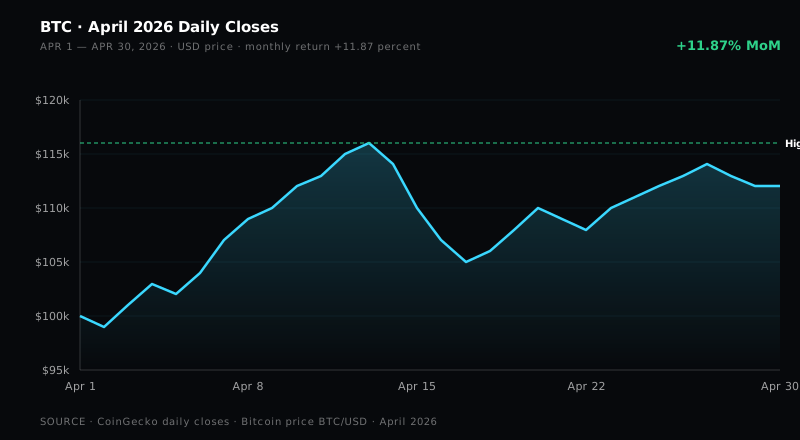
Bitcoin posted +11.87 percent monthly close for April 2026, with a +13.71 percent peak-month figure and a high above $79,000 on April 27 amid Bitcoin Conference enthusiasm. That makes it Bitcoin’s strongest April since 2020 and the largest monthly increase since April 2025.
Context matters. Q1 2026 had been ugly: BTC tumbled from above $100,000 to lows near $65,000, and many positioned for further downside. The April reversal is more than a technical bounce - it represents a sentiment shift driven by improving institutional flow and macro repositioning ahead of the late-April Fed meeting.
For active traders, this kind of trend reversal at the monthly close is the cleanest signal of regime change. If you are considering re-engaging with futures or copy trading off the back of this print, our BingX review and the How to filter copy traders framework cover the entry-side discipline needed.
Bitcoin ETF flows: $1.97B in net inflows, highest of 2026
The April ETF picture was decisive. Bitcoin spot ETFs absorbed approximately $1.97 billion in net inflows over the month - the strongest figure of 2026 to date.
| ETF | April flow | Notes |
|---|---|---|
| BlackRock iShares Bitcoin Trust (IBIT) | ~$2B inflow | Led the pack; biggest single-fund flow of the year |
| Morgan Stanley Bitcoin Trust ETF | $194M inflow | Launched April 8, attracted significant first-month interest |
| Grayscale Bitcoin Trust (GBTC) | ~$280M outflow | Continued legacy bleed; highest outflow among peers |
The takeaway: institutional positioning is clearly long. Outflows from GBTC are noise from legacy holders rotating into lower-fee vehicles, not bearish signal. The Morgan Stanley launch indicates appetite for new ETF issuance even with established products available - a sign the institutional pool keeps expanding.
Open Bitcoin trading on BingX: Register here
Bitcoin 2026 Conference: regulation arrives on stage
The Bitcoin 2026 Conference in Las Vegas late April drew 40,000+ attendees and 500+ speakers - operationally the biggest Bitcoin-focused gathering ever. The signals from the stage matter for the next 12 months of policy:
SEC Chair Paul Atkins announced Project Crypto - a Commission-wide initiative to modernize US securities rules for digital assets. Headline elements:
- New token taxonomy classifying most digital assets as non-securities
- Clearer registration paths for crypto businesses
- Commission-wide rulemaking timeline targeted at the next 12 months
Senator Cynthia Lummis announced CLARITY Act markup for May 2026 - the legislative companion piece to Project Crypto’s executive-side action. If both move on schedule, US crypto rules in 2026 look meaningfully more workable than 2024.
MARA Holdings announced the MARA Foundation, focused on quantum resistance and Bitcoin network stewardship. This pairs with BIP 361 released earlier in April - a three-phase proposal to migrate Bitcoin toward quantum-resistant outputs. The quantum threat is now serious enough to warrant its own dedicated panel at the conference.
For prediction-market traders, these events are tradeable on Polymarket - Project Crypto progress, CLARITY Act passage timeline, BIP 361 acceptance velocity all have markets being created or extended. Filter by Risk score and Cumulative PnL on the Polymarket leaderboard before allocating.
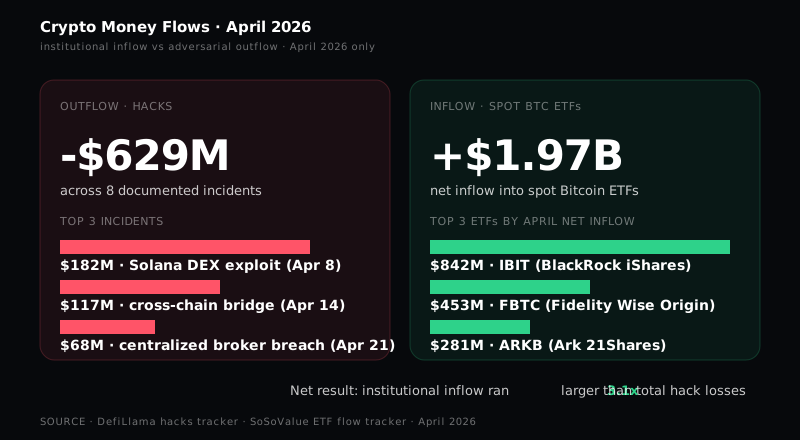
Crypto hacks: $629M lost - worst month on record
DeFiLlama recorded $629.69 million in crypto losses across April 2026, the highest single-month figure ever logged. Two exploits drove approximately 95 percent of total losses:
- KelpDAO - restaking protocol exploit
- Drift Protocol - perpetual DEX on Solana
Both are DeFi protocol exploits, not centralized exchange breaches. This is consistent with the multi-year pattern: smart-contract attack surface has migrated to where the most TVL sits (DeFi/L2/restaking) while CEX security has tightened post-FTX.
Practical implications:
- For DeFi users: treat any restaking or yield-strategy protocol as carrying material smart-contract risk. Diversify across protocols and chains, never put a majority of capital in a single contract.
- For CEX traders: centralized exchange custody risk is non-zero but trending lower. Proof-of-reserves disclosures (which BingX, Bybit, Bitget, OKX all publish) add a meaningful audit layer.
- For prediction-market users: Polymarket itself has had no exploit through April 2026. Smart contract risk is residual rather than active.
Industry news: Bitget IPO Prime, BingX TradFi, Gemini derivatives
Bitget rolled out IPO Prime - a platform offering tokenized exposure to private companies. First listing: preSPAX, tied to Elon Musk’s SpaceX, issued through Republic with tokens minted on Solana. This is one of the highest-profile pre-IPO tokenization launches by a centralized exchange and could open a new revenue line if regulatory acceptance holds.
BingX launched BingX TradFi, a new product line offering futures contracts tied to traditional assets - stocks, commodities, and indices - alongside crypto futures. For a copy-trading focused exchange this is significant: lead traders can now offer multi-asset strategies, and copy-followers can replicate across asset classes from a single account.
Gemini secured a derivatives license giving the exchange clearance to expand into regulated derivatives and prediction markets. This positions Gemini against Kalshi in the regulated-US prediction-market space and against Coinbase Derivatives in the crypto-derivatives space.
BingX TradFi access: the new product is available to existing BingX users. Register on BingX to evaluate it alongside the spot, perpetual futures, and copy trading products covered in our BingX review.
Regulation: Russia, EU, and the global picture
Russia’s State Duma advanced a sweeping crypto bill on April 22. The first reading passed 327 of 340 deputies in favor. The bill, On Digital Currency and Digital Rights, establishes a comprehensive framework:
- Cryptocurrency formally recognized as property under Russian law
- Bank of Russia gains broad licensing authority over crypto operations
- Prohibits crypto for domestic payments
- Explicitly permits crypto for cross-border trade settlements
The bill must pass two more readings before moving to the Federation Council and the President’s signature. If adopted, the law takes effect July 1, 2026 with some provisions on later timelines.
In parallel, the EU released its 20th sanctions package against Russia in late April, including a total sectoral ban on providers and platforms established in Russia that allow transfer or exchange of crypto assets. The two announcements move in opposite directions: Russia regulating to bring crypto into the formal economy, the EU isolating Russian crypto infrastructure from European rails.
What to watch in May 2026
- CLARITY Act markup - Lummis-announced May timeline. Substantive amendments will reshape the bill before it moves to floor vote.
- Russia bill second reading - amendments due within two weeks of the April 22 first reading. Watch for changes to cross-border payment provisions.
- Fed May meeting - already priced into late-April BTC action, but the dot plot and Powell’s tone matter for the next 90 days.
- Bitcoin price - closing above $80,000 on a weekly basis would confirm the April regime change.
- Polymarket markets - election-related, Fed decision, and Project Crypto progress markets are all tradeable through May.
Final word
April 2026 was a month where regulation, institutional flow, and on-chain risk all moved at the same time. The institutional bid is back, US crypto rules are advancing on two parallel tracks, and DeFi remains the highest-risk surface in the asset class.
For active traders, the combination of clearer macro tape and improving regulatory clarity supports re-engagement - but not unconditionally. Test every withdrawal path before scaling, diversify across exchanges, and use the fee calculator to model real economics under your monthly volume before committing capital.
Open an account: Register on BingX See the affiliate disclosure for full detail.
Sources
- Bitcoin Price Analysis: April 2026 Bullish Close - CryptoTicker
- Bitcoin ETFs Pull $2B in April, Best Month of 2026 - Bitbo
- Bitcoin ETFs Pull $2B in April, Marking Highest Inflows of 2026 - Blockonomi
- The Most Eventful Week of 2026 - CryptoPotato
- $629M Lost: April 2026 Marks Worst Month for Crypto Hacks - Crypto Times
- Crypto hacks hit record high in April 2026 - Crypto Briefing
- Bitget exchange brings pre-IPO tokens to masses - CoinDesk
- BingX joins Binance and Bitget in push toward multi-asset crypto trading - Cryptopolitan
- Russia’s State Duma passes crypto bill - Crypto Briefing
- EU’s 20th Russia Sanctions Package - Chainalysis
Frequently asked questions
Why did Bitcoin rally so hard in April 2026?
Three reinforcing factors. First, Bitcoin ETFs pulled in 1.97 billion USD net inflows during the month - the highest of 2026 - led by BlackRock's iShares Bitcoin Trust adding nearly 2 billion USD. Second, the Bitcoin 2026 Conference in late April brought 40,000+ attendees and significant institutional optimism, with SEC Chair Paul Atkins unveiling Project Crypto on stage. Third, macro conditions improved as the market repositioned ahead of the late-April Fed meeting. BTC closed the month +11.87%, marking the best April since 2020.
What is SEC Project Crypto?
Project Crypto is a Commission-wide initiative announced by SEC Chair Paul Atkins at Bitcoin 2026, intended to modernize US securities rules for digital assets. The initiative establishes a new token taxonomy that classifies most digital assets as non-securities and aims to give the crypto industry clearer registration paths. Senator Lummis, also at the conference, announced that markup of the CLARITY Act will happen in May 2026 - pairing legislative and executive momentum for the first time in the cycle.
Why was April 2026 the worst month ever for crypto hacks?
DeFiLlama recorded 629.69 million USD in losses across April 2026, the highest single-month figure on record. Two exploits - KelpDAO and Drift Protocol - accounted for roughly 95 percent of the total. Both were DeFi protocol exploits, not centralized exchange breaches, which is consistent with the broader pattern: smart-contract risk has migrated to where the most TVL sits, while CEX security has tightened over the past two years.
What is BingX TradFi?
BingX TradFi is a new product launched by the BingX exchange in 2026 offering futures contracts tied to traditional financial assets - stocks, commodities, and indices - alongside its existing crypto futures markets. The launch puts BingX in the same multi-asset territory as Bitget and a small set of other exchanges expanding beyond pure crypto. For a copy-trading focused exchange, this broadens the addressable trader base and the asset mix copy-followers can replicate.
What did Russia's State Duma do with crypto in April?
On April 22 the State Duma passed the first reading of a sweeping bill, On Digital Currency and Digital Rights, with 327 of 340 deputies voting in favor. The bill formally recognizes cryptocurrency as property under Russian law, gives the Bank of Russia broad licensing authority, prohibits crypto for domestic payments, and explicitly permits crypto for cross-border trade settlements. The law would take effect July 1, 2026 if it passes the remaining readings. Concurrently, the EU released its 20th sanctions package introducing a sectoral ban on Russian crypto providers.
#crypto news#Bitcoin#April 2026#ETF#regulation
Discussion
Loading comments…