
Score: 8.7 / 10 · Best for: copy trading depth and email-only onboarding · Watch out: jurisdiction restrictions, leverage culture, lead-trader concentration risk · Updated: July 2026
BingX is one of the largest copy-trading-first crypto exchanges by trader marketplace size and follower volume. This independent review covers what matters before you deposit: real fee schedule, copy trading marketplace depth, KYC tiers and withdrawal limits, security posture, and jurisdiction restrictions. We score every exchange on the same methodology - affiliate compensation does not move rankings.
Not financial advice. Crypto trading is high risk. Copy trading delegates execution to another trader and can amplify losses. Verify rules in your jurisdiction before depositing.
Update, July 2026: BingX has stayed clean through the first half of 2026: no major security incident since the September 2024 hot-wallet event, which was fully reimbursed, and monthly third-party Proof of Reserves attestations still show 100%+ coverage on major assets. On the copy-trading side the platform has now processed more than 700 million copy orders, refreshed its Copy Trading Plaza discovery layer, and rolled out an optimized fee-calculation model that uses your account’s actual fee rate instead of a fixed estimate, so follower position sizing tracks the lead trader more precisely. The $5 copy minimum and the lead-trader profit-share model below are unchanged. Every fee, tier and limit in this review is current as of this update.
What is BingX
BingX (formerly Bingbon) launched in 2018 and is registered in the British Virgin Islands with operating teams across Singapore, Lithuania, and Australia. The platform’s core differentiator is its copy-trading leaderboard, which the company says hosts hundreds of thousands of registered lead traders. Spot and futures are also available, but the product surface area heavily prioritises copy and social trading.
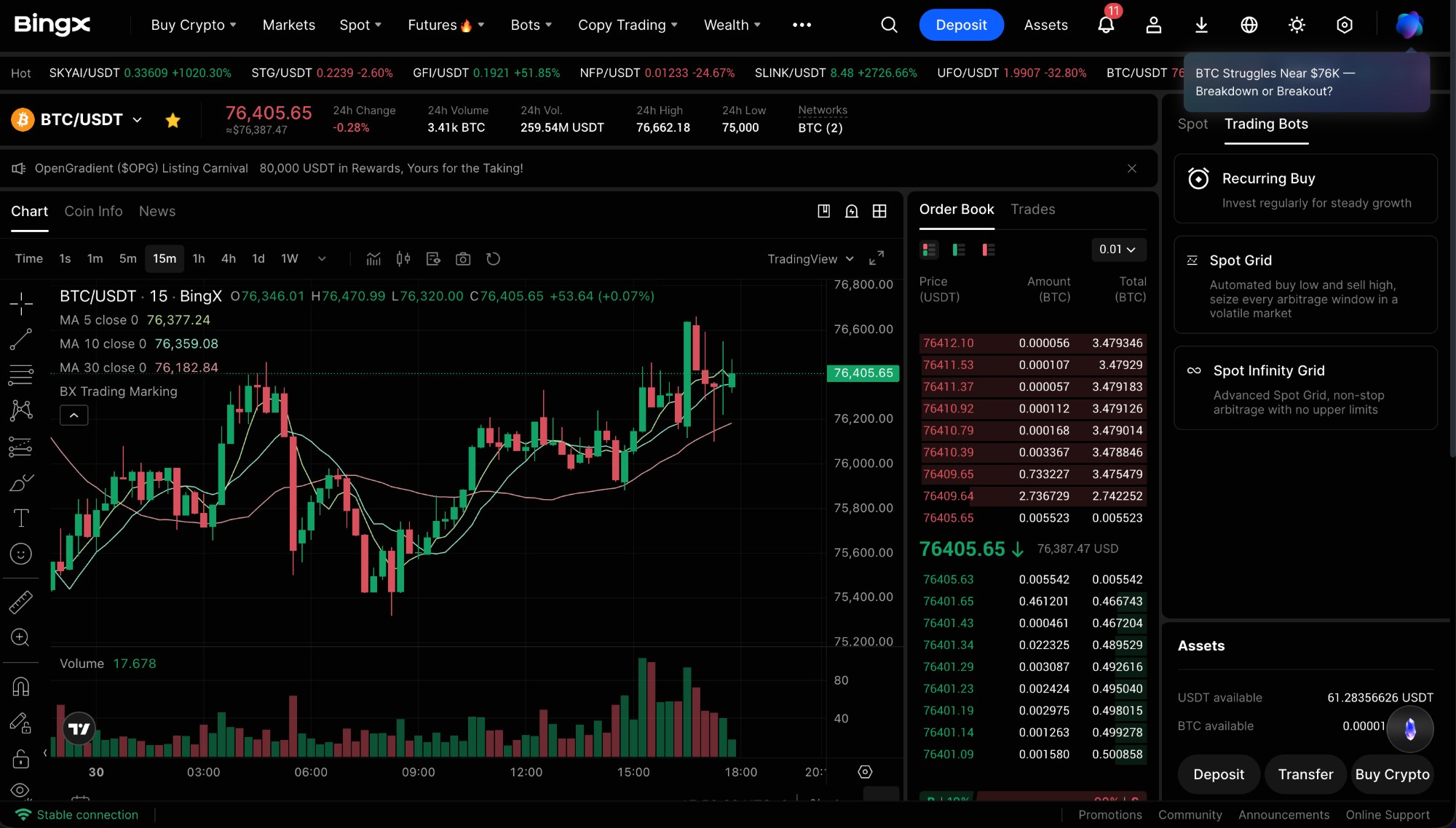
The trading interface is dense but readable, with TradingView charts, a live order book, and one-click access to spot, futures, and Trading Bots (Recurring Buy, Spot Grid, Spot Infinity Grid). The right rail switches between Order Book and Trades, and the assets panel exposes deposit, transfer, and conversion in one place.
Copy trading leaderboard
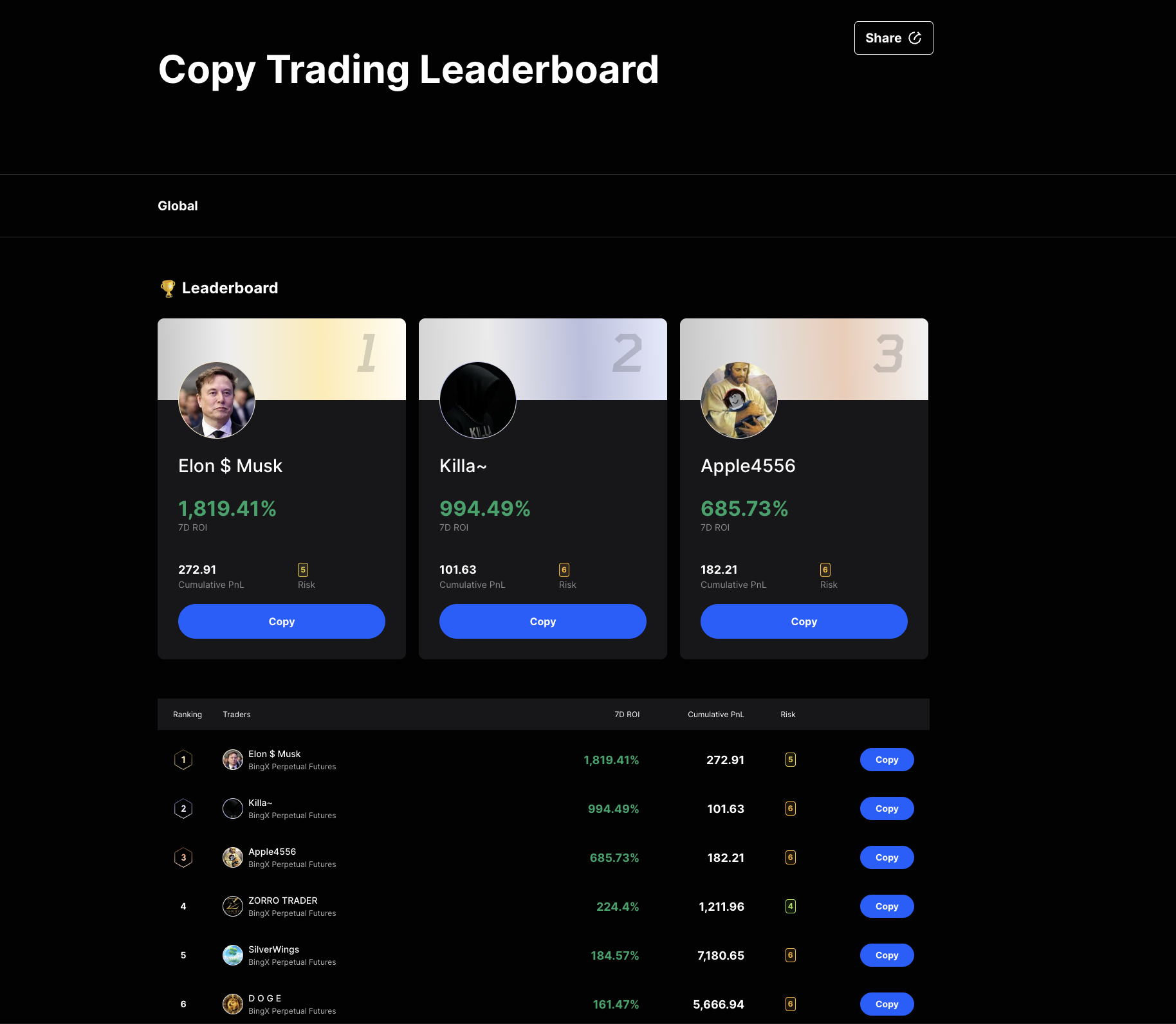
The copy trading leaderboard is BingX’s strongest dimension and the reason most retail users open an account. Lead traders publish public stats including:
- ROI windows (7d / 30d / 90d / 180d / lifetime)
- Cumulative PnL in USDT - absolute, not percentage
- Risk score (numeric, higher means riskier)
- Win rate - share of profitable closed trades
- Average position holding time - flags scalpers versus swing traders
- Copy Trading days - how long the trader has been on the copy product
- Trading frequency (weekly) - proxy for activity level
BingX uses a fixed proportion replication model: when a lead trader opens a position, each follower’s account opens a position scaled to their copy allocation. Stop-loss and take-profit levels set by the lead are mirrored, but followers can override or close positions independently.
Risk lens - read this twice. ROI is the most-clicked metric and the least useful in isolation. The number 1 trader on the leaderboard at the time of writing - Elon $ Musk - shows +1,819.41% 30D ROI, +272.91 USDT cumulative PnL, and a Risk score of 5. Looks incredible. Now check the trader page below.
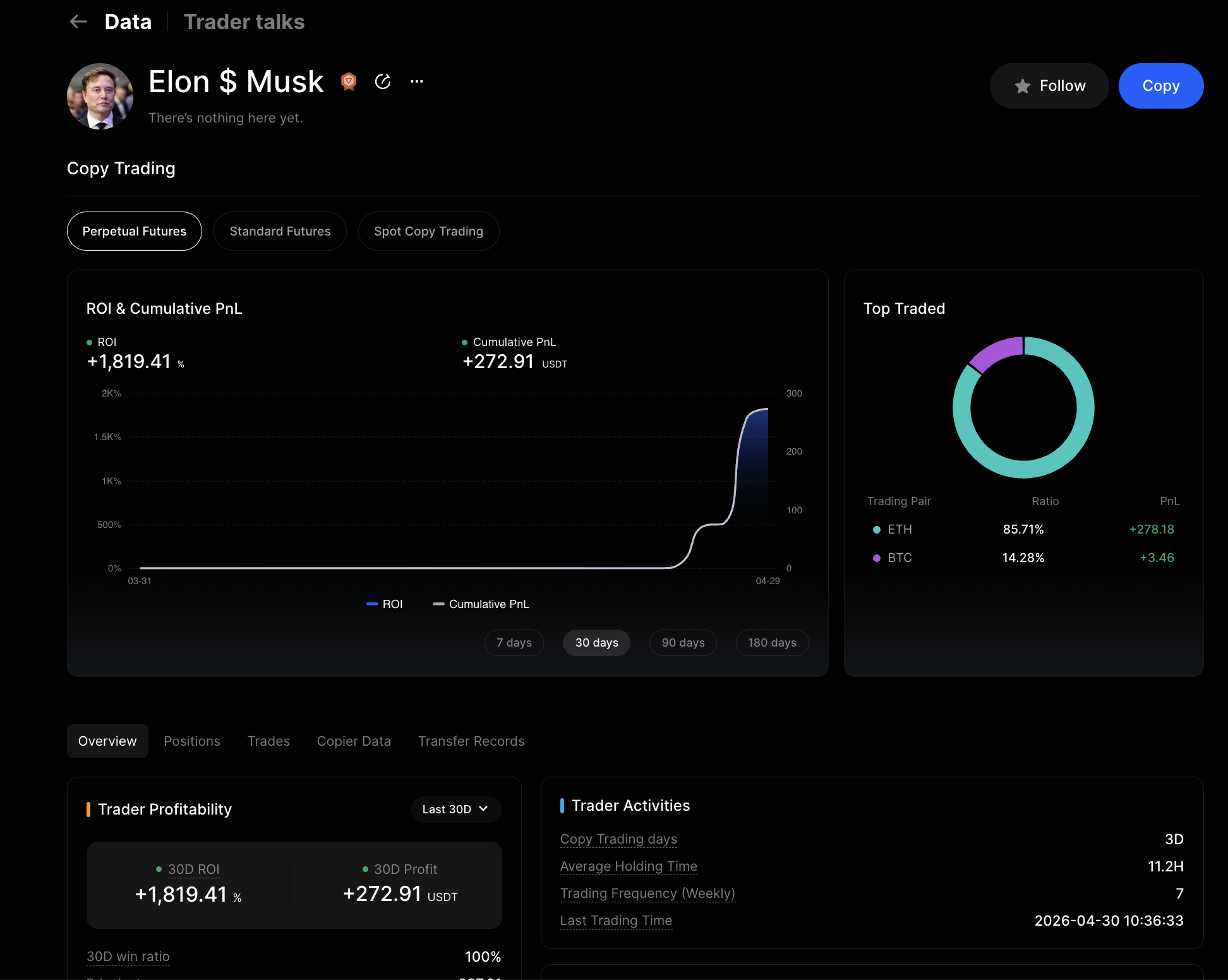
The headline ROI is real, but the underlying numbers are decisive: 3 days of copy-trading history, a 100% win ratio (statistically impossible to sustain), and a low absolute PnL implying a small account that took outsized risk. Filter by Risk score, account age (over 180 days where possible), and Copy Trading days - not the percentage at the top of the card. Our methodology lists the full lead-trader risk framework.
The leaderboard’s top 3 at snapshot time:
| Rank | Trader | 7D ROI | Cumulative PnL | Risk |
|---|---|---|---|---|
| 1 | Elon $ Musk | 1,819.41% | 272.91 | 5 |
| 2 | Killa~ | 994.49% | 101.63 | 6 |
| 3 | Apple4556 | 685.73% | 182.21 | 6 |
| 4 | ZORRO TRADER | 224.4% | 1,211.96 | 4 |
| 5 | SilverWings | 184.57% | 7,180.65 | 6 |
See the live leaderboard on BingX →
Notice how rank 4 (ZORRO TRADER, Risk 4) has a much smaller ROI but 5× the absolute PnL of rank 1. That is what a real account looks like. The ROI sort favours small, volatile accounts; the cumulative-PnL sort and lower Risk score favour traders with size and discipline.
Fees breakdown - Perpetual Futures
BingX Perpetual Futures fees are competitive at every VIP tier. Perpetual Futures Copy Trading and Perpetual Futures Grid charge the same rates as Perpetual Futures - Crypto, so the table below is the operative one for copy traders.
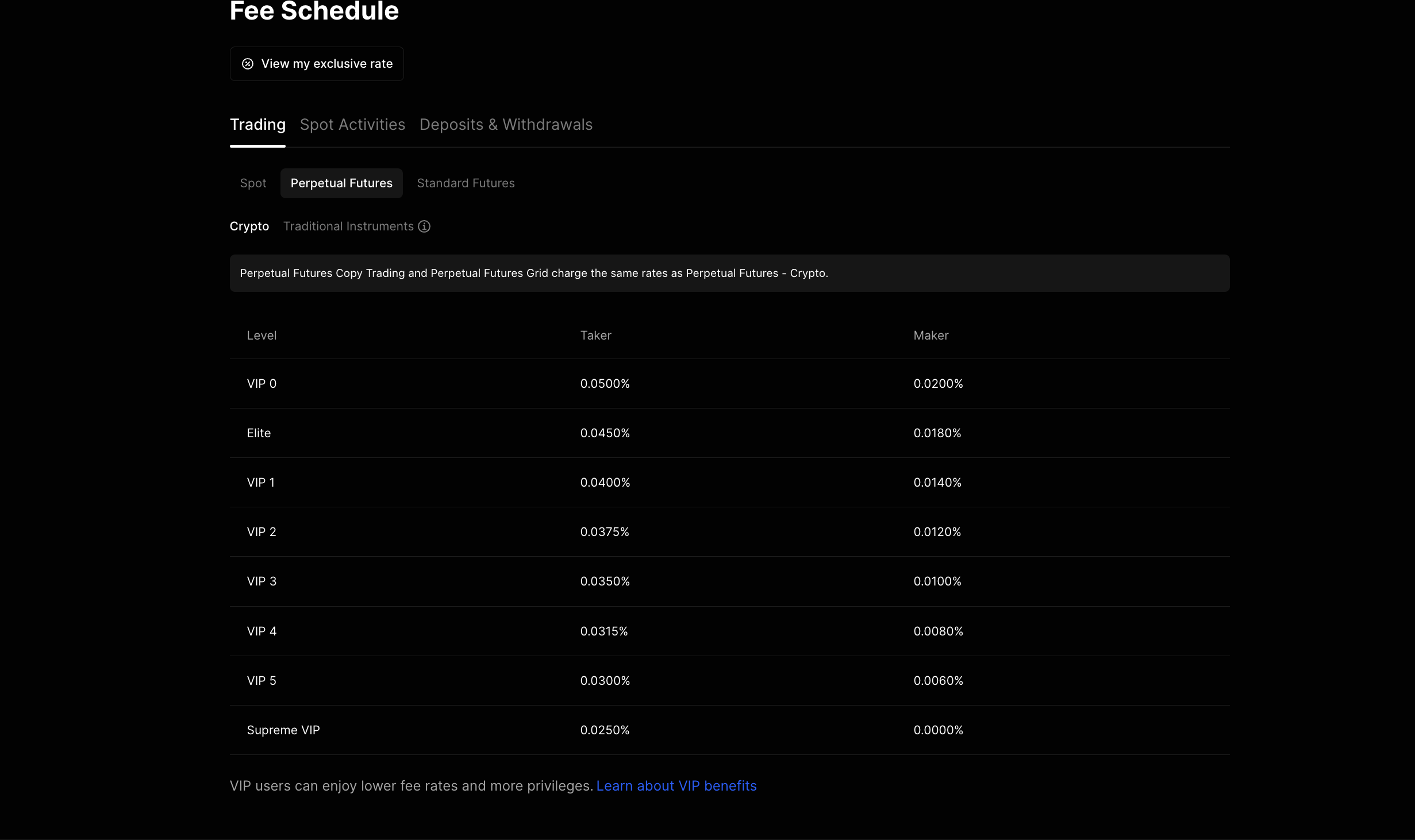
| Tier | Taker | Maker |
|---|---|---|
| VIP 0 | 0.0500% | 0.0200% |
| Elite | 0.0450% | 0.0180% |
| VIP 1 | 0.0400% | 0.0140% |
| VIP 2 | 0.0375% | 0.0120% |
| VIP 3 | 0.0350% | 0.0100% |
| VIP 4 | 0.0315% | 0.0080% |
| VIP 5 | 0.0300% | 0.0060% |
| Supreme VIP | 0.0250% | 0.0000% |
A few practical reads:
- At VIP 0 - the default for new retail accounts - perpetual futures cost 0.0500% taker / 0.0200% maker. Copy trading inherits this. That is competitive with Bybit and Bitget at base tier.
- Maker rate goes to zero at Supreme VIP. For high-volume market-making strategies this is meaningful, but Supreme VIP is unreachable for retail copy traders.
- There is no separate copy-trading subscription. The trading fee shown here is what BingX charges per executed copy trade. On top, lead traders typically take a profit share on net-profitable closed trades (configured per trader, often around 10 percent). Losing trades pay no profit share.
- Spot and Standard Futures schedules are separate and not shown here. Run your scenario through our fee calculator before scaling volume.
KYC and withdrawal limits - what’s actually required
BingX uses tiered identity verification. Email-only registration unlocks trading immediately; verification raises limits and unlocks fiat options. The platform’s verified Advanced Verification tier shows the following privileges:
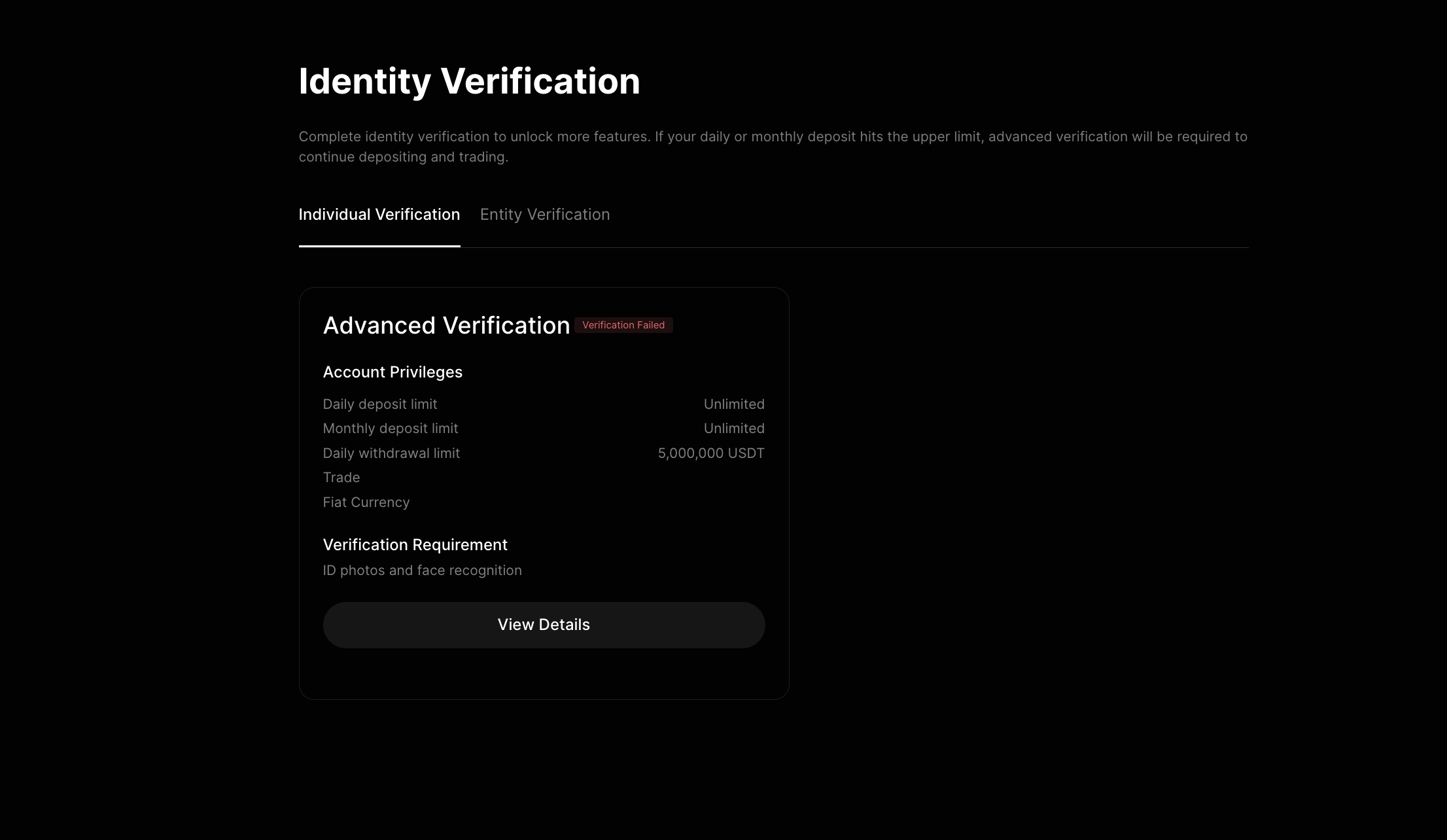
- Daily deposit limit: Unlimited
- Monthly deposit limit: Unlimited
- Daily withdrawal limit: 5,000,000 USDT
- Verification requirement: ID photos and face recognition
Unverified (email-only) accounts can still trade spot, futures, and copy-trading, but withdrawal limits are significantly tighter than the verified 5,000,000 USDT/day figure. Check the limit shown on your own dashboard before depositing.
Important regulatory caveats:
- EU member states. MiCA (Markets in Crypto-Assets, effective 2024) pushes exchanges toward mandatory KYC. New EU accounts may face verification at signup.
- United Kingdom and Australia. Local AML regulations apply on top of platform policy.
- AML triggers. Even on a Standard-tier account, BingX reserves the right to require verification retroactively for any withdrawal that triggers AML flags.
The global regulatory direction is toward broader verification, not narrower. Treat any “no-KYC” framing as a temporary feature, not a guarantee. If you plan to scale balances above small retail levels, complete Advanced Verification early - both because the 5,000,000 USDT/day cap covers virtually all retail use cases, and because a verified account is harder to lock during AML reviews.
Deposits and withdrawals
- Crypto deposits. Supported across major networks: BTC, ETH, BSC, Tron, Solana, Polygon, Arbitrum, Optimism, Avalanche, and others. Deposit fees are zero on BingX’s side; you pay the network gas. The dashboard shows BTC supported on 2 networks at snapshot time.
- Crypto withdrawals. Small flat fee per asset and network. Processing is generally fast - minutes to a couple of hours - but can queue during high volatility.
- Fiat. Card purchase via P2P or third-party providers in supported countries. Direct bank transfer support is limited and jurisdiction-dependent.
If you plan to hold crypto long-term, withdraw to self-custody rather than leaving balances on any centralized exchange. Custody risk is real even on well-run platforms.
Security and operations
- Proof of reserves. BingX publishes Merkle-tree-based proof-of-reserves attestations. Users can verify their balance is included in the snapshot.
- Hot and cold wallet split. The majority of customer assets are claimed to be in cold storage; specific percentages are not always disclosed.
- Hack history. In September 2024, BingX experienced a hot-wallet incident with reported losses around 44 million USD. The exchange covered user balances and resumed normal operations within 24 hours. No follow-on incident has been reported through April 2026.
- Insurance fund. BingX maintains a stated user-protection fund.
The 2024 incident is the most important security data point. Compared to historical exchange failures (FTX, Mt. Gox), BingX’s response - full user reimbursement, fast resumption - was reasonable. But it is a reminder that hot-wallet exposure is non-zero on any exchange.
Country restrictions
BingX is not available to users in:
- The United States - residents and persons present in the US
- Cuba, Iran, North Korea, Syria, and other sanctioned jurisdictions
- Crimea, Donetsk, and Luhansk regions
- Singapore retail customers
- Specific other jurisdictions disclosed in the BingX terms of service
The platform geo-blocks restricted IPs. Using a VPN to bypass restrictions violates the terms of service and can lead to account closure and asset freeze. Do not use a VPN to register from a restricted country.
Pros and cons
Pros
- One of the deepest copy-trading leaderboards among non-Bitget peers
- Email-only registration available for unverified-tier trading in most countries
- Competitive Perpetual Futures fees: 0.0500% taker / 0.0200% maker at VIP 0, scaling to 0.0000% maker at Supreme VIP
- Copy Trading and Grid charge the same rates as Perpetual Futures - no per-product surcharge
- 5,000,000 USDT daily withdrawal at Advanced Verification covers virtually all retail use cases
- Proof of reserves published; full user reimbursement after the 2024 hot-wallet incident
- Strong native mobile UX
Cons
- US, Singapore retail, and several other jurisdictions blocked
- The leaderboard is dominated by short-track-record, high-ROI accounts - discipline required to filter (the top trader at snapshot has 3 days of history)
- Marketing tilts toward leverage-heavy futures content; risk literacy is on the user
- Spot and Standard Futures fees are not always as competitive as derivatives-focused peers - model your actual mix in the fee calculator
How BingX compares
We score BingX 8.7 / 10 on the same six-factor rubric used across exchange reviews. Its closest peers in copy trading depth are Bitget (broad marketplace) and Bybit (newer copy product, strong derivatives stack). OKX has the deepest order books but a less retail-friendly copy-trading UX. Detailed comparisons are forthcoming under comparisons.
How to start (and what to actually do)
- Register with email through the BingX site or app. Use a unique, strong password and enable 2FA immediately.
- Complete Advanced Verification early. ID photos plus face recognition. Even if your jurisdiction does not currently mandate it, the 5,000,000 USDT/day cap is a comfortable ceiling and a verified account is harder to lock during AML reviews.
- Deposit a small amount first. Never your full intended capital. Test deposit, withdrawal, and copy trading on 200 to 500 USD before scaling.
- Filter the leaderboard properly. Discard the top of the 7D ROI ranking - those are short-history accounts. Sort by Cumulative PnL and Risk score (lower is better). Open trader pages and check Copy Trading days (over 90 days), Average Holding Time (avoid pure scalpers), and the equity curve shape (gradual, not vertical).
- Allocate to three to five lead traders, not one. Concentration on a single trader is the most common copy-trading mistake.
- Set personal stop-loss rules. The platform replicates trades; it does not save you from a leveraged blow-up.
- Withdraw profits regularly to self-custody. Do not let unrealised gains compound on a centralised exchange indefinitely.
Open an account: Register on BingX See the affiliate disclosure for full detail.
Final word
BingX is a strong choice for retail traders whose primary intent is copy trading and who accept the trade-off of a non-US, leverage-heavy venue. The fee schedule is competitive across every VIP tier, the leaderboard is the deepest among its direct peers, and verification is gradual rather than aggressive. The two non-negotiable steps before depositing real money: read the methodology, and run your monthly volume through the fee calculator - then ignore the top of the ROI leaderboard and filter on Risk, Cumulative PnL, and Copy Trading days instead.
Frequently asked questions
Is KYC required on BingX?
BingX historically allows email-only registration with spot, futures, and copy trading enabled at the Standard tier. Daily withdrawal at the verified Advanced Verification tier is 5,000,000 USDT with unlimited deposits; lower tiers face significantly tighter caps. New accounts in EU member states, the UK, Australia, and a few other jurisdictions may face mandatory KYC at signup due to MiCA and local AML rules. The platform also reserves the right to require KYC retroactively if AML flags trigger. Always verify the current policy for your country before depositing.
What are BingX Perpetual Futures fees?
At VIP 0 (default tier), BingX Perpetual Futures fees are 0.0500% taker and 0.0200% maker on crypto pairs. They scale down through Elite, VIP 1 to VIP 5, reaching 0.0250% taker and 0.0000% maker at the Supreme VIP tier. Perpetual Futures Copy Trading and Perpetual Futures Grid charge the same rates as Perpetual Futures - Crypto. There is no separate copy-trading subscription fee, but lead traders typically take a profit share on net-profitable closed trades that the follower keeps.
Is BingX safe to use?
BingX publishes Merkle-tree proof-of-reserves attestations and operates a stated user-protection fund. In September 2024, a hot-wallet incident reported losses around 44 million USD; user balances were fully covered and operations resumed within 24 hours, with no follow-on incident reported through 2026. As with any centralized exchange, custody risk is non-zero - withdraw to self-custody for long-term holdings.
Can US users use BingX?
BingX is restricted in the United States, several sanctioned jurisdictions, and Singaporean retail customers. The site geo-blocks restricted IPs. Using a VPN to bypass restrictions violates BingX terms of service and can lead to account closure or frozen funds. Do not register from a restricted country.
How does BingX copy trading work?
Users browse a leaderboard of lead traders ranked by ROI, cumulative PnL, and a numeric Risk score. After choosing a trader you allocate copy capital, and the system replicates their futures or spot trades on your account proportionally. Stop-losses and take-profits set by the lead are mirrored. Followers can override or close positions independently. Trading fees are the same as Perpetual Futures; lead traders take a profit share on profitable trades.
#BingX#copy trading#exchange review#futures#KYC
Discussion
Loading comments…