
Score: 7.7 / 10 · Best for: altcoin breadth, built-in trading bots, KCS daily-bonus economics · Watch out: centralized custody risk, post-CFTC KYC tightening, thin liquidity on long-tail pairs · Updated: July 2026
Update, July 2026: The US regulatory chapter, referenced as the “2024 CFTC settlement” below, has now fully closed and hardened. KuCoin’s operator, Peken Global, pleaded guilty in January 2025 to running an unlicensed money-transmitting business, carrying roughly $297 million in combined penalties and forfeiture. On 31 March 2026 a federal court approved a CFTC consent order that adds a $500,000 civil penalty and permanently bars the platform from US participants unless it registers as a foreign board of trade, converting the earlier two-year US exit into an indefinite ban. None of this touched custody or non-US operations: user balances, the KYC rules and the fee schedule below are unaffected. Outside the US, everything in this review still applies.
KuCoin is a centralized crypto exchange that has been operating since 2017, headquartered in Seychelles, with a global retail focus and the broadest altcoin selection among major venues. This independent review covers what matters before you deposit: real fee schedule, current KYC posture after the 2024 CFTC settlement, the KCS token economics that get oversold and underexplained, the trading-bot product that quietly became one of KuCoin’s strongest differentiators, and the 2020 hack story that gets cited without context. We score every exchange on the same methodology and affiliate compensation does not move rankings.
Not financial advice. Crypto trading is high risk. Custody on any centralized exchange is non-zero risk. Verify what is legal in your jurisdiction before depositing. Read the risk disclaimer before scaling capital.
What is KuCoin
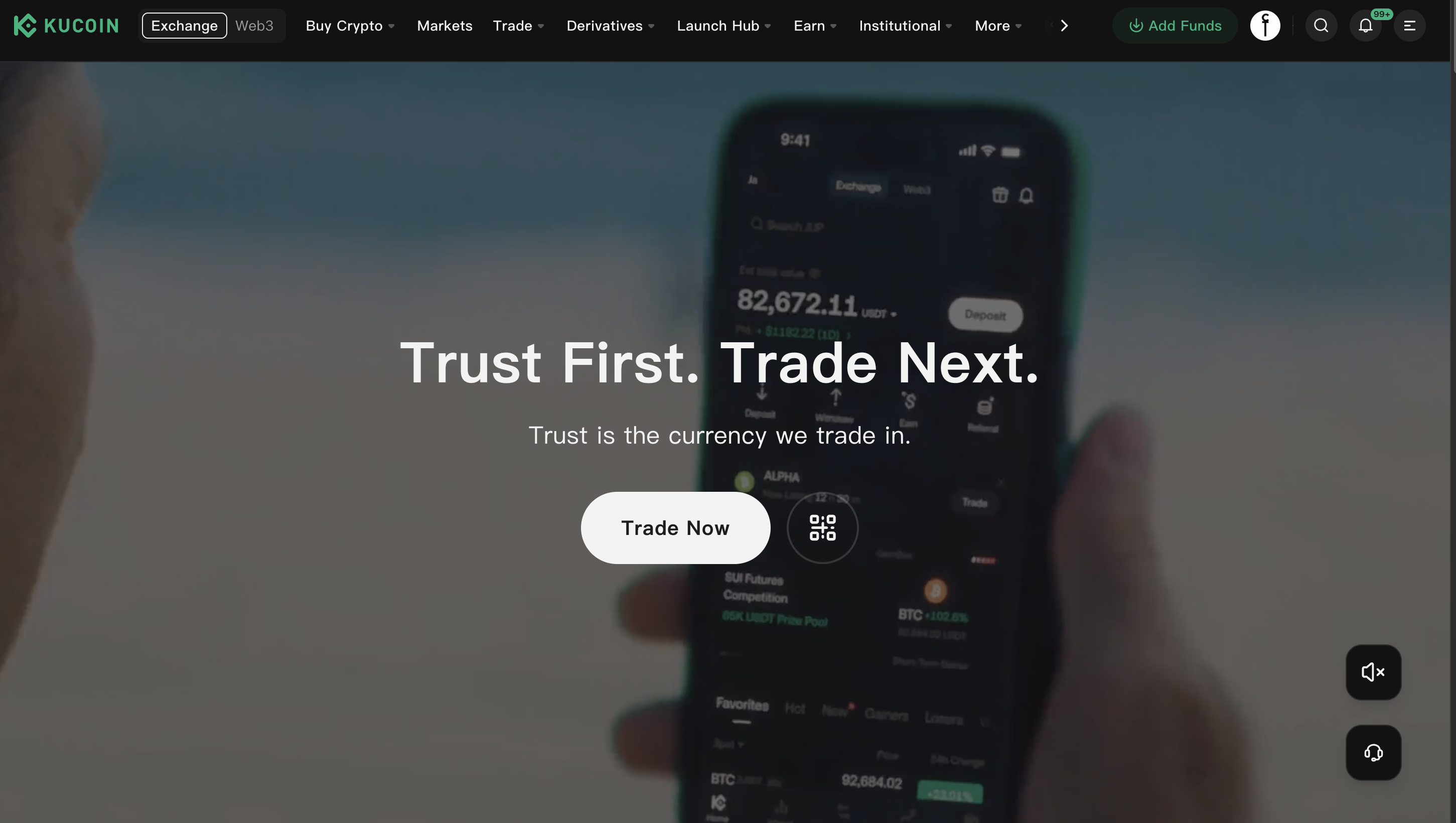
KuCoin launched in September 2017 and has grown into one of the top-10 crypto exchanges by spot volume, currently serving over 30 million users across 200+ markets. The company is headquartered in Seychelles, with operational entities in regional hubs and a corporate structure that has been described, fairly, as opaque compared to publicly disclosed exchanges like Coinbase or Kraken. Founder Michael Gan and co-founder Eric Don remain involved in leadership.
The platform’s identity is built on three things: long-tail altcoin coverage that Binance does not match, KCS token economics that distribute exchange revenue back to holders, and a deep set of built-in trading bots that turn KuCoin into more than a passive order-book venue. The 2020 hot-wallet exploit and the 2024 CFTC settlement are the two events that define the regulatory and trust narrative around the platform. Both deserve clear treatment, and we cover them in the security section below.
Markets and asset coverage
KuCoin lists over 700 spot trading pairs as of 2026. That figure includes major-cap pairs (BTC, ETH, SOL, BNB) traded against USDT, USDC, and KCS, plus a long tail of mid-cap and small-cap altcoins, many of which arrive on KuCoin weeks or months earlier than they reach Binance, Coinbase, or other major venues. The listing standards are intentionally lower than the largest exchanges, which is both the strength and the structural risk: more chances to be early on a real project, more chances to hold a token that delists or rugs.
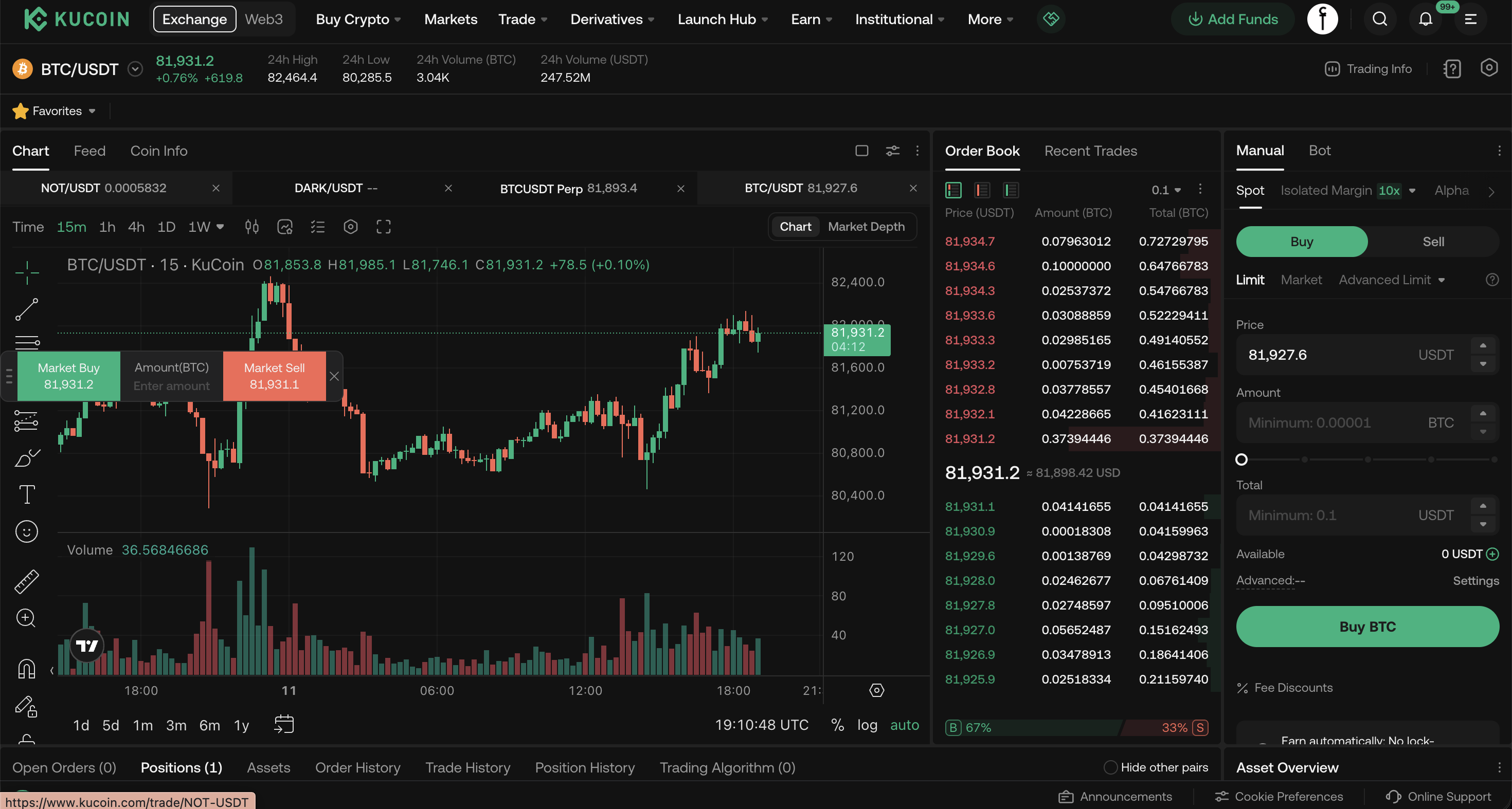
Derivatives coverage is more focused. Perpetual futures cover the top 100 pairs by liquidity (BTC, ETH, SOL, major alts) with leverage up to 100x on majors and lower limits on smaller pairs. Margin trading covers a similar range but with cross and isolated modes available depending on pair. KuCoin does not run an options market, which is a real gap if your strategy is options-driven (look at Deribit or Bybit instead).
Liquidity is the honest tradeoff for the breadth. On BTC/USDT and ETH/USDT spot, KuCoin spreads stay competitive with Binance and OKX for retail order sizes. Move to mid-cap altcoins and the picture changes: book depth drops, spreads widen to 10 to 50 basis points, and a market order over $50K can move the printed price by half a percent or more. For altcoin accumulation in size, use limit orders and split executions, or accept the cost of immediacy as a tax for the listing access.
Fees breakdown
Default spot fees are 0.10 percent maker and 0.10 percent taker. Enabling the KCS fee discount drops both sides to 0.08 percent, the same flat rate, no maker-taker asymmetry. Perpetual futures cost 0.02 percent maker and 0.06 percent taker at the default tier. VIP tiers reduce both based on rolling 30-day volume, with VIP 5 reaching roughly 0.045 percent / 0.075 percent spot and 0.012 percent / 0.040 percent on futures.
| Tier | Spot maker / taker | Futures maker / taker | Threshold (30d) |
|---|---|---|---|
| Default | 0.10% / 0.10% | 0.02% / 0.06% | none |
| Default + KCS | 0.08% / 0.08% | 0.02% / 0.06% | hold any KCS |
| VIP 1 | 0.08% / 0.10% | 0.018% / 0.05% | $50K |
| VIP 3 | 0.06% / 0.08% | 0.014% / 0.045% | $1M |
| VIP 5 | 0.045% / 0.075% | 0.012% / 0.040% | $5M |
Withdrawal fees are network-dependent and float with chain congestion. USDT on Tron is the cheapest meaningful path (typically $1 fixed). USDT on Ethereum can spike well over $10 during high-gas periods. USDC on Solana is fast and cheap when available.
The honest framing: KuCoin is not the cheapest exchange on paper. Binance with BNB discount is roughly 5 basis points cheaper on spot, and Bybit is competitive on derivatives. KuCoin’s edge comes from the KCS daily bonus stacked on top of the fee discount, which we cover next.
The KCS token economics
KCS is KuCoin’s native utility token. It does two things that matter for retail traders: it enables the 20 percent fee discount when set as the fee payment token (same as BNB on Binance), and it pays a daily bonus to holders of 6 KCS or more, distributed in USDT-equivalent from a share of platform trading revenue.
The daily bonus is the part that gets undersold. Yield varies with platform volume and KCS price, generally landing between 1 and 4 percent annualized at retail holding sizes. For a trader running $50K monthly volume, the combined fee discount plus bonus often nets positive against the price risk of holding KCS. For a trader running $5K monthly volume, the token-price exposure usually outweighs the savings. There is no lock-up: bonus eligibility is determined by daily wallet snapshot.
The risk is straightforward: KCS price tracks platform health, retail crypto sentiment, and broader market beta. A drawdown of 50 percent on KCS is not unprecedented (we have seen worse during prior bear cycles). If you would not hold KCS as a speculative position independent of the bonus, the math probably does not work for you. If you would, the bonus is a real yield enhancement.
Trading bots and Earn products
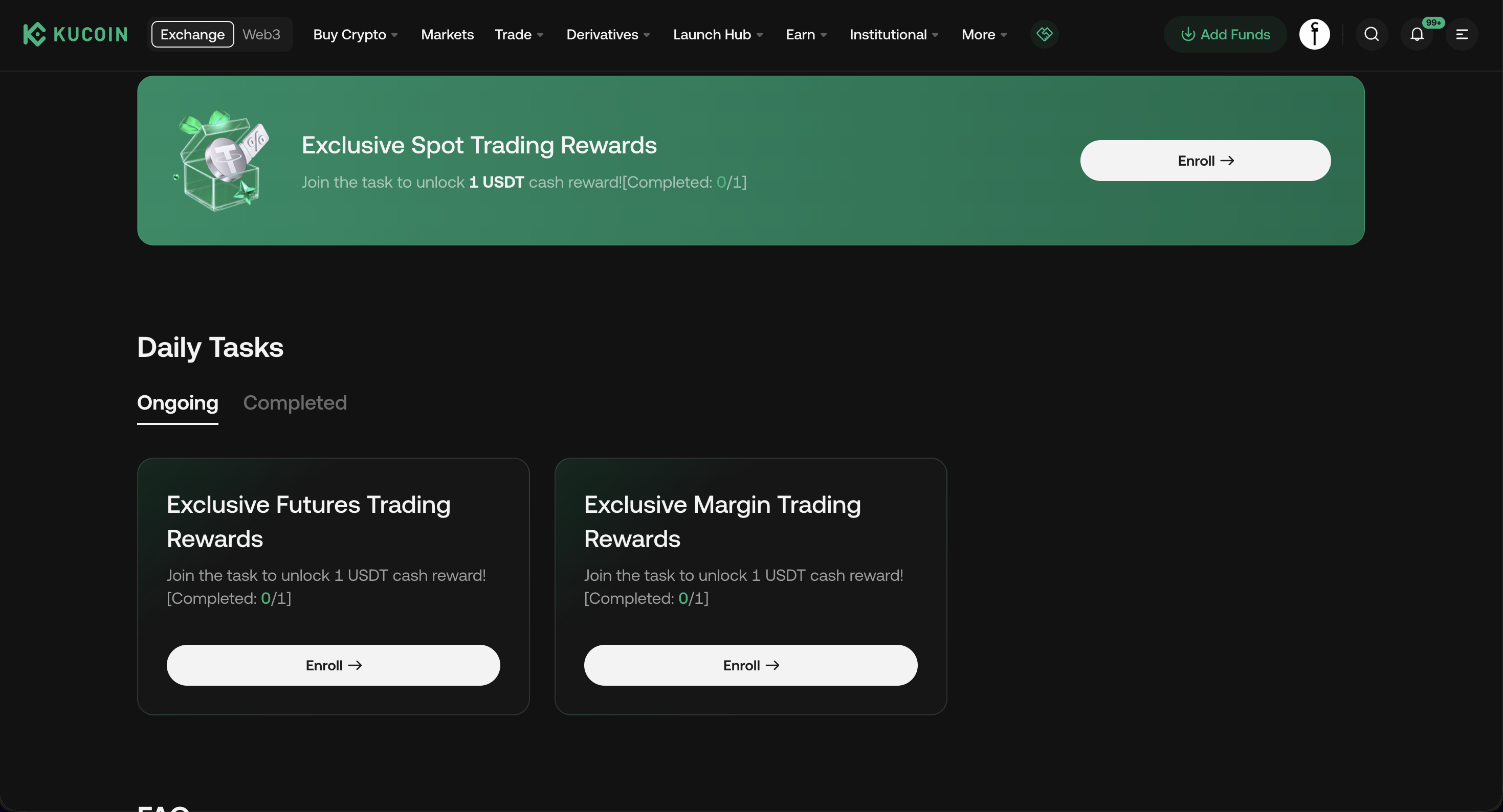
This is where KuCoin quietly outpaces most CEX competitors. Six built-in bot types are accessible from the main trading view: Spot Grid, Futures Grid, DCA, Smart Rebalance, Infinity Grid, and Arbitrage. Configuration takes under a minute, bots run server-side without requiring a hosted machine or third-party connector, and trades count toward your VIP volume threshold.
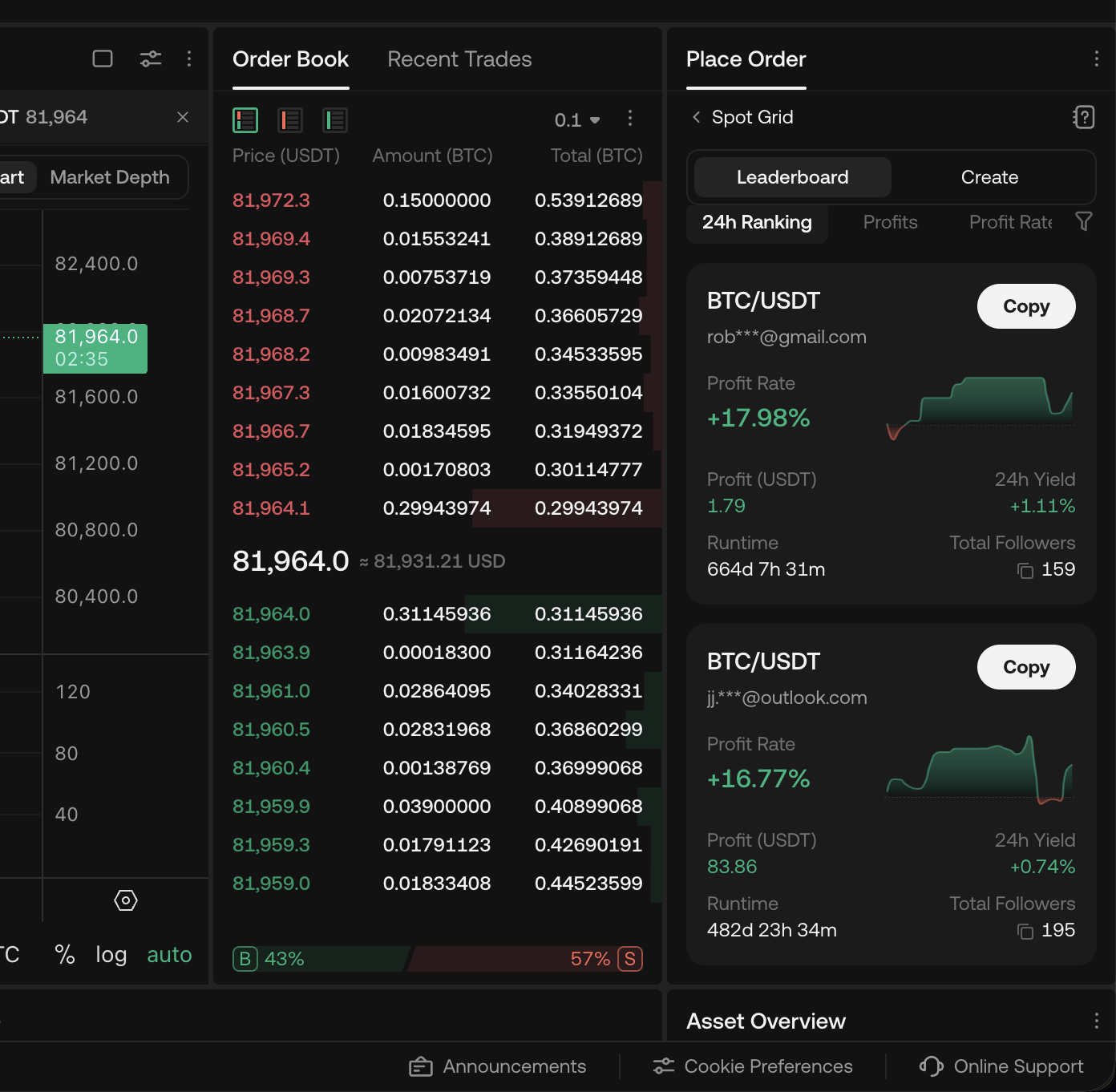
The leaderboard introduces the same survivor-bias trap that copy-trading marketplaces have. Top-ranked configurations are visible after the fact, which makes the headline yields look better than they will work for new copiers. Filter on runtime (favor configurations that have been alive for more than 30 days), look at drawdown not just yield, and start with allocation sizes you can lose without changing your trading style.
Beyond bots, KuCoin runs an Earn product covering staking, structured savings, dual investment, and fixed-term yields. Coverage is broad on the top stakeable tokens (ETH, SOL, ADA, DOT) and the yields are competitive against direct staking. Dual investment products carry real downside risk and should not be approached as savings; they are option-payoff structures wrapped in friendly UI. Read the small print before allocating.
KYC and country restrictions
This is the part that changed the most after 2024. Before the CFTC settlement, KuCoin operated a tiered model where email-only accounts could withdraw up to roughly 5 BTC per day, attracting users who wanted to avoid full identity verification. That cap was withdrawn during the post-settlement compliance push.
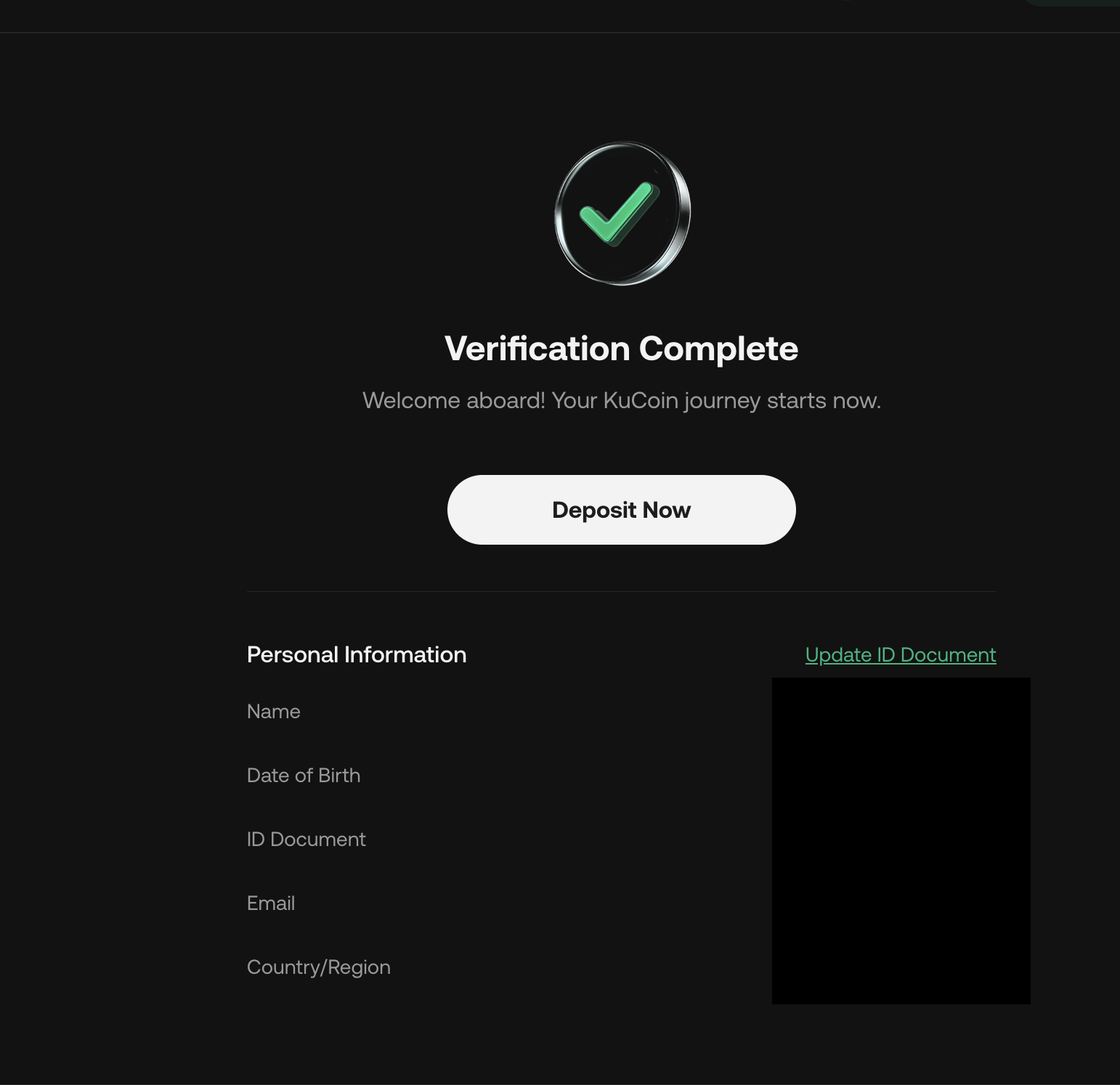
As of 2026, new accounts can still register with email, but the moment you try to deposit meaningful amounts, trade futures, use fiat onramps, or sustain trading volume past low retail thresholds, KuCoin will prompt for Basic verification (government ID, address, liveness check). Treat KYC as required for any serious use. The platform is no longer a no-KYC venue in any practical sense for the trading patterns we cover in our research.
Country restrictions include the United States (official since the 2024 CFTC settlement), Canada (closed in 2023), parts of Ontario specifically, the UK in tighter form, and the OFAC-sanctioned regions (North Korea, Iran, Syria, Cuba, Crimea). Some other regions show a “we currently do not provide services in your country” banner depending on IP and account history, with partial functionality (spot works, futures or specific pairs do not). The full list updates without much notice. Verify current availability directly on KuCoin before depositing.
Security and incident history
KuCoin’s incident record is dominated by one event: the September 2020 hot-wallet exploit. Approximately $281M in BTC, ETH, and ERC-20 tokens drained from hot wallets through a private-key compromise (the post-mortem pointed to a leaked operational credential, not a smart-contract bug). Within 24 hours, KuCoin coordinated with token issuers to invalidate large portions of the stolen supply, contracted chain-analytics firms to track and freeze direct theft, and topped up the remainder from corporate reserves. No user lost funds.
The post-incident response is the part that matters going forward. KuCoin shortened hot-wallet limits, rotated cold storage on a faster cadence, and added multi-sig on operational withdrawals. No comparable custody incident has happened since. The platform now publishes Merkle-tree proof-of-reserves attestations on a regular cadence and operates an insurance pool funded from platform revenue.
The other significant event is the 2024 CFTC settlement, which is regulatory rather than custody. KuCoin agreed to compliance terms (stricter KYC, US-user geo-blocking, transaction monitoring upgrades) but did not lose user funds, did not suspend withdrawals, and did not face criminal charges against the leadership. The settlement is comparable in shape to the OKX February 2025 DOJ settlement (covered in our OKX review) but smaller in scale and without the public fine figure disclosed.
The residual risk profile is standard for a major centralized exchange: operator failure, custody compromise, regulatory action that restricts your jurisdiction, smart-contract risk on the KuCoin Wallet side, and listing risk on long-tail altcoins. None of these are KuCoin-specific weaknesses; they are the cost of using any CEX. For long-term holdings, use the KuCoin Wallet self-custody side or a hardware wallet.
Copy trading on KuCoin
KuCoin runs a Copy Trading Hub similar in shape to BingX and Bybit, with a marketplace of lead traders sortable by 30-day PnL, total copiers, win rate, and days active. The product is competent and the lead-trader pool has grown materially through 2024 to 2026.
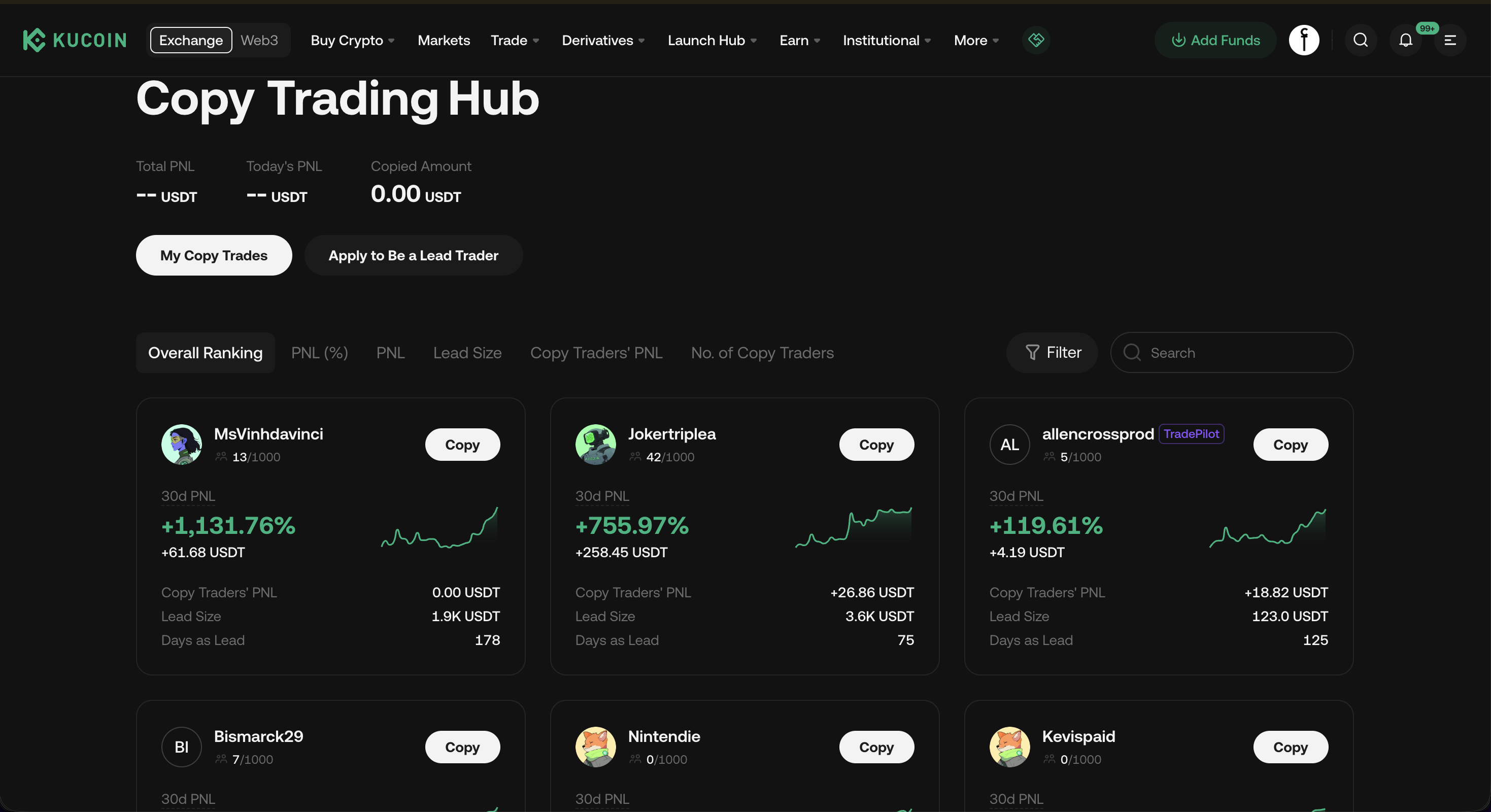
The honest comparison: KuCoin’s copy trading is functional but not the strongest on the market. BingX runs a deeper and better-filtered marketplace, and Bitget’s copy product is similarly mature. We cover the full picture in our BingX copy trading guide. On KuCoin specifically, copy trading is a competent secondary product behind the spot trading and trading-bot stack, not a flagship feature.
Pros and cons
Pros
- Over 700 spot pairs with faster listing pace than top-tier exchanges, real edge for altcoin-focused strategies
- Built-in trading bots with leaderboard, server-side execution, and integration into the trading interface
- KCS economics combine fee discount and daily revenue-share bonus, the daily bonus has no equivalent at BNB scale
- Functional copy trading and Earn products covering most retail use cases
- Self-custody KuCoin Wallet integrated with the main app for DeFi access
- Post-2020 security posture has held without incident for over five years
- Tier-based KYC still allows email-only registration to start (verification triggered by trading volume, not signup)
Cons
- Centralized custody risk. The 2020 hot-wallet exploit was recovered but the pattern of risk is the same as any CEX
- Post-CFTC KYC tightening means the historical no-KYC withdrawal limit is gone; serious use requires Basic verification
- No US-licensed product after the 2024 CFTC settlement
- Liquidity thinner than Binance and Bybit on top pairs; spreads widen materially on mid-cap and small-cap altcoins
- KCS price exposure required to capture the bonus; the math works for active traders, not for occasional users
- Listing speed is also listing-quality risk; long-tail pairs include real rug and delisting risk
- Headline copy-trading product trails BingX and Bitget in marketplace depth and filter sophistication
How KuCoin compares
Read the full KuCoin vs Binance comparison for the head-to-head detail on liquidity, fees with token discounts, copy trading, trading bots, regulatory history, and use-case fit. Short version: KuCoin wins on altcoin breadth and bots, Binance wins on liquidity and product surface. Neither has a meaningful US path.
Against OKX, KuCoin is closer in scale and product breadth than to Binance. OKX edges out on Web3 wallet integration and DeFi access; KuCoin edges out on trading-bot maturity and retail-friendliness of the bot UI. Both took regulatory hits in 2024 to 2025.
Against BingX, KuCoin has a wider native-product surface (Earn, bots, KCS economics) but a less developed copy-trading marketplace. BingX is the better choice for copy-trading-first strategies.
A direct KuCoin vs Bybit head-to-head is on our roadmap and will land in the same cluster as this review.
How to start
The signup flow is short. Email or social login, optional referral code, and you are inside the platform with a tradeable account before you have to commit to any verification. Adding our referral code CXEBGAS3 at signup pre-fills the relationship and is the path we recommend if you came to this review through the affiliate disclosure.
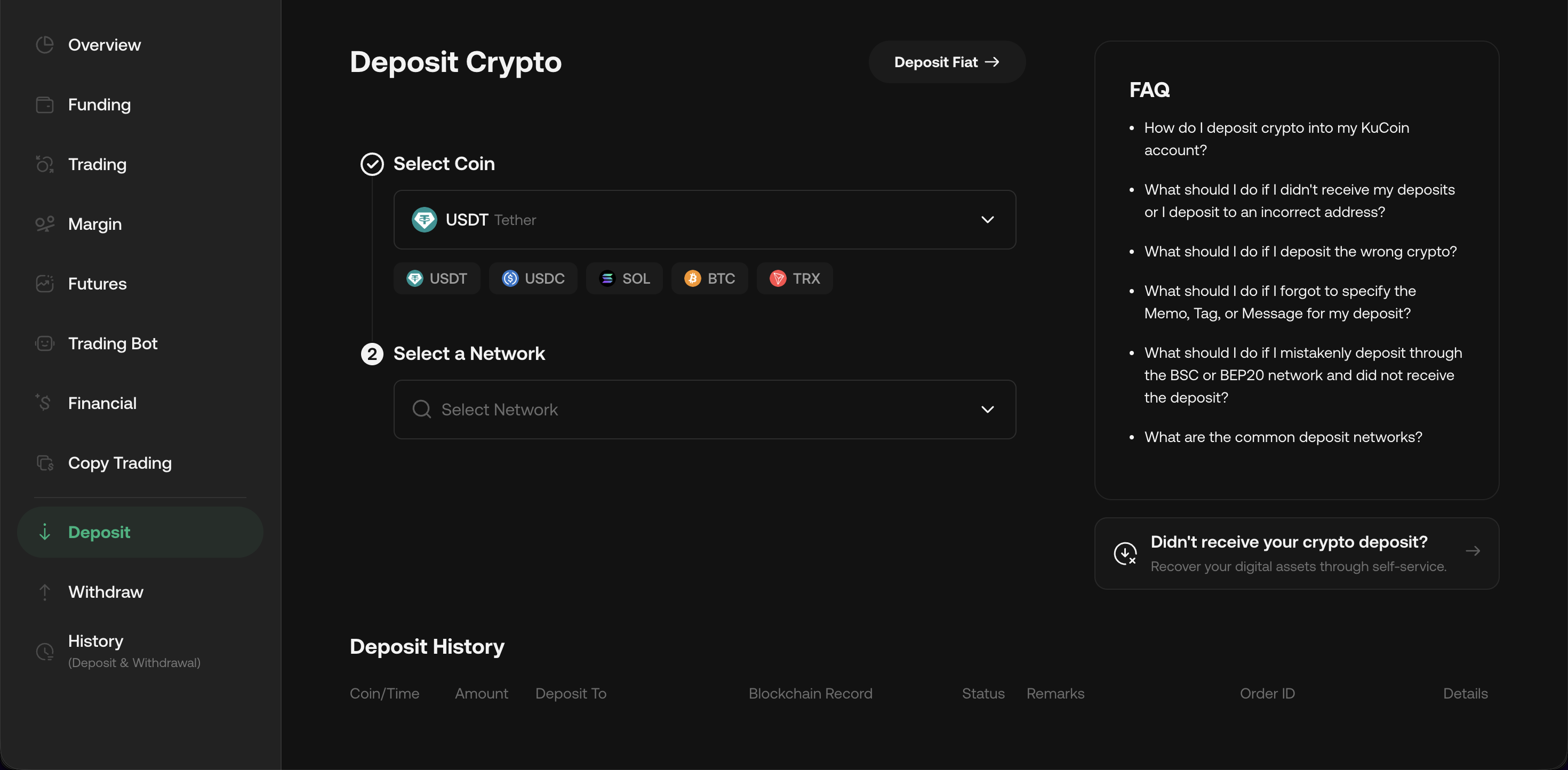
From signup to first trade, the realistic flow is:
- Sign up with email (any provider that you fully control). Two-factor authentication enabled immediately. Hardware-key 2FA is supported and recommended.
- Complete Basic verification. Government ID, address proof, liveness check. Approval is typically minutes to hours for clean applications.
- Deposit USDT. Tron is the cheapest network. USDC on Solana is the alternative if you want lower confirmation times. Always confirm the network on both sides before sending.
- Optional: buy a small amount of KCS. Six KCS or more unlocks the daily bonus. If you are not sure whether to hold, skip this step and revisit after a month of platform usage.
- Test withdrawal early. Send a small amount back to self-custody. Verify the withdrawal path before scaling the balance.
- Start with spot before futures. Futures liquidation can wipe an account in minutes. If you are new to perpetuals, do paper trading or very small position sizes for a meaningful period before scaling.
Final verdict
KuCoin in 2026 is a solid second-tier exchange with two clear strengths and a known risk profile. The altcoin breadth and the trading-bot stack are real edges that justify a position in a multi-exchange retail trading setup. The 2020 hack is recovered and remediated. The 2024 CFTC settlement is real regulatory baggage but did not affect custody and did not change the platform’s structural product.
The honest framing on score: 7.7 out of 10. Above OKX’s 7.9-on-features-only score because the trading-bot and retail-friendly tooling closes part of the gap, below BingX’s 8.7 because the copy-trading marketplace is materially weaker, and below Polymarket’s 8.6 because centralized custody risk is real where Polymarket’s self-custodial model removes it.
For a retail trader running an altcoin-heavy strategy with active bot use, KuCoin is the strongest single-platform option in 2026. For a US-based trader or someone whose priority is maximum liquidity and product breadth, KuCoin is not the right answer; look at Kraken or Coinbase (US-licensed) or Binance (international, comparable scale).
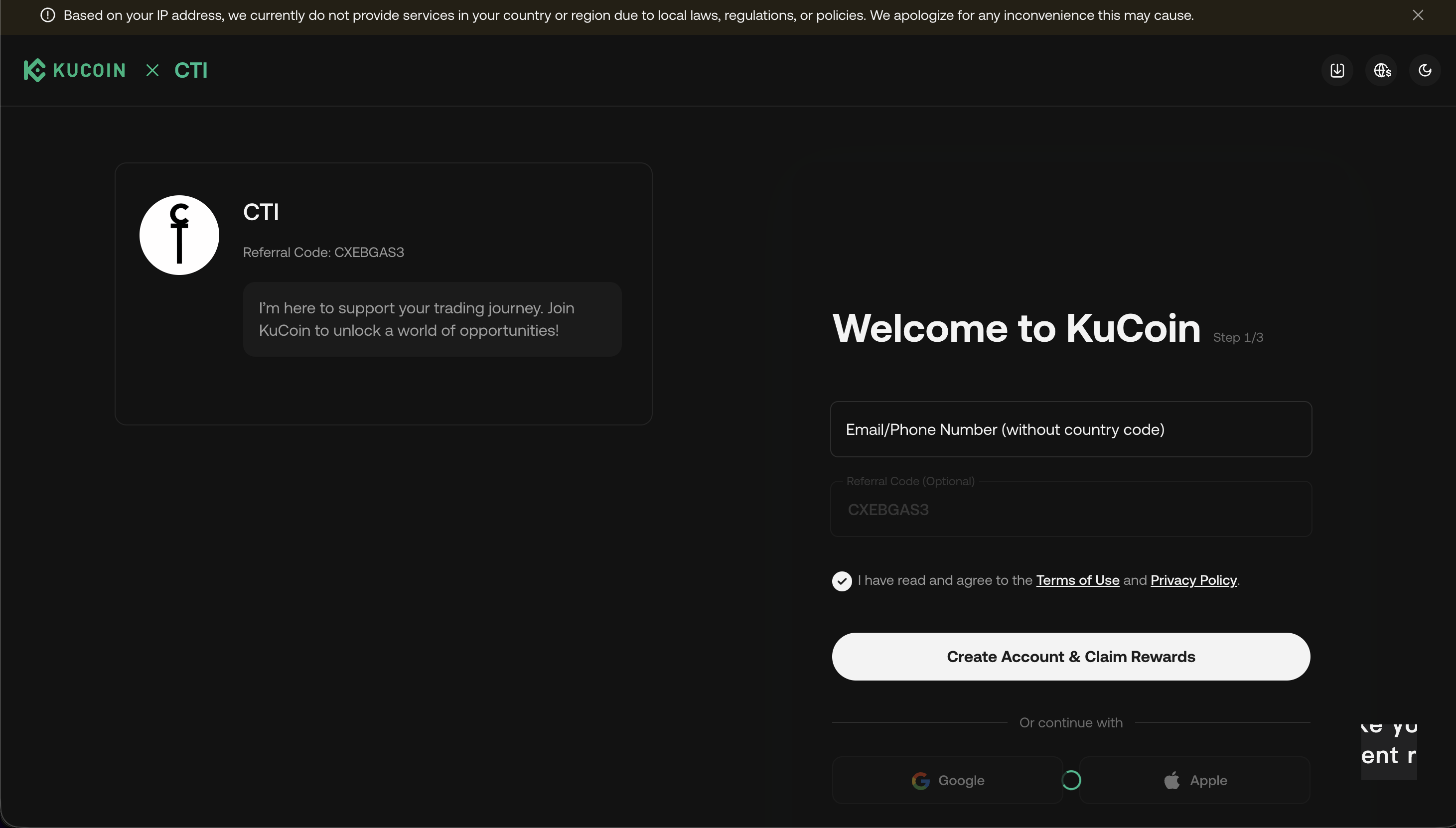
Open an account: Register on KuCoin. See the affiliate disclosure for full detail.
Read next
- KuCoin vs Binance. Head-to-head on liquidity, fees, KYC, and product fit.
- OKX review. Adjacent platform, similar tier.
- BingX review. The copy-trading-first alternative.
- BingX copy trading guide. If copy trading is your primary use case.
- Methodology. How we evaluate platforms.
- Risk disclaimer.
Frequently asked questions
Is KuCoin safe to use in 2026?
Operationally, yes, with caveats. KuCoin has been trading since 2017, publishes Merkle-tree proof-of-reserves, and runs a self-funded insurance pool. The September 2020 hot-wallet exploit drained around $281M but every user balance was made whole through coordinated token-issuer freezes, chain-analytics recovery, and corporate reserves. The 2024 CFTC settlement tightened global KYC and pushed US users off the platform but did not affect custody. The remaining risk is the standard centralized-exchange profile: smart-contract risk on the KuCoin Wallet side, operator-failure risk on the custodial side, and oracle/listing risk on long-tail altcoins.
What are KuCoin fees in 2026?
Default spot fees are 0.10 percent maker and 0.10 percent taker, dropping to 0.08 percent both sides when KCS fee discount is enabled. Perpetual futures cost 0.02 percent maker and 0.06 percent taker at the default tier. VIP tiers reduce both based on 30-day volume, with VIP 5+ reaching 0.045 percent / 0.075 percent on spot and tighter on futures. Withdrawal fees are network-dependent. USDT on Tron remains the cheapest meaningful path. The fee schedule is not the cheapest in the market but is competitive once token discount is on.
Does KuCoin require KYC?
More than it used to. Before the 2024 CFTC settlement, KuCoin operated a tiered model where email-only accounts could withdraw up to roughly 5 BTC per day. That cap was withdrawn during the post-settlement compliance push. As of 2026, new accounts can register with email but most meaningful functionality (large deposits, perpetual futures, fiat onramps, sustained trading volume) requires Basic verification at minimum. Treat KYC as required for any serious use.
Can US users use KuCoin in 2026?
Not officially. KuCoin has no US-licensed product after the 2024 CFTC settlement, and the international platform geo-blocks US IPs at signup and account level. Using a VPN to circumvent the block is a TOS breach. US-based traders should look at Kraken, Coinbase, or Gemini for compliant access.
What is KCS and is it worth holding?
KCS (KuCoin Token) is the platform's native utility token. Holding any amount enables the 20 percent fee discount; holding at least 6 KCS unlocks the KCS daily bonus, which distributes a share of exchange trading revenue back to KCS holders as a per-day USDT-equivalent yield. The mechanism is real but the holding requirement carries token-price exposure. For active traders running over $50K monthly volume, the combined discount plus bonus often net-pays the price risk. For occasional traders, the token risk usually outweighs the savings.
How do KuCoin trading bots work?
KuCoin runs six built-in bot types directly in the trading view: Spot Grid, Futures Grid, DCA, Smart Rebalance, Infinity Grid, and Arbitrage. Configuration takes under a minute, bots run server-side with no hosted machine required, and a public leaderboard surfaces top-performing community configurations sortable by 24-hour yield, runtime, and copier count. Bot trades count toward your VIP volume. Most retail users start with Spot Grid for sideways markets and DCA for accumulation, and learn the harder ones (Futures Grid, Infinity) only after seeing real PnL on the simpler ones.
How does KuCoin compare to Binance and Bybit?
Versus Binance: KuCoin has more altcoins (700+ vs ~350) and faster new-listing pace, but thinner liquidity on top pairs and a smaller product surface. Read the head-to-head in our [KuCoin vs Binance comparison](/blog/kucoin-vs-binance/). Versus Bybit: KuCoin has stronger spot and built-in bot focus, Bybit has deeper derivatives and copy trading. Versus BingX: KuCoin has more native products, BingX has the better-built copy-trading marketplace.
What about the 2020 hack and 2024 CFTC settlement?
Two separate stories. The 2020 hot-wallet exploit ($281M drained from hot wallets) was the largest test of KuCoin's incident-response capability. Recovery worked: token issuers froze affected supply, chain analytics recovered direct theft, and corporate reserves topped up the remainder. No user lost funds. Post-mortem improvements (smaller hot-wallet limits, faster cold-storage rotation) appeared to address root causes; no comparable incident has happened since. The 2024 CFTC settlement was regulatory, not custody-related. KuCoin agreed to compliance terms including stricter KYC and US-user geo-blocking. Custody and on-chain operations were not affected.
#KuCoin#exchange review#altcoins#trading bots#KCS#fees
Discussion
Loading comments…