
BingX runs one of the largest copy trading marketplaces in crypto: 12,000+ active lead traders, and one of the deepest leaderboards by interface depth. It’s also one of the most easily mis-used products on the platform. The default leaderboard view ranks by 7-day ROI, and the top of that list is a structural trap: small accounts running 30-50× leverage that caught one good week. Copy from there and you’ll learn that the chart slope and the survival rate aren’t the same metric.
This guide is the practical playbook. How the product actually works, the filters that matter on the leaderboard, allocation rules that survive contact with reality, the fee structure no marketing page leads with, and the failure modes that kill new copy traders.
Not financial advice. Copy trading delegates execution to another person. Your capital is fully exposed to their decisions, regardless of how those decisions are described in their public profile. Leverage and liquidation risk live on your account, not theirs. Read the risk disclaimer before allocating real money.
How copy trading on BingX actually works
The mechanics are simple, but get them right before you fund the first slot.
You pick a lead trader from the leaderboard and allocate part of your USDT balance to copying them. When that lead trader opens a position on USDT-margined perpetual futures (which is where 95%+ of BingX copy trading happens), BingX automatically opens a proportional position on your account. The proportion is set by the lead’s “copy ratio” plus your allocated capital. So if the lead opens a $10,000 BTC long with 5× leverage, and you’ve allocated $500, your account opens roughly a $500 BTC long with the same leverage.
When the lead closes the position, your matching position closes. Profit goes back to your USDT balance, minus fees. Loss reduces your balance, including BingX’s normal trading fee on entry and exit.
You can stop copying any time. New trades stop appearing on your account immediately. Existing positions stay open until the lead closes them or you close them manually.
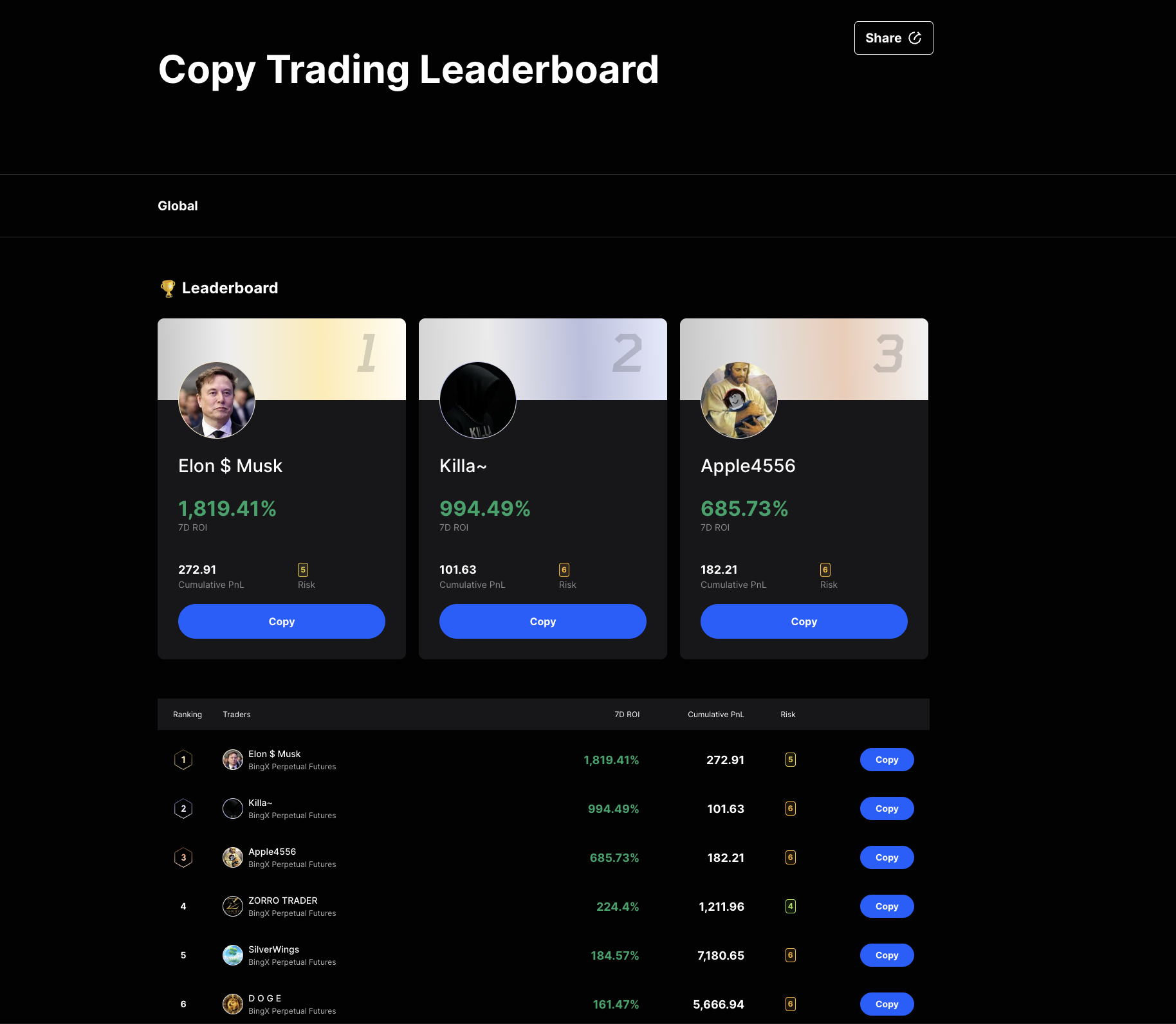
The leaderboard trap
Sorted by 7-day ROI (the default), the top is structurally a parade of small accounts with extreme leverage that caught a directional move in the last week.
Imagine an account with $200 of capital running 50× leverage on a single BTC long. If BTC moves 3% in their direction, they’re up 150%. The leaderboard shows +150% ROI for the week, and they sit at the top. If BTC had moved 3% the other way, they’d be liquidated and the account wouldn’t exist anymore. The leaderboard never shows the second outcome. You only see the survivors.
This is survivorship bias at the product level. The BingX leaderboard is a sample of accounts that didn’t blow up this week. The trader who’s there next week is mostly a different trader.
For reliable selection, re-sort by Cumulative PnL descending, then apply filters.
Filters that matter
Five signals separate a trader worth copying from a trader who topped the leaderboard last week and won’t top it next week.
Risk score (filter to 4 or lower if available)
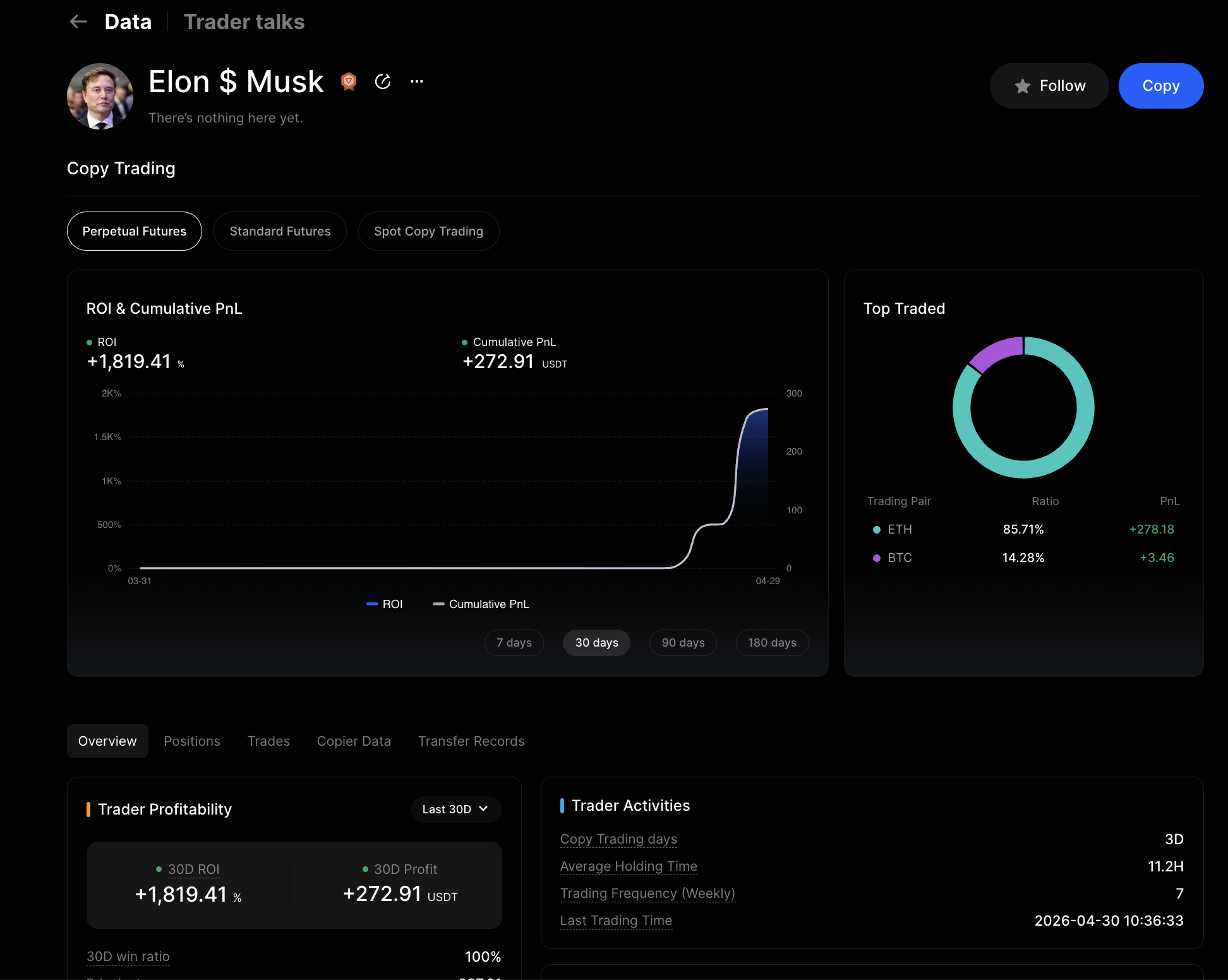
BingX assigns a risk score that loosely tracks volatility, leverage usage, and drawdown patterns. Higher number means more aggressive. Anything above 5 is leveraged-degen territory: interesting to watch, expensive to copy at any meaningful size.
Cumulative PnL trend
Look at the equity curve, not the headline number. You want gradual, with shallow drawdowns and steady recovery. You do not want vertical. Vertical curves come from over-leverage that hasn’t hit its blowup yet, and the blowup is mathematically inevitable on a long enough timeline.
Account age and sample size
Less than 90 days of live performance is insufficient data. Two months of good trades on the way up doesn’t tell you anything about how the trader handles a regime change. Ideal: 180+ days, multiple market regimes (one risk-off period at minimum), 100+ trades for statistical significance.
Average holding time
Avoid scalpers. Average hold times under 1 hour usually mean a high-frequency strategy that scales poorly across copiers (latency, slippage, many small fills). Look for 4-hour to multi-day holding times on most positions. Position traders survive copy slippage; scalpers don’t.
Position concentration
Single-asset concentration above 60% is a flag. Single-side concentration (always long, never short) tells you the trader hasn’t been tested through a real bear cycle. Both reduce copy resilience.
Allocation strategy that survives reality
The single biggest mistake new copy traders make is putting too much capital with one trader on day one. Three rules.
First, diversify across 3-5 lead traders. Different strategies (momentum, mean-reversion, multi-asset breakout), different timeframes, different regimes they perform in. One trader is one strategy’s blowup risk concentrated.
Second, start at 25% of intended size. Whatever total capital you eventually want copy-traded, allocate one-quarter of it on the first session. Watch the system run for 30 days against your filters. Scale up only after you’ve seen at least one drawdown handled the way you expected.
Third, never max the per-trader cap. If a lead’s max copy capital is 5,000 USDT, allocating exactly 5,000 means they can’t take new copiers and you’ll be at the front of any “copier limit reached” event. Allocate less, leave room.
A defensible starting setup looks like this: $2,000 total capital, split across four traders at $500 each, all filtered for Risk score ≤ 4, Cumulative PnL positive over 180+ days, 4h+ average hold, less than 60% single-asset concentration. Run that for 30 days, then double the allocation if the equity curve on your account looks like the equity curve on theirs.
Fee structure
Two fee layers compound on each trade.
First, the BingX trading fee. Taker fee around 0.045% on perpetuals, lower at VIP tiers. Paid on every entry and every exit, win or lose.
Second, the lead trader profit share. Default ~10%, can run higher for popular leaders. Calculated on net profit per trade or per period (the lead chooses). Losses don’t pay profit share, but you eat the full loss including the trading fee.
Math example. Lead opens $10,000 long BTC at 100,000, closes at 102,000 (2% move). Gross profit: $200. Your $500 allocation participates proportionally for $10 profit. Subtract BingX taker fee on entry ($0.45) and exit ($0.45), about $0.90 total. Then subtract 10% profit share to lead ($1.00). Your net is roughly $8.10. Realized as ~1.6% on your allocation, against the headline 2% move on BTC.
That’s a winning trade. Now the same setup but BTC moves 2% the wrong way. Gross loss $200, your share $10, plus entry/exit fees $0.90. Your net loss is roughly $10.90 on a 2% adverse move, against a perfect-fill loss of $10. Asymmetry is small, but it adds up over many trades.
Risk lens: what kills copy traders
Not blowup risk in the dramatic sense (lead trader liquidates and your account loses 100%). That happens, but it’s rare on filtered traders. The bigger killers are slow.
Profit decay. Many copy traders show strong returns when copy capital is small, then performance degrades as more copiers join. Reasons: slippage on bigger fills, the trader switches to higher-cap strategies that don’t work as well, or they got lucky in a specific regime that’s now over.
Regime change. The lead’s strategy worked in 2024’s slow-bleed sideways market. 2026’s environment is different. Strategies that haven’t survived through at least one regime transition haven’t shown they can.
Behavioral risk on your end. Copying means you’re trusting another person’s discipline. When a trader has a 25% drawdown, it’s hard not to stop copying right at the bottom (which is when their next leg up usually starts). Most copy trader losses come from copier behavior, not lead trader behavior.
Fee drag at scale. 10% profit share + 0.045% × 2 trades × ~50 trades/month = significant fee drag on your gross return. The trader has to outperform a meaningful headwind for the net to look attractive.
Common mistakes new copy traders make
- Sorting by 7-day ROI and copying #1. Already covered. Don’t.
- Putting full size on one trader. Same risk as putting all your capital in one altcoin position.
- Stopping copying at the bottom of a drawdown. This converts a temporary drawdown into a permanent one. Either trust your filter and wait, or unwind systematically.
- Treating “copy trading” as passive income. It’s a form of delegated discretionary trading, with all the volatility that implies. Active monitoring required.
- Ignoring the profit share fee in expected return calculations. 10% off the top compounds heavily over many trades.
- Re-running the same filter every week. Once you’ve selected a portfolio of traders, give the filter time to work. Constantly re-shuffling is a new kind of overtrading.
- Skipping diversification because the top trader looks too good to dilute. That’s exactly when you most need to diversify; the standout returns are the most likely to mean-revert.
How to monitor and when to stop copying
Run a weekly check. Look at each lead trader’s equity curve over the past 7 and 30 days. If the curve looks materially different from when you started copying (different volatility, different drawdown depth, different position sizing), re-run your filter on them.
Stop signals:
- Lead trader drawdown exceeds the historical max from before you copied
- Lead trader’s strategy or asset focus changes (started trading altcoins when their record is BTC-only)
- Risk score climbs (BingX recalculates this)
- Lead trader hasn’t traded in 14+ days (often a sign they’re rebuilding from a bad month off-platform)
When you stop copying, existing positions stay open. Decide separately whether to close them manually or let the lead close them. Usually let them close, since closing in the middle of a position is timing the lead’s exit, which you have no edge on.
How BingX copy trading compares to Bitget, Bybit, OKX
Quick comparison from the methodology rubric, same scoring criteria across all four:
| BingX | Bitget | Bybit | OKX | |
|---|---|---|---|---|
| Trader pool size | Largest | Large (volume leader) | Medium | Smallest |
| Filter granularity | Best | Good | Limited | Limited |
| Default sort trap | 7d ROI | 7d ROI | 30d ROI | 7d ROI |
| Lead transparency | Full equity curve | Full but harder to read | Limited | Limited |
| Profit share | ~10% default | ~10% default | ~10% default | ~10% default |
| BTC perp spread | Tight | Tight | Tightest | Mid |
If copy trading is your primary use case, BingX has the deepest pool and the best filters. Bitget has the largest volume but the leaderboard signal-to-noise is lower. Bybit is best for derivatives execution, but the copy-trading product is less mature. OKX is solid as an exchange, but its copy product trails the others.
For full reviews: BingX review →, BingX vs OKX →.
Read next
- BingX review →, methodology score, fees, security, jurisdictional restrictions
- How to sign up on BingX →, full registration walkthrough
- BingX without KYC →, Standard-tier setup, copy trading included
- Methodology →, the lead-trader risk framework in detail
- Risk disclaimer →
Open BingX Copy Trading: BingX Leaderboard →. See the affiliate disclosure for full detail.
Frequently asked questions
How does copy trading on BingX actually work?
You allocate a slice of your USDT balance to a lead trader you pick from the leaderboard. When the lead opens a position, BingX opens a proportional position on your account using your allocated capital. When the lead closes, your position closes. The lead trader earns a profit-share fee (typically 10-20%) on your profitable trades. They earn nothing on your losses, but you eat the full loss. Most BingX copy trading happens on USDT-margined perpetual futures, so leverage and liquidation risk apply to your account, not the lead's.
Is BingX copy trading profitable?
It can be, but the marketing photo of «top trader +312% in 30 days» is a survivor-bias illusion. Most retail copiers underperform the lead trader they copy due to slippage, late entries, profit-share fees, and the random-walk fact that the trader who topped last month's leaderboard will mostly not top next month's. Realistic expectation for a well-filtered diversified portfolio of lead traders: roughly the same risk-adjusted return profile as professional discretionary trading, which is hard to beat the index over multiple years.
What's the minimum to start copy trading on BingX?
BingX requires no minimum at the platform level beyond enough USDT to cover position margin. Practically, allocations below ~$100 per trader rarely make sense; slippage and small position sizing make tracking the lead's results imprecise. Most copy traders starting seriously work with $500-$2,000 split across 3-5 leaders.
How are BingX copy trading fees structured?
Two layers. First, you pay normal BingX trading fees (taker fee around 0.045% on perpetuals, lower with VIP tier). Second, the lead trader takes a profit-share fee on net profitable trades. The default is around 10% but can run higher for popular leaders. The profit share is calculated per trade or per period depending on the lead's setting. Losing trades pay no profit share, but you eat the full loss including BingX's trading fee.
Can I copy trade on BingX without KYC?
Yes. Standard tier (email-only signup) supports copy trading. The leaderboard, all filters, and the allocation flow work without ID upload. KYC (BingX calls it Advanced Verification) is needed for the 5,000,000 USDT/day withdrawal cap and fiat on-ramps in supported countries, not for copy trading itself. Read the [no-KYC registration guide](/blog/bingx-review/) for the full path.
Why is the BingX copy trading leaderboard top usually unreliable?
The default sort is 7-day ROI. Sorted by 7-day ROI, the top of the list is structurally biased toward small, high-leverage accounts that hit a streak in the last week. A trader running 50× leverage on a $200 account that catches one good move can hit +400% ROI in a week. The same trader will be back at zero (or liquidated) within a month or two. Reliable selection requires re-sorting by Cumulative PnL, filtering for Risk score, account age, and average holding time.
Can the lead trader take my money?
Not directly. Custody of your USDT stays in your BingX account. The lead trader can only place trades on your behalf within the rules you've set (allocation cap, leverage limit, copy ratio). They earn profit share on winning trades. They can't withdraw your funds or change your allocation. The risk you take on is that they place bad trades and your capital takes the loss. You can stop copying at any time and that ends new trades on your account immediately.
How many lead traders should I copy?
Three to five filtered traders, allocation distributed across them. One-trader concentration is the most common copy-trading mistake; you become exposed to one person's psychological state and one strategy's regime sensitivity. Three to five lets you average over different styles and reduces single-trader blow-up risk.
#BingX#copy trading#leaderboard#risk#allocation#guide
Discussion
Loading comments…