
Polymarket’s verification story is weirder than most exchanges’. There’s no central “upload your passport” page on the main app. Instead, the platform uses a layered system: part wallet-based onboarding, part geographic gating, part separate-product compliance for the users who go through Polymarket’s CFTC-licensed QCEX path. If you’re trying to figure out what you actually need to provide before placing a bet on the next election or rate decision in 2026, here’s how it breaks down.
Not financial advice. Prediction markets are legally classified differently across jurisdictions: derivatives in some, gambling in others, outright banned for retail in places like the UK and (until 2025) the US. Verify what’s legal where you live before depositing. Polymarket markets can resolve unexpectedly on ambiguous events. Read the risk disclaimer before scaling.
TL;DR
Two parallel Polymarket experiences exist in 2026.
Polymarket app (polymarket.com) is wallet-based. No ID upload. Available worldwide except for an explicit blocked-country list. This is the path most retail users will ever see.
Polymarket via QCEX is for US users only. Full KYC, full AML, regulated as a CFTC-listed designated contract market. Exists because of Polymarket’s $112M acquisition of QCX/QCEX in 2025, which is what brought legal US access back after the 2022 CFTC settlement.
Outside the US and outside the restricted list: deposit USDC, trade, withdraw, without ever showing an ID. Inside the US: that path doesn’t exist; you go through QCEX with full verification.
Why Polymarket’s KYC is unusual
Most centralized crypto venues run the same playbook: email signup, optional KYC for higher limits, mandatory KYC for withdrawals over a threshold. Polymarket inverted this for two structural reasons.
The first reason is product architecture. Polymarket runs on Polygon. Positions are conditional tokens (CTF). The matching engine and order book live off-chain, but settlement is on-chain. There is no built-in fiat ramp; users move USDC in and out of their own wallets. That removes most of the regulatory hooks that force KYC at conventional exchanges, where the operator is custodying fiat.
The second reason is the 2022 CFTC settlement. The CFTC fined Polymarket $1.4M and barred US users in early 2022 for operating an unregistered binary options exchange. Rather than rebuild as a US-licensed venue, Polymarket scrapped the US side of the product, ran the rest of the world unchanged, and in 2025 acquired QCX (a small CFTC-regulated designated contract market) for $112M. That license now gates legal US access, but on a separate code path with conventional KYC bolted on.
So you have the wallet-based main app (no KYC, geographic restrictions) and the QCEX-licensed US path (full KYC, no geographic restrictions) coexisting under the same brand.
The wallet-based path: what’s actually required
If you sign up at polymarket.com from a non-restricted country, here’s what happens in order.
- Email or wallet connection. Polymarket uses Privy (the Magic Link successor) to abstract wallet setup. Log in with email and Privy provisions a smart wallet behind the scenes, or connect an existing Web3 wallet (MetaMask, Coinbase Wallet, Rabby).
- Geographic check. Your IP is checked against the restricted-country list. Blocked country means the wallet exists but is read-only: no funding, no positions, no withdrawals beyond what’s already there.
- Sanctions screening. Polymarket runs your wallet address against OFAC sanctions lists via chain analytics (Chainalysis or TRM Labs are the two most common providers in this niche). Sanctioned addresses are blocked. This is why some users with addresses that previously interacted with Tornado Cash or other sanctioned protocols see their accounts restricted.
- No ID upload. No passport. No selfie. The platform doesn’t know your name.
That’s the no-KYC path in full. From there: fund the account with USDC on Polygon, place trades up to whatever the per-market liquidity allows, withdraw freely.
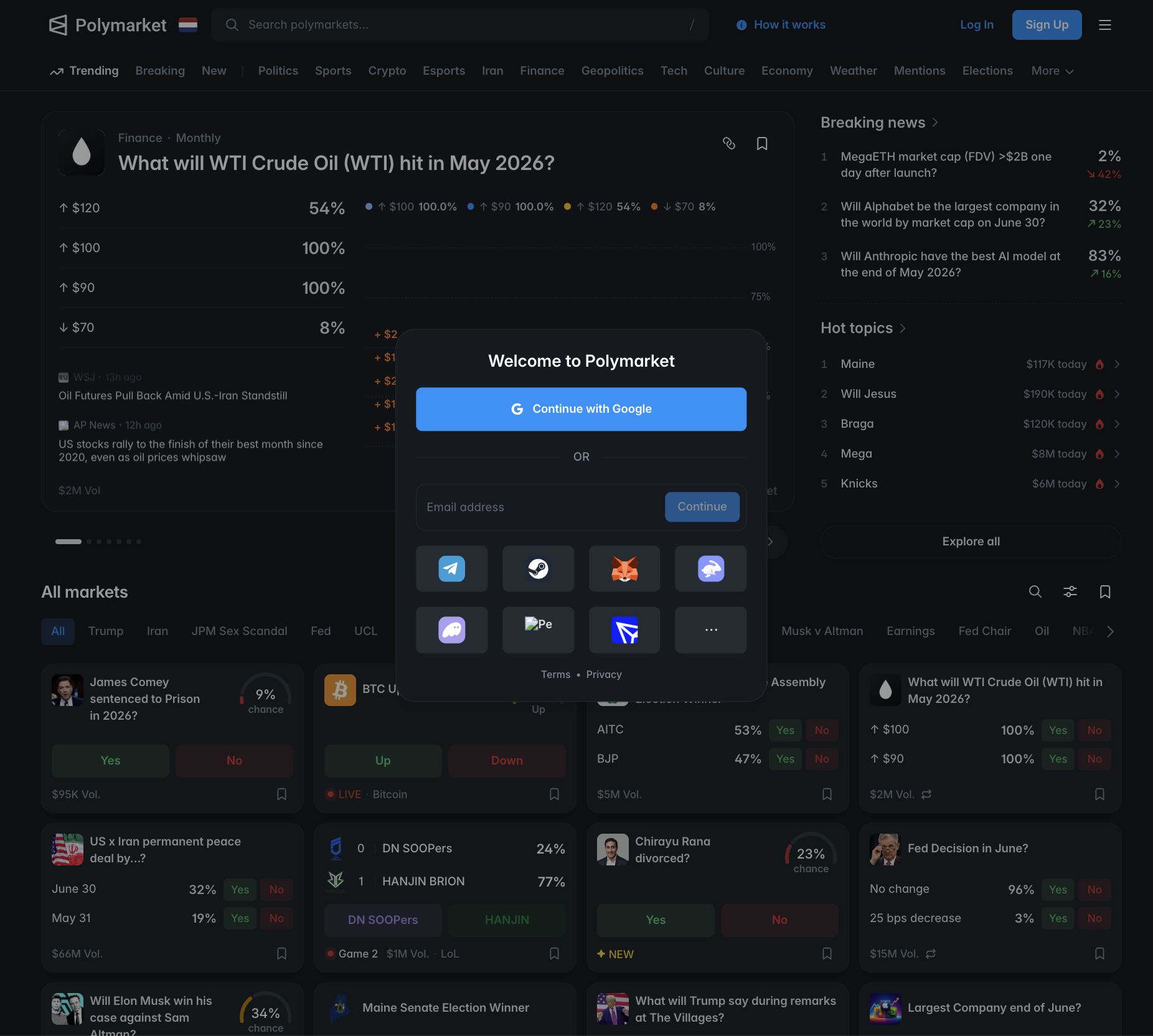
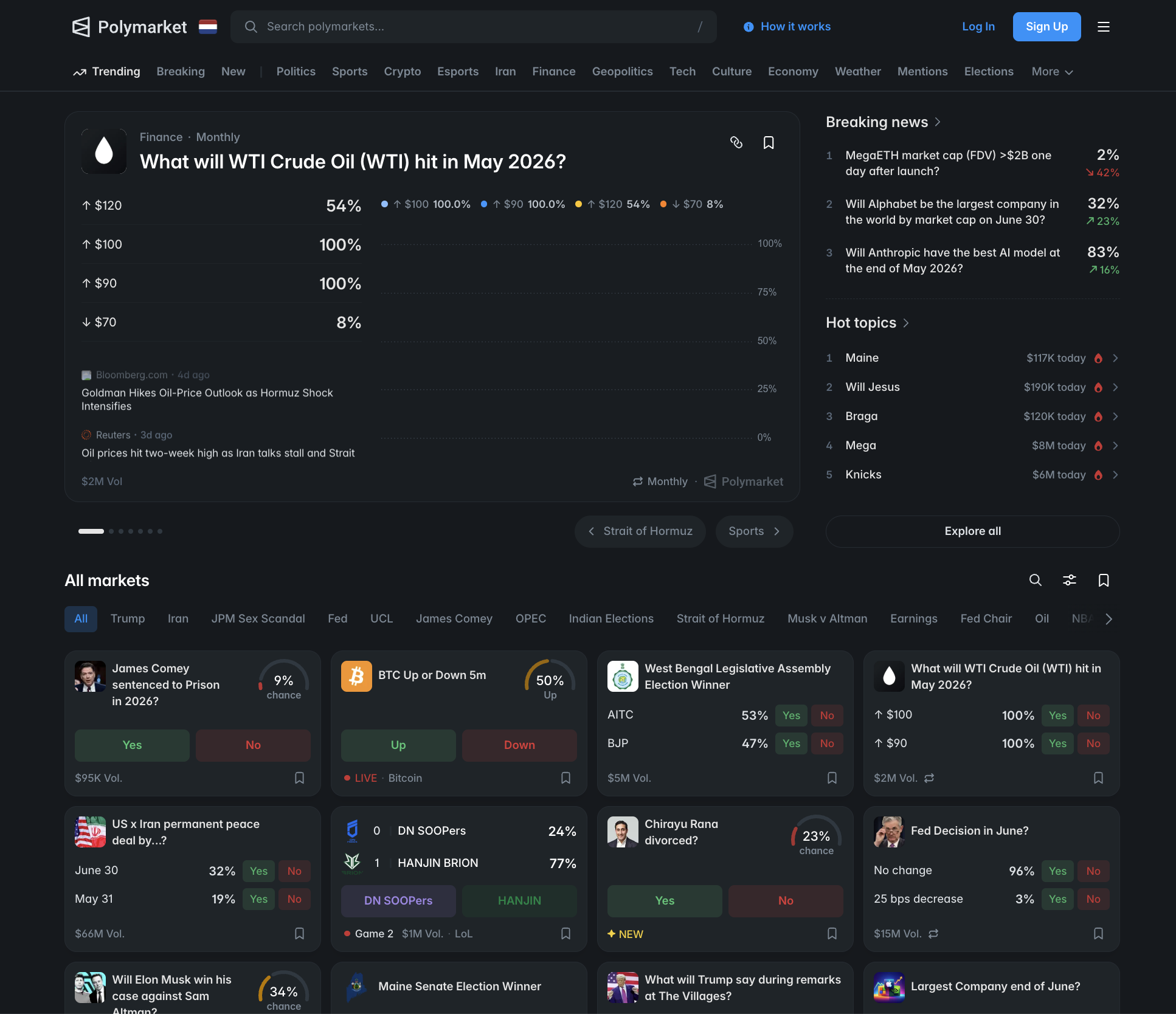
Restricted countries (May 2026)
The restricted list has grown since 2022 as more regulators moved on prediction markets. Snapshot for 2026 (verify on the official Polymarket terms before signing up, since this updates without notice):
- United States. Wallet path blocked since the 2022 CFTC settlement; legal access only through the QCEX product.
- United Kingdom. Restricted in 2025 after the UK Gambling Commission ruled that Polymarket markets are gambling under UK law and require a UK gambling license to serve UK users.
- France. Restricted under French gambling and prediction-market regulations.
- Belgium. Restricted by the Gaming Commission.
- Quebec, Canada. Restricted under provincial gambling rules; the rest of Canada generally OK.
- Singapore. MAS warning issued; retail access restricted.
- Japan, Taiwan, Thailand. Restricted under prediction-market gambling regulations.
- OFAC-sanctioned jurisdictions. North Korea, Iran, Syria, Cuba, Russia (US-sanctioned regions specifically), Crimea, Donetsk, Luhansk.
Sign in from any of these via VPN and you’re violating the terms of service. Polymarket detects most consumer VPNs through IP reputation services and chain-pattern analysis: deposit IP differs from trading IP, fingerprints don’t match, the VPN exit node is on a known-proxy list. Caught accounts have funds frozen, and the funds aren’t returned because under the TOS you weren’t entitled to use the platform. Don’t.
When KYC gets forced on the wallet path
Even if you’re in a non-restricted country, three scenarios trigger enhanced verification.
- Sanctions match. Your wallet flags as having interacted with a sanctioned address. Block, no recourse short of explaining to compliance, which usually means submitting full KYC anyway.
- High-volume trading. Accounts running seven-figure positions, or rapid five-figure deposit-trade-withdraw cycles, have been documented through 2025-2026 as triggering verification under platform-internal AML thresholds. The thresholds aren’t published.
- Deposit pattern flags. Funds arriving from a known mixer (Tornado Cash, Sinbad), freshly-laundered chain hops, or addresses linked to fraud. The chain analytics catch most of this automatically.
The verification, when it triggers, is closer to standard exchange KYC: government ID, liveness check, source-of-funds questions. Refuse and the account stays read-only. You can withdraw remaining USDC but can’t open new positions.
The QCEX path: full KYC for US users
If you’re in the US and want legal access to Polymarket-style prediction markets in 2026, the entry point is the QCEX-branded product. Verification covers:
- Government ID: passport, driver’s license, or state ID
- SSN, required for IRS Form 1099 tax reporting
- Address verification: utility bill, bank statement, or similar
- Liveness selfie, an anti-fraud check
- Source-of-funds questions, for accounts approaching higher tiers
Approval times are similar to a regulated US broker: minutes to several business days depending on edge cases.
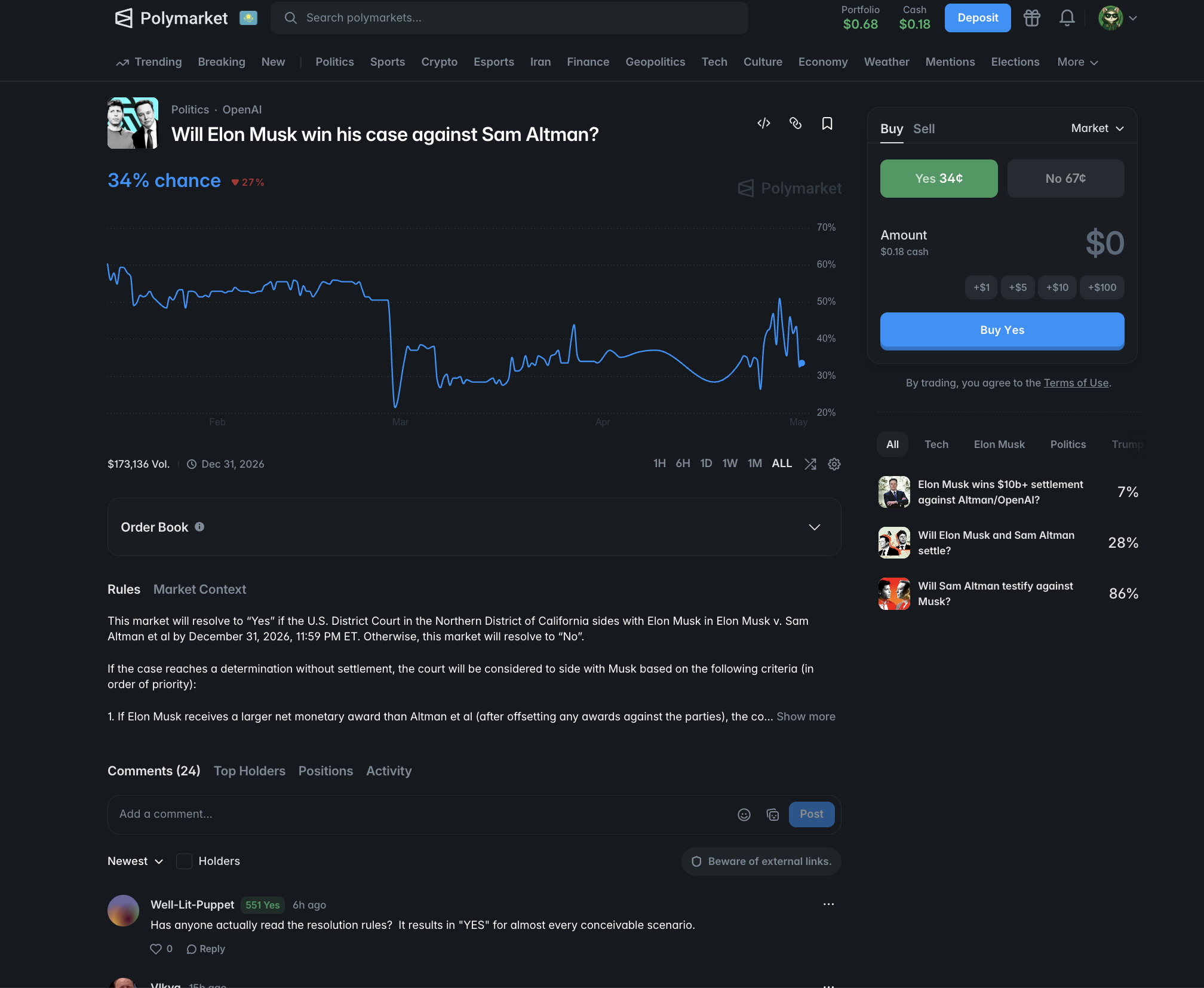
Position limits and contract types differ from the wallet-based product. QCEX trades event contracts framed as binary options under CFTC rules, with maximum position sizes per contract. The polymarket.com odds and the QCEX product odds usually track but aren’t identical; liquidity is fragmented across the two pools, and cross-market arbitrage between them is itself an emerging strategy among US-licensed market makers.
What’s not “KYC” but feels like it
Three Polymarket-side checks aren’t formal KYC but trip up new users anyway.
Wallet age and history. A brand-new wallet funded immediately and used to place a large position can get flagged for review even on the no-KYC path. Use a wallet with some prior on-chain activity (a few small swaps, a couple of deposits and withdrawals on Polygon), so it looks organic rather than freshly-created-for-Polymarket.
USDC source. USDC sent from a CEX with your name attached (Coinbase, Kraken) leaves a chain trail back to your verified identity even if Polymarket itself never asks. If on-chain pseudonymity matters to you, fund through a wallet that didn’t come from a verified CEX, though that opens its own questions about source-of-funds compliance later.
Browser fingerprint. Polymarket logs device and browser fingerprints. Switching from a clean profile to a fingerprint that’s been seen on a flagged account triggers review. Don’t reuse a browser session across multiple accounts.
What changed in 2025-2026
A short timeline of the moves that shaped today’s KYC landscape:
- Q1 2025. UK Gambling Commission rules Polymarket markets are gambling under UK law. Mandatory geo-block of UK users follows.
- Q2 2025. Polymarket announces the $112M acquisition of QCX (CFTC-regulated DCM), opening the path back to legal US access.
- Q3 2025. France and Belgium add Polymarket to restricted-platforms lists under local AML and gambling rules.
- Q4 2025. QCEX-branded US product launches with full KYC and CFTC compliance. Singapore MAS issues retail warning.
- Through 2026. Wallet-based path on polymarket.com remains the default for non-restricted users. AML triggers tightened on high-volume accounts.
Common mistakes
- Assuming “no KYC” means “anonymous.” Polymarket has your email (if you used Privy email login), your IP at every session, your device fingerprint, and every on-chain address you ever deposit from or withdraw to. Pseudonymity ≠ anonymity.
- Funding straight from a name-attached CEX. Permanent on-chain trail back to your identity. If anonymity matters, route through a non-KYC wallet and accept the source-of-funds tradeoff.
- VPN-from-blocked-country signup. Account closure with funds locked. The terms are clear that you have no claim if you weren’t allowed in.
- Reusing a wallet that touched Tornado Cash or another sanctioned protocol. The chain analytics catch this. Use a clean wallet for Polymarket activity, even if you don’t plan to scale.
- Treating Polymarket as low-risk because there’s no exchange to fail. Smart-contract risk, oracle risk on UMA, thin-liquidity slippage on prediction markets. Different risk profile, not lower.
- Stacking small deposits to evade AML thresholds. Structuring is itself an AML flag. The chain analytics watch for the pattern.
How this compares to BingX, Bybit, and other CEX KYC
If you’re coming from a centralized crypto exchange, the practical contrast:
| Polymarket (wallet path) | BingX / Bybit / OKX (Standard tier) | |
|---|---|---|
| ID required at signup | No | No |
| ID required for full withdrawals | No | Yes (5,000,000 USDT cap on BingX, similar on others) |
| Custodian | You (your wallet) | The exchange |
| Sanctions screening | Yes, on every wallet | Yes, on every account |
| AML review trigger | Volume / deposit pattern | Volume / deposit pattern |
| Restricted-country list | Yes (US, UK, EU subset, etc.) | Yes (US, UK, EU subset, etc.) |
The wallet-based custody is the structural difference. Everything else is closer than the marketing on either side suggests.
For comparison reading: BingX no-KYC registration guide →, BingX review →.
Read next
- Polymarket review →, methodology score, full feature breakdown
- How to sign up on Polymarket →, step-by-step wallet onboarding
- How to deposit USDC on Polymarket →, Polygon network deposit flow
- How to withdraw from Polymarket →, exit liquidity on the wallet path
- Methodology →, how we evaluate platforms
- Risk disclaimer →
Open Polymarket: Sign up at polymarket.com. See the affiliate disclosure for full detail.
Frequently asked questions
Does Polymarket require KYC?
On the main wallet-based polymarket.com app, no, assuming you're in a non-restricted country and your wallet doesn't flag for sanctions screening. There's no ID upload, no liveness check, no name. On the QCEX-licensed product (the legal US path since 2025), yes: full KYC including government ID, SSN, address verification, and liveness selfie are required, the same as a regulated US broker.
Can US users use Polymarket without KYC?
No. The wallet-based polymarket.com app blocks US IPs at the geographic check, and has done so since the 2022 CFTC settlement. The only legal US path in 2026 is the QCEX-branded product, which Polymarket acquired in 2025, and that requires full KYC. Using a VPN to access the wallet path from a US IP is a terms violation that results in account restriction and frozen funds, not a workaround.
What's the maximum I can deposit and trade without KYC?
There's no single hard cap published by Polymarket for the no-KYC wallet path, but accounts placing five- and six-figure positions in short windows have been flagged for AML review and asked for verification anecdotally through 2025-2026. If you want a clean retail setup, keep individual deposits and position sizes within ranges typical for retail prediction-market activity.
Which countries can use Polymarket without KYC in 2026?
Most jurisdictions outside the US, UK, France, Belgium, Quebec, Singapore, Japan, Taiwan, Thailand, and the OFAC-sanctioned regions (Cuba, Iran, North Korea, Syria, Crimea, Donetsk, Luhansk). The list updates without much notice as regulators move on prediction markets. The registration flow itself is the source of truth: if your IP is blocked at signup, your country is currently on the list.
Is Polymarket safer than a centralized crypto exchange?
Different risk profile, not necessarily safer. USDC sits in your own wallet until trade settlement, so exchange-collapse risk (Mt. Gox, FTX) is structurally lower. But you take on smart-contract risk on Polygon, oracle risk on UMA-resolved markets (ambiguous events can resolve unexpectedly), and thin liquidity on long-tail prediction markets. Both classes of risk are real, just shaped differently than the custodian-failure mode at a centralized exchange.
Will my country be unblocked later?
Possibly in either direction. Polymarket's reach has expanded in 2025 (US via the QCEX acquisition) and contracted in 2024-2025 (UK, France, Belgium added to the restricted list). Regulation in prediction markets is moving fast both ways. Watch the official Polymarket announcements rather than third-party sources for accurate updates on your specific jurisdiction.
Can I use a VPN to access Polymarket from a blocked country?
Technically possible, terrible idea. Polymarket detects most consumer VPNs through IP reputation services and chain-pattern analysis (deposit IP vs. trading IP mismatch, fingerprint inconsistencies). Caught accounts have funds frozen, and under the terms of service, you have no claim to those funds because you weren't entitled to use the platform. Even uncaught, you're depositing money into a service you're contractually banned from. Not worth it.
Is Polymarket legal in my country?
That's a question for a local lawyer, not a research site. In the US, the QCEX-licensed product is legal; the wallet-based app is not. In the UK, France, Belgium, Quebec, and Singapore, neither is legal for retail users as of 2026. Most other jurisdictions sit in a regulatory gray zone, not explicitly licensed and not explicitly banned. If your country is not on the restricted list and not OFAC-sanctioned, the wallet-based app generally operates without local enforcement.
#Polymarket#KYC#prediction markets#compliance#QCEX#regulation#guide
Discussion
Loading comments…