
Score: 8.6 / 10 · Best for: zero-fee event trading, deep politics and geopolitics markets, on-chain transparency · Watch out: UMA dispute risk, US regulatory complexity, thin liquidity on niche markets · Updated: May 2026
Polymarket is the largest decentralized prediction market by cumulative volume (over $10 billion since launch, with $3.6 billion+ during the 2024 US election cycle alone). It runs on Polygon, settles in USDC, and charges no trading fees at the protocol level. This independent review covers what matters before you deposit: market depth, fee structure, KYC tiers, US regulatory status, security model, and how Polymarket compares to its peers. We score every platform on the same methodology - affiliate compensation does not move rankings.
Not financial advice. Prediction markets are speculation. Outcomes can resolve against you, niche markets can be illiquid, and US users face state-by-state eligibility. Verify rules in your jurisdiction before depositing.
What is Polymarket
Polymarket launched in 2020 and is led by founder Shayne Coplan. The platform asks yes/no questions about real-world outcomes - election winners, sports results, crypto price thresholds, geopolitical events, Fed decisions, pop culture predictions - and lets users buy YES or NO shares at prices between 1¢ and 99¢. Each share pays out 1 USDC if the outcome it represents wins, and 0 if it loses.
The differentiator versus a traditional sportsbook is mechanical: there is no house. Trading happens peer-to-peer on an order book; prices reflect what other users are willing to pay. The platform takes no spread and charges no transaction fee. Polymarket earns by capturing future value through its embedded UMA bond economy and ecosystem activity, not by clipping every trade.
Markets and liquidity
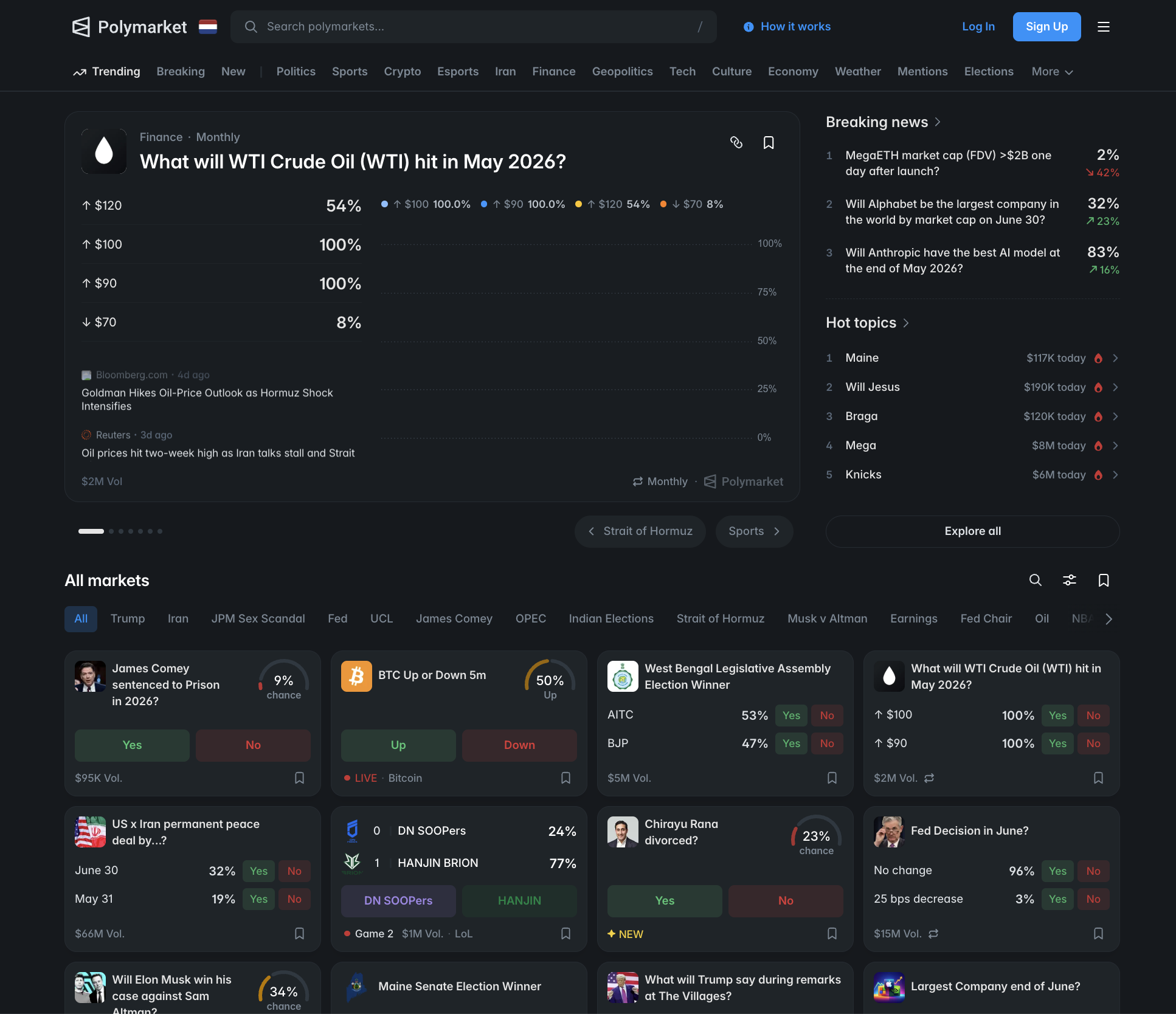
Polymarket’s catalogue spans Politics, Sports, Crypto, Pop Culture, Geopolitics, Tech, Culture, Economy, Weather, Mentions, Elections, and more. Coverage rotates around current news; the platform launches new markets within hours of major events.
Each market shows:
- Implied probability (the YES price as a percentage)
- Cumulative volume since the market opened
- Resolution date or condition
- Liquidity (depth of the order book)
- Recent price chart with historical YES probability
The volume picture is bimodal. Headline markets - major elections, Fed decisions, crypto price thresholds with clear resolution dates - routinely cross 1 to 100 million USDC in volume. Niche markets - obscure local elections, pop culture trivia, narrow time windows - can have under 10,000 USDC and a wide bid/ask spread. Treat the second category as entertainment, not as edge-bearing trades.
Fees breakdown
This is Polymarket’s headline feature: zero trading fees at the protocol level. No maker fee, no taker fee, no spread markup. Other platforms (BingX, Bybit, Bitget) charge 0.02-0.10% per trade; Polymarket charges nothing.
Real costs:
| Cost | When | Amount |
|---|---|---|
| Polygon network gas | Every on-chain trade | Typically a few cents (often sponsored by Polymarket for embedded wallets) |
| Fiat onramp (MoonPay) | Funding via card or bank | 3 to 5 percent over mid-market |
| Withdrawal to wallet | Off-ramping USDC | Polygon gas only |
| Bridge to Ethereum | If moving USDC back to L1 | Polygon→ETH bridge fee, typically $1-3 |
| UMA dispute bond | Only if you propose or dispute resolution | Standard 750 USDC bond per dispute |
The fee model rewards high-volume traders disproportionately. A trader running 100,000 USDC monthly volume on BingX pays ~$50/month in fees. The same trader on Polymarket pays effectively zero, plus $2-10 in gas.
KYC and US regulatory status
Polymarket’s regulatory situation changed materially in 2024-2025. After a CFTC settlement (~$1.4 million civil monetary penalty in November 2024) over operating an unregistered swaps facility for US persons, Polymarket acquired QCX, a CFTC-licensed derivatives contract market. As of 2026:
- International users access the main
polymarket.cominterface. The standard email-or-wallet signup applies. KYC is generally not required for basic trading; larger deposits or fiat onramps may trigger verification depending on jurisdiction and provider. - US users access a separate regulated entity with full KYC requirements. State-by-state eligibility applies - some US states are not supported even on the regulated path. Verify on the Polymarket site for your state.
The international app is geo-restricted from US IPs, and using a VPN to circumvent this violates the terms of service. Beyond the US, Polymarket excludes a small set of sanctioned jurisdictions (Iran, North Korea, Syria, etc.) per AML compliance.
Security and operations
- On-chain settlement. Trading and resolution happen on Polygon. Smart contracts are open source and audited. Funds are held in user-controlled wallets between trades, not in a centralized custodian.
- Oracle. Resolution is via UMA’s optimistic oracle. A proposer asserts an outcome with a bond; the dispute window opens; if undisputed, the outcome is final. If disputed, UMA’s DVM token holders vote. Most markets resolve cleanly. Edge cases (ambiguous wording, breaking news during dispute window) can take 2 to 5 days.
- Smart contract risk. Like all on-chain protocols, there is residual smart contract risk. To date, no exploits have caused user fund loss on Polymarket’s market contracts.
- Frontend / app risk. The Polymarket frontend is closed source. If the frontend goes down, your funds are still on-chain and recoverable through alternative interfaces, but UX-level access could be disrupted.
- Custody risk. When funds are in your embedded Polymarket wallet, you control them. If you signed up via email and lose access to that email, recovery is a support process - keep email well secured.
The single biggest operational risk is UMA dispute outcome variance. Most disputes resolve as expected; a small fraction produce surprising results due to wording ambiguity or DVM voter incentives. For high-stakes markets, read the resolution rules carefully and avoid markets with subjective wording.
Country restrictions
Polymarket is not available to:
- United States via the international app - US users are routed to the QCX-regulated US entity with KYC and state restrictions
- Iran, North Korea, Syria, Cuba, and other sanctioned jurisdictions
- Specific other countries disclosed in the Polymarket terms of service
Unlike most centralized exchanges, Polymarket is open in many jurisdictions where exchanges are restricted, because it is a self-custodial dApp rather than a custodial venue. That said, legal status of online prediction trading varies widely by country. Check local rules before depositing.
Pros and cons
Pros
- Zero trading fees - significant edge over centralized venues for active traders
- Deepest prediction market by cumulative volume (over 10B USDC lifetime)
- On-chain transparency - orders, settlements, and reserves verifiable directly on Polygon
- Self-custodial by default - funds remain in user-controlled wallets
- Strong election and politics coverage; growing in sports, crypto, geopolitics
- Regulated US access (via QCX) restored as of 2026
- Email-only embedded wallet onboarding for crypto-newcomers
Cons
- UMA dispute resolution can produce surprising outcomes on ambiguously worded markets
- Niche markets can have very thin liquidity and wide spreads
- US access path is more restrictive than international - KYC, state eligibility
- Gas-paying may require holding small MATIC balances on some flows (often sponsored by Polymarket, but not always)
- No leverage or copy trading - different audience than crypto futures platforms
How Polymarket compares
We score Polymarket 8.6 / 10 on the same six-factor rubric used across platform reviews. Closest peers:
- Kalshi - US-licensed CFTC-regulated event-contract exchange. More limited market catalogue, friendlier US regulatory wrapper, no on-chain settlement. Better for US users wanting maximum regulatory clarity.
- PredictIt - academic-research prediction market with very small position limits ($850 per market) and a cap of 5,000 traders per market. Mostly academic-political; legacy product.
- Manifold Markets - play-money or small-stakes prediction market with a strong community. Good for learning the mechanics; not for serious capital deployment.
- Sportsbooks (DraftKings, FanDuel) - different product entirely. House sets odds with margin, no peer-to-peer order book.
For derivatives-style trading with copy trading, see our BingX review.
How to start
- Verify country eligibility on Polymarket directly. International app vs US-regulated entity have different signup flows.
- Sign up by email or wallet. Email is simpler for first-time crypto users; wallet (MetaMask, WalletConnect) for crypto-natives. Full walkthrough: How to sign up on Polymarket.
- Secure the account. For email accounts, enable 2FA on the email itself (it is now your master credential). For wallet accounts, store the seed phrase offline.
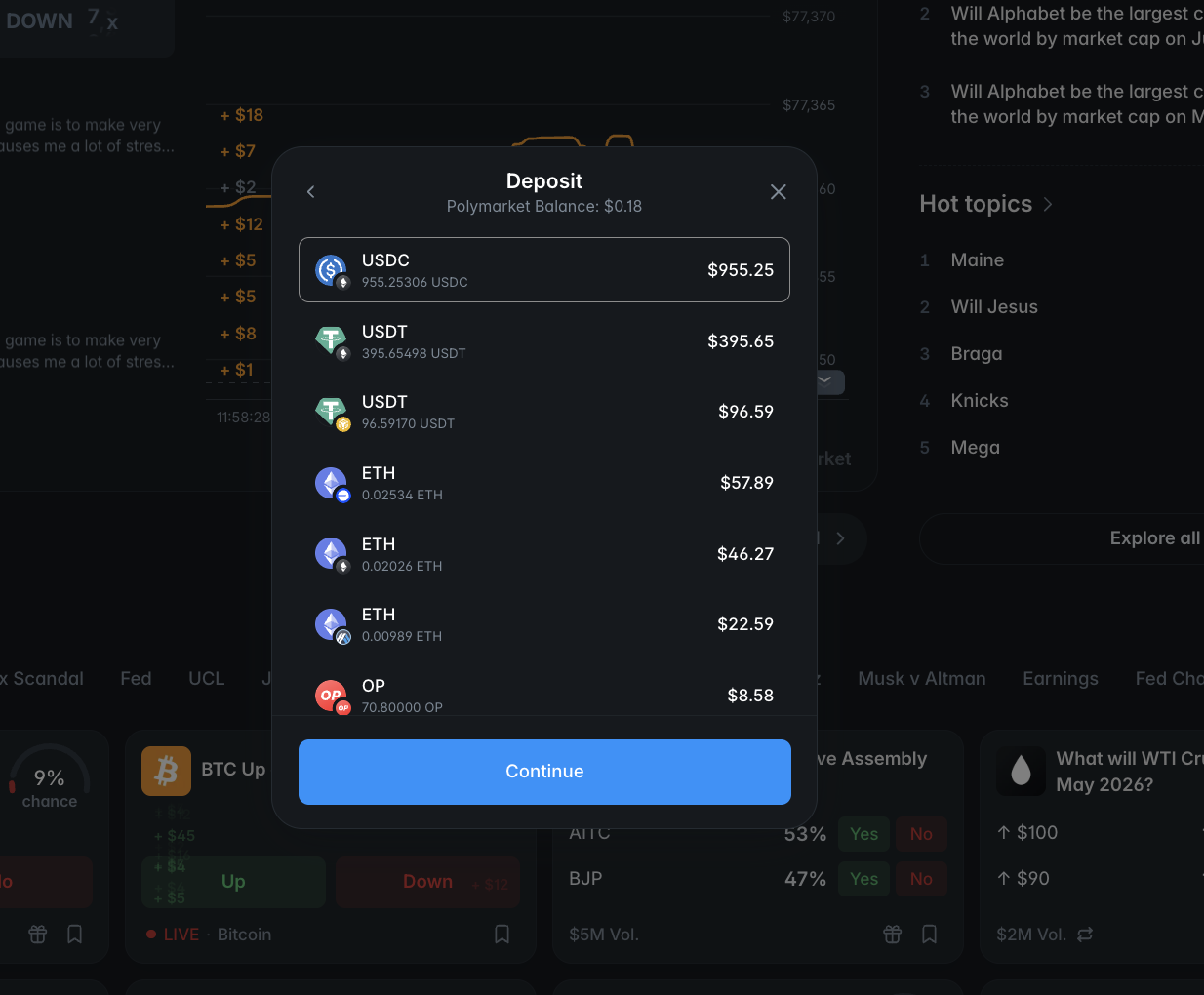
- Fund with USDC on Polygon. Detailed guide: How to deposit USDC on Polymarket. Critical: the network must be Polygon. Wrong-network transfers can lose funds.
- Test withdrawal early. Pull a small amount back to self-custody before scaling deposits. Walkthrough: How to withdraw from Polymarket.
- Stay in your circle of competence. Bet on topics you genuinely follow. Niche markets in topics you have no information on are graveyards for casual money.
- Diversify across 3 to 5 concurrent positions. Concentration is the most common new-user mistake.
- Watch the dispute window. Markets are not final until UMA’s window closes. A market showing your side as winning can flip during a dispute.
Open an account: Register on Polymarket See the affiliate disclosure for full detail.
Final word
Polymarket is the strongest pure prediction market in 2026 by depth, transparency, and economics. Zero trading fees plus on-chain settlement give it a structural edge for active traders that no centralized venue can match. The trade-offs are real: UMA dispute variance is non-zero, US access is regulatory-complex, and niche markets can be illiquid. None of those are dealbreakers for a disciplined trader who reads market rules carefully and stays in researched topics.
For event-based trading without leverage and copy-trading complexity, Polymarket sets the standard. For derivatives and copy trading, the BingX review covers the strongest peer in that category. Read the methodology, test small first, and treat the dispute window as part of every position’s risk.
Frequently asked questions
Is Polymarket legit and safe?
Polymarket is operational since 2020 and one of the largest prediction markets by volume. Trading and settlement are on-chain (Polygon, USDC), so contracts are publicly auditable. Custody is self-directed: funds stay in your wallet between trades. Main risks are not fraud but oracle disputes (resolution can take days under UMA's optimistic oracle) and regulatory complexity in the United States. There has been no platform-level loss-of-funds incident.
What fees does Polymarket charge?
Polymarket charges zero trading fees at the protocol level - no maker, no taker, no spread markup beyond the order book. Real costs are network gas on Polygon (a few cents per trade) and any onramp fees for fiat-to-USDC conversion (typically 3 to 5 percent over mid-market via MoonPay). Withdrawing to an external wallet pays only network gas.
Can US users use Polymarket in 2026?
Yes, but through a separately regulated path. After the November 2024 CFTC settlement, Polymarket acquired QCX, a CFTC-licensed derivatives exchange, and offers US access through that regulated entity with KYC requirements and state-by-state eligibility. The international app remains restricted for US persons. Verify your state's eligibility on Polymarket directly.
How do markets resolve on Polymarket?
Markets resolve through UMA's optimistic oracle. A proposer suggests an outcome and posts a bond; if no one disputes within the dispute window (typically 2 hours initially, longer for contested cases), the outcome is final. If disputed, UMA's DVM token holders vote on the resolution. Most markets resolve within minutes to hours; contested ones can take 2 to 5 days.
What is the minimum to start on Polymarket?
There is no platform minimum deposit. Network minimums apply per asset and chain. Realistically, deposit at least 20 to 50 USDC to cover network gas overhead and have meaningful position sizing. Trades start from fractions of a USDC, so you can place small experimental bets.
How is Polymarket different from a sportsbook?
A sportsbook sets odds and takes the other side of your bet - house wins on average through margin. Polymarket is a peer-to-peer order book where users trade against each other. Prices reflect aggregate market belief, not house margin. There is no spread tax, but there is liquidity risk on niche markets and resolution risk on disputed ones.
Polymarket vs Kalshi - which should I use?
Kalshi is a US-licensed CFTC-regulated exchange with a narrower set of regulated event contracts and a friendlier US regulatory wrapper. Polymarket has deeper markets, more international topics (geopolitics, sports, pop culture, crypto), zero trading fees, and on-chain settlement. For US users wanting maximum regulatory clarity, Kalshi. For depth and breadth across topics, Polymarket. We will publish a full comparison soon.
#Polymarket#prediction markets#exchange review#USDC#UMA
Discussion
Loading comments…