
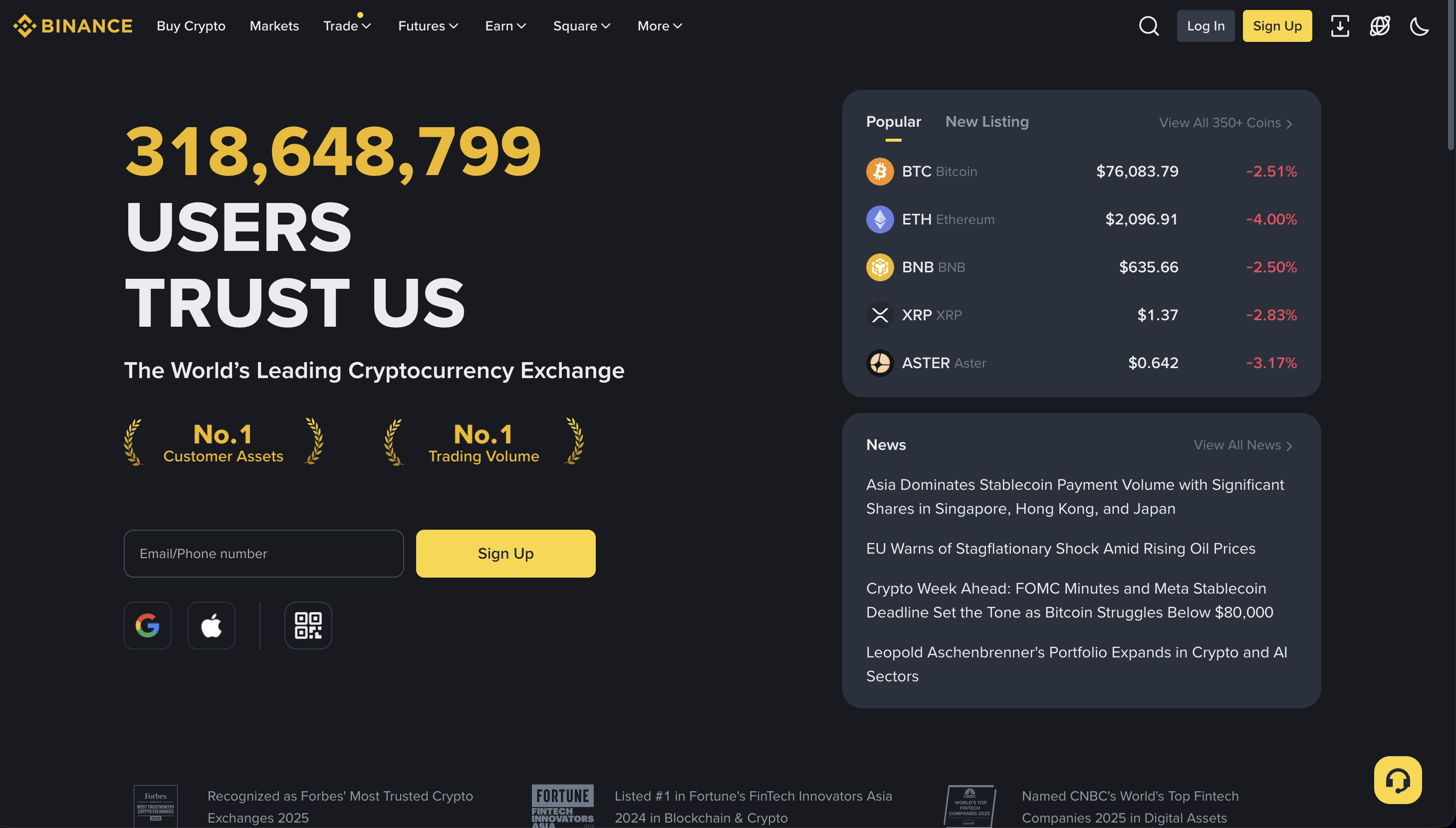
TL;DR: Binance wins on liquidity, top-50 spreads, regulatory reach (in non-US jurisdictions), and product breadth. KuCoin wins on altcoin selection, listing speed for new tokens, built-in trading bots, and a slightly more retail-friendly fee structure once you factor token discounts. Neither has a meaningful US path. Below is the head-to-head, factor by factor, with the use cases where each platform is the correct answer.
Not financial advice. Crypto trading is high risk. Both platforms have been through major regulatory events in 2023-2024. Verify country availability and current fees before depositing. Read the risk disclaimer before scaling capital onto either.
Quick comparison
| Factor | KuCoin | Binance |
|---|---|---|
| Founded | 2017 | 2017 |
| Headquarters | Seychelles | Cayman Islands (since 2024) |
| Spot maker / taker (base) | 0.10% / 0.10% | 0.10% / 0.10% |
| Spot with token discount | 0.08% (KCS, 20% off) | 0.075% (BNB, 25% off) |
| Perpetual futures maker / taker | 0.02% / 0.06% | 0.02% / 0.04% |
| Spot pairs available | 700+ | ~350 |
| Native token | KCS (fee discount + dividend) | BNB (fee discount + utility) |
| Built-in trading bots | 6+ bot types, first-class UI | Available but secondary |
| Copy trading | Available, mid-tier depth | Available since 2023, growing |
| Web3 / DeFi integration | Limited | Broad (BNB Chain, BNB ecosystem) |
| US availability | None | Binance.US (restricted scope) |
| Recent regulatory event | CFTC settlement 2024 | DOJ settlement Nov 2023 ($4.3B) |
| Hot wallet incident history | Sept 2020 ($281M, recovered) | 2019 ($40M, SAFU covered) |
| Proof of reserves | Published | Published |
Liquidity and spreads
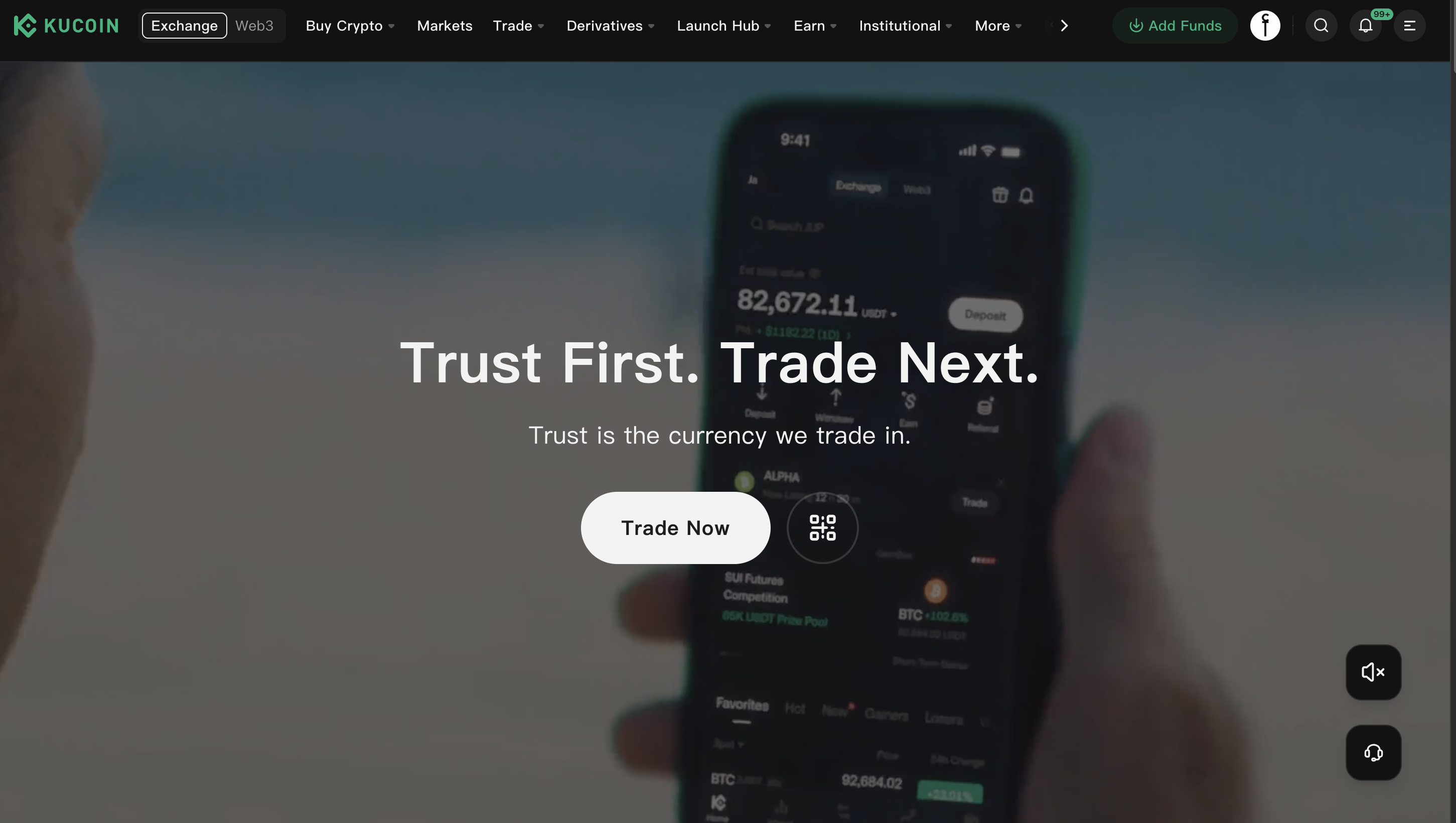
This is where the size difference shows up. Binance is the largest crypto exchange in the world by spot and derivatives volume, and the order book depth follows. On BTC/USDT, ETH/USDT, and the top 30 pairs, Binance carries multi-million-dollar liquidity inside the top 5 bid/ask levels during normal hours. The spread on BTC/USDT routinely sits at one tick. Slippage on a $50K market order is negligible.
KuCoin is smaller. The top pairs are still liquid enough for retail trading, but the spread on BTC/USDT is wider (typically 1-2 ticks) and the depth at level 5 is roughly an order of magnitude lower. For a $100K market buy on BTC/USDT, Binance fills inside one tick. KuCoin will move the market by a few basis points.
The practical consequence: if your trades are large enough that slippage matters more than fee headline, Binance wins on cost-of-execution despite identical headline fees. For typical retail traders running under $10K per order, the difference disappears into noise.
Asset coverage and listings
The picture inverts here.
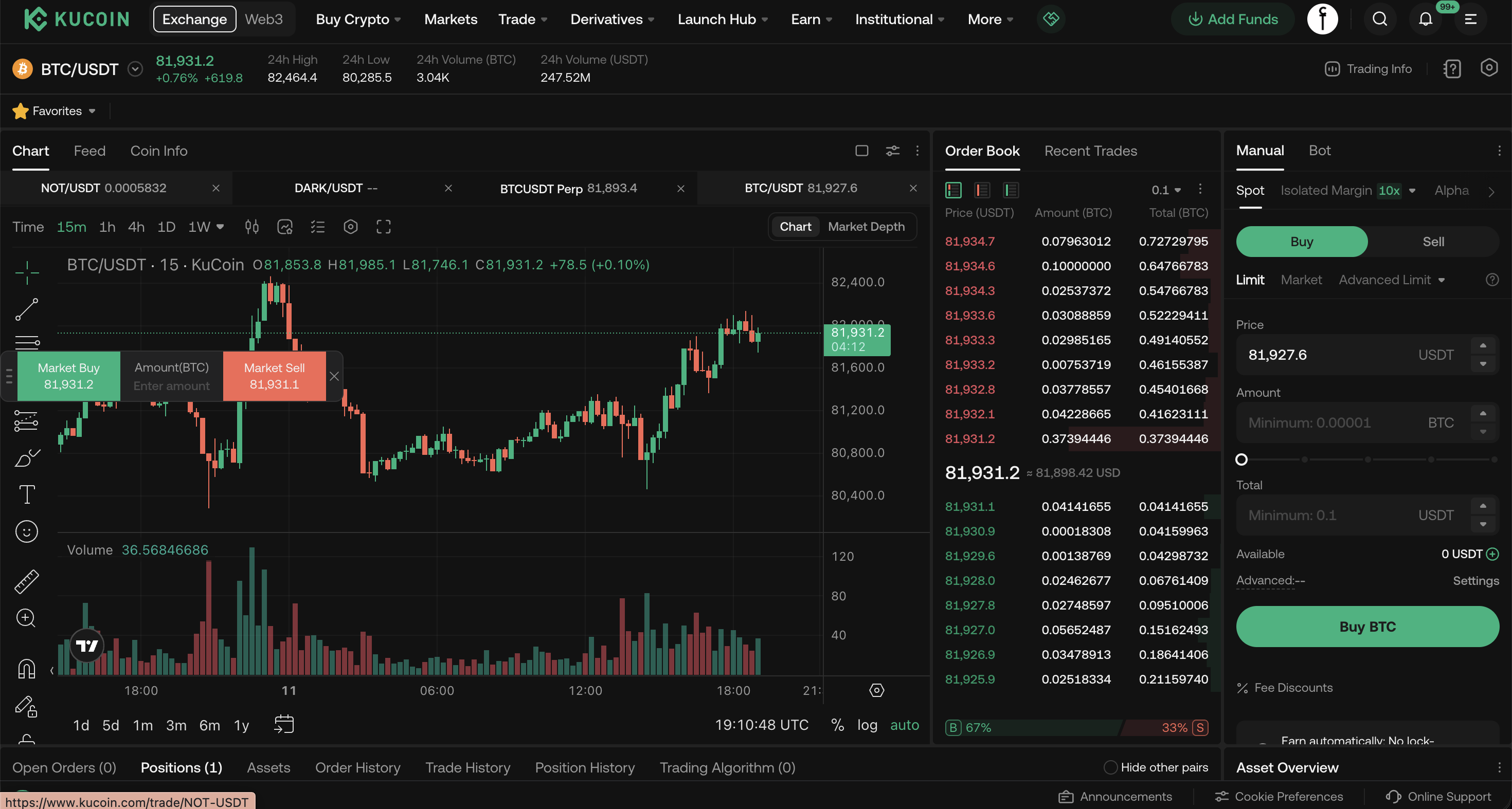
KuCoin lists over 700 spot pairs as of 2026, including a long tail of mid-cap and small-cap altcoins that take months or years longer to reach Binance. The listing standards are lower, which is both the strength and the warning: more selection means more chances to catch a new token early, but also more chances to hold a project that delists or rugs.
Binance lists roughly 350 spot pairs in 2026, having pruned and tightened standards through 2024-2025. Listings come with marketing weight (Binance Launchpad, Innovation Zone), more rigorous diligence, and stronger ongoing trading volume. The tradeoff is that by the time something lists on Binance, the early-listing premium is usually gone.
For traders running breakout-on-new-listings strategies, altcoin rotation portfolios, or any thesis that depends on being early in a token, KuCoin has the structural advantage. For traders focused on the top 30 pairs with maximum liquidity and listing credibility, Binance has it.
Fees: close on paper, BNB economics tilt it
At base tier, both platforms charge 0.10 percent spot maker and 0.10 percent spot taker. Identical. The fee story diverges once token discounts and VIP tiers enter:
- Binance with BNB discount active: 25 percent off, so spot fees drop to 0.075 percent. Holding BNB and toggling “Use BNB to pay fees” is the standard retail setup.
- KuCoin with KCS: 20 percent off, so spot fees drop to 0.08 percent. Slightly worse than BNB on percentage, but KCS also pays a daily bonus from a share of exchange revenue (the KCS daily bonus mechanism), which is a separate yield component not present on BNB.
On perpetual futures, Binance is meaningfully cheaper at base tier: 0.04 percent taker vs KuCoin’s 0.06 percent. For an active futures trader running $1M per month volume, that’s $200 saved on Binance.
VIP tiers scale fees down on both. Binance’s curve is more aggressive at the top, which favors institutional volume. For retail, neither scales fast enough for the tier to matter unless you cross $10M monthly volume.
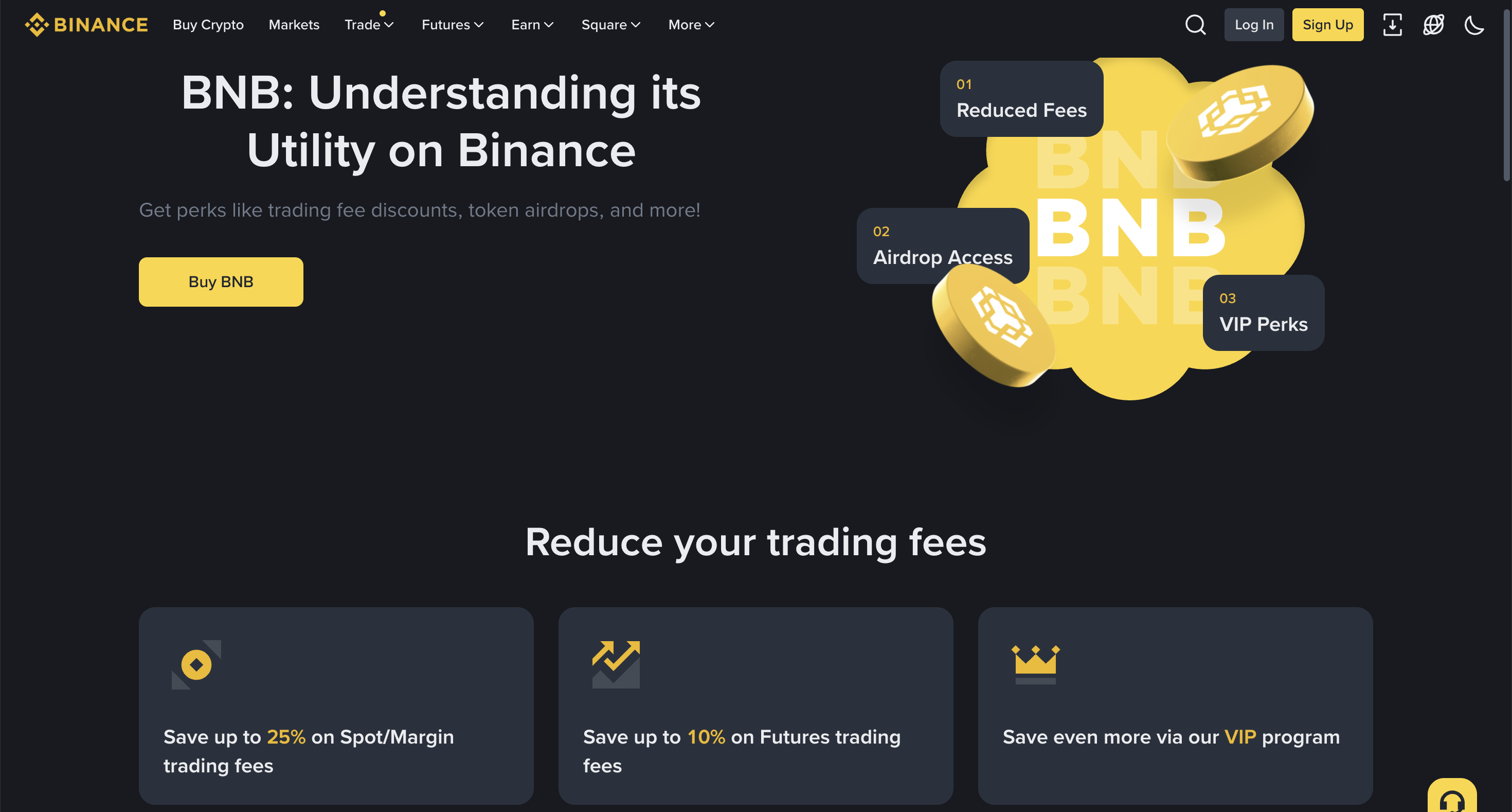
Net: for spot trading at retail volume, Binance is roughly 5 basis points cheaper. For futures, Binance is 20 basis points cheaper on taker. The KCS daily bonus partially offsets the gap if KuCoin’s payout structure works for you, but it requires holding KCS as a position (with the price risk that implies).
KYC posture in 2026
Both have tightened. The era of email-only crypto trading at major centralized exchanges is mostly over.
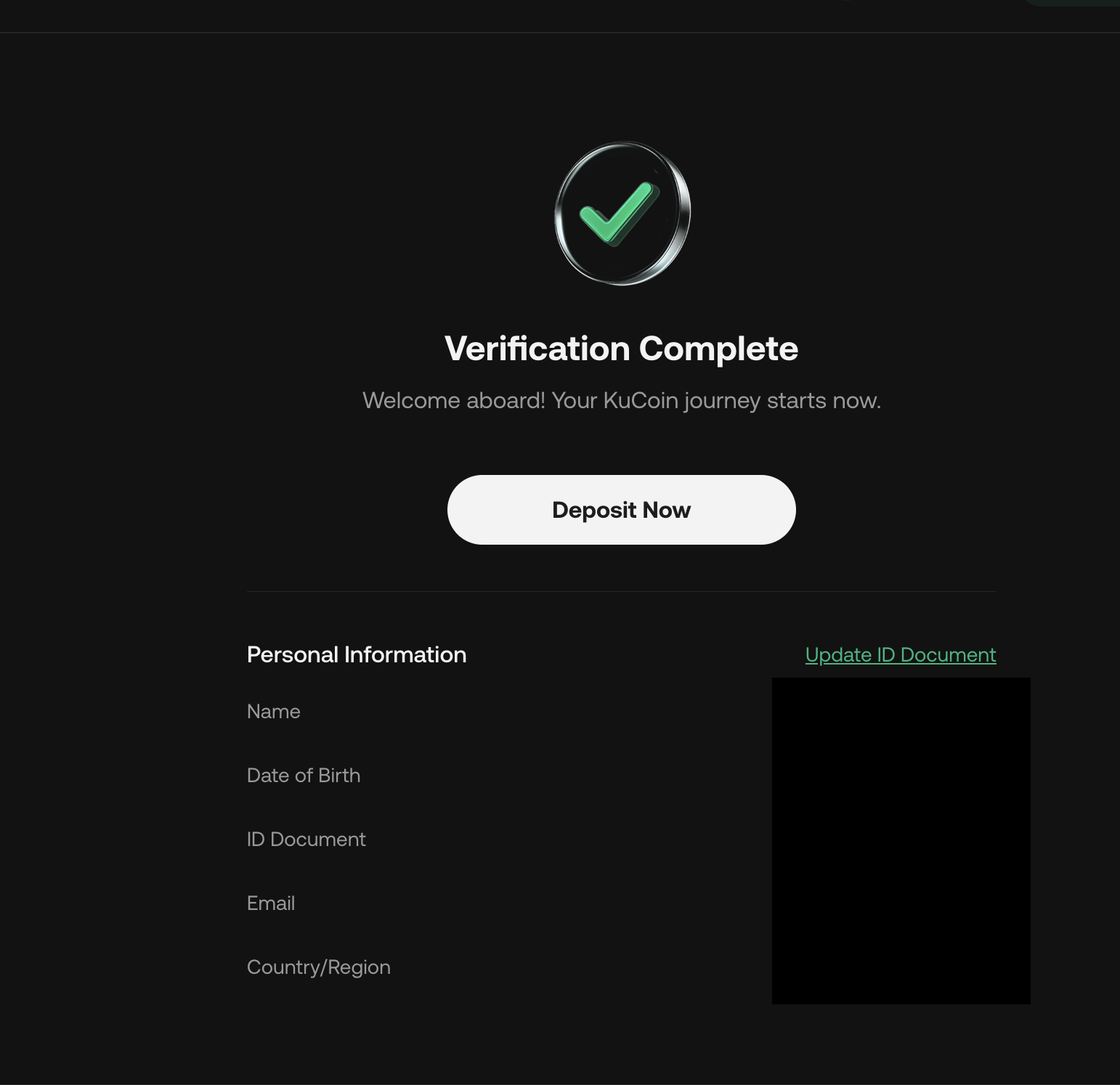
- Binance: mandatory KYC for essentially all account functions globally as of 2025. The verification process is rigorous: government ID, liveness check, address verification, source of funds for higher tiers. Approval is typically same-day for clean applications.
- KuCoin: still has tiered access in some jurisdictions, but withdrew the famous no-KYC withdrawal limit during the post-CFTC compliance push of 2024-2025. Standard accounts can still register with email, but most meaningful functionality (large deposits, futures, fiat onramps) requires verification.
Practical takeaway: assume you will complete KYC on either. If avoiding KYC is the primary driver of platform choice, neither of these is the answer. Look at decentralized perps venues or self-custodial alternatives instead.
For users specifically researching KuCoin’s current KYC status, our KuCoin sign-up guide covers the 2026 requirements step by step. (KYC information here is general guidance, verify the current tier structure on KuCoin directly before depositing.)
Regulatory history: both have a chapter
Neither platform is regulatorily clean. Both went through major events in the last three years.
Binance: DOJ settlement, November 2023. The US Department of Justice settled with Binance for approximately $4.3 billion over anti-money-laundering and sanctions violations. CZ (founder Changpeng Zhao) pleaded guilty personally and stepped down as CEO. The platform continued operating; Richard Teng took over leadership. Compliance overhead has substantially expanded since.
KuCoin: CFTC settlement, 2024. KuCoin reached a settlement with the CFTC over operating an unregistered derivatives venue for US users. The civil penalty was smaller than Binance’s by orders of magnitude, but the strategic effect was similar: tighter KYC, geo-blocking, withdrawal of the no-KYC limit, and a long-term commitment to compliance overhead.
Reading these events: neither platform is a fly-by-night operation that ran from regulators. Both took the settlements, paid the fines, and kept operating with enhanced compliance. The risk for users going forward is not platform collapse from regulatory action; the risk is gradual product erosion as compliance constraints tighten what each platform can offer.
Security and hack history
KuCoin: September 2020 hot wallet exploit. Approximately $281M in BTC, ETH, and ERC-20 tokens drained from hot wallets. KuCoin coordinated with token issuers to invalidate large portions of the stolen tokens, recovered significant amounts directly through chain analytics, and covered the remaining user balances from corporate reserves. No user lost funds. The post-mortem (improved hot wallet limits, faster cold storage rotation) appeared to address the root causes.
Binance: 2019 hot wallet exploit. Approximately $40M in BTC stolen via a phishing and API key compromise targeting a single hot wallet. Binance covered the loss from the SAFU (Secure Asset Fund for Users) insurance fund that the platform self-funds from trading fees. No user lost funds. SAFU has grown to approximately $1 billion as of 2026 and remains the largest exchange-funded insurance pool in crypto.
Operationally, neither has had a customer-loss event despite multiple incidents. The model both platforms use, self-insurance with proof of reserves, has held under stress. That said, both platforms are still custodial exchanges. The institutional risk of holding funds on either has the same shape, just with strong historical track records of handling incidents without harming users.
Copy trading
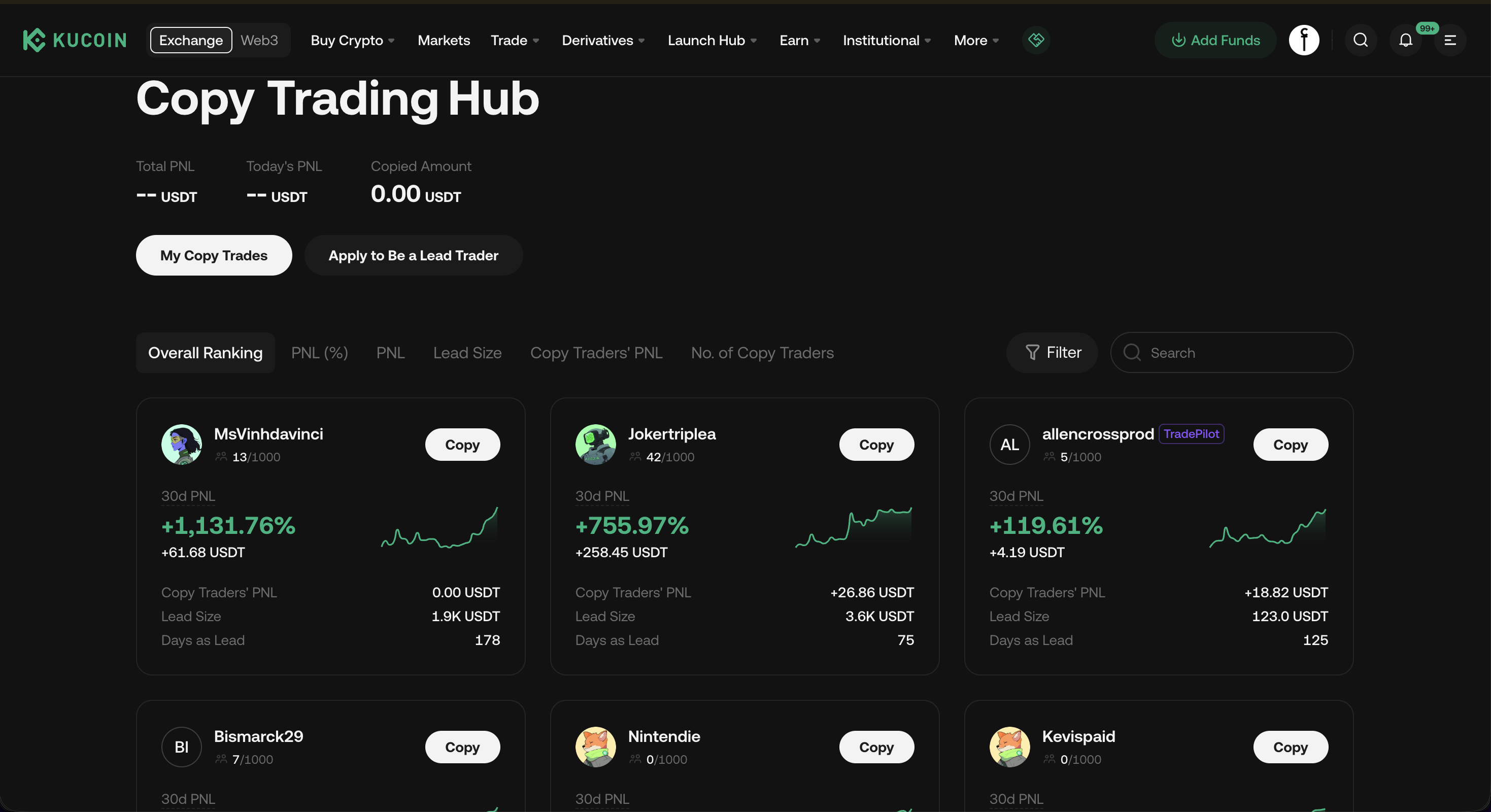
Neither is the strongest choice. Both have built copy trading products into broader trading platforms, and both feel like features rather than primary products.
- KuCoin copy trading: has existed longer, has a separate marketplace UI that distinguishes the product from main trading, and the leaderboard is sortable on PnL, ROI, win rate, and follower count. The number of active lead traders is mid-tier across exchanges.
- Binance copy trading: launched in 2023, growing fast on the strength of Binance’s brand and traffic. Marketplace is now competitive on lead-trader count but UX feels more like a copy-tab inside the futures interface than a dedicated product.
For traders whose primary goal is copy trading, neither KuCoin nor Binance is the best fit. BingX and Bitget are purpose-built for this. We cover the comparison in detail in BingX copy trading guide. Between the two on this page, KuCoin has the slight edge for copy-trading focus, but the gap is small and Binance is closing it.
Trading bots and earn products
This is one of the few categories where KuCoin clearly leads.
KuCoin trading bots: six bot types accessible from the main trading view, including spot grid, futures grid, DCA, smart rebalance, infinity grid, and arbitrage. Configuration takes under a minute, backtesting is functional, and bots run server-side without requiring a hosted machine. For traders who want to deploy systematic strategies without writing code, this is mature.
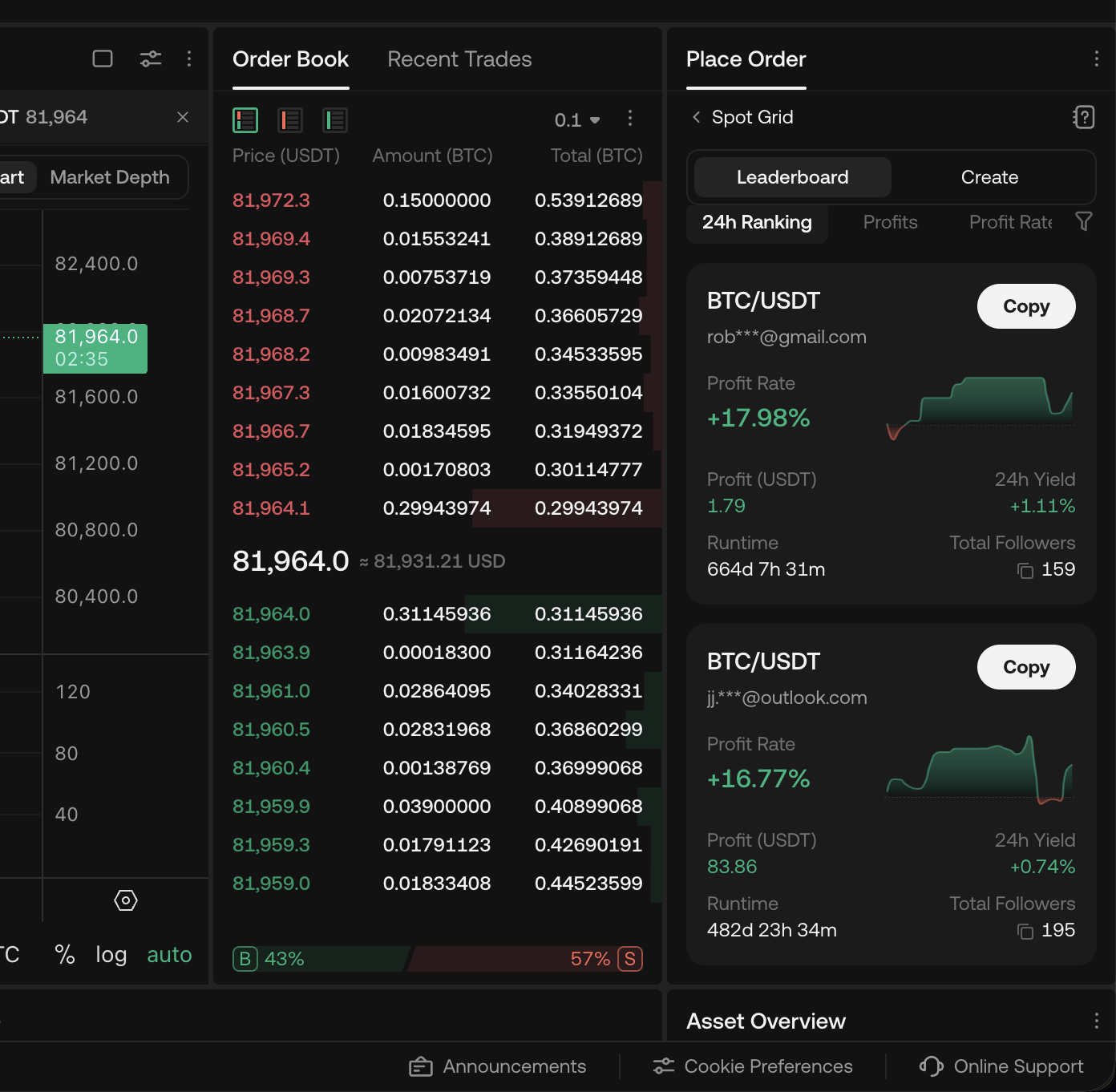
Binance trading bots: present (TWAP, spot grid, futures grid, DCA), but the configuration UX is less polished and the placement deeper in the menu hierarchy suggests it is not a priority product.
Both run earn products covering staking, savings, dual investment, and structured yield. Binance Earn has broader coverage and higher yields on the flagship products like BNB staking. KuCoin Earn is comparable on the basics with fewer exotic products. For passive yield, Binance is slightly ahead; for active bot-based strategies, KuCoin is meaningfully ahead.
Pick KuCoin if
- You need altcoin breadth, particularly outside the top 100
- You want to be early on new listings, accepting more listing-quality variance
- Trading bots are core to your strategy and you do not want to host them yourself
- You value KCS daily bonus economics on top of standard fees
- You are outside the US and want a viable alternative to Binance with comparable fees
Pick Binance if
- You trade primarily BTC, ETH, and top-30 pairs and need tightest spreads
- Your volume is high enough that small fee gaps compound (over $100K per month)
- You want broader product surface: options, structured products, broader Earn, P2P
- BNB ecosystem participation matters (Launchpad access, BNB Chain DeFi)
- You are willing to navigate post-DOJ compliance and the slightly slower listing pace as tradeoffs
Verdict
For most retail traders building a long-term position across altcoins with active bot strategies, KuCoin is the better starting point. The combination of altcoin selection, integrated trading bots, and KCS economics matters more for that profile than the marginal fee or spread advantage Binance carries on the top pairs.
For traders running concentrated BTC/ETH positions, high-volume futures, or strategies that need maximum liquidity and product breadth, Binance remains the standard.
Both carry regulatory baggage that did not exist in 2022. Both are stricter on KYC than they used to be. Neither has a US path that competes with Kraken or Coinbase for US-based traders. The honest framing in 2026 is that these are two of the strongest non-US-focused centralized exchanges, with overlapping use cases and distinct edges. Pick the one whose edge matches your actual trading.
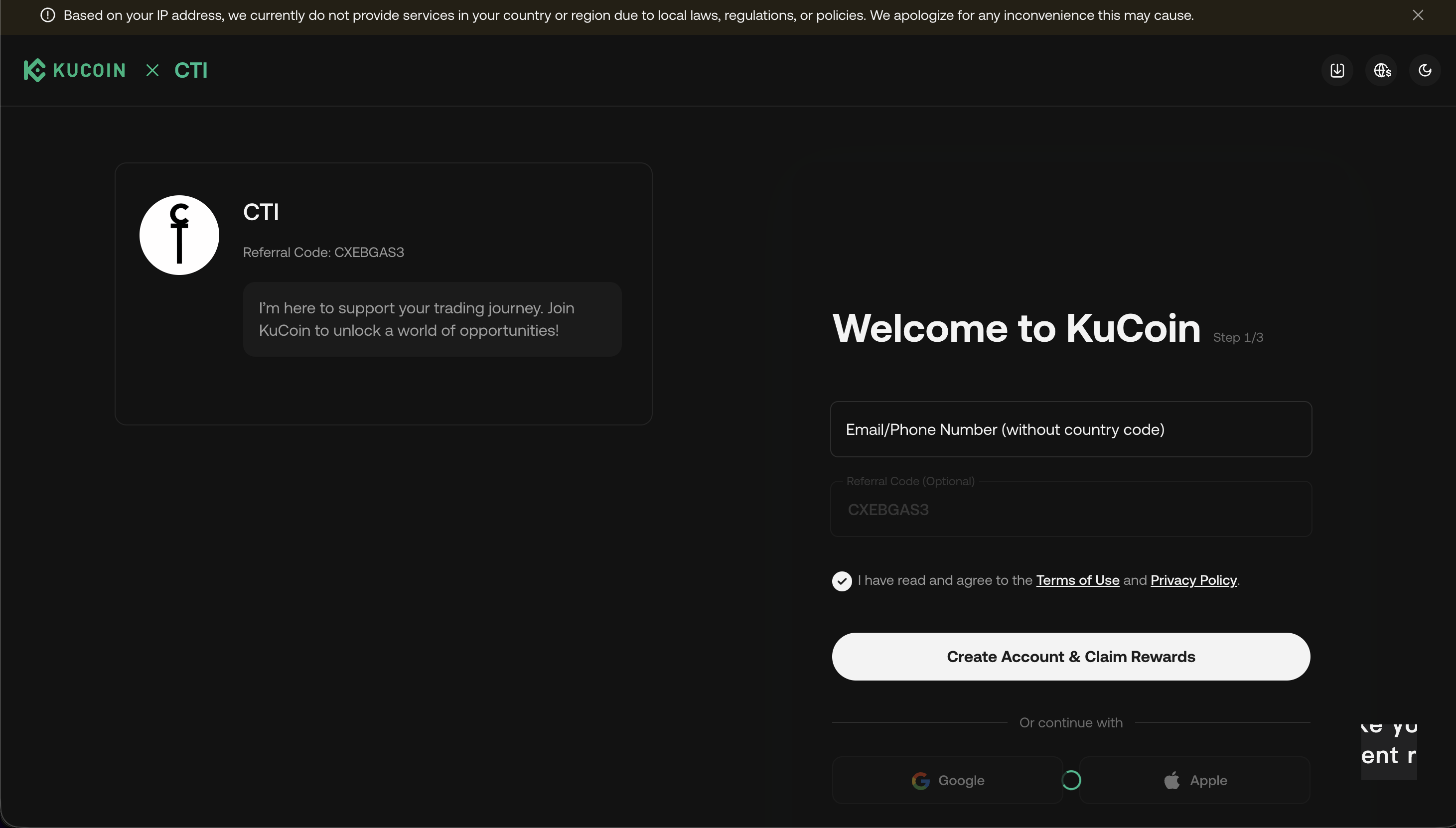
For altcoin and trading-bot focus: Open KuCoin. See the affiliate disclosure for full detail.
Read next
- BingX vs OKX comparison. Different head-to-head, different audience.
- BingX copy trading guide. The dedicated copy trading benchmark.
- OKX review. The third major option in the same tier.
- Methodology. How we evaluate platforms.
- Risk disclaimer.
Frequently asked questions
KuCoin or Binance, which is better for altcoins?
KuCoin. The altcoin selection is broader (over 700 spot pairs vs about 350 on Binance), small-cap and mid-cap listings happen earlier, and the threshold for getting a token listed is lower. Binance has the bigger names and deeper liquidity on the top 50 pairs, but the long tail of altcoins, especially newer launches and niche tokens, lives on KuCoin first. If your strategy depends on early-listing exposure or a wide token mix, KuCoin wins. If your strategy lives in BTC, ETH, and the top 30, Binance has tighter spreads.
Are Binance fees lower than KuCoin?
At base tier and without token discounts, fees are nearly identical: both charge 0.10 percent spot maker and taker. With native token discounts active, Binance comes out slightly cheaper. BNB at 25 percent discount brings spot fees to 0.075 percent, KCS at 20 percent discount brings KuCoin spot to 0.08 percent. Futures fees are also close: Binance 0.02 percent maker / 0.04 percent taker, KuCoin 0.02 percent / 0.06 percent. For typical retail volume, the absolute fee difference is small. Token discounts matter more than the headline rate.
Is KuCoin safer than Binance?
Different histories, similar current risk profile. Binance has survived a $40M hot wallet exploit in 2019 (covered by SAFU insurance) and the 2023 DOJ settlement for $4.3 billion that resulted in CZ stepping down as CEO. KuCoin survived a $281M hot wallet exploit in September 2020 (fully recovered through partner cooperation and the affected token issuers) and a 2024 CFTC settlement related to US user access. Neither has had a customer-loss event. Both publish proof of reserves. For long-term holdings, withdraw to self-custody from either, regardless of which you pick for trading.
Can US users use KuCoin or Binance?
Neither in the unrestricted form. Binance operates a separate Binance.US entity with significantly reduced product scope, full KYC, and ongoing regulatory uncertainty in 2026. KuCoin has no US-licensed product and the international platform blocks US IPs. For US traders, neither is a strong choice; consider regulated alternatives like Kraken or Coinbase. Outside the US, both are widely available with regional restrictions that have tightened across 2024-2025.
Does KuCoin or Binance have better copy trading?
Binance launched copy trading in 2023 and the marketplace has grown to several thousand lead traders, but the product still feels like a feature added to a broader platform. KuCoin's copy trading has existed longer, with comparable lead-trader counts and a UX that more clearly separates the copy product from the main trading interface. Neither matches BingX or Bitget on copy-trading depth or filter sophistication. For dedicated copy trading, look at our [BingX copy trading guide](/blog/bingx-copy-trading-guide/) instead. Between these two, KuCoin has a slight edge on copy trading specifically; Binance wins on every other metric.
How do KuCoin and Binance compare on KYC?
Both tightened KYC materially in 2024-2025. Binance now requires KYC for essentially all new accounts globally, with very limited functionality before verification. KuCoin still has tiered access in some jurisdictions but withdrew the famous five-BTC-per-day no-KYC limit during the post-CFTC compliance push. As of 2026, expect to complete KYC on either platform for any meaningful trading volume. If avoiding KYC is the primary driver, neither is the right answer; look at decentralized venues.
Which has more trading products?
Binance has the broader product surface: spot, margin, perpetual futures, options, structured products, P2P, NFT marketplace, launchpad, and Earn. KuCoin's range is narrower: spot, margin, perpetual futures, trading bots (built-in grid/DCA/rebalance), KuMining cloud mining, and Earn. For pure variety of products, Binance is ahead. For the specific combination of trading bots integrated into spot/futures and KCS token economics, KuCoin offers something Binance does not.
Which one for trading bots specifically?
KuCoin. Built-in bots are a first-class product: spot grid, futures grid, DCA, smart rebalance, infinity grid, arbitrage. The bot panel is integrated into the main trading view, deployment takes under a minute, and the backtest interface is functional. Binance has trading bots too (TWAP, spot grid, futures grid, DCA), but they sit deeper in the menu and the configuration UX is less polished. For traders building bot-heavy strategies, KuCoin is the better starting point.
#KuCoin#Binance#comparison#altcoins#fees#copy trading
Discussion
Loading comments…