
TL;DR: KuCoin wins on altcoin breadth, listing speed, native trading bots, and KCS token economics. Bybit wins on derivatives depth, perpetual futures spreads, copy trading marketplace, and a slightly faster fee curve at higher VIP tiers. Neither has a meaningful US path. Below is the head-to-head, factor by factor, and the use cases where each platform is the correct answer.
Not financial advice. Crypto trading is high risk. Both platforms have been through major events: KuCoin’s 2020 hack and 2024 CFTC settlement, Bybit’s 2025 exploit. Verify country availability and current fees before depositing. Read the risk disclaimer before scaling capital onto either.
Quick comparison
| Factor | KuCoin | Bybit |
|---|---|---|
| Founded | 2017 | 2018 |
| Headquarters | Seychelles | Dubai (operational, Singapore previously) |
| Spot maker / taker (base) | 0.10% / 0.10% | 0.10% / 0.10% |
| Spot with token discount | 0.08% (KCS, 20% off) | ~0.08% (BIT, comparable) |
| Perpetual futures maker / taker | 0.02% / 0.06% | 0.02% / 0.055% |
| Spot pairs available | 700+ | ~400 |
| Native token | KCS (fee discount + daily bonus) | BIT (fee discount + ecosystem) |
| Built-in trading bots | 6+ types, first-class UI | Available, less developed |
| Copy trading | Available, mid-tier | Available, more central to product |
| Derivatives surface | Perpetual futures, margin | Perpetuals, options, broader product set |
| US availability | None | None |
| Recent major event | 2024 CFTC settlement | 2025 $1.5B exploit (insurance covered) |
| Proof of reserves | Published Merkle-tree | Published Merkle-tree |
Liquidity and execution
On BTC/USDT and ETH/USDT, both platforms have liquidity that handles retail order sizes without meaningful slippage. Bybit’s derivatives liquidity is the better-known strength: perpetual futures order books on top pairs are tighter than KuCoin’s, and the spread on BTC/USDT perp typically sits at one tick at most retail order sizes.
KuCoin’s spot order books are competitive on majors but thinner than Bybit’s on mid-cap altcoins. The slippage curve on a $50K market order is meaningful on KuCoin for altcoins outside the top 100 and effectively negligible on Bybit for the pairs it lists. The trade-off: Bybit lists fewer of those pairs.
For execution-sensitive traders running concentrated positions in liquid assets, Bybit is slightly better. For traders running diversified altcoin portfolios across the long tail, KuCoin is the only option of the two.
Asset coverage
KuCoin lists more than 700 spot trading pairs as of 2026. Bybit lists approximately 400. The difference is concentrated in the long tail: mid-cap and small-cap altcoins that take months or years to reach Bybit (if ever) and arrive on KuCoin within weeks of demand existing.
The trade-off is listing quality. KuCoin’s lower listing threshold means more chances to be early in a real project and more chances to hold a token that delists or rugs. Bybit’s tighter listing standards filter more of the long-tail garbage but also filter the early-stage opportunities.
For derivatives, both platforms cover the top 100 perpetual pairs. Bybit has a wider spread of leverage settings (including products with up to 200x leverage on majors) and offers options markets on BTC and ETH that KuCoin does not. For options-driven strategies, Bybit is the only option of the two.
Fee structure
At default tier the fee schedules are nearly identical on spot. Both charge 0.10 percent maker and 0.10 percent taker. Token discounts bring spot fees to roughly the same effective rate (KCS at 20 percent off gives KuCoin spot 0.08 percent; BIT discount on Bybit is comparable).
On perpetual futures, Bybit is slightly cheaper at base tier: 0.02 percent maker and 0.055 percent taker vs KuCoin’s 0.02 percent and 0.060 percent. The 5 basis point gap on taker is real but small in absolute terms; for a trader running $100K futures volume per month, that gap costs an extra $5.
The bigger difference is at higher VIP tiers. Bybit’s curve scales fees down faster for high-volume traders, particularly on derivatives. For a trader at $5M monthly volume, Bybit’s effective fee schedule is materially cheaper than KuCoin’s. For retail volume under $1M per month, the platforms are close enough that fees should not drive the choice.
Detailed KuCoin fee breakdown in our fees explained guide.
Native token economics
KuCoin’s KCS pays a daily bonus on top of the 20 percent fee discount. The bonus distributes a share of platform trading revenue to KCS holders (minimum 6 KCS) in USDT-equivalent daily. Annualized yields in 2026 run 1 to 4 percent depending on platform volume and KCS price.
Bybit’s BIT token offers a fee discount and ecosystem benefits but does not have a comparable platform-revenue-share mechanism. Holding BIT for the discount makes sense if you would hold the token anyway; holding it specifically to capture extra yield does not produce the same daily-bonus stack as KCS.
For active traders who would hold a native exchange token anyway, KuCoin’s KCS economics are more attractive than Bybit’s BIT. For traders who do not want token price exposure as a precondition for fee savings, neither is compelling.
KYC posture in 2026
Both platforms tightened materially in the 2024 to 2026 window.
Bybit: moved to mandatory KYC for essentially all account functions globally. The unverified tier is effectively read-only for new accounts. Verification is required to deposit material amounts, trade futures, or use any meaningful platform feature. The shift accelerated after the 2025 exploit, which raised compliance scrutiny across the platform.
KuCoin: maintains a tiered model where unverified accounts can technically register and trade spot in small sizes, but withdrawal limits trigger verification prompts quickly. The famous 5 BTC per day no-KYC limit was retracted during the 2024 CFTC compliance push. Practical floor for unverified use is now significantly lower (covered in detail in our no-KYC 2026 guide).
Practical takeaway: for any meaningful trading on either platform, plan on completing Basic verification. If avoiding KYC is the primary driver, neither is the right answer; look at decentralized venues or self-custodial alternatives like Polymarket.
Regulatory history
KuCoin: 2024 CFTC settlement. Civil terms including tighter KYC, US geo-blocking, transaction monitoring upgrades. Custody and user balances unaffected. The platform continued operating throughout. Smaller in scale than the major DOJ settlements at Binance or OKX.
Bybit: 2025 exploit. The platform suffered an approximately $1.5 billion exploit, linked publicly to North Korean threat actor activity (Lazarus Group). Bybit absorbed the loss via the insurance fund and kept user balances whole. No withdrawal suspension at platform level. The event triggered enhanced compliance scrutiny and accelerated the KYC tightening described above.
Reading these events: both platforms survived major operational stress events without user-fund loss. Neither has had a custody collapse or operator failure. The risk profile going forward is comparable across the two; the source of the risk differs (regulatory pressure on KuCoin, exploit exposure on Bybit) but neither has materialized as user harm.
Trading bots: KuCoin’s clear edge
KuCoin operates six native bot types directly integrated into the trading view:
- Spot Grid. Buys low, sells high within a defined price range.
- Futures Grid. Same on perpetuals with leverage.
- DCA. Disciplined accumulation.
- Smart Rebalance. Multi-asset portfolio weight maintenance.
- Infinity Grid. Spot Grid without an upper bound.
- Arbitrage. Captures price differences across related markets.
The product is mature, server-side, and integrated into the main trading flow. A public leaderboard exposes top-performing configurations sortable by 24h yield, runtime, and copier count. Bot trades count toward VIP volume on the same calculation as manual trades.
Bybit added native bots in 2023. The product is less developed: fewer bot types are available, the configuration UI is less polished, and the community leaderboard is smaller. For traders building bot-heavy strategies, KuCoin is the clearly stronger platform. We cover the full bot stack in our KuCoin trading bots guide.
Copy trading: Bybit’s clear edge
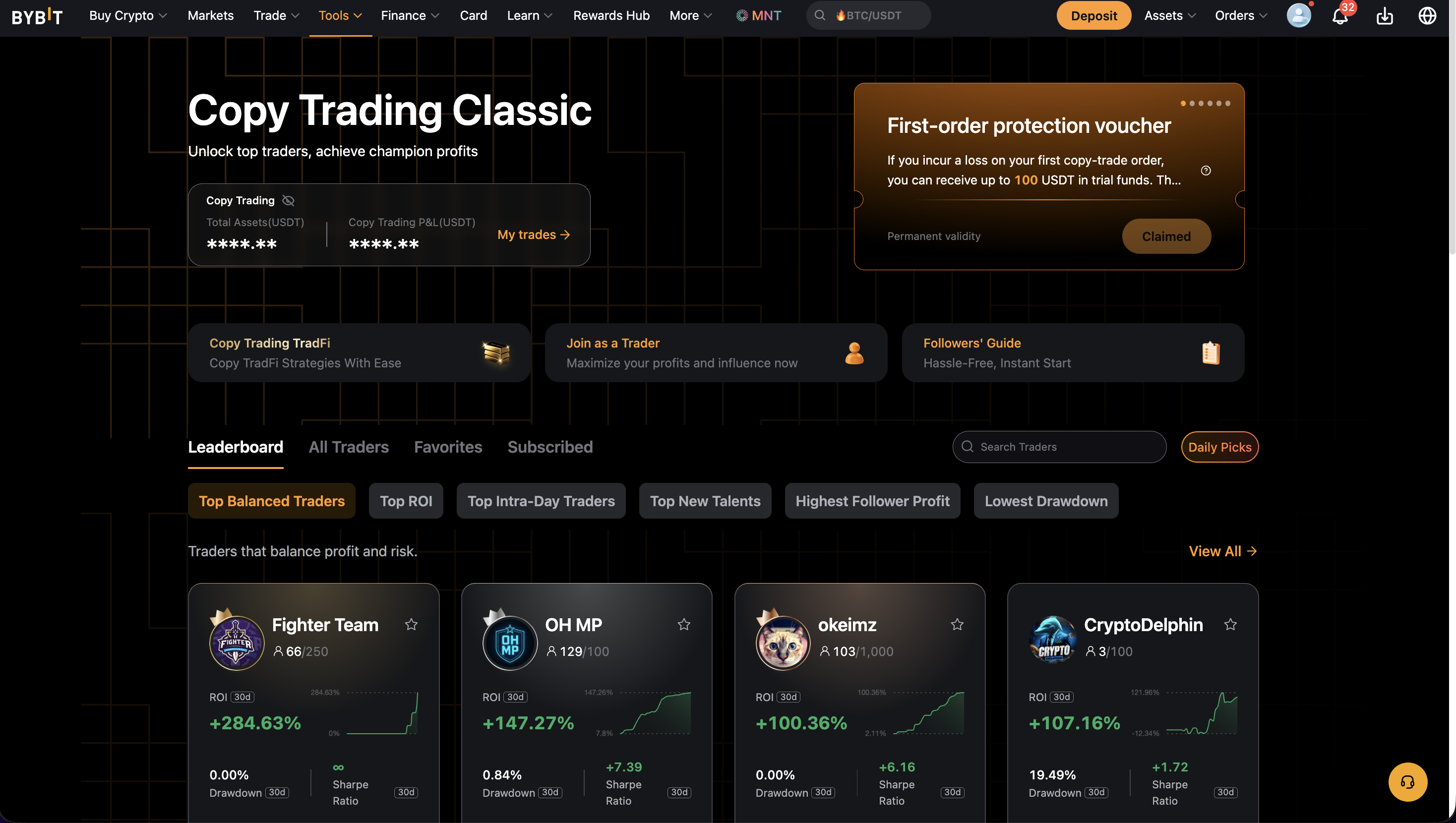
Bybit’s copy trading product is more central to the platform’s positioning and the lead-trader marketplace is more actively curated. The filter set is more sophisticated than KuCoin’s, and the volume of active lead traders is larger.
KuCoin’s copy trading exists and works. The product is functional but is a secondary product behind spot trading and the bot stack. The lead-trader marketplace is smaller, the filter set is less developed, and the discoverability of the product within the broader KuCoin interface is lower.
Honest framing: neither matches BingX or Bitget on copy trading depth. For users whose primary need is copy trading specifically, look at BingX (see our BingX copy trading guide) rather than choosing between KuCoin and Bybit on this dimension. Between these two for users who want copy trading available but not as a primary product, Bybit is the better fit.
Use case: pick KuCoin if
- You need altcoin breadth, particularly outside the top 100
- You want to be early on new listings, accepting more listing-quality variance
- Trading bots are core to your strategy and you do not want to host them yourself
- You value KCS daily-bonus economics on top of standard fees
- You prefer a tiered KYC model where small trading can happen pre-verification
Use case: pick Bybit if
- You trade primarily perpetual futures and need the deepest order book in that category
- Options markets are part of your strategy (Bybit offers BTC/ETH options, KuCoin does not)
- Copy trading is a meaningful part of your workflow (Bybit’s product is more developed)
- You expect to scale to $1M+ monthly volume and want a faster VIP fee curve
- You are comfortable with mandatory KYC from day one
Verdict
For retail traders running spot-heavy strategies with altcoin exposure and active use of trading bots, KuCoin is the better choice in 2026. The combination of altcoin breadth, bot product maturity, and KCS economics suits that profile.
For traders running derivatives-heavy strategies with concentrated positions in liquid assets, options exposure, or active copy trading, Bybit is the better choice. The derivatives depth, the broader product surface, and the more developed copy trading marketplace fit that profile.
Both carry the standard CEX custody risk shape. Both have survived major stress events without user loss. Neither has a meaningful US path. Pick the one whose product surface matches your actual trading workflow rather than treating them as substitutes; they are competitive on different dimensions.
Open KuCoin if altcoin-and-bots is your fit: Register on KuCoin. See the affiliate disclosure for full detail.
Read next
- KuCoin review. Full feature breakdown and scoring.
- KuCoin vs Binance. Adjacent comparison on a different axis.
- KuCoin trading bots. The clearest KuCoin edge in this comparison.
- KuCoin fees explained. Detailed fee math.
- BingX copy trading guide. The right choice if copy trading is your primary need.
- Methodology. How we evaluate platforms.
- Risk disclaimer.
Frequently asked questions
KuCoin or Bybit, which is better for altcoins?
KuCoin. The altcoin selection is materially wider (700+ spot pairs vs ~400 on Bybit), and KuCoin lists smaller-cap tokens months earlier on average. Bybit has the major altcoins everyone wants and tighter liquidity on the ones it lists, but does not match KuCoin on the long tail. If your strategy involves catching new listings, KuCoin wins. If it focuses on top-50 altcoins with the best execution, Bybit is competitive.
Are Bybit fees lower than KuCoin?
On futures, slightly. Bybit's default perpetual taker is 0.055 percent vs KuCoin's 0.060 percent. With BIT discount and KCS discount applied, both come out in the same neighborhood. Spot fees are 0.10 percent maker and taker on both at base. The real fee difference shows at VIP tiers, where Bybit's curve favors high-volume derivatives traders. For typical retail users, the fee gap between the two platforms is small enough that it should not drive the choice.
Is KuCoin or Bybit safer?
Different risk shapes, both inside normal CEX risk bands. KuCoin had the Sept 2020 $281M hot wallet incident (fully recovered, no user loss) and the 2024 CFTC settlement (regulatory, not custody). Bybit had a major early-2025 incident involving a $1.5 billion exploit linked to North Korean threat actor activity, which the platform absorbed via insurance fund and kept user balances whole. Both publish proof of reserves. Neither has had a customer-loss event. Forward-looking, treat them as comparable CEX-tier risk.
Which has better copy trading, KuCoin or Bybit?
Bybit. The copy trading product is more central to Bybit's roadmap and the lead-trader marketplace is deeper and more actively curated. KuCoin's copy trading exists and is functional but is a secondary product behind spot trading and trading bots. For users whose primary motivation is copy trading specifically, neither matches BingX or Bitget on depth and filter sophistication (see our [BingX copy trading guide](/blog/bingx-copy-trading-guide/)), but between these two Bybit is the better choice.
How do KuCoin and Bybit compare on KYC in 2026?
Both tightened materially in 2024 to 2026. Bybit moved to mandatory KYC for most account functions globally; the unverified tier is essentially read-only for new accounts. KuCoin maintains tiered access where unverified accounts can still trade spot in small sizes, but withdrawal limits hit fast (see our [no-KYC 2026 guide](/blog/is-kucoin-safe/) for details). For practical purposes, assume KYC is required on either platform for meaningful trading volume.
Which has more trading products?
Bybit has the broader derivatives surface (perpetual futures across more assets, options, USDT and USDC margined contracts, larger spread of leverage settings). KuCoin has a slightly broader spot pair listing, deeper native trading-bot product, and the KCS token economics layer. For derivatives-first traders, Bybit. For spot-and-bots-first traders, KuCoin.
Are KuCoin trading bots better than Bybit's?
Yes, by a meaningful margin. KuCoin has six native bot types (Spot Grid, Futures Grid, DCA, Smart Rebalance, Infinity Grid, Arbitrage) fully integrated into the trading interface with a public leaderboard. Bybit added native bots in 2023 but the product is less developed, fewer bot types are available, and the configuration UI sits deeper in the menu hierarchy. For automated-strategy users, KuCoin is the better platform.
Can US users use KuCoin or Bybit?
Neither in the unrestricted form. KuCoin geo-blocks US IPs after the 2024 CFTC settlement and there is no US-licensed alternative. Bybit similarly does not serve US users; the platform has been on the SEC's radar without a US-licensed product. For US-based traders, Kraken, Coinbase, or Gemini are the right answer. Both KuCoin and Bybit are widely available outside the US.
#KuCoin#Bybit#comparison#altcoins#derivatives#copy trading
Discussion
Loading comments…