
KuCoin’s fee structure in 2026 is competitive but not the cheapest. The headline rates sit at 0.10 percent spot maker and taker, dropping to 0.08 percent with the KCS discount enabled. Perpetual futures run 0.02 percent maker and 0.06 percent taker at default tier. VIP tiers scale both down based on 30-day rolling volume. KCS economics add a daily bonus on top of the fee discount that can materially shift the math for active users. This guide breaks down every fee category, the math behind the KCS discount, the network costs that dominate withdrawal economics, and the hidden costs that headline fee comparisons miss.
Not financial advice. Fee schedules change. Verify current rates on KuCoin directly before basing a strategy on the numbers below. Holding KCS for the fee discount and daily bonus introduces token price risk independent of the fee math. Read the risk disclaimer before scaling.
Spot trading fees
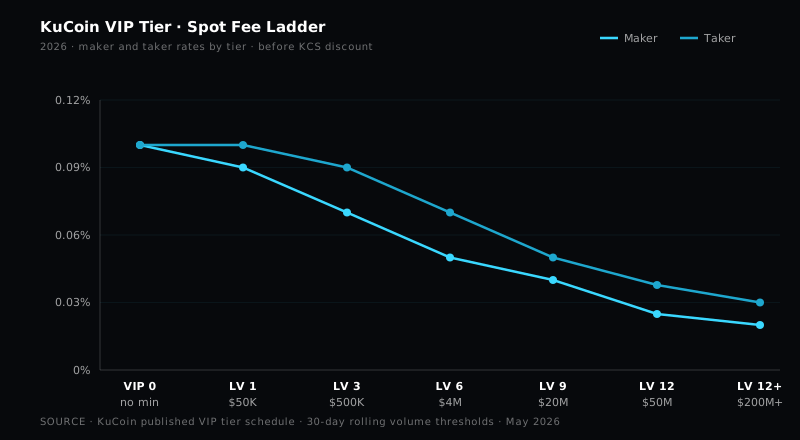
The default schedule and how it changes with KCS and VIP volume:
| Tier | Spot maker | Spot taker | 30-day volume threshold |
|---|---|---|---|
| Default | 0.10% | 0.10% | none |
| Default + KCS toggle | 0.08% | 0.08% | hold any KCS |
| VIP 1 | 0.08% | 0.10% | $50K |
| VIP 1 + KCS | 0.07% | 0.09% | $50K |
| VIP 3 | 0.06% | 0.08% | $1M |
| VIP 5 | 0.045% | 0.075% | $5M |
| VIP 9 | 0.012% | 0.030% | $200M |
Important nuances:
- The KCS discount applies at every tier, not just the default tier. A VIP 3 account with KCS toggled pays approximately 0.048 percent / 0.064 percent rather than 0.06 / 0.08.
- The discount is per-trade, applied automatically once you hold any positive KCS balance and toggle the “Use KCS to pay fees” option in account settings. Most users miss this toggle on first signup.
- KCS to pay fees has to actually deduct from the KCS balance. If your KCS balance hits zero mid-trade, the fee falls back to the non-discount rate.
Futures (perpetual) trading fees
| Tier | Futures maker | Futures taker | Volume threshold |
|---|---|---|---|
| Default | 0.02% | 0.06% | none |
| VIP 1 | 0.018% | 0.05% | $50K |
| VIP 3 | 0.014% | 0.045% | $1M |
| VIP 5 | 0.012% | 0.04% | $5M |
| VIP 9 | 0.000% | 0.027% | $200M |
Notes on futures specifically:
- KCS discount applies to futures fees the same way it applies to spot, with the same 20 percent reduction.
- Funding rate is separate from trading fees. Perpetual contracts pay or receive funding every 8 hours based on the long/short imbalance. On heavily skewed pairs (large long-bias on majors during bull windows), funding can erode position economics more than the trading fee.
- Liquidation has its own fee structure (typically a few basis points of position size) on top of any clearing penalty. Avoid letting positions liquidate; close manually before liquidation triggers.
The KCS discount math
KCS is KuCoin’s native utility token. Two mechanics matter for retail fees:
Fee discount (20 percent). Hold any positive KCS balance in your account, toggle “Use KCS to pay fees” in account settings, and your maker and taker fees drop by 20 percent across spot and futures. This is the headline benefit.
Daily bonus. Hold at least 6 KCS in your account and you become eligible for the daily bonus, distributed in USDT equivalent from a share of platform trading revenue. The exact yield varies day to day. Annualized yields in 2026 typically run between 1 and 4 percent on retail holding sizes.
The math for a retail trader running $50K monthly volume:
- Without KCS: $50,000 × 0.10% × 2 = $100 monthly in fees
- With KCS discount: $50,000 × 0.08% × 2 = $80 monthly in fees
- Savings: $20 per month, $240 per year
To capture that savings you need to hold some KCS, and KCS price is volatile. A 30 percent drawdown on $1,000 of KCS held all year ($300 loss) wipes out the fee savings entirely. The break-even calculation depends on volume, KCS holding size, and KCS price stability over the holding period.
For a trader running $1M monthly volume the math changes:
- Without KCS at VIP 3: $1,000,000 × 0.06% × 2 = $1,200 monthly
- With KCS at VIP 3: $1,000,000 × 0.048% × 2 = $960 monthly
- Savings: $240 per month, $2,880 per year
At that scale the discount alone justifies KCS exposure for many users, and the daily bonus stack adds further.
Honest framing: the KCS discount is mathematically meaningful for active traders and effectively negligible for occasional users. Run your own monthly fee number against your KCS holding size before treating the discount as free.
Withdrawal fees by network
Network gas dominates withdrawal economics. The relevant comparison for USDT, the most common withdrawal asset:
| Network | Typical USDT withdrawal fee | Notes |
|---|---|---|
| Tron (TRC20) | 1 USDT flat | Cheapest meaningful rail, fast confirmation |
| Solana | ~1 USDT | Fast, low cost when network not congested |
| Polygon | ~1 USDT | Cheap, slightly slower than Tron |
| BNB Smart Chain | ~1 USDT | Cheap, less common path |
| Arbitrum | 1-3 USDT | Depends on Ethereum gas |
| Ethereum (ERC20) | 5-20 USDT | Spikes above 20 during congestion |
Critical guidance: always confirm the network on both ends (the address you are sending to and the network selected in the KuCoin withdrawal dropdown) before submitting. Wrong-network withdrawals are the single most common source of user-error fund loss across every CEX.
For BTC withdrawals, expect 0.0002-0.0005 BTC depending on mempool conditions. For ETH withdrawals on mainnet, expect 0.003-0.01 ETH at current gas. KuCoin updates the network fee dynamically.
Hidden costs that headline comparisons miss
Three categories of cost that get ignored in spreadsheet fee comparisons:
Spread and slippage on thin altcoin pairs. On BTC/USDT the spread sits around 1 basis point and slippage on a $10,000 market order is minimal. On a mid-cap altcoin pair the spread can be 10-50 basis points and a $10,000 market order can move the printed price by half a percent. The “trading fee” is 0.10 percent; the spread plus slippage cost can easily be 50 basis points or more. This is the largest hidden cost for altcoin-focused traders.
The in-app Convert feature. KuCoin offers a one-click crypto-to-crypto convert tool that hides the spread inside the quoted rate. The convert rate typically runs 50 to 100 basis points above the spot market rate for the pair. For any conversion above $100 of value, use spot trading instead.
Dual investment and structured yield. These products are marketed as yield enhancements but are option-like payoff structures. The headline yield assumes the underlying lands inside a specific price band; outside that band you get worse-than-spot economics. Read the payoff structure before allocating capital; don’t treat them as “yield products” alongside staking.
VIP volume thresholds and how to climb them
The 30-day rolling volume calculation:
- Combines spot and futures volume into a single number
- Includes trades from KuCoin trading bots (Spot Grid, Futures Grid, DCA, etc.)
- Excludes convert and dual-investment volume
- Updates approximately every 4 hours
The non-obvious lever: bot trades count toward VIP volume. A Spot Grid configuration on a major pair running 24/7 can accumulate $50K-$200K of monthly volume on a $5K allocation, often pushing the account into VIP 1 or higher even when the account holder is not actively trading manually. We cover the bot side in detail in the KuCoin trading bots guide.
For users who want to climb tiers deliberately:
- VIP 1 ($50K monthly): achievable with a single active Spot Grid configuration on BTC/USDT or ETH/USDT.
- VIP 3 ($1M monthly): requires either institutional-scale manual trading or multiple bot configurations running in parallel.
- VIP 5 ($5M monthly): institutional volume; not a retail target.
Fee comparison vs Binance, Bybit, OKX
At retail volume without token discounts:
| Platform | Spot maker | Spot taker | Futures maker | Futures taker |
|---|---|---|---|---|
| KuCoin | 0.10% | 0.10% | 0.02% | 0.06% |
| Binance | 0.10% | 0.10% | 0.02% | 0.04% |
| Bybit | 0.10% | 0.10% | 0.02% | 0.055% |
| OKX | 0.08% | 0.10% | 0.02% | 0.05% |
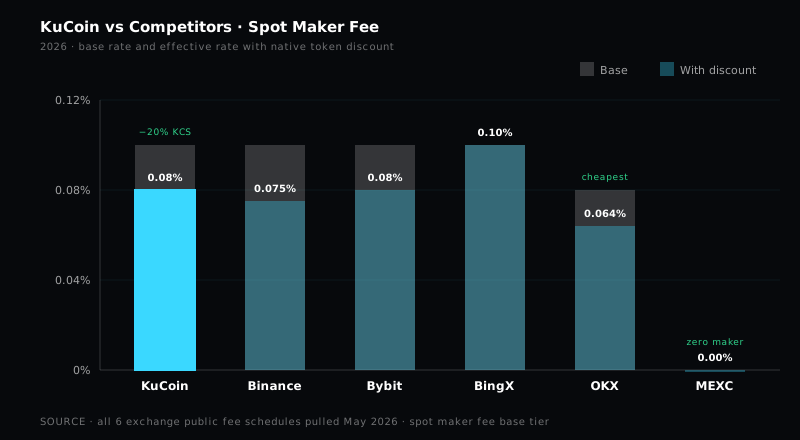
With native token discounts applied (BNB 25 percent, KCS 20 percent, BIT comparable):
| Platform | Effective spot | Effective futures taker |
|---|---|---|
| Binance | 0.075% | 0.040% |
| KuCoin | 0.08% | 0.06% (no discount on futures taker base) |
| Bybit | ~0.08% | ~0.05% |
| OKX | ~0.07% | ~0.04% |
Binance with BNB is the cheapest at retail volume. KuCoin is slightly more expensive on futures taker but adds the KCS daily bonus as a separate yield component. For pure fee minimization at retail scale, Binance wins. For the bundled product (fees plus KCS yield plus bot stack), KuCoin can come out ahead depending on activity profile.
Detailed comparison in our KuCoin vs Binance head-to-head.
When KuCoin fees are unbeatable, and when they are not
Unbeatable when:
- You are running active Spot Grid bots that generate VIP-tier volume while you hold KCS for the daily bonus on top
- Your strategy is altcoin-heavy and KuCoin lists pairs Binance does not (no fee comparison if the alternative is no access)
- You value the KCS daily bonus as a yield stream alongside fee savings
Not unbeatable when:
- You trade primarily BTC/ETH and high-volume futures (Binance wins on raw taker rate)
- Your monthly volume is low enough that the KCS price risk outweighs the discount savings (under approximately $20K monthly)
- You do not want token price exposure as a precondition for fee savings
What to do today
If you have a KuCoin account and have not enabled the KCS toggle:
- Buy a small amount of KCS (a single KCS unit is sufficient to activate the discount; 6 KCS unlocks the daily bonus on top)
- Go to account settings, find “Use KCS to pay fees”, toggle on
- Verify on your next trade that the fee shown deducts from KCS balance rather than the traded asset
If you do not have a KuCoin account and want to set one up with the affiliate referral pre-filled:
Sign up: Register on KuCoin with referral code
CXEBGAS3applied.
The signup uses email or wallet only at the first step. KYC is not required to start, though it will be required for higher withdrawal limits and full futures access (see our no-KYC 2026 guide for the current reality).
Read next
- KuCoin review. Full feature breakdown including fees in context.
- KuCoin vs Binance. Head-to-head with detailed fee comparison.
- KuCoin trading bots. How bot trades drive VIP volume.
- KuCoin no-KYC 2026. What still works without full verification.
- Methodology. How we evaluate platforms.
- Risk disclaimer.
Frequently asked questions
What are KuCoin's spot trading fees in 2026?
Default spot fees are 0.10 percent maker and 0.10 percent taker. Activating the KCS fee discount (holding any KCS in your account and toggling 'Use KCS to pay fees') lowers both sides to 0.08 percent. VIP tiers reduce fees further based on 30-day rolling volume, with VIP 5 reaching approximately 0.045 percent maker / 0.075 percent taker on spot.
Are KuCoin's futures fees competitive?
At default tier, perpetual futures cost 0.02 percent maker and 0.06 percent taker. This is competitive with Binance (0.02 / 0.04) but slightly worse on taker. With VIP volume the taker rate drops faster than Binance's curve at the high end, but at retail volume the headline taker fee on KuCoin futures runs 2 basis points above Binance. For active futures traders that gap matters; for occasional users it does not.
How does the KCS daily bonus work?
Hold at least 6 KCS in your KuCoin account and you become eligible for the daily bonus, distributed in USDT equivalent from a share of platform trading revenue. The exact yield varies day to day with platform volume and KCS price. Annualized yields in 2026 typically run between 1 and 4 percent on retail holding sizes. The bonus is paid daily, not locked, and you can adjust your holding any time. The catch is KCS price risk: the bonus only nets positive if you would hold KCS anyway as a speculative position.
What is the cheapest network to withdraw USDT from KuCoin?
Tron is the cheapest meaningful path, typically 1 USDT flat. Polygon and Solana are alternative cheap rails when available. Ethereum USDT can spike above 10 USDT during high-gas periods. Always confirm the network on both sides (sender wallet and receiving address) before sending; wrong-network withdrawals are the most common user-error fund loss across every CEX.
Do KuCoin VIP tiers count both spot and futures volume?
Yes. The 30-day rolling volume calculation combines spot and futures volume into a single number used for tier qualification. This means an active futures trader can drive VIP tier upgrades that benefit their spot fees and vice versa. Bot trades count toward the same calculation, which is one of the strongest non-obvious arguments for running Spot Grid bots on major pairs (see our [trading bots guide](/blog/kucoin-trading-bots/)).
Are there hidden costs on KuCoin beyond the trading fees?
Three meaningful ones. First, spread and slippage on thin-liquidity altcoin pairs can dwarf the headline trading fee on positions above a few thousand dollars. Second, conversion fees on the in-app crypto-to-crypto convert feature can run 50 to 100 basis points above the market price, depending on the pair; use spot trading for any non-trivial conversion. Third, dual investment and structured yield products carry option-like risk that can manifest as a loss disguised as a 'lower yield' outcome.
How do KuCoin fees compare to Binance and Bybit?
At base tier without any token discount, all three are essentially tied at 0.10 percent spot. With native token discounts: BNB at 25 percent off brings Binance to 0.075 percent (cheapest), KCS at 20 percent brings KuCoin to 0.08 percent, BIT discount brings Bybit to a comparable level. On perpetual futures, Binance has a slight taker-rate edge at retail volume. For VIP-tier institutional volume, Binance and OKX scale fees down faster than KuCoin. For typical retail volume the difference is small enough to ignore.
Is KuCoin still worth using just for the fees?
No. Fee structure alone does not justify the choice. KuCoin makes sense for its altcoin breadth, native trading bots, and KCS daily bonus economics. If pure fee minimization is the goal, Binance (with BNB) is slightly cheaper at retail volume. The platform's value sits in product fit, not in being the absolute cheapest fee schedule.
#KuCoin#fees#KCS#VIP#withdrawal#guide
Discussion
Loading comments…