
KuCoin’s trading-bot product is the platform’s clearest edge over Binance, Bybit, and most peer exchanges. Six native bot types run server-side, integrated into the main trading view, with a leaderboard exposing top community configurations. The product is mature, retail-friendly, and meaningfully different from the “we also have bots” feature that competitors retrofitted into existing platforms. It is also misused at scale, primarily through the leaderboard’s survivor-bias trap and through users picking bot types that do not match the market regime. This guide walks the six bots, what each is good for, how the leaderboard tricks new users, and what actually kills bot strategies in 2026.
Not financial advice. Bot strategies are not zero-risk. Range-bound assumptions break in trending markets, futures grids liquidate on sharp moves, and survivor bias on public leaderboards is real. Read the risk disclaimer before allocating material capital.
The six KuCoin bots at a glance
| Bot | What it does | Best for | Worst case |
|---|---|---|---|
| Spot Grid | Buys low, sells high within a defined price range | Range-bound major pairs | Price exits range; bot stops trading |
| Futures Grid | Same mechanic on perpetual futures, with leverage | Range-bound futures, sized position | Liquidation if leverage too high |
| DCA | Buys a set amount at regular intervals or price triggers | Accumulating an asset you want regardless of price | Asset trends down for the entire DCA window |
| Smart Rebalance | Maintains target portfolio weights across multiple assets | Multi-asset portfolios with periodic rebalancing | Whipsaw losses if assets are highly correlated |
| Infinity Grid | Spot Grid with no upper bound; sells on the way up | Long-term position in an asset you expect to trend up slowly | Strong uptrend converts your crypto position back to USDT |
| Arbitrage | Captures price differences between related markets | Niche, requires depth on both legs | Spread compresses faster than fees can cover |
The first three (Spot Grid, Futures Grid, DCA) cover most retail use cases. The remaining three serve specific scenarios that benefit experienced users.
The leaderboard trap
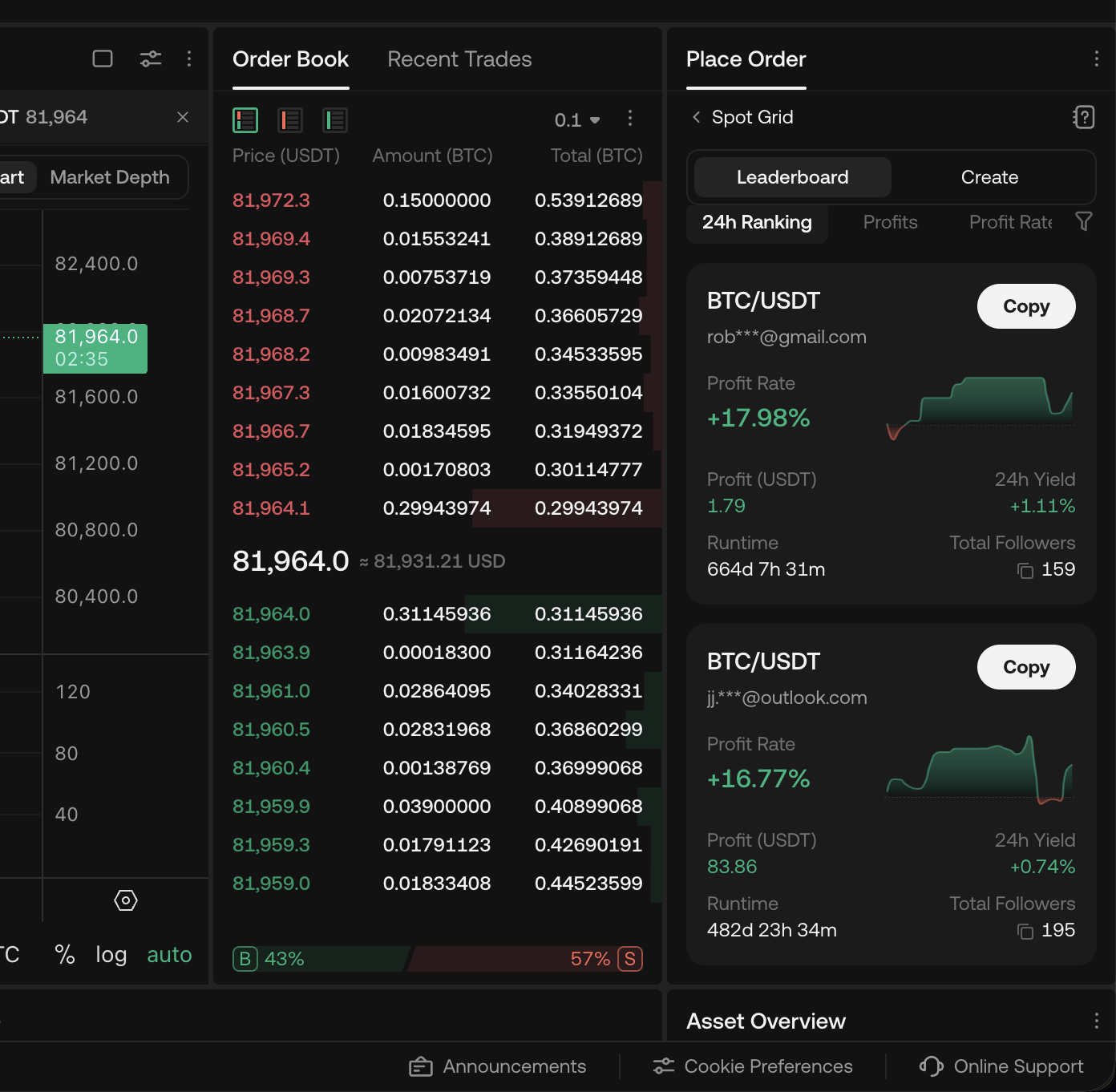
KuCoin exposes a public leaderboard of community-built bot configurations, sortable by 24-hour yield, runtime, and copier count. The default sort is by 24-hour yield. This is the trap.
Sort by 24-hour yield and the top of the list is structurally the bots that caught one favourable move in the last day. Many of these configurations have been alive for less than a week. Most will regress to the mean within the next 30 days. Some will turn negative as the regime that produced the headline yield ends.
The correct way to read the leaderboard:
- Sort by runtime first. Filter to configurations that have been alive at least 30 days. This eliminates the freshest survivors.
- Inspect the price-range setting against the asset’s current price. A configuration whose range no longer brackets the current price is not actively trading; the historical yield is irrelevant to your decision now.
- Look at the drawdown column, not only yield. A bot that returned 8 percent with a 40 percent drawdown is not the same risk-adjusted product as a bot that returned 6 percent with a 12 percent drawdown.
- Check the copier count and the configuration creator’s history. A configuration with 5,000 copiers and a creator who has been running bots for two years is meaningfully different from a configuration with 12 copiers and a one-week-old account.
Apply these filters and the top of the actual useful list looks nothing like the default leaderboard view. Start with the small allocation; size up only if the actual fill quality matches the historical results.
Spot Grid: the entry-level bot
Spot Grid is what most users should start with. The mechanic is simple: define a price range, define the number of grid lines, allocate USDT. The bot places buy orders at each grid line below the current price and sell orders above. When the price moves, orders fill, and the bot re-places the opposite-side order at the same line. Profit comes from the spread between buy and sell on each grid level.
Configuration anchors:
- Asset selection. Major pairs (BTC/USDT, ETH/USDT, SOL/USDT) have the liquidity and spread profile that grid bots work well on. Low-cap altcoins with wide spreads and thin order books eat the entire grid yield in slippage. Stick to the top 30 by liquidity until you have a specific reason to deviate.
- Price range. Set a range that brackets the typical volatility window for the asset, not the whole 12-month chart. A common error is setting too wide a range, which spreads the grid lines too far apart and reduces the number of profitable fills per cycle.
- Grid count. More grid lines means more fills but each fill has smaller profit. The fee math matters: at 0.08 percent per leg with KCS discount, a tight grid with many lines can yield-grind itself flat. Start with 30 to 80 grid lines for major pairs.
- Stop-loss handling. Spot Grid does not liquidate, but if price exits the range you stop earning. Decide in advance whether you re-set the range manually or accept the bot has done its job and stops.
Spot Grid is most profitable in choppy, range-bound markets. In strong uptrends it underperforms holding the underlying. In strong downtrends it accumulates the asset on the way down (which is what you want if you wanted to be long the asset) but the open position can sit on a paper loss for a long time.
Futures Grid: same idea, real liquidation risk
Futures Grid runs the same grid mechanic on perpetual futures with leverage. The headline yields look much higher because the leverage amplifies the percentage return on margin. The risk profile is meaningfully different from Spot Grid.
Key differences:
- Liquidation is real. If price moves against your position past the maintenance margin, the bot’s open position liquidates and the strategy is over. Spot Grid has no liquidation; the worst case is “bot stops trading.”
- Funding rate matters. Perpetual futures pay funding every few hours based on the long/short imbalance. A grid bot holding a directional bias for a long period eats or earns funding. On heavily long-biased markets, funding can erode grid yield significantly.
- Margin sizing. The mistake new users make is sizing the grid based on the headline allocation, not on the leverage-adjusted exposure. A 10x Futures Grid with $1,000 of margin has $10,000 of exposure. Treat the position size as the exposure, not the margin.
Realistic guidance: start with 2x or 3x leverage on Futures Grid, not the maximum the platform allows. Use the same range and grid-count discipline as Spot Grid. Monitor the liquidation price actively in the first week.
DCA, Smart Rebalance, Infinity, Arbitrage
The remaining four bot types serve narrower scenarios.
DCA Bot. Buys a defined amount at regular intervals or on price triggers. This is the simplest disciplined-accumulation strategy: pick the asset, pick the cadence (daily, weekly, or per-percent-drop), allocate USDT. DCA works for users who want to accumulate an asset they have a long-term thesis on without trying to time entries. The bot is not generating alpha; it is executing a discipline. The benefit is exactly that it removes the user from the timing decision.
Smart Rebalance. Maintains target weights across a multi-asset portfolio. Set the assets, set the target percentages, set the rebalance trigger (time-based or deviation-based). When one asset’s weight drifts past the trigger, the bot sells some of it and buys the underweight assets. This works well in portfolios where the assets are not highly correlated; works poorly when all your assets are tech-correlated and move together.
Infinity Grid. Spot Grid with no upper price bound. The bot keeps adding sell orders as price moves up, converting more of your crypto position back to USDT. This is appropriate when you want to harvest volatility on an asset you do not expect to moon, or when you want to gradually de-risk an existing long position. Not appropriate as a generic “growth” strategy; if the asset trends strongly up, Infinity Grid will sell you out of most of your position at progressively higher prices and leave you under-allocated at the next pullback.
Arbitrage. Captures price differences between related markets (typically between spot and futures on the same asset, or between two perpetual contracts). Lower yield, lower risk than directional bots, but requires meaningful capital to overcome fees. Realistic yields in 2026 sit in low single digits annualised after fees on the major pairs. Niche product for users who want a near-market-neutral allocation.
Fees and the VIP volume question
Bot trades count toward your 30-day rolling VIP volume the same way manual trades do. This is the strongest non-obvious argument for running Spot Grid on a major pair: the bot generates VIP-relevant volume that brings down your fees on everything else you trade on the platform, including manual entries.
The math at default fees (0.10 percent per leg, 0.08 percent with KCS):
- A Spot Grid configuration on BTC/USDT with 50 grid lines and modest volatility can rack up $50,000 to $200,000 of monthly volume on a $5,000 allocation.
- That volume puts the account at VIP 1 (50K threshold) or higher.
- VIP 1 brings spot fees to 0.08 percent maker / 0.10 percent taker (or lower with KCS); the effective savings compound across the rest of the trading on the account.
This argument breaks down on tight grids where the fee compounds against you. Run the math: total daily volume times two times your per-leg fee, divided by your allocation, should give a daily fee drag that you can compare against the bot’s daily yield. If fees are eating 30 percent or more of yield, the grid is too tight.
What kills bot strategies
Five recurring failure modes we see across KuCoin bot users:
- Wrong asset. Low-cap altcoins with wide spreads, frequent listings and delistings, and thin order books. Grid bots need liquidity and predictable volatility. Stay top-30 unless you have a clear thesis.
- Wrong range. Setting a price range that does not bracket the asset’s actual volatility window. The bot exits the range early, stops trading, and the user discovers the strategy never had a chance to compound.
- Fee math ignored. Tight grids on a 0.10 percent fee structure can lose to fees before they ever turn a profit. Run the daily fee drag math before deploying.
- Futures Grid over-leveraged. Running 10x or 20x on Futures Grid in a market that has not moved sharply in the user’s testing window. The first sharp move liquidates the position, the strategy ends, the historical “yield” was on borrowed time.
- Leaderboard following. Copying the top 24h yield configuration. By the time it is at the top, the market regime that produced the yield is usually ending. The configuration regresses; the copier underperforms what the leaderboard advertised.
The first three are user-side discipline failures. The fourth is leverage-management. The fifth is structural: the same survivor bias that kills copy-trading marketplaces also kills bot leaderboard chasers.
KuCoin bots vs the alternatives
| Platform | Strengths | Weaknesses |
|---|---|---|
| KuCoin | Six native bot types, integrated UI, leaderboard, VIP volume credit | Centralised exchange custody risk |
| Binance | Spot Grid, Futures Grid, DCA available | UI sits deeper in menu, configuration less polished, less variety |
| Bybit | Bots launched in 2023, growing | Feels grafted on, smaller community of public configurations |
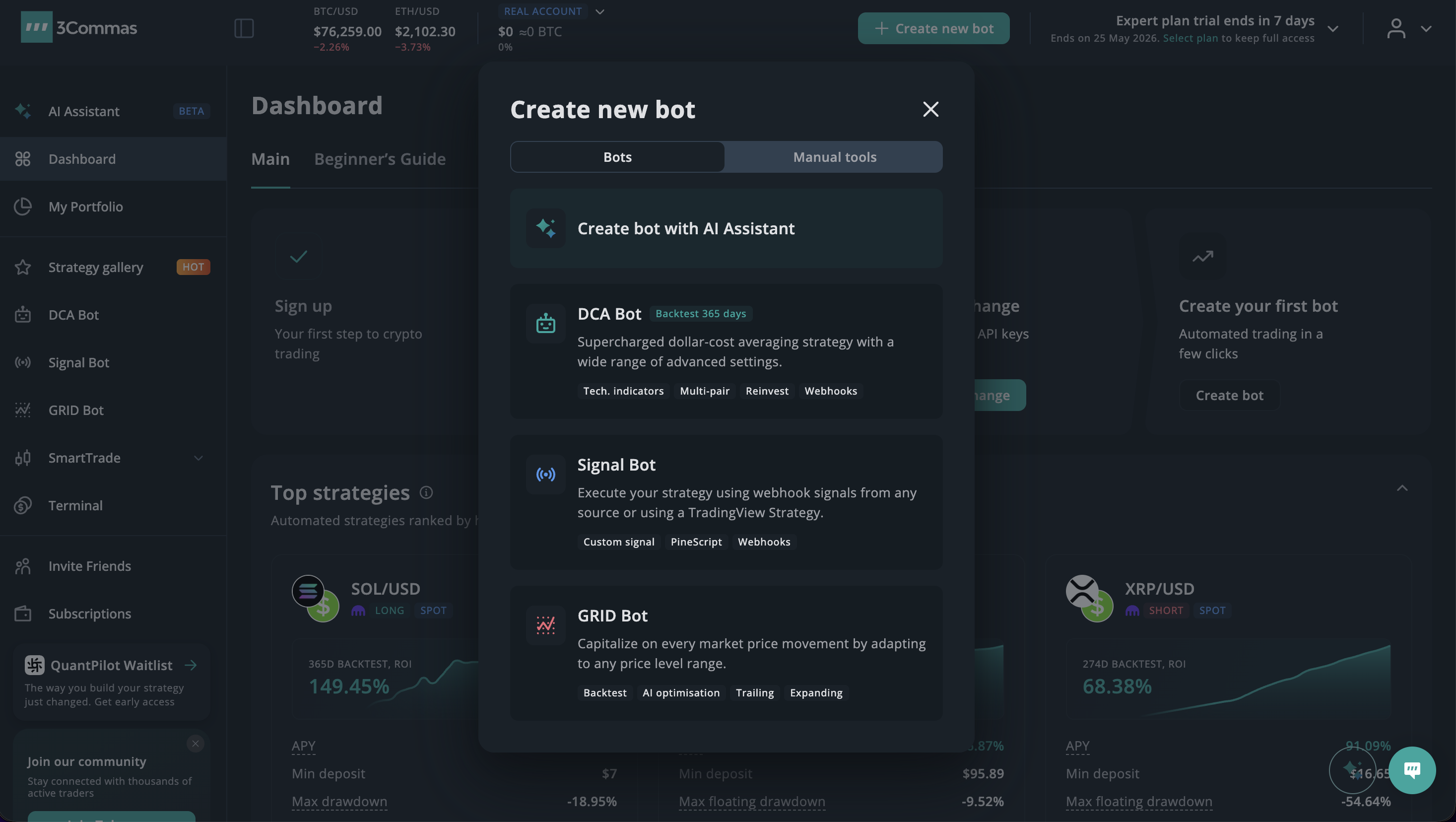
| 3Commas | Multi-exchange unified bot layer, more advanced strategy options | Subscription cost, API-key surface area, requires you to run on exchanges with weaker native UX |
| Hyperliquid | DEX-side bot ecosystem growing | Onchain perpetuals only, no spot |
For most retail users, KuCoin’s native bots are the right answer. The product is mature enough that the marginal value from a third-party layer like 3Commas is small, and the cost (subscription, API-key risk) is real. Move to 3Commas when you need multi-exchange execution that KuCoin cannot provide internally.
When KuCoin bots are not the right answer
- You want to trade only on a DEX. Hyperliquid’s bot ecosystem is the alternative for onchain perpetuals.
- You want a fully automated multi-exchange strategy. 3Commas or a custom layer over the exchange APIs.
- You want copy-trading exposure rather than bot exposure. Read our BingX copy trading guide for the strongest CEX copy product.
- You are uncomfortable with custodial risk on KuCoin specifically. See our is KuCoin safe article for the full risk decomposition.
For everyone else, the KuCoin bot stack is the strongest single-platform product in this category in 2026, and it is the main reason we score the platform highly on retail-tool maturity in the pillar review.
Open KuCoin to access the bot stack: Register on KuCoin. See the affiliate disclosure for full detail.
Read next
- KuCoin review. Full feature breakdown including bots as the score driver.
- KuCoin vs Binance. Head-to-head where bots are the clearest KuCoin edge.
- Is KuCoin safe. Risk decomposition before allocating bot capital.
- BingX copy trading guide. Alternative if your real need is copy-following, not automated execution.
- Methodology. How we evaluate platforms.
- Risk disclaimer.
Frequently asked questions
Which KuCoin trading bot is the best for beginners?
Spot Grid in a range-bound major pair (BTC/USDT or ETH/USDT). It is the simplest mechanic to understand, runs server-side with no hosted infrastructure required, and the worst-case loss is bounded by the price range you set. Avoid Futures Grid until you understand how liquidation works at the leverage you choose. Avoid Infinity Grid in your first month because it sells more on the way up and can leave you with a smaller crypto position at the wrong time.
Do KuCoin bot trades count toward VIP volume tiers?
Yes. Bot trades count toward your 30-day rolling volume the same way manual trades do, which is the strongest fee-tier argument for high-frequency Spot Grid strategies. A grid running on BTC/USDT with 50 to 100 grid lines and modest volatility can rack up VIP-relevant volume on positions that are not large in dollar terms. KuCoin does not publish a bot-specific fee schedule; standard VIP tiers apply.
Are KuCoin bot leaderboard results reliable?
Treat them like centralised exchange copy-trading leaderboards: structurally over-represented by survivor bias. Top-ranked bot configurations are visible after the fact, which makes the headline 24h yield figures look better than they will perform for new copiers. Filter by runtime (favour configurations alive 30+ days), look at drawdown not only yield, and start with allocation sizes you can lose without changing your trading style. The top of the leaderboard is rarely the right configuration to copy.
What is the difference between Spot Grid and Infinity Grid?
Spot Grid runs in a price range you define and buys low, sells high, within that range. If price exits the range, the bot stops trading. Infinity Grid has no upper price bound and keeps adding sell orders as price moves up, which means it is selling crypto on the way up and converting your position back to USDT. Infinity is appropriate when you do not have a strong conviction the asset will mean-revert; Spot Grid is appropriate when you expect range-bound behaviour.
Can I run KuCoin bots without KYC?
Mostly yes. Bot creation and execution are available at the unverified tier in 2026. Where verification matters is withdrawal volume above the practical cap and futures access (Futures Grid often requires Basic verification). For the read-only honesty on what still works without full KYC, see our [no-KYC 2026 guide](/blog/is-kucoin-safe/).
Do KuCoin bots make money?
Yes and no. In range-bound markets, well-configured grid bots accumulate fees from volatility and net positive on the underlying. In trending markets, grids underperform a buy-and-hold position on the same asset because they convert exposure to USDT on the way up. DCA bots make money on volatile assets the user already wants to accumulate. None of these strategies generate alpha by themselves; they execute a discipline that the user could in principle execute manually but typically does not.
How do KuCoin bots compare to Binance, Bybit, and 3Commas?
KuCoin has the deepest native bot product on the major CEX side. Binance has Spot Grid and DCA but the UI sits deeper in the menu and the configuration is less polished. Bybit added bots in 2023 and the product feels grafted on. 3Commas is the third-party heavyweight that bridges multiple exchanges with a unified bot layer, more powerful for advanced strategies but adds subscription cost and an API-key surface. Most retail users are better served by KuCoin's native bots than by a third-party layer until they have a clear reason to need cross-exchange execution.
What kills bot strategies on KuCoin specifically?
Five recurring failures. First, choosing the wrong asset (low liquidity, wide spreads, frequent listings/delistings). Second, setting price ranges that exit on the first volatility cycle. Third, ignoring exchange fees in the math; even at 0.08 percent with KCS discount, a high-grid-count configuration eats into yield. Fourth, running Futures Grid at leverage that survives only smooth markets and liquidates on the first sharp move. Fifth, treating the leaderboard as truth; configurations at the top of 24h yield are statistically the ones most likely to regress to the mean.
#KuCoin#trading bots#grid bot#DCA#automation#tool review
Discussion
Loading comments…