
Verdict: yes, with four risks worth understanding before depositing. KuCoin in 2026 has a strong operational record since the September 2020 hot wallet recovery and survived the 2024 CFTC settlement without freezing any user balance. It is a centralized custodial exchange, so it carries the standard category of CEX risk on top of the platform-specific story. This is a focused safety review, not a feature breakdown. For full scoring read the KuCoin review; for KYC specifics read the no-KYC 2026 guide. Here we walk through every material way you could lose money on KuCoin, ranked by realistic frequency.
Not financial advice. Crypto trading is high risk. Custody on any centralized exchange is a non-zero risk regardless of operating history. Verify what is legal in your jurisdiction before depositing. Read the risk disclaimer before scaling capital.
The short answer
KuCoin in 2026 is operationally safer than most centralized crypto exchanges in three specific dimensions (post-incident response track record, proof-of-reserves cadence, hack-event recovery without user loss), and operationally riskier in two (less regulatory coverage than Binance, Kraken, or Coinbase; greater listing-quality variance from the long-tail altcoin focus). If you use KuCoin as a trading venue and move material holdings to self-custody, the platform sits well inside the normal-CEX risk band. If you treat it as a long-term holding venue or expect US-licensed-grade regulatory clarity, you will be uncomfortable.
The four risks worth knowing, ranked by how often they actually bite users:
- Listing risk on long-tail altcoins. Rug-pulls and delistings on low-cap tokens.
- User-side security failure. Phished credentials, SIM swap, weak 2FA.
- Regulatory access change. Country added to the restricted list, account migration friction.
- Smart-contract risk on KuCoin Wallet (DeFi side). Relevant only if you use the Web3 wallet for on-chain DeFi.
What is not on this list is platform-level theft, operator failure, or a withdrawal freeze. None has happened, and the architecture plus track record makes the first two structurally hard.
Has KuCoin been hacked?
Yes, once at scale, six years ago. The September 2020 hot wallet exploit drained approximately $281M in BTC, ETH, and ERC-20 tokens via a private-key compromise. The post-mortem pointed to a leaked operational credential, not a smart-contract bug or a fundamental architecture flaw.
What happened next is the part that matters going forward. Within 24 hours KuCoin coordinated with token issuers to invalidate large portions of the stolen supply, contracted chain-analytics firms to track and freeze direct theft, and topped up the remaining balances from corporate reserves. No user lost funds. The post-mortem produced concrete operational changes:
- Tighter hot wallet limits (smaller portion of total reserves held in any one hot wallet)
- Faster cold storage rotation cadence
- Multi-sig on operational withdrawal flows
- Insurance fund accumulation from platform revenue
The aggregate result: no comparable custody incident has occurred since. Five-plus years of operational stress (the 2021 bull market peak, the 2022 FTX cascade, the 2023 bank-failure cycle, the 2024 CFTC enforcement push) have not produced another hot wallet event. Past performance is not a guarantee but it is a meaningful data point on the platform’s incident-response and security-engineering capability.
Custody and counterparty risk
KuCoin is a centralized custodial exchange. Funds deposited to your KuCoin address are held by KuCoin’s hot and cold wallet infrastructure under platform control until you withdraw. This is the same model as Binance, Coinbase, Kraken, Bybit, and every other CEX. The risk shape:
- Hot wallet compromise. Mitigated by smaller hot wallet allocations, cold storage majority, multi-sig. Realistic but historically recovered without user loss on KuCoin (2020 incident).
- Cold wallet compromise. Extraordinary event. Has never happened at scale on KuCoin or its peer set. Defense relies on physical and operational security.
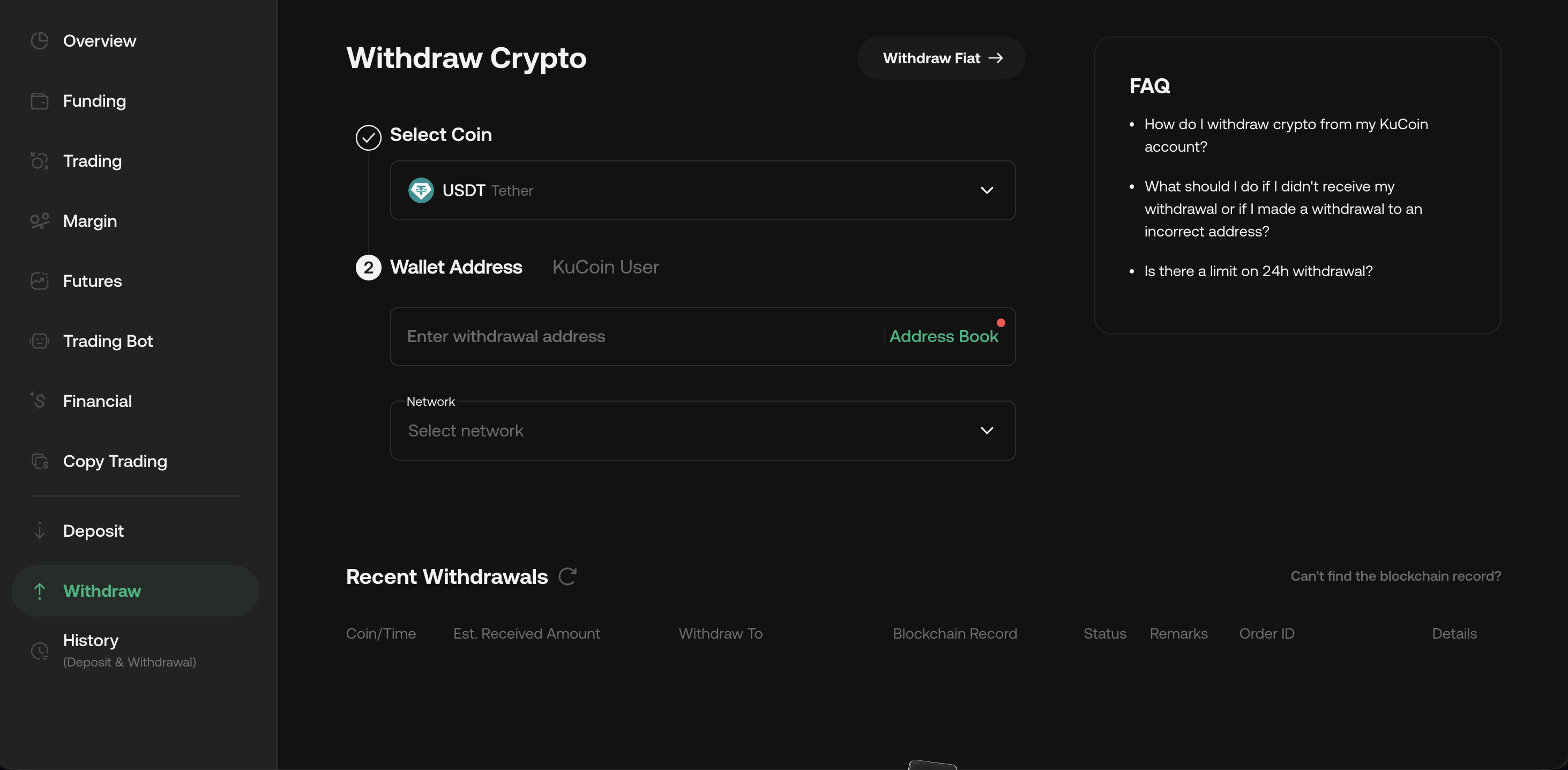
- Operator failure. The FTX category. Has not happened on KuCoin. The platform did not commingle user funds at the level FTX did. Proof of reserves is the public attestation of the wall between user balances and corporate balance sheet.
- Withdrawal suspension under stress. Has not happened on KuCoin even during the 2020 incident or the 2024 CFTC settlement aftermath. Withdrawals continued through both stress events.
The realistic forward-looking probability of a platform-level custody failure is low but non-zero. This is the same statement true for any CEX. The standard mitigation applies: do not park position-style holdings on the platform; use it as a trading venue and an active yield surface, not as cold storage.
Proof of reserves and the trust stack
KuCoin publishes Merkle-tree proof-of-reserves attestations on a regular cadence covering main wallet balances against aggregated user liabilities. The methodology adopts the same shape that most major centralized exchanges adopted in the 2022-2023 post-FTX trust-reset cycle: snapshot user balances, compute Merkle root, publish a tree that each user can independently verify against their own balance.
What proof of reserves verifies:
- The exchange held at least X of asset Y at the snapshot moment
- Aggregated user liabilities on the platform sum to at most that X
What proof of reserves does not verify:
- Off-chain liabilities (loans, debts, future commitments)
- Encumbrances on the wallet contents (collateral pledges, lock-ups)
- Continuity between snapshots (a brief solvent moment for the snapshot does not prove ongoing solvency)
- Source of the reserves (could be borrowed for the snapshot)
Treat the attestations as a meaningful but partial trust signal. KuCoin’s specific implementation has not been independently audited for the off-chain liability picture. The same caveat applies to most peer CEX implementations.
Regulatory risk
The 2024 CFTC settlement is the defining regulatory event of the past two years. KuCoin agreed to civil terms over operating an unregistered derivatives venue serving US users. The visible aftermath:
- US users were geo-blocked at signup. Existing US accounts went through forced offboarding.
- KYC tightened globally. The famous 5 BTC per day no-KYC withdrawal limit was retracted (see our no-KYC 2026 guide for the current reality).
- Transaction monitoring upgrades shipped.
- A long-term compliance commitment was added to the platform’s roadmap.
The settlement was regulatory rather than custodial. KuCoin did not lose user funds, did not suspend withdrawals, and did not face criminal charges against leadership. The shape is comparable to the OKX February 2025 DOJ deferred prosecution agreement (covered in our OKX review) but smaller in scale and without the public fine figure disclosed.
The forward-looking regulatory risk is that the geographic footprint continues to narrow. Several jurisdictions (Canada, Ontario specifically, UK derivatives, parts of the EU) have tightened. Russia and a few other regions sit in a soft-block state with partial functionality. A user whose country is currently marginal could see access tighten without notice.
User-side security failures
This is the realistic largest source of user-fund loss across all CEXs, not specific to KuCoin. The pattern repeats:
- Phished credentials. Fake KuCoin login domains, fake support chats on Telegram. The user signs in, the attacker captures the session, withdrawals follow.
- SIM swap on the recovery phone. Attacker gets the mobile number, intercepts the 2FA SMS, resets the account.
- Weak 2FA. SMS 2FA is the weakest layer. Authenticator app 2FA is better. Hardware-key 2FA is the only one immune to phishing.
- Reused passwords. Credentials leaked in a prior breach, attacker tries them on KuCoin, gets in.
- Compromised email recovery. The email behind the account is the master credential. Loss of email control means loss of the account.
None of these are KuCoin failures; they are user-side failures that affect every exchange. The mitigations are the same:
- Use a dedicated email for crypto accounts, locked with hardware-key 2FA
- Use hardware-key 2FA on KuCoin itself (not SMS)
- Never reuse a password across crypto accounts
- Confirm the URL before entering credentials; bookmark the real KuCoin login
- Treat unsolicited “KuCoin Support” DMs on Telegram or Discord as 100% scam
Smart-contract risk on KuCoin Wallet
KuCoin operates a self-custodial Web3 wallet integrated with the main app for users who want DeFi access. This is a separate product from the exchange custody side. Risks here:
- Smart contract bugs in DeFi protocols the user interacts with via the wallet
- Approval permissions granted by the user that later get exploited
- MEV / sandwich attacks on transactions through public RPCs
These are general Web3 risks, not KuCoin-specific. If you use the wallet, follow standard hygiene: separate hot and cold wallets, revoke unused token approvals, prefer well-audited protocols.
How KuCoin compares on safety
| Risk dimension | KuCoin | Binance | Coinbase |
|---|---|---|---|
| Operator failure / custody collapse | None to date | None to date | None to date, US-public-company guardrails |
| Hot wallet incident history | Sept 2020 ($281M, recovered) | 2019 ($40M, SAFU covered) | None |
| Regulatory status | CFTC settlement 2024, partial coverage | DOJ settlement Nov 2023, broad coverage | US-licensed, public company |
| Proof of reserves | Published Merkle-tree | Published Merkle-tree | Quarterly auditor reports |
| Insurance fund | Yes, undisclosed size | SAFU ~$1B | No explicit fund, balance-sheet backed |
| Withdrawal suspension history | None | None | None |
| Long-tail listing risk | High (700+ pairs) | Moderate (~350 pairs) | Low (curated) |
All three platforms carry real risk. The risk shapes differ. Coinbase trades highest regulatory clarity for lower listing breadth and higher fees. Binance trades the broadest product surface for the largest regulatory event in the recent record. KuCoin trades altcoin breadth and trading-bot depth for less regulatory coverage.
What kills KuCoin users (and what does not)
What we see actually losing people money on KuCoin:
- Concentration in one low-cap altcoin that rugs or delists
- Phishing through fake KuCoin Discord links and X DMs
- Email compromise on the address tied to the account
- Trading futures with high leverage in volatile windows
- Locking funds in a yield product without reading the lock-up terms
- Country-restriction surprises locking the official frontend before exit
What does not kill them despite the marketing fear:
- Platform-level theft. None in five-plus years post-incident.
- Operator failure. Has not happened.
- Withdrawal suspension at platform level. Not in the record.
- Hack of the same shape as 2020. Has not recurred.
Habits that prevent most of the above
- Treat the email behind the account as a master credential. Dedicated address, hardware-key 2FA, password manager.
- Use hardware-key 2FA on KuCoin itself. Not SMS.
- Read the listing’s age, depth, and team before trading any low-cap. If the answer is “I do not know,” size accordingly or skip.
- Withdraw to self-custody between trading sessions if your allocation is material. USDT in your wallet is safer than USDT sitting on a CEX you log into infrequently.
- Use the KuCoin Wallet only for active DeFi positions. Cold storage belongs on a hardware wallet.
- Do not VPN in from a blocked country. Detection works. Caught accounts go to withdrawal-only or frozen.
Verdict
KuCoin in 2026 is safer than a typical mid-tier centralized crypto exchange on the dimensions that historically kill user funds (no operator failure, no custody theft of user balances, no withdrawal suspension), and less forgiving on the dimensions where the user is responsible for security (key and email hygiene, leverage management, listing-quality assessment). Used with discipline it is a credible operational venue for active trading. Used carelessly it offers no more safety net than any other CEX.
If you want a single decision rule: treat the platform as a trading venue, never as a custody venue. Keep on-platform only what is actively allocated to open positions or short-term yield products. Withdraw the rest to self-custody. This is the same rule that applies to Binance, Bybit, OKX, and every other CEX; it is not a KuCoin-specific caution.
Open KuCoin if the safety story fits your use case: Register on KuCoin. See the affiliate disclosure for full detail.
Read next
- KuCoin review. Full feature breakdown and scoring.
- KuCoin vs Binance. Head-to-head safety, fees, products.
- KuCoin no-KYC 2026 guide. What still works without full verification.
- Is Polymarket safe. Sibling risk-analysis on a different platform shape.
- Methodology. How we evaluate platforms.
- Risk disclaimer.
Frequently asked questions
Has KuCoin been hacked?
Yes, once at scale. In September 2020 attackers drained approximately $281M in BTC, ETH, and ERC-20 tokens from KuCoin hot wallets via a private-key compromise. KuCoin coordinated with token issuers to invalidate large portions of the stolen supply, used chain-analytics firms to trace and freeze the rest, and topped up remaining balances from corporate reserves. No user lost funds. The post-mortem produced tighter hot wallet limits, faster cold storage rotation, and multi-sig on operational withdrawals. No comparable custody incident has occurred since.
Can KuCoin take my money?
In principle yes, because KuCoin is a centralized custodial exchange. Funds you deposit are held by KuCoin's hot and cold wallet infrastructure under KuCoin's control until you withdraw. The platform has not done this and has survived two major stress tests (the 2020 hack and the 2024 CFTC settlement) without freezing user balances or suspending withdrawals at platform level. Long-term holdings should still move to self-custody via the KuCoin Wallet or a hardware wallet. Custody on any CEX is a non-zero risk regardless of operating history.
What is the biggest real risk on KuCoin?
Standard centralized exchange custody risk plus listing risk on the long tail. KuCoin lists more than 700 spot pairs, which is the platform's main acquisition angle but also the entry point for the most common user-side losses: rug-pulls and delisting on low-cap tokens that should not have been listed in the first place. Operator failure has not happened, hack recovery has worked, regulatory action has not affected balances. What kills users is concentration in a single thin-liquidity altcoin that goes to zero, not a KuCoin-level event.
Is KuCoin safer than Binance or Coinbase?
Different histories, comparable forward-looking risk profile against Binance; Coinbase is in a different bucket. Binance is larger and more regulated post-DOJ settlement. KuCoin is smaller and less regulated but operationally clean since the 2020 incident. Coinbase is a US-listed public company with disclosed financials and a different risk shape (regulatory and operational, not unregulated venue risk). For US users Coinbase or Kraken are the right answer. For non-US users KuCoin is comparable to Binance and Bybit on raw operational safety, and the choice should come down to product fit not safety.
Is KuCoin regulated?
Partially and unevenly. The platform reached a settlement with the US CFTC in 2024 over operating an unregistered derivatives venue for US users, with civil terms including tighter KYC, US geo-blocking, and a long-term compliance commitment. KuCoin is not US-licensed and has no US-compliant product. In several other jurisdictions (Canada, UK, parts of EU) the platform operates under varying degrees of restriction. The compliance posture has tightened across 2024-2026 but the platform remains less regulated than US-licensed venues like Coinbase or Kraken.
Does KuCoin have proof of reserves?
Yes. KuCoin publishes Merkle-tree proof-of-reserves attestations on a regular cadence covering the main wallet balances against user liabilities. The methodology is comparable to what other major centralized exchanges adopted in 2022-2023 after the FTX collapse. Proof of reserves verifies what the exchange held at the snapshot moment; it does not verify off-chain liabilities or hidden encumbrances. Treat it as a meaningful but partial trust signal.
Should I keep large amounts on KuCoin?
Not as a long-term store. KuCoin functions as a trading venue and a yield-product surface; both legitimate uses involve funds being on the platform during active use. For position-style holdings, withdraw to self-custody (KuCoin Wallet for active DeFi, hardware wallet for cold storage). The general rule applies to any CEX: keep on-platform only what you have actively allocated to open positions or short-term yield products.
What about the 2024 CFTC settlement?
Regulatory rather than custodial. KuCoin agreed to civil terms over operating a derivatives venue for US users without proper registration. The platform continued operating, did not lose user funds, did not suspend withdrawals, and did not face criminal charges against leadership. The visible aftermath: tighter KYC globally, US geo-blocking, transaction monitoring upgrades. Comparable in shape to the OKX February 2025 DOJ deferred prosecution agreement covered in our [OKX review](/blog/okx-review/) but smaller in scale and without the public fine figure disclosed.
#KuCoin#safety#hack#CFTC#proof of reserves#custody
Discussion
Loading comments…