
Score: 8.2 / 10 · Good for: derivatives, options markets, copy trading marketplace, retail futures execution · Watch out: centralized-exchange custody risk, no US path, post-2025 KYC tightening, ecosystem token has no daily yield · Updated: July 2026
Update, July 2026: The February 2025 exploit, still the defining event below, has aged well from a solvency standpoint. Within about two days Bybit sourced roughly $1.23 billion in ETH through bridge loans, large deposits and OTC buys, closing the deficit and restoring 1:1 backing; industry partners froze around $42.89 million of the stolen funds, and a Recovery Bounty offered 10% of anything clawed back. Chain-analytics firms attribute the theft to North Korea’s Lazarus Group, which hijacked a Safe multisig approval during a routine cold-to-hot wallet transfer rather than breaking Bybit’s custody directly. Through mid-2026 there has been no follow-on incident and proof-of-reserves attestations show full backing. Fees, KYC and the sections below are current as of this update.
Bybit is a centralized cryptocurrency exchange founded in 2018, headquartered operationally in Dubai (previously Singapore), with a derivatives-first identity that became its strategic moat as the industry matured. The platform survived a major operational stress event in February 2025 (approximately $1.5 billion exploit linked publicly to North Korean threat actor activity) without losing user funds and emerged with the same product positioning but a hardened compliance posture. This independent review covers what matters before depositing: derivatives depth, fee structure with the BIT discount, the 2025 hack response in detail, KYC reality in 2026, copy trading product maturity, and how Bybit fits within a multi-exchange retail trader’s stack. We score every platform on the same methodology and affiliate payouts do not move the rankings.
Not financial advice. Crypto trading is high risk. Custody on any centralized exchange is a non-zero risk regardless of operating history. Derivatives products carry leverage risk that can wipe an account in minutes. Verify what is legal in your jurisdiction before depositing. Read the risk disclaimer.
What is Bybit
Bybit launched in March 2018 and grew rapidly during the 2020-2021 derivatives boom on the back of one product: clean, fast, retail-friendly perpetual futures execution. The platform’s headline pair pages routinely cleared $5-10 billion in daily volume during peak periods and the order book quality on top derivatives pairs became a benchmark against Binance and OKX. Founder Ben Zhou stayed on as CEO through the 2025 hack and the platform expanded into spot, options, structured products, and copy trading without losing the derivatives identity.
Operationally, Bybit moved its headquarters from Singapore to Dubai in 2022 to align with a more crypto-permissive regulatory environment, then continued to operate across multiple jurisdictions with regional sub-entities. The corporate structure is comparable in opacity to KuCoin or Bitget: less transparent than publicly listed venues like Coinbase, but the operational history of clean withdrawals, proof of reserves, and incident-response track record (notably the 2025 exploit) speaks louder than corporate-disclosure aesthetics.
The platform’s identity in 2026 rests on three pillars. First, derivatives depth: perpetual futures order books that compete with Binance’s at retail size and offer leverage settings up to 200x on majors. Second, options markets: Bybit is one of a small handful of CEXs offering BTC and ETH options with usable liquidity, which is a real differentiator for hedging-strategy users. Third, copy trading: a marketplace launched in 2022 that has grown to thousands of lead traders with sortable filters, comparable in maturity to KuCoin’s though shallower than BingX or Bitget.
Markets and asset coverage
Bybit lists approximately 400 spot trading pairs as of 2026. This is materially fewer than KuCoin (700+) but comparable to OKX and Binance. The listing standards are tighter than KuCoin’s, which trades altcoin breadth for listing-quality consistency. The long tail is shorter, but the tokens that do list typically have higher liquidity and lower delisting risk.
Derivatives are where Bybit’s coverage is broadest. Perpetual futures cover the top 100 pairs by liquidity with leverage up to 200x on BTC, ETH, and SOL, and lower limits on smaller pairs. USDT-margined and USDC-margined perpetuals both available, which matters for advanced users running portfolio margin or basis trades. Options markets on BTC and ETH are listed with European-style settlement and weekly/monthly expirations. Options liquidity is thinner than Deribit (the options market leader) but Bybit is the only major retail-friendly CEX offering options at this depth.
Margin trading and isolated/cross spot margin are available with leverage up to 10x on supported pairs. The structured-products surface includes dual investment, accumulating positions, and yield-enhanced products that are option-payoff structures dressed up as savings; read the payoff curves before allocating capital, these are not yield products in the staking sense.
The trade-off across all this coverage is liquidity at the long-tail edge. Bybit’s spot order books on top-50 pairs are competitive, but mid-cap altcoin liquidity is thinner than KuCoin’s and slippage on a $50K order can move the printed price by 30-50 basis points. For execution-sensitive traders with concentrated positions in liquid assets, Bybit fits well. For traders running diversified long-tail altcoin portfolios, KuCoin (covered in our KuCoin review) is the better venue.
Fee structure
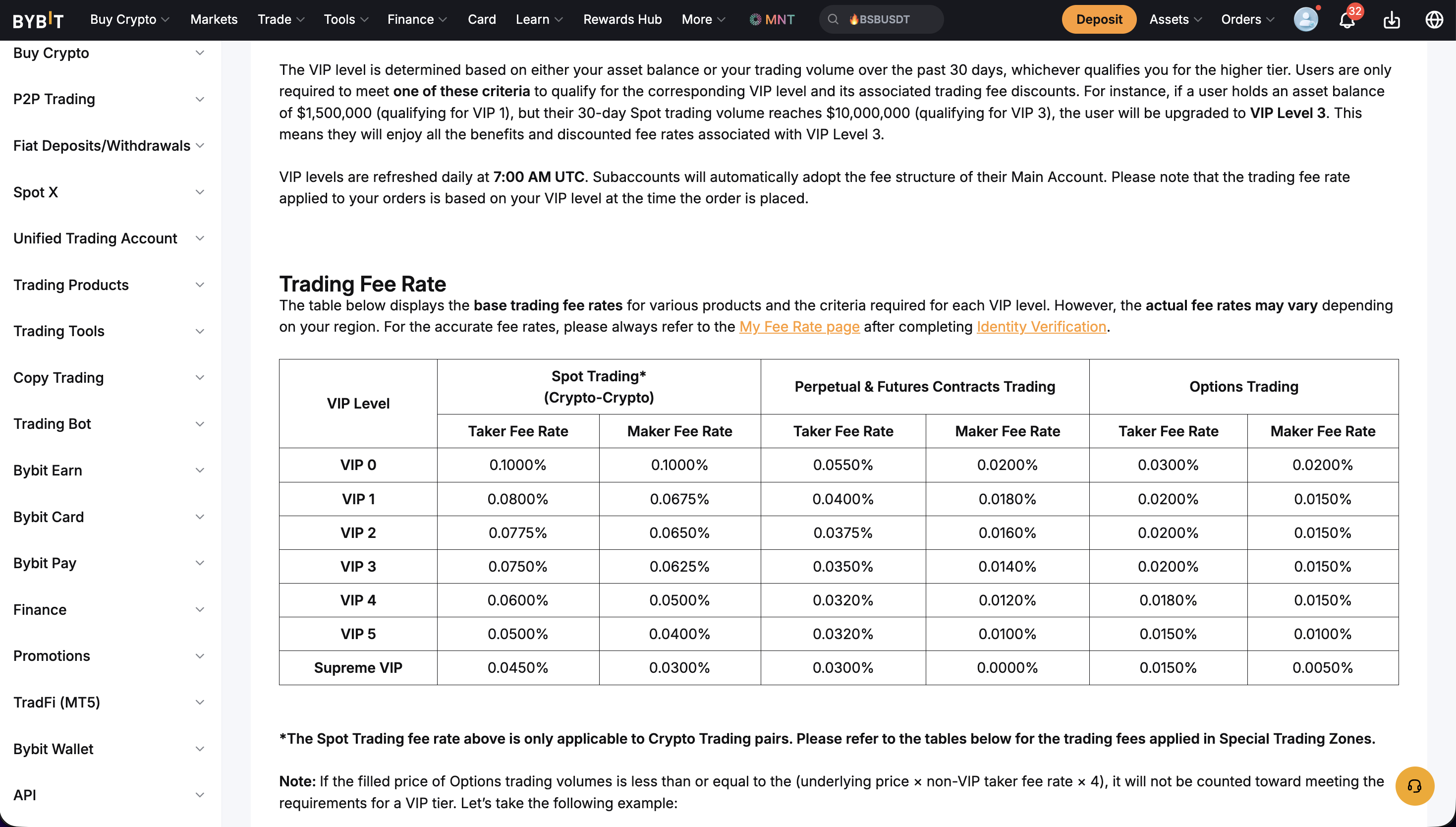
At default tier, Bybit charges 0.10 percent maker and 0.10 percent taker on spot. Activating the BIT fee discount (holding any positive BIT balance and toggling the option in account settings) lowers both sides by 20 percent to 0.08 percent. Perpetual futures cost 0.02 percent maker and 0.055 percent taker at default tier; with BIT discount the taker drops to 0.044 percent.
| Tier | Spot maker / taker | Futures maker / taker | 30-day volume threshold |
|---|---|---|---|
| Default | 0.10% / 0.10% | 0.02% / 0.055% | none |
| Default + BIT | 0.08% / 0.08% | 0.016% / 0.044% | hold any BIT |
| VIP 1 | 0.06% / 0.08% | 0.014% / 0.045% | $100K |
| VIP 3 | 0.04% / 0.07% | 0.010% / 0.038% | $1M |
| VIP 5 | 0.02% / 0.06% | 0.005% / 0.025% | $10M |
The VIP curve is competitive with Binance and OKX at the high end and meaningfully better than KuCoin’s at $1M+ monthly volume. For institutional or whale users running serious size on futures, Bybit’s fee economics are among the best in the industry. For typical retail volume under $1M per month, the headline difference between Bybit and peers is small.
Funding rate is separate from trading fees. Perpetual contracts pay or receive funding every 8 hours based on the long/short imbalance. Heavily long-biased markets can see funding rates that erode position economics more than the trading fee itself; for a sustained-bias retail trader, funding is the line item to monitor, not the maker/taker fee.
Withdrawal fees depend on network. USDT on Tron is the cheapest meaningful path (typically 1 USDT flat). USDC on Solana is fast and cheap when available. USDT on Ethereum mainnet can spike above 10 USDT during high-gas periods. Always confirm the network on both ends before sending; wrong-network withdrawals are the single most common user-error fund loss across every CEX.
The 2025 exploit and security response
This is the defining operational event in Bybit’s recent history. On February 21, 2025, attackers drained approximately $1.5 billion from one of Bybit’s ETH cold wallets, by hijacking a routine multisig transfer, in what is widely reported as the largest single-exchange exploit on record. Public attribution from chain analytics firms (Elliptic, TRM Labs, Chainalysis) pointed to North Korean threat actor activity, specifically operations associated with the Lazarus Group.
The response is the part that matters going forward. Within 24 hours Bybit confirmed the incident publicly, kept the platform running with continued withdrawal availability, and announced that user balances would be made whole regardless of the loss. Within 7 days the platform sourced bridge funding through a combination of insurance reserves, treasury liquidity, and direct loans from third-party partners, restoring the wallet balance to a fully-collateralized position against user liabilities. No user lost funds. The platform did not suspend withdrawals at any point during the incident response window.
Post-incident operational changes shipped through 2025-2026:
- Hot wallet limits tightened materially. Smaller share of total reserves held in any single hot wallet.
- Multi-signature requirements expanded across operational withdrawal flows.
- Independent security audits commissioned and published.
- KYC tightening across the platform (covered in the KYC section below).
- Proof of reserves cadence increased, with a Merkle-tree attestation now published more frequently than the previous schedule.
The forward-looking risk assessment: Bybit demonstrated a clean incident-response capability under one of the largest stress events in the industry’s history. The same custodial-CEX risk shape applies as to any peer (Binance, OKX, KuCoin) but the operational track record on the most consequential event is now better-documented than most. For long-term holdings the standard rule applies: keep on-platform only what you have actively allocated to open positions or short-term yield products; withdraw the rest to self-custody.
KYC and country availability
The post-exploit compliance push tightened KYC across the platform in 2025-2026. As of 2026, Bybit requires verification for essentially every account function beyond browsing. The tier structure:
| Tier | What it requires | What it unlocks |
|---|---|---|
| Unverified | Email or wallet only | Browse markets, view leaderboards, no deposits |
| Lite verification | Name, country, date of birth, government ID upload | Spot trading, deposits, low withdrawal cap |
| Standard verification | Liveness selfie, address proof | Full spot and futures, copy trading, higher withdrawal cap |
| Pro verification | Source-of-funds, enhanced due diligence | OTC desk, institutional features, highest withdrawal limits |
The unverified tier is effectively read-only for new accounts in 2026. The era of email-only meaningful trading on Bybit ended in 2025. For practical purposes assume Standard verification is required for any retail trading workflow.
Country availability is geo-restricted. The US is officially not served; Bybit does not operate a US-licensed product and US IPs are blocked at signup. UK retail derivatives access is restricted under FCA rules. Several other jurisdictions (Canada, parts of EU, Hong Kong retail, Japan, Taiwan, Thailand) have varying degrees of restriction. The restricted-country list updates without much notice; verify availability directly on Bybit before depositing material capital.
Copy trading
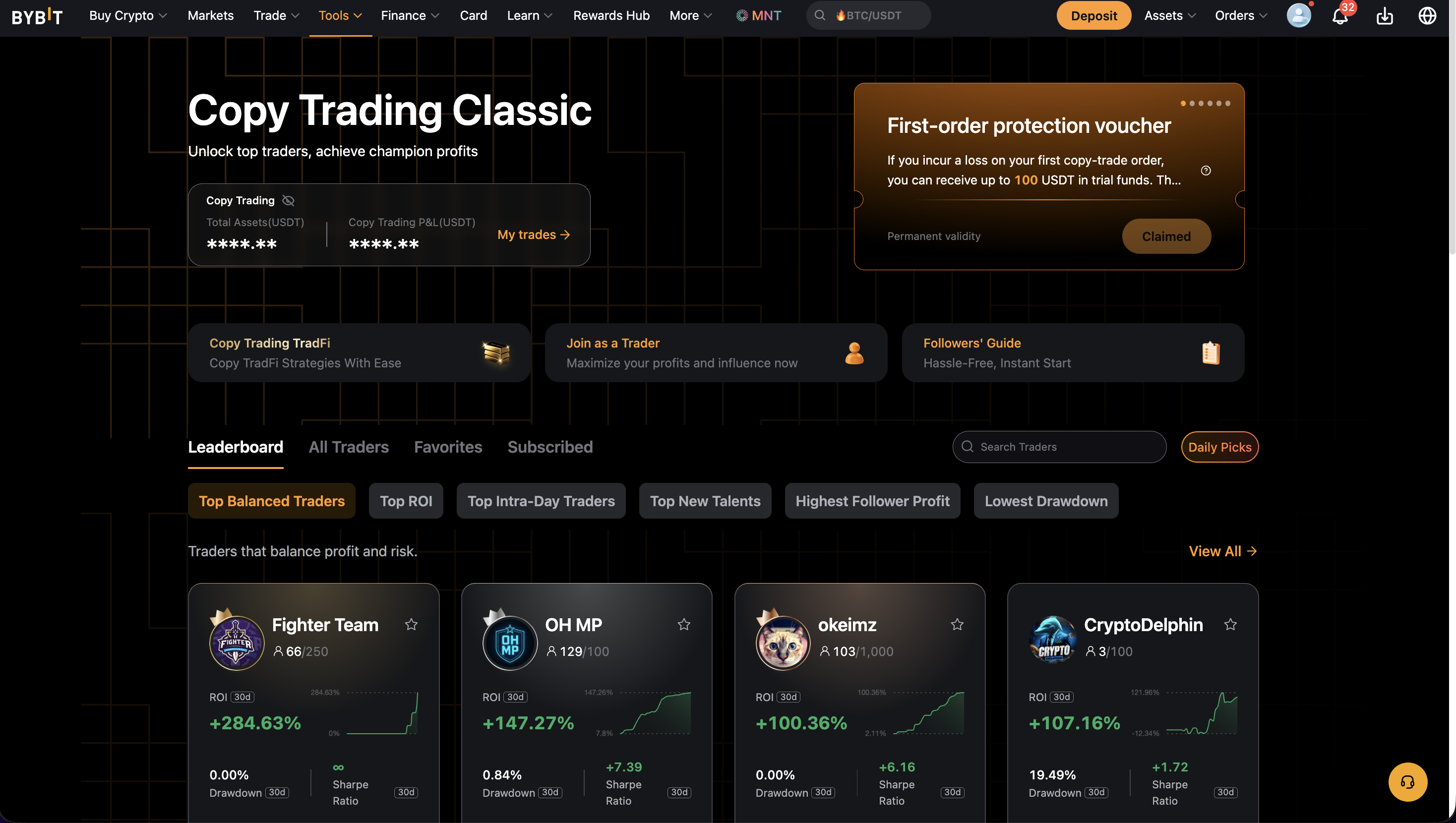
Bybit launched its copy trading marketplace in 2022 and grew it as a meaningful product within the platform rather than a side feature. The lead-trader marketplace exposes filterable metrics: 30-day PnL, win rate, follower count, AUM under management, average holding time, drawdown. The filters are more sophisticated than KuCoin’s copy trading product and the marketplace volume is larger.
Lead-trader fees on Bybit are typically structured as profit-share on net winning periods, with the lead taking 10-20 percent of follower profits. Losing periods do not pay the lead trader anything but the follower still eats the full loss plus underlying trading fees on those positions. This is the standard model across CEX copy trading; the implementation matters more than the headline split.
Honest framing: Bybit’s copy trading is good but not the strongest CEX option in 2026. BingX and Bitget have deeper marketplaces with more aggressively curated lead-trader pools. For users whose primary need is copy trading specifically, see our BingX copy trading guide. For users who want copy trading available within a broader derivatives-first platform, Bybit fits.
BIT token and ecosystem
BIT is Bybit’s native utility token. Two mechanics matter for retail users:
Fee discount. Holding any positive BIT balance and toggling “Use BIT to pay fees” in settings activates a 20 percent discount across spot and futures maker/taker fees. The discount applies at every VIP tier, not just the default tier.
Ecosystem access. BIT grants priority access to certain Bybit launchpad listings, structured-product slots, and ecosystem promotions. The value of this access varies considerably by week; for some launchpad windows it can be meaningful, for others it is negligible.
Unlike KuCoin’s KCS, BIT does not pay a daily platform-revenue-share bonus. The value proposition is the fee discount plus optional ecosystem participation, not yield. The break-even analysis is: hold BIT only if you would hold the token anyway as a speculative position, or if your trading volume is high enough that the discount alone justifies the price-risk exposure. For most retail users with monthly volume under $50K, the math is marginal.
Pros and cons
Pros
- Strong derivatives execution; perpetual futures order books compete with Binance on top pairs
- Options markets on BTC and ETH with usable liquidity (rare among CEX peers)
- Copy trading marketplace is more developed than KuCoin’s and OKX’s
- 2025 hack response was clean: no user loss, no withdrawal suspension, full recovery within days
- VIP fee curve scales aggressively for high-volume traders ($1M+ monthly)
- Wide product surface: futures, options, structured products, P2P, Earn, Card
- BIT discount applies across all fee categories without complex stacking rules
Cons
- Centralized exchange custody risk; the 2025 exploit was recovered but the risk shape remains
- No US-licensed product; US users excluded entirely
- KYC tightened materially in 2025-2026; meaningful trading requires Standard verification
- Mid-cap altcoin liquidity thinner than KuCoin or Binance
- BIT lacks a daily-yield mechanism comparable to KCS daily bonus
- Trading bots less developed than KuCoin’s native bot stack (see KuCoin trading bots)
- Spot pair listing more conservative than KuCoin (~400 vs 700+)
How Bybit compares
Head-to-head context in our existing comparisons:
- KuCoin vs Bybit covers the trade-off in detail. Short version: Bybit wins on derivatives and options; KuCoin wins on altcoins, bots, and KCS economics.
- A Bybit vs Binance head-to-head is shipping in the same cluster as this review. Short version: Bybit is the derivatives specialist; Binance is the broadest CEX by product surface.
- For users primarily focused on copy trading, BingX copy trading guide shows why BingX leads the dedicated marketplace.
If your strategy is futures-heavy with options exposure, Bybit is the right answer of the major CEX set. If your strategy is altcoin-heavy with active bot deployment, KuCoin is the better venue. If you want maximum product surface and the deepest top-pair liquidity, Binance.
How to start
The signup flow is short. Email or wallet, optional referral code, and you are inside the platform with a tradable account before committing to verification.
- Use the affiliate signup link. Our referral code
159120activates if you arrive through partner.bybit.com/b/159120. This is how you support our independent research without changing how the platform works for you. - Sign up with email or wallet. Use an email you control with a strong password. Enable hardware-key two-factor authentication immediately; the 2025 hack was platform-side, but user-side compromises are far more common.
- Complete Standard verification. Government ID, liveness selfie, address proof. Approval is typically minutes to a few hours for clean applications.
- Deposit USDT. Tron is the cheapest network. Confirm the network on both ends before sending. Wrong-network sends are the most common user-error fund loss.
- Start with spot before futures. Futures liquidation can wipe an account in minutes. If you are new to perpetuals, paper-trade or use very small position sizes for a meaningful period before scaling.
- Test withdrawal early. Send a small amount back to self-custody. Verify the withdrawal path before scaling the balance.
- Consider BIT if your volume justifies it. Otherwise skip the token and re-evaluate after a month of platform use.
Final verdict
In 2026, Bybit is the strongest derivatives-first centralized exchange for retail traders running futures and options strategies. The 2025 hack and the response to it demonstrated incident-response capability at a level few peers can claim. The product surface (perpetuals, options, structured products, copy trading, P2P, Card) is wide enough to be a one-stop venue for most active retail traders outside the US.
Honest framing on the score: 8.2 out of 10. Above Bitget on derivatives execution and options depth, slightly below Binance on raw liquidity and product variety, comparable to KuCoin in overall feature breadth but stronger on derivatives weaker on altcoins and bots. The 2025 exploit pulls the security sub-score lower than it would otherwise be, but the response pulls it back up; the net effect is neutral.
For a retail trader running a derivatives-heavy strategy with options exposure or active use of copy trading, Bybit is a credible primary venue in 2026. For US-based traders or users who prioritize altcoin breadth and trading bots, look elsewhere.
Open account: Register on Bybit. See the affiliate disclosure for full detail.
Read next
- Hyperliquid vs Bybit. DEX-versus-CEX head-to-head for perpetuals traders.
- KuCoin vs Bybit. Head-to-head on derivatives vs altcoins.
- KuCoin review. The sibling mid-tier CEX with a different strategic focus.
- BingX review. The copy-trading-first alternative.
- OKX review. Comparable scale and regulatory history.
- Methodology. How we evaluate platforms.
- Risk disclaimer.
Frequently asked questions
Is Bybit safe to use in 2026?
Yes, with the same standard centralized exchange risk profile as any peer. Bybit suffered a major exploit in February 2025 (approximately $1.5 billion drained, linked publicly to North Korean threat actor activity, specifically the Lazarus Group). The platform absorbed the loss through its insurance fund and operational reserves, kept user balances whole, and did not suspend withdrawals at the platform level. The incident-response handling was clean. The forward-looking risk profile is comparable to Binance, KuCoin, and other major CEXs.
What are Bybit's trading fees?
Spot fees are 0.10 percent maker and 0.10 percent taker at default tier. Perpetual futures cost 0.02 percent maker and 0.055 percent taker. Activating the BIT discount lowers both sides by 20 percent. VIP tiers scale fees down based on 30-day rolling volume, with the curve favoring high-volume derivatives traders. At VIP 3 perpetual taker drops to roughly 0.038 percent. Withdrawal fees depend on network: USDT on Tron is the cheapest meaningful path (typically 1 USDT flat).
Does Bybit have copy trading?
Yes, and it is more central to the platform than at most peer CEXs. Bybit's copy trading marketplace launched in 2022 and has grown to thousands of lead traders sortable by PnL, win rate, follower count, and AUM. The product feels purpose-built rather than retrofitted. For traders whose primary motivation is copy trading on a CEX, Bybit ranks behind BingX and Bitget on depth, but ahead of KuCoin and OKX. For pure copy-trading focus, see our [BingX copy trading guide](/blog/bingx-copy-trading-guide/) for the strongest dedicated marketplace.
Can US users use Bybit in 2026?
No. Bybit does not serve US users and does not operate a US-licensed product. The platform has been on the SEC's radar since 2024 without resolution. For US-based traders, the right answer is a US-licensed venue: Kraken, Coinbase, or Gemini. Outside the US, Bybit is widely available with regional restrictions that tightened after the February 2025 exploit.
What is BIT and is it worth holding?
BIT is Bybit's native utility token. Holding BIT activates a 20 percent trading fee discount and grants access to certain ecosystem benefits. Unlike KuCoin's KCS, BIT does not pay a daily platform-revenue-share bonus. The value proposition is the fee discount plus ecosystem participation, not yield. For active traders with monthly volume above $100K who would hold a token anyway, BIT can make sense. For occasional users, the token price exposure typically outweighs the fee savings.
How does Bybit compare to Binance and KuCoin?
Versus Binance: Bybit is a derivatives specialist (perpetuals, options, structured products), while Binance is the broadest CEX by product surface. For futures-heavy retail strategies Bybit is tighter on execution. For spot, altcoins, and Earn variety, Binance is broader. Versus KuCoin: Bybit has stronger derivatives, options markets, and a more developed copy trading marketplace; KuCoin has more altcoin pairs and a deeper native trading-bot product. Head-to-head in our [KuCoin vs Bybit comparison](/blog/kucoin-vs-bybit/).
Does Bybit require KYC?
In 2026, yes for almost all functions. After the February 2025 exploit, Bybit tightened KYC globally and now requires verification for essentially every account function beyond browsing. The unverified tier is effectively read-only for new accounts. Verification (government ID, liveness selfie, address proof at higher tiers) is required to deposit, trade futures, withdraw, or use copy trading. The era of email-only meaningful trading on Bybit ended in 2025.
What products does Bybit offer beyond spot and futures?
A broad list. Perpetual futures with USDT and USDC margining, options markets on BTC and ETH (one of the few CEXs offering options), structured yield products, Bybit Earn (staking and savings), P2P trading, NFT marketplace (smaller than peers), Bybit Card (crypto debit card in supported regions), and TradeGPT (AI-assisted trading interface). For options-driven strategies specifically, Bybit is one of the few CEX options of any depth.
#Bybit#exchange review#derivatives#copy trading#BIT#options
Discussion
Loading comments…