
TL;DR: As of January 1, 2025, Russia taxes crypto income at 13% up to 2.4 million RUB of annual taxable income and 15% above. Federal Law 259-FZ together with Tax Code amendments 372-FZ ended the pre-2024 grey zone. Capital gains, mining, staking, airdrops, P2P proceeds, and NFT sales are all reportable. Cost basis uses FIFO, with a 10-year loss carry-forward. Form 3-NDFL is due April 30 of the year following the tax period, with payment by July 15. Industrial mining requires legal-entity registration under Federal Law 221-FZ. CFC rules apply for ownership stakes above 25% in foreign entities holding crypto. Non-declaration carries 5% per month penalties, criminal exposure above 2.7M RUB unpaid over three years under Article 198 of the Criminal Code, and a detection probability that has risen sharply since 2024.
Not legal or tax advice. This article summarizes published Russian Federation tax legislation as of May 2026 based on Federal Law 259-FZ, Federal Law 372-FZ, Federal Law 221-FZ, and Tax Code provisions. Rules change. Interpretive practice varies by regional inspectorate. Consult a qualified Russian tax advisor before filing. The Russian Federation is currently outside OECD CRS automatic information exchange, but bilateral information requests, KYC data flows from major exchanges, and on-chain analytics through Rosfinmonitoring all close the offshore-anonymity gap progressively. Hiding income carries criminal exposure under Article 198 of the Criminal Code above the 2.7M RUB threshold. Read the risk disclaimer before relying on any portion of this guide.
Summary table: rates, deadlines, exemptions
| Item | 2026 rule |
|---|---|
| Tax base, residents | Personal income (NDFL), aggregated across all NDFL-base sources |
| Rate, income up to 2.4M RUB/year | 13% |
| Rate, income above 2.4M RUB/year | 15% (on the excess only) |
| Rate, non-residents (under 183 days) | Generally 30% on Russian-source income, crypto treatment varies; verify case-by-case |
| Rate, legal entities | 25% corporate profit tax from 2025 |
| Declaration form | Form 3-NDFL |
| Filing channel | Personal Account of the Taxpayer on nalog.ru, paper at regional inspectorate, or via authorized representative |
| Tax year | Calendar year (January 1, December 31) |
| Declaration deadline | April 30 of the year following the tax year |
| Payment deadline | July 15 of the year following the tax year |
| Cost basis method | FIFO only since 2024 (LIFO and average cost not permitted) |
| Loss carry-forward | 10 years, against future crypto gains only |
| Mining registration (industrial) | Required under Federal Law 221-FZ; legal entity or IP status |
| Mining threshold for individuals | 6,000 kWh/month electricity, above which registration required |
| Exempt: wallet-to-wallet transfers (same owner) | Yes, not a taxable event |
| Exempt: holding without sale | Yes, unrealized gains not taxed |
| Exempt: gifts to close relatives | Yes, under Article 217 of the Tax Code |
| Taxable: airdrops, hard forks, staking, mining | Yes, at fair market value on receipt |
| Taxable: P2P fiat-to-crypto, crypto-to-fiat, crypto-to-crypto | Yes |
| Taxable: NFT sales | Yes, as property disposal |
| Late filing penalty | 5%/month of unpaid tax, max 30%, min 1,000 RUB |
| Underpayment penalty | 20% (40% if intentional), Article 122 Tax Code |
| Criminal threshold | 2.7M RUB unpaid over any 3 consecutive years, Article 198 Criminal Code |
A quick orientation: the table above is the spine of this guide. Each row corresponds to one decision a Russian resident filing crypto income for 2025 needs to make. The rest of this article unpacks each row with worked examples, the underlying statute, and the practical filing mechanics.
What this guide does not cover
A short scope statement, since the surface is wide.
This guide is written for Russian tax residents (183+ days in Russia per calendar year) filing personal income tax on crypto held for investment or earned through mining, staking, airdrops, and P2P trading. It does not cover:
- Legal-entity (LLC/IP) crypto tax accounting. Corporate profit tax at 25%, VAT exposure on certain crypto-adjacent activities, and the legal-entity mining registry under Federal Law 221-FZ are their own discipline. Engage an accountant familiar with cryptocurrency reporting if you operate through a legal entity.
- Cross-border tax residency questions. If you spend portions of the year in multiple jurisdictions, dual-residency analysis and double-tax treaty interpretation require a specialist. Russia has DTAs with many countries but suspended several through 2023-2024.
- Specific exchange tax reports. Centralized exchanges generally do not provide Russia-formatted tax statements. You build the 3-NDFL submission from transaction history exports manually or through a third-party tax tool.
- Sanctions compliance. Some Russian residents face restricted access to foreign exchanges due to platform-level geofencing of EU/US-resident product. Tax obligations apply regardless of whether the exchange remains accessible.
- Detailed audit defense. If you receive a formal information request from the Federal Tax Service, engage a tax lawyer immediately. Self-representation in a crypto audit is a poor allocation of risk.
With those caveats, what follows is the practical filing framework.
The 2024-2026 regulatory framework
The legal foundation for taxing crypto in Russia rests on four instruments enacted between 2020 and 2024, with full enforcement effective January 1, 2025.
Federal Law 259-FZ “On Digital Financial Assets”
Federal Law 259-FZ “On Digital Financial Assets, Digital Currency, and on Amendments to Certain Legislative Acts of the Russian Federation” was originally signed in July 2020 and effective from January 1, 2021. The law established the legal category of “digital currency” (цифровая валюта) as distinct from electronic money or securities, prohibited the use of digital currency as a means of payment for goods and services within Russia, and obligated Russian residents to disclose digital currency ownership when total annual transaction value exceeded specific thresholds.
The 2020 version of 259-FZ left tax treatment under-specified. The Federal Tax Service issued informal guidance in 2021-2023 indicating that crypto gains were taxable as property disposal under existing Tax Code rules, but the practical enforcement posture was light. Many residents declared nothing and faced no consequence.
Federal Law 372-FZ: Tax Code amendments
Federal Law 372-FZ, signed in November 2024, amended Chapter 23 of the Tax Code (the personal income tax chapter) to add explicit provisions for digital currency. The amendments:
- Defined digital currency as taxable property for NDFL purposes.
- Specified FIFO as the mandatory cost basis method.
- Set the loss carry-forward period at 10 years against future crypto gains.
- Clarified that wallet-to-wallet transfers within the same beneficial owner are not taxable events.
- Confirmed that mining, staking, and airdrop income is taxable at fair market value on receipt.
The 372-FZ amendments took full effect from January 1, 2025, making 2025 the first full tax year under the new regime and 2026 the first declaration cycle in which residents must file under the explicit crypto provisions.
Federal Law 221-FZ: mining registry
Federal Law 221-FZ, effective November 1, 2024, established the legal framework for industrial mining. Legal entities and individual entrepreneurs (IPs) intending to mine commercially must register with the Federal Tax Service in a dedicated mining registry. Individuals are exempt from registration if monthly electricity consumption attributable to mining stays below 6,000 kWh. Above that threshold, individuals must either reduce capacity or transition to IP status.
What changed versus the pre-2024 grey zone
Three things changed in practice:
- Explicit tax provisions. Before 372-FZ, residents had to read tax obligations into general property-disposal rules. After 372-FZ, the rules are stated. Pleading interpretive ambiguity in a 2026 audit is no longer credible.
- Information flow. The Federal Tax Service now receives bank inflow data through standard reporting, monitors P2P payment patterns through automated tooling, and has formal information channels with Russian-licensed exchanges. KYC data from foreign exchanges still flows through bilateral requests and through OFAC/AML cooperation frameworks where applicable.
- Enforcement signal. Public statements by Minfin and the Federal Tax Service through 2024-2025 emphasized that the period of light enforcement is closing. Tax compliance budgets for crypto-specific enforcement have increased, including dedicated analytical units at Rosfinmonitoring.
For deeper context on choosing platforms that operate transparently in this environment, see our guide to no-KYC crypto exchanges in 2026 and the practical how to buy crypto in 2026 walkthrough.
What’s taxable
Every transaction below is a taxable event under the post-2024 framework. The list is exhaustive in practice; if you executed any of these in 2025, you have something to declare in 2026.
Capital gains on sale
Sale of crypto for fiat (RUB or foreign currency) realizes a gain or loss equal to (proceeds in RUB at transaction date exchange rate) minus (FIFO cost basis in RUB). This is the most common taxable event and applies whether the sale executes on a Russian exchange, a foreign exchange, P2P, OTC, or through a payment processor.
Crypto-to-crypto trades
Swapping BTC for ETH, or USDT for SOL, or any pair-to-pair conversion is a disposal of the asset being sold. The proceeds equal the fair market value in RUB of the asset received at the moment of trade. The cost basis is the FIFO cost basis of the asset disposed. The fact that you never touched RUB does not change the treatment.
A worked example: you hold 1 ETH with a cost basis of 200,000 RUB. You swap that 1 ETH for 5,000 USDT at a moment when 1 ETH equals 300,000 RUB. You have a disposal of 1 ETH at 300,000 RUB, realizing a 100,000 RUB gain. The 5,000 USDT now sits in your account with a cost basis of 300,000 RUB.
Mining income
Mined coins are taxed at fair market value in RUB at the moment they hit your wallet (more precisely, at the moment of credited block reward or pool payout). The valuation uses the official exchange rate from a recognized source on that date. Subsequent sale of those coins is a separate capital gain or loss event using the receipt-day RUB value as the cost basis.
For industrial miners operating as legal entities or IPs, mining proceeds flow through corporate profit tax at 25% rather than personal NDFL. The mining-input electricity costs become deductible business expenses. The registry registration under 221-FZ is the threshold for crossing into that regime.
Staking rewards and lending interest
Staking rewards paid by a Layer 1 protocol, exchange staking products, and DeFi liquid staking are all taxable as ordinary income at fair market value on receipt. The treatment is analogous to deposit interest, but the moment of receipt matters: rewards are taxable when they become withdrawable from the staking contract, not when they are first computed by the protocol.
Lending interest paid in crypto on platforms like Aave, Compound, or centralized lending desks follows the same rule.
Airdrops and hard forks
Tokens received via airdrop are taxable at fair market value on the date they become controllable in your wallet. The “controllable” wording matters because some airdrops require an active claim transaction. The taxable event is the claim moment, not the announcement moment. If the airdropped token has no liquid market at receipt, the fair market value is zero and the cost basis is zero; tax then arises on later sale.
Hard fork tokens follow the same rule: receipt is taxable at fair market value, with subsequent sale a separate event.
P2P trading
P2P trades on Bybit, Binance, Bitget, Huobi/HTX, OKX, MEXC, and any other venue are taxable. The fact that settlement happens peer-to-peer rather than through an order book does not change the analysis. Each leg of the trade is valued at fair market value at the time, and gain or loss is computed against FIFO cost basis.
The Federal Tax Service has direct visibility into the Russian-bank side of P2P transactions. Recurring inflows above 600,000 RUB per transaction or 1,000,000 RUB per month trigger pattern analysis under existing AML/CFT regulation. Whether the corresponding crypto leg is fully visible depends on which exchange you used and whether that exchange shares KYC data with Russian authorities under request.
NFT sales
NFTs are treated as digital property. Sale realizes gain or loss against cost basis, computed in RUB terms. Royalty payments to NFT creators are taxable as ordinary income at receipt.
What is not taxable
- Wallet-to-wallet transfers of the same owner. Moving your BTC from exchange A to exchange B, or from an exchange to a self-custody wallet, is not a disposal. Documentation matters; keep transaction hashes and account ownership records.
- Holding without sale. Unrealized gains are not taxed. You only owe when you realize.
- Gifts to close relatives. Article 217 of the Tax Code exempts gifts between close relatives (spouses, parents, children, siblings, grandparents, grandchildren). Gifts to non-relatives above 4,000 RUB per year are taxable to the recipient.
- Spending crypto on personal consumption. Technically a sale moment in some interpretations, but the prohibition on using digital currency as a means of payment within Russia under 259-FZ makes this a moot point for most residents.
Tax rates and brackets
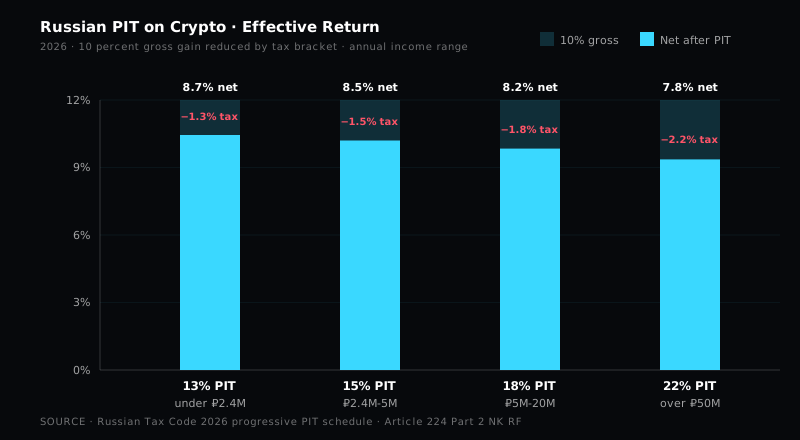
The 2025 progressive NDFL structure replaced the long-standing flat 13% rate that had been in place since 2001.
Resident rates (183+ days in Russia)
| Annual NDFL-base income | Rate |
|---|---|
| Up to 2.4M RUB | 13% |
| 2.4M to 5M RUB | 15% (on excess above 2.4M) |
| 5M to 20M RUB | 18% (on excess above 5M) |
| 20M to 50M RUB | 20% (on excess above 20M) |
| Above 50M RUB | 22% (on excess above 50M) |
A clarification on how the brackets work: the 2024 reform introduced a five-tier progression for general NDFL-base income. For most retail crypto traders, the practical brackets are the first two: 13% and 15%. Crypto gains aggregate with salary, freelance income, and most other NDFL-base sources. If your total NDFL base for the year is 3,000,000 RUB, the first 2,400,000 RUB is taxed at 13% (totaling 312,000 RUB) and the next 600,000 RUB is taxed at 15% (totaling 90,000 RUB) for a combined liability of 402,000 RUB.
Worked example: salary plus crypto
You earn 2,000,000 RUB in salary in 2025 and realize a 1,500,000 RUB net crypto gain. Your total NDFL base is 3,500,000 RUB. The first 2,400,000 RUB is taxed at 13% (312,000 RUB); the next 1,100,000 RUB is taxed at 15% (165,000 RUB). Total liability: 477,000 RUB. Your employer withholds NDFL on the salary portion; you owe the crypto-related delta on filing.
Non-resident rates (under 183 days in Russia)
Non-residents historically face 30% on Russian-source income under Article 224. Crypto treatment for non-residents in 2026 remains less than fully clarified in official guidance; the conservative interpretation applies the 30% rate to Russian-source crypto income, with the practical question of what counts as “Russian-source” depending on facts. If you spend less than half the year in Russia, do not treat the 13/15% brackets as your default; confirm residency status and applicable rate with a tax advisor.
Legal entities
Russian legal entities pay corporate profit tax at 25% (raised from 20% effective January 1, 2025) on crypto proceeds after deduction of allowable costs. Individual entrepreneurs (IPs) on the simplified tax system can elect 6% on gross revenue or 15% on net income, with crypto-related expenses deductible under the 15% regime.
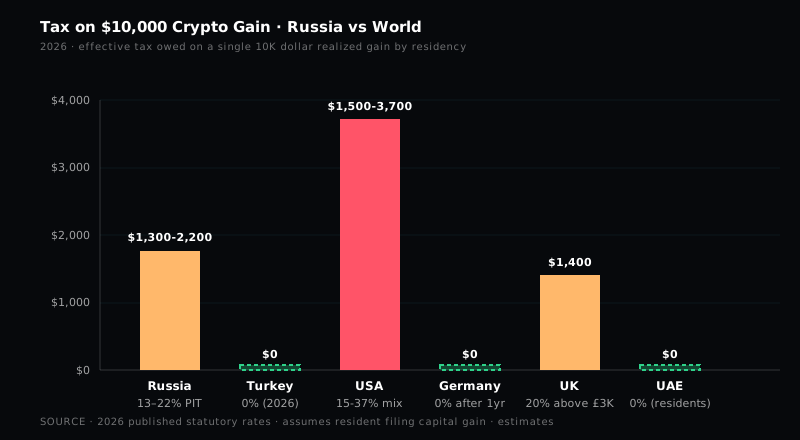
Cost basis: FIFO and worked examples
Cost basis calculation is the most error-prone part of a crypto 3-NDFL filing for most residents.
FIFO is mandatory
Federal Law 372-FZ specified FIFO (First In, First Out) as the only permitted cost basis method for crypto disposals from 2024 onward. LIFO (Last In, First Out), specific identification, and average cost are not allowed. The choice is removed; FIFO applies to every position.
FIFO operates per-asset, not per-portfolio. BTC FIFO and ETH FIFO are separate lot queues. A sale of 0.7 BTC draws from the oldest unsold BTC lots, regardless of what is happening in your ETH stack.
Worked example: three BTC lots, one sale
You executed the following BTC transactions in 2025:
- March 1: Bought 1 BTC at 5,000,000 RUB per BTC. Cost: 5,000,000 RUB.
- June 1: Bought 0.5 BTC at 7,000,000 RUB per BTC. Cost: 3,500,000 RUB.
- October 1: Sold 0.7 BTC at 11,428,571 RUB per BTC (total proceeds 8,000,000 RUB).
FIFO matches the 0.7 BTC sold against the March 1 lot, which has 1 BTC unsold at the time of sale.
- Cost basis allocated to the 0.7 BTC sold: 0.7 x 5,000,000 = 3,500,000 RUB.
- Proceeds: 8,000,000 RUB.
- Taxable gain: 8,000,000, 3,500,000 = 4,500,000 RUB.
After the sale, your remaining position is 0.3 BTC from the March 1 lot (with allocated cost basis of 0.3 x 5,000,000 = 1,500,000 RUB) plus 0.5 BTC from the June 1 lot (cost basis 3,500,000 RUB). Total remaining: 0.8 BTC at 5,000,000 RUB combined cost basis.
Worked example: P2P with foreign-currency leg
You sold 5,000 USDT for cash USD via P2P in May 2025 at a moment when 1 USDT equaled 95 RUB and the USDT-to-USD rate was 1:1. You received the equivalent of 475,000 RUB in USD cash.
- Proceeds: 475,000 RUB.
- FIFO cost basis on 5,000 USDT: Suppose your oldest USDT lots have a weighted average cost of 90 RUB per USDT. Cost basis = 5,000 x 90 = 450,000 RUB.
- Taxable gain: 25,000 RUB.
The fact that you received USD cash rather than RUB does not exempt the transaction. The proceeds are valued in RUB at the transaction-date exchange rate.
Worked example: realized loss and carry-forward
You bought 10 SOL at 20,000 RUB per SOL in January 2025 (cost 200,000 RUB) and sold all 10 in November 2025 at 12,000 RUB per SOL (proceeds 120,000 RUB). You realize a 80,000 RUB loss on that position.
If your aggregate net 2025 crypto position is a loss, that loss carries forward up to 10 years and offsets future crypto gains only. It cannot offset salary, dividends, or other NDFL-base income. The carry-forward is asset-class restricted: crypto losses offset crypto gains.
Documentation requirements
Maintain, at minimum, for every disposal:
- Date and time of acquisition.
- Cost in RUB at acquisition (using transaction-date exchange rate).
- Date and time of disposal.
- Proceeds in RUB at disposal (using transaction-date exchange rate).
- Exchange or counterparty.
- Transaction hash or exchange order ID.
The Federal Tax Service does not currently mandate a specific format for this record-keeping, but in an audit you must produce the underlying data. Most active traders maintain a transaction CSV exported from each exchange, augmented with daily exchange rate lookups for the conversion to RUB. Third-party tax tools (some Russia-focused, some adapted from US-focused tools) can automate the FIFO calculation, but the responsibility for accuracy remains with the taxpayer.
For a fee-aware sense of what your trading costs look like before tax, the exchange fees calculator sets the baseline; tax then applies on top of net gains after fees.
How to file Form 3-NDFL
The 3-NDFL declaration is the single document that consolidates all crypto-related income for the tax year.
Filing channels
There are three permitted channels:
- Personal Account of the Taxpayer (Личный кабинет налогоплательщика, ЛК ФЛ) on nalog.ru. The default channel for most residents. Requires a Gosuslugi account or a separate ЛК ФЛ registration via in-person visit to an inspectorate (one-time setup).
- Paper filing at the regional inspectorate. Allowed but inefficient. The 3-NDFL form for 2025 income runs to multiple pages with crypto-specific sections.
- Through an authorized representative. Tax advisors and licensed accountants can file on your behalf with a notarized power of attorney.
The 2026 declaration form: new crypto section
The 3-NDFL form published for the 2025 tax year includes a dedicated digital currency section (Приложение for digital assets). The section captures, per asset:
- Asset name and identifier.
- Date and proceeds in RUB for each disposal.
- FIFO cost basis allocated to each disposal.
- Net gain or loss per asset.
- Aggregate gain or loss for the digital currency category.
Mining and staking income are reported in a separate income-source field. Airdrops fall under “other income.” P2P trades are aggregated within the disposal section by counterparty asset.
Step by step for first-time filers
- Gather transaction history. Export CSVs from every exchange you used in 2025. Include deposits, withdrawals, trades, P2P, staking rewards, and any other event.
- Convert to RUB at transaction-date rates. Use the Central Bank of Russia (CBR) official rate or a recognized public rate source. Document your source.
- Apply FIFO per asset. For each disposal, identify the oldest unsold lot and allocate cost basis.
- Compute mining/staking/airdrop receipts at fair market value on receipt date.
- Aggregate and total. Sum gains, sum losses, compute net.
- Log into ЛК ФЛ on nalog.ru. Open the 3-NDFL section for the 2025 tax year.
- Fill the digital currency section. Enter per-disposal data or upload a supporting document.
- Submit declaration by April 30, 2026.
- Pay tax by July 15, 2026. Payment is via bank transfer to the Federal Tax Service treasury account; details auto-populate in ЛК ФЛ after declaration submission.
- Retain documentation. Keep transaction history and supporting calculations for at least 4 years post-filing (the standard tax audit window).
Common mistakes
- Forgetting crypto-to-crypto trades. These are disposals. Failing to report them is the single most common error.
- Using cost basis from a foreign currency without RUB conversion. Cost basis must be in RUB at the acquisition-date rate. USD or USDT cost basis is not directly usable.
- Skipping mining/staking receipts. These are taxable on receipt at fair market value, not only on subsequent sale.
- Mismatched dates. Use trade timestamps in Moscow time. Some exchanges export in UTC; convert before computing rates.
- Late filing without amendment. If you miss April 30, file as soon as possible. Penalties compound monthly; late filing with payment is materially better than non-filing.
Mining and staking: practical specifics
Mining and staking sit at the intersection of income tax and the new mining registry framework.
Industrial mining: registration required
Federal Law 221-FZ, effective November 1, 2024, requires legal-entity or IP registration for industrial mining. The Federal Tax Service maintains the mining registry; registration involves disclosure of mining capacity, power consumption, and operational location. Registered miners face standard corporate profit tax (25%) on mining proceeds after deductible costs (electricity, equipment depreciation, premises rent, internet, payroll). Unregistered industrial mining is prohibited and exposes operators to administrative and potential criminal penalties.
Individual mining: under the 6,000 kWh threshold
Individuals can mine without registration if monthly electricity consumption stays under 6,000 kWh. This threshold accommodates small-scale home miners (a handful of ASICs or a modest GPU rig) but excludes anything approaching commercial operation. Mining income for unregistered individuals is taxed at the standard NDFL rates (13/15%) on fair market value at receipt.
If you mine above 6,000 kWh per month at any point, you must register (transition to IP status) and shift to corporate-tax accounting from the registration moment forward. Retroactive treatment for the months before registration depends on facts; consult a tax advisor before regularizing late.
Staking and DeFi yield
Staking rewards are treated as ordinary income at receipt, valued in RUB at the date-of-receipt market rate. The treatment is consistent across:
- Layer 1 protocol staking (Ethereum, Cardano, Solana, etc.).
- Exchange staking products (Bybit Earn, Bitget Earn, Binance Earn, OKX Earn).
- Liquid staking (Lido stETH rewards, Rocket Pool rETH appreciation).
- DeFi yield farming (Aave deposits, Compound, Curve, Yearn).
The moment of receipt is when the reward becomes withdrawable, not when it is first computed by the protocol. For continuously accruing rewards (like stETH rebasing), the practical interpretation is to mark to market at periodic intervals; quarterly is a defensible cadence absent specific guidance.
A subtlety: when you eventually sell the staked-reward tokens, you compute a second taxable event using the receipt-day RUB value as the cost basis. Holders who let staking rewards accumulate for years then sell are sometimes surprised by the dual taxation: once on receipt, once on disposal. Both events are required.
Lending and interest
Lending interest in crypto is taxable as ordinary income on receipt, identical to staking treatment. Interest paid in fiat from a crypto-collateralized loan is also taxable; the loan principal itself is not income at receipt.
P2P trading and on-chain visibility
P2P is where the gap between theoretical and actual enforcement is widest. Worth being honest about what’s tracked.
What the Federal Tax Service sees
Two information flows are now operational:
- Bank-side data. Every Russian bank reports inflows to the Federal Tax Service under standard reporting frameworks. Recurring transfers from unrelated counterparties at sizes above 600,000 RUB per transaction or 1,000,000 RUB per month trigger automated pattern flags. The bank itself, under AML/CFT obligations, may also file a suspicious activity report independently.
- Exchange-side data. Russian-licensed exchanges (limited number, mostly OTC desks) share KYC data with Russian authorities under existing channels. Foreign exchanges (Bybit, Bitget, Binance, OKX, MEXC, Huobi/HTX, etc.) share data under bilateral information requests; the practical responsiveness varies by exchange and jurisdiction.
On-chain analytics by Rosfinmonitoring
Rosfinmonitoring (the Federal Financial Monitoring Service) has expanded its on-chain analytics capacity since 2023, with dedicated tooling for blockchain transaction tracing. The capability covers major chains (Bitcoin, Ethereum, Tron primarily) and is most effective at tracing flows that touch known centralized exchange addresses. Self-custody to self-custody transfers and chain hops through privacy-preserving protocols are harder to trace, but the analytical perimeter widens annually.
What is and isn’t realistically tracked in 2026
- Tracked with high probability: P2P trades that touch a Russian bank account on either leg. KYC-verified exchange withdrawals to Russian-bank fiat off-ramps. Large transfers from foreign exchanges back to Russian fiat infrastructure.
- Tracked with moderate probability: Transfers between foreign exchanges where both have KYC data on the user and respond to information requests. On-chain flows that begin and end at KYC-verified exchange addresses.
- Tracked with low probability: Pure self-custody on-chain activity that never touches a Russian fiat off-ramp and never withdraws to a KYC-verified Russian exchange.
The “low probability” category is shrinking. Long-term capital that stays in self-custody and never converts to RUB has limited audit exposure today, but the moment that capital re-enters the Russian fiat system, the full trail becomes recoverable.
Practical posture for P2P traders
Declare everything that touched a Russian bank account. The bank-side data flow makes selective declaration risky; if the Federal Tax Service identifies inflows that do not appear on your 3-NDFL, the conversation moves from administrative penalty to potential criminal exposure.
CFC reporting and foreign accounts
The foreign-account reporting framework is the most administratively complex piece of the Russian crypto tax regime.
Foreign financial account disclosure
Federal Law 173-FZ “On Currency Regulation and Currency Control” requires Russian residents to disclose foreign financial accounts and to report annual movements on those accounts. The framework was historically focused on traditional bank accounts but has expanded over recent years to cover accounts at foreign payment systems and foreign organizations providing financial services.
Whether a centralized cryptocurrency exchange qualifies as a “foreign organization providing financial services” remains a judgment call in 2026. The Federal Tax Service has not issued definitive guidance for every exchange type. The safe interpretation is to disclose:
- Foreign exchange accounts you control directly.
- Foreign payment system accounts holding crypto.
- Foreign brokerage accounts holding crypto-adjacent securities (ETF positions, mining-company equity).
Reports are filed by June 1 for the prior calendar year, separately from the 3-NDFL declaration.
Controlled Foreign Company (CFC) rules
CFC rules apply when a Russian resident owns:
- More than 25% of a foreign legal entity, or
- More than 10% of a foreign legal entity in which Russian residents collectively own more than 50%.
If you operate crypto through a foreign LLC, BVI/Cayman corporation, or similar offshore vehicle, CFC rules may apply. The foreign entity’s profit is then subject to deemed-distribution rules with corresponding NDFL or corporate-tax liability on the Russian beneficial owner.
CFC profit calculation is non-trivial: the entity’s profit is computed under either Russian accounting rules or the entity’s home-jurisdiction rules with adjustments. Specialist advice is essential here; self-administration of CFC reporting is a frequent source of audit findings.
CRS automatic exchange status
The Russian Federation has been outside the OECD Common Reporting Standard automatic exchange since 2022, when several partner jurisdictions suspended exchange relationships. This means Russian residents’ foreign account data is not automatically transmitted to Russian authorities by partner-jurisdiction tax services.
The practical consequence is not “offshore accounts are invisible.” Bilateral information requests still operate, and several major jurisdictions retain cooperative tax information channels with Russia under treaty or under specific case-by-case arrangements. The trajectory through 2026 has been toward more disclosure, not less, with several jurisdictions resuming partial cooperation through 2025.
The interpretation: do not rely on CRS-gap analysis as a tax strategy. The gap is real but narrowing, and the cost of detection on an undisclosed material position is asymmetric.
Sanctions interaction
A wrinkle specific to Russian residents in 2026: many foreign exchanges and banks geofence or restrict EU/US-resident product access in ways that overlap with Russian-resident restrictions. Some Russian residents hold accounts at platforms that have legal questions about continued service. Tax obligations apply regardless of whether the underlying account remains accessible; lost access to an account does not exempt the historical income from declaration.
Risks of non-declaration
The penalty framework has multiple layers. Each layer compounds on the prior.
Administrative penalties
- Late filing of 3-NDFL. 5% of unpaid tax per full or partial month of delay, minimum 1,000 RUB, maximum 30% of the assessed sum. Article 119 of the Tax Code.
- Underpayment of tax. 20% of the underpaid amount, increasing to 40% if the underpayment is deemed intentional. Article 122 of the Tax Code.
- Late payment. Penalty interest accrues daily at 1/300 of the CBR refinancing rate for the first 30 days, then 1/150 thereafter. Article 75 of the Tax Code.
- Failure to file CFC notification. 50,000 RUB per uncalled foreign entity. Article 129.6 of the Tax Code.
- Failure to file foreign account disclosure. Up to 20,000 RUB for individuals under Article 15.25 of the Code of Administrative Offences, plus potential currency control penalties depending on transaction amounts.
Criminal liability: Article 198 of the Criminal Code
Article 198 of the Criminal Code criminalizes evasion of personal income tax above specific thresholds:
- Large-scale evasion. Unpaid tax exceeding 2.7 million RUB over any three consecutive financial years. Penalty: fine of 100,000 to 300,000 RUB, or imprisonment up to one year.
- Especially large-scale evasion. Unpaid tax exceeding 13.5 million RUB over any three consecutive financial years. Penalty: fine of 200,000 to 500,000 RUB, or imprisonment up to three years.
The thresholds apply cumulatively across three years, so a sustained mid-six-figure annual underpayment can cross the criminal line within two or three tax cycles. First-time offenders who pay the assessed amount plus penalties before the criminal case is initiated typically avoid prosecution; this is the explicit deferred-prosecution mechanism under existing practice.
Detection probability in 2026
Three years ago, detection probability for a mid-six-figure undisclosed crypto position was low. In 2026, it is not. The combination of:
- Bank-side inflow data flow to the Federal Tax Service.
- KYC data sharing from major exchanges (under request) and from Russian-licensed venues (routine).
- On-chain analytics by Rosfinmonitoring.
- Increased compliance budget and dedicated crypto-enforcement units.
…has shifted the practical detection curve. Residents who declared nothing for 2021-2023 and have not been audited yet face a real prospective risk of look-back audits as the Federal Tax Service expands its review of historical periods. The standard tax audit window in Russia is 4 years, which means the 2025 tax year remains in audit scope through 2029.
The practical recommendation
Declare and pay. The penalty asymmetry is severe enough that even on a position you think the tax authority cannot see, the expected-value math favors compliance for any material amount. Engage a tax advisor for any first-year filing if you have multiple income streams (mining, staking, P2P, capital gains across multiple exchanges); the cost of professional help is small relative to the cost of an audit finding.
Step-by-step: declaring your first crypto tax year
A condensed playbook for someone filing crypto income on 3-NDFL for the first time, covering the 2025 tax year due April 30, 2026.
Step 1: confirm tax residency
Count days physically present in Russia during the calendar year 2025. If 183 days or more, you are a tax resident for that year and the 13/15% bracket structure applies. Below 183 days, consult a tax advisor on non-resident treatment before proceeding.
Step 2: identify all 2025 crypto activity
Pull complete transaction history from every exchange, wallet, DeFi protocol, staking arrangement, and P2P channel you used during 2025. Look for:
- All buy and sell transactions on centralized exchanges.
- Crypto-to-crypto swaps.
- P2P fiat-to-crypto and crypto-to-fiat trades.
- Mining proceeds (block rewards or pool payouts).
- Staking, lending, and DeFi yield receipts.
- Airdrops claimed and hard fork tokens received.
- NFT mints, sales, and royalties.
- Self-custody to exchange transfers (not taxable, but document for FIFO continuity).
Step 3: build the cost-basis ledger
For every asset you transacted in 2025, build a FIFO lot queue:
- Each acquisition is a lot with a date, quantity, and RUB cost basis.
- Each disposal pops the oldest lots until the disposal quantity is filled.
- For pre-2025 holdings, use the original RUB acquisition cost or, if unavailable, the December 31, 2024 fair market value as the carrying basis under transitional rules.
Spreadsheet-based ledgers work for low transaction volume. Third-party tax software is necessary for active traders.
Step 4: convert every transaction to RUB
Use the CBR official rate for the transaction date for fiat conversions. For crypto-to-crypto trades, value at fair market RUB on the trade date using a recognized public rate source. Document your rate source consistently across the filing.
Step 5: aggregate by category
The 3-NDFL form requires reporting by income type:
- Disposal proceeds and FIFO cost basis (capital gains line).
- Mining proceeds (ordinary income from mining activity).
- Staking and lending receipts (ordinary income from passive crypto activity).
- Airdrops and hard fork tokens (other income at fair market value on receipt).
- NFT sales (property disposal).
Step 6: complete CFC and foreign account disclosures
If applicable:
- File CFC notifications by March 20, 2026 for foreign entities controlled in 2025.
- File foreign financial account disclosures by June 1, 2026 (separate from 3-NDFL).
Step 7: file 3-NDFL by April 30, 2026
Submit via ЛК ФЛ on nalog.ru. Review the auto-computed tax liability against your manual calculation; submit any clarifying attachments.
Step 8: pay tax by July 15, 2026
Tax payment is via bank transfer to the Federal Tax Service treasury account. Payment details auto-populate in ЛК ФЛ after declaration acceptance.
Step 9: retain documentation
Keep your transaction history, FIFO ledger, exchange rate sources, and all supporting documentation for at least 4 years post-filing. In an audit, you produce this evidence pack on request.
Step 10: budget for next year
The 2026 tax year (declared in 2027) will face the same framework. Set up a transaction-logging discipline early: record every transaction in real time with the RUB rate, rather than reconstructing nine months later from CSV exports.
For the methodological approach we use across all our tax and exchange comparisons, see the editorial methodology.
Bottom line
Russia’s crypto tax framework crossed from grey zone to explicit regime on January 1, 2025. The 2026 declaration cycle is the first full filing year under Federal Law 372-FZ Tax Code amendments. The structure is now stable enough to plan against: 13% up to 2.4M RUB of annual income, 15% above; FIFO cost basis with a 10-year loss carry-forward; Form 3-NDFL by April 30, payment by July 15; mining and staking taxed at fair market value on receipt; P2P treated identically to exchange-side disposal; CFC rules apply at the 25% ownership threshold.
The enforcement posture has shifted with the framework. Bank-side reporting, exchange KYC data flows, and Rosfinmonitoring on-chain analytics close the detection gap that supported pre-2024 non-declaration. Article 198 of the Criminal Code criminalizes evasion above 2.7 million RUB unpaid over three years, with first-time offenders typically resolving through payment of assessed amounts plus penalties before prosecution becomes formal.
The practical advice for Russian residents with crypto income in 2025: declare, document, and engage a tax advisor for any first-year filing involving multiple income streams. The penalty math, the detection trajectory, and the criminal exposure thresholds all favor compliance over selective disclosure. Compare exchange fee structures with the fees calculator as a starting point for understanding your net position; tax then applies on the gains that remain after costs.
One closing reminder. This guide reflects published Russian Federation legislation as of May 2026. Tax law changes. Interpretive practice changes. Regional inspectorate posture changes. Verify current rules with a qualified Russian tax advisor before filing, and read the risk disclaimer before relying on any portion of this article for decisions with financial consequence.
Read next
- Best no-KYC crypto exchanges in 2026. What “no-KYC” means in 2026, the realistic options, and the tax-disclosure interaction.
- How to buy crypto in 2026. The on-ramp landscape for Russian residents and what each path means for tax reporting.
- Exchange fees calculator. Compare trading-cost structures across major platforms; baseline for net-position planning.
- Methodology. How we research and rank exchanges, tax frameworks, and platform recommendations.
- Risk disclaimer.
Frequently asked questions
Are crypto profits taxable in Russia in 2026?
Yes. Since January 1, 2025, Federal Law 259-FZ together with Tax Code amendments (Federal Law 372-FZ) treats cryptocurrency as taxable property for residents. Capital gains, mining income, staking rewards, airdrops, and P2P proceeds are all reportable on Form 3-NDFL. The pre-2024 grey zone, where the Federal Tax Service tolerated non-declaration in practice, is gone. Personal income tax applies at 13% up to 2.4M RUB of annual taxable income and 15% above that threshold. The declaration window opens January 1 and closes April 30 of the year following the tax period, with payment due July 15.
What's the crypto tax rate in Russia?
13% on annual taxable crypto income up to 2.4 million RUB; 15% on the portion above that threshold. The brackets apply to the aggregate of all NDFL-base income, not just crypto, so high-salary earners hit the 15% rate sooner. Non-residents (under 183 days in Russia per calendar year) face a different regime under Article 224 of the Tax Code, with 30% rates historically applying to most types of Russian-source income; crypto treatment for non-residents remains less clear and is best clarified with a tax advisor. Legal entities pay corporate profit tax at 25% from 2025 onward.
When is the crypto tax declaration deadline?
April 30 of the year following the tax year. For income earned in 2025, the 3-NDFL declaration is due by April 30, 2026. Tax payment itself is due by July 15, 2026. The declaration is filed through the Personal Account of the Taxpayer (Личный кабинет налогоплательщика) on nalog.ru, or in paper form at the regional inspectorate. Late filing triggers a 5% per month penalty on unpaid tax, capped at 30% of the assessed sum but no less than 1,000 RUB. The clock starts the day after the deadline passes.
How do I calculate cost basis on multiple buys?
FIFO (First In, First Out) is the default and only permitted method since 2024. Each sale matches against the oldest unsold units of that asset. Example: buy 1 BTC at 5,000,000 RUB on March 1, buy 0.5 BTC at 7,000,000 RUB on June 1, sell 0.7 BTC for 8,000,000 RUB on October 1. The 0.7 BTC sold draws from the March 1 lot at 5,000,000 RUB per BTC. Cost basis: 0.7 x 5,000,000 = 3,500,000 RUB. Proceeds: 0.7 x (8,000,000 / 0.7) = 8,000,000 RUB. Wait, proceeds are total sale, which is 8,000,000 RUB for 0.7 BTC sold at 11,428,571 RUB per BTC. Taxable gain: 8,000,000 - 3,500,000 = 4,500,000 RUB.
Is P2P trading taxable in Russia?
Yes. P2P crypto trades on Bybit, Binance, Bitget, or any other venue are taxable transactions. Crypto-to-fiat sales realize gain or loss at the RUB exchange rate on the transaction date. Crypto-to-crypto trades are also taxable, with each leg valued at fair market value at the time. The fact that a P2P trade settles peer-to-peer (rather than through an exchange order book) does not change tax treatment. The Federal Tax Service has access to bank transaction data and uses pattern recognition to flag suspicious recurring P2P inflows, particularly above 600,000 RUB in a single transaction or 1,000,000 RUB in a calendar month.
What about mining and staking income?
Mining income is taxed at fair market value of the mined coins at the moment of receipt into your wallet, in RUB terms. The same date-of-receipt rule applies to staking rewards, airdrops, and lending interest paid in crypto. Industrial mining requires registration as a legal entity or individual entrepreneur under Federal Law 221-FZ, effective November 1, 2024. Individuals can mine without registration up to a 6,000 kWh per month electricity consumption ceiling. Above that threshold, registration is mandatory. Mined coins held after receipt then become a cost-basis position; subsequent sale is a separate capital gain or loss event.
Do I need to declare foreign exchange accounts?
Russian tax residents must report foreign financial accounts annually under Federal Law 173-FZ, including accounts at foreign payment systems and at foreign organizations providing financial services. Whether centralized crypto exchanges qualify depends on jurisdiction and legal form; the safer interpretation in 2026 is to disclose. CFC (Controlled Foreign Company) rules apply if you own more than 25% of a foreign legal entity (or more than 10% if Russian residents collectively own over 50%) holding crypto. Russia has been outside the OECD Common Reporting Standard automatic exchange since 2022, but bilateral information requests still occur, and the trajectory is toward more disclosure, not less.
What happens if I don't declare?
Late filing of Form 3-NDFL triggers a 5% per month fine on unpaid tax (minimum 1,000 RUB, maximum 30% of the assessed sum). Underpayment of tax incurs an additional 20% penalty (Article 122 of the Tax Code) on the underpaid amount, doubling to 40% if the underpayment is deemed intentional. Criminal liability under Article 198 of the Criminal Code applies when unpaid tax exceeds 2.7 million RUB over any three consecutive financial years. The detection probability is no longer negligible: the Federal Tax Service now cross-references bank inflows, crypto exchange KYC data, and on-chain analytics through Rosfinmonitoring.
#taxes#Russia#regulation#compliance#3-NDFL#crypto tax
Discussion
Loading comments…