
TL;DR: Spot means you own the actual coin. Futures means you bet on the price without owning the coin. Spot has no leverage, no liquidation, no funding rate, and you can hold forever. Futures has all four and adds liquidation risk plus daily funding costs. For beginners, the answer is almost always spot first, for at least six months.
Risk warning: Crypto futures trading carries substantial risk of capital loss, and most retail accounts lose money within their first year. This article is educational, not financial advice. Read our risk disclaimer before trading any leveraged product, and confirm your jurisdiction allows the product you plan to use.
What is spot trading in crypto?
Spot trading is the simplest form of crypto exposure. You send cash, a stablecoin, or another crypto to an exchange, place a buy order, and the exchange credits the coin to your account. According to a 2024 report by The Block Research (The Block crypto data dashboard, 2024), spot trading accounted for roughly 30% of total centralized exchange volume that year, with the remainder split across perpetual futures, options, and structured products.
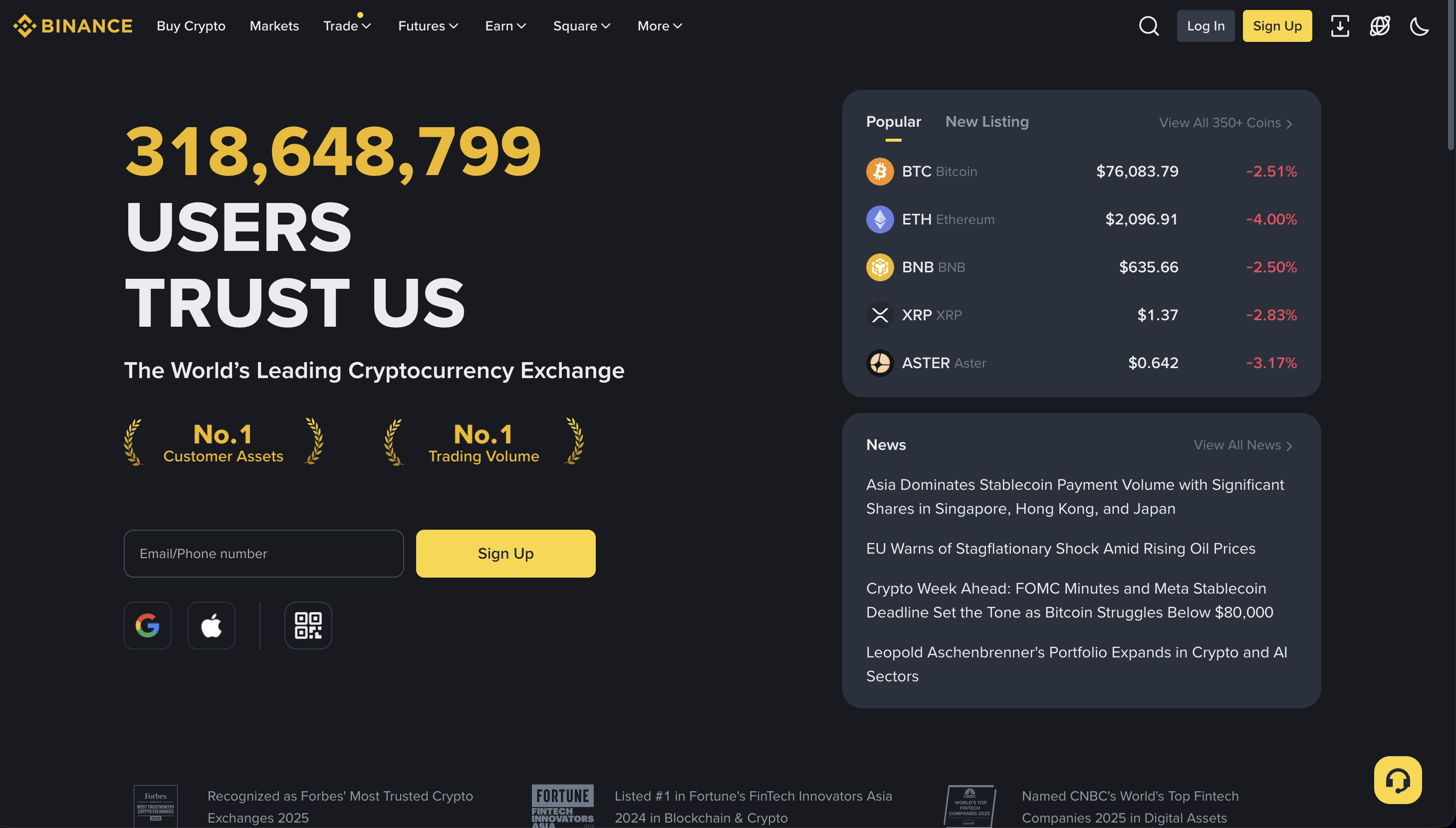
The mechanism is direct ownership. You pay $1,000 of USDT at $103,200 per BTC and the exchange credits 0.0097 BTC to your spot wallet. That 0.0097 BTC is yours. You can sell it on the same exchange, transfer it to a different exchange, or withdraw it to a self-custody wallet like Ledger or Trezor.
What are the defining features of spot?
Five rules separate spot from every other crypto trading product:
- No leverage. Your position size cannot exceed your cash balance. A $1,000 account buys $1,000 of crypto.
- No expiry. Spot positions have no time limit. You can hold a coin for ten years if you want.
- No funding rate. Once you own the coin, the exchange does not charge ongoing fees to hold it on the platform.
- No liquidation. Your worst case is a 100% drawdown if the asset goes to zero. There is no margin call.
- Withdrawable to wallet. You control the private key path. Spot coins can leave the exchange.
What does a real spot trade cost?
Spot fees on major exchanges in 2026 typically sit at 0.075% to 0.10% per trade for tier-zero accounts. A $1,000 buy costs $0.75 to $1.00 in trading fees. A round trip (buy then sell) doubles that to $1.50 to $2.00. Withdrawal fees vary by network, with BTC withdrawals costing 0.0001 to 0.0006 BTC depending on the venue, and stablecoins moving for under $1 on TRC-20 or Solana rails.
Compared to futures, this fee structure is benign. There is no funding rate compounding against you while you hold, no liquidation insurance fee, and no overnight financing cost. The price you pay is the price you pay. Read our how to buy crypto guide for 2026 for the step-by-step purchase walkthrough.
What is futures trading in crypto?
Futures trading is a derivative product. You post collateral, called margin, and open a contract that tracks the spot price of a crypto asset. According to data from CCData (CCData Exchange Review, 2024), crypto perpetual futures accounted for over 70% of total derivatives volume across centralized venues, with daily notional turnover regularly exceeding $200 billion in active months.
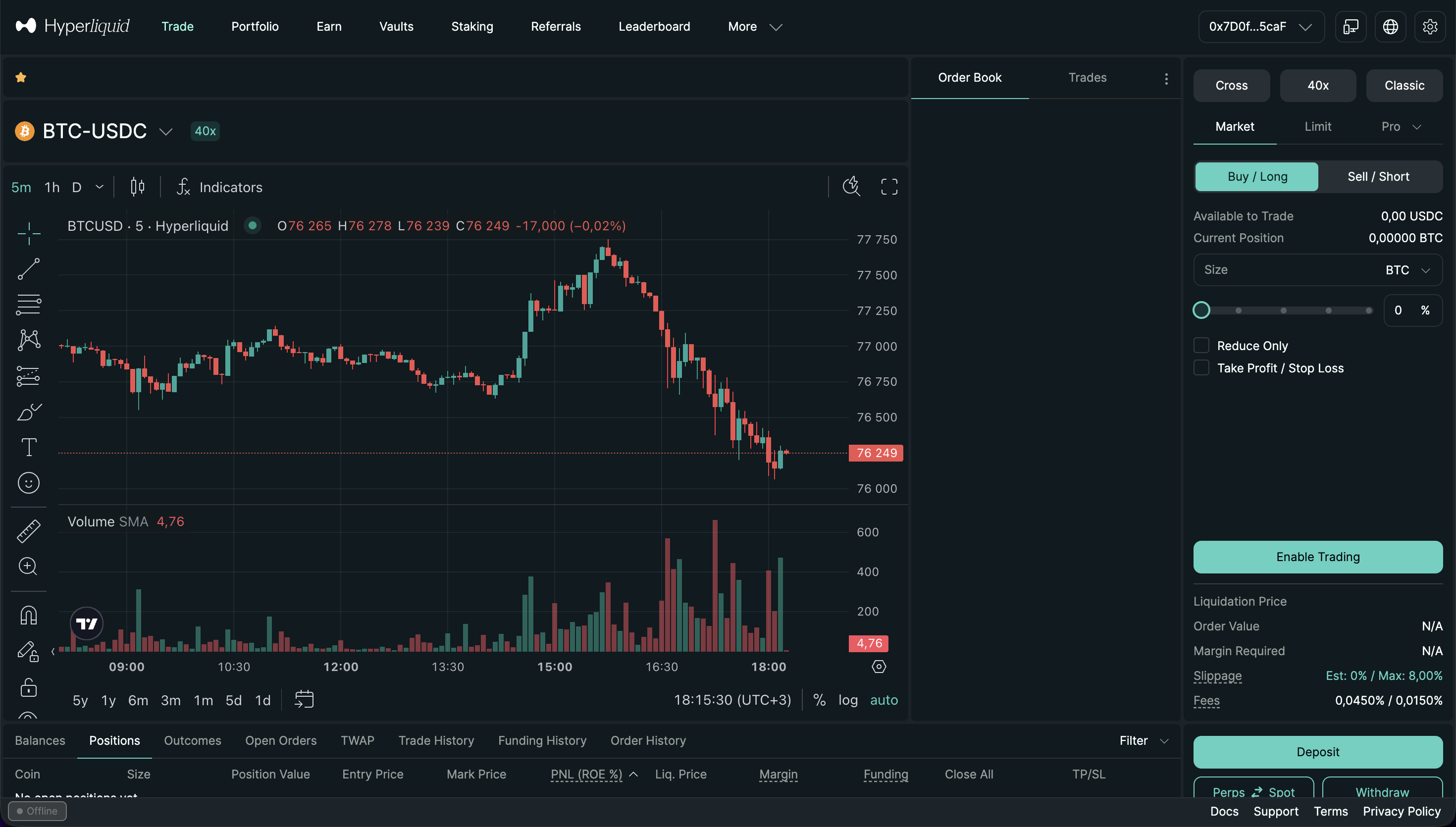
You never receive the underlying crypto. A 10x long on BTC with $1,000 margin creates a $10,000 notional position, but no BTC is delivered to your wallet. You profit or lose based on price movement, and the exchange settles the result in USDT or another quote currency when you close.
What is a perpetual futures contract?
The dominant futures product in crypto is the perpetual contract, often called a “perp.” It has three defining traits:
- No expiry date. Unlike traditional futures, perpetuals do not settle on a quarterly or monthly cycle. You can hold a position indefinitely as long as margin holds up.
- Funding rate every eight hours. To keep the perpetual price anchored to spot, the exchange charges a recurring payment between longs and shorts. Typical rates sit near 0.01% per interval in flat markets, spiking to 0.1% or higher in euphoria.
- Mark price liquidation. Exchanges use a smoothed reference price to trigger liquidation, which prevents single-tick wicks from closing positions on flash spikes.
How does liquidation actually work?
Liquidation is the force-close mechanism that protects the exchange when your margin drops below the maintenance threshold. On a 10x long with $1,000 margin and a 0.5% maintenance margin rate, liquidation triggers near a 9.5% adverse price move. The exchange sells the position, you lose the posted collateral, and the trade is over.
This is the feature that separates a survivable spot loss from a wiped futures account. On spot, a 30% Bitcoin decline leaves you with a 30% unrealized loss and the coin still in your wallet. On 10x futures, the same move closes your trade and erases your margin. Bybit’s futures interface is among the clearest for beginners learning the mechanics, with on-screen liquidation price updates as you change leverage settings on the order panel. You can practice with small position sizes through a Bybit account once you have spot fundamentals down, ideally not before. For the deeper math on liquidation tiers and maintenance margin, see our crypto leverage explained guide.
What does a futures trade actually cost?
Three cost layers stack on every futures position:
- Trading fees. Maker fees run 0.01 to 0.02%, taker fees 0.04 to 0.06% on most major venues. A round trip on a $10,000 notional position costs $10 to $15.
- Funding rate. A 0.01% funding rate every eight hours equals $3 per day on a $10,000 position, or roughly $90 per month. In bull markets the rate can quadruple.
- Slippage on liquidation. If you do get liquidated, the exchange sells into thin liquidity and the final realized loss can exceed your posted margin slightly, before insurance fund coverage kicks in.
How do spot and futures compare side by side?
The differences between spot and futures are easier to grasp in a single comparison than in prose. Across nine common dimensions, the products diverge sharply on risk, ownership, and complexity. According to Kaiko market structure research (Kaiko Research, 2024), the average retail spot account holds positions for 47 days while the average retail futures account holds for 11 hours, a difference that reveals what each product is actually used for.
| Aspect | Spot | Futures |
|---|---|---|
| Own the coin? | Yes | No |
| Max position vs collateral | 1x | Up to 200x |
| Liquidation? | No | Yes |
| Funding rate? | No | Yes (every 8h) |
| Can hold forever? | Yes | Yes (perp) |
| Can short? | No (without margin) | Yes |
| Withdraw to wallet? | Yes | No |
| Tax treatment | Capital gains on sale | Often ordinary income depending on jurisdiction |
| Beginner-friendly? | Yes | No |
The table reveals an asymmetry. Futures offers two genuine advantages (leverage and shorting) and a long list of frictions (liquidation, funding, no ownership, no withdrawal, complex tax). Spot offers fewer levers but removes the failure modes that wipe retail accounts. A beginner trading spot can be slow, undisciplined, or unlucky and still hold the coin at the end. A beginner trading futures with the same flaws is often out of the game inside the first quarter.
What does the math look like on a $1,000 trade?
Numbers expose the trade-off more cleanly than any framework. Take two traders with identical $1,000 starting balances, both bullish on Bitcoin at $103,200, both opening a position on the same day. According to a 2024 Coinglass analysis (Coinglass liquidation dashboard, 2024), Bitcoin recorded 18 days with intraday moves of 5% or more during 2024, which makes the scenarios below realistic rather than theoretical.
The spot path
Trader A buys $1,000 of BTC at $103,200. After the 0.10% spot fee, she ends up holding 0.00969 BTC.
- If BTC rises to $110,000 (+6.6%): Position value is $1,066. Profit is $66, or 6.6% on capital.
- If BTC drops to $93,000 (-9.9%): Position value is $901. Unrealized loss is $99. She still holds 0.00969 BTC and can wait for recovery.
The downside is bounded by the price drop. The coin survives in the wallet.
The futures path
Trader B opens a 10x long on BTC at $103,200 using $1,000 as isolated margin. Notional position size is $10,000. Maintenance margin rate is 0.5%. Estimated liquidation price sits around $93,500.
- If BTC rises to $110,000 (+6.6%): Notional gain is $660. After 0.06% taker fees ($12 round trip) and three days of 0.01% funding ($9), net profit is roughly $639, or 64% on margin.
- If BTC drops to $93,000 (-9.9%): The position liquidates before the move completes. Trader B loses the entire $1,000 collateral.
Same starting capital, same coin, same direction. The futures trader generates ten times the upside but bears 100% downside on a single 10% adverse move. The spot trader keeps her coins regardless of which way the market goes.
Why the asymmetry matters
The futures path produces a higher win when the trader is right and a total loss when the trader is wrong. The spot path produces smaller wins and smaller losses, both proportional to the price move. Over hundreds of trades, the spot trader’s account survives bad runs. The futures trader needs near-perfect entry timing to avoid liquidation, and timing 10% adverse moves on Bitcoin requires a level of skill that takes years to develop. The fees calculator at our fees comparison tool lets you model your own scenario with current rates.
What is the funding rate trap?
The funding rate is the silent cost most beginners overlook on perpetual futures. According to data aggregated by CryptoQuant (CryptoQuant funding rate analytics, 2024), average funding rates on BTC perpetuals across Binance, Bybit, and OKX sat at 0.01% per eight-hour interval through most of 2024, with sustained spikes above 0.05% during the March and November rallies.
The mechanism is anchoring. When perpetual price drifts above spot, longs pay shorts to push the perpetual back down. When perpetual drifts below spot, shorts pay longs. The payment happens every eight hours, automatically debited or credited to your margin balance.
The compounding math
Consider a 30-day hold on a $10,000 notional position with funding sitting at an elevated 0.05% per interval. That equals three intervals per day, ninety intervals per month, and 4.5% of notional in pure funding cost. On a 10x leveraged position with $1,000 margin, that 4.5% of $10,000 equals $450, or 45% of your margin in one month before any price movement.
The trap is structural. In a strong bull market, when retail traders are most likely to pile into longs, funding rates climb because demand for long exposure exceeds short interest. The traders most eager to be long pay the most to hold the position. The traders fading the rally collect funding while shorting at premium prices.
Spot has zero funding cost. Once you own the coin, holding it costs nothing beyond the spread and the original fee. This is one of the largest hidden advantages of spot for any holding period beyond a few days. For the underlying risk framework, see our crypto risk management guide for beginners.
When is spot clearly the right choice for you?
Spot is the right product for most retail traders most of the time. According to a 2024 Chainalysis report (Chainalysis Global Crypto Adoption Index, 2024), over 580 million people held some crypto worldwide, and the vast majority used spot exchanges or self-custody wallets rather than derivatives venues. The use cases below cover roughly 90% of retail intent.
You should choose spot if any of these apply:
- You are accumulating for the long term. Buying BTC or ETH monthly with the intent to hold for years is a spot use case. Funding rates would eat returns over that horizon.
- You actually want to own crypto. Self-custody, hardware wallets, and on-chain transfers all require holding the actual coin. Futures positions cannot be moved off-exchange.
- You have less than $5,000 in trading capital. Below that threshold, the math on futures position sizing becomes brittle. One bad trade ends the account.
- You want to withdraw to self-custody. Spot coins can leave the exchange. Futures positions cannot.
- You live in a jurisdiction where futures are restricted. US retail traders cannot legally access offshore perpetual venues. UK, Singapore, and parts of the EU have similar limits. Confirm your local rules before depositing anywhere.
For non-US beginners, the practical first step is opening an account at one of the platforms we cover in our beginner exchange comparison. Spot pairs are available on every major venue. Pick the one that fits your jurisdiction and fee tier.
When does futures have a legitimate role?
Futures has real applications, none of them designed for beginners. According to BIS Quarterly Review research (Bank for International Settlements, 2024), crypto derivatives volume grew from roughly $5 trillion notional in 2020 to over $50 trillion in 2024, driven primarily by institutional desks, market makers, and arbitrage firms rather than retail directional traders.
The legitimate use cases for futures look like this:
- Hedging spot exposure. A trader holding $50,000 of spot BTC who wants to protect against a short-term decline can open a 1x short perpetual against the position. Any drop in spot is offset by the gain on the short, minus funding cost.
- High-conviction shorts on overpriced alts. When an altcoin runs 300% in a week on hype, an experienced trader can short the perpetual to capture mean reversion. This is not a beginner strategy. Timing the top of an irrational move requires discipline and capital cushion most retail accounts do not have.
- Capital efficiency for sophisticated portfolios. A market maker running delta-neutral books uses cross margin and leverage to size positions efficiently. The trader earns spread, funding, and rebates while keeping net exposure near zero.
- Funding rate arbitrage. When funding spikes above 0.1% per interval, sophisticated traders can short the perpetual while buying spot, capturing the funding payment with minimal directional risk. This is sometimes called the cash-and-carry trade.
Why this is not a beginner playbook
Every legitimate futures use case requires either deep capital, technical infrastructure, or years of trading experience. The retail trader opening 25x longs on BTC after a YouTube tutorial is not doing any of the above. That trader is taking a directional bet with a 14-hour median time to liquidation, based on internal exchange data published through 2025. The product itself is not the problem. The misuse of the product by undertrained users is the problem.
If you do choose to learn futures eventually, the path is: six months of profitable spot trading, then begin paper-trading futures, then trade futures live at 2x to 3x leverage with isolated margin and strict stop losses, then scale only after documented consistency. There is no shortcut.
How do taxes differ between spot and futures?
Tax treatment varies sharply by jurisdiction and by product type, and the gap can change after-tax returns materially. According to a 2024 PwC Global Crypto Tax Report (PwC Global Crypto Tax Report, 2024), over 60 countries now have specific crypto tax frameworks, with spot trades almost universally treated as capital gains events and futures often treated as ordinary income or financial derivative income.
The general patterns look like this:
- Spot in most jurisdictions: Capital gains tax on the difference between sale price and cost basis. Long-term holding periods (one year in the US, longer in some EU countries) often reduce the rate.
- Futures in the US: Regulated CFTC futures contracts use 60/40 capital gains splitting (60% long-term, 40% short-term regardless of holding period). Offshore perpetual contracts sit in a grey area and are generally treated as ordinary income.
- Futures in Russia: Often classified as ordinary income at 13 to 22% depending on income tier. See our Russia crypto tax guide for 2026 for the full breakdown.
- Futures in Turkey: Treatment depends on whether the trade is on a domestic licensed venue or offshore. Details in our Turkey crypto tax guide for 2026.
- Futures in Argentina: Generally subject to the same income tax tiers as other speculative income, with inflation adjustments. Our Argentina exchange guide for 2026 covers the local context.
Tax authorities now receive direct exchange data feeds through the OECD Crypto-Asset Reporting Framework (CARF) and the EU’s DAC8 directive. Accurate reporting matters more in 2026 than it did even three years ago. The honest baseline: track every trade from day one, export CSVs monthly, and consult a local tax professional before your first filing. Skipping this step is the single most expensive mistake beginners make after liquidation.
Final word
Spot is where every crypto trader should start, and where most should stay. You own the coin. You cannot be liquidated. You pay no funding rate. You can withdraw to a hardware wallet. The downside is bounded by the price decline of the asset, not by a leverage multiplier or a margin call. For the first six months of a trading journey, spot teaches every skill that matters: order types, exchange interface, position sizing, emotional control, and tax tracking. Futures adds leverage, liquidation, funding, and complexity, and offers nothing a beginner needs. If futures becomes part of your plan later, treat it as a separate skill earned through documented profitable spot trading, not as a starting point. The traders who survive the first year are the ones who picked the simpler product and learned it well.
Frequently asked questions
What is the main difference between spot and futures crypto trading?
Spot trading means you exchange cash or stablecoins for the actual coin and the exchange credits that coin to your wallet. You can withdraw it to a hardware wallet, hold it forever, and your worst case is a 100% drawdown if the asset goes to zero. Futures trading means you post collateral and open a derivative contract that tracks the spot price. You never receive the underlying coin. The position uses leverage, can be force-closed if price moves against you, and pays a funding rate every eight hours on perpetual contracts. Spot is ownership. Futures is a directional bet. For a first-time trader the practical answer is spot, for at least six months.
Is spot trading safer than futures for beginners?
Yes, by a wide margin. On spot you cannot be liquidated because there is no leverage and no margin call. A 30% drop in Bitcoin produces a 30% unrealized loss, not a wiped account. You still hold the coin and can wait for recovery. On futures, that same 30% move against a 10x position closes the trade and zeros your collateral. A 2023 working paper from the Brazilian Securities Commission found that roughly 97% of retail futures traders lost money over a 12-month window ([CVM and FGV-EAESP study](https://www.cvm.gov.br), 2023). Spot removes the liquidation lever entirely, which is the single largest source of beginner account death.
Can you make money faster with futures than spot?
In theory yes, in practice usually no. A 10x leveraged long turns a 5% Bitcoin move into a 50% return on margin, while spot returns the same 5%. The catch is symmetry: the same 10x position liquidates on a 9 to 10% adverse move, and Bitcoin produces moves of that size multiple times per month on liquid pairs. Coinglass tracked 70 to 90% liquidation rates within 30 days for retail accounts using 25x or higher on majors throughout 2024 and 2025 ([Coinglass liquidation dashboard](https://www.coinglass.com), 2025). Spot grows slower, but the math does not turn against you. Most retail futures accounts produce a fast win, then a fast wipe.
What is a perpetual futures contract?
A perpetual futures contract is a derivative that tracks the spot price of a crypto asset without an expiry date. You can hold the position indefinitely as long as your margin covers the maintenance requirement. To keep the perpetual price anchored to spot, exchanges charge a funding rate, usually every eight hours, paid between longs and shorts. When the perpetual trades above spot, longs pay shorts. When below, shorts pay longs. Typical funding rates sit near 0.01% per interval, or roughly 11% per year in a flat market. In aggressive bull conditions, funding can spike above 0.1% per interval, which translates to over 100% annualized cost on the notional position. Perpetuals are the dominant futures product across Bybit, Binance, OKX, and most international venues.
Do you pay taxes differently on spot vs futures?
Yes, and the gap can be significant depending on jurisdiction. Spot trades are usually treated as capital gains events. You owe tax on the difference between sale price and cost basis when you dispose of the coin. Futures contracts are often treated as ordinary income, mark-to-market gains, or financial derivative income, with different rates and reporting rules. In the United States, regulated futures contracts use 60/40 capital gains splitting, while perpetual contracts on offshore venues sit in a grey area. Russia treats futures as ordinary income at 13 to 22%. Turkey, Argentina, and Brazil each have their own rules. Tax authorities now receive direct data feeds from major exchanges through OECD CARF and DAC8 frameworks, so accurate reporting matters more than ever.
What is liquidation in crypto futures?
Liquidation is the forced closure of a leveraged position when your margin drops below the maintenance threshold. The exchange sells your position to prevent losses larger than your collateral. On a 10x long with $1,000 margin, liquidation triggers near a 9 to 10% adverse price move, depending on the exchange's maintenance margin rate. You lose your entire posted collateral. On spot, this mechanism does not exist because there is no borrowed capital and no margin call. Your loss is limited to the price decline of the coin you own. Liquidation is the single feature that separates a survivable spot loss from a wiped futures account, and it is the reason beginners should avoid leverage until they have months of disciplined practice.
Can you short crypto with spot trading?
Not directly. Spot trading is a buy-and-hold mechanism. You exchange cash for the coin and profit only if the price rises. To short, you need a borrowed asset or a derivative. Some exchanges offer spot margin where you borrow the coin, sell it, and buy it back later, but this introduces borrow fees and liquidation risk similar to futures. The cleaner way to short crypto is through perpetual futures, where you open a short position and profit from price declines. Inverse and options products also allow short exposure. For beginners, the inability to short on spot is a feature, not a limitation. Most retail short attempts fail because timing the top of a trend is harder than identifying the trend itself.
Which is better for long-term crypto investing, spot or futures?
Spot, with no real contest. Long-term investing means accumulating an asset you believe will rise over years, then holding it through volatility. Futures cannot do this efficiently. Funding rates accumulate continuously on perpetual contracts, eating returns even when the position is profitable. A 0.01% funding rate every eight hours equals roughly 11% per year in carrying costs on the notional position. Over a five-year holding period, that drag exceeds 50% before any price impact. Spot has zero carrying cost beyond the original purchase fees, lets you withdraw the coin to self-custody, and removes liquidation risk entirely. Every serious long-term crypto holder we have encountered uses spot, often combined with cold storage. Futures is a trading tool, not a holding tool.
#guide#beginners#spot#futures#leverage#trading#comparison
Discussion
Loading comments…