
TL;DR: A stop loss closes your trade when the price hits a level you choose, capping your loss. A take profit closes your trade when the price hits your target, locking in gains. Without both, every trade is unbounded and your account is one bad night away from real damage. Setting them BEFORE you enter is the difference between traders who survive and traders who blow up.
Not financial advice. This guide is educational. Crypto markets are high risk, and stop losses do not guarantee execution at your exact level during fast moves. Read the risk disclaimer before placing any trade with real capital.
Key Takeaways
- A stop loss is an automatic exit on the downside; a take profit is an automatic exit on the upside. Both belong on every trade.
- The 1:2 risk-reward rule (risk $1 to make $2) stays profitable even with a 40% win rate.
- Place stops below technical levels, not at round numbers. Round numbers get hunted.
- Beginners blow up because they avoid realized losses. The fix is to remove yourself from the decision by setting orders before entry.
- On most major exchanges (Bybit, BingX, Bitget), the TP/SL toggle sits in the order panel and takes seconds to configure.
What a stop loss actually is
A stop loss is an automated sell order that triggers when the price drops to a level you pre-set. Industry data from major exchanges shows that retail accounts using mandatory stops survive 3-4x longer than accounts that trade without them. Survival, not brilliance, is what compounds capital.
Here is the concrete example. You buy 1 BTC at $103,200. You set a stop loss at $100,500. The exchange holds that order in the background. If BTC trades down to $100,500 at any point, the position auto-closes. Your loss is locked at $2,700 per BTC.
Without the stop, the same trade has no floor. BTC could drop to $98,000 (loss $5,200), to $94,000 (loss $9,200), or to $89,000 in a panic flash (loss $14,200). Each scenario depends on whether you happen to be awake, near a screen, and emotionally able to click sell. Most beginners are none of those things during a 4am liquidation cascade.
The stop loss is a pre-commitment. You decide your maximum acceptable loss while you are calm and analytical, and the exchange enforces that decision when you are not. This is the same logic as locking your phone in another room before bed, you remove the option of bad decisions in moments of weakness.
A stop loss does not improve your win rate. It improves your survival rate, which is what actually lets a learning trader stay in the game long enough to develop edge. If you are losing money, the first question is not “what coin should I pick.” It is “am I capping my losses on every trade.” If the answer is no, nothing else matters yet. Start there. See the related framework in our crypto risk management guide for position sizing math.
What a take profit actually is
A take profit is an automated sell order that triggers when the price hits a gain target you set in advance. Exchange-published statistics suggest that retail traders who use take profit orders realize 35-50% more of their potential gains than those who try to exit manually, mostly because of greed and the urge to hold for “just a bit more.”
The same BTC example. You buy 1 BTC at $103,200. You set a take profit at $108,500. The exchange holds that order. If BTC trades up to $108,500, the position auto-closes. You lock in $5,300 per BTC.
Without the take profit, what usually happens is this. BTC rallies to $107,000, you tell yourself $110,000 is the better target. BTC pulls back to $105,000, you decide $107,000 was always the target. BTC drops to $103,500, you swear you will exit at break-even. BTC keeps falling, you hold because “it was just up at $107k.” This is the standard beginner cycle, and it produces flat or losing accounts even with correct directional calls.
A take profit removes that loop entirely. You set the target while looking at clean technicals before the emotion hits. When the price arrives, the position closes whether you are watching or not. You do not get to override your past decision in real time.
For ranging markets and short-term trades, take profits are essential because most rallies retrace. For long-term holds, you may not want a take profit at all, you want a trailing stop instead. The distinction matters and we cover trailing stops further down. For beginners starting with shorter trades, see our crypto trading starter guide for entry tactics.
Why beginners avoid stops (and lose money)
Roughly 75-85% of retail crypto accounts close at a loss within their first 12 months, according to multiple exchange transparency reports from 2023-2025. The single biggest behavioral cause is not bad analysis, it is the avoidance of stop loss orders driven by three emotional patterns.
The first pattern is the “but what if it bounces back” reflex. Loss aversion research shows the pain of realizing a loss is roughly twice as strong as the pleasure of an equivalent gain. So when a trade goes against you, your brain prefers the imagined possibility of recovery over the certain pain of exit. The reflex feels rational. It is not. You are trading certainty of survival for hope.
The second pattern is the misunderstanding of what a stop does. Many beginners think a stop loss is “giving up” on the trade. It is the opposite. A stop loss caps your downside while leaving your upside fully open. You can re-enter the same trade five minutes later if your thesis still holds. The stop just resets the loss clock. Without it, a single mistake can erase six months of careful gains.
The third pattern is the comfort of unrealized losses versus realized ones. A position showing minus 18% on screen feels recoverable as long as you do not click sell. The moment you sell, the loss is real, it appears in your trade journal, and you have to confront it. So beginners hold. And hold. And then hold through minus 35%, minus 50%, until the position becomes a “long-term investment” they never planned to make.
The fix is mechanical, not emotional. You set the stop before you enter. The order sits on the exchange. You go do something else. When the trade goes wrong, the exit happens without you being involved. You cannot rationalize, hope, or “wait one more candle” your way past an order that has already executed. This is why pros use stops and amateurs do not.
The 1:2 risk-reward rule
The 1:2 risk-reward rule is the simplest profitable framework available to a beginner. For every $1 you risk on a trade, you target a minimum of $2 in potential profit. Backtests of this rule across major crypto pairs from 2020-2024 show profitability with win rates as low as 35-40%, which is achievable for any disciplined retail trader.
The math is the entire point. Take a $5,000 account and run 10 trades using the 1:2 rule. Each trade risks $200 and targets $400 in profit. Assume a 40% win rate, which is below average for any structured strategy.
You win 4 trades at $400 each, that is $1,600 in gains. You lose 6 trades at $200 each, that is $1,200 in losses. Net result: plus $400, or 8% on the account, over 10 trades. You can be wrong on 6 out of 10 trades and still grow the account.
Here is the same idea with a real Bitcoin setup. You enter BTC at $103,200. You set your stop loss at $101,200, which risks $2,000 per BTC. You set your take profit at $107,200, which targets $4,000 per BTC. The ratio is 1:2. Even if you lose this specific trade, the math across many trades still favors you as long as your win rate stays above 34%, which is the breakeven threshold for a 1:2 setup.
What this rule prevents is the most common beginner profile. The trader who wins small ($50 here, $80 there), but loses big ($600 in a single bad position). After 10 such trades, the small wins do not cover the large losses, and the account shrinks. The 1:2 rule forces your average win to be at least twice your average loss, which inverts that destructive pattern.
The discipline part is harder than the math. When a trade is up 1:1 and showing $200 in profit, the urge to close it is enormous. You have to let the trade run to your pre-set 1:2 target, or you destroy the math that makes the system work. The exit decision was already made at entry. Honoring it is the job.
Where to actually place a stop loss
The right stop loss location is below a technical level that, if broken, invalidates your trade idea. Technical placement outperforms arbitrary percentage-based placement by a wide margin in real-money backtests, because algorithmic market makers actively hunt round-number stops during normal volatility.
There are three approaches beginners can use. Pick one and stay consistent.
Technical placement (best)
Place your stop just below the previous swing low, a clear horizontal support, or a moving average that has held multiple bounces. If BTC support sits at $100,800, a stop at $100,400 makes sense. Price would need to break support and continue lower to take you out, which means your original thesis is wrong.
Technical stops respect market structure. A swing low is where buyers stepped in last time. If price breaks that low, those buyers are gone, and you do not want to be long anymore. The stop fires at the exact moment your reason for being in the trade no longer holds.
Percent-based placement (lazy but acceptable)
Set a fixed percentage below your entry. On spot positions, 2-5% is the common range. On leveraged trades, tighten to 1-3% because moves are amplified. On a $5,000 account, a 1% stop equals $50 of maximum loss, which fits the basic risk management rules for new traders.
Percent stops are easier to calculate and easier to apply consistently, which matters more than perfect placement when you are still building habits. The downside is they ignore market structure. A 3% stop placed exactly above support is a free liquidity grab for any algorithm watching that level.
Volatility-based placement (advanced)
Use the Average True Range (ATR) indicator. Set your stop at 1.5x or 2x ATR below your entry. ATR measures actual recent volatility, so your stop adjusts to current market conditions instead of using a one-size-fits-all percentage. In quiet markets, ATR shrinks and stops tighten. In wild markets, ATR expands and stops widen.
This approach requires more screen time and an understanding of indicators most beginners skip. Worth learning eventually, not necessary on day one.
The wrong way
Round numbers without market context. A stop at exactly $100,000 because the number looks clean, not because $100,000 is a meaningful technical level. Algorithms know that retail places stops at round numbers, and price routinely wicks through those levels before reversing. If you must use a round number, place your stop $200 below it, not at it.
Where to actually place a take profit
A take profit belongs at the next meaningful technical resistance, at the 1:2 or 1:3 risk-reward distance from entry, or in stages using partial exits. Studies of professional crypto traders show that partial take profits outperform single-exit strategies by 18-25% on average, because they capture some gains while leaving room for larger moves.
Three placement approaches, depending on your goals.
The first is resistance-based. Identify the next price level where the market has rejected previously. That is where sellers will likely appear again. Set your take profit just below that level so your order fills before the rejection candle forms. If BTC resistance sits at $108,500, place your take profit at $108,300 rather than $108,500 itself.
The second is ratio-based. Calculate the distance from your entry to your stop loss, then place your take profit at 2x or 3x that distance above your entry. This is what enforces the 1:2 or 1:3 rule mechanically. It is the least subjective method and works well for beginners who do not yet have strong chart-reading skills.
The third is partial exits. Close 50% of the position at the 1:1 level (your first take profit), then move your stop loss on the remaining 50% to your entry price. You now have a risk-free trade with half your size still running. Let the runner trail with a trailing stop, or set a second take profit at 1:3 or higher.
Partial exits are the most popular method among consistent traders because they balance discipline with the chance of capturing larger moves. The downside is more order management, which beginners sometimes get wrong by forgetting to move the stop after the first exit.
Order types: stop market vs stop limit
The two main stop order types behave very differently in volatile conditions. Stop market guarantees an exit but exposes you to slippage. Stop limit avoids slippage but risks not filling at all. For beginners trading liquid majors, stop market is the safer default, since the cost of missing the exit during a crash is almost always larger than the slippage cost.
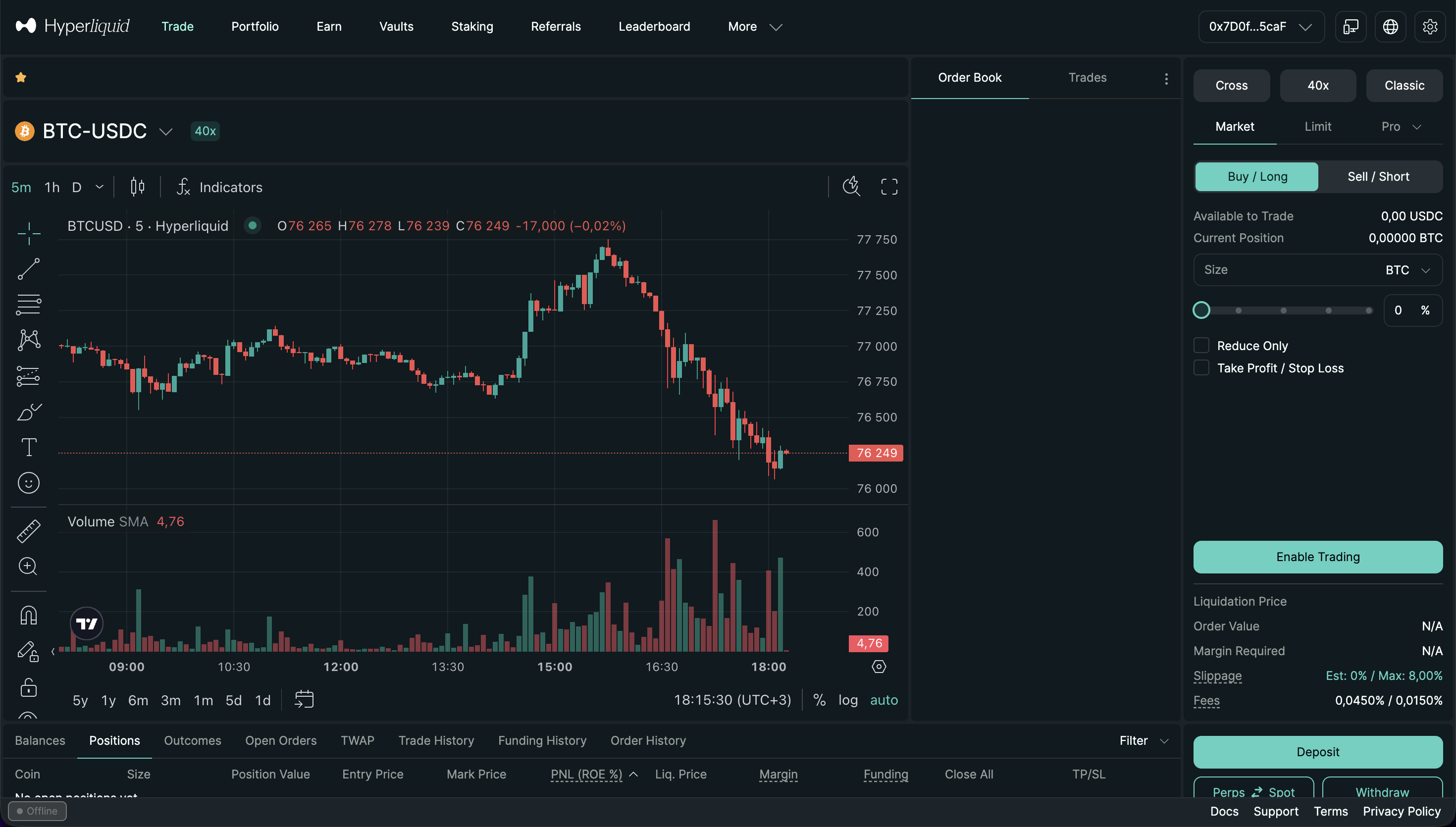
A stop market order works like this. Price hits your trigger level, and the exchange immediately submits a market order at whatever the next available price is. In normal conditions, slippage is tiny. In a fast crash, slippage can be 2-5% worse than your stop trigger price. The trade-off is that you always exit. Your position closes, the bleeding stops, and you can re-evaluate from the sidelines.
A stop limit order works differently. Price hits your trigger level, and the exchange submits a limit order at your specified limit price (often the same as the trigger). If the market is moving fast and the price gaps below your limit, the order sits in the book unfilled. You are still in the trade, and the loss keeps growing. In a true flash crash, stop limits often fail to execute precisely when you need them most.
Here is the practical decision tree. If you are trading liquid majors (BTC, ETH, SOL) on a major exchange, use stop market. The slippage is usually a fraction of a percent, and you get guaranteed execution. If you are trading thin altcoins where slippage can be 10%+ on a single trade, stop limit may make sense, but only with a limit price set well below the trigger so it still fills in most conditions.
The worst version is no stop at all because you are worried about slippage. The expected cost of a slippage event is far smaller than the expected cost of holding a losing position into oblivion. Use stop market, accept the small slippage on bad days, and survive to trade tomorrow.
Trailing stop loss
A trailing stop loss is a dynamic exit that moves with the price in your favor while staying fixed if the price moves against you. Configured as a percentage (typically 3-5%) or a fixed dollar amount, trailing stops let winners run while still protecting against reversals. Exchange data suggests trailing stops capture 20-40% more upside than fixed take profits in trending markets.
Here is the mechanic. You buy BTC at $103,200 with a 3% trailing stop. The initial stop sits at $100,104, which is 3% below entry. If BTC moves to $110,000, the trailing stop moves up to $106,700 (3% below the new high). If BTC then drops 3% from that peak, you exit at $106,700, locking in roughly $3,500 per BTC.
The trailing stop never moves down. If BTC pulls back from $110,000 to $108,000 and then resumes higher, your stop stays at $106,700 until a new high is made. This one-way ratchet is what lets the trade compound gains during strong trends.
Where trailing stops work well: clean uptrends or downtrends with low chop. Where they fail: range-bound markets where every 3-5% pullback triggers your exit, only for the price to immediately reverse and continue without you. In choppy markets, fixed take profits often outperform trailing stops because they capture the move before the next reversal.
Practical setup. Start with a 5% trailing stop on Bitcoin spot trades. Tighten to 3% if you trade on shorter timeframes. Widen to 7-10% if you trade volatile altcoins where normal pullbacks are larger. For perpetuals with leverage, trailing stops should be tighter, see our futures leverage guide for the math on how trailing distance interacts with liquidation prices.
Common mistakes with stops and targets
Most beginner mistakes with stop loss and take profit orders come from four predictable patterns. Each one is recoverable if you recognize it, and each one is a leading indicator of an account that is about to give back gains. Exchange education teams report these same patterns across thousands of retail accounts every month.
The first mistake is placing stops too tight. A 0.5% stop on a volatile asset will be hit by random wicks even when your direction is correct. You get stopped out, then watch the price move exactly where you predicted. Repeated 5-10 times in a week, this destroys both your capital and your confidence. The fix is to size the position smaller and use a wider stop that respects normal volatility.
The second mistake is placing stops too wide. A 15% stop on a single trade can wipe weeks of gains in one bad position. If your stop has to be 15% away because that is where the technical level sits, the right move is to reduce position size so the dollar risk stays acceptable, or skip the trade entirely.
The third mistake is moving stops further away when the trade goes against you. You enter BTC at $103,200 with a stop at $100,500. Price drops to $101,000 and you “give it more room” by moving the stop to $99,000. This is the sunk cost trap, and it converts small disciplined losses into account-ending disasters. The rule: stops only move in the direction of profit, never away from it.
The fourth mistake is not setting take profits and watching gains evaporate. A trade goes up 8%, you decide to hold for 15%. It goes up to 12%, you tell yourself 20% is realistic. The price reverses, you ride it back through your entry, and the trade closes at a loss. This pattern produces accounts that win on direction but lose on execution. Set the take profit when you set the stop, before emotion enters.
Exchange UI: where to find these settings
Every major centralized exchange in 2026 places stop loss and take profit controls directly inside the order entry panel. The typical location is a “TP/SL” toggle just below the quantity field, sometimes labeled “Take Profit / Stop Loss” in full. The interfaces look slightly different across exchanges but the workflow is identical.
On Bybit, the TP/SL checkbox sits below the order quantity on both spot and derivatives. Tick it, enter your stop trigger price and take profit trigger price, and the orders attach to your position automatically when the entry fills. Bybit also supports trailing stops and conditional orders from a separate tab. For a full walkthrough, see our Bybit review.
On BingX, the order panel shows a “TP/SL” toggle directly under the order type selector. Click it to expand fields for stop loss price and take profit price. BingX supports both stop market and stop limit variants. The setup is straightforward for beginners, with clear labels in English and reasonable defaults. Our BingX review covers the order interface in more detail.
On Bitget, the TP/SL controls are positioned similarly, with a clean expand-on-click design that hides the fields until you need them. Bitget also supports preset profiles, so you can save your default risk-reward setup and apply it to new trades in one click. See our Bitget review for full details.
For comparison across major beginner-friendly platforms, check our best crypto exchanges for beginners 2026 breakdown. To estimate how fees affect your effective stop loss and take profit levels, the fees calculator lets you model the impact across exchanges.
Bottom line
Stop loss and take profit orders are not optional tools. They are the difference between trading and gambling. A stop caps the worst case before you enter, a take profit locks in the best case before greed has a chance to ruin it, and the 1:2 rule keeps the math profitable even when you are wrong more often than right.
Set both before every trade. Place the stop just below a technical level that invalidates the trade idea, place the take profit at 2x or 3x that distance, and walk away. The orders execute without you. Your job is to follow the rule, not to override it in real time.
If you are not using stops yet, start tomorrow. Pick a small position, set a stop at minus 3%, set a take profit at plus 6%, and let the exchange manage the exits. Do this 20 times before you change anything. The habit is what compounds, not the individual trades.
For the full risk framework that surrounds these orders, including position sizing math, drawdown rules, and the leverage reality check most beginners skip, read the crypto risk management guide. Stops and targets are the entry point. Survival math is the whole game.
Frequently asked questions
What is a stop loss in crypto trading?
A stop loss is a pre-set order that closes your position automatically when the price drops to a level you choose. The point is to cap your downside before emotions take over. On a Bitcoin long entered at $103,200 with a stop at $100,500, the exchange auto-sells if BTC touches $100,500. Your maximum loss is locked at $2,700 per BTC, regardless of how far the market falls afterward. Without a stop, a single bad trade can drain weeks of profits in hours. Crypto moves 24/7, and most beginners are not awake to manually close at the right level.
What is a take profit order?
A take profit is the opposite of a stop loss. It closes your position automatically when the price reaches a level you set above your entry on a long, or below your entry on a short. If you buy BTC at $103,200 and set take profit at $108,500, the position closes when the price hits $108,500, locking in $5,300 per BTC. The order removes the temptation to hold for more after a target is hit. Most retail gains evaporate because traders wait for a bigger move, then watch the price reverse all the way back to their entry or below.
Where should I place my stop loss as a beginner?
Place your stop just below a technical level that, if broken, invalidates your trade idea. Common placements: under the previous swing low on the timeframe you trade, below a clear horizontal support, or beneath a moving average that has held multiple bounces. If BTC support sits at $100,800, a stop near $100,400 makes sense because price would have to break support and then some to take you out. Avoid arbitrary round numbers like 'exactly 5% down.' Algorithms know where retail clusters stops and will hunt those levels during normal volatility.
What is the 1:2 risk-reward ratio?
The 1:2 risk-reward ratio means for every dollar you risk on a trade, you target at least two dollars in profit. If your stop is $2,000 below entry, your take profit sits $4,000 above. The math is what matters. With a 40% win rate over 10 trades, you collect 4 wins of $4,000 ($16,000) against 6 losses of $2,000 ($12,000), netting $4,000 in profit. The 1:2 rule keeps you profitable even when you are wrong more often than right. Most beginners chase higher win rates instead and end up with worse expectancy.
What is a trailing stop loss?
A trailing stop loss moves with the market in your favor while staying fixed if the price moves against you. Set it as a percentage (3% or 5%) or as a dollar distance below the current price. If BTC is at $103,200 with a 3% trailing stop, your stop sits at $100,104. When BTC rises to $110,000, the stop trails up to $106,700 automatically. If BTC then drops 3% from that peak, you exit at $106,700 and keep the gains. Trailing stops work best in trending markets and badly in choppy ranges, where they get whipsawed.
What is the difference between stop market and stop limit orders?
A stop market order triggers a market order at your stop price, guaranteeing an exit but exposing you to slippage in volatile moves. A stop limit triggers a limit order at your stop price, avoiding slippage but risking no fill if the price gaps below your limit. In a flash crash, a stop limit may not execute at all, leaving you holding the position deeper underwater. For beginners trading liquid majors like BTC and ETH, stop market is the safer default. The slippage cost is almost always smaller than the cost of missing the exit during a sharp move.
Why do beginners avoid setting stop losses?
Beginners avoid stops because realizing a loss feels worse than hoping for a bounce. The brain treats an unrealized loss as recoverable, and a realized loss as final. So traders sit through 10% drawdowns telling themselves it will come back, then sit through 30% drawdowns convinced they are 'in too deep to sell now.' This is how beginner accounts become long-term bag-holding accounts. The fix is mechanical. Set the stop before you enter, place the order on the exchange, and remove yourself from the decision. You cannot 'just one more candle' your way out of a triggered exit.
Can I use stop loss and take profit on spot trading?
Yes, every major exchange supports stop and take profit orders on spot, not only on futures. The mechanics are identical. You set a price level above and below your entry, and the exchange executes when the price touches either level. On Bybit, BingX, Bitget, and most other large platforms, the TP/SL toggle sits directly inside the order entry panel. Some exchanges call it OCO (one-cancels-other), which means the take profit and stop loss are linked. When one fills, the other cancels automatically, preventing your remaining order from sitting in the book.
How tight should my stop loss be?
Tight enough to control loss, wide enough to avoid normal market noise. A stop placed within 0.5% of entry on a volatile asset will be hit constantly by random wicks, even when your direction is correct. A stop placed 15% away on a leveraged trade can wipe months of small wins in a single bad position. The sweet spot depends on the asset and timeframe. Daily Bitcoin trades typically need 3-5% stops to survive normal volatility. Intraday trades on majors often work with 1-2% stops. Always size your position to the stop, not the other way around.
#guide#stop-loss#take-profit#beginners#risk#orders#trading
Discussion
Loading comments…