
TL;DR: Starting crypto trading in 2026 means more than buying coins. It is a workflow: pick a regulated exchange, complete KYC, deposit a small amount, learn to place a limit order on spot, size positions at 1 to 5 percent of capital per trade, use stop losses, and journal every trade. Skip futures for the first six months. Skip copy trading until you understand what good performance actually looks like. Most beginners lose money in their first year because they treat trading like buying lottery tickets. The traders who survive treat it like a slow craft.
Not financial advice. Crypto trading carries substantial risk of loss. The information in this guide is educational. We have no insight into your finances, jurisdiction, or risk tolerance. Read the risk disclaimer and our methodology before committing capital. Past performance does not predict future results.
What “trading” actually means
Most newcomers blur three different activities under “crypto trading,” and the confusion costs them money. Buying and holding Bitcoin for two years is not trading. That is investing or “stacking.” Trading means taking deliberate positions with a defined entry, exit, and risk plan, usually over horizons of minutes to weeks. The distinction matters because the skills, time commitment, and tax treatment differ.
There are three common paths a beginner sees pitched:
- Spot trading: You buy the actual asset (Bitcoin, Ethereum, a stablecoin pair). Your downside is capped at zero. No liquidation. No funding fees. This is where everyone should start. If you bought $500 of BTC at $103,200 and BTC drops to $90,000, you have an unrealized loss of roughly $64. You still own the BTC.
- Futures trading: You trade leveraged contracts. A 10x position means you control $5,000 of BTC exposure with $500 of margin. A 10 percent move against you wipes the position. Funding fees are paid every eight hours. This is professional-grade risk that retail consistently underestimates.
- Copy trading: You allocate funds that mirror another trader’s positions automatically. Detailed in our what is copy trading guide. It removes the strategy work but adds platform risk and lead-trader selection risk. Not a shortcut to skipping the learning curve.
This guide focuses on the spot-first path. Futures and copy trading appear later in the workflow, and only after you have a base of competence.
Step 1: Pick the right exchange
Exchange choice is the single largest decision a beginner makes, and most people make it badly. They pick whichever platform a YouTuber promoted with a sign-up code. The criteria that actually matter:
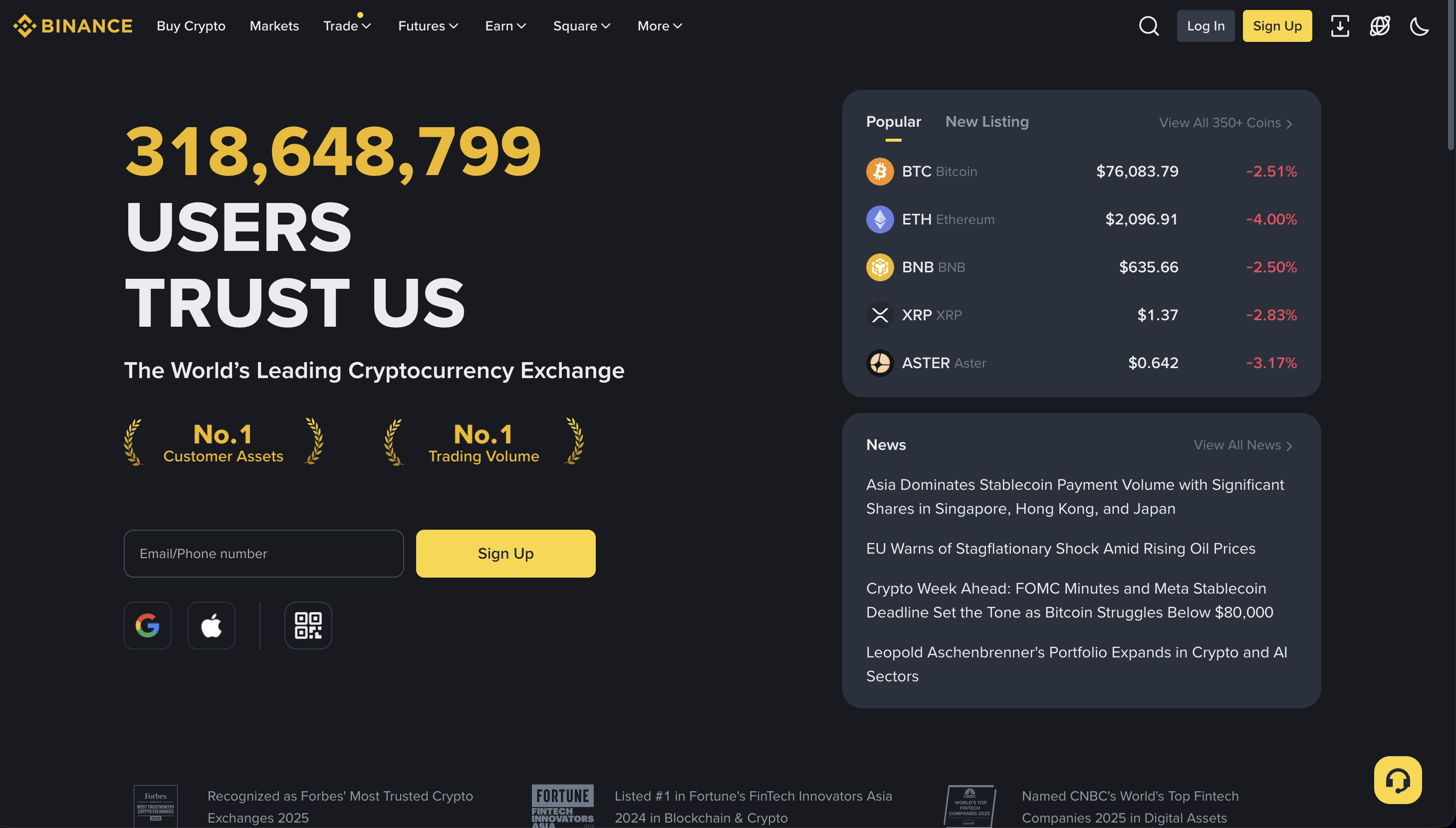
Jurisdiction and licensing. If you live in the US, your practical options are Coinbase, Kraken, and Gemini. International exchanges (Bybit, BingX, OKX, Bitget) do not serve US users and geo-block US IPs. Trying to bypass this with a VPN is how funds get frozen during withdrawal. For UK users, FCA-registered platforms apply different rules. For most of Europe, MiCA-compliant exchanges are the default in 2026. For LATAM and Southeast Asia, the international platforms are accessible.
Proof of reserves and security record. After FTX collapsed in November 2022, proof-of-reserves became table stakes. A 2024 audit by CryptoQuant tracked monthly reserve attestations across 15 major exchanges (CryptoQuant exchange reserves dashboard, 2024). Bybit, OKX, Binance, Bitget, BingX, and Coinbase all publish regular attestations. If an exchange does not publish proof of reserves in 2026, that alone is a reason to skip it.
Fee structure. Spot maker fees on tier-zero accounts at most major exchanges sit between 0.075 percent and 0.20 percent. Taker fees run 0.10 to 0.25 percent. Withdrawal fees vary widely: BTC withdrawal can cost 0.0001 BTC to 0.0006 BTC depending on the venue. Our fees calculator compares actual cost on a $1,000 round trip.
UI for beginners. Some exchanges have clean beginner modes (Coinbase, Bybit’s Simple mode). Others throw you into a derivatives terminal on first login. The friction matters when you are learning.
For non-US beginners in 2026, the practical shortlist is Bybit (deep liquidity, polished UX, the largest by spot+derivatives volume after Binance) and BingX (built around copy trading, friendly for first-time users). We rank both alongside OKX, Bitget, Coinbase, and Kraken in our full beginner exchange comparison. If you want to support the site, signing up via BingX or Bybit helps fund our independent research, but choose whichever fits your jurisdiction and feature needs, not whichever pays us.
Step 2: Account setup and KYC
Plan to spend 15 to 60 minutes on this step. KYC (Know Your Customer) is mandatory on every regulated exchange and increasingly enforced on previously lighter platforms. The 2023 to 2025 enforcement cycle effectively ended the no-KYC era on major venues.
What you will need:
- A government-issued photo ID (passport, national ID card, or driver’s license in most jurisdictions)
- A clear selfie or short video for liveness verification
- A utility bill or bank statement dated within the last 90 days, for address verification at higher tiers
- A working email address and phone number for two-factor authentication
- For some jurisdictions: a tax identification number (SSN in the US, NIN in the UK, CPF in Brazil, NIE in Spain)
Tiered verification. Most exchanges have multiple KYC levels. Basic KYC (ID plus selfie) unlocks deposits up to a few thousand dollars per day. Full KYC (with proof of address) raises limits to tens or hundreds of thousands. Start with basic. You will not need higher limits for months.
Time expectations. Automated KYC clears in 5 to 30 minutes on most platforms in 2026. Manual review can take 1 to 3 business days during high-volume periods (every bull market spike floods compliance teams). Submit during off-peak hours if you want faster turnaround.
Two-factor authentication. Enable it the moment you complete KYC, before depositing any money. Use an authenticator app (Google Authenticator, Authy, or Aegis) rather than SMS. SIM-swap attacks remain a real attack vector against retail traders.
Step 3: First deposit (small)
Deposit a small amount first. Not because the exchange will steal it, but because you will inevitably make a mistake on your first transfer, and a $100 mistake is education while a $5,000 mistake is a problem.
Two main deposit paths:
- Fiat deposit via bank transfer (ACH, SEPA, Faster Payments, Pix in Brazil). Typically free or near-free, takes minutes to 1 to 2 business days. Card deposits work but carry 1 to 5 percent fees and should be avoided for anything beyond emergency funding.
- Stablecoin deposit (USDT or USDC sent from another wallet or exchange). Instant once the blockchain confirms. Network fees vary: TRC-20 USDT costs roughly $1, ERC-20 USDT $3 to $15 depending on Ethereum gas, Solana USDC under $0.01. If you already hold stablecoins elsewhere, this is often cheaper than fiat rails.
The test deposit rule. Always send a small amount first. For your very first transfer to a new exchange, send $20 to $50 of stablecoins as a test. Confirm it arrives in your spot wallet. Then send the rest. This is one of the few rituals that experienced traders never skip, because reversed addresses, wrong networks, and pasting errors do happen.
Why deposit small initially. $200 to $500 is plenty for your first month of learning. With $300, you can make 30 trades at $10 each, or 6 trades at $50 each, and learn the entire workflow. With $5,000 on day one, you will be tempted to size up before you should. Capital follows competence, not the other way around.
Read our companion guide on how to buy crypto in 2026 if you need to convert fiat to crypto before depositing.
Step 4: Your first trade, spot, not futures
Your first trade should be BTC or ETH on spot. Not a meme coin. Not a 50x leveraged position. Not a “stealth gem” some Telegram channel promoted. Bitcoin or Ethereum, spot, small size.
Why BTC or ETH. They have the deepest liquidity, the tightest spreads, the lowest slippage, and the longest track records. Their behavior is easier to study because there is 10+ years of price history. Altcoin trading introduces multiple failure modes at once (low liquidity, project risk, exchange listing risk) that beginners cannot separate from their own decisions.
Limit order vs market order. Understanding this distinction is the most important micro-skill on your first day.
- A market order buys or sells immediately at the best available price. Fast, but you accept whatever the order book offers. On illiquid pairs, you can lose 1 to 3 percent to slippage.
- A limit order places a buy or sell at a specific price you choose. It only fills if the market reaches that price. You pay maker fees (usually lower than taker fees) and avoid slippage. The trade-off is the order may never fill.
Concrete example. Say BTC is trading at $103,200. You want to buy $100 worth. If you place a market order, the exchange might fill you at $103,210 instantly, and you pay a taker fee of, say, 0.10 percent ($0.10). If you place a limit buy at $102,800, you save $400 per BTC (about $0.39 on your $100 position) but only if BTC dips to $102,800 within the order’s lifetime. If BTC rallies to $104,000 without touching $102,800, your limit order never fills, and you miss the move.
Step-by-step for your first trade:
- Move from your spot wallet into the spot trading interface for the BTC/USDT pair.
- Choose limit order. Resist the urge to market-buy on day one.
- Set the price slightly below current market (0.1 to 0.3 percent below for high-liquidity pairs).
- Set the quantity. Start with $50 to $100 total notional. Not 50 percent of your account.
- Review the order. Confirm the fee and total cost shown match your math.
- Submit. Watch the order book to see how it sits.
- If it fills, screenshot the trade. Note the entry price, fee, and timestamp.
- Do not check it every five minutes for the next hour. Walk away.
Common first-trade mistakes. Buying with a market order on a low-liquidity altcoin and losing 5 percent to slippage instantly. Misreading the order quantity field (entering 10 BTC instead of 10 USDT). Setting a stop loss in the wrong direction. Confusing the spot wallet with the futures wallet. Every experienced trader has done at least one of these. Doing it on $50 is a story. Doing it on $5,000 is a disaster.
Step 5: Position sizing math
Position sizing is the single most underrated skill in retail trading. It is also the most boring, which is why beginners ignore it. A 2022 Binance research piece on retail trader behavior noted that account survival rates correlate more strongly with average position size relative to capital than with any other variable, including win rate (Binance Research retail behavior series, 2022).
The 1 to 5 percent rule. For your first three months, never risk more than 1 to 5 percent of total account capital on a single trade. Risk means the dollar amount you would lose if your stop loss triggers, not the notional size of the position.
Concrete examples.
- Account size: $500. Maximum risk per trade at 2 percent: $10. If your stop loss is 5 percent below entry, the position size that risks $10 is $200 ($10 / 0.05).
- Account size: $1,000. Maximum risk per trade at 3 percent: $30. With a 4 percent stop, position size is $750 ($30 / 0.04).
- Account size: $2,000. Maximum risk per trade at 2 percent: $40. With a 3 percent stop, position size is $1,333. Notional exposure is large, but actual dollar risk is bounded.
Why this matters. If you risk 2 percent per trade, you can be wrong ten times in a row and still have 81.7 percent of your starting capital. If you risk 20 percent per trade, ten losses in a row leave you with 10.7 percent. Drawdown math is exponential, and recovery requires asymmetric gains. A 50 percent drawdown needs a 100 percent gain to recover. A 75 percent drawdown needs a 300 percent gain.
The position sizing formula.
Position size = (Account size * Risk per trade %) / Stop loss distance %Write this down. Tape it next to your screen. Use it before every trade. Do not deviate. The instinct to size up after a winning streak is the most common path to blowing an account. The instinct to size up after a losing streak (“I need to win this one back”) is the second most common. Both are wrong. Position sizing is mechanical, not discretionary.
Step 6: Stop loss and take profit
Stop losses are not optional, even on spot. The argument “I am not using leverage so I do not need a stop” misses the point. A stop loss is a pre-committed decision about how much you are willing to lose. Without one, beginners freeze when prices drop and watch a 5 percent loss become a 40 percent loss while telling themselves the bounce is coming.
Stop loss types.
- Hard stop: A live order placed on the exchange that triggers automatically when price hits your level. Recommended for beginners. Removes discretion from a moment when you cannot trust your own judgment.
- Mental stop: A price level you commit to, but no live order. Requires discipline most beginners do not yet have. Use only after a few months of demonstrated stop-loss adherence.
Where to place the stop. A common starting framework: set the stop below a recent swing low or support level. The stop should be at a level that says “if price reaches here, my thesis is wrong.” Not “let me back out 1 percent below entry because I am scared.” That is overoptimization.
Concrete example. You buy BTC at $103,200. Recent daily swing low is at $99,500. You place a stop at $99,200 (slightly below the swing low to avoid stop hunts). Distance: $4,000, or 3.87 percent. If your account is $1,000 and you risk 2 percent ($20), position size is $20 / 0.0387 = $517 of BTC. Take profit: define before entry. A reasonable framework is a 2:1 reward-to-risk ratio. If your stop is $4,000 below entry, take profit is $8,000 above, at $111,200.
Take profit discipline. Take profit can be scaled. Take half off at the first target. Move the stop to breakeven. Let the remainder run with a trailing stop. This converts a winning trade into a structured exit rather than a one-shot guess.
Step 7: Track your trades
Every trade you make in your first year should be journaled. Not in your head. In writing, in a spreadsheet or dedicated trading journal app. This single habit separates traders who improve from traders who keep making the same mistakes.
What to record per trade:
- Date, time, and pair (BTC/USDT, ETH/USDT)
- Entry price, position size, total notional
- Stop loss price and take profit target
- Why you entered (one or two sentences, before the trade)
- Exit price, exit time, and P&L in dollars and percent
- Fees paid
- One-line lesson after the trade closes
Why this works. Memory is unreliable. Three months in, you will not remember whether you were profitable on ETH longs in March or just remember the big winner. The journal forces honesty. After 50 trades you start seeing patterns: certain pairs work for you, certain times of day are disasters, certain emotional states (after a loss, late at night, during major news) correlate with mistakes.
Tax record-keeping. Most jurisdictions require trade-level records. Tax software like Koinly or CoinLedger imports your exchange CSV automatically, but you should keep your own backup. Exchange data can disappear (closed accounts, delisted pairs, platform shutdowns). Your journal is the source of truth.
Common beginner mistakes
The patterns are remarkably consistent across new traders. Recognizing them in advance does not prevent them, but it does shorten the lesson.
Overleveraging on futures. New traders look at 100x leverage and see opportunity. The math shows ruin: at 100x, a 1 percent adverse move liquidates the position, and crypto routinely makes 1 percent moves in minutes. Industry P&L disclosures from major derivatives venues suggest 70 to 85 percent of retail futures accounts are net negative within 12 months (Bybit P&L public dashboard, 2024).
FOMO buying tops. The asset is up 40 percent in a week. Social media is full of green charts. You buy. Within 72 hours the asset corrects 15 to 25 percent, and your position is underwater. The cure is mechanical: never buy an asset that has rallied more than 20 percent in the last 7 days without a pre-defined plan that includes scaling in and a hard stop.
Revenge trading. You take a loss. You feel angry. You open another trade immediately at double the size to “win it back.” This is how single-loss days turn into account-blowing days. The rule: after a loss exceeding 1.5 times your normal risk, walk away from the screen for at least four hours. Trade the next session, not the next minute.
No stop loss. Discussed above. The number one cause of catastrophic single-trade losses.
All-in on one altcoin. You read about a project on Twitter. The thesis sounds compelling. You put 80 percent of the account in. The project rugs, or the token unlocks crash the price, or the narrative shifts. Diversification across at least three to five positions is not a sophisticated technique. It is basic survival.
Paid signal groups. Channels selling “high-conviction calls” for a monthly subscription are net wealth-destroying for nearly all subscribers. The economics: if the signals actually worked, the operator would trade their own capital, not sell access for $99 a month. The 2024 wave of pump-and-dump signal group enforcement actions across the US and EU underscored what most people already knew.
Ignoring fees and funding rates. A 0.1 percent fee on each side of a trade is 0.2 percent round-trip. Make 100 round-trip trades and you have paid 20 percent of your initial position in fees alone, before any P&L. Futures funding rates can run 0.01 to 0.1 percent every eight hours, which compounds quickly on held positions.
When (if ever) to add futures
Futures are the high-octane version of spot trading. Same charts, same pairs, but with leverage, funding fees, and liquidation risk. Approximately 70 to 80 percent of retail futures traders lose money in their first year, based on multiple exchange-disclosed P&L distributions (CVM Brazil retail derivatives study, 2023; Bybit P&L dashboards, 2024).
When to consider it. Only after at least six months of demonstrably profitable spot trading, with a journal that shows positive expectancy across at least 100 trades. Even then, start with 2x to 3x leverage on a small portion of capital (10 to 20 percent of total account), not your full balance.
What changes versus spot. Funding fees apply to held positions every eight hours. Liquidation can wipe a position before you have time to react. Position sizing math changes: at 5x leverage, a 4 percent adverse move is a 20 percent loss on your margin. The mental load of managing leveraged positions is significantly higher.
The honest case. For most retail traders, futures are not necessary. Spot Bitcoin and Ethereum in a bull market produce returns large enough that adding leverage primarily adds path risk, not expected value. The reason retail piles into futures is not because the math works in their favor. It is because the dopamine cycle is faster.
If you eventually want futures access, the major venues are Bybit, BingX, OKX, Bitget, and Hyperliquid. None should be your first stop.
When (if ever) to add copy trading
Copy trading lets you mirror another trader’s positions automatically, sized to your capital. The pitch is appealing: skip the learning curve, let an experienced trader do the work. The reality is more complex.
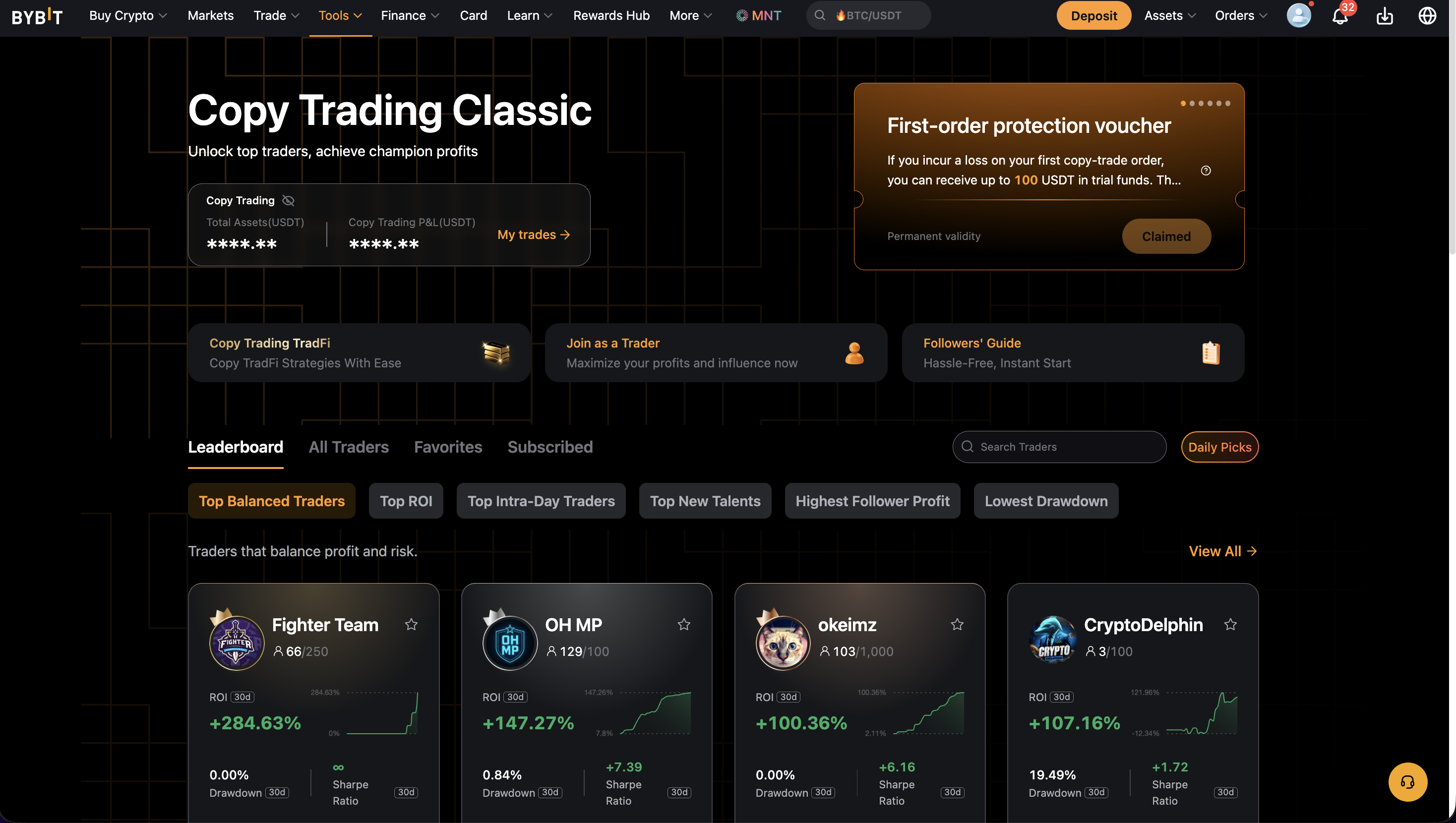
The honest case for copy trading. It can shorten the time to capital deployment for users who lack interest in the active learning curve. It also surfaces what good performance looks like, which is educational. We cover the mechanics and platform selection in what is copy trading and rank the platforms in our best copy trading platforms guide.
The honest case against starting with copy trading. Lead trader selection is its own skill. Most leaderboards reward volatility and short-term performance, which means the visible “top traders” are often running high-risk strategies on the verge of blowing up. A 2024 analysis of one major copy trading platform’s leaderboard found that 60 percent of top-ranked traders over a 90-day window were ranked outside the top 30 percent six months later (CopyTradeInsider internal leaderboard tracking, 2024). Following the wrong trader can lose money faster than trading yourself.
Realistic sequencing. Spot first. Demonstrate basic competence over three to six months. Then, if you want copy trading as a supplementary allocation, treat it as a paid service: track the lead trader’s drawdowns, fees, and strategy style, and never allocate more than 20 to 30 percent of capital to a single lead. Copy trading is not a beginner shortcut. It is an allocation tool for people who already understand what they are looking at.
What to read next
Once you have the basics from this guide, the next steps depend on what you want to deepen:
- For comparing exchanges in your country: best crypto exchanges for beginners 2026
- For converting fiat to crypto without trading: how to buy crypto in 2026
- For understanding copy trading mechanics: what is copy trading
- For platform-specific reviews: Bybit review and BingX review
- For our research process and ranking criteria: methodology
- For the full risk picture: risk disclaimer
A final reminder. Crypto trading is real risk with real money. The educational tone of this guide should not be mistaken for endorsement. Most retail traders lose money in their first year. The honest path is small capital, deliberate practice, and patience with the curve. If you find yourself trading more on emotion than on a plan, the right answer is to stop and reset, not to size up. We have no insight into your situation, so use this as a starting framework, not a prescription. Read the risk disclaimer once more before you fund any account, and be honest with yourself about whether you are trading or gambling. The difference matters more than any indicator setup.
Frequently asked questions
How much money do I need to start crypto trading?
You can start with as little as $50, and we recommend $200 to $500 for your first month so position sizing math works out cleanly. Most major exchanges allow trades as small as $5 to $10 on spot pairs. Starting small is the point: the first 50 to 100 trades are tuition you pay to learn how orders, fees, slippage, and your own psychology behave. Anyone telling beginners to fund $5,000+ accounts on day one is either selling something or has forgotten what beginner mistakes feel like. Scale capital only after three to six months of disciplined trading on the smaller account.
Is crypto trading legal for beginners?
Spot crypto trading is legal in most countries for adults, including the USA, UK, EU, Canada, Australia, Brazil, and most of Asia and Latin America. Derivatives access varies: futures and leveraged products are restricted or banned for retail in the US, UK, Singapore, and a few other jurisdictions. Copy trading and prop accounts have their own regional rules. Some countries (China, Algeria, Egypt, Bangladesh, Nepal) ban crypto trading entirely. Check your local rules before funding any exchange. Tax obligations also vary widely: most countries treat crypto gains as taxable income or capital gains, and underreporting is increasingly easy to detect through exchange data sharing.
Should I start with spot or futures trading?
Spot. Always spot first. Spot trading means you buy the actual asset, hold it, and your loss is limited to what you put in. Futures trading uses leverage, often 10x to 100x, which means a 1% adverse move can wipe out a 10x leveraged position. Industry data from major exchanges suggests 70 to 80 percent of retail futures accounts lose money within their first year ([Bybit P&L disclosure logs](https://www.bybit.com), 2024). Spot teaches you order types, exchange UX, position sizing, and emotional control without the liquidation risk. Add futures only after at least six months of consistent profitable spot trading, and even then start at 2x to 3x leverage on a small portion of capital.
Which exchange is best for a beginner in 2026?
The right choice depends on your country, what you want to trade, and whether you want copy trading. For US users, Coinbase and Kraken are the practical answers. For non-US users, Bybit, BingX, OKX, and Bitget are the main international choices, each with different strengths. Bybit has the deepest derivatives liquidity. BingX is built around copy trading. OKX has the cleanest Web3 integration. Bitget has the most aggressive promo structure but a busier UI. We compare them in detail in our [beginner exchange guide](/blog/best-crypto-exchanges-for-beginners-2026/). Avoid any platform you cannot find a transparent fee schedule or proof-of-reserves report for.
How long does it take to actually become profitable?
Most retail traders take 12 to 24 months to reach consistent profitability, and a significant share never do. A 2023 study by the Brazilian Securities Commission found that 97 percent of retail futures traders lost money over a 12-month window ([CVM working paper, FGV-EAESP](https://cvm.gov.br), 2023). Profitability is not the same as making a few good trades. It means a positive expectancy across at least 100 to 200 trades, with documented risk control. Beginners often mistake luck (a bull market) for skill. The honest answer: assume your first six months will be net negative or breakeven after fees, and treat it as paid education.
Do I need to learn technical analysis to trade crypto?
Some, but not as much as YouTubers suggest. The basics that genuinely matter: support and resistance, trend identification, volume, and a couple of timeframe combinations (4h plus daily is a common starting setup). Beyond that, most retail technical analysis is pattern-matching that performs no better than coin flips in backtests. The 80/20 of beginner edge is not in indicator stacking. It comes from position sizing discipline, stop loss adherence, journaling, and avoiding overtrading. A trader with one moving average and strict risk management consistently beats a trader with 12 indicators and no risk plan.
What are the most common beginner crypto trading mistakes?
The patterns repeat across nearly every new trader. Overleveraging on futures (using 20x to 100x on the first week). Trading too many pairs at once. Revenge trading after a loss. Not setting stop losses. FOMO buying tops after a 30 percent green candle. All-in on a single altcoin based on Twitter hype. Joining paid signal groups. Holding losers and selling winners (the disposition effect). Ignoring fees and funding rates. Treating a bull-market gain as a sign of skill. Each of these has wiped out specific accounts we have seen. The fix is not more information. It is mechanical rules followed even when bored or angry.
How do I report crypto trading taxes as a beginner?
Tax treatment varies, but in most countries every trade (crypto to crypto, crypto to fiat, crypto to stablecoin) is a taxable event. You owe tax on the gain, calculated as sale price minus cost basis. Keep a CSV export of every trade from day one. Most exchanges provide a year-end download. Tax software like Koinly, CoinLedger, or local equivalents will aggregate trades across exchanges and produce filing-ready reports. The IRS, HMRC, and most European tax authorities now receive direct data feeds from major exchanges through frameworks like DAC8 and the OECD CARF, so the days of quiet underreporting are essentially over. Plan for tax from your first trade, not your first profitable year.
#guide#beginners#trading#spot#futures#risk#BingX#Bybit
Discussion
Loading comments…