
Taker fees are charged when you take liquidity off the book with a market order or an aggressive limit. Maker fees are charged when you make liquidity by placing a limit order that sits on the book. Maker fees are almost always lower than taker fees, sometimes zero, sometimes even negative at the highest tiers. Knowing which side you are on changes how much trading actually costs.
Not financial advice. Fee schedules change. Verify current rates on each exchange before making decisions based on the numbers in this guide. Read the methodology for how we source and refresh fee data.
What “the order book” actually is
The order book is the live list of buy and sell orders sitting at every price level for a trading pair. On a Bitcoin pair, the buy side (bids) holds orders from traders willing to buy at specific prices. The sell side (asks) holds orders from traders willing to sell. Each side stacks orders by price, with the best bid at the top of the buy side and the best ask at the top of the sell side.
The gap between the best bid and best ask is the spread. On a deep pair like BTC/USDT during normal hours, the spread might be a single dollar on a $103,000 price. On a thin altcoin pair it can be 50 basis points or more. Spread is the real cost of liquidity, separate from the trading fee.
Two order types interact with the book differently. A limit order specifies a price, and if that price is not currently available on the book, the order sits and waits. A market order does not specify a price, and it executes immediately against whatever orders are sitting on the opposite side of the book. The action of sitting versus consuming is what defines a maker versus a taker.
Order book depth is what protects you from slippage on bigger trades. If the top of the sell side has only 0.05 BTC available at $103,201 and the next level has 0.20 BTC at $103,210, a market buy of 0.10 BTC eats through both levels and averages a worse price than the touch. The deeper the book, the less slippage. Makers contribute that depth.
What is a maker order?
A maker order is a limit order placed at a price away from the current market that adds new liquidity to the book. The order sits and waits for someone else to trade against it. Because the order is not consuming any existing liquidity, the exchange charges a lower fee or no fee at all, and at the highest VIP tiers some venues even pay a rebate.
Worked example. BTC is trading at $103,200. The best bid is $103,199 and the best ask is $103,201. You want to buy, but you are patient and willing to wait for a small dip. You place a limit buy at $103,150, which is $50 below the current market. Your order sits on the buy side of the book at the $103,150 level. You have not consumed any existing sell order. You have added a new bid.
If the price drifts down and a seller decides to market-sell into your bid, your order fills at $103,150 and you pay the maker fee on that fill. If the price never drops to your level, your order stays open until you cancel it or it expires.
The key word is “sits.” A limit order that sits is a maker order. A limit order that executes immediately is not, even though it is technically a limit order. The distinction is whether your order added depth to the book or removed depth from the other side. This trips up beginners often, because they assume “limit order” automatically means “maker.” It does not.
What is a taker order?
A taker order is any order that executes immediately against an existing order on the book, consuming liquidity. The most common taker order is a market order, but an aggressive limit order can also be a taker if its price crosses the spread. Takers pay a higher fee because they are removing depth that the exchange wants to preserve.
Worked example. BTC is trading at $103,200. The best bid is $103,199 and the best ask is $103,201. You decide you want to be in the trade right now, no waiting. You place a market buy for 0.05 BTC. Your order matches against the cheapest sell orders on the book, starting at $103,201 and walking up the ask side until your 0.05 BTC is filled. You have consumed existing sell liquidity. You are a taker.
The same outcome happens with an aggressive limit. If you place a limit buy at $103,250 while the best ask is $103,201, your order crosses the spread and immediately executes against the sell orders priced between $103,201 and $103,250. You used a limit order, but you behaved like a taker, so you pay the taker fee.
Aggressive limits are useful when you want a price ceiling on a fast move but still need immediate execution. The downside is the higher fee. If you do not need instant fill, pricing the limit conservatively (a few ticks behind the touch) and using post-only flips the trade to maker side.
Why exchanges charge differently for makers and takers
Exchanges compete on liquidity. A trading pair with thin depth is unattractive to bigger traders because their orders move the price too much. A pair with thick depth attracts more volume, which generates more fee revenue. Every venue wants depth, which is why makers get a discount or zero fee.
Makers provide the depth that takers consume. If no one is making, the book is empty and takers have nothing to trade against. The maker-taker model is the standard incentive structure across every major spot and futures venue in crypto, and it mirrors how equity exchanges have priced liquidity for decades.
The economic flow is straightforward. Maker fee revenue is small or zero. Taker fee revenue is the larger share. The spread between the two compensates makers (indirectly, via lower costs) for the service of being patient and providing depth. At the highest VIP tiers some venues invert this and pay maker rebates, meaning the maker receives a small payment for each fill rather than paying a fee.
For retail traders, the practical implication is simple. Default to maker orders whenever possible. Reserve takers for moments when speed is more valuable than the fee saving. The next sections cover the actual rates and the math.
Maker vs taker rates at major exchanges in 2026
The table below shows default Level 0 rates on spot and futures across the major venues retail traders use. All rates assume no native token discount and no VIP tier qualification. Referral codes, BNB or KCS holder discounts, and 30-day volume can lower these.
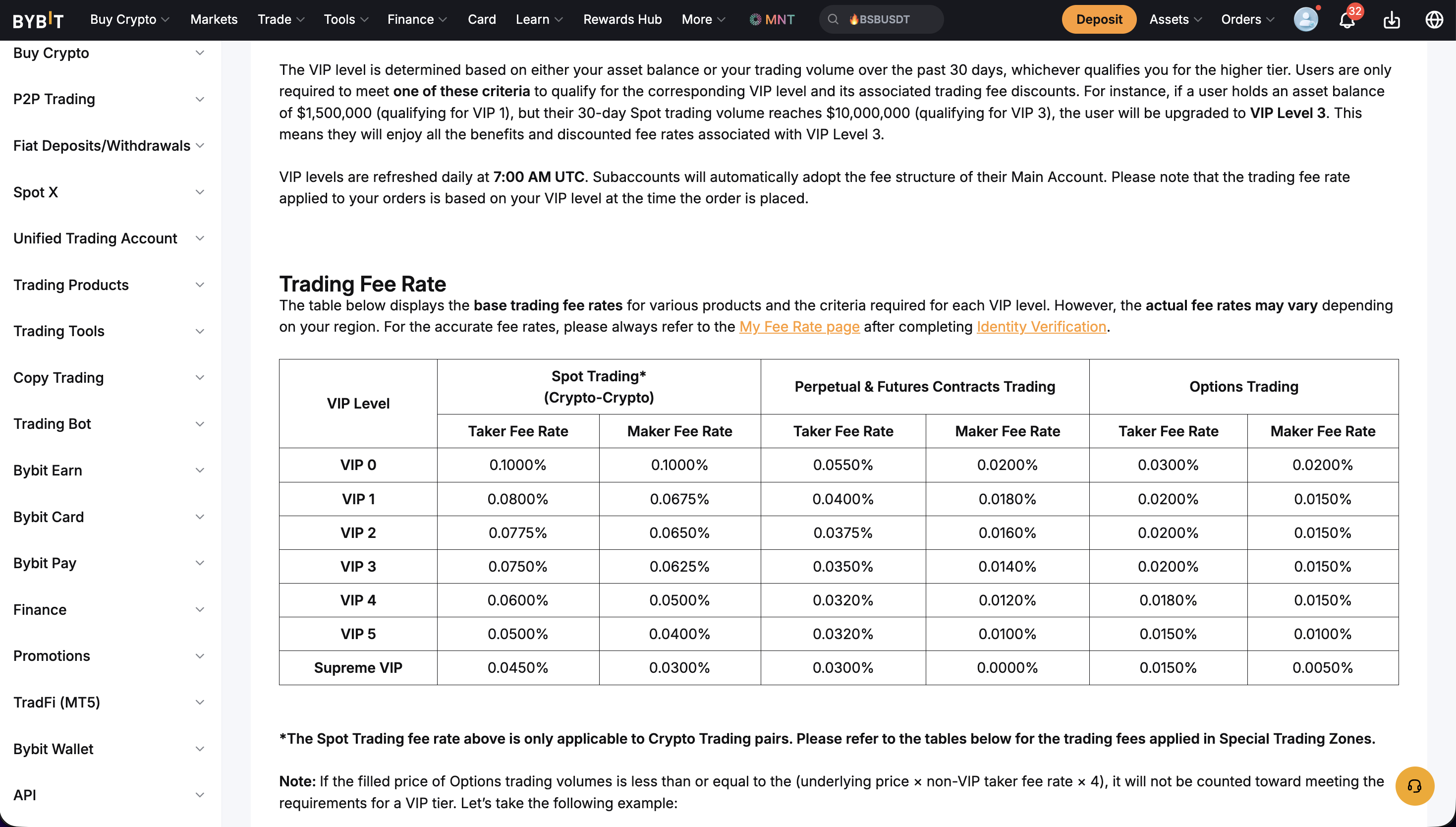
| Exchange | Maker (spot) | Taker (spot) | Maker (futures) | Taker (futures) |
|---|---|---|---|---|
| Binance | 0.10% | 0.10% | 0.02% | 0.04% |
| Bybit | 0.10% | 0.10% | 0.01% | 0.06% |
| BingX | 0.10% | 0.10% | 0.02% | 0.05% |
| OKX | 0.08% | 0.10% | 0.02% | 0.05% |
| Bitget | 0.10% | 0.10% | 0.02% | 0.06% |
| MEXC | 0.00% | 0.05% | 0.00% | 0.02% |
| KuCoin | 0.10% | 0.10% | 0.02% | 0.06% |
Things to notice. On spot, OKX has a small edge with 0.08 percent maker, and MEXC stands alone at 0.00 percent maker. The taker side clusters at 0.10 percent on most venues, with MEXC again the outlier at 0.05 percent. Futures rates are 80 to 90 percent cheaper than spot on the maker side and 40 to 60 percent cheaper on the taker side, reflecting the higher volume and leveraged nature of perpetual contracts.
Native token discounts can change the ranking. Holding and using BNB on Binance brings spot fees to roughly 0.075 percent on both sides, the cheapest among the BNB-discounted majors. KCS on KuCoin trims fees by 20 percent across spot and futures. Bybit and OKX run periodic promotions on specific pairs that drop maker to zero.
Referral codes and signup bonuses can add another 10 to 20 percent discount on top, but only at certain venues and only for new accounts. For a full side-by-side that updates with rate changes, see the crypto exchange fee showdown and the fees calculator.
The math: how fees compound over a year
Fees feel small per trade. On a $1,000 trade at 0.10 percent, the fee is $1. That seems unimportant. The problem is that active trading multiplies that small number by hundreds of fills per year, and the compound effect is large enough to materially change account performance.
Worked example. You start with $5,000. You run four round-trip trades per week, which is two fills per round trip (entry plus exit), so eight fills per week. A full year of trading is 52 weeks, giving 416 fills total. Assume each fill uses the full $5,000 account size, which is a simplification but a common pattern for traders who go all-in on a single position at a time.
At 0.10 percent taker fee per fill, each fill costs $5,000 times 0.001, or $5. Over 416 fills that is $2,080 in fees, or 41.6 percent of the starting capital, paid to the exchange across the year. At 0.02 percent maker fee per fill (the typical futures maker rate), each fill costs $1, and the annual total is $416, or 8.3 percent of starting capital. The gap is $1,664 per year on a $5,000 account just from order type discipline.
The same math at a lower trade frequency. Two round trips per week, four fills, 208 fills annually. At 0.10 percent taker: $1,040 per year, 20.8 percent of capital. At 0.02 percent maker: $208 per year, 4.2 percent of capital. Gap of $832.
The point is not the exact figure, which depends on your trade size and frequency. The point is that fees scale linearly with fill count, and order type changes the per-fill cost by 5x. That 5x compounds over hundreds of fills per year into a number that often exceeds what active retail traders make from their actual trading edge. Many strategies that look profitable on paper turn unprofitable once the fee drag is honest. See the risk management guide for how to size positions with fees baked in.
How to actually lock in maker rates
Use post-only limit orders. This is the single most useful tool on any exchange trading interface. Post-only is an order flag that tells the venue: if my limit order would execute immediately as a taker, cancel it instead of letting it cross the spread. The result is that every fill on a post-only order is guaranteed to be a maker fill.
On Binance, the post-only option appears as a checkbox under the limit order form, often inside an “Advanced” or “TIF” (time-in-force) dropdown labeled “Post Only” or “GTX.” On Bybit, the equivalent flag is “PostOnly” in the order panel. OKX, Bitget, and BingX use similar labeling. The exact menu path differs, but every major exchange supports the feature on spot and futures. KuCoin and MEXC also expose post-only on their futures interfaces.
Practical workflow. You want to buy BTC near the current price. The best ask is $103,201. Instead of market-buying or placing an aggressive limit at $103,205, you place a post-only limit buy at $103,200, which is one tick below the ask. If the price ticks down by a single dollar your order fills as a maker. If the price runs higher without ticking down, your order sits and waits. If you placed the limit at $103,201 with post-only enabled, the order might be rejected because it crosses the touch (some venues treat the best ask price as taker territory).
The cost of post-only is patience. You sometimes miss fills entirely if the price runs away from you. For traders running breakout entries this is a real downside. For traders running mean-reversion or ladder entries, post-only is essentially free improvement. The right framing is: if you do not need immediate fill, default to post-only. If you do need immediate fill, accept the taker cost and move on.
A second technique is bracket orders with maker-priced take-profits. When you enter a position as a taker (because the entry was time-sensitive), set the exit at a limit price that will sit on the book. The exit fill earns the maker rate, which recovers some of the entry cost. See the how to start crypto trading guide for full bracket order workflows.
When taker is unavoidable
Some trades cannot wait. High-conviction entries on fast-moving news, time-sensitive exits during volatile drops, liquidation defense to avoid forced closure: all of these require immediate fill regardless of fee. Trying to enforce maker-only on these trades costs more than the taker fee would have, because you miss the move entirely.
The right approach is to plan for taker trades as a category. Set a rule like “any trade triggered by a news event or by a stop-loss exit gets executed at market, no questions asked.” Inside that rule, accept the fee as a cost of doing business. Outside that rule, default to maker.
Another unavoidable taker scenario is closing a futures position before liquidation. If your position is approaching the liquidation price and you need to exit, a limit order risks missing the fill and triggering forced closure, which costs more than any fee saving. Market-out and pay the taker fee.
Recognizing the maker-versus-taker decision in advance, rather than reacting to it in the moment, is what separates traders who control their fee drag from those who do not.
Common beginner mistakes
The most common mistake is using market orders by default. Many platforms default the order type dropdown to “Market” on first load, and beginners click “Buy” without changing it. Every fill becomes a taker fill, even for trades that had no time pressure.
The second mistake is placing limit orders that immediately cross the spread without realizing. A trader sees BTC at $103,200, types $103,250 into the limit buy field thinking “I am being patient by capping my price,” and the order fills immediately as a taker against existing asks at $103,201, $103,202, and so on. The trader pays the taker fee and gets a worse average price than they expected. The fix is post-only, or pricing limits behind the touch on the patient side (below the best bid for a limit buy, above the best ask for a limit sell).
A third mistake is assuming maker means “you will always get filled.” A maker order only fills if someone else trades against it. If you place a limit buy at $103,150 and the price rallies to $104,500 without touching your level, your order never fills. You miss the entry and the move. For trades where the entry trigger is “I want to be in now,” maker discipline is the wrong tool. Pick maker for patient entries, taker for time-sensitive ones.
A fourth mistake is treating fee differences across exchanges as the most important variable. The fee gap between Binance and KuCoin on spot is small at retail volume. The gap between using market orders versus post-only limits on the same exchange is much larger. Fix the order type first, then optimize the exchange.
VIP tiers and how to reach them
Most exchanges run tiered fee schedules where higher 30-day trading volume unlocks lower fees. Tier 1 typically requires $1 million to $10 million in volume, depending on the venue. Maker rebates (negative maker fees, meaning the exchange pays you) usually start at VIP 6 or higher, which requires hundreds of millions in volume.
For retail traders the realistic conclusion is blunt. VIP tiers are not the right lever. A $5,000 account would need to turn over 200 times in a month to hit $1 million in volume, which is unrealistic and ill-advised. The fees on that level of overtrading would dwarf any tier benefit anyway.
What does work for retail. First, the order type lever (maker vs taker) is fully under your control and cuts fees by 5x at default tiers. Second, the native token discount lever (BNB, KCS, etc.) is available without volume gating and trims 20 to 25 percent off the fee. Third, referral codes on signup can add another 10 to 20 percent at certain venues. The combined effect of these three retail-accessible levers often beats what a low-tier VIP would receive.
A note on volume-based promotions. Some platforms run limited-time campaigns that effectively grant temporary VIP-tier fees to all users or specific pair fills. These are worth tracking but should not be confused with the structural VIP schedule. For a deep dive on which exchanges suit which trader profile, see the best exchanges for beginners guide, the Binance review, the Bybit review, and the BingX review. For traders interested specifically in zero-maker spot trading, MEXC is the standout option among the majors.
The takeaway
Order type discipline is the single largest fee lever available to retail traders. Default to post-only limit orders on every trade where speed is not critical. Accept taker fills on the trades where speed matters and treat the fee as a planned cost. Pick the exchange based on product fit, not on a small headline fee gap, because the gap between maker and taker on your home venue dwarfs the gap between venues on the same order type.
Verify rates before trading. Fee schedules change. The numbers in this guide reflect 2026 default Level 0 rates and may differ on the day you read this. Cross-reference with the fees calculator and the exchange fee showdown for the latest data. For a deeper look at KuCoin’s KCS-based discount specifically, see the KuCoin fees guide.
The honest summary. Active trading at default taker rates is a tax on impatience. Switching to maker-only via post-only orders costs nothing except occasional missed fills, and the annual fee saving on a small account is large enough to change whether the strategy is profitable at all.
Frequently asked questions
What is the difference between a maker and a taker fee in crypto?
A taker fee applies when your order is filled immediately against an existing order on the book, which is what happens with a market order or an aggressive limit order. A maker fee applies when your limit order is placed away from the current market and sits on the book waiting for someone else to trade against it. Makers add liquidity, takers remove it. Because exchanges want depth on their order book, they charge takers more (or charge makers nothing, or even pay rebates at high tiers). On most major venues in 2026 the default taker fee is 0.10 percent and the default maker fee is the same or lower, with futures rates running far cheaper on both sides.
Why is my trading fee higher than I expected?
Almost always because the order executed as a taker even though you used a limit order. Limit orders only earn the maker rate if they sit on the book without immediately matching. If you place a limit buy above the best ask, or a limit sell below the best bid, your order crosses the spread and you pay the taker fee. The fix is to either price your limit conservatively (a few ticks behind the touch) or use the post-only option, which cancels the order if it would execute immediately. Post-only is the easiest way to guarantee maker-only fills.
What is a post-only order?
Post-only is an order flag that tells the exchange to reject your limit order if it would execute immediately as a taker. The order is either posted to the book at your specified price (making you a maker) or canceled entirely. It is the cleanest way to enforce maker-only behavior across a trading session. Most major exchanges including Binance, Bybit, OKX, Bitget, and BingX expose a post-only checkbox on their trading interface. Some platforms label it 'maker only' or 'add liquidity only.' The effect is identical.
Are zero maker fees actually free?
Zero maker fees mean the exchange charges no commission on the maker side of a trade, but they are not 'free' in a strict sense. You still pay the spread between the bid and ask, which is the real cost of liquidity on every order. You also pay any network withdrawal fee when moving the asset off the exchange. MEXC offers zero spot maker as of 2026, and several other venues run promotional zero-maker periods on specific pairs. Zero maker is a real benefit for active traders, but the spread and withdrawal cost still apply.
Can I always trade as a maker?
No. A maker order only fills if someone else trades against it, which means you cannot control whether or when you get filled. If you place a limit buy at $103,150 and the price rallies to $104,000 without trading down to your level, you miss the entry entirely. Maker-only discipline works for patient entries, ladder fills, and exit targets, but it fails for time-sensitive trades like reacting to news or cutting a position in a fast drop. Plan for some taker fills as part of the cost of active trading.
Do VIP tiers make a real difference for retail traders?
Not at typical retail volume. The first VIP tier on most major exchanges requires $1 million to $10 million in 30-day rolling volume, which corresponds to a $25,000 to $250,000 account turning over multiple times per week. Most retail traders never cross VIP 1. The realistic fee lever for retail is the order type (maker vs taker) and the native token discount (BNB on Binance, KCS on KuCoin), not the VIP tier. Maker rebates exist for VIP 6 and above on some platforms, but those tiers require institutional-scale volume.
Are futures maker and taker fees lower than spot?
Yes, on every major exchange. The typical default in 2026 is 0.02 percent futures maker and 0.04 to 0.06 percent futures taker, compared to 0.10 percent on spot for both sides. The gap exists because futures volume is much higher and the contracts are leveraged, so a small fee against a large notional position still generates meaningful revenue for the exchange. The lower headline rate also makes futures more attractive to high-frequency traders, which is part of why perpetual futures volume dominates spot on most CEXes.
How much can switching to maker orders save me over a year?
On a $5,000 account doing four round-trip spot trades per week, the gap between paying 0.10 percent taker on every fill and 0.02 percent maker on every fill works out to roughly $1,650 per year, or about 33 percent of the starting capital. The exact number depends on how often you trade and how much of your account you risk per trade. The lesson is not the precise figure but the direction: fees compound, and order type discipline is one of the few free improvements available to retail traders.
#guide#fees#beginners#maker#taker#trading#spot
Discussion
Loading comments…