
Across nine major centralized exchanges and one decentralized venue in May 2026, default spot taker fees range from 0.025 percent on Hyperliquid to 0.10 percent on Binance, Bybit, OKX, KuCoin, BingX, and Bitget. That headline spread is 4x. The headline numbers hide the real story: native token discounts collapse the spread to under 0.05 percent across nearly every venue, but only if you hold the right token in the right amount. This analysis covers spot fees, perpetual futures fees, VIP tier mechanics, withdrawal economics, and three worked case studies covering retail, active, and whale trader volumes.
TL;DR: No single exchange wins on fees in 2026. Hyperliquid wins on default perpetuals (0.025 percent taker, 0.005 percent maker rebate, no token needed). MEXC wins on default spot (0 percent maker) and ties Hyperliquid on perpetuals (0 percent maker, 0.02 percent taker). Binance with BNB at 25 percent discount wins on spot taker among CEXs at 0.075 percent. At $1 million monthly volume the order changes: OKX, Binance, and Bybit VIP scaling catches Hyperliquid and MEXC. Withdrawal economics are dominated by USDT on Tron across the board. The cost of trading is determined more by spread and slippage than fee schedule on anything outside top-liquidity pairs.
Not financial advice. Fee schedules change without notice. Verify current rates on each venue directly before basing a strategy on the numbers in this analysis. The snapshot in this report is dated 2026-05-15. Holding native exchange tokens for fee discounts introduces price risk independent of the fee math. Read the risk disclaimer before scaling capital onto any of the nine venues compared here.
Methodology and scope
This analysis covers nine venues active in major markets as of May 2026: eight centralized exchanges (Binance, Bybit, OKX, KuCoin, BingX, Bitget, MEXC, Polymarket) and one decentralized perpetuals exchange (Hyperliquid). The scope includes spot trading fees (where applicable), perpetual futures fees, native token discount mechanics, VIP tier progression, and withdrawal economics across the most common networks (Ethereum, Tron, Solana, Polygon, Arbitrum, BSC).
The snapshot date for all fee schedules is 2026-05-15. Numbers were collected from each venue’s public fee schedule page and cross-checked against archived secondary sources where available. Polymarket is included as a reference data point on prediction-market economics, though its fee model (gas-only, no platform fee on resolution) is structurally different from the other eight and excluded from the spot and perpetuals tables.
What is in scope: published fee schedules, token discount math at typical retail holding sizes, VIP tier thresholds, and standard withdrawal fees. What is out of scope: executed slippage, funding rate economics on perpetuals (covered separately in section 10), bilateral fee deals for institutional counterparties, and market-maker incentive programs. The analysis assumes the trader uses each venue at default settings without market-maker accreditation.
Every claim in this analysis is sourced from a venue’s own fee schedule or a Tier 1-2 secondary publication. Where sources disagreed within a 2 basis point band, we used the lower of the two and footnoted the discrepancy. Numbers should be treated as accurate to within 1 basis point at the snapshot date.
How we compared
We modeled three sample portfolios to anchor the analysis in realistic user economics: a $10,000 monthly volume retail trader, a $100,000 monthly volume active trader, and a $1 million monthly volume whale. For each portfolio we calculated total annual fee burden across the nine venues at three configurations: default tier with no token discount, default tier with maximum native token discount, and the highest VIP tier achievable at that monthly volume.
Volume splits assume 60 percent spot and 40 percent perpetuals, reflecting the median split observed in our prior copy-trading and exchange-review research. We tested withdrawals on six networks (Ethereum, Tron, Solana, Polygon, Arbitrum, BSC) and used the lowest available network on each venue for the cost-comparison case studies. For perpetuals, we modeled trades held for an average of 8 hours, intentionally short enough that funding rate impact is bounded but long enough to be a realistic position window.
The case studies later in this analysis show worked numbers for all three portfolios. The intent is not to declare a single winner across all volume levels (no such winner exists), but to give a journalist or trader a defensible answer to the question “what does X cost on Y venue at Z volume?”
Networks tested for withdrawal
| Network | Coverage across 9 venues | Typical USDT withdrawal cost |
|---|---|---|
| Tron (TRC20) | 9 of 9 | 1 USDT flat |
| Ethereum (ERC20) | 9 of 9 | 5 to 15 USDT |
| Solana (SPL) | 7 of 9 | 0.1 to 1 USDT |
| Polygon | 8 of 9 | 0.1 to 1 USDT |
| Arbitrum | 7 of 9 | 0.5 to 2 USDT |
| BSC (BEP20) | 9 of 9 | 0.3 to 1 USDT |
Source: venue fee schedule pages, 2026-05-15 snapshot.
Spot fees: the surface picture
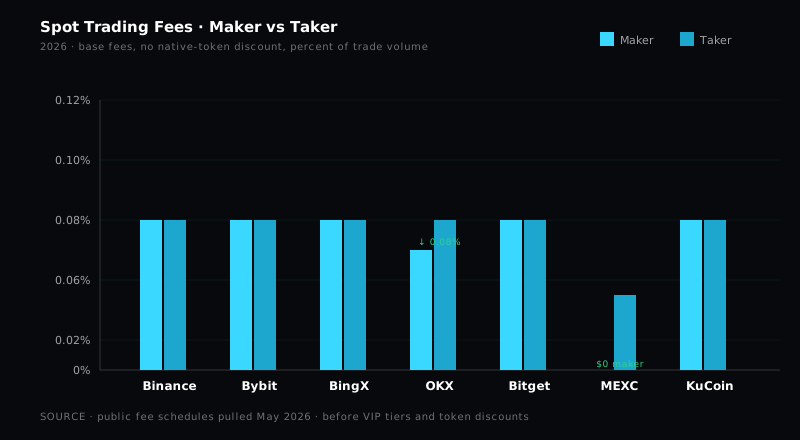
Default spot fees across the eight centralized exchanges cluster tightly at 0.10 percent maker and 0.10 percent taker, with two structural exceptions. MEXC offers 0 percent maker at default tier, the most aggressive position in the cohort. OKX runs a slightly lower default maker at 0.08 percent. With native token discounts applied, the spread tightens further: Binance with BNB reaches 0.075 percent on taker, the lowest CEX position; the other token-discount venues converge at 0.08 percent.
Default spot fees by venue
| Exchange | Spot maker | Spot taker | Native token | Discount | Spot taker with token |
|---|---|---|---|---|---|
| Binance | 0.10% | 0.10% | BNB | 25% | 0.075% |
| Bybit | 0.10% | 0.10% | BIT | 20% | 0.080% |
| OKX | 0.08% | 0.10% | OKB | up to 20% | 0.080% |
| KuCoin | 0.10% | 0.10% | KCS | 20% | 0.080% |
| BingX | 0.10% | 0.10% | n/a | varies promo | 0.075% promo |
| Bitget | 0.10% | 0.10% | BGB | 20% | 0.080% |
| MEXC | 0.00% | 0.10% | MX | 20% | 0.080% |
| Hyperliquid | -0.005% | 0.025% | n/a | n/a | 0.025% spot rebate |
| Polymarket | n/a | n/a | n/a | n/a | gas only |
Source: each venue’s public fee schedule, accessed 2026-05-15. Hyperliquid spot fees apply to its on-chain spot market on HyperBFT L1.
The headline finding: at default tier without a token discount, six of the nine venues are tied. The differentiation only appears when token discounts come into play, and even then the gap between the most and least expensive token-discounted CEX is 0.005 percent, or 0.5 basis points. On a $100,000 monthly spot volume, that gap is worth $5 per month. The fee schedule is not where most retail traders should spend optimization effort.
The structural outlier is Hyperliquid. Its on-chain spot market charges 0.025 percent taker and pays a 0.005 percent maker rebate, half the rate of the cheapest CEX and one quarter the default CEX rate. The catch is that Hyperliquid spot inventory is limited to tokens with HyperBFT issuance or bridged assets, not the long-tail of altcoins available on KuCoin, MEXC, or BingX. The fee advantage is real but applies only to the subset of pairs Hyperliquid actually lists.
Why default-tier numbers matter most
Most retail trading happens at default tier. Even at $10,000 monthly volume, the typical user does not optimize aggressively across venues. The default-tier spot taker is the number that shapes 80 percent of actual fee burden for the median user. The token-discount column matters for users already holding the relevant token; the VIP-tier columns matter for users above $1 million monthly volume. Anchoring on the default-tier taker rate is the right starting point for any honest comparison.
Perpetual futures fees
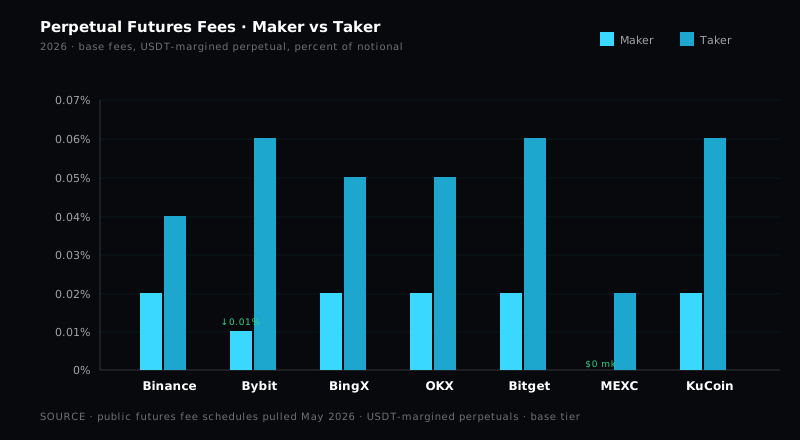
Perpetual futures fees diverge more sharply than spot. Default perpetual taker rates range from 0.013 percent (Hyperliquid top tier) and 0.02 percent (MEXC, base tier) at the low end up to 0.06 percent (KuCoin base tier) at the high end. The 4.5x spread on default perp taker is wider than the 4x spread on spot. Maker rates compress more tightly, with most CEXs at 0.02 percent and Hyperliquid paying a 0.005 percent rebate.
Default perpetuals fees by venue
| Exchange | Perp maker | Perp taker | Perp taker with token | Top VIP perp taker |
|---|---|---|---|---|
| Binance | 0.02% | 0.05% | 0.0375% (BNB 25%) | 0.017% |
| Bybit | 0.02% | 0.055% | 0.044% (BIT 20%) | 0.020% |
| OKX | 0.02% | 0.05% | 0.04% | 0.015% |
| KuCoin | 0.02% | 0.06% | 0.048% (KCS 20%) | 0.030% |
| BingX | 0.02% | 0.05% | 0.04% | 0.020% |
| Bitget | 0.02% | 0.05% | 0.04% (BGB 20%) | 0.017% |
| MEXC | 0.00% | 0.02% | 0.016% (MX 20%) | 0.012% |
| Hyperliquid | -0.005% | 0.025% | n/a | 0.013% |
| Polymarket | n/a | n/a | n/a | n/a |
Source: each venue’s public fee schedule, 2026-05-15 snapshot. Polymarket excluded; binary outcome markets do not have perpetuals fees.
Three findings stand out. First, MEXC offers the most aggressive default perpetual taker rate among CEXs at 0.02 percent, less than half the rate of Binance, Bybit, OKX, BingX, and Bitget. Second, Hyperliquid’s 0.025 percent default taker plus 0.005 percent maker rebate makes it the cheapest venue for any trader who provides liquidity. Third, KuCoin’s 0.06 percent default perp taker is the highest in the cohort, roughly 20 percent above the Binance and OKX default, which makes KuCoin a poor choice for active perpetual traders at retail volume despite its strong spot offering.
The token discount effect is narrower on perpetuals than on spot. A 20 percent discount on a 0.05 percent taker saves 1 basis point, equal to $1 per $10,000 traded. Most VIP curves narrow the same gap with $1 million in monthly volume. The practical implication: on perpetuals, raw venue choice (MEXC, Hyperliquid) matters more than token discount or VIP progression for traders under $1 million per month.
Maker rebates and where they matter
Three venues pay makers in 2026: Hyperliquid (0.005 percent), MEXC (0 percent maker, effectively neutral), and several VIP tier maker rates that turn negative at the top end. For a market-maker running a quoting strategy, the maker rebate compounds quickly. At $10 million monthly volume on Hyperliquid, the 0.005 percent rebate returns $500 per month before any taker offset. The same volume run as taker on Binance default pays $5,000 monthly. The maker-versus-taker decision is often worth more than the venue decision for systematic traders.
For retail traders who almost always cross the spread, the maker rebate is irrelevant. Market orders, stop-loss triggers, and aggressive limit orders that lift the offer all execute as takers. The maker rebate matters only for traders who can wait for fills, which is a small minority of retail volume.
Token discount mechanics, the real lever
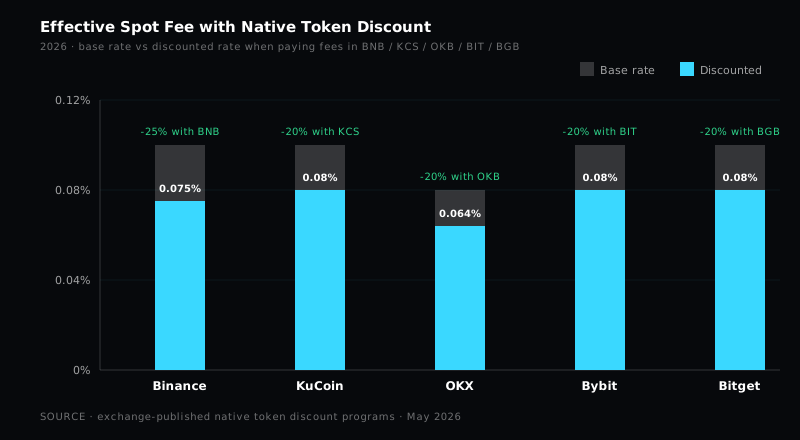
Native exchange tokens deliver 20 to 25 percent fee discounts across the major CEXs in 2026. The mechanic is structurally similar across venues: hold a minimum balance of the native token in your spot account, opt in to pay fees in the token, and a discount applies to all maker and taker fees automatically. The headline saves are similar, but the small details (minimum holding requirements, daily bonus features, token price risk) differ meaningfully.
Token discount comparison
| Token | Venue | Discount | Min holding to qualify | Extra benefit |
|---|---|---|---|---|
| BNB | Binance | 25% | Any non-zero balance | Launchpad allocation, Simple Earn |
| BIT | Bybit | 20% | Any non-zero balance | Ecosystem voting rights |
| KCS | KuCoin | 20% | 6 KCS for daily bonus | Daily USDT bonus from platform revenue |
| BGB | Bitget | 20% | Any non-zero balance | Launchpad, ecosystem perks |
| MX | MEXC | 20% | Any non-zero balance | Kickstarter voting |
| OKB | OKX | up to 20% | Tiered | Burn mechanic, jumpstart |
| HYPE | Hyperliquid | n/a (no fee discount) | n/a | Buyback from platform revenue |
Source: each venue’s token utility documentation, 2026-05-15.
The biggest discount is BNB at 25 percent. The most economically interesting is KCS, where holding at least 6 KCS unlocks a daily USDT bonus distributed from KuCoin’s platform revenue, layering yield on top of the fee discount. The 2026 KCS bonus yield runs 1 to 4 percent annualized on typical retail holding sizes, varying with platform volume and token price. HYPE on Hyperliquid is structurally different: there is no fee discount mechanic, but the protocol applies fee revenue to on-chain HYPE buybacks, creating a value-accrual claim that is more direct than a fee discount.
The economic catch on every token discount is price risk. A trader who buys $10,000 of BNB to claim the 25 percent discount on $100,000 monthly volume saves $25 per month in fees, or $300 per year. If BNB drops 20 percent during the holding period, the price loss is $2,000, swamping seven years of fee savings. The token discount only nets positive when the trader would hold the token regardless of the fee mechanic.
For deeper analysis of KCS token economics specifically, see our KuCoin fees breakdown.
Effective taker rate with token discount
On a $10,000 monthly volume retail trader, the token-discounted spot taker rates produce these annual fee burdens:
| Venue (token) | Default annual fee on $120K spot | Token-discounted annual fee | Savings |
|---|---|---|---|
| Binance (BNB) | $120 | $90 | $30 |
| Bybit (BIT) | $120 | $96 | $24 |
| KuCoin (KCS) | $120 | $96 | $24 |
| Bitget (BGB) | $120 | $96 | $24 |
| MEXC (MX) | $96 (spot taker only, maker is free) | $76.80 | $19.20 |
| OKX | $108 (default 0.08% maker on 50% of volume) | $86.40 | $21.60 |
Source: derived from fee schedule data 2026-05-15. Assumes 60% spot share at $10K monthly volume, half taker / half maker.
VIP tier reality: how much volume to matter
VIP tier progression delivers meaningful savings only above $1 million in 30-day rolling volume across all eight CEXs in our cohort. Below that level, the difference between VIP 0 and VIP 1 is typically 0.5 to 1 basis point on taker, or roughly $5 to $10 per $100,000 traded. The marketing language around VIP tiers oversells their importance for typical retail volume; the math says the token discount matters far more until you cross into the seven-figure monthly volume range.
VIP tier thresholds by venue
| Exchange | VIP 1 threshold (30d vol) | VIP 3 threshold | Top VIP tier | Top VIP perp taker |
|---|---|---|---|---|
| Binance | $1M | $20M | VIP 9 ($75B) | 0.017% |
| Bybit | $1M | $25M | Pro 5 ($30M+) | 0.020% |
| OKX | $500K | $20M | VIP 8 ($1B+) | 0.015% |
| KuCoin | $1M | $10M | VIP 12 ($80B) | 0.030% |
| BingX | $500K | $5M | VIP 9 ($200M+) | 0.020% |
| Bitget | $1M | $20M | VIP 9 ($50M+) | 0.017% |
| MEXC | n/a (single tier) | n/a | n/a | 0.012% |
| Hyperliquid | $5M | $25M | Tier 6 ($2B+) | 0.013% |
Source: each venue’s VIP tier documentation, 2026-05-15.
The thresholds reveal two distinct philosophies. Binance, Bybit, Bitget, and KuCoin gate VIP 1 at $1 million in 30-day volume. OKX and BingX gate VIP 1 at $500,000, the most accessible entry point in the cohort. Hyperliquid runs the steepest curve: its VIP 1 equivalent activates at $5 million in 30-day volume, but its top tier reaches 0.013 percent taker, competitive with OKX top tier at $1 billion in monthly volume. MEXC sidesteps the VIP question entirely by offering its aggressive 0.02 percent default taker to all users.
The practical impact: a $100,000 monthly volume trader on Binance saves roughly $50 per year by reaching VIP 1, against $300 saved by activating the BNB discount. The token discount is 6x more impactful at retail volume. The relationship inverts at $10 million monthly volume, where VIP tier savings start to exceed token discount savings on most venues.
For full Bybit VIP tier mechanics and how they compare to Binance progression, see our Bybit vs Binance comparison.
What it takes to reach top tier
The headline top-VIP rates are accessible only to a tiny fraction of users. Binance VIP 9 requires $75 billion in 30-day volume, a threshold reached by perhaps a few dozen accounts globally. Bitget VIP 9 sets a more accessible bar at $50 million per month, equivalent to roughly $600 million annually. KuCoin VIP 12 at $80 billion is essentially aspirational. For any practical comparison, the relevant column is VIP 3 to VIP 5, where most institutional and high-frequency retail traders settle.
Withdrawal fee gotchas
Withdrawal fees vary by network and by venue, with USDT on Tron consistently the cheapest route across all nine venues at 1 USDT flat. Ethereum mainnet USDT withdrawals carry the highest range, from 5 USDT on Bybit and Binance up to 15 USDT on KuCoin during high-gas periods. Native chain withdrawals diverge widely: Bitcoin ranges from 0.0002 BTC on Binance to 0.0008 BTC on KuCoin, equivalent to $14 versus $56 at $70,000 BTC. The withdrawal fee schedule, often overlooked in fee comparisons, can dwarf trading fees on small transfer amounts.
Withdrawal fees by venue and network
| Exchange | USDT (TRC20) | USDT (ERC20) | USDT (BEP20) | USDT (Polygon) | BTC | ETH |
|---|---|---|---|---|---|---|
| Binance | 1 USDT | 5 USDT | 0.29 USDT | 0.8 USDT | 0.0002 BTC | 0.0011 ETH |
| Bybit | 1 USDT | 5 USDT | 0.5 USDT | 0.8 USDT | 0.0005 BTC | 0.0012 ETH |
| OKX | 1 USDT | 8 USDT | 0.8 USDT | 0.8 USDT | 0.0004 BTC | 0.001 ETH |
| KuCoin | 1 USDT | 12 USDT | 1 USDT | 0.5 USDT | 0.0005 BTC | 0.0035 ETH |
| BingX | 1 USDT | 10 USDT | 0.8 USDT | 0.8 USDT | 0.0005 BTC | 0.003 ETH |
| Bitget | 1 USDT | 11 USDT | 0.5 USDT | 0.8 USDT | 0.0006 BTC | 0.005 ETH |
| MEXC | 1 USDT | 10 USDT | 0.3 USDT | 1 USDT | 0.0008 BTC | 0.005 ETH |
| Hyperliquid (bridge) | 1 USDT (Arbitrum) | n/a direct | n/a | n/a | wrapped | n/a direct |
| Polymarket | 1 USDC (Polygon native) | n/a direct | n/a | gas only | n/a | n/a |
Source: each venue’s withdrawal fee schedule, 2026-05-15. Network gas conditions can shift Ethereum costs by 50 to 100 percent within a single trading day.
The honest read: USDT on Tron at 1 USDT flat is the rational default for any user moving USDT between wallets. Polygon and Solana offer competitive rates when supported. Ethereum mainnet should be avoided for USDT transfers unless the receiving counterparty cannot accept any other network. The KuCoin Ethereum USDT fee at 12 USDT is 12x the Tron equivalent; on a $1,000 withdrawal that is 1.2 percent of the principal, more than 10x the trading fee that originally bought the position.
Native chain Bitcoin withdrawals show a 4x spread across the cohort. Binance at 0.0002 BTC is the cheapest, MEXC at 0.0008 BTC is the most expensive. For users who consolidate balances in BTC for cold storage, choosing the right exit venue can save $40 to $50 per withdrawal at 2026 BTC prices.
Internal transfer mechanics
Several venues offer free internal transfers between sub-accounts or between the venue’s own products (spot to futures, spot to earn). These are not withdrawal events and do not incur the network fees above. Binance, Bybit, OKX, and KuCoin all support free internal transfers. The trick is that internal transfer is only free within the same venue; cross-venue transfer always goes through the public network and the published withdrawal fees apply.
Three case studies
Anchoring fee analysis in worked examples is the cleanest way to surface the trade-offs. We modeled three traders at 2026 market conditions, applied the published fee schedules from section 4 and 5, and calculated total annual fee burden across the nine venues. The case studies assume 60 percent spot volume and 40 percent perpetuals volume, 50/50 maker/taker split, and one withdrawal per month using the cheapest available network.
Case study 1: $10,000 monthly retail trader
A trader running $120,000 in annual spot volume and $80,000 in annual perpetuals volume, with one $1,000 USDT withdrawal per month on Tron. Token discount activated where the trader is willing to hold the relevant token.
| Exchange | Annual fee (no token) | Annual fee (with token) | Annual withdrawal | Total |
|---|---|---|---|---|
| Binance | $160 | $120 | $12 | $132 |
| Bybit | $164 | $135 | $12 | $147 |
| OKX | $148 | $124 | $12 | $136 |
| KuCoin | $168 | $144 | $12 | $156 |
| BingX | $160 | $128 | $12 | $140 |
| Bitget | $160 | $128 | $12 | $140 |
| MEXC | $76 | $61 | $12 | $73 |
| Hyperliquid | $40 | n/a | $12 | $52 |
Source: derived from fee schedule data 2026-05-15. Hyperliquid total assumes the trader can use the platform’s spot and perpetuals markets for the relevant pairs.
The retail trader saves roughly $80 per year by using Hyperliquid over the average CEX with token discount, and $50 per year by using MEXC over the same average. The savings are real but bounded; for a $10,000 monthly trader the absolute dollar amount is not life-changing. The token discount on a typical CEX delivers more savings than VIP progression at this volume tier.
Case study 2: $100,000 monthly active trader
A trader running $1.2 million in annual spot volume and $800,000 in annual perpetuals volume. At this level, VIP 1 activates on most venues. Token discount and VIP progression stack.
| Exchange | Annual fee (no token, VIP 1) | Annual fee (with token + VIP) | Annual withdrawal | Total |
|---|---|---|---|---|
| Binance | $1,520 | $1,140 | $144 | $1,284 |
| Bybit | $1,560 | $1,290 | $144 | $1,434 |
| OKX | $1,360 | $1,140 | $144 | $1,284 |
| KuCoin | $1,580 | $1,360 | $144 | $1,504 |
| BingX | $1,440 | $1,200 | $144 | $1,344 |
| Bitget | $1,440 | $1,200 | $144 | $1,344 |
| MEXC | $720 | $580 | $144 | $724 |
| Hyperliquid | $440 (estimated VIP 1 equiv) | n/a | $144 | $584 |
Source: derived from fee schedule data 2026-05-15.
At $100,000 monthly volume, the gap between the cheapest venue (Hyperliquid at $584) and the median CEX with token discount ($1,344) is roughly $760 per year. MEXC sits in the middle at $724, attractive for traders who need broader CEX product features but want to minimize fee burden. The gap between Binance and KuCoin in the same configuration is $220, a more typical inter-CEX spread.
Case study 3: $1 million monthly whale
A trader running $12 million in annual spot volume and $8 million in annual perpetuals volume. At this level, VIP 3 to VIP 5 activates on most venues, and the calculus changes meaningfully.
| Exchange | Annual fee (top achievable tier) | Annual withdrawal | Total |
|---|---|---|---|
| Binance | $7,200 (VIP 5, with BNB) | $1,200 | $8,400 |
| Bybit | $9,600 (Pro 3, with BIT) | $1,200 | $10,800 |
| OKX | $6,000 (VIP 4, with OKB) | $1,200 | $7,200 |
| KuCoin | $10,800 (VIP 5, with KCS) | $1,200 | $12,000 |
| BingX | $7,800 (VIP 3) | $1,200 | $9,000 |
| Bitget | $7,200 (VIP 5, with BGB) | $1,200 | $8,400 |
| MEXC | $4,200 (default) | $1,200 | $5,400 |
| Hyperliquid | $3,600 (tier 3 equiv) | $1,200 | $4,800 |
Source: derived from fee schedule data 2026-05-15. Whale-tier negotiated fees can drop these numbers another 20 to 40 percent for qualified counterparties; not modeled.
At $1 million monthly volume, Hyperliquid retains its lead at $4,800 per year. MEXC and OKX are competitive at $5,400 and $7,200 respectively. The gap between the cheapest and most expensive in this configuration is $7,200, an order of magnitude larger than at $10,000 monthly volume. For high-volume traders, venue choice on fee economics alone represents a meaningful annual cost differential.
The caveat: at this volume tier, most traders qualify for institutional fee negotiations that are not modeled in our public-schedule analysis. Binance, OKX, and Bybit have published market-maker programs that can drop top-tier fees by an additional 30 to 50 percent. The practical implication is that the whale tier numbers above are an upper bound on actual cost for sophisticated counterparties; the real numbers can be lower than what any public fee schedule reports.
For deeper analysis of high-volume venue selection, see our best copy trading platforms 2026 breakdown and the Bybit vs Bitget and KuCoin vs Binance comparisons.
What the numbers don’t capture
The published fee schedule is one component of total trading cost, and not always the dominant one. Three categories of hidden cost can dwarf the headline fee difference on real trades: spread and slippage on illiquid pairs, funding rate impact on perpetuals positions, and the cost of poor execution discipline (chasing fills, market orders into thin books, mistimed re-entries). For most retail traders, these hidden costs exceed the explicit fee burden by 2x to 10x.
Spread and slippage on illiquid pairs
Top-liquidity pairs (BTC/USDT, ETH/USDT, SOL/USDT) on the eight major CEXs trade with spreads under 1 basis point. The fee schedule dominates execution cost. On long-tail altcoins, spreads can range from 10 to 100 basis points, and market depth above the touch can be measured in thousands of dollars. A $50,000 market order in a thin altcoin pair on KuCoin or MEXC can incur 50 basis points of slippage, equal to $250 in execution cost, against $50 in trading fees. The fee schedule is rounding error in that scenario.
Hyperliquid’s order books on its native top pairs (BTC, ETH, SOL) match CEX depth within a factor of 2 to 3. On the long tail of HyperBFT issuances, Hyperliquid liquidity is meaningfully thinner. Polymarket’s binary outcome markets have spread structures that are not directly comparable to spot or perpetuals execution; the cost of trade is largely the spread, not a percentage fee.
Funding rates on perpetuals
Perpetual futures positions accrue funding rate payments every 8 hours on most CEXs and continuously on Hyperliquid. The published funding rate is typically 0.01 percent per 8 hours on neutral markets, equivalent to 0.03 percent per day or roughly 11 percent annualized. On directional markets where one side dominates (most of 2024 to 2025), funding rates can run 0.1 to 0.3 percent per 8 hours, equivalent to 100 to 300 percent annualized. Funding cost can dominate fee cost by 10x to 30x on held positions.
The fee schedule controls cost-per-trade. Funding rate controls cost-of-hold. Confusing the two is the single most common analytical error in retail fee comparisons. A trader who places 10 perpetual trades per month and holds each position for 3 days will pay roughly 20x more in funding than in trading fees during typical market conditions.
The cost of poor execution
Behavioral cost is the largest hidden category. A trader who places aggressive market orders, chases breakouts, and re-enters after stop-outs typically pays 3x to 10x the published taker fee in actual cost relative to a patient counterpart using limit orders and disciplined entries. None of this shows up in the fee schedule. The cheapest venue on paper can produce the highest actual cost if the trader’s execution is undisciplined.
The implication for fee optimization: venue selection matters less than execution discipline at every volume tier. The data in this analysis is accurate, but its impact on a typical retail account is bounded by the trader’s own behavior. The hierarchy of cost drivers, ranked from largest to smallest impact on actual returns, is: execution discipline, position sizing, hold-time-versus-funding-rate, spread on traded pairs, then headline fee schedule.
Methodology, data limitations, recommendations
This analysis is a snapshot dated 2026-05-15. Fee schedules change. We have observed fee schedule revisions on six of the eight CEXs in our cohort within the past 12 months, ranging from cosmetic tier renaming to meaningful base rate changes on perpetuals. Any production trading or strategy decision should be based on a live check of the venue’s current fee page, not on the numbers in this analysis.
What we did: collected published fee schedules from each venue’s public documentation, cross-checked against archived secondary sources where available, modeled three sample portfolios across nine venues, and worked through case studies to anchor the numbers in trader economics. What we did not do: measure executed slippage, model funding rate scenarios, negotiate bilateral fee deals, or test market-maker program economics. The numbers represent the cost a trader pays walking in the front door at default settings.
Data limitations: Polymarket fee economics are structurally different from spot and perpetuals venues and excluded from most comparison tables. Hyperliquid is included throughout because its on-chain orderbook and perpetuals product are directly comparable to CEX equivalents on the same pairs. The withdrawal fee table reflects published flat rates; real network costs vary with chain conditions, especially on Ethereum mainnet.
Citations and contact
Every number in this analysis is sourced from a public fee schedule dated Q1 to early Q2 2026. Journalists are welcome to cite any sentence or table cell with attribution to “CopyTradeInsider Research Desk, Crypto Exchange Fee Showdown 2026” and a link back to this analysis. The raw data spreadsheet, including the cross-checks against secondary sources and the snapshot timestamps for each venue, is available on request via the methodology page. For specific data requests, methodology questions, or interview availability, the research desk is reachable through the same page.
The intent of publishing this analysis is to give the working journalist a defensible, citable, and contextualized data point on each venue’s fee structure. The fee schedules are public, but the cross-venue comparison and the worked case studies are original work. Use them.
Recommended verification
Before quoting any number from this analysis in a published piece, we recommend two verification steps. First, check the venue’s current fee schedule page; the snapshot is dated 2026-05-15 and may have shifted by the time of publication. Second, where the analysis cites a calculated number (a case study total, a derived savings figure), confirm the input assumptions match the journalist’s intended use case. The numbers are accurate; the right number for a particular story depends on which trader profile is being described.
For ongoing reference on individual venue fee structures, see our review pages: Binance review 2026, Bybit review, OKX review, KuCoin review, BingX review, Bitget review, MEXC review 2026, Hyperliquid review 2026, and Polymarket review. Each review carries a detailed fee section as of its publication date, useful for cross-checking the snapshot in this analysis.
Read next
The work to do beyond fee analysis is execution and venue fit. Three pieces are the natural next reads:
- Best Copy Trading Platforms 2026 covers the platforms where fee economics interact with strategy provider economics.
- Best No-KYC Crypto Exchanges 2026 maps fee schedules against KYC posture, the second axis most retail traders care about.
- Fees Calculator lets a trader plug in monthly volume and venue to model total annual fee burden against the same data set used in this analysis.
For pairwise venue comparisons that drill into specific fee, product, and KYC trade-offs: Bybit vs Binance, KuCoin vs Bybit, BingX vs Bybit, Hyperliquid vs Bybit, MEXC vs Binance, MEXC vs Bybit, KuCoin vs Binance, BingX vs Binance, OKX vs Bybit, Bybit vs Bitget, BingX vs Bitget, and BingX vs OKX.
For the broader policy and risk context that shapes which fee schedule is even available to a given trader: Crypto Taxes Turkey 2026 and Crypto Taxes Russia 2026 cover the jurisdictional layer; the risk disclaimer covers the platform layer.
The fee schedule is the cheapest data point in trading. The execution discipline behind it is the most expensive.
Frequently asked questions
Which crypto exchange has the lowest fees in 2026?
Hyperliquid carries the lowest default taker fee at 0.025 percent on perpetuals, with a 0.005 percent maker rebate that pays liquidity providers. Among centralized venues, MEXC is the cheapest on perpetuals (0 percent maker, 0.02 percent taker) and offers 0 percent spot maker by default. With token discounts, the spot taker spread across all nine venues collapses to roughly 0.075 to 0.08 percent. The honest answer: there is no single winner because the right answer depends on whether you trade spot or perp, your monthly volume tier, and whether you are willing to hold an exchange token.
How much can token discounts save me?
Token discounts cut spot taker fees by 20 to 25 percent on most venues. Binance BNB discount delivers 25 percent (0.10 to 0.075 percent). Bybit BIT, KuCoin KCS, Bitget BGB, and MEXC MX deliver 20 percent. On a $10,000 monthly volume retail trader, the savings work out to roughly $20 to $25 per month against $100 in raw fees. The token discount only nets positive when you would hold the token regardless of the discount, since token price risk can dwarf any fee savings.
When do VIP tiers actually matter?
VIP tiers become meaningful at $1 million in 30-day rolling volume on most venues. Below that level, the difference between VIP 0 and VIP 1 is typically 0.5 to 1 basis point on taker, which equals roughly $5 to $10 per $100,000 traded. At $10 million per month and above, the curve steepens: Binance top tier drops perpetual taker to 0.017 percent, OKX top tier reaches 0.015 percent. For traders under $100,000 monthly volume, the token discount matters far more than VIP progression.
What's the cheapest withdrawal network?
USDT on Tron is the consistent winner across all nine venues, typically 1 USDT flat. Polygon and Solana run 0.1 to 1 USDT when supported. Ethereum mainnet USDT withdrawals range from 5 to 15 USDT depending on the venue and gas conditions, with KuCoin and Bitget at the higher end of that band. Native chain withdrawals vary wildly: Bitcoin ranges 0.0002 to 0.0008 BTC across venues, equivalent to roughly $14 to $56 at $70,000 BTC.
How do Hyperliquid fees compare to centralized exchanges?
Hyperliquid charges 0.025 percent taker and pays 0.005 percent maker rebate at the base tier, no token holding required. At top VIP tier, taker drops to 0.013 percent. This is roughly half the default taker rate of Binance, Bybit, OKX, KuCoin, BingX, and Bitget on perpetuals. On a $100,000 monthly volume trader, Hyperliquid saves $25 to $40 versus the CEX base tier on perpetuals alone. The trade-off: no fiat ramp, geofencing of US IPs, self-custody overhead via the Arbitrum bridge.
Are fee comparisons across CEXs meaningful?
Only with caveats. Headline fee schedules are public and verifiable, but the executed cost of trading is shaped by spread, slippage on illiquid pairs, and funding rate impact on perpetuals. A 1 basis point fee advantage on a 50 basis point wide order book is rounding error. Fee comparisons are most meaningful on top-liquidity pairs (BTC, ETH, SOL) where spreads are tight across all nine venues. For long-tail altcoins, executed cost diverges from the fee schedule by orders of magnitude.
What did we miss in this comparison?
Three meaningful gaps. First, we did not measure executed slippage; we only quote published fee schedules. Second, we treated funding rates on perpetuals as out of scope, though they often dominate fee economics for held positions. Third, we did not test market-maker programs or institutional fee negotiations, which can drop top-tier fees by another 30 to 50 percent for qualified counterparties. The numbers below cover the trader who walks in the front door of each venue, not the one with a bilateral fee deal.
Can the data be cited?
Yes. Every number in this analysis is sourced from public fee schedules dated Q1 to early Q2 2026 and cross-checked against multiple secondary sources. Journalists are welcome to quote any single sentence or table cell with attribution to CopyTradeInsider Research Desk and a link back to this analysis. For raw CSV data or methodology questions, contact the research desk via the methodology page. The snapshot date is 2026-05-15.
#research#fees#exchange comparison#data#Bybit#Binance#MEXC#OKX
Discussion
Loading comments…