
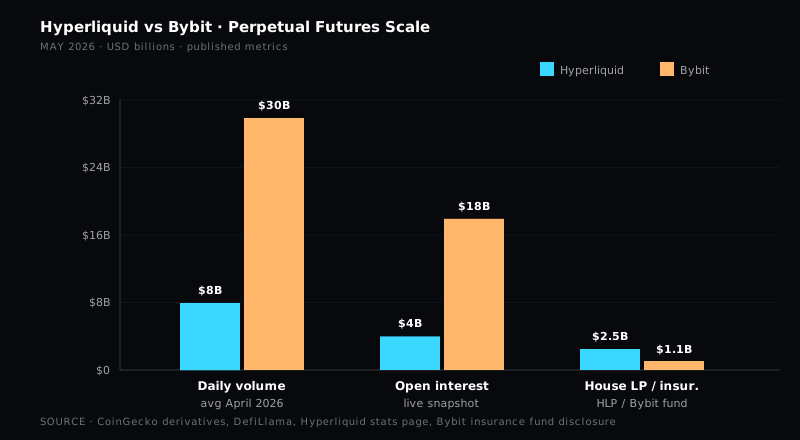
Two platforms shaped 2025 perpetual trading more than any other. Bybit is the largest derivatives centralized exchange by open interest; Hyperliquid is the largest perpetual DEX by trading volume, running its own purpose-built Layer 1 with an on-chain central limit order book. The question of which to use turns on custody preference, KYC tolerance, asset breadth, and what you actually need from a venue beyond the order book.
TL;DR: Hyperliquid wins on fees, no-KYC self-custody, and on-chain transparency for top-pair perpetual traders. Bybit wins on asset breadth, options markets, USDC-margined perpetuals, copy trading marketplace, fiat ramps, and a single-account UX without bridge management. Both have survived 2025 stress: Bybit through its $1.5 billion exploit response, Hyperliquid through validator decentralization and HLP vault resilience. Neither serves US users in unrestricted form. For no-KYC sophisticated perpetual trading, pick Hyperliquid. For derivatives breadth with custodial convenience, pick Bybit.
Not financial advice. Crypto trading is high risk. Bybit experienced a February 2025 hot wallet exploit of approximately $1.5 billion (Lazarus Group attribution, insurance fund covered all user losses). Hyperliquid runs custody through a smart contract bridge on Arbitrum, which carries smart-contract and validator-set risk that has not been stress-tested at Bybit’s scale. Both apply geofencing that changes without notice. Verify country availability and current fee schedules before depositing capital. Read the risk disclaimer before scaling capital onto either venue.
Verdict at a glance
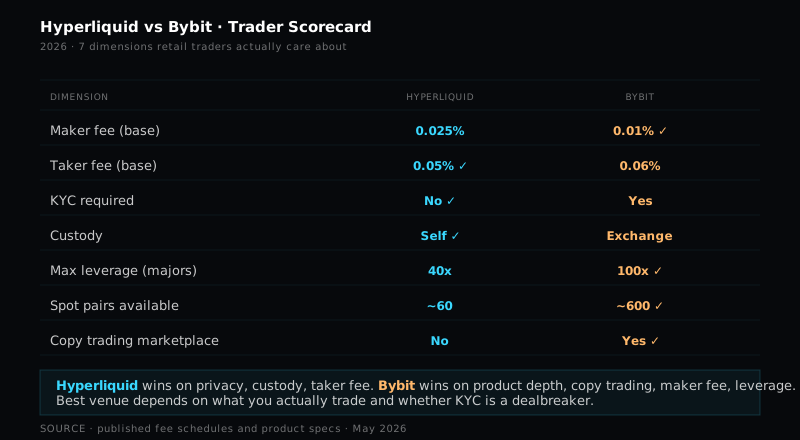
Here is who wins each category before the long discussion. The headline result: Hyperliquid takes 5 of 8 categories where they directly compete, but Bybit wins the categories that determine whether the platform fits an average retail user (asset breadth, fiat access, beginner UX).
| Category | Winner | Notes |
|---|---|---|
| Fees (retail volume) | Hyperliquid | 0.025% taker vs Bybit 0.055% at base; maker rebate of 0.005% on Hyperliquid pays makers. |
| Order book quality (majors) | Bybit, narrowly | Bybit deeper on block sizes; Hyperliquid competitive under $1M trade size. |
| KYC posture | Hyperliquid | Permissionless protocol vs mandatory KYC on Bybit post-Feb 2025. |
| Self-custody | Hyperliquid | Wallet-based; Bybit holds funds custodially. |
| Asset list breadth | Bybit | ~600 spot + ~450 perpetual + options; Hyperliquid is perp-only with ~200 pairs. |
| Max leverage | Bybit | 200x on majors vs Hyperliquid 50x cap. |
| Token value accrual | Hyperliquid (HYPE) | On-chain buyback from protocol fees; BIT is a fee-discount instrument. |
| US user access | Neither | Bybit blocks US entirely; Hyperliquid frontend blocks US IPs, protocol open. |
Two strong venues with deliberately different shapes. The rest of this article tests the verdict above against fees, order book mechanics, custody, regulatory posture, and trading experience.
At a glance
| Factor | Hyperliquid | Bybit |
|---|---|---|
| Founded | 2022 (mainnet 2023) | 2018 |
| Headquarters | Decentralized protocol (core contributors in BVI) | Dubai (operational) |
| Custody model | Self-custodial (wallet-based) | Custodial (platform holds funds) |
| KYC required for trading | None at protocol level | Mandatory (post-Feb 2025) |
| Spot pairs available | Limited (HIP-1 native spot, ~30 pairs) | ~600 |
| Perpetual pairs available | ~150 to 200 | ~450 |
| Max futures leverage | 50x on majors | 200x on majors |
| Spot fees (base maker/taker) | Variable (HIP-1 spot newer) | 0.10% / 0.10% |
| Perpetual taker (base) | 0.025% | 0.055% |
| Perpetual maker (base) | -0.005% (rebate) | 0.020% |
| Perpetual taker with token | 0.020% (HYPE staking tiers) | 0.044% (BIT, 20% off) |
| Options markets | None | BTC, ETH (European-style) |
| USDC-margined perpetuals | USDC native | Yes, deep liquidity |
| Copy trading marketplace | Vault leaders (informal) | Yes (formal product) |
| Fiat on-ramp | None (deposit USDC from L2) | Direct fiat ramps |
| Ecosystem token | HYPE (Nov 29 2024 TGE, ~28% airdrop, on-chain buyback) | BIT (20% off + Web3 plays) |
| Proof of reserves | On-chain by design | Merkle-tree, quarterly |
| Recent security event | None at scale (HLP losses absorbed without insolvency) | Feb 2025 hot wallet ($1.5B, covered) |
| US access | Frontend blocks US IPs; protocol open | None |
| HLP vault TVL (Q1 2026) | ~$388M | N/A (no equivalent product) |
The two platforms are not direct substitutes. Bybit is a full-stack derivatives venue with spot, options, copy trading, and structured products. Hyperliquid is a focused perpetual venue with on-chain settlement and self-custody. The decision tree begins with whether you want a wallet-native or account-native experience.
Order book architecture
The architectural choice drives most of the user-visible differences. Bybit operates a traditional centralized matching engine; Hyperliquid runs an on-chain CLOB on its own Layer 1, HyperBFT. The implications for latency, MEV exposure, and fairness are real but subtler than the marketing on either side suggests.
Bybit: centralized matching, off-chain settlement
Bybit’s matching engine runs in a single colocated data center, with order entry over standard CEX APIs (REST and WebSocket). Matched fills settle against the platform’s internal ledger; users see balance changes immediately in the UI but the underlying movement is a database write, not a blockchain transaction. This architecture wins on:
- Latency. Round-trip order-to-fill latency on Bybit is in the 10-50 millisecond range for colocated market makers, and under 200 milliseconds for retail clients globally.
- Throughput. The matching engine handles tens of thousands of orders per second without backpressure. Order cancellation and replacement are effectively instant.
- Predictability. Centralized matching means no slippage from blockchain ordering games. Front-running by other users is structurally impossible at the matching layer (though API-tier latency arbitrage is still a thing).
The trade-offs are equally clear. Users must trust Bybit’s order book, fill prices, and balance ledger. Settlement is opaque relative to on-chain alternatives. The platform can theoretically freeze accounts, halt trading, or change rules unilaterally.
Hyperliquid: on-chain CLOB on HyperBFT L1
Hyperliquid’s order book runs as a smart contract execution on HyperBFT, a custom Tendermint-derived consensus layer purpose-built for the protocol. Every order placement, cancellation, and fill is a state transition on the L1. The published block time is around 200 milliseconds with deterministic finality.
This design wins on:
- Transparency. Every fill, every order book change, every funding payment is on-chain and verifiable. Users do not trust the platform’s claim of execution; they verify it.
- Censorship resistance. No central operator can block specific wallets from trading at the protocol level (frontend access can be blocked, but a sophisticated user can interact with the contracts directly).
- Self-custody. Trading capital lives in user-controlled wallets, secured behind an Arbitrum bridge contract. No custodial intermediary holds the funds during a trade.
- MEV resistance. Hyperliquid’s order ordering does not expose retail orders to sandwich attacks the way an AMM perpetual would. The CLOB design is closer in spirit to a CEX than to Uniswap.
The trade-offs:
- Validator-set risk. HyperBFT runs on a smaller validator set than mainstream L1s. A coordinated validator attack or chain halt would be more disruptive than at Ethereum or Solana scale.
- Bridge risk. Deposits and withdrawals route through a smart-contract bridge on Arbitrum. Bridge contracts have been the most-exploited primitive in DeFi history; Hyperliquid’s bridge has not had an incident, but the risk class is real.
- Latency in absolute terms. 200 millisecond block times are fast for an L1 but still 5-10x slower than Bybit’s matching engine. For market makers running high-frequency strategies, this matters.
What they have in common
Both run CLOB-style order matching (continuous limit order books with maker/taker fee structures), both support standard order types (limit, market, stop, take-profit, trailing), both expose programmatic APIs. From a user perspective, the trading experience on a chart-and-orderbook screen looks broadly similar.
The honest assessment on top pairs
Through 2024 and into 2026, Hyperliquid’s top-pair liquidity caught up with Bybit’s enough that for a typical retail or small-institutional trader on BTC, ETH, or SOL perpetuals, the execution gap is no longer the deciding factor. Mid-size fills ($10k to $1M) execute with comparable slippage. The difference shows up in tail pairs (Bybit lists hundreds more perpetuals) and in block-size institutional orders (Bybit still has deeper market makers willing to quote $5M+ positions on majors).
For an active retail trader running positions under $500,000 per leg on major pairs, the order book quality difference is real but not dispositive. The choice will turn on other factors.
For deeper architecture mechanics: Hyperliquid review and Bybit review.
Fees compared
Headline fees diverge sharply, and the gap matters more than on Bybit-vs-Bitget where both sides ran similar curves. Hyperliquid is structurally cheaper at retail volume by a wide margin.
Perpetual futures fees, base tier
| Tier | Hyperliquid | Bybit (no token) | Bybit + BIT |
|---|---|---|---|
| Base / VIP 0 | -0.005% / 0.025% | 0.020% / 0.055% | 0.016% / 0.044% |
| Mid (Hyperliquid Tier 2, Bybit VIP 1) | -0.006% / 0.022% | 0.015% / 0.045% | 0.012% / 0.036% |
| Top (Hyperliquid staking discount + volume, Bybit VIP 3) | -0.008% / 0.018% | 0.010% / 0.030% | 0.008% / 0.024% |
| Market-making tier (Hyperliquid Tier 5, Bybit VIP 5) | -0.010% / 0.015% | 0.000% / 0.022% | 0.000% / 0.018% |
A few specific observations:
- Hyperliquid pays makers. The negative maker fee means a liquidity provider on Hyperliquid earns 0.005% on filled passive orders. Bybit charges makers 0.020% at the same tier. The difference, 0.025% per maker-side trade, compounds quickly for market-neutral strategies.
- Hyperliquid taker is lower at every tier. At base, Bybit’s taker is 0.055% vs Hyperliquid’s 0.025%, a 30 basis point gap per trade. With BIT discount, Bybit narrows to 0.044%; still 19 basis points above Hyperliquid’s base.
- Top VIP tiers converge. At Bybit VIP 5 with BIT, taker fees drop to 0.018%, slightly below Hyperliquid’s market-making tier. For traders running over $5M monthly volume with the BIT discount stacked, Bybit can become competitive or marginally cheaper.
Worked example: $250,000 monthly perpetual taker volume
- Hyperliquid base: $62.50
- Bybit base: $137.50 (more than 2x)
- Bybit + BIT discount: $110
A trader running $250k monthly perpetual taker volume saves roughly $48 to $75 per month on Hyperliquid versus Bybit. Annualized: $570 to $900. Not transformative, but a real and persistent saving that compounds with volume.
Worked example: $5M monthly perpetual taker volume
- Hyperliquid Tier 3 estimate: $900 (at 0.018% taker)
- Bybit VIP 3 + BIT: $1,200 (at 0.024% taker)
- Bybit VIP 5 + BIT (if applicable): $900 (at 0.018% taker)
At market-making scale, the platforms converge. The fee decision below $5M monthly volume firmly favors Hyperliquid; above that range, it depends on the trader’s specific VIP-tier negotiations with Bybit.
Maker rebate as a structural feature
The most underappreciated mechanic on Hyperliquid is the maker rebate. A market-making strategy that fills passively on Hyperliquid earns approximately 0.005% per trade on the maker side, paid by the protocol from taker fees. The same strategy on Bybit pays 0.020% on the maker side at base tier, only flattening to zero at VIP 5. For passive liquidity providers, Hyperliquid is materially more economic.
This is one of the reasons Hyperliquid’s order book depth has scaled so rapidly: the platform actively pays makers to provide liquidity, while most centralized venues only zero them out at top tiers.
Funding rates
Both platforms run continuous funding rate mechanisms tied to mark-vs-index spread. The headline funding rates on major pairs are within a few basis points across the two platforms because arbitrageurs keep them aligned. Neither is structurally cheaper on funding; this is determined by market conditions, not platform design.
Withdrawal fees
- Hyperliquid: bridge withdrawal to Arbitrum is a smart-contract transaction; gas-cost based, typically under $1 at normal L2 conditions.
- Bybit: 1 USDT flat on TRC-20, gas pass-through on ERC-20.
Hyperliquid’s bridge model means withdrawals are slower (typically a few minutes for L1-to-L2 finality) and pay variable L2 gas. Bybit’s centralized model means withdrawals can be near-instant on common networks, with flat predictable fees. Neither dominates on the withdrawal axis.
For full fee mechanics: Hyperliquid review and Bybit review.
KYC and country availability
The KYC gap is the largest structural difference between these platforms, and it tracks the custody architecture. Bybit holds your funds and is regulated as a financial intermediary; KYC is mandatory. Hyperliquid runs a permissionless protocol and applies geographic blocks only at the frontend level.
Bybit KYC posture in 2026
After the February 2025 exploit accelerated compliance investment, Bybit moved to mandatory KYC for nearly all account functions globally. The current structure:
- Unverified accounts. Effectively read-only for new sign-ups. Trading, deposits, and withdrawals are all gated.
- Standard KYC (government ID verification). Required for full spot, futures, and copy trading access. Daily withdrawal limit around 1,000,000 USDT for verified retail accounts.
- Advanced KYC (address verification + selfie). Required for higher withdrawal limits, OTC desk access, structured products, institutional features.
There is no meaningful unverified usage path on Bybit in 2026. New accounts complete Standard KYC or do not use the platform.
Hyperliquid KYC posture in 2026
Hyperliquid has no identity layer at the protocol level. Users connect a wallet, sign a transaction to deposit USDC through the Arbitrum bridge, and trade. The platform never sees a passport, ID, or address.
The frontend at app.hyperliquid.xyz applies IP-based geographic blocks (US, sanctioned jurisdictions, a handful of others). But the underlying smart contracts on Arbitrum and the HyperBFT L1 are accessible to any wallet that can sign a transaction. Power users who interact directly with the contracts, or who run their own frontend, can bypass the IP block. Whether doing so is legally advisable depends on jurisdiction; it is technically possible.
Country availability
Both platforms apply geofencing, but the lists differ:
Bybit hard blocks (no service):
- United States (entire jurisdiction)
- Canada (most provinces, post-CSA guidance)
- United Kingdom (FCA-related derivatives restrictions)
- Sanctioned: Iran, North Korea, Syria, Cuba, Crimea, others
Hyperliquid frontend blocks (protocol still accessible):
- United States IP addresses
- Sanctioned jurisdictions (OFAC list compliance at the frontend)
- A handful of others under regulatory pressure
The practical distinction: Bybit will close your account and freeze your balance if it detects a US connection during onboarding or KYC. Hyperliquid will block the frontend from your IP but the protocol does not have an identity layer to detect you. This is a meaningful difference for privacy-focused users, but it does not constitute legal authorization to use the protocol from a blocked jurisdiction. VPN workarounds violate Bybit’s terms of service and risk account closure plus fund freeze; using a wallet to interact with a permissionless protocol from a blocked jurisdiction is a different legal question with no clean answer.
For US-based users specifically, neither platform serves you in unrestricted form. Look at Kraken, Coinbase, Gemini, or CFTC-registered futures venues like the US-licensed alternatives covered here.
Self-custody vs custodial trade-offs
The custody model is the deepest architectural difference between these platforms. It drives both the user experience and the failure modes.
Bybit custodial model
Bybit holds customer funds on its own balance sheet. Users deposit fiat or crypto, see a balance in the account UI, and trade against that balance. Withdrawal is a request to the platform; the platform releases funds from its hot wallet (or cold wallet via the standard withdrawal flow). The user trusts Bybit’s solvency, security, and operational integrity.
Strengths of this model:
- Account recovery. Lost password? Reset via email and KYC verification. Lost 2FA device? Recovery support flow. The platform can restore access through identity verification.
- No private key burden. Users do not need to manage seed phrases, hardware wallets, or signing infrastructure. A traditional username and password (plus 2FA) is sufficient.
- Customer support. Disputes, accidental sends, frozen funds, all routes through a support ticket system. The platform has the authority to fix mistakes (when it chooses to).
- Fiat ramps. The custodial model is what makes direct fiat deposits and withdrawals possible. Banks settle to a known entity, not an anonymous wallet.
Failure modes of this model:
- Counterparty risk. If Bybit becomes insolvent, gets exploited beyond reserves, or freezes withdrawals for regulatory reasons, your funds are stuck. The February 2025 exploit was the canonical stress test of this risk class.
- Regulatory seizure. Sovereign action against the platform (sanctions, account freeze orders, exchange shutdowns) can prevent withdrawals regardless of solvency.
- Operational risk. Account hacking via SIM swap, phishing, or session hijack can drain a Bybit account in a way that self-custody designs prevent.
Bybit February 2025 exploit, and how it was handled
On February 21, 2025, Bybit’s ETH cold-to-hot wallet transfer process was compromised, with approximately $1.5 billion in ETH and ETH-derivative tokens drained in a single transaction. The attack was attributed to the Lazarus Group, the North Korean state-affiliated threat actor responsible for a string of prior exchange exploits.
Bybit’s response demonstrated the strengths of a well-run custodial exchange:
- Platform-level withdrawals continued uninterrupted throughout the incident.
- Insurance fund plus operational treasury absorbed the full loss.
- User balances were made whole within hours.
- CEO Ben Zhou ran live public briefings and coordinated with on-chain analytics firms to trace the stolen funds.
- Full operational recovery within 7 days, with external audit of rebuilt cold-wallet infrastructure.
The user-impact outcome was zero loss. The forward-looking interpretation is mixed: Bybit proved reserve adequacy and incident-response quality at the largest exchange-exploit scale on record, while also exposing a hot-wallet attack surface that other major exchanges had hardened earlier.
Hyperliquid self-custodial model
Hyperliquid does not hold customer funds. Users deposit USDC through a smart-contract bridge on Arbitrum into a wallet that they control on HyperBFT L1. Trading positions are tracked at the protocol level, but the underlying collateral is in user-controlled addresses. Withdrawal is a signed transaction that the user initiates; no platform approval is required.
Strengths of this model:
- No counterparty risk to the exchange operator. If Hyperliquid’s core team disappeared tomorrow, the protocol would continue running on its validator set, and user funds would remain withdrawable. There is no “exchange goes insolvent and freezes withdrawals” scenario.
- On-chain transparency. Reserves are not a quarterly attestation; they are publicly verifiable in real time on-chain.
- Self-determination. No frozen accounts, no withdrawal limits imposed by the platform, no terms-of-service violation that drains an account.
Failure modes of this model:
- Bridge risk. The Arbitrum bridge contract holds the USDC backing user balances on HyperBFT. A bridge contract exploit would drain backing for the L1 balances. Hyperliquid’s bridge has not had an incident, but bridge contracts have been the most-exploited primitive in DeFi history.
- Validator-set risk. HyperBFT runs on a smaller validator set than mainstream L1s. Coordinated validator action (or a chain halt) could disrupt trading or, in an extreme case, threaten settlement integrity.
- User key responsibility. Lose your seed phrase, lose your funds. No recovery path. No customer support that can restore access.
- Smart-contract risk. The protocol’s perpetual margin logic, liquidation engine, and HLP vault all run as on-chain code. Bugs or unforeseen edge cases can manifest in ways that custodial platforms can patch with a database write but on-chain platforms cannot.
Recovery story comparison
| Scenario | Bybit | Hyperliquid |
|---|---|---|
| Forgot password | Reset via email + KYC | Restore from seed phrase |
| Lost 2FA device | Support-mediated recovery | Restore from seed phrase |
| Lost seed phrase | N/A (no seed) | Permanent loss |
| Account hacked (phishing) | Possible support intervention | Funds gone if seed compromised |
| Platform insolvent | Insurance fund or freeze | No insolvency risk |
| Platform freezes account | Possible (terms violation) | Not possible at protocol level |
The two models are not better-and-worse; they trade different failure modes. Bybit insures against user error and provides a recovery path, at the cost of accepting platform-level risk. Hyperliquid eliminates platform risk, at the cost of zero recovery options for user error.
A reasonable mental model: Hyperliquid is harder to use safely (your seed phrase discipline is the difference between solvency and bankruptcy), but the failure modes are within your control. Bybit is easier to use safely (good password and 2FA hygiene suffices), but the failure modes are outside your control (you cannot prevent a Lazarus Group hot-wallet exploit).
For most users above six-figure balances, splitting capital between the two models is the practical answer.
Asset coverage and depth
The asset-list gap is a structural product decision. Bybit is a full-stack derivatives exchange; Hyperliquid is a focused perpetual venue.
Bybit asset coverage
- Spot pairs: approximately 600, covering most major and mid-cap tokens, plus a long tail of newer listings.
- Perpetual pairs: approximately 450, including USDT-margined and USDC-margined variants for major assets, plus inverse perpetuals (settled in the base asset).
- Options markets: BTC and ETH European-style options with daily, weekly, monthly, and quarterly expiries. Strikes range broadly around current spot. Greeks, IV surface, and strategy builders all supported.
- Structured products: Dual asset, shark fin, accumulator, principal-protected notes, and other structured payoffs available through the Bybit Earn surface.
- Trading bots: Grid, DCA, futures grid, arbitrage bots all native.
- Copy trading: Formal marketplace with thousands of lead traders, sizing controls, and per-trader sub-account isolation.
Hyperliquid asset coverage
- Spot pairs: Limited. The HIP-1 native spot launch added approximately 30 pairs, with the protocol still adding listings selectively.
- Perpetual pairs: approximately 150-200, including all major and most mid-cap tokens. Newer listings appear within days of strong CEX activity.
- Options markets: None at protocol level.
- Structured products: None at platform level (third-party builders are constructing strategies but not yet at scale).
- HLP vault: A protocol-operated market-making vault that users can deposit into for yield. TVL approximately $388 million in Q1 2026. Not a structured product in the traditional sense, but the closest equivalent.
- Copy trading: Informal vault-leader following (subscribe to a vault and let the leader’s strategy run), not a formal copy trading marketplace.
What the asset gap means in practice
For a diversified portfolio that needs spot, perpetuals, options, structured yield, and copy trading under one roof, Bybit is the only realistic choice between these two. The product surface gap is wide and intentional.
For a concentrated perpetual trader who trades a handful of major pairs and does not need options, structured products, or fiat ramps, Hyperliquid’s narrower surface is not a disadvantage. The platform is built for exactly this use case, and the lack of feature sprawl keeps the trading interface clean.
The right mental model: Bybit is a full-stack derivatives department store; Hyperliquid is a focused perpetual specialty shop. Match the platform to the strategy, not the other way around.
Token economics: HYPE vs BIT
The two tokens optimize for different theses. HYPE is a value-accrual play on protocol fee revenue; BIT is a fee-discount instrument with ecosystem exposure.
HYPE on Hyperliquid
HYPE launched on November 29, 2024 through a community airdrop event widely considered one of the most user-friendly token generation events in recent crypto history. Key parameters:
- Total supply: 1 billion HYPE.
- Community airdrop allocation: approximately 28% (one of the highest community-share airdrops among major perpetual DEXs).
- Foundation and core contributors: allocated with multi-year vesting schedules.
- Distribution methodology: Eligibility based on historical usage of the protocol (volume traded, USDC deposited, HLP participation), with no points-farming game.
The value-accrual mechanism is the more interesting part. The Hyperliquid protocol applies a portion of its fee revenue toward on-chain HYPE buybacks, executed transparently on the L1. As trading volume scales, fee revenue scales, and the buyback pressure on HYPE supply scales with it. By Q1 2026, the buyback program has progressively reduced circulating supply, with on-chain accounting verifiable at any time.
Additional HYPE utility:
- Staking discounts. HYPE staked above tier thresholds unlocks reduced trading fees and increased maker rebates.
- Governance. Limited current scope; protocol changes are coordinated by core contributors with community input. The governance surface is expected to expand.
- Vault leader bonus. Vault operators on Hyperliquid earn a share of HLP-style strategy profits; HYPE staking can enhance this share.
BIT on Bybit
BIT serves a more conventional centralized-exchange-token role:
- Fee discount. 20% off spot and perpetual fees when held above minimum thresholds.
- Launchpad access. Priority allocation in Bybit Launchpad token sales.
- Ecosystem exposure. BIT serves as a partial proxy for Bybit’s broader Web3 and Layer 2 investment portfolio. Bybit has been an active capital allocator into on-chain liquidity protocols and L2 ecosystems.
- Yield. BIT can be earned through Bybit Earn flexible and locked products, typically 3-8% APR depending on market conditions.
Value-accrual mechanics compared
| Mechanism | HYPE | BIT |
|---|---|---|
| Buyback from protocol fees | Yes, on-chain | No formalized buyback program |
| Fee discount | Tiered via staking | 20% flat |
| Native yield | Staking + vault bonuses | 3-8% APR via Bybit Earn |
| Governance | Limited current scope | None |
| Ecosystem play | Hyperliquid L1 native | Web3/L2 portfolio exposure |
| Supply trajectory | Progressively reduced via buyback | Static (no formal burn) |
For value-accrual focused holders, HYPE has the cleaner mechanic in 2026. The on-chain buyback gives token holders a direct claim on platform economics, scaled with usage. This is a structurally different proposition from BIT’s fee-discount-plus-ecosystem exposure.
For pure fee-discount holders on Bybit specifically, BIT is still the practical tool. You hold it, you save 20% on trading. No alternative comparison required.
Risk note on both tokens
Both tokens carry custodial exposure layered on top of trading exposure. Holding HYPE means trusting the validator set of HyperBFT and the smart contracts that mint, burn, and buyback. Holding BIT means trusting Bybit with both your trading capital and your token position. Size token holdings independently from trading capital, and treat them as separate risk allocations.
Trading experience
The interfaces optimize for different cohorts, and the design priorities reflect each platform’s strategic identity.
Bybit: derivatives industry benchmark
Bybit’s derivatives UI is widely considered the industry benchmark for power users. The order entry surface exposes leverage selection, position mode (cross/isolated), reduce-only flags, post-only flags, time-in-force options, and TP/SL configuration in a single screen without feeling cluttered. The depth chart, order book heatmap, and funding-rate display are tuned for active perpetual traders.
The breadth of products is a structural advantage: spot, perpetuals (USDT and USDC margined), inverse perpetuals, options (BTC and ETH), structured products, trading bots, and copy trading all live under one login. A trader can rotate strategies without switching venues.
Options support is a unique product line. Bybit’s BTC and ETH options markets ship with a Greeks display, implied volatility surface, and structured strategy builder (covered call, protective put, straddle, strangle). Among retail-friendly venues, only Bybit and Deribit offer this depth of options tooling.
Fiat ramps are direct: bank transfer, card, P2P, and a list of third-party providers all push fiat directly into the trading account. No bridge management, no L2 gas, no wallet signing for routine deposits.
Mobile experience: matches the web. Order entry on mobile is among the cleanest in the industry. Notifications, position management, and copy-trading controls are all present.
The cost of this density: a first-time perpetual user finds the interface intimidating. The learning curve is real, especially for users coming from a traditional brokerage or a simpler crypto venue.
Hyperliquid: perp-native clean UI
Hyperliquid’s UI is deliberately minimalist relative to Bybit’s. The trading screen surfaces a chart, order book, order entry, and position display, with limited additional clutter. The platform does one thing (perpetual futures trading on-chain) and the UI reflects that focus.
The wallet-native model means routine actions feel different from a centralized exchange: connecting a wallet, signing trade-approval transactions (or using the platform’s signing mode for batch authorization), and bridging USDC through the Arbitrum bridge on first deposit. Once set up, the day-to-day trading flow is competitive with a CEX. Order entry is fast, fills are deterministic, and the on-chain settlement is invisible at the UI layer.
HLP vault: users can deposit USDC into the HLP market-making vault and receive a share of vault profits (and losses). Vault TVL of approximately $388 million in Q1 2026. Not a structured product in the traditional sense, but functions as an on-chain yield-on-trading-flow product unique to Hyperliquid.
What is missing relative to Bybit:
- No fiat on-ramp. Users must bridge stablecoins from another network (typically Arbitrum or Ethereum).
- No options markets.
- No structured products.
- No formal copy trading marketplace (informal vault-following exists).
- No trading bots native to the platform (third-party integrations exist but are less polished).
For crypto-native traders who already hold stablecoins and want a clean perp-focused interface, the missing features are not a loss; they are reduced clutter. For first-time users coming in fresh, the absence of fiat ramps and the requirement to manage a wallet seed phrase add real friction.
Learning curve comparison
| Cohort | Better experience |
|---|---|
| First-time crypto user, fiat-funded | Bybit |
| Crypto-native, holds USDC, wants perp on majors | Hyperliquid |
| Options trader | Bybit (only realistic option) |
| Copy-trading-first user | Bybit |
| High-frequency market maker | Bybit (lower latency) |
| Self-custody non-negotiable | Hyperliquid |
| Privacy-focused, no-KYC | Hyperliquid |
| Want a single account for spot + perp + options | Bybit |
| Want on-chain transparent execution | Hyperliquid |
The UI difference tracks the strategic positioning. Bybit is built for breadth of products on a custodial model; Hyperliquid is built for on-chain perpetual trading with self-custody. Neither is objectively better; they optimize for different users.
Who should pick Bybit
Pick Bybit if at least two of the following apply:
- You trade options. Bybit’s BTC and ETH options markets are the only retail-friendly options venue between these two platforms. If options strategies are part of your workflow, Bybit is the default and Hyperliquid does not compete.
- You need fiat on-ramps. Bank transfers, card deposits, P2P, and direct fiat withdrawals are all available on Bybit. Hyperliquid requires bridging stablecoins from an external network.
- Copy trading is part of your strategy. Bybit operates a formal copy-trading marketplace with thousands of lead traders, sizing controls, and a refined discovery flow. Hyperliquid has informal vault-following but no equivalent product.
- You want spot, perpetuals, options, and yield in one account. The full-stack derivatives surface lives under one login on Bybit. Hyperliquid is perp-focused and would require pairing with other venues.
- You run USDC-margined perpetuals at scale. Bybit has deeper USDC perpetual liquidity than most competitors.
- You need 100x or 200x leverage. Bybit’s leverage ceiling exceeds Hyperliquid’s 50x cap on majors. For traders whose strategy requires that headroom, Bybit is the only choice.
- You prefer custodial account management. A username, password, and 2FA, with a recovery path through KYC, is structurally easier than seed-phrase management for many users.
- You are a beginner. The full fiat-to-trade flow on Bybit is materially easier than the wallet-bridge flow on Hyperliquid for a first-time crypto user.
The mid-tier copy trading product, options surface, and fiat ramps are real differentiators that Hyperliquid does not match. If two or more of these are critical, Bybit is the correct choice.
Who should pick Hyperliquid
Pick Hyperliquid if at least two of the following apply:
- Self-custody is non-negotiable. Hyperliquid’s wallet-based design means trading capital lives in user-controlled addresses, not on a platform balance sheet. For users who view custodial exposure as a primary risk, this is the structural answer.
- No-KYC is a requirement. Hyperliquid has no identity layer at the protocol level. Bybit moved to mandatory KYC in 2025. If KYC is unacceptable for privacy, jurisdictional, or compliance reasons, Hyperliquid is the only option here.
- You only trade perpetuals on majors. Hyperliquid’s top-pair liquidity is competitive with Bybit’s for sub-$1M trade sizes. If your strategy lives on BTC, ETH, SOL, and a handful of large-cap perpetuals, you do not lose execution quality by switching.
- You want lower fees. At retail volume, Hyperliquid is roughly 2x cheaper on the taker side and pays a maker rebate. For active traders running over $100k monthly volume, the annual savings are real.
- You want a token with a value-accrual claim on platform fees. HYPE’s on-chain buyback program scales with protocol revenue. BIT does not have an equivalent mechanic.
- You are comfortable with wallet management. Seed phrase discipline, hardware wallet usage, and bridge transactions are part of the daily flow. For crypto-natives, this is routine; for newcomers, it is real friction.
- You want on-chain transparent execution. Every fill, every order book change, every funding payment is verifiable on-chain in real time. Custodial venues require trust in platform attestations.
- You run market-making or passive liquidity strategies. The maker rebate of 0.005% structurally favors makers over Bybit’s 0.020% maker fee at base tier.
The narrower product surface (no options, no structured products, no fiat ramps, no formal copy trading) is the trade-off. If two or more of the above apply, Hyperliquid is the correct choice.
Verdict and final recommendation
The honest summary: this is a structural choice, not a quality comparison. Both platforms are well-built, both have survived their 2025 stress tests, and both target the perpetual futures market with deliberate but different architectures. The verdict turns on what kind of trader you are.
For sophisticated no-KYC perpetual traders on majors in 2026, Hyperliquid has a slight edge. The maker rebate, the lower taker fees, the self-custody model, the on-chain transparency, and the HYPE buyback mechanic compound into a structurally cheaper and more transparent venue for users whose strategy fits within the protocol’s narrower asset surface. The execution quality on BTC, ETH, and SOL perpetuals is now close enough to Bybit’s that the gap is not the deciding factor.
For derivatives-breadth users who need options, fiat ramps, copy trading, and a unified custodial account in 2026, Bybit is the correct answer. The product surface gap is wide and intentional. Hyperliquid does not compete on options at all, has no fiat ramps, and runs only an informal copy-trading equivalent. For traders whose workflow needs more than perpetual futures on majors, Bybit is the default.
Both are legitimate venues with proven stress responses. Bybit’s February 2025 exploit response demonstrated reserve adequacy and incident-response quality at the largest exchange-exploit scale on record. Hyperliquid has operated through 2024 and 2025 without a comparable headline event, with HLP vault stress events absorbed without protocol insolvency. The failure modes are different (counterparty vs bridge and validator), not better-or-worse.
Neither serves US users in unrestricted form. Bybit blocks the US entirely. Hyperliquid’s frontend blocks US IPs but the protocol is open at the contract level; using it from a blocked jurisdiction is a legal question with no clean answer. For US-based traders, look elsewhere.
The most useful framing: Hyperliquid and Bybit are not direct substitutes. They are two different products for two different theses about what a perpetual trading venue should be. A sophisticated trader might rationally use both for different parts of a portfolio: Hyperliquid for cheap self-custody perpetual exposure on majors, Bybit for options hedging, copy trading, and fiat ramps. The 2026 stack does not have to be either-or.
Open Hyperliquid for self-custody perpetuals: Read the full Hyperliquid review. On-chain CLOB, maker rebate, HYPE buyback program, no KYC at the protocol level.
Open Bybit for derivatives breadth: Open Bybit. Options, USDC perpetuals, fiat ramps, copy trading marketplace, and 200x leverage in one account.
See the affiliate disclosure for full detail. Bybit is a CopyTradeInsider partner; the link above includes partner attribution. Hyperliquid is covered editorially without an affiliate relationship. The recommendation tracks platform fit, not link economics.
Read next
- Hyperliquid review 2026. Full feature breakdown, fee mechanics, and on-chain risk discussion.
- Bybit review. Full feature breakdown and scoring.
- Bybit vs Bitget. Centralized exchange head-to-head on copy trading depth.
- Best no-KYC crypto exchanges 2026. Cross-platform comparison for privacy-focused traders.
- Methodology. How we evaluate exchanges.
- Risk disclaimer.
Frequently asked questions
Hyperliquid or Bybit for perpetual futures in 2026?
Hyperliquid edges out for no-KYC self-custody traders who only touch perpetuals on majors. The on-chain CLOB on HyperBFT L1 now offers spreads competitive with top centralized venues on BTC, ETH, and SOL, and the maker rebate of 0.005% pays you to provide liquidity. Bybit wins for traders who need options, USDC-margined perpetuals, structured products, copy trading, fiat ramps, or a single account UI without wallet bridging. Both are legitimate venues; the choice is structural, not quality-based.
Which has lower fees, Hyperliquid or Bybit?
Hyperliquid is cheaper at retail volume. Hyperliquid charges 0.025% taker and pays a 0.005% maker rebate on top pairs at the base tier. Bybit charges 0.055% taker and 0.020% maker at VIP 0 (some quote 0.060% before recent adjustments), dropping with BIT to 0.044% taker. A $100,000 round-trip costs roughly $50 in fees on Hyperliquid versus $75 to $110 on Bybit at VIP 0. At top VIP tiers Bybit narrows the gap; at retail volumes Hyperliquid wins on cost per dollar traded.
Do I need KYC on Hyperliquid vs Bybit?
No on Hyperliquid, yes on Bybit. Hyperliquid is a permissionless protocol; you connect a wallet, sign a transaction, and trade. The frontend at app.hyperliquid.xyz applies geographic IP blocks but the protocol itself has no identity layer. Bybit moved to mandatory full KYC for nearly all account functions after the February 2025 exploit accelerated compliance investments. There is no meaningful unverified usage path on Bybit in 2026.
Can US users use either?
Neither in unrestricted form. Bybit exited the US market entirely and has no US-licensed product. Hyperliquid's frontend geo-blocks US IP addresses, though the underlying protocol is open to any wallet that can sign a transaction. Self-custody users with their own infrastructure can technically interact with the contracts directly, but doing so may violate US securities and commodities law. For US-based traders, look at Kraken, Coinbase, or CFTC-registered futures venues, not these two.
Order book quality: Hyperliquid vs Bybit?
Bybit retains a small edge on absolute depth, Hyperliquid is competitive on top pairs. Bybit's BTC and ETH order books carry roughly $30-80 million within 10 basis points of mid through 2025 disclosures. Hyperliquid publishes equivalent on-chain depth of $15-40 million within the same band on BTC, ETH, and SOL perpetuals. For trade sizes under $1 million, Hyperliquid's execution on majors is essentially indistinguishable. For block-size institutional fills, Bybit still wins.
What's the leverage cap on each?
Hyperliquid caps at 50x on top pairs (BTC, ETH, SOL), with lower limits on smaller perpetuals. Bybit allows up to 200x on majors at base level, with isolated-margin scaling rules. The functional difference is smaller than the headline numbers suggest: both platforms aggressively reduce leverage on positions above standard size tiers, and most retail traders use 5-20x rather than the headline maximum. If 100x or 200x is critical to your strategy, Bybit is the only choice between these two.
Which is safer, Hyperliquid or Bybit?
Different risk profiles, not strictly comparable. Bybit holds customer funds custodially; the February 2025 cold-to-hot wallet exploit drained approximately $1.5 billion (Lazarus Group attribution), but the insurance fund and operational treasury absorbed losses and users were made whole. Hyperliquid runs self-custodial trading via a smart contract bridge on Arbitrum, eliminating exchange-custody risk but adding bridge and L1-validator risk. Hyperliquid validators have not been publicly stress-tested at Bybit's scale. Choose the failure mode you prefer.
HYPE vs BIT, which token is better?
HYPE has the stronger value-accrual mechanic in 2026. HYPE launched November 29, 2024 with a roughly 28% community airdrop, and the protocol applies fee revenue toward on-chain HYPE buybacks. By Q1 2026, the buyback program has reduced circulating supply progressively. BIT delivers a 20% trading-fee discount on Bybit plus Web3 ecosystem exposure; useful, but not as direct a claim on platform economics. For value-accrual exposure, HYPE wins; for fee discount on a single venue, BIT remains the practical tool. The two tokens optimize for different theses.
#Hyperliquid#Bybit#comparison#perp DEX#derivatives#HYPE#BIT
Discussion
Loading comments…