
TL;DR: BingX wins on copy trading marketplace depth, KYC flexibility at the Standard tier, and base-tier perpetual fees. Bybit wins on derivatives breadth (options markets, structured products, higher leverage ceiling), order book liquidity for larger positions, and brand recognition. Neither serves US users. The platforms occupy different strategic positions in 2026 and the right choice depends on what you actually want to do.
Not financial advice. Crypto trading is high risk. Both platforms have been through major security events: BingX September 2024 hot wallet exploit ($44M), Bybit February 2025 hot wallet exploit ($1.5B). Verify country availability and current fee schedules before depositing. Read the risk disclaimer before scaling capital onto either.
Quick comparison
| Factor | BingX | Bybit |
|---|---|---|
| Founded | 2018 | 2018 |
| Headquarters | Singapore | Dubai (operational, Singapore previously) |
| Spot maker / taker (base) | 0.10% / 0.10% | 0.10% / 0.10% |
| Spot with token discount | n/a (no native token) | 0.08% (BIT) |
| Perpetual maker / taker (base) | 0.020% / 0.050% | 0.020% / 0.055% |
| Perpetual with token discount | n/a | 0.016% / 0.044% (BIT) |
| Spot pairs available | ~700 | ~400 |
| Options markets | None | BTC, ETH |
| Max futures leverage | 150x on majors | 200x on majors |
| Native token | None | BIT (20% off + ecosystem) |
| Copy trading marketplace | Strong, central product | Mid-tier, secondary product |
| KYC at Standard tier | Email-only, full trading enabled | Mandatory for trading |
| Withdrawal limit (Standard) | ~50,000 USDT/day | Limited for unverified accounts |
| US availability | None | None |
| Recent security event | Sep 2024 exploit (~$44M, covered) | Feb 2025 exploit (~$1.5B, insurance covered) |
| Proof of reserves | Published Merkle-tree | Published Merkle-tree |
Copy trading: BingX’s strategic moat
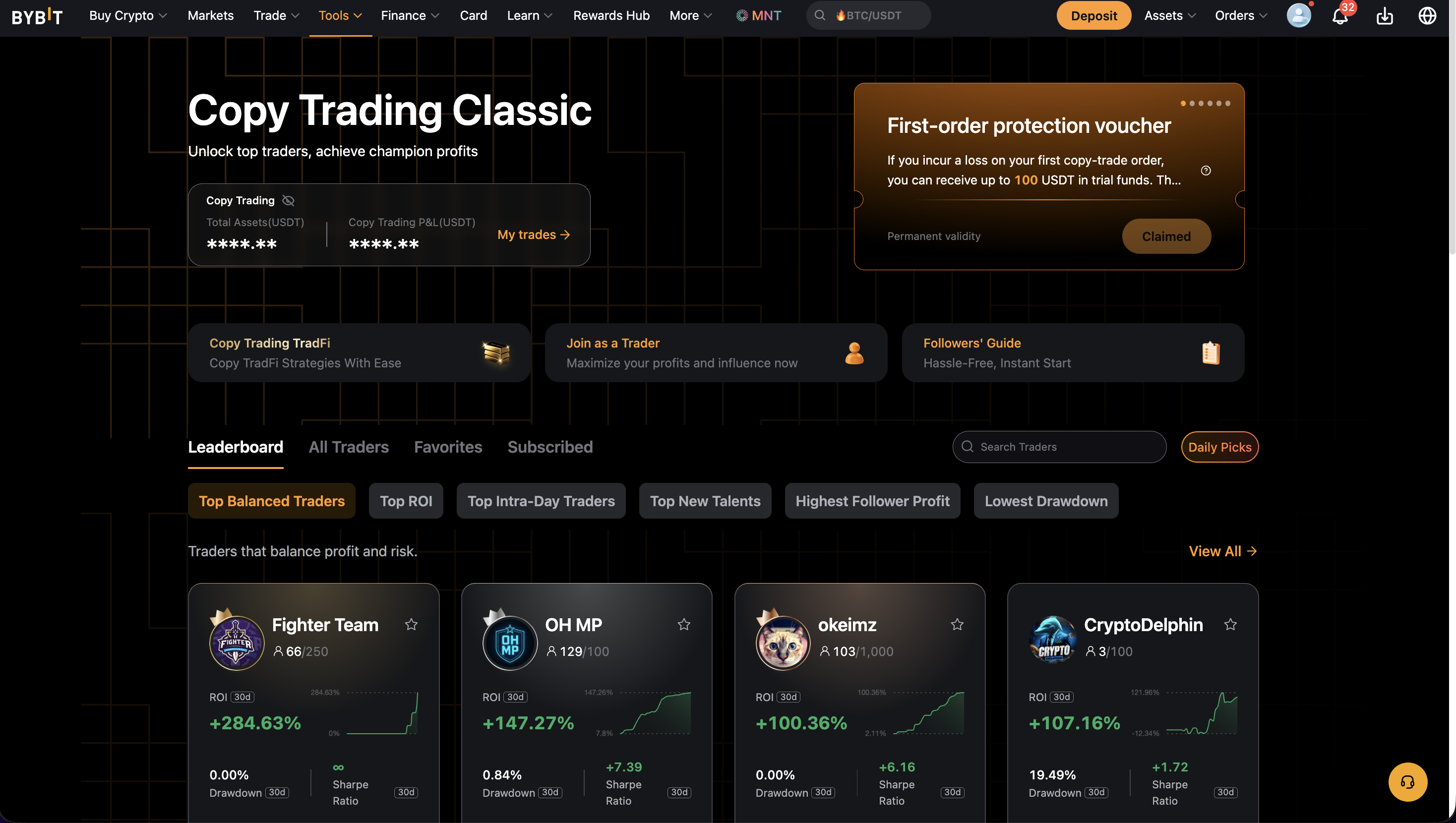
This is the cleanest differentiator between the platforms. BingX’s copy trading marketplace is more developed than Bybit’s across every meaningful dimension:
- Lead trader depth. BingX lists thousands of active lead traders across spot and perpetual strategies. Bybit’s marketplace is smaller and less actively curated.
- Filter and analytics. BingX exposes equity curves, drawdown stats, win rates, average position duration, risk scores, and assets traded as native filters. Bybit’s filter set is sparser.
- Risk controls. BingX offers per-lead-trader sizing, stop-out limits, and copy-position adjustment with finer granularity than Bybit.
- Discoverability. Copy trading is a top-level Bybit product, but it is one of many; on BingX it is positioned as a core platform pillar.
For users whose primary motivation is copy trading specifically, BingX is the stronger choice in 2026. See our BingX copy trading guide for the full marketplace walkthrough.
Bybit’s copy trading is not weak in absolute terms, it is just clearly behind BingX and Bitget on the dedicated copy trading axis. Bybit’s strengths are elsewhere.
Fee structure with token discounts
Both platforms charge similar headline rates. The interesting question is what each looks like after native-token discounts and tier escalation.
BingX base (VIP 0): spot 0.10% maker/taker, perpetual 0.020% maker / 0.050% taker. No native token, no token-discount mechanism. VIP tiers scale down through Elite, VIP 1-5, reaching 0.025% perpetual taker at the top.
Bybit base: spot 0.10% maker/taker, perpetual 0.020% maker / 0.055% taker. With BIT held in account (20% discount): spot 0.08% maker/taker, perpetual 0.016% maker / 0.044% taker. VIP tiers scale further.
Without a native token discount, BingX has the cheaper perpetual taker at default tier (0.050% vs 0.055%, a 5 basis point gap). With BIT held, Bybit becomes the cheaper venue (0.044% vs BingX’s 0.050%, a 6 basis point gap in Bybit’s favor).
The practical interpretation: if you would not otherwise hold BIT, BingX is cheaper. If you already hold BIT for ecosystem or speculative reasons, the fee advantage flips to Bybit. The decision depends on whether the BIT position is justified for non-fee reasons.
Worked example: a trader running $250K of perpetual taker volume per month pays $125 on BingX base, $137.50 on Bybit base, $110 on Bybit with BIT. The dollar gaps are not large at retail volume.
For detailed fee mechanics: BingX review and Bybit review.
Derivatives surface: Bybit’s strategic moat
Where BingX wins copy trading, Bybit wins derivatives breadth. Bybit lists products that BingX does not.
- Options markets. Bybit offers BTC and ETH options with European-style settlement and weekly/monthly expirations. Options liquidity is thinner than Deribit but Bybit is one of the few retail-friendly venues offering options at this depth. BingX has no options product.
- USDC-margined perpetuals. Bybit was early on this product and has more usage among portfolio-margin retail traders. BingX is USDT-margined and Coin-M only.
- Structured products. Bybit lists dual investment, accumulating positions, and yield-enhanced products. BingX has fewer structured offerings.
- Inverse perpetuals. Both offer this.
- Max leverage. Bybit caps at 200x on majors, BingX at 150x. For most retail strategies this difference is not meaningful; for the small subset of users running maximum-leverage strategies it matters.
For a trader running options strategies, hedging structures, or USDC-margined portfolios, Bybit is the only option between these two. For directional perpetuals with copy trading on the side, BingX covers the workflow.
KYC posture in 2026
This is the second-cleanest differentiator. The platforms diverged sharply on KYC after the 2024-2026 regulatory cycle.
BingX still operates a meaningful email-only Standard tier for users outside MiCA-affected jurisdictions and a few other gated regions. Spot trading, futures trading, and copy trading are all accessible at Standard with daily withdrawal limits around 50,000 USDT per day. Higher limits require Advanced verification.
Bybit moved to mandatory KYC for essentially all account functions globally after the February 2025 exploit accelerated compliance investments. New unverified accounts are effectively read-only.
If you specifically want to defer or avoid KYC for as long as possible, BingX is the better starting position. Both platforms will likely converge on stricter KYC over time as regulatory pressure compounds, but as of 2026 BingX retains the more flexible default.
For the workflow detail on BingX’s email-only path, see our BingX no-KYC registration guide and the related BingX sign-up walkthrough.
For users in the Russian Federation: both platforms remain accessible (BingX more reliably than Bybit, which has applied stricter geofencing on some Russian-IP ranges since 2024). Neither requires Russian-issued KYC documents at Standard tier on BingX. Verify current policy before depositing.
Security and incident history
Both platforms have survived major security events without user fund loss.
BingX: September 2024 hot wallet exploit. ~$44M drained from a hot wallet, attributed to a sophisticated external attack. BingX paused withdrawals briefly, restored from reserves, kept user balances whole, completed full recovery within 48 hours. Insurance reserves and operational treasury covered the loss.
Bybit: February 2025 hot wallet exploit. ~$1.5B drained from an ETH hot wallet, publicly attributed to North Korean threat actor activity (Lazarus Group). Bybit absorbed the loss through insurance and operational reserves, kept user balances whole, did not suspend platform-level withdrawals. Full recovery within 7 days.
The scale gap is real: Bybit’s incident was ~34x larger in absolute terms. The percentage of total assets affected was less extreme on Bybit (deeper reserves), but the headline number is worth noting. Both events were textbook incident-response performances. Neither resulted in user fund loss.
Both platforms publish Merkle-tree proof of reserves on a regular cadence. The forward-looking custodial risk profiles are comparable. Standard rule applies: withdraw to self-custody anything not actively trading.
Native token economics
This dimension is asymmetric.
Bybit with BIT offers a 20 percent fee discount, ecosystem access to Bybit launchpads and structured-product slots, and exchange-token exposure. The fee discount alone pays back roughly $200-400 per year for an active retail trader running $1M-2M of annual perpetual volume.
BingX has no native token discount mechanism. Fee reduction comes purely from VIP tier escalation tied to volume and balance, not from holding a token.
For users who would hold a native exchange token anyway (BNB on Binance, BIT on Bybit, KCS on KuCoin), the absence on BingX is a small disadvantage. For users who do not want exchange token exposure, BingX’s structure is cleaner.
For deeper KuCoin/Bybit token-economics comparison, see KuCoin vs Bybit.
Pros and cons summary
Pick BingX if:
- Copy trading is your primary or significant use case (BingX’s marketplace is the strongest on this axis between these two)
- You want to start trading with email-only KYC at the Standard tier
- You run directional perpetual strategies and don’t need options markets
- You don’t want to hold a native exchange token to get fee discounts
- You’re a retail-size trader where the deeper Bybit liquidity advantage doesn’t compound
Pick Bybit if:
- You run options strategies, USDC-margined portfolios, or structured-product positions
- You need the deepest order book between these two platforms for larger orders
- You hold BIT or are willing to hold BIT for the 20 percent fee discount
- 200x leverage availability matters to your strategy
- Brand recognition and trader community size factor into your decision
Verdict
For copy-trading-first users in 2026, BingX is the correct answer. The marketplace is more developed, the lead-trader analytics are deeper, the risk controls are finer, and the email-only sign-up path lowers friction. This is the strongest use case for BingX between these two platforms.
For derivatives-breadth users in 2026, Bybit is the correct answer. Options markets, USDC-margined perpetuals, structured products, and 200x leverage availability give Bybit the wider product surface. The mid-tier copy trading product is a side feature, not the main attraction.
Neither platform serves US users in unrestricted form. Both have survived major security events without user loss. Both publish proof of reserves. The choice should come down to use case fit, not brand intuition.
Open BingX for the copy trading edge: Register on BingX (Telegram club access included for active traders).
Open Bybit for derivatives breadth: Register on Bybit.
See the affiliate disclosure for full detail.
Read next
- BingX review. Full feature breakdown and scoring.
- Bybit review. Full feature breakdown and scoring.
- BingX copy trading guide. How the marketplace actually works.
- Bybit vs Binance. Bybit’s other major comparison.
- KuCoin vs Bybit. Cluster sibling on a different axis.
- BingX no-KYC registration. The email-only sign-up workflow.
- Methodology. How we evaluate platforms.
- Risk disclaimer.
Frequently asked questions
BingX or Bybit, which is better for copy trading?
BingX, by a clear margin. BingX has a dedicated copy trading marketplace that is more central to the platform identity, with deeper lead-trader filtering, public PnL transparency, equity-curve charts, drawdown caps, and per-lead position sizing controls. Bybit's copy trading product exists and is mid-tier in maturity, comparable to KuCoin's but shallower than BingX or Bitget. For users whose primary use case is copy trading specifically, BingX is the stronger choice.
Are BingX fees lower than Bybit?
On perpetual futures, slightly. BingX charges 0.020 percent maker and 0.050 percent taker at the default VIP 0 tier. Bybit charges 0.020 percent maker and 0.055 percent taker at default. With Bybit's BIT token discount (20 percent off), Bybit's perpetual taker drops to 0.044 percent, which is now cheaper than BingX. So without a native token discount BingX wins by ~0.005 percent; with the BIT discount Bybit edges ahead. For spot, BingX is 0.10 percent maker/taker; Bybit is 0.10 percent at base, 0.08 percent with BIT. The fee gap is small either way at retail volume.
Is BingX or Bybit safer?
Both have survived security events without user loss. Bybit had a major hot wallet exploit in February 2025 (~$1.5B drained, Lazarus Group attribution, insurance fund covered all losses). BingX had a smaller hot wallet exploit in September 2024 (~$44M, covered through reserves). Bybit's incident was larger in absolute terms; BingX's was smaller and earlier. Both response performances were within industry standard. The forward-looking custodial risk profiles are comparable. Treat them as equivalent for risk-management purposes and withdraw to self-custody anything not actively trading.
Can I use BingX or Bybit without KYC?
BingX has a more lenient default tier: email-only Standard tier still enables spot trading, futures trading, and copy trading with daily withdrawal limits around 50,000 USDT depending on jurisdiction. Bybit moved to mandatory KYC for essentially all account functions after its February 2025 exploit accelerated compliance investments. Unverified Bybit accounts are read-only for new sign-ups. For users who specifically want to defer or avoid KYC, BingX has the better starting position in 2026. See our [BingX no-KYC registration guide](/blog/bingx-review/) for the workflow detail.
Who has more derivatives products, BingX or Bybit?
Bybit. Bybit lists perpetual futures (USDT-margined and USDC-margined), options on BTC and ETH, structured products, inverse perpetuals, and futures-flavored trading bots. BingX lists perpetual futures (USDT-margined and Coin-M), spot, futures grid bots, and copy trading. BingX does not list options. For traders running options strategies, Bybit only. For traders running directional perpetuals with copy trading exposure, BingX fits the use case better.
What is the max leverage on each platform?
Bybit offers up to 200x on majors (BTC, ETH) and lower limits on smaller pairs. BingX offers up to 150x on majors and similarly scales down for smaller pairs. Both adjust leverage caps based on position size and volatility regime. For very high leverage retail strategies, Bybit's ceiling is higher; for typical 5x-20x retail leverage, both are functionally equivalent.
BingX or Bybit for high-volume traders?
Bybit, for liquidity reasons. Bybit's perpetual order book on top pairs has deeper depth than BingX. A trader running positions above $50K per order will see better execution on Bybit. For retail-size orders under $10K, both platforms execute comparably. The volume tier curves are also different: Bybit's VIP curve scales more aggressively at high volume, BingX's is flatter.
Can US users access BingX or Bybit?
Neither in the unrestricted form. Bybit does not serve US users at all and has no US-licensed product. BingX similarly restricts US-based access. For US-based traders, look at Kraken, Coinbase, or Gemini. Outside the US, both are widely available with regional restrictions in EU (MiCA), the UK, Australia, and a handful of other jurisdictions.
#BingX#Bybit#comparison#copy trading#derivatives#fees
Discussion
Loading comments…