
TL;DR: Binance wins on liquidity, raw fee minimization with BNB, product breadth, and brand recognition. Bybit wins on derivatives focus, retail-friendly futures UX, options market accessibility, and copy trading marketplace maturity. Neither has a meaningful US path. Below is the head-to-head, factor by factor, with the use cases where each platform is the correct answer.
Not financial advice. Crypto trading is high risk. Both platforms have been through major events: Binance’s 2023 DOJ settlement, Bybit’s 2025 exploit. Verify country availability and current fees before depositing. Read the risk disclaimer before scaling capital onto either.
Quick comparison
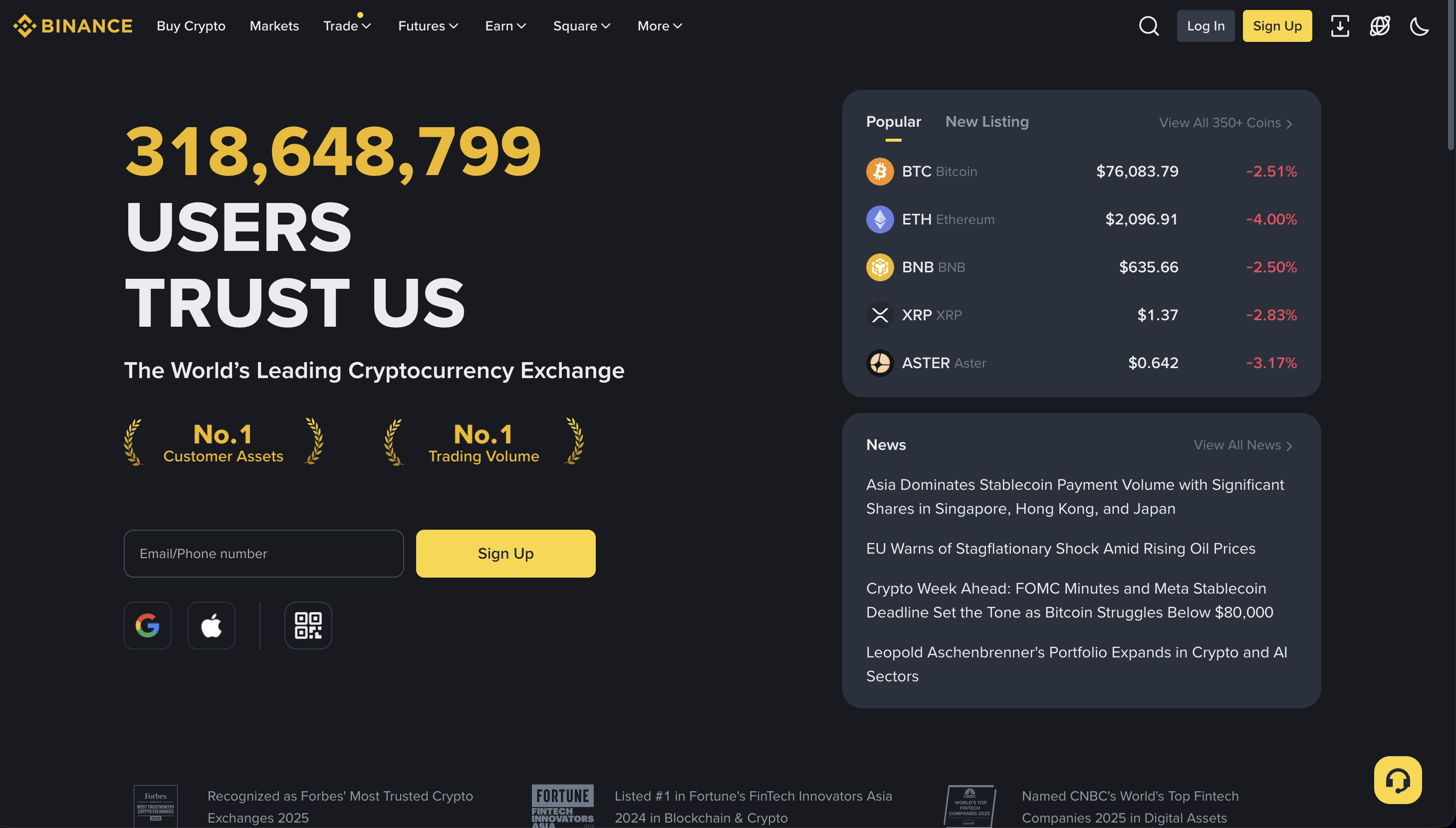
| Factor | Bybit | Binance |
|---|---|---|
| Founded | 2018 | 2017 |
| Headquarters | Dubai (operational, Singapore previously) | Cayman Islands (since 2024) |
| Spot maker / taker (base) | 0.10% / 0.10% | 0.10% / 0.10% |
| Spot with token discount | 0.08% (BIT) | 0.075% (BNB) |
| Perpetual futures maker / taker | 0.02% / 0.055% | 0.02% / 0.040% |
| Spot pairs available | ~400 | ~350 |
| Options markets | BTC, ETH | BTC, ETH |
| Max futures leverage | 200x on majors | 125x on majors |
| Native token | BIT (discount + ecosystem) | BNB (discount + chain + launchpad) |
| Copy trading | Mid-tier marketplace, central to platform | Available since 2023, less central |
| Built-in trading bots | Available, less developed | Available, less developed |
| US availability | None | Binance.US (restricted scope) |
| Recent major event | Feb 2025 exploit (~$1.5B, insurance covered) | Nov 2023 DOJ settlement ($4.3B) |
| Proof of reserves | Published Merkle-tree | Published Merkle-tree |
Liquidity and execution
Binance has the deepest order books in the industry across spot and derivatives. On BTC/USDT perp, the spread typically sits at one tick and depth at the top 5 bid/ask levels carries multi-million dollar liquidity. Slippage on a $100K market order on the top pair is negligible. The same holds for ETH/USDT, SOL/USDT, and the next layer of liquid majors.
Bybit’s derivatives liquidity is competitive at retail order sizes. On top pairs (BTC, ETH, SOL) the spread and depth match Binance close enough that a retail trader running positions under $50K per order will not see meaningful differences. The gap widens above that size, where Binance’s institutional liquidity advantage starts to matter, and at the long-tail edge where Binance lists more obscure derivatives pairs.
For spot trading, both platforms have liquidity that handles retail volume comfortably on the top pairs they cover. Binance lists ~350 spot pairs vs Bybit’s ~400; the listing-set overlap is high on the major altcoins. For the long-tail altcoin pairs that exist on one platform but not the other, look to KuCoin (700+ pairs, covered in our KuCoin review) as the wider listing-side venue.
The practical takeaway: for execution-sensitive retail traders running positions under $50K per order on top pairs, Bybit and Binance are functionally equivalent. For larger positions, Binance’s institutional liquidity edge starts to compound.
Fee structure with token discounts
Both platforms charge 0.10 percent maker and 0.10 percent taker on spot at default tier. With native token discounts:
- Binance with BNB at 25 percent off → spot 0.075 percent flat, perpetual maker 0.015 percent, perpetual taker 0.030 percent
- Bybit with BIT at 20 percent off → spot 0.08 percent flat, perpetual maker 0.016 percent, perpetual taker 0.044 percent
Binance is meaningfully cheaper on perpetual taker at retail volume. The 14 basis point gap (0.044 vs 0.030) is real money for an active futures trader. A trader running $500K monthly futures volume saves $70 per month on Binance versus Bybit.
The fee gap inverts at extreme VIP tiers. Bybit’s curve scales more aggressively above $10M monthly volume, where Bybit’s perpetual taker drops to 0.025 percent vs Binance’s roughly equivalent rate at the same level. For traders running $5M+ monthly volume, the platforms converge.
For typical retail volume (under $500K monthly), Binance with BNB is the cheaper venue for futures. For spot with token discounts, the difference is small enough to ignore (5 basis points).
Funding rate matters separately. Both platforms charge funding every 8 hours on perpetuals based on long/short imbalance. Funding rates are comparable across platforms because they are derived from market positioning, not platform pricing.
For detailed Bybit fee mechanics see our Bybit review; for Binance fee tier curve see the KuCoin vs Binance comparison which covers Binance fees in detail.
Derivatives surface: Bybit’s strategic moat
This is where the platforms differentiate philosophically. Bybit is a derivatives-first platform: perpetuals, options, structured products, and futures-flavored trading bots are the spine. Spot is a supporting product. Binance is a product-broadest platform: every product category from spot to NFTs to launchpad is well-developed; perpetuals are one of many, not the spine.
Practically:
- Perpetual futures. Both cover top 100 pairs. Bybit offers up to 200x leverage on majors, Binance up to 125x. For high-leverage retail strategies, Bybit’s ceiling matters; for institutional-style positioning, the difference is irrelevant.
- Options. Both list BTC and ETH options. Binance’s options product is institutional-feeling and the retail UX is less developed. Bybit’s options product is more accessible to retail traders. For retail options strategies (covered calls, protective puts, simple spreads), Bybit fits better; for sophisticated structures, Deribit remains the industry leader (not covered on this site).
- USDC-margined perpetuals. Both offer. Bybit’s USDC-margined product was launched earlier and has more usage among portfolio-margin retail traders.
- Inverse perpetuals. Both offer. Niche product for users who want coin-margined exposure.
For a derivatives-first retail trader, Bybit’s platform fits the workflow more naturally. For a multi-product retail trader who wants futures plus everything else, Binance’s breadth wins.
Spot and altcoins
Binance has stricter listing standards than Bybit, which translates to fewer but higher-quality listings. The Binance Launchpad system gates new tokens through a curated process; Bybit Launchpad exists but has lower selectivity. For users who want to be early on new tokens with platform-curated risk reduction, Binance Launchpad.
On the long-tail altcoin side, neither platform competes with KuCoin (700+ pairs). Bybit lists ~400 spot pairs, Binance lists ~350; both cover the major altcoins and the top 100 by market cap. For mid-cap altcoins outside the top 100, both platforms have notable gaps that KuCoin fills.
For a trader running an altcoin-heavy strategy, neither Bybit nor Binance is the optimal venue. See our KuCoin review and KuCoin vs Bybit for that angle.
Security and incident history
Both platforms have survived major events without user fund loss:
Binance: 2019 hot wallet exploit, 2023 DOJ settlement. The 2019 incident drained ~$40M and was covered by the SAFU insurance fund (now ~$1B). The 2023 DOJ settlement was regulatory rather than custodial: $4.3B civil settlement, CZ stepped down as CEO, no user fund impact, no withdrawal suspension. The platform continued operating throughout.
Bybit: February 2025 hot wallet exploit. ~$1.5B drained from an ETH hot wallet, publicly attributed to North Korean threat actor activity (Lazarus Group). Bybit absorbed the loss through insurance and operational reserves, kept user balances whole, did not suspend withdrawals at platform level. Full recovery within 7 days. Post-incident operational changes shipped through 2025-2026.
Both events were textbook incident-response performances. Both platforms publish Merkle-tree proof of reserves on a regular cadence. The forward-looking custodial risk profiles are comparable; the source of risk differs (regulatory pressure on Binance, exploit history on Bybit) but neither has materialized as user harm.
For long-term holdings on either platform, the standard rule applies: withdraw to self-custody anything you are not actively trading. CEX custody is non-zero risk regardless of operating history.
KYC posture in 2026
Both platforms tightened KYC materially across the 2024-2026 window.
Binance moved to mandatory KYC for essentially all account functions globally post the 2023 DOJ settlement. The verification process is rigorous and standardized.
Bybit moved to mandatory KYC after the February 2025 exploit accelerated compliance investments. The unverified tier is effectively read-only for new accounts.
Practical takeaway: assume Standard verification is required on either platform for any meaningful trading workflow. If avoiding KYC is the primary driver, neither is the right answer; look at decentralized venues like Hyperliquid for perpetuals or Polymarket for prediction markets.
Copy trading: Bybit’s edge over Binance
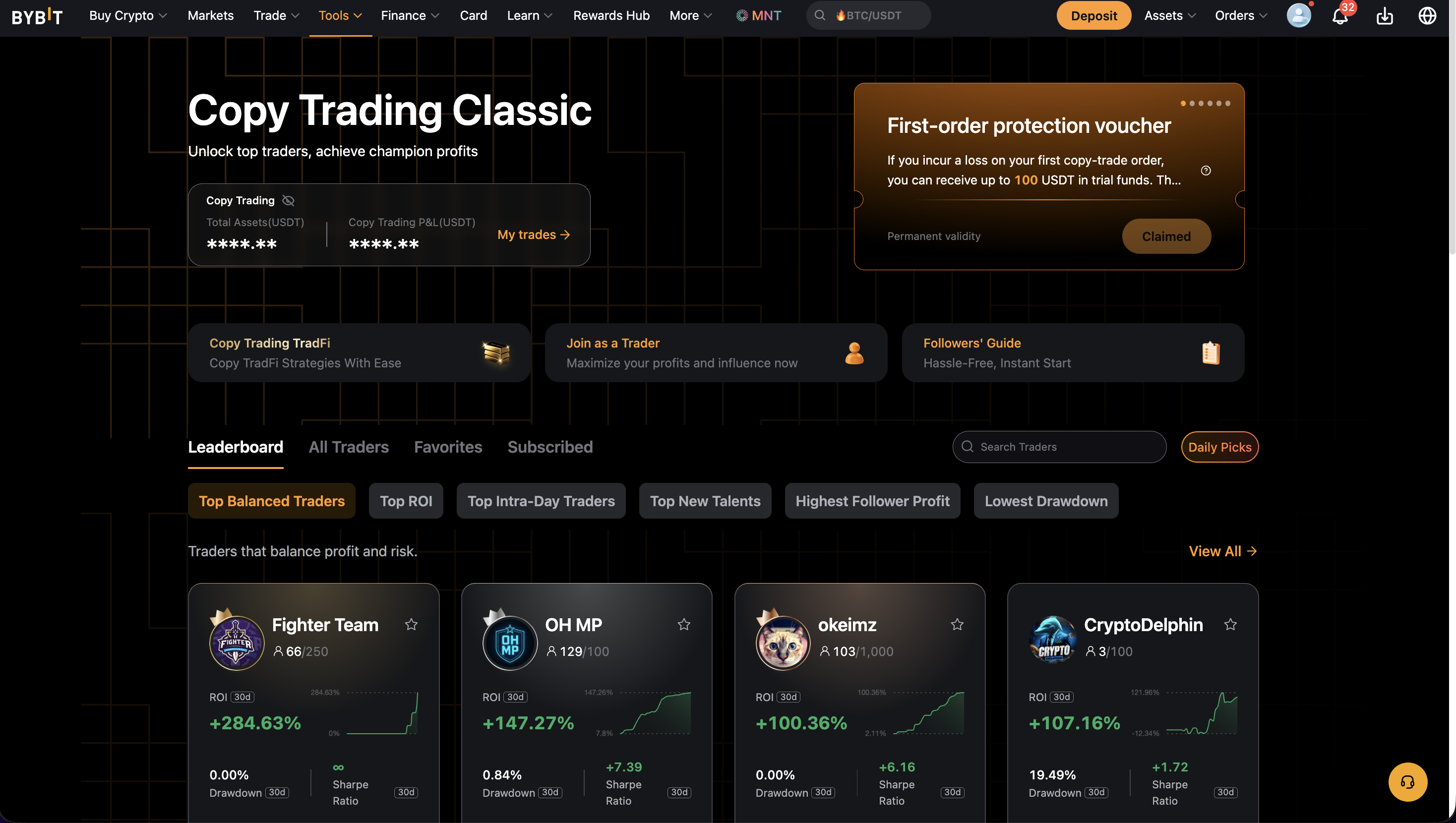
Binance launched copy trading in 2023, expanding the product alongside its existing platform. The marketplace has grown to several thousand lead traders but the product feels secondary to Binance’s main derivatives and spot offering.
Bybit launched copy trading in 2022 and grew it as a more central platform product. The lead-trader marketplace is more actively curated, the filter set is more sophisticated, and the discoverability within the broader Bybit interface is higher than the copy product within Binance.
Honest framing: neither matches BingX or Bitget on dedicated copy trading depth. For users whose primary motivation is copy trading specifically, see our BingX copy trading guide for the strongest dedicated marketplace. Between Bybit and Binance specifically, Bybit is the better choice on the copy trading dimension.
Native token economics
Two different value propositions:
Binance with BNB offers a 25 percent fee discount (the most aggressive in the industry), BNB Chain ecosystem participation, Binance Launchpad allocation access, and historically strong price performance. BNB is the more compelling token to hold across the industry by a significant margin.
Bybit with BIT offers a 20 percent fee discount and ecosystem access to Bybit launchpads and structured-product slots. No daily yield mechanism comparable to KuCoin’s KCS daily bonus. The value proposition is the fee discount plus optional ecosystem participation.
For active traders who would hold a native exchange token anyway, BNB is the stronger choice. For traders who want a fee discount without holding a major exchange token position, the math on BIT works for higher-volume retail users only.
Pros and cons summary
Pick Bybit if:
- You run a derivatives-first strategy with options exposure
- High-leverage trading is part of your workflow (200x on majors available)
- Copy trading is a meaningful part of your activity (Bybit’s product is more developed than Binance’s)
- You prefer a retail-friendly futures UX over institutional-feeling trading interfaces
- You want a more focused platform rather than a maximum-product-surface platform
Pick Binance if:
- You trade primarily BTC/ETH and need the deepest order books in the industry
- Your monthly volume is under $1M and fee minimization matters (BNB discount wins)
- You want the broadest product surface: options, structured products, P2P, NFT, launchpad, Earn, Card all under one roof
- BNB Chain ecosystem participation matters (Launchpad, DeFi on BNB Chain)
- You value brand recognition and the largest user community in crypto
Verdict
For most retail derivatives traders without a specific reason to choose one platform over the other, Binance is the safer default in 2026. The deepest liquidity, lowest retail fees with BNB, broadest product surface, and largest user community combine into a platform that is the industry default for a reason.
Bybit wins for specific user profiles: derivatives-first traders who want 200x leverage availability, retail options traders who want an accessible options UX, copy trading users who want a more central product than Binance’s, and users who prefer a focused platform over a maximum-breadth one.
Both carry regulatory baggage that did not exist in 2022. Both have survived major operational stress events. Neither has a meaningful US path. The choice should come down to product fit and use case, not safety or fees in isolation.
Open Bybit if it fits your use case: Register on Bybit. See the affiliate disclosure for full detail.
Read next
- Bybit review. Full feature breakdown and scoring.
- KuCoin vs Binance. Adjacent comparison on a different axis.
- KuCoin vs Bybit. Cluster sibling.
- KuCoin review. Mid-tier alternative with different strategic focus.
- BingX copy trading guide. The strongest dedicated copy trading marketplace.
- Methodology. How we evaluate platforms.
- Risk disclaimer.
Frequently asked questions
Bybit or Binance, which is better for derivatives?
Both are competitive at retail size, Binance is broader, Bybit is tighter. Binance has the deepest perpetual futures order books in the industry and the broadest product surface (perpetuals across more assets, USDT-margined and USDC-margined, options, structured products, futures with leverage up to 125x on majors). Bybit's derivatives execution on top pairs matches Binance at retail order sizes, offers leverage up to 200x on BTC and ETH, and has options markets that Binance also offers but Bybit reaches a larger retail user base for. For institutional volume, Binance. For retail futures with options on the side, Bybit fits.
Are Bybit fees lower than Binance?
On derivatives, at retail tier, slightly. Bybit's default perpetual taker is 0.055 percent vs Binance's 0.040 percent; Binance is actually cheaper on the headline. With token discounts: BNB at 25 percent off brings Binance perpetual taker to 0.030 percent, BIT at 20 percent off brings Bybit to 0.044 percent. Binance is structurally cheaper on perpetual taker for retail-volume traders. The fee gap inverts at very high VIP tiers (above $10M monthly volume) where Bybit's curve scales more aggressively. For typical retail under $1M monthly volume, Binance wins on fees.
Which one is safer?
Both have survived major events without user loss. Binance: 2019 hot wallet exploit ($40M, SAFU insurance covered), 2023 DOJ settlement ($4.3B, CZ stepped down as CEO, no user fund impact). Bybit: February 2025 hot wallet exploit (~$1.5B, Lazarus Group attribution, insurance fund covered, no user loss). The current forward-looking risk profiles are comparable. Binance's regulatory baggage is larger but better-resolved; Bybit's recent operational event is fresher in memory but the response was textbook. Treat them as equivalent on the safety dimension for risk-management purposes.
Bybit or Binance for copy trading?
Both have copy trading. Binance launched its product in 2023, growing on the strength of brand and traffic. Bybit's launched in 2022 and is more central to the platform identity, with a deeper lead-trader marketplace and more sophisticated filters. For users whose primary need is copy trading specifically, Bybit ranks higher than Binance, though neither matches BingX or Bitget on dedicated copy-trading depth. See our [BingX copy trading guide](/blog/bingx-copy-trading-guide/) for that comparison.
Can US users use Bybit or Binance?
Neither in the unrestricted form. Binance operates a separate Binance.US entity with reduced product scope, full KYC, and ongoing regulatory uncertainty post the 2023 DOJ settlement. Bybit does not serve US users at all and has no US-licensed product. For US-based traders, look at Kraken, Coinbase, or Gemini. Outside the US, both Bybit and Binance are widely available with regional restrictions that have tightened across 2024-2026.
Which has more trading products?
Binance. The product surface includes spot, margin, perpetual futures (USDT and USDC margined), options on BTC and ETH, structured products, P2P, NFT marketplace, launchpad, Earn (the broadest staking and savings selection in the industry), Binance Pay, and a card. Bybit's product surface is wide but more focused: perpetuals (with stronger retail-side UX), options, structured products, copy trading (more central than Binance's), Earn, P2P, and a card. For maximum product variety, Binance. For a derivatives-first platform with sufficient breadth elsewhere, Bybit.
Bybit or Binance for KYC?
Both tightened materially in 2024-2026 and both now require KYC for essentially all account functions. Binance's KYC tightening happened earlier (2024 post-DOJ settlement). Bybit's tightened sharper after the February 2025 exploit. Practically, expect to complete identity verification on either platform for any meaningful trading. If avoiding KYC is the primary driver, neither is the right answer; look at decentralized perp venues or self-custodial alternatives.
Is BIT or BNB the better native token to hold?
BNB is the better holding token for active traders, BIT is more situational. BNB offers a 25 percent fee discount, ecosystem participation across BNB Chain, launchpad allocation access, and historically strong price performance as Binance has grown. BIT offers a 20 percent fee discount and Bybit-ecosystem access but no daily yield mechanism comparable to KuCoin's KCS daily bonus. For pure fee minimization at retail volume, BNB. For BIT, the case is weaker unless you actively use Bybit launchpads or hold the token for non-fee reasons.
#Bybit#Binance#comparison#derivatives#copy trading#fees
Discussion
Loading comments…