
TL;DR: Bitget wins on copy trading depth, marketplace size, and beginner UX. Bybit wins on derivatives breadth (options markets, USDC-margined perpetuals, structured products), order book liquidity, and overall power-user surface. Both partner with CopyTradeInsider, both publish proof of reserves, both have survived security stress without user fund loss. Neither serves US users. For copy trading first, pick Bitget. For a primary trading account with copy trading on the side, pick Bybit.
Not financial advice. Crypto trading is high risk. Bybit experienced a February 2025 hot wallet exploit of approximately $1.5 billion (Lazarus Group attribution, insurance fund covered all losses). Bitget has had no comparable headline event. Both platforms apply geofencing that changes without notice. Verify country availability and current fee schedules before depositing. Read the risk disclaimer before scaling capital onto either platform.
At a glance
| Factor | Bybit | Bitget |
|---|---|---|
| Founded | 2018 | 2018 |
| Headquarters | Dubai (operational) | Seychelles registered, Singapore operational |
| US support | None | None |
| KYC required for trading | Mandatory (post-Feb 2025) | Mandatory for fiat, partial for crypto-only |
| Spot pairs available | ~600 | ~800 |
| Perpetual pairs available | ~450 | ~500 |
| Max futures leverage | 200x on majors | 125x on majors |
| Spot fees (base maker/taker) | 0.10% / 0.10% | 0.10% / 0.10% |
| Spot with token discount | 0.08% (BIT, 20% off) | 0.08% (BGB, 20% off) |
| Perpetual taker (base) | 0.060% | 0.060% |
| Perpetual taker with token | 0.048% (BIT) | 0.048% (BGB) |
| Copy trading launched | 2022 | 2020 |
| Copy trading lead-trader count | ~50,000 active | ~130,000+ elite traders |
| Options markets | BTC, ETH (European-style) | Limited |
| USDC-margined perpetuals | Yes, deep liquidity | Limited |
| Ecosystem token | BIT (20% off + Web3/L2 plays) | BGB (20% off + Earn lock-up yield) |
| Proof of reserves | Merkle-tree, quarterly | Merkle-tree, quarterly |
| Recent security event | Feb 2025 hot wallet ($1.5B, covered) | None at comparable scale |
| Trader marketplace style | Sophisticated, secondary product | Copy-first, central product |
Two well-built exchanges with overlapping but non-identical positioning. Bitget treats copy trading as the front door; Bybit treats it as one of many rooms in a larger derivatives house.
Fees compared
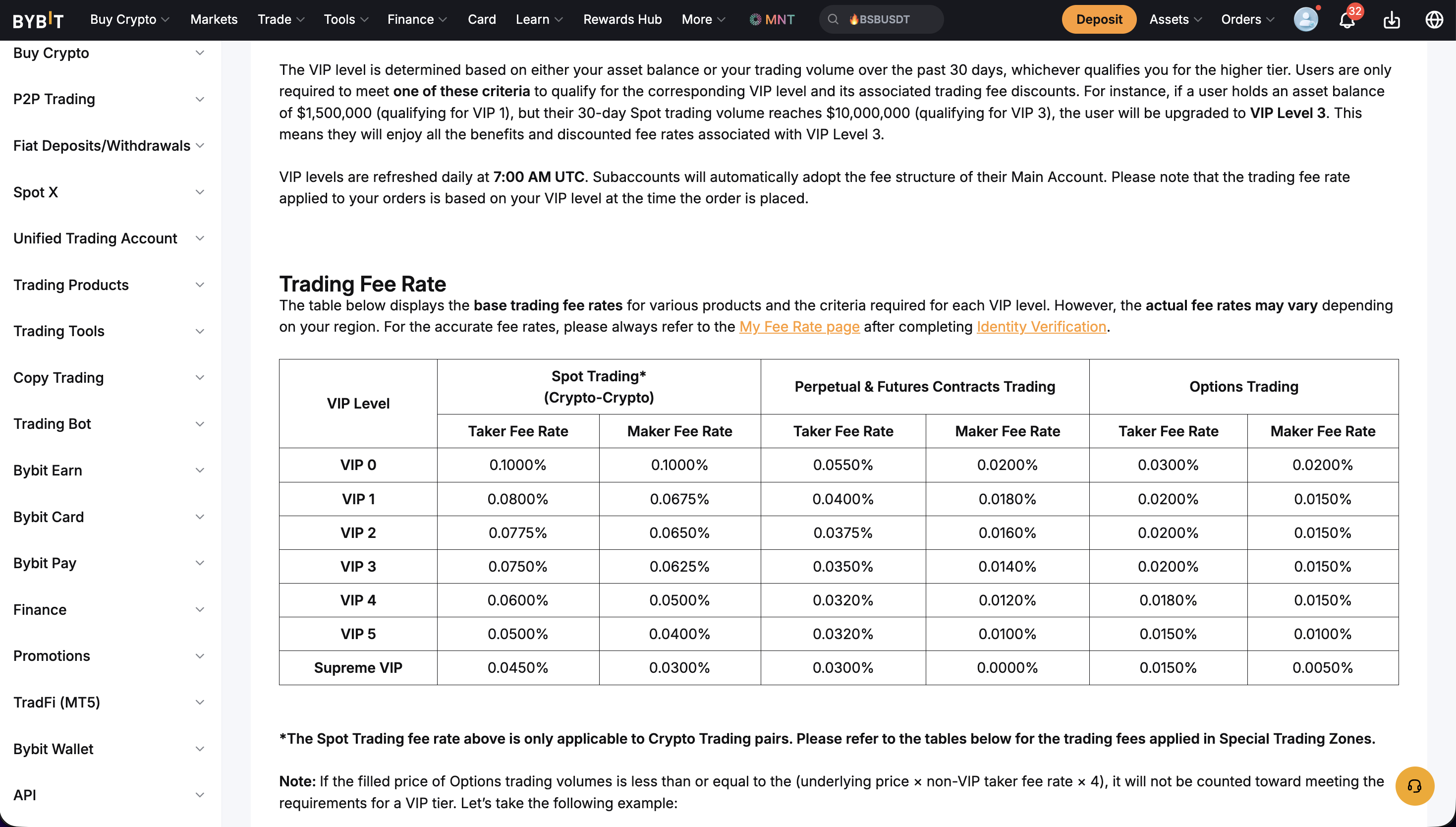
Headline rates are nearly identical. The interesting analysis is at the second and third decimal place, where token discounts and VIP tier curves diverge.
Spot fees
| Tier | Bybit (no token) | Bybit + BIT | Bitget (no token) | Bitget + BGB |
|---|---|---|---|---|
| VIP 0 | 0.100% / 0.100% | 0.080% / 0.080% | 0.100% / 0.100% | 0.080% / 0.080% |
| VIP 1 | 0.060% / 0.080% | 0.048% / 0.064% | 0.060% / 0.080% | 0.048% / 0.064% |
| VIP 3 | 0.040% / 0.060% | 0.032% / 0.048% | 0.040% / 0.060% | 0.032% / 0.048% |
| VIP 5 | 0.025% / 0.045% | 0.020% / 0.036% | 0.025% / 0.045% | 0.020% / 0.036% |
At retail volume the two are functionally indistinguishable. At market-making tier (VIP 5+), the curves still match. Spot is not where the fee decision should turn.
Perpetual futures fees
| Tier | Bybit (no token) | Bybit + BIT | Bitget (no token) | Bitget + BGB |
|---|---|---|---|---|
| VIP 0 | 0.020% / 0.060% | 0.016% / 0.048% | 0.020% / 0.060% | 0.016% / 0.048% |
| VIP 1 | 0.015% / 0.045% | 0.012% / 0.036% | 0.016% / 0.046% | 0.013% / 0.037% |
| VIP 3 | 0.010% / 0.030% | 0.008% / 0.024% | 0.012% / 0.034% | 0.010% / 0.027% |
| VIP 5 | 0.000% / 0.022% | 0.000% / 0.018% | 0.005% / 0.025% | 0.004% / 0.020% |
Bybit’s perpetual taker curve scales slightly more aggressively at the top tiers. For a trader running $5M+ monthly perpetual volume, Bybit ends up 1-3 basis points cheaper. At retail volume (under $1M monthly), the platforms are equivalent.
Worked example: monthly cost at $250K perpetual taker volume
- Bybit base: $150
- Bybit + BIT (20% off): $120
- Bitget base: $150
- Bitget + BGB (20% off): $120
The dollar gap between platforms at retail volume is essentially zero. Token discount matters more than platform choice for fee outcomes at this size.
Withdrawal fees, USDT TRC-20
- Bybit: 1 USDT flat
- Bitget: 1 USDT flat
Identical for the most common withdrawal path. ERC-20 withdrawal fees diverge with gas conditions; both pass through gas with a small platform markup. Neither is materially cheaper on the withdrawal side.
For deeper fee mechanics: Bybit review and Bitget review.
Copy trading depth
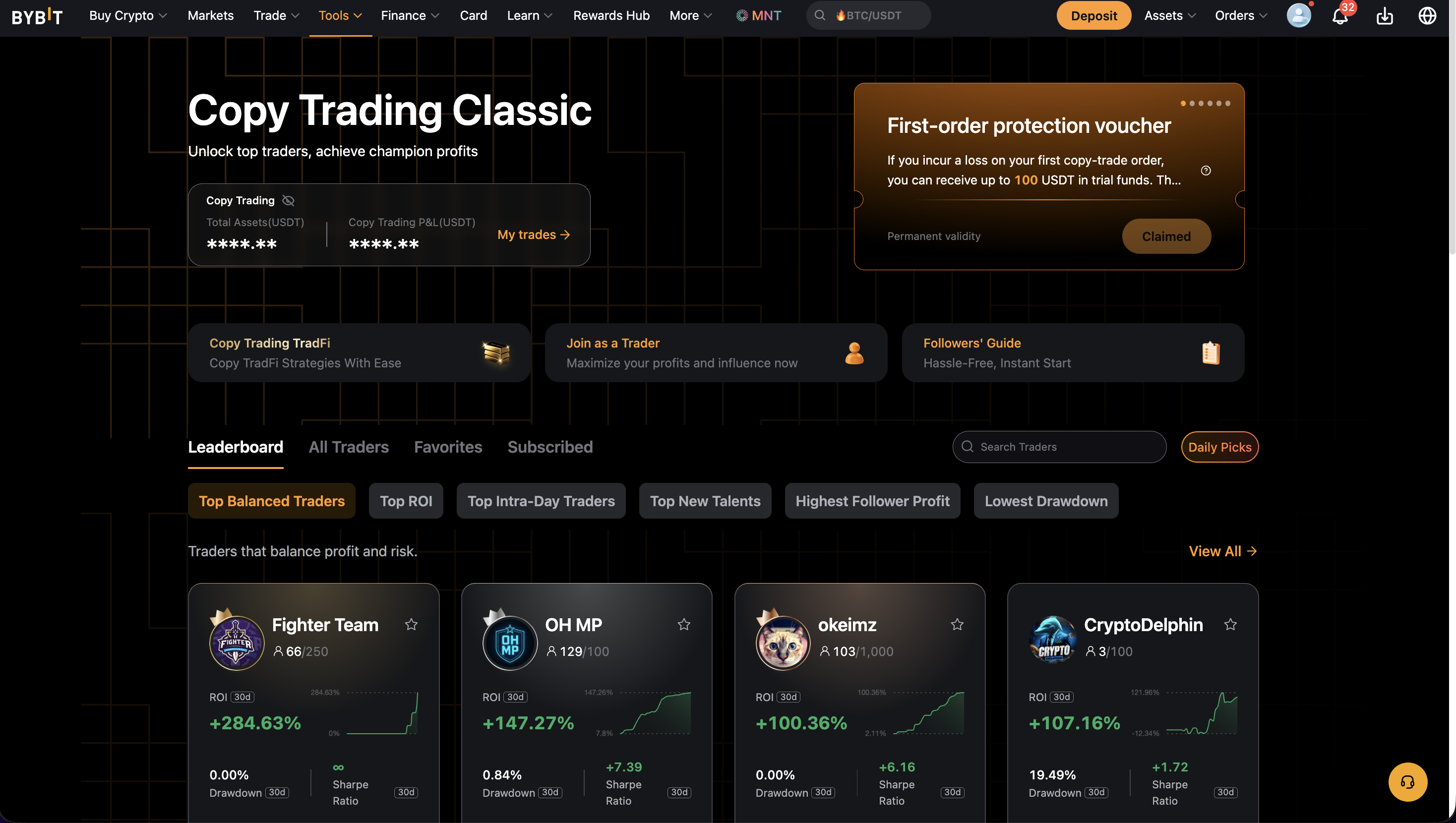
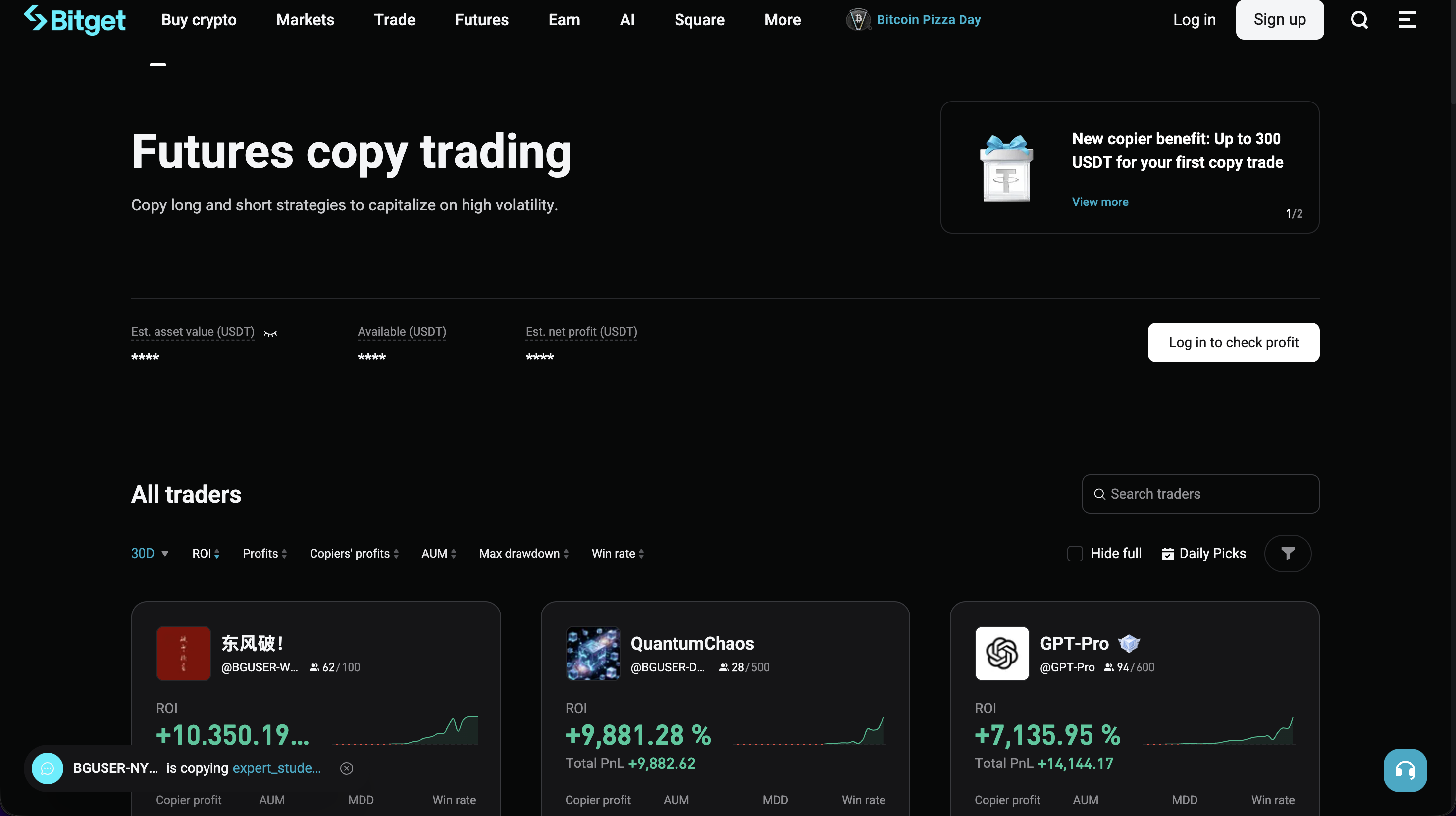
This is the cleanest differentiator between the platforms, and it tilts firmly toward Bitget.
Why Bitget leads on copy trading
Bitget launched copy trading in 2020, two years before Bybit, and treated it as a core platform pillar rather than a feature bolt-on. That two-year head start compounded into measurable advantages that persist into 2026.
- Lead-trader marketplace size. Bitget discloses more than 130,000 elite traders across spot and futures strategies. Bybit’s marketplace is materially smaller, with public estimates in the 40,000-60,000 range for active lead traders.
- Cumulative copy-trading volume. Bitget reported over $2 billion in cumulative copy-trading volume by mid-2024, the highest disclosed figure among centralized exchanges. Bybit does not publish equivalent copy-specific volume metrics.
- One-click copy UX. Bitget pioneered the one-click copy workflow, allowing a user to subscribe to a lead trader, set a sizing multiplier, and begin copying within 30 seconds. Bybit’s flow is slightly more involved (3-5 clicks plus a configuration step).
- Profit-sharing structure. Both platforms charge a 10% profit share on positive copy returns by default, paid to the lead trader. Lead traders can adjust this floor on Bitget; Bybit applies a more standardized fee schedule.
- Minimum copy amount. Both allow copy at 10 USDT per lead trader on most strategies, with some elite traders gating at 50-100 USDT.
Where Bybit has narrowed the gap
Bybit’s copy trading product is not weak; it is clearly second on this axis but the team has invested visibly since 2022.
- Filter sophistication. Bybit’s lead-trader filters now match Bitget’s on equity curves, drawdown stats, win rate, average position duration, and asset coverage.
- Risk controls. Both platforms expose per-lead-trader sizing limits, stop-out thresholds, and copy-position adjustment.
- Lead-trader quality. Bybit attracts a different cohort of lead traders, weighted toward higher-leverage perpetual specialists. Bitget’s pool skews toward more diversified, lower-drawdown strategies.
Practical recommendation
For users whose primary motivation is copy trading specifically, Bitget is the correct choice in 2026. The marketplace depth advantage is real and measurable. See our Bitget copy trading guide for the full marketplace walkthrough.
Users who want copy trading as a side feature within a broader derivatives workflow will find Bybit’s product perfectly adequate. The choice is not “Bitget is good, Bybit is bad”; it is “Bitget is purpose-built for copy, Bybit is purpose-built for derivatives with copy attached.”
Security and track record
Both platforms have survived security stress without user fund loss, but the headline events look very different.
Bybit, February 2025: the largest exchange exploit on record
On February 21, 2025, Bybit’s ETH cold-to-hot wallet transfer process was compromised, with approximately $1.5 billion in ETH and ETH-derivative tokens drained over the course of a single transaction. The attack was publicly attributed to the Lazarus Group, the North Korean state-affiliated threat actor responsible for a string of prior exchange exploits.
Bybit’s response was textbook:
- No suspension of platform-level withdrawals. Users continued withdrawing throughout the incident, an unusually strong signal of liquidity adequacy.
- Insurance fund and operational treasury absorbed the loss. User balances were made whole within hours.
- Public communication cadence. CEO Ben Zhou ran live press briefings, published wallet addresses, and coordinated with on-chain analytics firms to trace the stolen funds.
- Full operational recovery within 7 days. Cold wallet infrastructure was rebuilt and audited externally.
The incident was, in absolute terms, the largest exchange exploit on record. The user-impact outcome was zero loss. The forward-looking interpretation is mixed: Bybit demonstrated reserve adequacy and incident-response quality at extreme scale, but also exposed a hot-wallet attack surface that other major exchanges had hardened earlier.
Bitget: no headline exploit, smaller transparency footprint
Bitget has not had an event at comparable scale. The platform has had minor incidents (a 2022 VOXEL trading anomaly that resulted in user refunds, a few smaller liquidity events), but nothing approaching the Bybit February 2025 magnitude.
The transparency footprint is also smaller. Bitget publishes Merkle-tree proof of reserves on the same quarterly cadence as Bybit, but the published insurance fund is smaller in absolute terms (consistent with Bitget’s smaller overall balance sheet). Bitget’s hot-wallet attack surface has not been publicly stress-tested at the scale Bybit’s was.
How to read the security comparison
Two reasonable interpretations:
- Bybit is now battle-tested. The platform absorbed the largest exchange exploit on record without user loss. Reserves and response capability are now publicly proven.
- Bitget has not been stress-tested at scale. The absence of a major event is informative but not conclusive about resilience.
In practice both platforms publish proof of reserves, both have insurance funds, both have survived their respective stress periods. Standard rule applies: withdraw to self-custody anything not actively trading. Treat each as a trading venue, not a long-term custody solution.
For the full incident write-ups: Bybit review and Bitget review.
KYC tiers
Both platforms tightened KYC posture meaningfully through the 2024-2026 regulatory cycle. The starting positions diverge, but the trajectories are converging.
Bybit KYC in 2026
Bybit moved to mandatory KYC for essentially all account functions globally after the February 2025 exploit accelerated compliance investments. The new tier structure:
- Unverified accounts. Effectively read-only for new sign-ups. Trading, deposits, and withdrawals are gated.
- Standard KYC (ID verification). Full spot, futures, and copy trading access. Daily withdrawal limit around 1,000,000 USDT for verified retail accounts.
- Advanced KYC (address verification). Higher withdrawal limits and access to OTC desk, structured products, institutional features.
The practical interpretation: in 2026, you complete Standard KYC to use Bybit at all. There is no meaningful unverified usage path.
Bitget KYC in 2026
Bitget’s KYC posture is slightly more permissive but trending toward Bybit’s:
- Unverified accounts. Crypto-only deposits, spot trading allowed with daily withdrawal limits around 50,000 USDT in some jurisdictions, futures gated.
- Standard KYC. Full futures and copy trading access. Daily withdrawal limit raised to 500,000-1,000,000 USDT depending on region.
- Advanced KYC. Higher limits, fiat on-ramp access.
Bitget retains a more usable unverified tier for crypto-deposit users who want to spot-trade only. For copy trading and futures, both platforms now require ID verification.
If the priority is deferring or avoiding KYC for as long as possible, Bitget has the better starting position in 2026, but the gap is narrower than it was even 12 months ago. Both platforms will likely converge on stricter KYC over time.
Country availability
Both platforms apply geofencing that overlaps but is not identical.
Hard blocks (no service)
- United States. Both Bybit and Bitget exclude US-based users entirely. No US-licensed product on either side.
- Canada (most provinces). Both have withdrawn or restricted service following Canadian Securities Administrators guidance.
- United Kingdom. Both apply FCA-related restrictions on retail derivatives access. Spot may still be available in limited form.
- Sanctioned jurisdictions. Iran, North Korea, Syria, Cuba, Crimea, and others, on both platforms.
Soft restrictions (limited service)
- European Union under MiCA. Both platforms have applied or are applying for MiCA-compliant entities in select jurisdictions. Some products (perpetual futures, options) face additional gating for EU retail. Verify current status in your specific member state.
- Australia. Both available with some derivative-product restrictions for retail.
- Russian Federation. Both remain accessible. Bitget has applied less aggressive geofencing here than Bybit, though both require region-appropriate KYC at the verified tier.
- Turkey, Spain, Indonesia, Brazil. Both available with some product-level restrictions.
Practical workflow
Both platforms list a country availability page in their footer. Check before depositing. VPN workarounds violate terms of service on both sides and risk account closure plus fund freeze on next on-chain or fiat interaction.
For US-based users, look at Kraken, Coinbase, Gemini, or CFTC-registered futures venues. Neither Bybit nor Bitget will serve you in unrestricted form.
BIT vs BGB ecosystem tokens
Both platforms offer a native token that drives fee discounts and ecosystem access. The two are roughly equivalent on fee mechanics but diverge sharply on what they do beyond fees.
BIT on Bybit
- Fee discount. 20% off spot and perpetual fees when held in account at minimum thresholds.
- Ecosystem access. Priority allocation in Bybit Launchpad, structured-product slots, and Web3 ecosystem plays. Bybit has been an active investor in Layer 2 and on-chain liquidity protocols, with BIT serving as a partial ecosystem token.
- Yield. BIT can be earned through Bybit Earn flexible and locked products, with rates typically 3-8% APR depending on market conditions.
- Liquidity. Reasonably deep on Bybit itself; thinner on external venues.
BGB on Bitget
- Fee discount. 20% off spot and perpetual fees on Bitget, equivalent to BIT mechanics.
- Native yield via Bitget Earn lock-up. This is the strongest BGB-specific differentiator. Bitget Earn has historically offered BGB lock-up products at meaningfully higher yields than equivalent BIT products: 8-15% APR on 30-90 day locked positions through 2024-2025 cycles. The yield is funded by Bitget operational treasury and has been one of the most consistent native-token earn products among major exchanges.
- Buyback and burn. Bitget runs a quarterly buyback-and-burn program that has reduced BGB circulating supply progressively since 2022.
- Ecosystem. Bitget Wallet (formerly BitKeep) integrates BGB as a partial governance and incentive token, though the on-chain ecosystem play is narrower than Bybit’s Web3 surface.
How to pick between the two
For yield-focused holders: BGB has the stronger native earn proposition. The Bitget Earn lock-up yield premium has been the most consistent native-token income stream among major exchange tokens through the 2024-2026 cycle.
For ecosystem-breadth holders: BIT has the wider surface. Bybit’s Web3 and Layer 2 ecosystem activity is more substantial, with BIT serving as a partial proxy for that growth.
As pure fee-discount instruments, the two are equivalent in 2026. Choose based on which non-fee proposition matters more to you.
Token holding adds custodial exposure on top of trading exposure. Holding BIT or BGB means trusting the exchange with both your trading capital and your token position. Size accordingly.
Trading experience and UI
Both platforms ship competent native and mobile experiences. The design priorities diverge, and the difference is felt by different user cohorts.
Bybit: derivatives industry benchmark
Bybit’s derivatives UI is widely considered the industry benchmark for power users. The order entry surface exposes leverage selection, position mode (cross/isolated), reduce-only flags, post-only flags, time-in-force options, and TP/SL configuration in a single screen without feeling cluttered. The depth chart, order book heatmap, and funding-rate display are tuned for active perpetual traders.
Options support is a unique advantage. Bybit’s BTC and ETH options markets ship with a Greeks display, implied volatility surface, and structured strategy builder (covered call, protective put, straddle, strangle). Among retail-friendly exchanges, only Bybit and Deribit offer this depth of options tooling.
Mobile app: matches the web experience well. Order entry on mobile is among the cleanest in the industry. Notifications, position management, and copy-trading controls are all present.
The cost of this density: a first-time perpetual user will find the interface intimidating. The learning curve is real.
Bitget: copy-trading-first UX
Bitget’s UI is deliberately tuned for users whose primary path through the platform is copy trading. The landing page surfaces lead-trader rankings, marketplace filters, and one-click copy entry. The perpetual trading interface is less dense than Bybit’s, which trades power-user features for cognitive accessibility.
For beginners or users whose strategy is “copy a few elite traders and let them run,” Bitget’s flow is materially easier. The first-deposit-to-first-copy time is the shortest among major exchanges.
For active directional traders who want full perpetual tooling, Bitget’s interface is adequate but second-tier compared with Bybit’s. Options support is limited.
Mobile app: very strong on copy-trading specifically. The mobile flow for browsing lead traders, comparing equity curves, and adjusting copy positions is best-in-class.
Side-by-side summary
| Use case | Better UI |
|---|---|
| Active perpetual trading | Bybit |
| Options strategies | Bybit (only realistic option) |
| Copy trading discovery | Bitget |
| One-click copy entry | Bitget |
| Mobile copy management | Bitget |
| Mobile order entry | Bybit |
| Beginner futures onboarding | Bitget |
| Power-user customization | Bybit |
The UI choice tracks the strategic positioning: Bybit is built for traders who prioritize derivatives breadth; Bitget is built for users who prioritize copy trading access. Neither is objectively better; they optimize for different cohorts.
Who should pick Bybit
Pick Bybit if at least two of the following apply:
- You run options strategies. Bybit’s BTC and ETH options markets are the only retail-friendly option between these two platforms. If options are part of your workflow, Bybit is the default.
- You trade USDC-margined perpetuals. Bybit was early on USDC margin and has deeper liquidity on this product line than Bitget.
- You run high-volume perpetual strategies. The VIP curve scales more aggressively at the top tiers, and order book depth on majors is deeper. For traders running $1M+ monthly perpetual volume, Bybit’s execution is materially better.
- You want the broadest derivatives surface in one account. Spot, perpetuals (USDT and USDC margined), inverse perpetuals, options, structured products, and trading bots all live under one roof.
- 200x leverage availability matters to your strategy. Bybit’s leverage ceiling is higher than Bitget’s 125x.
- You hold or are willing to hold BIT. The 20% fee discount and ecosystem exposure pay back well at active retail volume.
The mid-tier copy trading product is a side feature on Bybit, not the main attraction. If copy trading is your primary use case, the next section is for you.
Who should pick Bitget
Pick Bitget if at least two of the following apply:
- Copy trading is your primary use case. The marketplace depth, lead-trader count, and one-click UX are all stronger than Bybit’s. Bitget is purpose-built for this workflow.
- You are a copy-trading beginner. The landing page, lead-trader discovery flow, and first-copy time are designed for users new to the model. Friction is materially lower.
- You want native yield on the exchange token. BGB’s Bitget Earn lock-up yield (8-15% APR on locked terms) is the strongest native-token earn product among major exchanges.
- Your strategy is “subscribe and let it run.” Bitget’s marketplace and discovery surface are tuned for selecting elite traders and monitoring their performance, not for active directional trading.
- You want a slightly more permissive KYC starting position. Spot trading at unverified tier with crypto-only deposits is still possible on Bitget in 2026; less so on Bybit.
- You want exposure to a smaller, more focused platform. Bitget’s strategic identity is tighter than Bybit’s. The product surface is narrower but the core copy-trading proposition is more developed.
For users who plan to start with copy trading and then graduate to directional perpetuals or options within 6-12 months, Bybit may be the better long-term home. For users who plan to stay in the copy-trading workflow long-term, Bitget is the correct platform.
Verdict and final recommendation
For copy-trading-first users in 2026, Bitget is the correct answer. The marketplace is larger, the lead-trader count is higher, the discovery and entry flow are smoother, and the BGB native yield adds a real income layer for users willing to hold the token. This is Bitget’s core strategic identity and the area where the platform measurably outperforms.
For derivatives-breadth users in 2026, Bybit is the correct answer. Options markets, USDC-margined perpetuals, structured products, deeper order book on majors, and 200x leverage availability give Bybit the wider surface. The mid-tier copy trading product is a competent side feature, not the differentiating attraction.
Both are safe enough for active trading, with the Bybit February 2025 exploit demonstrating reserve adequacy and incident-response quality at extreme scale, and Bitget operating without a comparable headline event. Both publish Merkle-tree proof of reserves. Both have insurance funds. Standard custody rule applies: withdraw to self-custody anything not actively trading on either platform.
Neither platform serves US users in unrestricted form. For US-based traders, look at Kraken, Coinbase, Gemini, or regulated CFTC futures venues.
The summary: this is one of the cleaner head-to-heads in the exchange landscape, because the two platforms have differentiated rather than converged. Bitget went deep on copy trading; Bybit went broad on derivatives. The choice should track use case, not brand intuition or fee minutiae (the fees are essentially identical).
Open Bitget for copy-trading depth: Open Bitget. The largest copy-trading marketplace among major exchanges, with BGB earn yield on the side.
Open Bybit for derivatives breadth: Open Bybit. Options, USDC perpetuals, structured products, and 200x leverage in one account.
See the affiliate disclosure for full detail. Both platforms are CopyTradeInsider partners; both links above include partner attribution. The recommendation tracks platform fit, not link economics.
Read next
- Bybit review. Full feature breakdown and scoring.
- Bitget review. Full feature breakdown and scoring.
- Bitget copy trading guide. How the marketplace actually works in 2026.
- Best copy trading platforms 2026. Cross-platform ranking and methodology.
- Methodology. How we evaluate exchanges.
- Risk disclaimer.
Frequently asked questions
Bybit or Bitget for copy trading?
Bitget, with a meaningful margin. Bitget launched copy trading in 2020 and the product is the core of its identity, with the deepest published lead-trader marketplace among major exchanges, more than 130,000 elite traders by 2025 disclosures, and the most refined one-click copy workflow. Bybit launched copy trading in 2022 and has caught up on filtering sophistication, but the marketplace is smaller and the product sits one tier below Bitget's. For copy trading specifically, Bitget is the correct choice.
Are Bybit and Bitget safe?
Both are safe for active trading, with the standard caveat that no custodial exchange is risk-free. Bybit survived a February 2025 hot wallet exploit of approximately $1.5 billion attributed to the Lazarus Group; user balances were made whole through insurance reserves and operational treasury. Bitget has had no comparable headline exploit but publishes a smaller proof-of-reserves footprint and a smaller insurance fund. Both publish Merkle-tree proof of reserves. Treat each as a trading venue, not a custody solution.
Which has lower fees, Bybit or Bitget?
Roughly equivalent at the base tier. Both charge 0.10% spot maker/taker and 0.020% maker, 0.060% taker on USDT perpetuals at VIP 0. With BIT held on Bybit, fees drop 20% (spot 0.08%, perpetual taker 0.048%). With BGB held on Bitget, the discount runs around 20% on most product lines (spot 0.08%, perpetual taker 0.048%). The two are within a basis point or two of each other at any given tier. Volume-based VIP scaling differs slightly: Bybit's curve is steeper at the top, Bitget's is flatter.
Does either work for US users?
No. Neither Bybit nor Bitget serves US-based users in unrestricted form. Bybit exited the US market entirely and has no US-licensed product. Bitget similarly does not accept US-resident sign-ups. For US-based traders, look at Kraken, Coinbase, Gemini, or regulated CFTC-registered futures venues. VPN workarounds violate terms of service on both platforms and risk account closure plus fund freeze.
BIT vs BGB, which token is better?
Different use cases. BIT gives a 20% trading-fee discount on Bybit plus exposure to Bybit's broader Web3 and Layer 2 ecosystem plays. BGB gives a roughly 20% fee discount on Bitget plus access to higher-yield staking through Bitget Earn (with native lock-up products that paid 8-15% APR through 2024-2025 cycles). For yield-focused holders, BGB has the stronger native earn proposition. For ecosystem-breadth holders, BIT has the wider surface. As pure fee-discount instruments, the two are roughly equivalent in 2026.
Which has more copy trading volume?
Bitget, by public disclosure. Bitget reported over $2 billion in cumulative copy-trading volume by mid-2024 and has consistently ranked as the largest copy trading venue by participating capital. Bybit does not publish equivalent copy-trading-specific volume figures, but third-party trackers place it at roughly one-third to one-half of Bitget's copy-trading throughput. For users prioritizing marketplace depth and lead-trader liquidity, Bitget has the clear data advantage.
What's the minimum to start copy trading on each?
Both have low effective minimums. Bitget allows copy trading with as little as 10 USDT per lead trader on most strategies, with some elite traders setting higher minimums (50-100 USDT). Bybit's minimum copy amount is typically 10 USDT per position, with some lead traders gating at 100 USDT. Practical minimum for diversified copy across 5-10 lead traders: 100-500 USDT on either platform. The minimum is not the binding constraint; lead-trader selection and risk sizing matter far more.
Which is better for futures beginners?
Bitget, narrowly. Bitget's UI deliberately surfaces copy trading and a simplified contract entry flow, which lowers the cognitive load for first-time perpetual users. Bybit's interface is the derivatives industry benchmark for power users but presents more options upfront, which can overwhelm beginners. If the user plans to graduate from copy trading into directional perpetuals within 6-12 months, Bybit is the better long-term home. For pure copy-first beginners, Bitget reduces friction.
#Bybit#Bitget#comparison#copy trading#BGB#BIT#derivatives
Discussion
Loading comments…