
TL;DR: Bitget copy trading is one of two dedicated crypto copy trading platforms in 2026 (BingX is the other). The marketplace has the largest absolute lead trader pool among crypto-focused CEXs. The filter set is competitive with BingX. Fees: regular trading + 10-20% profit share. The 5-criteria framework for lead selection (180+ day track record, max drawdown <30%, position duration match, win rate + ratio, trade frequency 1-5/week) applies identically across platforms. Below is the platform-specific walkthrough for Bitget.
Not financial advice. Crypto copy trading is high risk. Lead traders can and do lose money. Past performance does not predict future returns. Verify country availability before depositing. Read the risk disclaimer before scaling capital.
Bitget copy trading marketplace overview
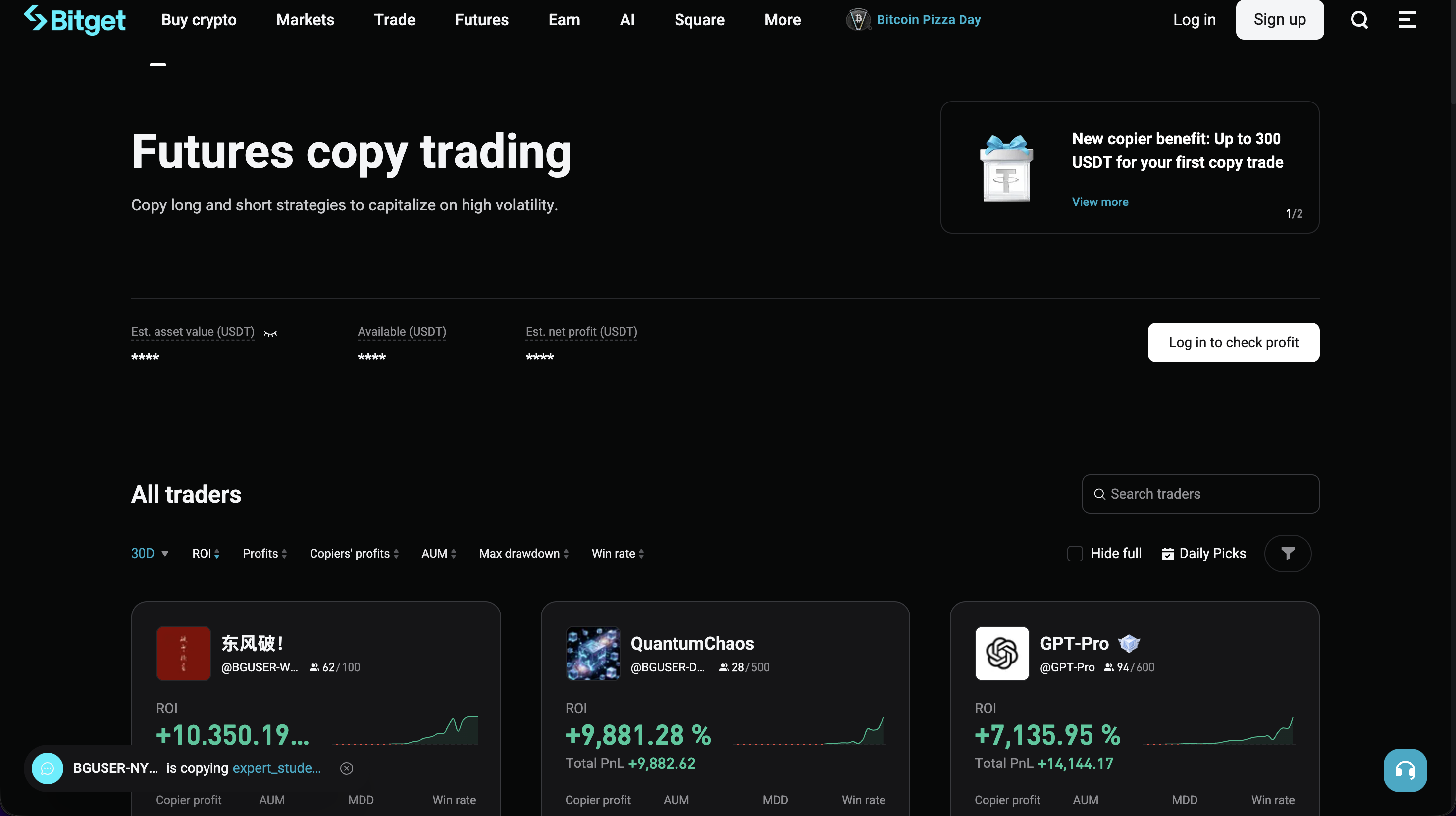
Bitget operates a dedicated copy trading marketplace that’s been a core product investment since 2020-2021. By 2026 it has accumulated the largest absolute lead trader pool among crypto-focused CEXs.
The marketplace has two main sections:
-
Spot copy trading for users who want exposure to lead traders making directional spot purchases (BTC, ETH, altcoins). Lower variance, fewer positions per period.
-
Futures copy trading (the dominant section by user count) for perpetual futures. Higher variance, more positions, leverage available.
You can copy multiple lead traders simultaneously across both sections. Most active copy traders use a mix: some spot leads for medium-term positions, some futures leads for shorter-term directional plays.
For the head-to-head comparison with BingX’s marketplace see our BingX vs Bitget article. For the foundational explainer of how copy trading works generally see what is copy trading.
Filter set walkthrough
Bitget’s filters cover the major metrics that matter for lead evaluation. The full list on the marketplace:
- Cumulative profit with selectable windows (7d, 30d, 90d, 180d, all-time)
- ROI sorted in same windows
- Maximum drawdown as a percentage
- Win rate as a percentage
- Follower count and AUM
- Asset class breakdown (BTC-focused, ETH-focused, altcoin-heavy, mixed)
- Days since last trade (filter out inactive leads)
- Profit share percentage the lead charges
What Bitget’s filter set does NOT have that BingX does:
- Risk score (BingX has an integrated 1-10 risk metric)
- Position duration breakdown (BingX shows average holding time as a sortable column)
These are nice-to-haves but not deal-breakers. You can derive duration from looking at the lead’s position log directly.
Recommended filter setup for screening
When you first open the Bitget copy trading marketplace, default sort is usually by recent ROI. Change this to 180-day cumulative profit as the primary sort. Apply these filters:
- Time window: 180 days minimum
- Maximum drawdown: under 30%
- Active in last 30 days (filter out leads that stopped trading)
- AUM range: $500K-$5M (small enough to have room to grow, large enough to be a real strategy)
This shrinks the marketplace from 5,000+ active leads to typically 50-100 viable candidates. From there you’d do detailed evaluation on the top 10-15.
The 5-criteria lead trader evaluation framework
This is the same framework that applies to all copy trading platforms. Specifics for Bitget UI included.
Criterion 1: 180+ day cumulative profit
Why: 180+ days captures at least one volatility regime change, sometimes two. Leads with 30-day stats only have demonstrated nothing about durable edge.
On Bitget: use the time-window selector on the lead’s profile page to display 180-day data. If the lead doesn’t have 180 days of history, move on. They might be excellent, but you can’t tell yet.
Criterion 2: Maximum drawdown under 30%
Why: drawdown is peak-to-trough decline. Anything above 40% is fragile. The 20-30% range is realistic for competent leads. Below 20% with 180+ days is unusual and either signals real risk management or a short eval window hiding the true drawdown.
On Bitget: max drawdown is shown as a separate metric on the lead’s profile. Visible as a percentage. Look at the equity curve chart; visible drawdowns there can reveal patterns the headline number obscures.
Criterion 3: Average position duration matched to your monitoring
Three buckets:
- Sub-1 day: high-frequency. Hard to copy cleanly because slippage and execution lag hurt copiers more than the lead. Generally avoid unless platform copy-execution is fast (Bitget’s is good but not perfect).
- 1-7 days: swing trading. Copyable. The retail-friendly bucket.
- 7+ days: position trading. Easiest to copy with lowest fee drag.
On Bitget: you derive this from the lead’s position log. Open the lead’s recent trades and look at average time-in-position across the last 20-30 trades. Bitget doesn’t show this as a sortable filter (unlike BingX), so you check it during shortlisting.
Criterion 4: Win rate paired with win/loss ratio
Why: 90% win rate alone can be a Martingale signature. Always pair with average win vs average loss.
Healthy patterns:
- 55% win rate with avg win $150, avg loss $100 (small edge, manageable losses)
- 35-45% win rate with avg win $400, avg loss $120 (trend-follower)
Martingale signature: avg loss is 5-10x avg win, win rate 80%+. Avoid.
On Bitget: win rate is shown as a percentage. Average win/loss isn’t a top-level metric; you derive it by sampling the lead’s recent closed trades. This takes 5 minutes per candidate but eliminates Martingales.
Criterion 5: Trade frequency
- Sub-1 per week: hard to evaluate, statistical confidence accumulates too slowly
- 1-5 per week: ideal eval and copy execution
- 5-20 per week: workable, watch fee drag
- 20+ per day: fights the fee curve
On Bitget: derive from position log; count closed trades in the last 30 days, divide by 4 to get weekly rate.
Position sizing across Bitget leads
After picking leads, the framework for allocation:
Default: equal weight across 4-6 leads
Spread your capital evenly. Cap any single lead at 25-30% of total copy capital. Concentration is how copy traders blow up.
Diversify by strategy profile
4-6 leads should cover different strategy profiles:
- 1-2 short-duration (intraday or swing)
- 1-2 longer-duration (multi-day positions)
- 1 BTC/ETH-focused
- 1 altcoin-leaning
- 1 hedge-style if available (delta-neutral or pairs)
This is harder to find but worth the search. Four leads all running BTC perpetual longs aren’t four bets; they’re one bet with four wrappers.
Per-lead stop-out limits
Bitget lets you set automatic copy-pause if a lead’s drawdown exceeds a threshold. Set this at the lead’s historical max drawdown + 10% safety margin.
If they exceed it, the system stops copying. You don’t have to close positions immediately, just stop adding new ones until you re-evaluate.
Rebalance every 90 days, not weekly
Random variance over short windows looks like signal but isn’t. A lead can have a bad month and still be the same lead with the same edge. Cut leads only if they’ve deviated materially from their historical track record over 90+ days.
Fee math on Bitget specifically
Two layers stack on every position:
Layer 1: Underlying trading fees
At default VIP 0 tier:
- Spot: 0.10% maker, 0.10% taker
- Futures: 0.020% maker, 0.060% taker
With BGB token held (20% discount):
- Spot: 0.08% maker, 0.08% taker
- Futures: 0.016% maker, 0.048% taker
For copy trading, you pay these fees on entry AND exit. So a round-trip on futures default tier costs 0.080% (0.020% maker on entry + 0.060% taker on exit, assuming the lead uses limit + market orders typical of swing strategies).
Layer 2: Profit share to the lead
Typical 10-20% of net profit on winning periods. Bitget calculates this per closed trade in most cases. Losing trades pay no profit share but the underlying trading fees still apply.
Worked example
$10,000 allocated, lead generates 30% gross return over a year with 100 trades.
- Gross profit before fees: $3,000
- Trading fees (round trip 0.08% on default + BGB held): ~$640 over 100 trades on average position size
- Net before profit share: $2,360
- Profit share at 15% on net winning trades only: ~$300
- Funding rate drag on perpetuals (avg 5-day duration, slightly long-biased market): ~$200
- Net to you: ~$1,860 = 18.6% real return on allocation
Compare to: BingX where default perpetual taker is 0.050% (vs Bitget’s 0.060%), so without BGB held, BingX saves about $100-150 over the same volume. With BGB held, Bitget catches up.
The fee math is competitive. The decision between Bitget and BingX should come down to other factors (filter set, KYC tolerance, jurisdiction availability) rather than fee math.
Common mistakes on Bitget copy trading
1. Picking by 30-day ROI
The default Bitget marketplace sort is recent ROI. Change to 180-day cumulative. Never pick from the 30-day leaderboard top.
2. Allocating to one big lead
Single-lead concentration. The lead you pick will have a bad quarter eventually. Spread across 4-6.
3. Ignoring the 2023 leaderboard incident lesson
In mid-2023, several Bitget lead traders manipulated displayed performance via coordinated round-trips between linked accounts. Bitget caught the pattern and refunded affected followers. The fix was technical. The lesson for followers: even on a well-policed marketplace, do your own validation. Look at the lead’s position log directly, not just the headline metrics.
4. Not holding BGB if you trade actively
The 20% discount is material at $250K+ monthly volume. If you’re at that level, BGB pays back. Below $50K monthly, the math is marginal.
5. Override the lead’s exits manually
Bitget lets you close copied positions yourself. Resist. You’re paying the lead for judgment; overriding their exits means you get their entries with your exits. Usually the worst of both worlds.
6. Scaling allocation lump-sum after a winning month
Most blow-ups happen right after a 5-10x allocation increase that follows a green month. Random variance feels like edge. Then variance reverts and the larger position size produces a larger loss.
Scale gradually. Add 20-50% over 90 days max.
7. Treating Bitget copy trading as primary income
Treat the first 6 months as tuition. The realistic distribution: most retail copy traders break even or lose in the first year while learning the framework.
How Bitget compares to BingX on copy trading
Quick comparison (full breakdown in our BingX vs Bitget article):
| Factor | BingX | Bitget |
|---|---|---|
| Marketplace depth | Strong | Strongest absolute pool |
| Filter set | Deepest (risk score, position duration filter) | Strong, slightly behind BingX |
| KYC at Standard tier | Email-only in most jurisdictions | Mandatory KYC immediately |
| Perpetual taker (default) | 0.050% | 0.060% |
| Perpetual taker (with token) | n/a (no token discount) | 0.048% (with BGB) |
| Spot pairs available | ~700 | ~650 |
| Recent security event | Sep 2024 hot wallet (~$44M, covered) | 2023 leaderboard manipulation (refunded) |
| Track record specifically in copy trading | Strong (2020-2025) | Strongest (2018-2025) |
| Our affiliate partnership | Primary | Partnered |
Both are credible. The decision typically comes down to KYC tolerance and jurisdiction availability.
For a deeper review of Bitget overall (not just copy trading) see our Bitget review.
Step-by-step: starting Bitget copy trading with $1,000-2,000
For a first-time Bitget copy trader:
Step 1: Sign up
Use our partner link: partner.bitget.com/bg/0J6AVQ. Email + password. Set up Authenticator app 2FA immediately.
Step 2: Complete Standard KYC
Bitget requires KYC for any meaningful trading in 2026. Have ready:
- Government-issued photo ID
- Liveness selfie
- Optional address proof for higher tiers
Approval typically takes minutes to a few hours.
Step 3: Deposit USDT
USDT via Tron network is the cheapest path (1 USDT flat fee). USDC via Solana is fast and cheap when available. Avoid USDT via Ethereum mainnet during high-gas periods.
If you’re funding from local currency (RUB, TRY, EUR, etc.), use Bitget’s P2P section. 5-30 minutes, 1-3% spread over interbank rate.
Step 4: Filter the marketplace
Apply the filters from the screening section above:
- 180-day cumulative profit (primary sort)
- Max drawdown under 30%
- Active in last 30 days
- AUM range $500K-$5M
This shrinks the marketplace to typically 50-100 viable candidates.
Step 5: Shortlist 8-10 candidates
For each, check:
- Equity curve shape (smooth upward = real edge or Martingale; choppy upward = realistic real-trader curve)
- Average position duration (sample 20-30 recent trades)
- Win rate paired with avg win/loss
- Trade frequency
- Asset class allocation
- Profit share percentage they charge
5 minutes per candidate.
Step 6: Allocate to 4-6 leads
Equal weight to start. Cap any single lead at 25-30% of total copy capital. Different strategy profiles (some short-duration, some longer; mix of BTC/ETH-focused and altcoin-leaning).
Step 7: Set per-lead stop-outs
For each lead, set automatic copy-pause at their historical max drawdown + 10%. Bitget’s interface has this in the copy settings per lead.
Step 8: Wait 30-60 days before evaluating
Resist the urge to swap leads in the first month. Random variance can make a great lead look bad and a bad lead look great over short windows.
Step 9: Review at 90 days
Which leads tracked their historical performance? Which deviated significantly? Rebalance: cut leads underperforming by >30% of expected profile, add new from your shortlist.
Step 10: Scale only after 6 months of stable results
If your portfolio of leads has tracked roughly its expected return profile over 180 days, consider increasing total allocation. Below that, treat the experience as tuition.
Verdict
Bitget copy trading is one of two credible dedicated crypto copy trading platforms in 2026. The marketplace has the largest absolute lead pool, the filter set covers the major metrics, and the platform has a longer dedicated track record in copy trading than BingX.
Where BingX edges Bitget: slightly more sophisticated filters (risk score, position duration breakdown), email-only Standard tier signup, slightly lower base perpetual fees without native token held.
Where Bitget edges BingX: larger absolute lead trader pool, longer brand recognition in copy trading specifically, fee math comparable to BingX once BGB discount applied.
For users picking between the two: try the marketplace UI of both before depositing. The “right” platform is the one whose filtering and lead selection feels intuitive for your workflow. Either is materially better than Bybit, KuCoin, or OKX on the copy trading axis specifically.
For users committed to Bitget specifically: this guide is the framework. Start with $1,000-2,000, spread across 4-6 leads, apply the 5-criteria evaluation, treat first 6 months as tuition, scale gradually based on actual results vs expected profile.
Open Bitget for the largest absolute copy trading marketplace: Register on Bitget. See the affiliate disclosure for full detail.
Read next
- Bitget review. Full feature breakdown of Bitget beyond copy trading.
- BingX vs Bitget. Head-to-head on the two dedicated crypto copy trading platforms.
- Best copy trading platforms 2026. Full ranking across six platforms.
- How to copy trade crypto. Foundational 5-criteria framework that applies across all platforms.
- What is copy trading. Plain-English explainer for users new to the concept.
- BingX copy trading guide. Parallel guide for the other dedicated platform.
- Methodology. How we evaluate platforms.
- Risk disclaimer.
Frequently asked questions
How does Bitget copy trading work?
You browse the Bitget copy trading marketplace, pick lead traders, allocate capital to each, and the platform automatically mirrors their trades into your account. When a lead opens a position, your account opens a proportional one. When they close, you close. You pay regular spot or futures fees plus a profit share (typically 10-20 percent) to the lead on net winning periods. The platform handles execution and the profit-share accounting; you handle lead selection and allocation.
What's the difference between Bitget and BingX copy trading?
Bitget has a larger absolute lead trader pool (built over more years of dedicated investment in copy trading specifically). BingX has slightly more sophisticated filters (risk score, position duration breakdown) and lower onboarding friction (email-only Standard tier in most jurisdictions). Bitget requires KYC immediately. Both materially exceed Bybit, KuCoin, and OKX on the copy trading axis. See our [BingX vs Bitget](/blog/bingx-vs-bitget/) head-to-head for the detailed comparison.
What are Bitget copy trading fees?
Two layers stack. First, regular trading fees: spot 0.10% maker/taker, perpetual futures 0.020% maker / 0.060% taker on default VIP 0 tier. With BGB token held, both sides drop 20% (perpetual taker becomes 0.048%). Second, profit share to lead traders: 10-20 percent of net profit on winning periods, calculated by the platform. Losing periods pay no profit share but you still pay the underlying trading fees. Worked example: $10K allocation, 30% gross return, 100 trades, 15% profit share = approximately $250-1,000 net depending on trade frequency and fee tier.
How do I pick a good lead trader on Bitget?
Apply the 5-criteria framework: (1) 180+ day cumulative profit, not 7-day or 30-day window, (2) max drawdown under 30% indicates risk management, (3) position duration matched to your monitoring willingness (1-7 days is the retail-friendly sweet spot), (4) win rate paired with average win/loss ratio (90% win with avg loss 5x avg win is a Martingale signature), (5) trade frequency 1-5 per week ideal. Apply all five together. Avoid the leaderboard top of the day; it's survivor bias.
Can Bitget freeze my copy trading account?
Like any centralized exchange, yes, under specific conditions. AML pattern detection on deposits from flagged addresses, large rapid withdrawals exceeding caps, or jurisdiction restrictions can trigger account freeze. Bitget specifically tightened controls post the 2023 leaderboard manipulation incident. For regular retail copy trading with KYC completed, account freeze is rare. The standard rule applies: don't park large long-term holdings on the platform; treat Bitget as a trading venue, not custody.
Is BGB worth holding for copy trading discount?
Depends on volume. Holding any positive BGB activates a 20% discount across spot and perpetual fees. For active retail copy traders running $250K-$500K monthly perpetual volume, BGB saves $50-150 per month. The trade-off is BGB price exposure: you're holding a speculative token to capture a fee discount. For monthly volume under $50K, the math is marginal. Hold BGB only if you'd hold the token anyway as a speculative position, or if your volume is high enough that fee discount alone justifies the price risk.
Can I lose more than I deposit on Bitget copy trading?
On spot copy trading: no. Your maximum loss is the allocated capital. On futures copy trading with leverage: theoretically yes, but Bitget has liquidation engines that close positions before negative balance is reached in normal conditions. Extreme volatility (flash crashes, exchange-level event) can produce negative balance in rare cases. Bitget offers negative balance protection on retail accounts, but verify the current policy in your jurisdiction before depositing.
How much should I allocate to Bitget copy trading?
Practical floor: $1,000-2,000 spread across 4-6 lead traders. Below that, fees and minimum position sizes fight you. The amount should be capital you can fully afford to lose entirely. Treat the first 6 months as tuition while you learn the lead evaluation framework, not as primary income. Most retail copy traders break even or lose money in their first year while learning. Scale only after 6 months of consistent track record matching your expected profile.
#Bitget#copy trading#guide#BGB#lead traders#risk management
Discussion
Loading comments…