
TL;DR: Copy trading lets you mirror an experienced trader’s positions automatically on a centralized exchange. The mechanics are simple. The hard part is picking lead traders that don’t blow up, sizing positions so a single blow-up doesn’t ruin you, and ignoring the leaderboard top-of-the-week trap. This guide covers what works, what doesn’t, the math, and the platforms that actually fit retail traders in 2026.
Not financial advice. Crypto copy trading is high risk. Past lead trader performance does not predict future results. Most retail copy traders break even or lose money in their first year. Verify country availability before depositing. Read the risk disclaimer before scaling capital.
What copy trading actually is
Copy trading is an exchange feature where your account automatically mirrors the trades of an experienced trader (the lead trader) you’ve selected. When they open a position, your account opens a proportional position based on your allocated capital. When they close, you close. The platform handles execution. You pay the same trading fees you would on direct trades plus a profit share to the lead on net winning periods.
What it is not:
- It is not passive yield. Lead traders take real risk; their losses are your losses.
- It is not automated trading you can ignore. Bad leads do exist on every marketplace.
- It is not “set and forget” income. The lead pool turns over, the best of last quarter may be the worst of next.
The realistic mental model: you are hiring a discretionary fund manager, except you can fire them mid-trade by stopping the copy, and the marketplace gives you transparent (if backward-looking) performance data to pick from.
How copy trading works mechanically
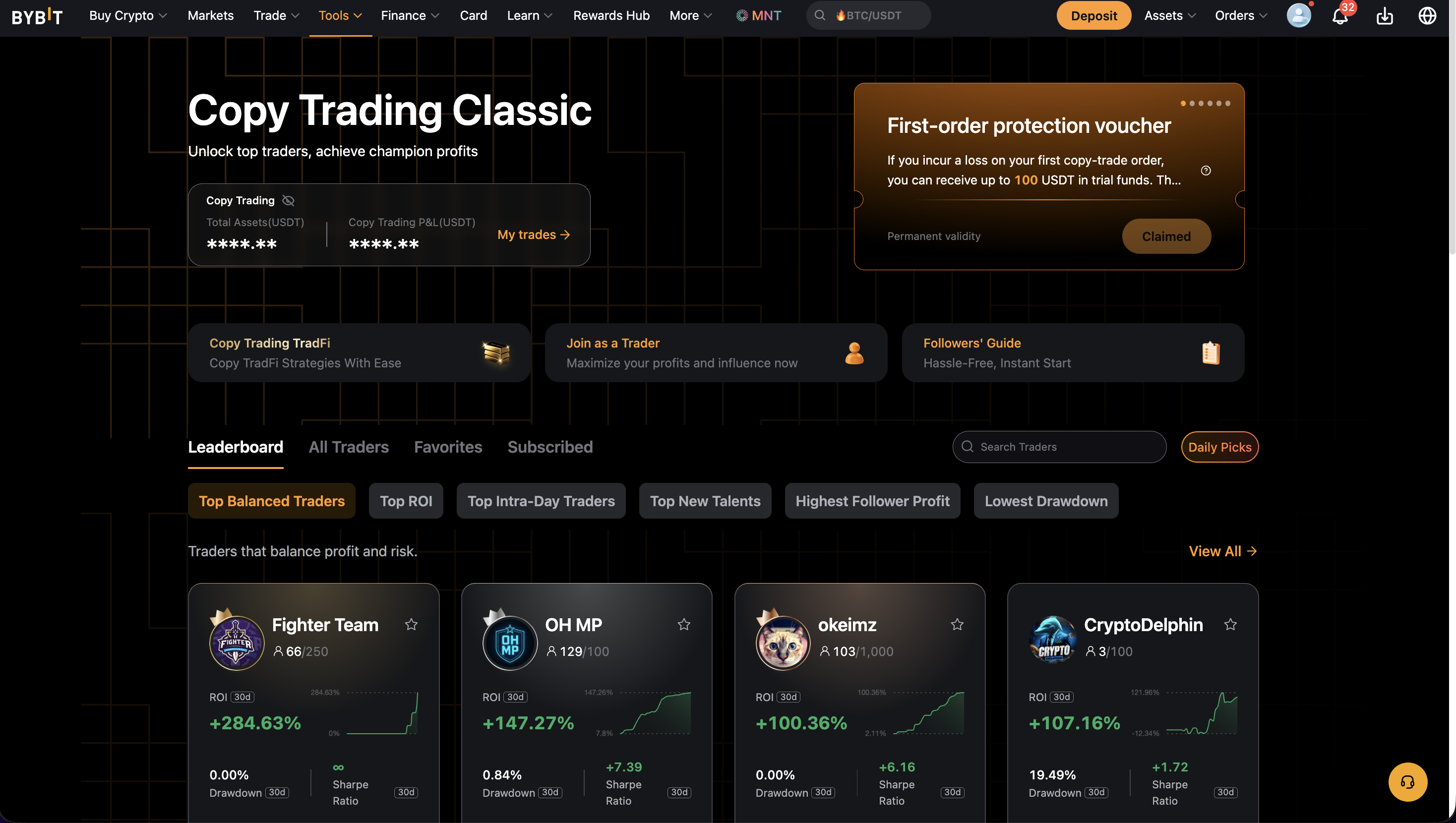
Three layers stack:
1. Lead trader. A trader who has opted into the platform’s copy trading program. The platform shows their historical performance, position log, current open positions, follower count, and assets under management. The lead trades their own real capital; followers’ capital scales independently in their own sub-accounts.
2. Follower (you). You browse the marketplace, evaluate leads by metrics, allocate capital to ones that fit your risk profile, and the platform mirrors their subsequent trades into your account. You can stop copying anytime; existing positions either close or transfer to your manual control depending on platform.
3. Profit share contract. The lead earns a percentage of net profit on winning periods, typically 10-20 percent. Different platforms structure this differently: some calculate per closed trade, some per high-water mark periods, some weekly or monthly. Read the specific contract on your platform.
The trading fees you pay on copy-trade positions are the same as you’d pay on direct trades. Funding rates on perpetuals apply normally. The profit share is on top of those underlying fees.
The lead trader selection framework
This is the entire game. Pick the wrong lead and the rest doesn’t matter. The framework most experienced copy traders converge on:
1. Cumulative profit over 180+ days
Anything shorter is noise. The 7-day leaderboard is the worst possible signal because the visible top is whoever just got lucky in the latest volatility window. The 30-day leaderboard is slightly better but still dominated by variance.
180+ days captures at least one volatility regime change, usually two. Leads that survived 180+ days of varied conditions have demonstrated some kind of edge or at least survival discipline. Leads with 30-day stats only have demonstrated nothing.
Practical filter: sort the marketplace by 180-day cumulative profit, then look at the equity curve. Smooth upward = either a real edge or a Martingale pattern about to blow (check max drawdown). Choppy upward = realistic real-trader equity curve.
2. Maximum drawdown over the same period
Drawdown is the peak-to-trough decline in equity. Anything above 40 percent is fragile; the lead has gotten unlucky once and could get unlucky again. Below 20 percent is rare and suggests either real risk management or a short evaluation window hiding the actual drawdown.
The 20-30 percent range is realistic for competent leads. Below 20 percent for 180+ days is unusual and often means the lead trades small or in a market regime that has been kind to their style.
Pattern to flag: if cumulative profit is +200 percent but max drawdown is 45 percent, the lead has had a near-death experience. They survived, but the question is whether next quarter’s near-death experience will end differently.
3. Average position duration
Three buckets:
- Sub-1-day. High-frequency, hard to copy cleanly because slippage and execution lag hurt copiers more than the lead. Generally avoid unless the platform has aggressive copy-execution infrastructure.
- 1-7 days. Swing trading. Copyable. Most retail-friendly bucket.
- 7+ days. Position trading. Easiest to copy. Lower fee drag.
Match the lead’s duration to your monitoring willingness. If you can’t check your account daily, copying a sub-1-day lead means you won’t notice when they blow up until it’s too late.
4. Win rate combined with win/loss ratio
A common Martingale pattern: 90 percent win rate with average win $50 and average loss $500. Net positive in calm periods, catastrophic in one bad position. Avoid.
Healthier patterns: 50-60 percent win rate with average win $150 and average loss $100 (small edge, manageable losses), or 35-45 percent win rate with average win $400 and average loss $120 (trend-following style, low hit rate but big wins cover small losses).
The single-metric trap: never pick by win rate alone. Always combine with average win/loss ratio.
5. Trade frequency
- Sub-1 trade per week: hard to evaluate, accumulates statistical confidence too slowly.
- 1-5 trades per week: ideal for evaluation and copy execution.
- 5-20 per week: still workable, watch for fee drag.
- 20+ per day: fights the fee curve. The lead needs an unusually high edge per trade to overcome cumulative trading fees plus profit share.
Position sizing across leads
After picking leads, the second question is how much to allocate to each. The framework:
Equal weight is the default. Spread allocation evenly across 4-6 leads with different strategy profiles (some short-duration, some longer; some altcoin-heavy, some BTC/ETH focused). Equal weight avoids over-concentration risk and removes one decision you’d otherwise need to make.
Adjust weight by drawdown tolerance. Leads with lower max drawdown over 180+ days can take slightly larger allocations because the realistic downside per lead is smaller. Leads with higher drawdown should take smaller allocations.
Cap any single lead at 25-30 percent of total copy capital. Concentration risk is real. The lead with the best metrics today might blow up next quarter.
Set per-lead stop-out limits. Most platforms let you set a maximum drawdown after which the copy is automatically paused. Use this. Set it at the lead’s historical max drawdown plus 10 percent as a safety margin. If they exceed it, the system stops copying and you reassess.
The fee math
Two layers stack on every position:
-
Underlying trading fees. Taker fee on entry, taker fee on exit. Typically 0.05-0.10 percent each side at retail tier. So roughly 0.10-0.20 percent round-trip per trade.
-
Profit share to the lead. 10-20 percent of net profit on winning periods. Different platforms calculate this differently; the most common is per closed trade (winning trades pay profit share, losing trades don’t).
Worked example: $10,000 allocated, a lead returns 30 percent gross over a year with 100 trades.
- Gross profit: $3,000
- Trading fees: ~$10,000 × 100 trades × 0.10 percent per side × 2 sides = $2,000 over the year (this is significant)
- Net profit before profit share: $1,000
- Profit share at 15 percent on net winning trades only (approximation): ~$200
- Net to follower: ~$800 = 8 percent net return on allocation
The trading fee drag is the unfair surprise. A high-frequency lead with high gross returns can leave the copier with a tiny net return after fees. Lower-frequency leads with smaller gross returns sometimes net more.
This is why average position duration matters: longer-duration leads pay less in cumulative trading fees per dollar of returns.
Common mistakes and how to avoid them
Picking by leaderboard top of the day. The visible top of any leaderboard is whoever just got lucky in the latest volatility regime. The leaderboard does not show the leads that blew up last quarter and got delisted. Always evaluate cumulative profit over 180+ days.
Allocating to a single lead. Concentration risk is real. Even the best leads have bad quarters. Spread across 4-6 leads with different strategy profiles.
Confusing copy trading with passive yield. Copy trading is active risk-bearing capital. Your USDT in a copy trading account is not the same as USDT in a savings product. The lead can lose your money.
Ignoring the underlying platform fees. Profit share is on top of normal trading fees. A high-frequency lead can rack up significant fee drag even with a positive gross return.
Failing the survivor bias test. Always ask: how would I have picked this lead 180 days ago when they had no track record? If the answer involves the leaderboard top of the moment, your strategy is unstable.
Adjusting positions mid-trade. Most copy trading platforms let you manually close copied positions. Resist the urge. You’re paying the lead for their judgment; if you override their decisions, you’re getting the worst of both worlds (their entry, your exit).
Following crypto-Twitter hype around specific leads. Public name recognition does not equal trading skill. Some of the best leads are quiet; some of the loudest leads are publicly visible because they’re paid to be loud.
Step-by-step: starting with $1,000
-
Pick the platform. BingX is the strongest dedicated crypto copy trading marketplace in 2026 (see our BingX copy trading guide for the full walkthrough). For dedicated alternatives, Bitget is the credible second pick.
-
Sign up and complete KYC if your jurisdiction requires it. BingX Standard tier is email-only in most regions.
-
Deposit small. Start with $1,000-2,000 you can fully afford to lose. The first 6 months are tuition, not income.
-
Filter the marketplace. Sort by 180-day cumulative profit. Look at equity curves. Check max drawdown. Eliminate leads with drawdown above 40 percent or duration under 1 day.
-
Shortlist 8-10 candidates. Read their position history. Look at the trade frequency. Check if their strategy seems coherent (BTC/ETH focused vs altcoin scalping vs trend-following).
-
Allocate to 4-6 leads. Equal weight or slightly skew toward lower-drawdown leads. Set per-lead stop-out at their historical max drawdown plus 10 percent.
-
Wait 30-60 days before evaluating. Resist the urge to swap leads in the first month. Random variance can make a great lead look bad and a bad lead look great over short windows.
-
Review at 90 days. Which leads are tracking their historical performance? Which are deviating significantly? Rebalance: cut leads underperforming by more than 30 percent of their historical track record, add new leads from your shortlist.
-
Scale only after 6 months of stable performance. If your portfolio of leads has tracked roughly its expected return profile over 180 days, consider increasing total allocation. Below that, treat the experience as tuition.
When copy trading is the wrong choice
Copy trading is not for everyone. Pass if:
- You want passive yield. Use savings products (KuCoin Earn, Bybit Earn, USDC on Aave or similar DeFi). Copy trading is active risk.
- You want to learn trading skills yourself. Direct trading teaches more than copy trading. You learn from being responsible for the decisions.
- You can’t fully afford to lose the allocated capital. Crypto copy trading is high risk. Treat the allocation as money you’d be okay losing entirely.
- You can’t check your account at least weekly. Lead traders can blow up between checks. You need to be able to step in when stop-outs trigger.
When copy trading is the right choice:
- You want crypto exposure but don’t want to develop the time or skill for direct trading
- You’re willing to actively monitor and rebalance every 30-90 days
- You can fully afford to lose the allocation
- You understand it as a portfolio of active bets, not a passive income product
Verdict
Copy trading works when you treat it like hiring fund managers rather than picking a stock tip. The framework matters more than the platform: 180+ day track records, 4-6 lead diversification, drawdown caps, position sizing discipline, no leaderboard-chasing.
The platforms that actually fit retail copy trading in 2026 are ranked in our best copy trading platforms 2026 review. BingX is the default recommendation for crypto-native users; eToro for cross-asset; Bitget as a dedicated alternative.
The single most important rule: start small. Pay your tuition. The realistic distribution of copy trading outcomes for beginners is heavy-tailed and most break even or lose money in the first 6 months. The ones who eventually make it have spent that time learning the lead-evaluation framework, not chasing leaderboard tops.
Open BingX for the strongest crypto copy trading marketplace: Register on BingX. See the affiliate disclosure for full detail.
Read next
- Best copy trading platforms 2026. Full ranking with honest scoring.
- BingX copy trading guide. How the marketplace actually works.
- BingX review. Full feature breakdown and scoring.
- Bybit review. Bybit-specific copy trading depth.
- KuCoin review. KuCoin-specific copy trading depth.
- BingX vs Bybit. Head-to-head comparison.
- Methodology. How we evaluate platforms.
- Risk disclaimer.
Frequently asked questions
What is copy trading in crypto?
Copy trading is a feature where you automatically mirror the trades of an experienced trader (the lead trader) on a centralized exchange. When the lead opens a position, your account opens a proportional position. When they close, you close. You pay the underlying trading fees on every position plus a profit share to the lead (typically 10-20 percent of net profit on winning periods). Losing periods pay the lead nothing but you still pay trading fees on those positions. Copy trading is active risk-bearing capital, not passive yield.
Is copy trading profitable for beginners?
Sometimes, but the realistic distribution is heavy-tailed and most beginners break even or lose money in the first 6 months. The visible top of any leaderboard is whoever survived the recent volatility regime, not whoever has a durable edge. Profitable copy trading for beginners requires discipline that beginners typically don't have: 180+ day evaluation windows before allocating real size, diversification across 4-6 uncorrelated leads, drawdown caps per lead, no chasing top-of-week ROI. Start with $200-500 spread across 4 leads to learn the mechanics before scaling.
How much money do I need to start copy trading?
Minimum allocations on major copy trading platforms start at $10-50 per lead trader. The practical floor for risk-managed copy trading is $1,000-2,000 spread across 4-6 leads. Below that the math fights you on position sizing: a single position blow-up wipes a meaningful percentage of a $200 account. Start with what you can fully afford to lose and treat the first 6 months as paying tuition to learn the lead-evaluation framework, not as primary income.
Which platform is best for copy trading?
BingX in 2026 for most crypto-native copy traders. The marketplace is the deepest among crypto-focused CEXs, the filter set covers equity curve, drawdown, win rate, average duration, risk score and traded assets, and the email-only Standard tier lowers onboarding friction. Bitget is the strongest dedicated alternative. Bybit and KuCoin work if copy trading is a side feature alongside derivatives or altcoins respectively. eToro is the right answer for cross-asset users (stocks plus crypto) or US-based traders. See our full [best copy trading platforms 2026 ranking](/blog/best-copy-trading-platforms-2026/).
How are copy trading fees structured?
Two layers. First, the same trading fees you pay on direct trades on that platform (taker fee on entry and exit, funding rate on perpetuals, around 0.05-0.10 percent per side at retail tier). Second, a profit share to the lead trader on net winning periods, typically 10-20 percent of profits depending on lead and platform. Worked example: $10,000 allocated, 30 percent annual gross return, 15 percent profit share = roughly $2,550 net after profit share, before trading fees and funding. Losing periods pay no profit share but you still pay trading fees.
Can I lose money copy trading?
Yes, easily. Lead traders take real positions with real risk. Their losses are your losses, multiplied by your allocation ratio. The standard scenarios that wipe copy traders: concentrated allocation to a single lead who blows up, copying a lead who Martingaled into a single bad position, allocating to a lead during a volatile regime they aren't suited for, or chasing the leaderboard top of the week (almost always a high-variance lead about to revert). Treat copy trading as active investing, not passive yield.
What metrics matter when picking a lead trader?
Five things in order: (1) cumulative profit over 180+ days (not 7-day or 30-day), (2) maximum drawdown (anything above 40 percent is fragile), (3) average position duration (sub-1-day is high-frequency, harder to copy with slippage; multi-day or longer is more copyable), (4) win rate combined with average win/loss ratio (high win rate with small wins and large losses is a Martingale pattern that eventually blows up), (5) trade frequency (sub-1 per week is hard to evaluate, above 20 per day fights the fee curve).
Is copy trading legal in my country?
In most jurisdictions yes, with caveats. The US restricts most international copy trading platforms; for US users, look at eToro for the traditional finance copy trading model or Kraken/Coinbase for direct trading. EU users face MiCA-related restrictions that tightened in 2024-2026. UK retail derivatives access is restricted under FCA rules. Verify country availability on each platform before depositing. Russia and several other jurisdictions face platform-specific restrictions on most crypto exchanges (Bybit and BingX remain the most accessible).
#copy trading#guide#beginner#BingX#lead traders#risk management
Discussion
Loading comments…