
TL;DR: BingX wins crypto copy trading in 2026 on marketplace depth, filter sophistication, and onboarding friction. Bybit and KuCoin sit mid-tier with copy trading as a side feature alongside derivatives and altcoin strengths respectively. Bitget is the strongest dedicated alternative if BingX doesn’t fit jurisdiction. OKX has copy trading but it’s a small part of a broader product surface. eToro is the answer for cross-asset users who want stocks plus crypto in one place. For most users whose primary motivation is copy trading specifically: BingX.
Not financial advice. Crypto copy trading is high risk. Past lead trader performance does not predict future results. Most retail copy traders break even or lose money over multi-quarter periods. Verify country availability before depositing on any platform. Read the risk disclaimer before scaling capital.
Quick ranking
| Rank | Platform | Best for | Score | Affiliate |
|---|---|---|---|---|
| 1 | BingX | Crypto-native copy trading, email-only signup, marketplace depth | 8.7 / 10 | Open BingX |
| 2 | Bybit | Derivatives traders who want copy trading on the side | 8.0 / 10 | Open Bybit |
| 3 | KuCoin | Altcoin-heavy traders who use copy trading occasionally | 7.5 / 10 | Open KuCoin |
| 4 | Bitget | Dedicated copy trading alternative to BingX, longer track record | 8.2 / 10 | Open Bitget |
| 5 | OKX | Multi-product platform where copy trading is one of many | 7.0 / 10 | Not partnered |
| 6 | eToro | Cross-asset traders (stocks plus crypto), traditional finance crossover | 7.0 / 10 | Not partnered |
How we scored
Each platform was evaluated on six axes weighted toward copy-trading-first use cases:
- Marketplace depth (25%). Active lead trader count, breadth across spot and derivatives strategies, frequency of new entrants.
- Filter sophistication (20%). Equity curve charts, drawdown stats, win rate, average position duration, risk scoring, asset filtering.
- Risk controls (15%). Per-lead sizing, stop-out limits, drawdown caps, copy-position adjustment granularity.
- Onboarding friction (15%). KYC requirements, jurisdictions covered, time from signup to first copy trade.
- Underlying trading economics (15%). Maker/taker fees, funding rate competitiveness, withdrawal fee structure.
- Track record and trust (10%). Years operating, security incidents and response, proof of reserves, regulatory posture.
Affiliate payouts are excluded from scoring. BingX, Bybit, KuCoin, and Bitget carry our affiliate codes; OKX and eToro do not. The ranking reflects product fit, not partnership economics. Bitget ranks above Bybit and KuCoin on the copy trading axis specifically because the product is stronger, not because of partnership economics.
1. BingX: Best overall for crypto copy trading
Score: 8.7 / 10
BingX wins crypto-native copy trading in 2026 on every meaningful dimension. The marketplace lists thousands of active lead traders across spot and perpetual strategies. The filter set is the deepest in the crypto copy trading category: equity curve, max drawdown, win rate, average duration, risk score, asset allocation, copy trader count, AUM. Discoverability is high because copy trading is a core platform pillar, not a secondary tab.
Pros
- Deepest active lead trader marketplace among crypto-focused CEXs
- Email-only Standard tier still works in 2026 for most jurisdictions (no KYC required for daily withdrawal up to ~50,000 USDT)
- Strong filter set with drawdown caps, risk scoring, and per-lead sizing
- Competitive base fees: 0.020 percent maker / 0.050 percent taker on perpetuals
- No native token required for fee discount escalation; pure VIP tier curve
Cons
- September 2024 hot wallet exploit (~$44M, covered through reserves, no user loss) is fresher in memory than competitors
- Brand recognition lower than Binance or Bybit
- No US-licensed product; US users excluded
- Smaller spot pair selection than KuCoin for altcoin-heavy strategies
Who BingX fits: users whose primary motivation is copy trading specifically, who want to start with email-only signup, who run directional perpetual strategies with allocation across 4-6 lead traders.
Full review: BingX review. How the marketplace actually works: BingX copy trading guide.
Open BingX. Telegram club access included for active traders.
2. Bybit: Best for derivatives-first traders
Score: 8.0 / 10
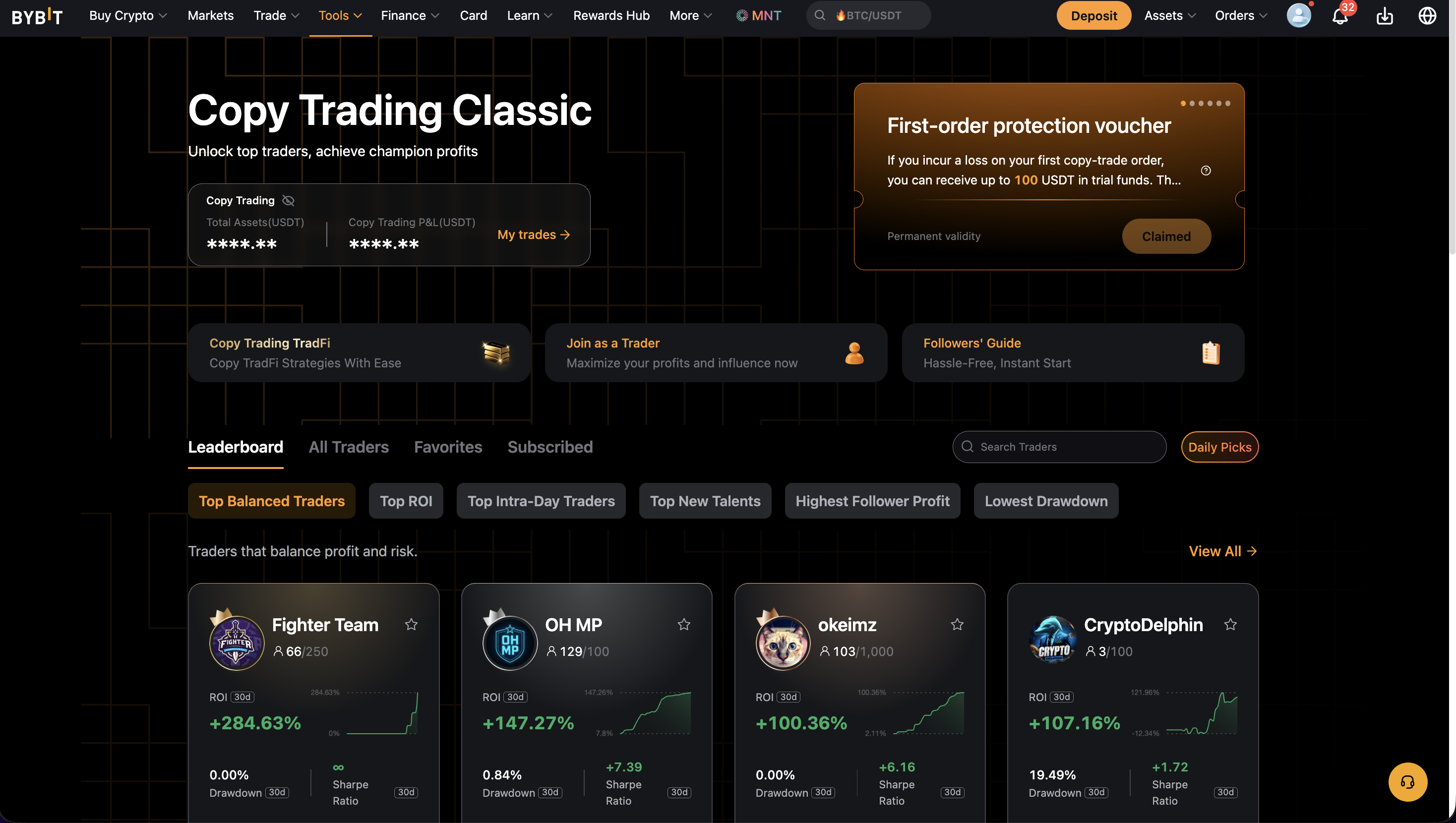
Bybit’s copy trading product is solid but secondary to its derivatives and options surface. The marketplace launched in 2022, has grown to thousands of lead traders, and offers reasonable filter coverage. The product feels integrated into the broader Bybit interface rather than the central pillar it is on BingX. Discoverability inside Bybit is good; comparison against BingX shows BingX’s marketplace is more active and the filter set is deeper.
Pros
- Strong overall platform with derivatives breadth (options on BTC/ETH, USDC-margined perpetuals, structured products)
- Up to 200x leverage on majors for users who want high-leverage strategies
- BIT token offers a 20 percent fee discount across spot and perpetuals
- Survived the February 2025 ~$1.5B Lazarus exploit without user loss; recovery in 7 days
- Established brand and large trader community
Cons
- Copy trading marketplace less developed than BingX and Bitget
- KYC mandatory in 2026 for essentially all functions (post-2025 exploit tightening)
- No US-licensed product
- February 2025 exploit was the largest single-exchange security event on record (though no user funds were lost)
Who Bybit fits: users who run derivatives-first strategies (perpetuals, options, structured products) with copy trading as a side feature, not the core motivation.
Full review: Bybit review. Head-to-head: BingX vs Bybit.
3. KuCoin: Best for altcoin-heavy traders
Score: 7.5 / 10
KuCoin’s copy trading product is the third-tier option among the three platforms we cover with affiliate codes. The marketplace exists, the filter set covers basic metrics, but the product is meaningfully less developed than BingX or Bybit. KuCoin’s strength is elsewhere: 700+ spot pairs, the strongest trading bot stack among CEXs, and the KCS token’s daily revenue-share bonus.
Pros
- ~700 spot pairs, the broadest altcoin coverage of any major CEX
- Trading bot product (spot grid, futures grid, infinity grid, DCA, smart rebalance, smart trade) is the most developed among CEXs
- KCS pays a daily bonus from platform revenue (unique among major exchange tokens)
- Email-only Standard tier with up to 5 BTC daily withdrawal pre-2024 (now tighter post-CFTC settlement)
- 2020 ~$281M hot wallet exploit recovered cleanly with no user loss
Cons
- Copy trading marketplace materially smaller and less actively curated than BingX or Bybit
- 2024 CFTC settlement tightened US geoblocking and KYC requirements
- No US-licensed product
- Long-tail altcoin listing risk is real (some tokens delist or rug)
Who KuCoin fits: users whose primary strategy is altcoin-focused with trading bots, who use copy trading occasionally rather than as the core workflow.
Full review: KuCoin review. Trading bot deep dive: KuCoin trading bots.
4. Bitget: Strongest dedicated alternative
Score: 8.2 / 10
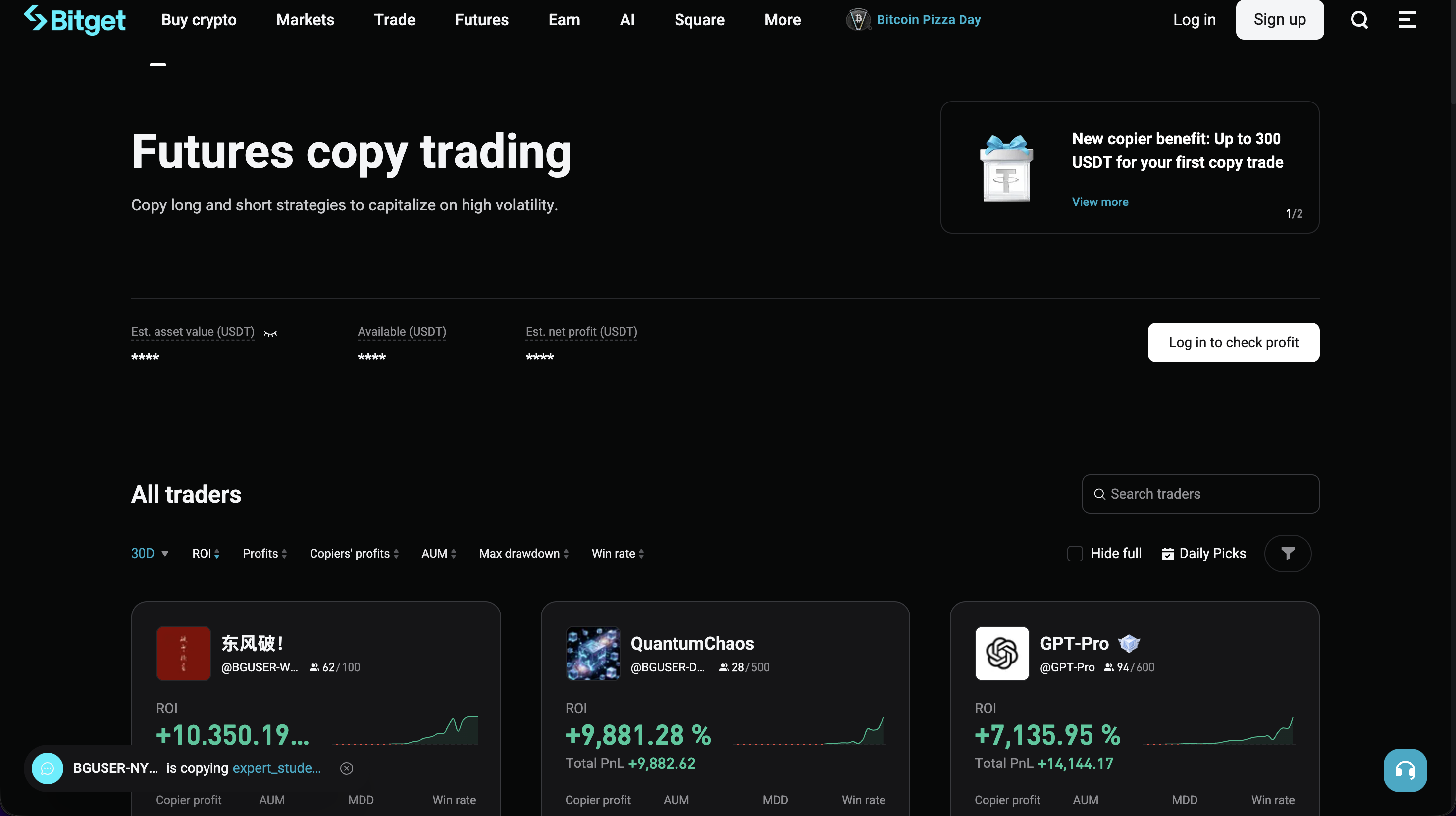
Bitget is the closest competitor to BingX on dedicated copy trading depth. The marketplace is large with longer brand recognition in the copy trading vertical, the filter set is competitive with BingX, and the platform has invested heavily in copy trading as a core product. We rank it above Bybit and KuCoin on the copy trading axis specifically because the product fits the dedicated copy trading use case better.
Pros
- Dedicated copy trading product comparable to BingX in depth and marketplace activity
- Strong filter set with drawdown caps, win rate, ROI sorting
- Established crypto-native platform with broad spot and derivatives coverage
- Larger absolute lead trader pool than BingX (slightly), built up over more years
- No native token discount required for fee escalation
Cons
- Filter set slightly less developed than BingX on advanced metrics (risk score, position duration breakdown)
- Mandatory KYC tightened across 2024-2026; no email-only Standard tier path
- No US-licensed product
- Some regulatory pressure in EU and UK jurisdictions
Who Bitget fits: users who want a dedicated copy trading marketplace alternative to BingX, who don’t mind completing KYC immediately, who value a longer copy trading track record, or who are in a jurisdiction where BingX is restricted.
Honest framing: if BingX works in your country and you want email-only Standard tier signup, BingX is our first recommendation. Bitget is the credible alternative when BingX doesn’t fit or when you want to diversify across two dedicated copy trading platforms. See our BingX vs Bitget head-to-head for the deeper comparison.
Open Bitget as the dedicated copy trading alternative.
5. OKX: Multi-product generalist (not partnered)
Score: 7.0 / 10
OKX has copy trading. The product exists, the marketplace lists lead traders, the filter set covers the basics. It is not the primary reason users choose OKX. OKX’s positioning is multi-product generalist (spot, perpetuals, options, DeFi, NFT marketplace, Web3 wallet) with copy trading as one capability among many.
Pros
- Broad product surface beyond copy trading: comparable to Binance in feature variety
- Strong derivatives liquidity, especially on Asian trading hours
- Web3 wallet integration for self-custody users
- Established platform with regulatory progress in some jurisdictions
Cons
- Copy trading marketplace and filter set behind BingX, Bybit, Bitget
- February 2025 US DOJ deferred prosecution agreement (no user impact, but regulatory baggage)
- Copy trading is not a strategic priority for the platform
Who OKX fits: users who want a multi-product platform with copy trading available, who are not making copy trading the primary use case.
Adjacent comparison: BingX vs OKX. Full review: OKX review.
6. eToro: Best for cross-asset traders (not partnered, not crypto-native)
Score: 7.0 / 10
eToro is the answer if you want copy trading across crypto and stocks in one platform. The product is much older than crypto-native copy trading (eToro launched copy trading in 2010, predating most crypto exchanges) and is regulated in most jurisdictions including the US. The trade-off is that crypto-specific product depth is meaningfully lower than crypto-native platforms.
Pros
- Regulated and licensed in most major jurisdictions including the US
- Cross-asset: trade stocks, ETFs, commodities, and crypto from one account
- Longest copy trading track record in the industry (15+ years)
- Cleaner regulatory posture than any crypto-native platform
Cons
- Crypto-specific product depth is below crypto-native platforms (smaller selection of pairs, narrower derivatives, higher crypto fees)
- Spread-based pricing on crypto creates opaque effective fees
- Crypto withdrawal to external wallets has friction; eToro positions itself as a long-term investment platform, not a crypto trader’s hub
Who eToro fits: users who want copy trading as a small part of a broader cross-asset portfolio (stocks plus crypto), who value regulatory clarity over crypto-specific product depth, or who are US-based and need a US-regulated path.
How to pick: decision tree
-
Is copy trading your primary motivation?
- Yes → continue to question 2
- No, I want copy trading as a side feature → pick the platform whose primary product fits you (Bybit for derivatives, KuCoin for altcoins, OKX for multi-product)
-
Is your jurisdiction US?
- Yes → eToro is the only practical answer at retail tier
- No → continue to question 3
-
Do you want email-only signup at the Standard tier?
- Yes → BingX is the strongest fit
- No, KYC is fine → BingX or Bitget; pick by jurisdiction availability
-
Do you want a broad product surface beyond copy trading?
- Yes → Bybit (derivatives breadth) or OKX (everything-platform)
- No, focused copy trading is fine → BingX or Bitget
-
Do you run altcoin-heavy strategies alongside copy trading?
- Yes → KuCoin (700+ spot pairs) for the altcoin side, BingX for copy trading; run both
- No, majors only → BingX or Bybit
Common mistakes when picking a copy trading platform
Picking by leaderboard top of the day. The visible top of any copy trading leaderboard is whoever just survived a volatility regime. The leaderboard does not show the leads that blew up last quarter and got delisted. Always evaluate cumulative profit over 180+ days, not 7-day or 30-day windows.
Confusing copy trading with passive yield. Copy trading is active risk-bearing capital. Following a lead trader is not the same as holding USDT in an Earn product. Lead traders can and do lose money; followers eat the full loss plus underlying trading fees on losing positions.
Allocating to a single lead trader. Concentration risk is real. The standard playbook is 4-6 leads with different strategy profiles (some short-duration, some longer; some altcoin-heavy, some BTC/ETH focused) with stop-out limits per lead.
Ignoring the underlying platform fees. Profit share to the lead is on top of normal trading fees. A high-frequency lead can rack up significant fee drag even with a positive return. The fee structure of the underlying platform matters more than people credit.
Failing the survivor-bias test. Always ask: how would I have picked this lead 180 days ago? If the answer involves the leaderboard top of the moment, the strategy is unstable.
Pros and cons summary
BingX (1st): Deepest marketplace + easiest onboarding. Lower brand recognition. Recent (Sep 2024) security event.
Bybit (2nd): Strongest overall platform with derivatives breadth. Copy trading is secondary. Feb 2025 large exploit fresh in memory.
KuCoin (3rd): Best altcoin coverage and trading bots. Copy trading is least developed of the affiliate-partnered three.
Bitget (4th): Strongest dedicated copy trading alternative if BingX doesn’t fit. Honest second pick, partnered affiliate.
OKX (5th, not partnered): Multi-product generalist. Copy trading is a side feature.
eToro (6th, not partnered, not crypto-native): Cross-asset and US-friendly. Crypto-specific depth is shallow.
Verdict
For most users whose primary motivation is copy trading specifically in 2026, BingX is the right answer. The marketplace is deepest, the filter set is most developed, the onboarding friction is lowest, and the affiliate stack on this site (TG club access, leaderboard referral, partner signup) makes it the natural recommendation we use ourselves.
If BingX doesn’t fit your jurisdiction or you want to diversify, Bitget is the credible second pick with a comparable dedicated copy trading marketplace and slightly longer brand track record in this vertical.
If copy trading is a side feature alongside derivatives or altcoin strategies, Bybit or KuCoin work as the broader platform with copy trading available rather than central.
For US-based users or cross-asset traders, eToro is the practical answer despite the lower crypto-specific depth.
The single rule that matters more than the platform pick: start small, evaluate at least 180 days of cumulative profit on any lead trader before allocating real size, diversify across 4-6 leads, and remember that the leaderboard top of the day is a survivor-bias trap.
Open BingX for the strongest crypto copy trading marketplace: Register on BingX (Telegram club access included for active traders).
See the affiliate disclosure for full detail.
Read next
- BingX review. Full feature breakdown and scoring.
- BingX copy trading guide. How the marketplace actually works.
- Bybit review. Full feature breakdown and scoring.
- KuCoin review. Full feature breakdown and scoring.
- BingX vs Bybit. Head-to-head comparison.
- BingX vs OKX. Adjacent comparison.
- KuCoin vs Bybit. Mid-tier comparison.
- Methodology. How we evaluate platforms.
- Risk disclaimer.
Frequently asked questions
What is the best copy trading platform in 2026?
BingX, for most users whose primary use case is copy trading specifically. The marketplace has the deepest active lead trader pool among crypto-focused CEXs, the filter set covers equity curve, drawdown, win rate, average position duration, risk score and traded assets, and the email-only Standard tier lowers onboarding friction. Bitget runs a comparable marketplace and is the strongest dedicated alternative. Bybit and KuCoin sit in mid-tier; eToro is the right answer for traditional finance crossover (stocks plus crypto) rather than crypto-native copy trading.
Is copy trading actually profitable?
For some users in some periods, yes; the realistic distribution is heavy-tailed and most retail copy traders break even or lose money over multi-quarter periods. The lead trader marketplace runs on survivor bias: the visible top of the leaderboard is whoever survived the recent volatility regime, not whoever has a durable edge. Profitable copy trading requires the same discipline as direct trading: position sizing, diversification across multiple uncorrelated leads, drawdown limits, and patience through 30-60 day evaluation windows before allocating real size. See our [BingX copy trading guide](/blog/bingx-copy-trading-guide/) for the screening framework.
Do copy trading platforms charge extra fees?
Two layers. First, the same trading fees you pay on direct trades on that platform (taker fee on entry and exit, funding rate on perpetuals). Second, a profit share to the lead trader on net winning periods, typically 10-20 percent of profits, depending on lead and platform. Losing periods pay the lead nothing, but the follower still pays the underlying trading fees on those positions. Worked example: a follower allocating $10,000 with a 50 percent annual return and a 15 percent profit share keeps roughly $4,250 net after profit share, before trading fees and funding.
Which copy trading platform has the lowest fees?
On the underlying trading side, BingX and Bybit are roughly tied at retail tier: BingX 0.020 percent maker / 0.050 percent taker on perpetuals, Bybit 0.020 percent maker / 0.055 percent taker. With BIT discount Bybit drops to 0.044 percent. KuCoin runs 0.020 percent maker / 0.060 percent taker with a 20 percent KCS discount available. Profit share to lead traders is comparable across platforms (10-20 percent). The fee question matters less than the lead trader quality for net outcome.
Is copy trading legal in my country?
In most jurisdictions yes, with caveats. The US restricts most international copy trading platforms; for US-based users, look at Kraken or Coinbase for direct trading (no significant US copy trading product) or eToro for the traditional finance copy trading model. EU users face MiCA-related restrictions that tightened access to retail leverage and some copy trading features in 2024-2026. UK retail derivatives access is restricted under FCA rules. Verify country availability on each platform before depositing.
Can I copy trade with a small account?
Yes. Minimum allocations on the major copy trading platforms typically start at $10-50 per lead trader. The harder problem is risk management at small size: with a $200 account spread across 3 lead traders, a single position blow-up can wipe a meaningful percentage. The practical floor for risk-managed copy trading is $1,000-2,000 across 4-6 leads. Below that the math fights you on position sizing and the profit share economics.
What metrics actually matter when picking a lead trader?
Five things in order: (1) cumulative profit over 180+ days (not 7-day or 30-day, those are noise), (2) maximum drawdown (anything above 40 percent is fragile), (3) average position duration (sub-1-day is high-frequency, harder to copy with slippage; multi-day or longer is more copyable), (4) win rate combined with average win/loss ratio (high win rate with small wins and large losses is a Martingale pattern), (5) trade frequency (anything sub-1 trade per week is hard to evaluate, anything above 20 per day fights the fee curve).
How is this ranking compiled?
We tested or used each platform with real capital across 2024-2026, evaluated the copy trading marketplace depth and filter sophistication, ran the standard scoring (security, fees, KYC, ecosystem, recovery from incidents), and ranked by what most retail copy-trading-first users will actually want. Affiliate payouts do not move ranking; BingX leads because the product is strongest, not because of partnership economics. See our [methodology](/methodology/) for the full scoring framework.
#copy trading#BingX#Bybit#KuCoin#Bitget#OKX#comparison#ranking
Discussion
Loading comments…