
TL;DR: Copy trading is when your account automatically mirrors the trades of an experienced trader on a centralized exchange or broker platform. You allocate capital, pick lead traders, and the platform handles execution. You pay regular trading fees plus a profit share to the lead on winning periods. It’s not passive income; it’s delegated active risk. Most beginners break even or lose money in the first year. Below is the full explainer with mechanics, history, who it fits, who it doesn’t, and where to start.
Not financial advice. Crypto copy trading is high risk. Lead traders can and do lose money. Past performance does not predict future returns. Verify country availability and start with capital you can fully afford to lose. Read the risk disclaimer before scaling.
What copy trading actually is
Copy trading is a feature on certain trading platforms that connects two parties:
- Lead trader (signal provider): an experienced trader who opens positions in their own account. The platform makes their performance public.
- Follower (copier): you, allocating capital to the platform. When the lead trades, your account makes a proportional trade.
The mechanics are straightforward. You pick a lead. The platform shows you their historical performance, current open positions, follower count, and risk metrics. You allocate capital. From that moment, every position the lead opens triggers a proportional position in your account. When they close, you close. You pay regular trading fees on every position, plus a profit share to the lead on net winning periods.
The mental model: you’re hiring a discretionary fund manager. Except you can fire them mid-trade by stopping the copy, and the platform shows you transparent performance data to evaluate them.
A brief history
Copy trading didn’t start in crypto. It started in 2007-2010 in traditional finance:
- eToro launched in 2007 in forex, added social trading in 2010, and pioneered the modern copy trading model
- ZuluTrade built signal-provider networks for forex around the same time
- MetaTrader plugins added basic copy functionality for retail brokerage clients
Crypto-native copy trading emerged 2018-2020 as the broader crypto adoption wave matured:
- BingX launched in 2018 and invested heavily in copy trading 2020-2022
- Bitget entered the category 2020-2021 with similar focus
- Bybit added copy trading in 2022 as a secondary feature
- Binance added copy trading in 2023 expanding from its derivatives base
By 2026, the dedicated crypto copy trading platforms (BingX, Bitget) outperform non-dedicated ones on marketplace depth, filter sophistication, and lead trader pool quality.
How it works mechanically
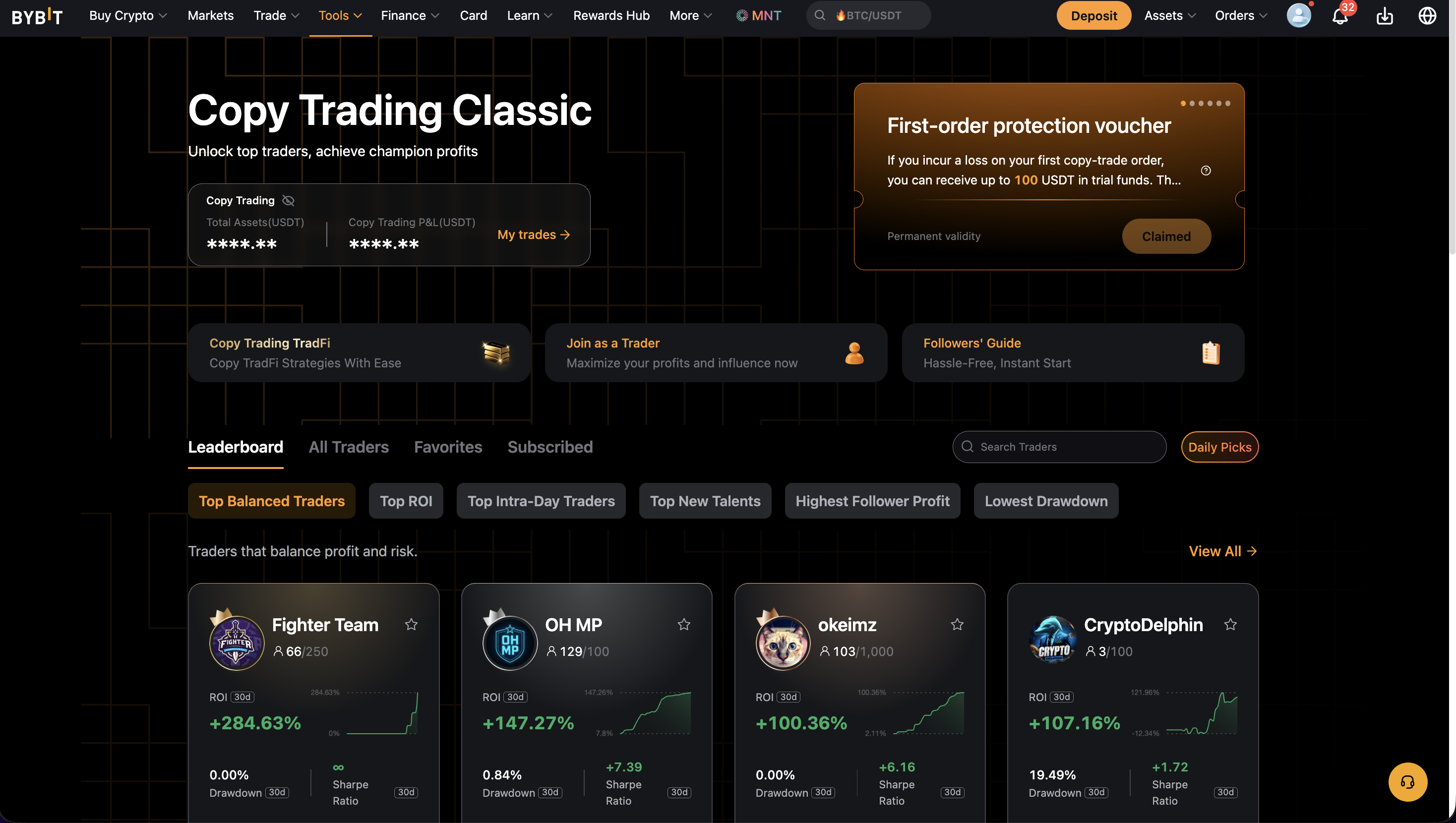
Three layers stack together:
1. Lead trader opt-in
A lead trader opens an account on the platform and applies to be listed publicly. The platform tracks their actual trading from real capital. There’s no simulation: leads are trading their own money, and their displayed track record reflects real outcomes.
The platform shows the lead’s:
- Cumulative profit over various windows (7d, 30d, 90d, 180d, all-time)
- Maximum drawdown
- Win rate
- Average position duration
- Number of followers
- Assets under management (AUM)
- Asset allocation breakdown
2. Follower allocation
You browse the marketplace, filter by metrics that matter for your strategy (more on this in the framework section), pick a lead, and allocate capital. The platform either segregates your capital in a sub-account dedicated to that lead, or marks the capital as available for that lead’s copy positions only.
Each lead gets their own allocation. You can copy multiple leads simultaneously, and your total platform balance is split across them.
3. Trade execution and profit share
When the lead opens a position, the platform automatically opens a proportional position in your account. The proportion is based on your allocation versus the lead’s account size (or sometimes a fixed multiplier you set).
When the lead closes the position, your position closes too. You pay regular trading fees (typically 0.05-0.10 percent taker fee on entry plus exit, plus any funding rate on perpetual contracts).
On net winning periods, the platform calculates the lead’s profit share. Most platforms structure this as 10-20 percent of net profit on closed trades or high-water-mark periods. The platform handles the accounting; you see the profit share deducted from your account.
On losing periods, the lead earns nothing on profit share but you still pay the underlying trading fees.
Who copy trading fits
The honest answer: a smaller subset of crypto users than the marketing suggests.
Copy trading fits if:
- You want crypto exposure but don’t want to develop trading skills. The framework requires discipline but less specific trading knowledge than direct trading.
- You can actively monitor and rebalance every 30-90 days. Copy trading is not set-and-forget; lead traders can blow up.
- You can afford to lose the allocated capital entirely. Crypto copy trading is high risk; treat it as money you’d be okay losing.
- You understand it as a portfolio of active bets, not passive income. Most beginners get this wrong.
Copy trading does NOT fit if:
- You want passive yield. Use savings products instead (USDC in DeFi at 4-8% APY, Earn products on CEXs at 3-7% APY). Copy trading is active risk.
- You want to learn trading skills yourself. Direct trading teaches more. Copy trading delegates the judgment.
- You can’t check your account at least weekly. Lead traders can blow up between checks.
- Your time horizon is under 6 months. Most copy traders break even or lose in the first year while learning the framework.
- You’re emotionally reactive to drawdowns. Even good leads have 20-30 percent drawdowns; reactive panic-selling cycles you through losing patterns.
Realistic profit expectations
The marketing makes copy trading sound like passive income. The reality is heavy-tailed:
- Top 10 percent of copy traders (after 12+ months of consistent practice) often produce 15-40 percent annual returns net of fees. These users have learned to evaluate leads systematically and size positions correctly.
- Middle 50 percent typically break even to small gain or loss. The fees, profit share, and average lead quality net out to roughly market average.
- Bottom 40 percent lose money, sometimes substantial amounts. The common causes: lead trader concentration, chasing leaderboard tops, treating losses as personal failure and abandoning the framework, scaling allocation lump-sum after a winning month.
This distribution mirrors retail trading in general. Copy trading doesn’t change the fundamental probability distribution of retail outcomes; it just shifts who’s making the trade decisions.
For framework details on evaluating lead traders see our how to copy trade crypto guide.
Copy trading vs alternatives
Three common comparisons:
vs direct trading
You make every decision. More learning, more time investment, more variance. Suitable if you want to develop trading skills as a long-term project.
Copy trading is a lower-investment alternative for users who want crypto exposure without the time commitment.
vs passive yield products
USDC in DeFi savings, Coinbase Earn, KuCoin Earn, Aave deposits, similar products. 4-8 percent APY with much lower risk profile. No active monitoring required.
Copy trading is active risk that needs to beat ~8 percent passive yield AFTER fees to be worth doing. Most lead traders don’t deliver this over multi-year periods.
vs trading bots
KuCoin spot grid, futures grid, DCA bots execute pre-programmed strategies without human judgment. Bots fit ranging markets and systematic execution; they fail trending markets and require parameter tuning.
Copy trading delegates judgment to a human. Bots execute rules. Different mental models, different risk shapes.
vs traditional fund management
A mutual fund or hedge fund manager manages pooled capital with regulatory oversight, audited financials, and structured redemption windows. Higher minimum investment ($100K+), longer commitment periods, regulated environment.
Copy trading is the retail version: lower minimums, no structured commitment, less regulated, more transparent on real-time performance but less audited on overall track record.
Where to start
For most users wanting crypto copy trading specifically, the 2026 picks:
International users (non-US)
BingX for the deepest filter set and email-only Standard tier signup. Our top crypto copy trading recommendation. See our BingX review and BingX copy trading guide.
Bitget as the credible alternative if BingX is restricted in your jurisdiction. Larger absolute lead trader pool, slightly less filter sophistication. See our Bitget review.
US users
eToro for the regulated cross-asset (crypto + stocks) copy trading product. The only realistic US-licensed answer in 2026. Note: we do not have an affiliate relationship with eToro; this is product recommendation only.
Spanish users
Bit2Me has limited copy trading. BingX is more developed if your jurisdiction isn’t restricted. For Spain-specific guidance see our how to buy crypto in Spain.
Russian users
Bybit as the dominant Russian-friendly copy trading platform. BingX as a credible alternative with email-only signup. For Russia-specific guidance see our how to buy crypto in Russia.
Turkish users
BingX or Bybit with TRY P2P funding. For Turkey-specific guidance see our how to buy crypto in Turkey.
Common mistakes when starting
Five mistakes that wipe more copy trading accounts than anything else:
-
Picking by the leaderboard top of the day. The visible top is whoever just got lucky in the latest volatility regime. The leaderboard does not show leads that blew up last quarter. Always evaluate cumulative profit over 180+ days minimum.
-
Single-lead concentration. “This lead looks amazing, I’ll put everything in them.” Then they blow up. Always spread across 4-6 leads with different strategy profiles.
-
Treating copy trading as passive yield. It’s active risk-bearing capital. Lead traders can and do lose money. Your account can drop 30-50 percent in a bad month even with a well-diversified lead portfolio.
-
Ignoring underlying trading fees. Profit share to the lead is on top of normal trading fees. High-frequency leads can rack up significant fee drag even with positive gross returns.
-
Adjusting positions mid-trade. Most platforms let you manually close copied positions. Resist this urge. You’re paying the lead for their judgment; if you override their exits, you get the worst of both worlds (their entries, your exits).
Verdict
Copy trading is a legitimate retail crypto strategy when treated correctly: hire lead traders as fund managers, evaluate them systematically over 180+ day windows, diversify across 4-6 with different strategy profiles, size positions with drawdown caps, and monitor every 30-90 days.
Treated incorrectly (chase leaderboard tops, concentrate on one lead, treat as passive income, ignore fee drag), copy trading is a slightly slower way to lose money than direct trading.
The mental model that works: copy trading is hiring discretionary fund managers with public track records, low minimums, and instant fire-the-manager capability. The mental model that doesn’t work: copy trading is a get-rich-quick scheme where you “just copy the best traders.”
For users who want to try it, start with $1,000-2,000 across 4-6 leads on BingX or Bitget (non-US) or eToro (US). Treat the first 6 months as tuition. Read our how to copy trade crypto framework before allocating real capital.
Open BingX as the international default for copy trading: Register on BingX. See the affiliate disclosure for full detail.
Read next
- Best copy trading platforms 2026. Honest ranking of six platforms with scoring methodology.
- How to copy trade crypto. Practical 5-criteria framework for picking lead traders.
- BingX copy trading guide. Platform-specific walkthrough.
- BingX review. Our top international copy trading pick.
- Bitget review. The credible alternative for users who can’t access BingX.
- Methodology. How we evaluate platforms.
- Risk disclaimer.
Frequently asked questions
What is copy trading in simple terms?
Copy trading is a feature on certain trading platforms that automatically mirrors the positions of an experienced trader (called a lead trader or signal provider) onto your own account. When the lead trader opens a position, your account opens a proportional one. When they close, you close. You pay the regular trading fees plus a profit share to the lead trader on net winning periods. Copy trading exists for crypto, stocks, forex, and commodities. It's most popular in crypto (via BingX, Bitget, Bybit) and traditional finance (via eToro).
Is copy trading profitable in 2026?
Sometimes for some users, but the realistic distribution is heavy-tailed and most retail copy traders break even or lose money over multi-quarter periods. The visible top of any copy trading leaderboard is a survivor bias artifact: it shows whoever just got lucky in the latest volatility regime, not whoever has a durable edge. Profitable copy trading requires the same discipline as direct trading: lead trader evaluation, position sizing, diversification across uncorrelated leads, drawdown management. Treating it as passive income is the most common reason beginners lose money.
What's the difference between copy trading, mirror trading, and social trading?
Copy trading: you automatically copy a specific lead trader's positions in your own account. Mirror trading: similar but applies a strategy rather than a person (often algorithmic). Social trading: a broader category that includes copy trading plus discussion, news feeds, and community elements. In practice these terms overlap. eToro pioneered social trading in 2010 with copy trading as the main mechanic. Crypto platforms like BingX and Bitget use 'copy trading' as the dominant term in 2026 marketing.
How much do I need to start copy trading?
Platform minimums are typically $10-50 per lead trader. The practical floor for risk-managed copy trading is $1,000-2,000 spread across 4-6 leads. Below that, a single position blow-up wipes a meaningful percentage of your account. Most beginners should start with what they can fully afford to lose and treat the first 6 months as tuition to learn the lead evaluation framework, not as primary income.
What are the fees for copy trading?
Two layers stack. First, the same trading fees you'd pay on direct trades on the platform (taker fee on entry and exit, funding rate on perpetual contracts, typically 0.05-0.10 percent per side at retail tier). Second, a profit share to the lead trader on net winning periods, typically 10-20 percent of profits depending on the lead's contract. Losing periods pay the lead nothing but you still pay trading fees. The fee math compounds: high-frequency leads can rack up significant fee drag even with positive gross returns.
Which platform should I use for copy trading?
Depends on your country and goal. For crypto copy trading globally, BingX leads on filter sophistication and marketplace depth, Bitget is the credible alternative. Both materially exceed Bybit, KuCoin, and OKX on this axis. For US users, eToro is the regulated answer (cross-asset crypto + stocks). For Spanish users, Bit2Me offers limited copy trading; BingX is broader. See our [best copy trading platforms 2026 ranking](/blog/best-copy-trading-platforms-2026/) for the full comparison.
Is copy trading the same as automated trading or trading bots?
No. Copy trading mirrors a human lead trader's discretionary decisions. Automated trading uses algorithms running on rules you (or the bot developer) defined. Trading bots like KuCoin's spot grid or futures grid execute pre-programmed strategies (buy low, sell high within a range) without a human decision-maker. Copy trading is human-in-the-loop, bots are not. Each fits different use cases: copy trading for users who want to delegate judgment, bots for users who want systematic execution of a defined strategy.
Can I lose more than I deposit when copy trading?
On spot copy trading: no. Your maximum loss is the amount you allocated. On futures copy trading with leverage: yes, in theory. Most platforms have liquidation engines that close positions before negative balance is reached, but flash crashes or extreme volatility can cause negative balance in rare cases. Bybit, BingX, Bitget all offer negative balance protection on retail accounts in 2026, but the policy is platform-specific and worth verifying before depositing.
#copy trading#guide#beginner#explainer#BingX#eToro
Discussion
Loading comments…