
Score: 8.2 / 10 · Good for: dedicated copy trading marketplace, larger absolute lead trader pool, established crypto-native platform · Watch out for: mandatory KYC in most jurisdictions, 2023 leaderboard manipulation incident, no US-licensed product · Updated: May 2026
Bitget is a centralized cryptocurrency exchange founded in 2018, operationally based in Singapore. The platform built its position in 2020-2022 through aggressive investment in copy trading as a core product category, positioning itself as a competitor to BingX in the dedicated crypto copy trading vertical. It survived the 2022 FTX-cascade, the 2023 leaderboard manipulation incident, and the 2024-2026 regulatory tightening cycle without a major custody event. This independent review covers what matters before depositing: copy trading marketplace depth versus BingX, fee structure with BGB token, the 2023 incident in context, KYC reality in 2026, and where Bitget fits in a multi-exchange retail trader’s stack. We score each platform on the same methodology, and affiliate payouts do not move ratings.
Not financial advice. Crypto trading is high risk. Custody on any centralized exchange is non-zero risk regardless of operating history. Derivatives products carry leverage risk that can wipe an account in minutes. Verify country availability before depositing. Read the risk disclaimer.
What is Bitget
Bitget launched in 2018 and initially competed in the general derivatives category alongside Bybit and OKX. The strategic pivot came in 2020-2021 when Bitget invested heavily in copy trading as a core product surface, while competitors treated it as a side feature. By 2022-2023, Bitget had positioned itself as one of the two dedicated crypto copy trading platforms alongside BingX.
The leadership change in 2024 moved operational control to a new CEO Gracy Chen, with a continued focus on copy trading + futures as the dual product spine. The platform remains structurally similar in size to Bybit and OKX on raw derivatives volume but is meaningfully smaller than Binance.
The platform’s identity in 2026 rests on three pillars. First, copy trading: a marketplace with the largest absolute lead trader count among crypto-focused CEXs, built over more dedicated years of investment than competitors. Second, perpetual futures: liquid markets on the top 100 pairs with up to 125x leverage on majors. Third, BGB token economy: a 20% fee discount mechanic plus ecosystem access to Bitget Launchpad and structured products.
Markets and asset coverage
Bitget lists approximately 650 spot trading pairs as of 2026. This is comparable to BingX (~700) and meaningfully more than Bybit (~400) but less than KuCoin (700+). Listing standards are mid-tier: stricter than KuCoin’s long-tail policy, more permissive than Binance’s curated approach. The platform takes a middle ground that supports altcoin diversity without the rug-pull risk of the deepest long tail.
Derivatives are where coverage is broadest. Perpetual futures cover the top 100 pairs by liquidity with up to 125x leverage on majors. USDT-margined and Coin-M (inverse) perpetuals are both available. Bitget does not offer options markets, for that surface, Bybit is the answer (covered in our Bybit review).
Margin trading with isolated and cross-margin spot is available with leverage up to 10x on supported pairs. The structured products surface includes dual investment, accumulating positions, and a yield product called Earn that pays variable APY on USDT, USDC, and major coins.
The trade-off across all this coverage: liquidity on the deepest long-tail altcoin pairs is thinner than KuCoin. For altcoin-heavy strategies outside the top 200 by market cap, KuCoin remains the broader option. For directional trading on the top 100 pairs with copy trading allocation alongside, Bitget covers the workflow comfortably.
Copy trading marketplace
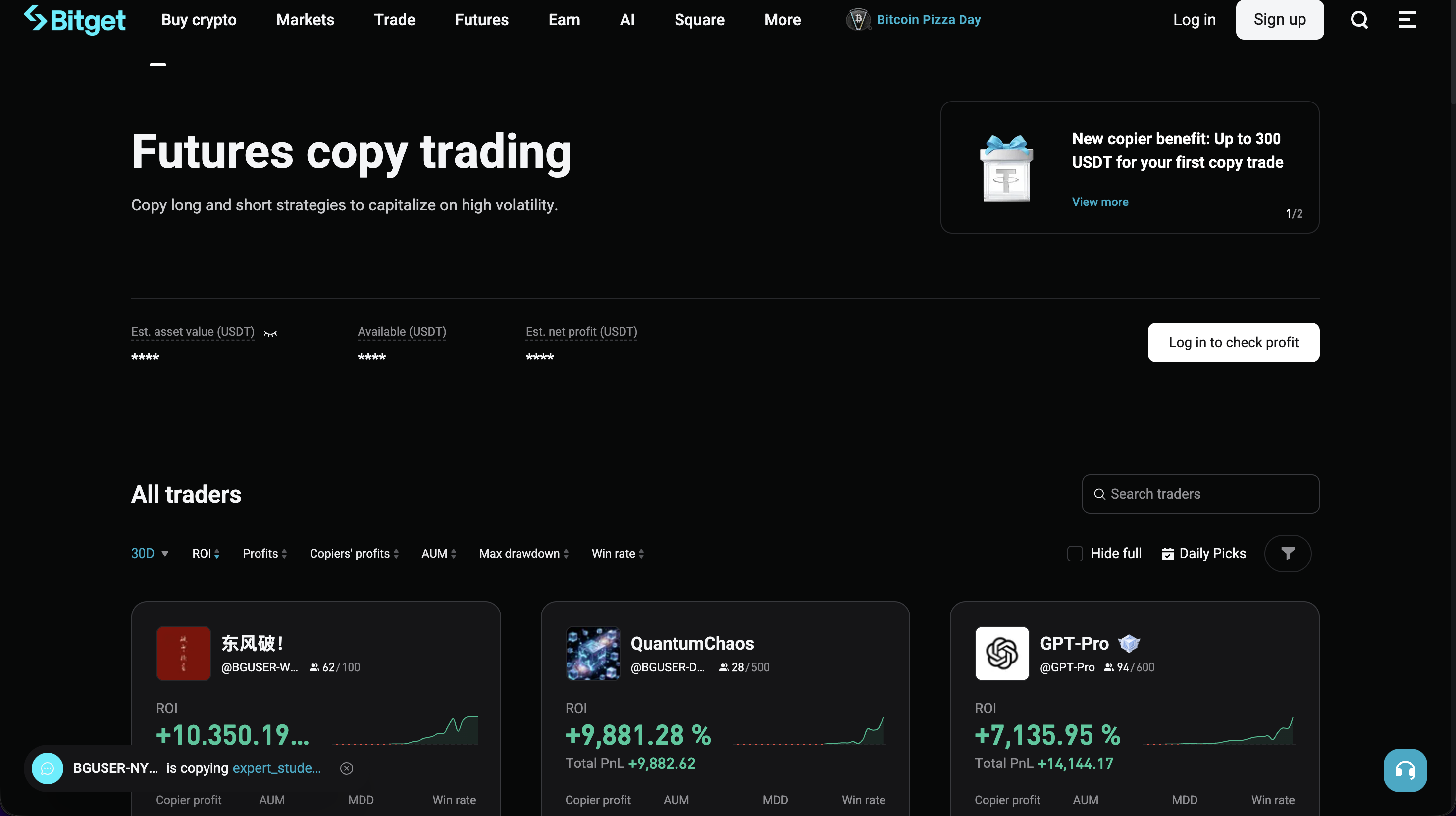
This is Bitget’s strategic moat and the primary reason to use the platform.
The marketplace lists thousands of active lead traders across spot and perpetual strategies. The absolute lead count is slightly larger than BingX, built up over more dedicated years of investment in copy trading specifically. The filter set covers cumulative profit by time window (30d, 90d, 180d, all-time), maximum drawdown, win rate, follower count, ROI sorting, asset class breakdown, and per-lead position sizing controls.
Compared to BingX directly: BingX has slightly more sophisticated filters on advanced metrics like risk score and position duration breakdown. Bitget has more absolute leads to choose from and a longer documented track record per established lead.
Compared to non-dedicated CEX copy trading (Bybit, KuCoin, OKX): Bitget materially exceeds all three on marketplace depth, filter sophistication, and platform-level investment in the copy trading product.
The honest framing: if BingX is restricted in your jurisdiction or you prefer the larger absolute pool, Bitget is the credible alternative. If you have the choice and want email-only Standard tier signup, BingX is the better starting point. See our BingX vs Bitget head-to-head for the deeper comparison.
For evaluating lead traders systematically, the framework from our how to copy trade crypto guide applies identically on Bitget: 180-day cumulative profit, max drawdown under 30%, position duration matching your monitoring willingness, win rate paired with win/loss ratio, trade frequency in the 1-5 per week sweet spot.
Fee structure
At default VIP 0 tier, Bitget charges 0.10% maker and 0.10% taker on spot. Activating the BGB fee discount (holding any positive BGB balance and toggling the option in account settings) reduces both sides by 20% to 0.08%. Perpetual futures are 0.020% maker and 0.060% taker at default tier; with BGB discount, taker drops to 0.048%.
| Tier | Spot maker / taker | Futures maker / taker | 30-day volume threshold |
|---|---|---|---|
| Default | 0.10% / 0.10% | 0.020% / 0.060% | none |
| Default + BGB | 0.08% / 0.08% | 0.016% / 0.048% | hold any BGB |
| VIP 1 | 0.08% / 0.09% | 0.018% / 0.055% | $100K |
| VIP 3 | 0.06% / 0.08% | 0.014% / 0.045% | $1M |
| VIP 5 | 0.04% / 0.06% | 0.008% / 0.035% | $10M |
Compared to BingX (0.050% perpetual taker default) and Bybit (0.055% default, 0.044% with BIT), Bitget’s default perpetual taker (0.060%) is slightly higher. With BGB held, Bitget drops to 0.048% which is comparable to Bybit-with-BIT and slightly cheaper than BingX base.
For active retail copy traders running $250K-$500K monthly perpetual volume, the fee difference between Bitget+BGB and BingX is roughly $25-50 per month, real but not decisive. The fee question matters less than lead trader selection quality.
Profit share to lead traders runs 10-20% on Bitget, depending on the specific lead’s contract terms. The platform doesn’t take a cut; the share goes from follower to lead directly.
Withdrawal fees depend on network. USDT on Tron is the cheapest at 1 USDT flat. USDC on Solana is fast and cheap when available. USDT on Ethereum mainnet can spike above 8 USDT during high-gas periods. Always confirm network on both sides before sending, wrong-network sends are the single most common user-error fund loss across all CEXs.
The 2023 leaderboard incident
This is the defining trust event in Bitget’s recent history. It was not a custody breach but a marketplace integrity issue worth understanding.
In mid-2023, several lead traders on Bitget’s copy trading marketplace were found to have manipulated their displayed performance through specific trade patterns. The mechanics involved coordinated round-trips between linked accounts to inflate displayed win rates and cumulative profit metrics without taking real directional risk.
The result was that affected followers were copying leads whose published track records overstated their actual edge. When the platform detected the patterns and removed the affected leads, some followers had open positions that converted from “copied from a successful lead” to “you’re now manually managing positions opened by a manipulator.”
Bitget’s response:
- Identified and removed the affected lead trader accounts
- Refunded impacted followers for losses traceable to the manipulation
- Implemented stricter manipulation detection algorithms targeting the specific patterns
- Made the leaderboard integrity audit process more transparent
- Published a post-incident statement explaining the changes
No platform-level fund loss occurred. The incident affected only the followers of the specific manipulated leads, and they were made whole through the refund process.
Forward-looking implication: the marketplace integrity audit is now stronger on Bitget than it was pre-2023. New leads face more scrutiny on suspicious patterns. The fix was technically sound. But the incident is a reminder that any copy trading marketplace requires active integrity policing, and that’s an ongoing operational task across the lifetime of the platform.
This is structurally different from the Feb 2025 Bybit $1.5B hot wallet exploit. Different categories of risk. Both have been responded to within industry norms. Forward-looking custody risk is comparable across the partnered CEXs covered on this site.
KYC and country availability
Bitget moved to mandatory KYC across 2024-2026 as regulatory pressure tightened. The platform’s tier structure:
| Tier | What it requires | What it unlocks |
|---|---|---|
| Unverified | Email or wallet only | Market viewing, no trading |
| Standard verification | Name, country, date of birth, government ID, liveness selfie | Spot trading, futures, copy trading, standard withdrawal cap |
| Enhanced verification | Address proof, source of funds questionnaire | Higher withdrawal limits, OTC desk access |
The unverified tier is effectively read-only for new accounts in 2026. The email-only Standard tier, historically available on Bitget, was phased out in 2024 in most jurisdictions. For practical purposes, assume Standard verification is required for any meaningful trading workflow on Bitget.
If avoiding KYC is your primary driver, BingX is the better starting point in 2026. BingX still maintains email-only Standard tier with daily withdrawal limits around 50,000 USDT in most non-EU/UK jurisdictions. See our BingX no-KYC registration guide for that path.
Country availability:
- United States. Not served. Signup is geo-blocked from US IPs.
- United Kingdom. Retail derivatives access restricted under FCA rules. Spot available with KYC.
- European Union. Available with country-by-country variations under MiCA.
- Canada. Restricted in Ontario; available in some provinces with restrictions.
- Russia. Available with standard KYC. Russian users can complete verification with Russian-issued ID.
- Hong Kong, Japan, Taiwan, Thailand. Varying degrees of restrictions; check current availability.
Country availability tightens over time, not loosens. A user whose jurisdiction is currently marginal may see access change without specific notice.
Copy trading head-to-head: Bitget vs BingX
This is the single most important comparison for someone choosing Bitget. Here’s the framework:
Pick Bitget if:
- You want the largest absolute lead trader pool
- You don’t mind completing KYC immediately
- You value the longer track record per established lead
- BingX is restricted in your jurisdiction
Pick BingX if:
- You want email-only Standard tier signup
- You value the deeper filter set (risk score, position duration breakdown)
- You’re a retail-size trader where slightly lower base perpetual fees matter
Either is materially better than non-dedicated copy trading CEXs (Bybit, KuCoin, OKX) on the copy trading axis specifically.
For the full breakdown with feature-by-feature tables, see BingX vs Bitget.
BGB token and ecosystem
BGB is Bitget’s native utility token. Two mechanics matter for retail users:
Fee discount. Holding any positive BGB balance and toggling the fee discount option in account settings activates a 20% reduction on spot and perpetual maker/taker fees. The discount applies across all VIP tiers, not only the default.
Ecosystem access. BGB grants priority access to Bitget Launchpad listings, structured product slots, and ecosystem promotions. The value of this access varies materially week-to-week; for some launchpad windows it can be meaningful, for others negligible.
Unlike KCS (KuCoin’s native token), BGB does not pay a daily revenue-share bonus. The value proposition is fee discount plus optional ecosystem participation, not yield.
Break-even analysis: hold BGB only if you would hold the token anyway as a speculative position, or if your trading volume is high enough that the fee discount alone justifies the price risk exposure. For most retail users with monthly volume under $50K, the math is marginal.
Pros and cons
Pros
- Largest absolute copy trading lead trader pool among partnered CEXs
- Established crypto-native platform with 8+ years of operating history
- Mandatory KYC + strong AML controls + post-2023 leaderboard integrity audits
- Competitive perpetual futures liquidity on top pairs
- BGB discount applies across all fee categories without complex stacking rules
- Wide product surface: futures, spot, copy trading, structured products, Earn, Launchpad
- ~650 spot pairs covers most retail altcoin needs
Cons
- Mandatory KYC in 2026, no email-only Standard tier path
- No US-licensed product; US users excluded entirely
- 2023 leaderboard manipulation incident, despite clean response, is part of the track record
- Default perpetual taker fee (0.060%) is highest among partnered CEXs (without BGB held)
- No options markets, for options strategies, Bybit is the answer
- Long-tail altcoin liquidity thinner than KuCoin
- BGB doesn’t pay daily yield bonus comparable to KCS
How Bitget compares
Head-to-head context in our existing comparisons:
-
BingX vs Bitget is the head-to-head most relevant for copy-trading-first users. Short version: Bitget has the larger absolute pool + longer track record per lead. BingX has slightly better filters + email-only KYC + lower base fees. Both materially exceed Bybit/KuCoin/OKX on copy trading.
-
Best copy trading platforms 2026 ranks Bitget at 8.2/10, fourth overall but second on the copy trading axis specifically (only BingX outranks it on this axis).
For derivatives breadth (options, structured products, USDC-margined perpetuals), Bybit covers what Bitget doesn’t. See Bybit review.
For altcoin depth beyond what Bitget lists, KuCoin’s 700+ pair coverage is broader. See KuCoin review.
If you want maximum product surface in one platform (NFT, Launchpad, Earn, P2P, Card), Binance covers more ground than Bitget.
The pattern: Bitget is a strong choice when copy trading is your primary motivation, with comfortable secondary capability in directional perpetual futures.
For users in Russia
Bitget remains accessible to Russian users in 2026 with standard KYC using Russian-issued ID. Unlike Binance (exited Russia via CommEX sale in 2023), Bitget continues to serve the Russian crypto trader base.
Practical recommendations for a Russian account:
- Do not use commercial VPN. Bitget detects most commercial VPNs and caught accounts go to withdrawal-only mode. Sign up and trade from your real IP.
- Complete Standard verification immediately. Post-2024, the platform gates most functions until full verification.
- Deposit USDT via Tron. Cheapest route, minimal fees.
- Check futures access. Some derivatives products may be restricted for individual jurisdictions even after KYC.
- Don’t park large amounts. Custody risk applies as on any CEX, plus geo-risk that regulatory policy for Russia could tighten without notice.
For broader context on crypto exchange choice for Russian-speaking users see the Russia section in KuCoin vs Binance and our Bybit review.
How to start
- Use the affiliate signup link. Our partner code activates if you sign up via partner.bitget.com/bg/0J6AVQ. This supports our independent research without changing how the platform works for you.
- Register and complete Standard KYC. Email + government ID + liveness selfie. Approval typically takes minutes to a few hours.
- Deposit USDT. Tron network for the cheapest path. Confirm network on both sides before sending.
- Start with copy trading specifically. Filter the marketplace by 180-day cumulative profit + max drawdown under 30% + position duration over 1 day. Pick 4-6 leads with different strategy profiles.
- Allocate $1,000-2,000 to start. Treat the first 6 months as tuition while you learn lead evaluation. Don’t lump-sum scale.
- Try a small withdrawal early. Confirm the path works for your network/asset combo before scaling balance.
- Consider BGB if volume justifies. Otherwise skip the token and re-evaluate after 90 days of platform usage.
Final verdict
In 2026, Bitget is the strongest dedicated alternative to BingX on the crypto copy trading axis. The marketplace is comparable in depth (slightly larger absolute pool), the filter set is competitive (slightly less developed than BingX on advanced metrics), and the operational history is clean since the 2023 leaderboard manipulation event was addressed.
Honest score: 8.2 / 10. Above Bybit (8.0) and KuCoin (7.5) on the copy trading axis specifically because Bitget is purpose-built for copy trading where those two have it as a side feature. Below BingX (8.7) because BingX offers email-only Standard tier + slightly better filters + slightly lower base fees.
For copy-trading-first retail traders who don’t mind completing KYC immediately, Bitget is a credible primary platform in 2026. For users who want maximum KYC flexibility at the Standard tier, BingX wins. For users who want copy trading alongside derivatives breadth (options, structured products), Bybit fits.
The platform is partnered through our affiliate program, see the affiliate disclosure for full detail. We rank Bitget honestly above several partnered platforms (Bybit, KuCoin) on the copy trading axis because the product is stronger there, not because of partnership economics.
Open Bitget for the largest absolute copy trading marketplace: Register on Bitget. See the affiliate disclosure for full detail.
Read next
- BingX vs Bitget. Head-to-head on the two dedicated crypto copy trading platforms.
- Best copy trading platforms 2026. Full ranking with honest scoring across 6 platforms.
- How to copy trade crypto. Beginner’s guide with the 5-criteria lead selection framework.
- BingX review. The primary alternative; full feature breakdown.
- Bybit review. Derivatives-first alternative with copy trading as side feature.
- KuCoin review. Altcoin-focused alternative with mid-tier copy trading.
- Methodology. How we evaluate platforms.
- Risk disclaimer.
Frequently asked questions
Is Bitget safe in 2026?
Yes, with the standard centralized exchange risk profile. Bitget has operated since 2018 without a major custody event. The 2023 leaderboard manipulation incident was a trust event (not a custody breach) where some lead traders were found gaming displayed performance metrics. Bitget addressed it with stricter manipulation detection, removed affected leads, and refunded impacted followers. No platform-level fund loss has occurred. Forward-looking custody risk is comparable to other top-tier CEXs.
How does Bitget copy trading compare to BingX?
Comparable depth, with slight tradeoffs. Bitget has a larger absolute lead trader pool (built up over more years of dedicated investment in copy trading specifically). BingX has slightly more sophisticated filters (risk score, position duration breakdown) and lower onboarding friction (email-only Standard tier). Both materially exceed Bybit, KuCoin, and OKX on the copy trading axis. Either is the right answer if copy trading is your primary use case. See our [BingX vs Bitget](/blog/bingx-vs-bitget/) head-to-head for the detailed comparison.
What are Bitget's fees?
Spot maker/taker 0.10% on default VIP 0 tier. Perpetual futures maker 0.020% and taker 0.060%. With BGB (Bitget Token) held, fees reduce by 20% across spot and perpetuals, bringing perpetual taker to 0.048%. VIP tiers scale further based on 30-day volume. Profit share to lead traders runs 10-20% on net winning periods, comparable to other copy trading platforms. Withdrawal fees depend on network, USDT on Tron at 1 USDT flat is the cheapest path.
Does Bitget require KYC?
Yes for essentially all account functions in 2026. Bitget moved to mandatory KYC across 2024-2026 as regulatory pressure tightened in EU, UK, and other jurisdictions. Unverified accounts are effectively read-only for new sign-ups. Standard verification (government ID + liveness selfie) is required for spot trading, futures, and copy trading. Bitget no longer offers an email-only Standard tier, if KYC flexibility is your priority, BingX is the better fit in 2026.
Can US users use Bitget?
No. Bitget does not serve US users and geo-blocks US IPs at signup. There is no US-licensed Bitget product. For US-based traders looking for copy trading specifically, eToro is the regulated answer (covers crypto plus stocks). For direct crypto trading in the US, Kraken, Coinbase, or Gemini. Bitget remains widely available outside the US with regional restrictions in EU (MiCA), UK retail derivatives, Canada, and a handful of other jurisdictions.
What is BGB and is it worth holding?
BGB is Bitget's native exchange token. Holding any positive balance and toggling the fee discount option in account settings activates a 20% reduction on spot and perpetual maker/taker fees. The discount applies across all VIP tiers, not just the default. BGB also unlocks Bitget Launchpad allocation access and ecosystem participation. Unlike KuCoin's KCS, BGB does not pay a daily revenue-share bonus. For active traders running $100K+ monthly volume, BGB makes sense for fee compression. For occasional users, the token price risk usually outweighs fee savings.
Bitget vs Bybit, which is better?
Different positioning. Bitget is a copy trading specialist with strong futures coverage. Bybit is a derivatives-first platform with copy trading as a secondary feature. For copy-trading-first users, Bitget is the better choice. For derivatives breadth (options markets, USDC-margined perpetuals, structured products), Bybit. Bybit had a much larger security event (Feb 2025 ~$1.5B Lazarus exploit, recovered cleanly with no user loss). Bitget's track record is cleaner on the custody dimension. Forward-looking risk comparable.
How do I start with Bitget?
Sign up via [bitget.com](https://partner.bitget.com/bg/0J6AVQ) using our partner link. Complete Standard KYC immediately (post-2024 you can't trade meaningfully without it). Deposit USDT via Tron network for the cheapest path. For copy trading specifically, filter the marketplace by 180-day cumulative profit + max drawdown under 30% + position duration over 1 day. Allocate across 4-6 leads with different strategy profiles. Start with $1,000-2,000 and treat the first 6 months as tuition while you learn the lead evaluation framework.
#Bitget#exchange review#copy trading#BGB#futures#KYC
Discussion
Loading comments…