
TL;DR: MEXC wins on altcoin breadth (around 2,800 spot pairs vs Bybit’s 400), no-KYC tolerance, and headline fee rates. Bybit wins on derivatives depth (options, USDC perpetuals, structured products), order book quality on majors, copy trading marketplace size (around 15,000 active lead traders vs MEXC’s 3,000-4,000), and post-2025 incident-response credibility. Both publish proof of reserves. Neither serves US users. For early-stage altcoin hunting and permissive onboarding, pick MEXC. For serious derivatives, options, or copy trading, pick Bybit.
Not financial advice. Crypto trading carries high risk. Bybit experienced a February 2025 hot wallet exploit of approximately $1.5 billion (Lazarus Group attribution, insurance fund covered all user losses). MEXC has had no comparable headline event but publishes a smaller transparency footprint. Both platforms apply geofencing that changes without notice, and both have tightened KYC posture through the 2024-2026 regulatory cycle. Verify country availability and current fee schedules before depositing. Read the risk disclaimer before scaling capital onto either platform.
At a glance
| Factor | MEXC | Bybit |
|---|---|---|
| Founded | 2018 | 2018 |
| Headquarters | Seychelles registered, operations in Singapore | Dubai (operational) |
| US support | None | None |
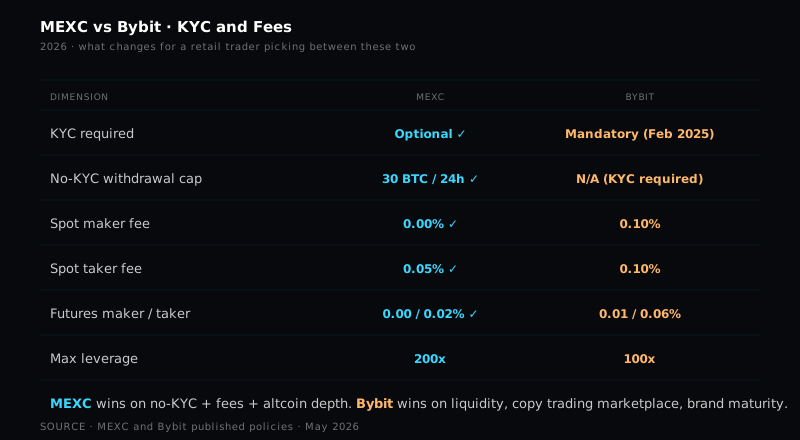
| KYC required for trading | Optional for crypto-only spot and modest futures | Mandatory (post-Feb 2025) |
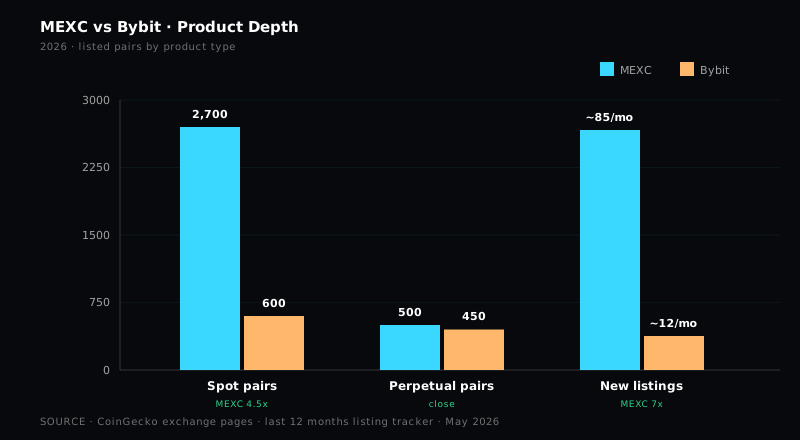
| Spot pairs available | ~2,800 across 1,800+ assets | ~400 |
| Perpetual pairs available | ~700 | ~450 |
| Max futures leverage | 200x on majors | 200x on majors |
| Spot fees (base maker/taker) | 0% / 0.05% | 0.10% / 0.10% |
| Spot with token discount | 0% / 0.04% (MX, 20% off taker) | 0.08% (BIT, 20% off) |
| Futures maker/taker (base) | 0% / 0.02% | 0.02% / 0.055% |
| Futures with token | 0% / 0.016% (MX) | 0.016% / 0.044% (BIT) |
| Copy trading launched | 2022 | 2022 |
| Copy trading lead-trader count | ~3,000-4,000 active | ~15,000 active |
| Options markets | Limited | BTC, ETH (European-style) |
| USDC-margined perpetuals | Limited | Yes, deep liquidity |
| Native token | MX (20% off + M-Day airdrops) | BIT (20% off + Web3/L2 exposure) |
| Proof of reserves | Merkle-tree, quarterly | Merkle-tree, quarterly |
| Recent security event | None at headline scale | Feb 2025 hot wallet ($1.5B, covered) |
| Strategic identity | Listing speed + altcoin breadth | Derivatives + copy trading platform |
Two well-funded exchanges that share founding year and leverage ceiling but otherwise compete on different axes. MEXC chases breadth and accessibility; Bybit chases depth and product surface on derivatives.
Asset coverage
This is where the two platforms diverge most visibly, and it tracks back to a deliberate strategic decision rather than execution quality on either side.
MEXC: breadth as a core thesis
MEXC lists around 2,800 spot trading pairs across more than 1,800 unique assets in 2026, with a listing process that prioritizes speed over rigor. The platform routinely lists new tokens within hours of major launches and remains the first major centralized venue for many low-cap and meme-tier assets. The listing breadth tracks back to MEXC’s strategic identity, which has been defined since 2020 as the venue for traders who need access to the long tail of crypto rather than depth on majors.
Practical implications:
- Early-stage exposure. New token listings often arrive on MEXC before they appear on Binance, Bybit, OKX, or Coinbase. For traders running early-listing strategies, this is a structural advantage.
- Mid-cap rotation. Mid-cap assets that have been listed on MEXC for months may still not be available on Bybit. Rotation strategies that cycle through 50-200 mid-cap names have materially better coverage on MEXC.
- Liquidity caveat. Breadth comes with thinner order books on long-tail listings. The top 100-200 pairs on MEXC have acceptable depth; pairs ranked 500+ may show wider spreads and lower fill quality.
- Listing risk. MEXC’s faster listing cadence also means a higher share of listings end up illiquid, delisted, or associated with rug events. Selection discipline matters more.
Bybit: curation over breadth
Bybit lists around 400 spot trading pairs in 2026, focused on assets with established liquidity, audited token contracts, and a track record of trading interest. The listing process is slower and more selective; many tokens listed on MEXC within hours of launch take weeks or months to arrive on Bybit, if they arrive at all.
Practical implications:
- Curation premium. The probability that a random Bybit listing turns out to be a rug or imminent delist is materially lower than on MEXC.
- Depth on majors. Bybit concentrates liquidity on a smaller universe of pairs, which produces tighter spreads, deeper order books, and better fill quality on the assets it does list.
- Coverage gap on the long tail. If your strategy involves anything outside the top 300-400 assets by market cap, Bybit will leave coverage gaps.
Practical recommendation
For traders whose edge is in the long tail (early-stage listings, low-cap discovery, meme rotation), MEXC has no real peer among major centralized exchanges. For traders whose edge is in the majors and high-liquidity mid-caps, Bybit’s depth and curation produce a cleaner trading experience. The asset-coverage axis tilts based on what you are actually trading, not on which platform is objectively better.
See our MEXC review and Bybit review for the full listing-process breakdown on each.
Fees compared
Headline rates favor MEXC at retail volume. The story changes at active perpetual-trader tier, where execution quality and order book depth start to matter more than headline taker rates.
Spot fees
| Tier | MEXC (no token) | MEXC + MX | Bybit (no token) | Bybit + BIT |
|---|---|---|---|---|
| VIP 0 | 0% / 0.05% | 0% / 0.04% | 0.100% / 0.100% | 0.080% / 0.080% |
| VIP 1 | 0% / 0.04% | 0% / 0.032% | 0.060% / 0.080% | 0.048% / 0.064% |
| VIP 3 | 0% / 0.03% | 0% / 0.024% | 0.040% / 0.060% | 0.032% / 0.048% |
| VIP 5 | 0% / 0.02% | 0% / 0.016% | 0.025% / 0.045% | 0.020% / 0.036% |
MEXC’s maker rate is zero across all tiers, which is the most aggressive standing offer among major centralized exchanges in 2026. The taker rate is also lower than Bybit at every tier. For a spot maker-only strategy, MEXC’s pricing is structurally hard to beat. For a taker-heavy spot strategy, MEXC is still around 50% cheaper than Bybit at retail volume.
Futures fees
| Tier | MEXC (no token) | MEXC + MX | Bybit (no token) | Bybit + BIT |
|---|---|---|---|---|
| VIP 0 | 0% / 0.02% | 0% / 0.016% | 0.020% / 0.055% | 0.016% / 0.044% |
| VIP 1 | 0% / 0.018% | 0% / 0.0144% | 0.015% / 0.045% | 0.012% / 0.036% |
| VIP 3 | 0% / 0.015% | 0% / 0.012% | 0.010% / 0.030% | 0.008% / 0.024% |
| VIP 5 | 0% / 0.012% | 0% / 0.0096% | 0.000% / 0.022% | 0.000% / 0.018% |
MEXC’s futures rates are also the more aggressive headline number, with zero maker fees across all tiers and a taker rate roughly 60-70% lower than Bybit at VIP 0. At the top VIP tier the gap narrows considerably, with Bybit’s market-maker rebate structure pulling the platforms close to parity for high-volume principals.
Worked example: monthly cost at $500K futures taker volume
- MEXC base: $100
- MEXC + MX (20% off): $80
- Bybit base: $275
- Bybit + BIT (20% off): $220
The dollar difference at retail volume is real. A trader running $500K monthly futures-taker volume pays around $175 more per month on Bybit before factoring in execution-quality differences.
When the headline rate is misleading
For active perpetual traders, the headline fee is only one input. Execution quality, slippage, and order book depth matter more in aggregate cost than the explicit fee rate. Bybit’s BTC and ETH perpetual order books typically show 2-4x deeper top-of-book liquidity than MEXC’s, which translates into tighter realized slippage on size. For a $10,000 market-buy on BTC perpetual, the realized cost difference between platforms is often larger than the headline fee gap.
The practical interpretation: on small clip sizes and on long-tail altcoin pairs, MEXC’s fee advantage flows straight to bottom line. On large clips of majors, Bybit’s execution depth can offset and sometimes reverse the headline fee gap.
Withdrawal fees, USDT TRC-20
- MEXC: 1 USDT flat
- Bybit: 1 USDT flat
Identical for the most common withdrawal path. ERC-20 withdrawal fees on both platforms pass through gas with a small platform markup. Neither is materially cheaper on the withdrawal side.
For deeper fee mechanics: MEXC review and Bybit review.
No-KYC posture
This is the single largest practical difference between the two platforms in 2026, and the gap widened after the February 2025 Bybit exploit accelerated compliance investments across the platform.
MEXC: still the most permissive major exchange
MEXC retains one of the most usable no-KYC tiers among major centralized exchanges in 2026. The current structure:
- Unverified accounts. Crypto-only deposits, full spot trading across the 2,800-pair universe, and futures access in most jurisdictions. Daily withdrawal limit is typically around 30 BTC equivalent for unverified users, which covers the realistic activity range for nearly all retail traders.
- Primary KYC. Higher daily withdrawal limits (200 BTC equivalent or more in most regions), fiat on-ramp access through limited partners, and access to specific promotional events.
- Advanced KYC. Institutional features, OTC desk, larger fiat throughput.
The interpretation: in 2026 you can use MEXC for a full crypto-deposit-and-trade workflow without completing identity verification, provided you stay within the unverified withdrawal limit. This is materially more permissive than Bybit, OKX, or Binance.
The standard caveats apply: MEXC has tightened KYC enforcement progressively through the 2024-2026 cycle, sometimes flagging accounts for verification based on activity patterns or jurisdiction signals. The permissive posture is real but not guaranteed indefinitely. See best no-KYC crypto exchanges 2026 for the full cross-platform comparison.
Bybit: mandatory KYC for essentially all functions
Bybit moved to mandatory identity verification for essentially all trading functions globally after the February 2025 hot wallet exploit accelerated compliance investments. The current structure:
- Unverified accounts. Effectively read-only for new sign-ups created after the post-exploit policy change. Trading, deposits, and withdrawals are gated.
- Standard KYC (ID verification). Full spot, futures, and copy trading access. Daily withdrawal limit around 1,000,000 USDT for verified retail accounts.
- Advanced KYC (address verification). Higher withdrawal limits and access to OTC desk, structured products, institutional features.
The practical interpretation: in 2026, you complete Standard KYC to use Bybit for any trading function. There is no meaningful unverified usage path remaining on Bybit, and accounts that pre-date the policy change have largely been migrated to mandatory KYC through forced re-verification cycles.
Practical recommendation
If preserving optionality on KYC is part of your account strategy, MEXC is the clear choice between these two platforms. The gap is wide and unlikely to close in the immediate future, although the broader regulatory trend points to tightening across the industry.
If KYC is not a constraint (you are willing or already required to complete identity verification for other accounts), the no-KYC axis becomes irrelevant to the comparison and the decision should rotate to derivatives depth, copy trading, fees, and execution quality.
Copy trading
Both platforms launched copy trading in 2022, but the products have diverged in depth, marketplace size, and execution quality through the 2023-2026 build cycle.
Bybit copy trading
Bybit’s copy trading product has matured into one of the more sophisticated offerings among centralized exchanges, with around 15,000 active lead traders by 2025 disclosures. Key characteristics:
- Lead-trader filter sophistication. Filters include equity curve, drawdown, win rate, average position duration, asset coverage, and a layered “elite” certification for traders who meet performance and risk-control criteria.
- Default categories. Top Balanced, Top ROI, Top Intra-Day, Top New Talents, Lowest Drawdown, plus a daily picks feed curated by the platform.
- Profit-sharing structure. Standard 10% profit share on positive copy returns by default, paid to the lead trader.
- Minimum copy amount. Typically 10 USDT per position, with some lead traders gating at higher minimums (50-100 USDT).
- Execution quality. Lead-trader orders fill on the same order book as direct retail orders, with copy execution mirrored within seconds of the lead’s fill in most cases. Slippage on copy positions tracks the underlying order book depth.
The Bybit copy trading product sits in the same tier as Bitget’s in terms of feature surface, slightly behind Bitget on marketplace size, and ahead of MEXC on essentially every depth axis. See bybit vs bitget for the head-to-head on copy trading specifically.
MEXC copy trading
MEXC launched its copy trading product later than Bybit and Bitget, and the marketplace remains smaller and less developed. Key characteristics:
- Lead-trader marketplace size. Around 3,000-4,000 active lead traders by 2025 disclosures, roughly one quarter the size of Bybit’s marketplace and around one thirtieth of Bitget’s.
- Filter sophistication. Basic filters for ROI, drawdown, and win rate, with less depth on average position duration, asset coverage, and risk-adjusted performance.
- Profit-sharing structure. Variable, typically 10% but with some lead traders setting custom rates.
- Execution quality. Copy execution occasionally lags during high-volatility sessions, particularly on long-tail altcoin pairs where order book depth is thinner. Direct retail orders on the same pair sometimes fill ahead of copy orders.
The MEXC copy trading product is functional and improving, but it is not the strategic centerpiece for the platform the way it is for Bitget or, secondarily, Bybit. For users whose primary motivation is copy trading, MEXC is a third-tier choice in 2026.
Practical recommendation
For copy trading specifically, Bybit is the better choice between these two platforms. The marketplace is around 4x larger, the filtering tools are more sophisticated, and the execution layer is more mature. See best copy trading platforms 2026 for the cross-platform ranking.
If your strategy is “copy a few lead traders on majors,” Bybit’s marketplace gives you a larger candidate pool and better execution. If your strategy is “copy a long-tail altcoin specialist,” MEXC may have lead traders Bybit does not, but the marketplace depth is thin and selection requires more diligence.
Derivatives execution
This is the axis on which Bybit’s strategic moat is widest, and the gap is structural rather than incremental.
Bybit’s derivatives depth
Bybit’s derivatives surface in 2026 covers spot, USDT-margined perpetuals, USDC-margined perpetuals, inverse perpetuals, BTC and ETH options (European-style), structured products, and a growing suite of trading bots. The product depth tracks back to Bybit’s strategic identity as a derivatives-first venue:
- Order book quality on majors. BTC and ETH perpetual order books on Bybit typically show 2-4x deeper top-of-book liquidity than MEXC, with tighter spreads and lower realized slippage on size. For a $50,000 market order on BTC perpetual, the cost difference often runs 5-15 basis points in Bybit’s favor.
- Options markets. Bybit’s BTC and ETH options markets ship with a Greeks display, implied volatility surface, and structured strategy builder. Among retail-friendly exchanges, only Bybit and Deribit offer this depth of options tooling.
- USDC-margined perpetuals. Bybit was early on USDC margin and has built liquidity to the point where USDC-margined BTC and ETH perpetuals show competitive depth with USDT pairs.
- Structured products. Yield enhancement notes, principal-protected products, and dual-currency products are available through Bybit Earn, with rates generally in the 5-15% APR range depending on product and term.
MEXC’s derivatives surface
MEXC’s derivatives offering covers spot, USDT-margined perpetuals (around 700 pairs), and a more limited futures coverage on the long tail of altcoins. Key characteristics:
- Perpetual breadth. MEXC lists perpetuals on roughly 700 underlying assets, materially more than Bybit’s 450. Long-tail altcoin perpetuals are accessible on MEXC that are not available on Bybit.
- Order book depth. On majors (BTC, ETH, SOL), MEXC’s perpetual order books are functional but thinner than Bybit’s. On mid-cap and long-tail pairs, MEXC’s perpetual depth is often better simply because Bybit does not list the pair.
- Options. Limited compared to Bybit; not a focus product for MEXC.
- Structured products. Available through MEXC Earn with rates broadly similar to Bybit Earn, but the product surface is narrower.
Practical recommendation
For active perpetual traders on majors and high-liquidity mid-caps, Bybit’s execution depth is materially better. The headline fee gap (MEXC is cheaper on rate card) is often offset by Bybit’s tighter spreads and deeper order books at meaningful size.
For traders running perpetual strategies on long-tail altcoins, MEXC may be the only realistic venue. The perpetual coverage on long-tail pairs is a real edge that Bybit does not match.
For options strategies, Bybit is the only practical choice between these two platforms. MEXC’s options surface does not compete on tooling depth.
Security and incident history
Both platforms have survived their respective security stress periods without user fund loss, but the public track records diverge sharply in scale and transparency.
Bybit, February 2025: the largest exchange exploit on record
On February 21, 2025, Bybit’s ETH cold-to-hot wallet transfer process was compromised, with approximately $1.5 billion in ETH and ETH-derivative tokens drained over the course of a single transaction. The attack was publicly attributed to the Lazarus Group, the North Korean state-affiliated threat actor responsible for a string of prior exchange exploits.
Bybit’s response was textbook:
- No suspension of platform-level withdrawals. Users continued withdrawing throughout the incident, an unusually strong signal of liquidity adequacy.
- Insurance fund and operational treasury absorbed the loss. User balances were made whole within hours.
- Public communication cadence. CEO Ben Zhou ran live press briefings, published wallet addresses, and coordinated with on-chain analytics firms to trace the stolen funds.
- Full operational recovery within 7 days. Cold wallet infrastructure was rebuilt and audited externally.
The incident was, in absolute terms, the largest exchange exploit on record. The user-impact outcome was zero loss. The forward-looking interpretation is mixed: Bybit demonstrated reserve adequacy and incident-response quality at extreme scale, but also exposed a hot-wallet attack surface that some competitors had hardened earlier.
MEXC: clean public track record, smaller transparency footprint
MEXC has had no incident at comparable scale through 2026. The platform has dealt with the usual small-scale issues common to high-velocity altcoin venues (occasional listing errors, isolated liquidity events on thin pairs, individual account disputes), but nothing approaching the Bybit February 2025 magnitude.
The transparency footprint is also smaller. MEXC publishes proof of reserves on a roughly quarterly cadence, but the disclosed insurance fund and reserve buffer are smaller in absolute terms than Bybit’s, and the audit detail is less granular. MEXC’s hot-wallet attack surface has not been publicly stress-tested at the scale Bybit’s was.
How to read the security comparison
Two reasonable interpretations:
- Bybit is now battle-tested. The platform absorbed the largest exchange exploit on record without user loss. Reserves and response capability are now publicly proven, and the post-exploit security investments (cold wallet rebuild, external audit, expanded insurance fund) have hardened the surface that was breached.
- MEXC has not been stress-tested at scale. The absence of a major event is informative but not conclusive about resilience. The smaller transparency footprint means external observers have less material with which to assess MEXC’s reserve adequacy.
In practice both platforms publish proof of reserves, both have insurance funds, and both have continued operating through the 2024-2026 cycle without user-level losses. Standard rule applies: withdraw to self-custody anything not actively trading. Treat each as a trading venue, not a long-term custody solution.
For the full incident write-ups: MEXC review and Bybit review.
MX vs BIT token economics
Both platforms offer a native token that drives fee discounts and ecosystem participation. The fee mechanics are roughly equivalent; the non-fee propositions diverge sharply.
MX on MEXC
- Fee discount. 20% off spot and futures fees when MX is held at minimum thresholds in the account. The discount applies to the taker component primarily, since the maker rate is already zero on both spot and futures.
- M-Day daily airdrop. This is the strongest MX-specific differentiator. M-Day is a near-daily airdrop event where MX holders can opt in to receive small allocations of newly listed tokens, structured as a lottery-style distribution among committed holders. Through 2024-2025 cycles, M-Day participation has returned a modest but consistent stream of new-token exposure to active MX holders.
- Listing exposure. MX holders gain priority allocation in Kickstarter and Launchpad-style listing events that occasionally produce outsized returns when a listed asset performs well.
- Yield. MX can be earned through MEXC Earn flexible and locked products, with rates typically in the 3-8% APR range depending on market conditions.
- Buyback and burn. MEXC runs a buyback program that has reduced MX circulating supply progressively since 2022, with quarterly disclosures.
BIT on Bybit
- Fee discount. 20% off spot and perpetual fees when held in account at minimum thresholds. Mechanics functionally equivalent to MX on the discount axis.
- Ecosystem access. Priority allocation in Bybit Launchpad, structured-product slots, and Web3 ecosystem plays. Bybit has been an active investor in Layer 2 and on-chain liquidity protocols, with BIT serving as a partial ecosystem token.
- Yield. BIT can be earned through Bybit Earn flexible and locked products, with rates typically 3-8% APR depending on market conditions.
- Liquidity. Reasonably deep on Bybit itself; thinner on external venues compared to top-20 centralized exchange tokens.
How to pick between the two
For airdrop-focused holders: MX has the stronger native utility. The M-Day program is a structural source of new-token exposure that BIT does not replicate. Active M-Day participants through 2024-2025 cycles often received cumulative airdrop value that compounded materially on top of the headline 20% fee discount.
For ecosystem-breadth holders: BIT has the wider surface. Bybit’s Web3 and Layer 2 ecosystem activity is more substantial, with BIT serving as a partial proxy for that growth.
As pure fee-discount instruments, the two are equivalent. Choose based on whether M-Day airdrop participation (MX) or ecosystem-breadth exposure (BIT) better fits your token-holding thesis.
Token holding adds custodial exposure on top of trading exposure. Holding MX or BIT means trusting the exchange with both your trading capital and your token position. Size accordingly.
Country availability
Both platforms apply geofencing that overlaps but is not identical, and both have tightened jurisdiction posture progressively through the 2024-2026 regulatory cycle.
Hard blocks (no service)
- United States. Both MEXC and Bybit exclude US-based users entirely. No US-licensed product on either side. MEXC applies IP geofencing and blocks US sign-ups; Bybit exited the US market entirely.
- Canada (most provinces). Both have withdrawn or restricted service following Canadian Securities Administrators guidance.
- United Kingdom. Both apply FCA-related restrictions on retail derivatives access. Spot may still be available in limited form.
- Sanctioned jurisdictions. Iran, North Korea, Syria, Cuba, Crimea, and others, on both platforms.
Soft restrictions (limited service)
- European Union under MiCA. Both platforms have applied or are applying for MiCA-compliant entities in select jurisdictions. Some products (perpetual futures, options) face additional gating for EU retail. Verify current status in your specific member state.
- Australia. Both available with some derivative-product restrictions for retail.
- Russian Federation. Both remain accessible. MEXC has applied less aggressive geofencing here than Bybit, consistent with MEXC’s broader permissive posture.
- Turkey, Spain, Indonesia, Brazil. Both available with some product-level restrictions.
Practical workflow
Both platforms list a country availability page in their footer. Check before depositing. VPN workarounds violate terms of service on both sides and risk account closure plus fund freeze on next on-chain or fiat interaction, particularly under the post-2025 Bybit compliance regime where account migration and forced re-verification have already affected accounts flagged for jurisdiction signals.
For US-based users, look at Kraken, Coinbase, Gemini, or CFTC-registered futures venues. Neither MEXC nor Bybit will serve you in unrestricted form in 2026.
Who should pick MEXC
Pick MEXC if at least two of the following apply:
- Your strategy involves long-tail altcoin exposure. MEXC’s around 2,800 spot pairs and 700 perpetual pairs cover the long tail at a depth no other major centralized exchange matches in 2026. For early-listing strategies, mid-cap rotation, or meme-tier participation, MEXC has no real peer.
- No-KYC tolerance is part of your account architecture. MEXC retains one of the most usable permissive tiers among major exchanges, with crypto-only deposit and around 30 BTC equivalent daily withdrawal at the unverified level. Bybit no longer offers this in any meaningful form.
- You participate in M-Day airdrop events. The MX-gated M-Day daily airdrop program is a structural source of new-token exposure that BIT does not replicate. For active token-holders who treat airdrop participation as part of return, MEXC’s native utility is materially better.
- Your spot strategy is maker-heavy. MEXC’s 0% spot maker rate is among the most aggressive standing offers in 2026 and translates into structurally lower cost for liquidity-providing strategies.
- Headline rate matters more than execution depth on majors. For small clip sizes and long-tail pairs, MEXC’s fee advantage flows directly to bottom line without being offset by slippage on majors.
- You want exposure to a more permissive platform with faster listing cadence. MEXC’s strategic identity tilts toward speed and breadth rather than curation and depth.
The mid-tier copy trading product on MEXC is a side feature, not the main attraction. If copy trading is your primary use case, the next section is for you.
Who should pick Bybit
Pick Bybit if at least two of the following apply:
- You run options strategies. Bybit’s BTC and ETH options markets are the only retail-friendly option between these two platforms. If options are part of your workflow, Bybit is the default.
- You trade USDC-margined perpetuals. Bybit was early on USDC margin and has deeper liquidity on this product line than MEXC.
- Copy trading is part of your workflow. Bybit’s marketplace is around 4x larger than MEXC’s (15,000 vs 3,000-4,000 active lead traders), the filters are more sophisticated, and the execution layer is more mature. For any serious copy trading workflow, Bybit is the better choice between these two.
- You run high-volume perpetual strategies on majors. Bybit’s BTC and ETH perpetual order books typically show 2-4x deeper top-of-book liquidity than MEXC, which often offsets the headline fee gap at meaningful size.
- You value the post-2025 security credential. Bybit absorbed the largest exchange exploit on record without user loss, demonstrated reserve adequacy at extreme scale, and rebuilt cold wallet infrastructure with external audit. For users who weight stress-tested resilience, this is a real signal.
- You want a structured-products and options surface in the same account. Spot, USDT and USDC perpetuals, inverse perpetuals, options, structured products, and trading bots all live under one roof.
- 200x leverage availability matters to your strategy. Bybit’s leverage ceiling matches MEXC’s at 200x on majors, with deeper execution behind that leverage.
- You hold or are willing to hold BIT. The 20% fee discount and ecosystem exposure pay back well at active retail volume.
The mid-tier altcoin breadth on Bybit is real but does not compete with MEXC on the long tail. If long-tail altcoin coverage is your primary use case, the previous section is for you.
Verdict and final recommendation
For altcoin breadth, no-KYC tolerance, and headline fee rates in 2026, MEXC is the correct answer. The platform’s around 2,800 spot pairs, permissive unverified tier, 0% spot maker rate, and M-Day airdrop participation produce a usability profile that no other major centralized exchange matches for the long-tail altcoin trader. MEXC is structurally optimized for accessibility and breadth, and the strategic identity has held through the 2024-2026 cycle.
For derivatives depth, options, copy trading, and post-2025 incident-response credibility, Bybit is the correct answer. The platform’s options markets, USDC-margined perpetual liquidity, structured products, copy trading marketplace (around 15,000 active lead traders), and the demonstrated reserve adequacy from the February 2025 exploit response give Bybit the wider product surface and the stronger institutional-grade signal. Bybit is built for traders who prioritize derivatives breadth and copy trading.
Both are reasonably safe for active trading, with Bybit’s February 2025 exploit demonstrating reserve adequacy and incident-response quality at extreme scale, and MEXC operating without a comparable headline event but with a smaller public transparency footprint. Both publish proof of reserves. Both have insurance funds. Standard custody rule applies: withdraw to self-custody anything not actively trading on either platform.
Neither platform serves US users in unrestricted form. For US-based traders, look at Kraken, Coinbase, Gemini, or regulated CFTC futures venues.
The summary: this is one of the cleaner head-to-heads in the exchange landscape because the two platforms occupy genuinely different strategic positions. MEXC went broad on altcoins and permissive on KYC; Bybit went deep on derivatives and built a copy trading marketplace around it. The choice should track use case, not brand intuition or headline fee comparisons.
Open MEXC for altcoin breadth and no-KYC tolerance: review the MEXC review for the full breakdown. Around 2,800 spot pairs, permissive unverified tier, M-Day airdrop participation, 0% spot maker rate.
Open Bybit for derivatives, options, and copy trading: Open Bybit. BTC and ETH options, USDC perpetuals, structured products, around 15,000 active copy trading lead traders, and the post-2025 stress-tested security credential.
See the affiliate disclosure for full detail. The Bybit link above includes partner attribution; the recommendation tracks platform fit rather than link economics.
Read next
- MEXC review 2026. Full feature breakdown and scoring.
- Bybit review. Full feature breakdown and scoring.
- Bybit vs Bitget. Head-to-head if copy trading is the primary axis.
- Best no-KYC crypto exchanges 2026. Cross-platform ranking on permissive onboarding.
- Best copy trading platforms 2026. Cross-platform ranking and methodology.
- Methodology. How we evaluate exchanges.
- Risk disclaimer.
Frequently asked questions
MEXC or Bybit in 2026?
Different jobs. MEXC wins on raw altcoin breadth (around 2,800 spot pairs vs Bybit's 400) and on no-KYC tolerance for crypto-only users. Bybit wins on derivatives depth, options markets, order book liquidity on majors, and the more mature copy trading marketplace (around 15,000 lead traders vs MEXC's 3,000-4,000). Pick MEXC for early-stage altcoin hunting and permissive onboarding; pick Bybit for serious perpetuals, options, and copy trading.
Which has better no-KYC limits?
MEXC, by a wide margin. MEXC remains one of the most permissive major centralized exchanges on KYC, with unverified users able to deposit crypto, trade spot, and withdraw up to around 30 BTC equivalent per day in many jurisdictions through 2026. Bybit moved to mandatory KYC for essentially all trading functions globally after the February 2025 hot wallet exploit accelerated compliance investments. In 2026 you complete ID verification to use Bybit at all.
Which is better for copy trading?
Bybit. Bybit launched copy trading in 2022 and has built it into a core product with roughly 15,000 active lead traders by 2025 disclosures, sophisticated filters, and deep order book liquidity on the perpetuals that lead traders actually trade. MEXC launched its copy trading product more recently and has a smaller marketplace (3,000-4,000 lead traders), thinner filtering tools, and a copy execution layer that occasionally lags behind during volatile sessions. For copy trading specifically, Bybit is the correct choice.
Who has more altcoin pairs?
MEXC, by a factor of roughly 7x. MEXC lists around 2,800 spot pairs across more than 1,800 unique assets, and routinely lists new tokens within hours of major launches. Bybit lists around 400 spot pairs, focused on higher-liquidity assets. If your strategy involves early-stage altcoin exposure, mid-cap rotation, or anything that requires breadth over depth, MEXC has no peer among major centralized exchanges in 2026.
Which has lower fees?
MEXC, slightly. MEXC charges 0% spot maker and 0.05% spot taker as the headline retail rate, with promotional zero-fee spot pairs rotating regularly. Bybit charges 0.10% spot maker/taker at VIP 0 (0.08% with BIT held). On futures, MEXC charges 0% maker and 0.02% taker; Bybit charges 0.02% maker and 0.055% taker. At retail volume MEXC is around 30-60% cheaper per trade. Execution quality on majors evens the comparison out for active traders.
Which is safer in 2026?
Both are reasonably safe for active trading, with the standard custodial caveat. Bybit survived a February 2025 hot wallet exploit of approximately $1.5 billion attributed to the Lazarus Group; user balances were made whole through insurance reserves and operational treasury within hours. MEXC has no comparable headline incident but publishes a smaller proof-of-reserves footprint and less detailed transparency reporting. Bybit is now battle-tested at extreme scale; MEXC has not been stress-tested at that scale publicly.
MX vs BIT, which token is better?
Different propositions. MX provides a 20% fee discount on MEXC plus M-Day daily airdrop participation, which has historically returned a modest but consistent stream of new token distributions to MX holders. BIT provides a 20% fee discount on Bybit plus exposure to Bybit's broader Web3 and Layer 2 ecosystem plays, with optional earn yield in the 3-8% APR range. For airdrop hunters, MX has the better native utility; for ecosystem-breadth exposure, BIT has the wider surface.
Can US users use either?
No. Neither MEXC nor Bybit serves US-based users in unrestricted form in 2026. MEXC blocks US sign-ups and applies IP geofencing; Bybit exited the US market entirely and has no US-licensed product. For US-based traders, look at Kraken, Coinbase, Gemini, or CFTC-registered futures venues. VPN workarounds violate terms of service on both platforms and risk account closure plus fund freeze at the next KYC or fiat interaction.
#MEXC#Bybit#comparison#altcoins#derivatives#MX#BIT
Discussion
Loading comments…