
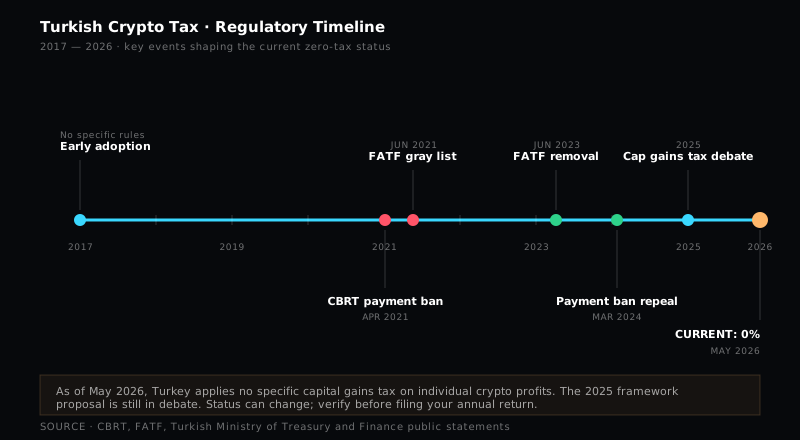
TL;DR: As of May 2026, Turkey does not levy a personal capital gains tax on cryptocurrency held for investment. Income from professional trading is taxable as commercial income (ticari kazanç) under progressive Income Tax Law brackets (15% to 40%). SPK Law No. 7518, effective July 2, 2024, brings crypto asset service providers under Capital Markets Board oversight; domestic platforms (Paribu, BTCTurk, Bitexen, ICRYPEX, Binance TR) submitted license applications during the transition window closing in August 2024. MASAK supervises AML/CFT through reporting institutions (banks, licensed exchanges, payment providers). A crypto tax draft prepared by the Ministry of Treasury and Finance was widely expected to take effect during 2026; the final form, rate structure, and effective date were not confirmed in primary legislation as of this writing. Lira-to-USDT conversions through banks and licensed exchanges are visible to MASAK by default. CBRT Regulation No. 31464 (April 2021) prohibits crypto as a means of payment but permits ownership and trading. Turkish residents using cross-border exchanges (Binance, Bybit, Bitget, OKX, MEXC) face no individual ban, but tax obligations follow residency and the regulatory perimeter has tightened.
Not legal or tax advice. This article summarizes published Turkish legislation as of May 2026, including CBRT Regulation No. 31464 (April 16, 2021), Capital Markets Board Law No. 7518 amendments (July 2, 2024), the Income Tax Law (Law No. 193), the Corporate Tax Law (Law No. 5520), and the AML Law (Law No. 5549) governing MASAK. The legal landscape is changing. A crypto-specific tax framework prepared by the Ministry of Treasury and Finance was under active development through 2025-2026 and may have been enacted after the publication of this article. Interpretive practice varies. Consult a qualified Turkish tax advisor (mali müşavir or yeminli mali müşavir) before filing or relying on any portion of this guide. Read the risk disclaimer before acting on anything here.
Summary table: current status, pending changes, declaration obligations
| Item | 2026 status |
|---|---|
| Capital gains tax on crypto, individuals | None enacted as of May 2026 |
| Professional trading income (ticari kazanç) | Taxable at progressive Income Tax Law rates, 15% to 40% |
| Corporate income tax on crypto businesses | 25% from 2025 onward (Law No. 5520) |
| SPK licensing of crypto service providers | In force since July 2, 2024 (Law No. 7518) |
| Domestic licensed exchanges (in process) | Paribu, BTCTurk, Bitexen, ICRYPEX, Binance TR, others |
| Cross-border exchange access for individuals | Not banned; not actively licensed by SPK |
| Crypto as means of payment | Prohibited under CBRT Regulation No. 31464 (April 16, 2021) |
| Crypto ownership and trading | Permitted for individuals |
| MASAK supervision | AML/CFT reporting via banks and licensed providers |
| Suspicious transaction reporting threshold | Fact-pattern based; no fixed retail trigger |
| Individual MASAK declaration | Not required for routine holdings |
| Mining, individual small-scale | No specific framework; practically untaxed |
| Mining, industrial corporate | Subject to 25% corporate tax; SPK considerations if customer-facing |
| Staking, individual | No specific framework; treatment depends on activity classification |
| Foreign account disclosure | Existing currency control framework may apply at higher balances |
| Pending 2026 crypto tax draft | Not enacted in published legislation as of May 2026 |
| TRY annual inflation, 2024 (TÜİK) | ~44% (down from 64.8% in 2023 peak) |
| TRY annual inflation, 2025 (TÜİK) | ~32% trending lower through year-end |
| Crypto-as-payment penalty | Reversal obligation on service provider; AML exposure on user side |
The table above is the snapshot. The rest of this guide unpacks each row with the underlying legal instrument, the practical implication for individuals, and the open questions where Turkish residents should expect more guidance through 2026.
Risk disclaimer: this landscape is moving
A short, direct statement about scope and uncertainty.
This guide reflects published Turkish law as of May 2026. Three sources of uncertainty apply. First, the Ministry of Treasury and Finance crypto tax draft was under active development through 2025-2026 and was widely expected to take effect during 2026; the article was written before that draft was confirmed as enacted in primary legislation. Second, SPK secondary regulation under Law No. 7518 continued to issue through 2025-2026, with implementation rules for licensed providers refined progressively. Third, MASAK guidance and bank-side reporting practice adapt to crypto-specific patterns on a rolling basis.
For any material position, consult a Turkish tax advisor (mali müşavir for routine accounting and tax filings, or yeminli mali müşavir for certified work and audit defense). The cost of a one-hour consultation is small relative to the cost of an interpretive error on a six-figure lira position. Self-reading of Turkish tax statutes in English translation is not a substitute for advice grounded in current published guidance and interpretive practice at the regional tax office (vergi dairesi) level.
This article does not cover: detailed corporate income tax accounting for crypto businesses, double-tax treaty interpretation for dual-residency cases, specific exchange-by-exchange tax report generation, or audit defense procedure. Each is its own discipline and requires specialist input.
The Turkish regulatory framework
Turkey’s crypto regulatory architecture rests on three pillars built progressively from 2021 through 2024, with one major piece (the tax framework) still awaiting completion.
Pillar 1: CBRT Regulation No. 31464 (April 16, 2021)
The Central Bank of the Republic of Turkey (Türkiye Cumhuriyet Merkez Bankası, TCMB; commonly referenced as CBRT in English) published Regulation No. 31464 in the Official Gazette on April 16, 2021. The regulation banned the use of crypto assets directly or indirectly in payment for goods and services, and prohibited payment service providers and electronic money institutions from facilitating crypto-related payment infrastructure.
Two things matter about the 2021 regulation. First, it did not ban ownership or trading. Turkish residents may freely buy, hold, and sell crypto; the prohibition narrowly targets the use of crypto as a means of payment. Second, the regulation pushed crypto out of the payment-system perimeter, which had downstream consequences for how banks treat crypto-related transactions and for the way crypto businesses structure their banking relationships.
Pillar 2: SPK Law No. 7518 (July 2, 2024)
The most consequential change to the Turkish crypto regulatory framework came with Law No. 7518 “On the Amendment of the Capital Markets Law,” published in the Official Gazette on July 2, 2024 and entering into force on the same date. The law inserted explicit provisions on crypto asset service providers (kripto varlık hizmet sağlayıcıları, KVHS) into the existing Capital Markets Law (Sermaye Piyasası Kanunu, Law No. 6362).
Three core elements of Law No. 7518:
- SPK licensing requirement. Any entity operating as a crypto asset service provider in Turkey, or actively soliciting Turkish customers from abroad, must obtain SPK licensing. The license covers exchange operations, custody, brokerage, and related services.
- Transition window. Existing providers operating in Turkey at the time of the law’s entry into force were given a one-month application window to file initial licensing applications and continue operating under transitional status pending review. The window closed on August 8, 2024.
- Penalty framework. Operating without an SPK license, or providing crypto services in a non-compliant manner, exposes the provider to administrative penalties up to specific lira thresholds, criminal exposure for unauthorized capital markets activity, and shutdown orders. Individual users are not the primary penalty target, but transacting with non-compliant providers may carry collateral AML risk.
Pillar 3: MASAK AML/CFT framework
MASAK, the Mali Suçları Araştırma Kurulu (Financial Crimes Investigation Board), operates under Law No. 5549 “On Prevention of Laundering Proceeds of Crime” and Law No. 6415 “On the Prevention of the Financing of Terrorism.” MASAK is the central financial intelligence unit; it does not collect taxes, and it does not require routine declarations from individual users.
MASAK obligations flow through reporting institutions:
- Banks report suspicious crypto-related transactions, including unusual lira inflows or outflows tied to known exchange addresses or P2P patterns.
- Licensed crypto service providers (post-Law No. 7518) report customer activity under their KYC/AML obligations.
- Payment institutions and electronic money institutions report under the same framework.
Individual users do not file routine MASAK reports. The institutional flow is what closes the visibility gap: a Turkish resident who converts lira to USDT through a domestic licensed exchange has both the bank-side and the exchange-side data captured under MASAK’s perimeter.
The missing pillar: explicit tax framework
The fourth piece, an explicit personal capital gains tax on crypto, has not been enacted as of May 2026. The Ministry of Treasury and Finance has worked on a tax framework since at least 2022, with multiple draft versions discussed publicly through 2024-2025. The pending status leaves Turkish residents with the current ambiguous regime: no capital gains tax on individual investment-style holding, but professional trading income taxed as commercial income under existing Income Tax Law provisions.
For a practical orientation to choosing a platform under the current Turkish regulatory perimeter, see our best crypto exchanges for beginners in 2026 and the how to buy crypto in 2026 walkthrough.
SPK licensing requirements
Law No. 7518 brought a previously unregulated industry into the Capital Markets Board’s perimeter in a single legislative move. The implementation has rolled out across 2024-2026 in distinct phases.
Who must be licensed
The Law applies to crypto asset service providers (KVHS) operating in Turkey or actively soliciting Turkish customers. The definition covers:
- Exchange operators. Centralized order-book platforms facilitating crypto-to-fiat or crypto-to-crypto trading.
- Custodians. Entities holding crypto assets on behalf of customers.
- Brokers. Intermediaries connecting customers with exchange liquidity.
- Issuers and ICO platforms. Entities offering new crypto assets to Turkish residents.
The “active solicitation” element is the gating concept for cross-border platforms. A foreign exchange that does not advertise in Turkish, does not maintain a Turkish-language site, and does not run a Turkish marketing function is generally outside the licensing perimeter even if Turkish residents use it. A foreign exchange that does any of those things may be deemed to operate in Turkey and trigger licensing.
Capital requirements and operational standards
SPK secondary regulation issued through 2024-2025 imposed:
- Minimum capital floors. Specific lira-denominated minimums for licensed exchanges and custodians, with the figures published in SPK communiqués (tebliğler) updated periodically.
- Custody segregation. Customer assets must be held separately from operator assets, with cold-storage thresholds and operational procedures specified.
- Internal controls. Mandatory compliance officers, internal audit functions, IT security frameworks, and reporting infrastructure to MASAK and SPK.
- Disclosure. Public-facing fee disclosures, risk warnings on trading interfaces, and standardized customer agreements.
- Audits. Annual independent audits filed with SPK.
The transition window: August 8, 2024 deadline
Providers operating in Turkey at the time Law No. 7518 took effect had until August 8, 2024 to file initial licensing applications and continue operating under transitional status pending review. Major domestic platforms submitted applications during this window:
- Paribu. Largest domestic exchange by trading volume; applied within the window.
- BTCTurk. Long-established domestic platform; applied.
- Bitexen. Applied.
- ICRYPEX. Applied.
- Binance TR. The local entity of Binance for Turkish operations; applied.
Several smaller domestic platforms either applied, exited the market, or were absorbed during the transition. The full list of applicants and licensed providers is maintained on the SPK website (spk.gov.tr) and updated as license decisions issue.
Cross-border platforms in the SPK perimeter
Cross-border platforms (Binance global, Bybit, Bitget, OKX, MEXC, BingX, KuCoin, others) are widely used by Turkish residents but have not, as a general matter, sought SPK licensing for cross-border solicitation. SPK posture through 2024-2025 emphasized that active marketing in Turkey by unlicensed cross-border providers was outside the perimeter, while individual use by Turkish residents was not the primary enforcement target.
The practical result in 2026: Turkish residents use both domestic licensed platforms and cross-border platforms in parallel. Domestic platforms offer direct lira pairs (BTC/TRY, ETH/TRY, USDT/TRY) with bank-wire on/off-ramps. Cross-border platforms offer deeper liquidity, broader asset selection, and derivatives access not available on domestic venues. The choice depends on user priorities; the tax and reporting implications are discussed in later sections.
For a comparative view of stablecoin options that matter for the lira-USDT relationship discussed below, see USDT vs USDC in 2026.
What’s taxable today
The current Turkish tax treatment of crypto for individuals turns on a single binary classification: is the activity investment-style (yatırım amaçlı) or commercial (ticari)?
No personal capital gains tax on crypto, as of May 2026
The Income Tax Law (Gelir Vergisi Kanunu, Law No. 193) sets out the categories of taxable income for individuals: commercial income (ticari kazanç), agricultural income, salary and wages, self-employed income, real estate income, securities income (menkul sermaye iratları), and other income/gains (sair kazanç ve iratlar). Cryptocurrency held for investment by an individual does not clearly fit into any of these categories under the current statute. The Revenue Administration (Gelir İdaresi Başkanlığı, GİB) has not issued binding guidance treating individual crypto investment gains as taxable under the existing categories.
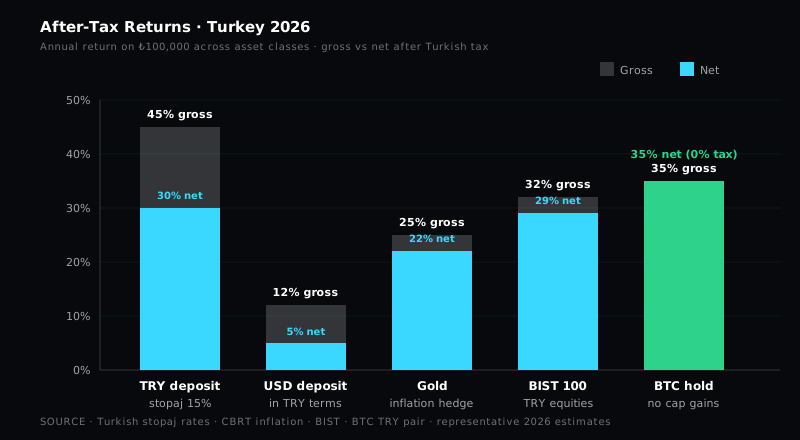
The practical posture as of May 2026: an ordinary individual who buys BTC or ETH, holds for months or years, and sells at a profit faces no clear capital gains tax obligation under published Turkish law. This is not the same as saying “crypto is tax-free in Turkey.” The activity-classification question remains, and the pending tax draft may change the analysis prospectively.
Professional trading: ticari kazanç classification
Income from professional trading is taxable as commercial income under Articles 37 to 51 of the Income Tax Law. The classification is fact-specific and turns on:
- Frequency. A trader executing dozens or hundreds of round-trip trades per day or per week is presumptively commercial in character.
- Volume. Aggregate annual turnover materially above ordinary investment scale points toward commercial classification.
- Organization. Operating through a structured setup (dedicated office, employees, advertising) indicates commercial activity.
- Continuity. Sustained activity over multiple tax years rather than occasional buy-and-sell behavior.
If activity is classified as commercial, the income enters the progressive Income Tax Law tariff. For 2025 income (declared in March 2026), the bands were:
| 2025 income (TRY) | Rate |
|---|---|
| Up to 110,000 | 15% |
| 110,000 to 230,000 | 20% (on excess above 110,000) |
| 230,000 to 870,000 | 27% (on excess above 230,000) |
| 870,000 to 3,000,000 | 35% (on excess above 870,000) |
| Above 3,000,000 | 40% (on excess above 3,000,000) |
Brackets are revaluation-adjusted annually. Commercial income is also subject to provisional tax (geçici vergi) on a quarterly basis, social security contributions (Bağ-Kur for individual entrepreneurs), and potential VAT (KDV) exposure on certain activities.
Corporate crypto activity
Companies operating crypto businesses (exchanges, brokerages, mining operations, advisory firms, market-makers) pay corporate income tax (kurumlar vergisi) at the standard rate of 25% under Law No. 5520, effective January 1, 2025. Crypto-related expenses are generally deductible against crypto revenue: electricity for mining, equipment depreciation, premises, payroll, marketing, professional fees. Withholding tax obligations apply to certain crypto-related payments (royalties, freelance payments to non-resident developers, etc.).
The gray zones
Several activities sit in zones the published statute does not address explicitly:
- Staking rewards for individual holders. The Revenue Administration has not issued guidance treating staking rewards as taxable income for individuals at receipt. In practice, the treatment depends on whether the activity is classified as investment-style or commercial. Routine self-staking by an individual ETH holder, for example, is unlikely to be commercial; running a validator-as-a-service business is.
- Mining for individuals. Small-scale individual mining is similarly under-specified. The pending tax draft may address mining explicitly; until then, the practical treatment for hobby-scale miners has been non-taxation.
- Airdrops. Treatment turns on whether the airdrop is consideration for past activity (potentially commercial in character) or an unconditional grant (more like a gift). Existing Income Tax Law provisions on gifts and other income may apply at higher values; specific advice is essential.
- NFT sales. Investment-style NFT holding and occasional sales sit similarly outside clear tax categorization. Active NFT trading at commercial scale falls under ticari kazanç.
The pending 2026 tax draft
The single most important piece of pending Turkish crypto law is the personal capital gains tax framework drafted by the Ministry of Treasury and Finance (Hazine ve Maliye Bakanlığı).
Background: why a draft has been pending so long
Turkey’s policy posture on crypto evolved from 2020-2021 hostility (the CBRT payment ban, public statements by senior officials against speculative crypto activity) toward a more institutional approach focused on capital markets regulation and tax base expansion. The pending tax framework reflects that pivot: rather than restrict crypto, capture a slice of trading activity through taxation.
Multiple draft versions have circulated since 2022. The Ministry of Treasury and Finance prepared text for inclusion in successive annual fiscal packages, but the framework has been postponed several times due to broader economic-policy considerations (inflation control, currency volatility, capital control concerns) and to the practical challenge of designing rules that work across both domestic licensed platforms and cross-border platforms.
Two proposal types discussed publicly through 2024-2025
Public reporting (Anadolu Agency, Bloomberg HT, Dünya Gazetesi, Hürriyet, T24) identified two main proposal types:
- Transaction tax. A low-rate per-transaction levy applied to crypto trades on licensed platforms. Specific figures discussed publicly included 0.03% per transaction (matching the rate applied to certain securities transactions under existing Turkish stamp tax / banking and insurance transaction tax frameworks). The mechanism would be collected at source by licensed exchanges, simplifying compliance for individual traders but generating a smaller tax base than capital gains taxation.
- Capital gains tax. A progressive capital gains framework mirroring the Income Tax Law tariff, with exemption thresholds and possibly preferential rates for long-held positions. The mechanism would require individual annual filing on a Schedule analogous to securities-income reporting in the existing income tax declaration.
Hybrid proposals combining a low transaction tax with selective capital gains treatment for high-frequency or commercial traders were also discussed. The final design as of May 2026 was not confirmed in primary legislative documents.
Expected effective date and grandfathering
Public reporting through late 2025 indicated that the framework was being finalized for inclusion in a broader fiscal package, with expectations that enactment would occur during 2026. Specific dates were not confirmed in primary legislation at the time of this writing.
Grandfathering treatment for existing positions is one of the more important practical questions. Three possibilities:
- Forward-only application. Positions held at the effective date are not retroactively taxed; gains accrued before that date are exempt; gains realized after that date face the new rate.
- Mark-to-market at effective date. Positions are deemed acquired at fair market value on the effective date, eliminating pre-existing unrealized gains from the tax base.
- Full historical application. Gains realized after the effective date are taxed using historical cost basis, capturing pre-existing unrealized gains. This is the harshest treatment and the least likely outcome based on stated policy preferences.
The mark-to-market mechanism is the most consistent with stated policy intent (capturing prospective trading activity without penalizing legacy holders). The forward-only mechanism is also plausible. Specific implementation will be visible in the final enacted text.
What changes if the draft passes
The most material change for individuals: a clear obligation to declare crypto income on an annual basis and to maintain cost-basis records. The current ambiguous regime allows individuals to leave investment-style holdings off any tax filing; a future framework will likely require:
- Maintenance of acquisition records (date, lira-equivalent cost, exchange or counterparty).
- Maintenance of disposal records (date, lira-equivalent proceeds, exchange or counterparty).
- Annual reporting either through the income tax declaration or through a parallel filing channel.
- Cost basis methodology (FIFO is the most common choice internationally and is likely if the framework follows mainstream design).
Preparing for these obligations now (regardless of when the framework takes effect) is the practical recommendation. Section 11 of this guide covers practical preparation in detail.
MASAK reporting and AML
MASAK supervision is the most active piece of the Turkish crypto regulatory perimeter for individuals, even though individuals themselves are not the direct filers.
How the institutional reporting flow works
The MASAK reporting framework operates through reporting institutions (yükümlüler), not directly through individuals. Reporting institutions include:
- Banks. All Turkish banks subject to Banking Law No. 5411.
- Licensed crypto service providers. Post-Law No. 7518 KVHS licensed by SPK.
- Payment institutions and electronic money institutions. Regulated under Law No. 6493.
- Securities intermediaries, insurance companies, certain professionals. Standard AML perimeter.
Each reporting institution operates under three core obligations:
- Know Your Customer (KYC). Identity verification, beneficial ownership identification, ongoing due diligence.
- Suspicious transaction reporting (STR). Filing of şüpheli işlem bildirimleri to MASAK when transactions exceed pattern-based thresholds or display anomalous characteristics.
- Record retention. Customer identification and transaction records retained for at least 8 years under existing AML/CFT regulation.
What triggers a suspicious transaction report
There is no fixed lira threshold for crypto-specific STR triggers. The reporting is pattern-based, applied by the institution’s internal compliance function. Common triggers include:
- Recurring lira inflows or outflows tied to known exchange-associated bank account numbers.
- Cash deposits followed by immediate transfers to crypto exchange accounts.
- Round-number transfers above ordinary household activity scale (the practical sense of “ordinary” varies by bank and by region).
- Transfers from third-party accounts to crypto exchange accounts (potential nominee or pass-through patterns).
- Cross-border flows to high-risk jurisdictions tied to crypto exchange identifiers.
The institution files the STR; MASAK then aggregates, analyzes, and shares with law enforcement, tax authorities, and other competent bodies as appropriate. The individual user is not informed that an STR was filed; this is by statutory design.
Practical visibility of lira-to-crypto activity
For a Turkish resident using a domestic licensed exchange (Paribu, BTCTurk, Bitexen, ICRYPEX, Binance TR), the lira-to-crypto and crypto-to-lira flows are visible to MASAK through both legs: bank wire reporting and licensed exchange KYC/AML reporting. For cross-border exchanges, the bank-side leg is visible; the exchange-side leg is visible only through bilateral information cooperation, which for crypto-specific data has been less standardized than for traditional banking.
P2P channels (over-the-counter trades organized via Telegram, WhatsApp, or direct messaging) reduce direct visibility on the exchange side but introduce additional risks: counterparty risk, potential AML-perimeter classification, and (in the worst case) inadvertent participation in flows that touch criminal proceeds. Banks have become increasingly sensitive to P2P-pattern lira flows; routine cash deposits paired with crypto-exchange transfers are a known STR trigger.
What individuals should know
Three practical points:
- Routine MASAK declarations are not an individual obligation. Individual users do not file routine MASAK forms.
- Bank-side visibility is high. Domestic licensed crypto activity through Turkish bank wires is visible to MASAK by default.
- Suspicious-pattern thresholds are not public. Banks adjust their internal triggers; there is no published lira number above which an inflow is automatically flagged.
The takeaway: structure crypto activity through domestic licensed channels for compliance simplicity, and assume bank-side visibility for any flow that touches a Turkish bank account.
Lira-USDT specifically
The lira-USDT relationship is the defining feature of Turkish crypto activity at retail scale, and it sits at the intersection of inflation hedging, capital control framework, and tax/AML disclosure.
Why USDT matters in Turkey
Turkey has experienced material currency volatility since 2018, with three significant episodes of lira depreciation against the dollar:
- 2018 currency crisis. Lira fell from ~3.8 TRY/USD at the start of the year to a peak above 7 TRY/USD by August 2018, recovering modestly thereafter.
- 2021-2022 currency crisis. Lira fell from ~7 TRY/USD in early 2021 to above 18 TRY/USD by December 2021, continuing to depreciate through 2022.
- 2023-2024 continued depreciation. Lira tested 35+ TRY/USD through 2024 before stabilizing modestly in 2025.
Cumulative TÜİK consumer price inflation through this period peaked at 64.8% on a 12-month basis in late 2023, moderating to approximately 44% in 2024 and trending toward 32% through 2025. Real interest rates remained negative for much of the period, leaving households searching for inflation-resistant savings instruments.
USDT (and to a lesser extent USDC and other dollar-pegged stablecoins) has become the dominant “savings dollar” for retail savers, alongside traditional channels (gold, foreign currency deposits, real estate). The USDT use case is straightforward: hold a dollar-equivalent asset in a self-custody wallet or a domestic exchange account, convert back to lira when needed for spending.
Reporting treatment of lira-to-USDT conversion
Under the current ambiguous regime, lira-to-USDT conversion by an individual investor is not directly a taxable event. USDT held as an investment-style position by an individual sits in the same uncategorized zone as BTC or ETH: no explicit capital gains framework applies. Conversion back to lira on later redemption similarly does not generate a clear tax obligation under existing statute (absent professional trading classification).
The reporting visibility, however, is high:
- Bank wire to domestic exchange. Visible to MASAK through bank reporting.
- Lira deposit to exchange account. Visible through exchange KYC.
- USDT purchase on domestic exchange. Recorded in licensed exchange transaction logs.
- Withdrawal of USDT to self-custody wallet. Recorded on the exchange side; on-chain trail begins from the withdrawal address.
- Later return of USDT to exchange and conversion to lira. Visible at both legs.
The lira-USDT pair on domestic exchanges typically prices at a slight premium to the global USDT-USD parity, reflecting the local supply/demand imbalance: Turkish residents are net buyers of dollar exposure, and the premium widens during episodes of lira weakness.
Capital control implications
Turkey’s foreign currency regulatory framework places certain restrictions on cross-border foreign currency movements, with the focus historically on commercial and large-balance flows rather than retail savings activity. Residents have been permitted to hold foreign currency deposits at Turkish banks and to maintain foreign currency accounts; restrictions tend to apply to commercial transactions, real estate purchases, and outbound investment.
For crypto specifically:
- No specific lira-to-stablecoin conversion limit has been published for individual retail conversions through licensed venues.
- Cross-border outflows of crypto to foreign exchanges are not directly restricted, but the AML/CFT reporting framework applies.
- Larger commercial-scale flows may trigger Banking Regulation and Supervision Agency (BDDK) or CBRT review under existing currency control provisions.
The retail savings posture is essentially permissive at the individual scale. The commercial and high-balance posture is more cautious; consult a mali müşavir before structuring crypto-denominated savings above ordinary household levels.
The forward question: what changes under the new tax draft
If the pending tax draft introduces a capital gains tax with FIFO cost-basis tracking, the lira-to-USDT-to-lira round trip becomes a tracked event sequence. Even if the round-trip is a wash in dollar terms, the lira depreciation between the buy and sell legs can create a lira-denominated gain that is taxable under a strict reading of the new framework. This is a known tension internationally (the “synthetic dollar exposure” problem for high-inflation jurisdictions) and is one of the design points the Ministry of Treasury and Finance is reportedly considering in finalizing the draft.
Stablecoin treatment under the new framework remains an open question. Pure-dollar-peg stablecoins might be carved out (preserving the savings-dollar use case) or might be treated identically to volatile crypto (capturing the lira-depreciation gain). The final design will be visible in the enacted text.
Mining and staking specifics
Crypto mining and staking sit in the most under-specified part of the current Turkish framework. Industrial activity is reasonably clear; small-scale individual activity is effectively unregulated.
Mining: no specific framework
There is no Turkish equivalent to Russia’s Federal Law 221-FZ industrial mining registry. Mining activity in Turkey is not separately licensed and is not subject to a kWh-based threshold for individual versus commercial classification.
Practical treatment as of May 2026:
- Small-scale individual mining. A handful of ASICs or a modest GPU rig operated at home by an individual is effectively untaxed. The Revenue Administration has not issued guidance treating hobby-scale mining as taxable income, and the practical posture has been non-enforcement at this scale.
- Mid-scale individual mining. Larger setups operated by individuals (dozens of ASICs, dedicated mining premises, structured electricity contracts) may face classification as commercial activity (ticari kazanç) on the same fact-pattern analysis as professional trading. Income would then be taxable at progressive Income Tax Law rates.
- Industrial mining through a legal entity. Commercial mining operations structured as a Limited Şirket (LTD) or Anonim Şirket (AŞ) pay corporate income tax at 25% on net mining income, with electricity, equipment depreciation, premises, and operational expenses deductible.
The electricity-cost dimension is structurally important for Turkish mining. Residential electricity tariffs in Turkey have risen materially since 2021 alongside lira depreciation and energy-cost inflation. The economics of bitcoin mining at residential rates are typically marginal; industrial-tariff access through commercial sites is the differentiator for sustainable mining operations.
Mining and SPK considerations
A mining operation that simply produces coins for the operator’s own account is a productive activity outside the SPK perimeter. A mining operation that takes customer deposits, offers cloud mining contracts to third parties, or provides custody services to other miners potentially crosses into KVHS territory and may require SPK licensing under Law No. 7518.
Staking: even less specific
Staking treatment is under-specified for individuals. Three sub-cases:
- Self-custody staking. An individual who runs their own validator (Ethereum, Cardano, Solana) or who participates in liquid staking (Lido, Rocket Pool) generates rewards that arguably fit “other income” categories under the Income Tax Law, but the Revenue Administration has not published guidance binding for individual filers. Practical treatment in 2026 has been non-enforcement for routine staking by individual holders.
- Exchange staking products. Bybit Earn, Binance Earn, Bitget Earn, OKX Earn, KuCoin Earn (and domestic licensed exchange equivalents where offered) generate staking rewards or yield-product income for users. Treatment is similar to self-custody staking under current framework; the licensed exchange may have reporting obligations under SPK secondary regulation if and as those rules expand.
- DeFi yield farming. Active DeFi participation (Aave, Compound, Curve, Yearn, Lido alternatives) generates yield in the form of token rewards or interest. Treatment depends on classification; high-activity DeFi participation may be characterized as commercial.
The pending draft’s likely impact
The pending tax draft is widely expected to address mining and staking. The most likely design borrows from international practice: mining and staking proceeds taxed at fair market value at the moment of receipt as ordinary income, with subsequent sale of the received coins generating a separate capital gain or loss event based on the receipt-day value as cost basis. This is the OECD-standard treatment and the most common design in jurisdictions that have enacted crypto-specific tax law.
If that design is adopted, individuals with non-trivial mining or staking activity should expect to maintain receipt-by-receipt records of date, quantity, and lira-equivalent fair market value at receipt. Section 11 covers practical preparation.
Foreign exchange usage
Cross-border exchange use is the elephant in the Turkish crypto room. Most active Turkish traders use a combination of domestic licensed platforms (for lira on/off-ramp) and cross-border platforms (for liquidity, asset selection, and derivatives). The regulatory and tax implications are nuanced.
Which cross-border exchanges Turkish users actually use
Public usage data, transaction volumes on Turkish-language community channels, and aggregate exchange traffic analytics through 2025 indicate that the most-used cross-border platforms for Turkish users are:
- Binance. Both the global platform and the local Binance TR entity; the global platform offers deeper liquidity and broader asset selection.
- Bybit. Particularly active among Turkish derivatives traders; lira P2P market is one of the most liquid for the platform.
- Bitget. Significant Turkish user base, especially for copy trading and futures.
- OKX. Active user base for spot and derivatives.
- MEXC. Long-tail altcoin access; some no-KYC functionality for smaller amounts.
- BingX. Copy trading focus; growing Turkish presence.
- KuCoin. Long-tail altcoin and earn products.
The SPK perimeter for cross-border use
Law No. 7518 regulates service providers operating in Turkey or actively soliciting Turkish customers. Individual use of a cross-border platform by a Turkish resident is not directly prohibited by the law; the perimeter targets the provider side, not the user side.
However, three practical points constrain cross-border use:
- Active solicitation by cross-border platforms is restricted. Foreign exchanges that maintain Turkish-language sites, run Turkish ad campaigns, or operate Turkish customer service functions may be deemed to operate in Turkey and trigger SPK enforcement.
- Lira on/off-ramps remain bank-MASAK-visible. Whether you use a domestic licensed exchange or a cross-border platform, the lira-side flow through Turkish banks is captured under MASAK reporting.
- Platform-level Turkish-resident restrictions. Some cross-border platforms restrict certain product features (futures, leverage, specific token listings) for users identified as Turkish residents under their internal AML/risk programs. These restrictions are platform-specific and shift over time.
Tax obligation: residency-based
Tax obligations under Turkish income tax and corporate income tax follow tax residency, not the licensing jurisdiction of the exchange. A Turkish tax resident with crypto income is, in principle, subject to Turkish tax rules on that income regardless of which platform generated it. Under the current ambiguous regime, individual investment-style crypto activity falls outside clear taxation; professional trading income remains taxable as ticari kazanç whether the platform is domestic licensed or cross-border.
If the pending tax draft introduces a capital gains framework, the residency-based approach will extend more clearly to cross-border activity. The compliance question becomes data: how does a Turkish individual provide cost-basis and proceeds data from a cross-border exchange that does not provide Turkish tax statements?
The answer is the same as in other jurisdictions facing this question. The taxpayer is responsible for reconstructing transaction history from exchange CSV exports, converting to lira at transaction-date rates, and computing tax obligations under the applicable cost-basis method (FIFO is the international default).
Foreign account disclosure and the currency control perimeter
The existing Turkish currency control framework, layered through CBRT and BDDK regulation alongside the Tax Procedure Law, has historically focused on commercial-scale foreign currency flows. Specific obligations to disclose foreign exchange accounts exist for certain categories of residents and certain types of accounts; for individual retail holdings on cross-border crypto exchanges, the practical posture in 2026 is that routine disclosure is not required, but high-balance positions may approach reporting thresholds depending on facts.
This is one of the points where Turkish residents materially benefit from professional advice. The cost of an hour with a mali müşavir to confirm whether your specific position triggers any existing reporting obligation is small relative to the cost of a missed disclosure on a material position.
What to do if the 2026 tax draft passes
Practical preparation for a framework that has not yet been enacted but is expected during 2026.
Why preparation matters now
If the framework takes effect during 2026, residents face several immediate questions:
- What cost basis applies to positions held at the effective date?
- What transaction history is needed for going-forward reporting?
- How does treatment differ between domestic licensed exchanges and cross-border platforms?
- What is the first declaration deadline?
Building the underlying record-keeping infrastructure now means that whichever specific design is enacted, you have the data ready. Reconstruction from CSV exports nine or twelve months after the fact is materially harder than real-time logging.
Action 1: pull complete transaction history
For every exchange you have used in 2024-2026, pull complete transaction history CSVs. Include:
- All buy and sell transactions on centralized exchanges.
- All crypto-to-crypto swaps.
- All P2P trades with lira-equivalent and crypto-equivalent legs.
- All deposits and withdrawals (timestamps and addresses).
- Any staking, lending, or DeFi yield receipts.
- Any mining proceeds.
- Any airdrops or hard fork tokens received.
Store these CSVs in a structured location with backup. Exchange data export functionality changes over time, and access to historical periods can become more limited as exchanges update systems.
Action 2: calculate cost basis in lira
For every existing position, compute the lira-equivalent acquisition cost at the original transaction date. The basic methodology:
- For lira purchases, the lira amount paid is the cost basis directly.
- For foreign-currency or stablecoin purchases, convert to lira at the CBRT official rate (or a recognized public rate) for the acquisition date.
- For crypto-to-crypto swaps, the fair market value in lira of the asset received at the trade moment is the new cost basis; the disposal of the asset traded away generates a notional gain or loss against its prior cost basis.
This is FIFO methodology and is the most common international standard. The new Turkish framework may specify a different methodology; FIFO is the safer default for now.
Action 3: maintain real-time logging going forward
From May 2026 onward, log every transaction in real time. The minimum data set per transaction:
- Date and time (with timezone).
- Exchange or counterparty.
- Asset.
- Quantity.
- Price in lira (using CBRT or recognized rate for the date).
- Transaction hash or exchange order ID.
- Notes (e.g., “buy,” “sell,” “swap into ETH,” “P2P lira inflow”).
A spreadsheet works for moderate transaction volume. Third-party tax tools (Koinly, CoinTracker, CoinLedger, others) can automate FIFO calculation across exchanges, with the caveat that no tool is specifically optimized for Turkish tax rules yet.
Action 4: separate investment activity from any commercial activity
If your crypto activity might cross the commercial-activity threshold under the existing ticari kazanç framework, separate it from investment-style activity now. This means:
- Different accounts or sub-accounts on the same exchange.
- Different cost-basis tracking workflows.
- Different professional advice (an accountant familiar with both income tax and the practicalities of crypto trader filings).
The classification question becomes more acute under any new framework, and clean separation simplifies the eventual filing.
Action 5: engage a mali müşavir for any material position
The most valuable single action: identify a Turkish tax advisor (mali müşavir, or yeminli mali müşavir for certified work) familiar with crypto issues, and schedule a baseline consultation. The cost is modest (typically a few thousand lira for a one-hour to two-hour session in 2026 terms); the value is high. The advisor will tell you:
- Whether your current activity has any classification risk under existing rules.
- What record-keeping the advisor would expect to see for any new framework.
- What the advisor’s read is on the pending tax draft based on current public reporting and professional network signals.
- What pre-emptive actions (entity restructuring, position rationalization, documentation upgrades) would be appropriate before the new framework takes effect.
The Turkish tax-advisor profession is well-developed and crypto-specific expertise has grown materially since 2022. Asking around in your local Chamber of Certified Public Accountants of Turkey (TÜRMOB) network or through professional contacts will identify qualified candidates.
Action 6: budget for the new compliance load
If a tax framework takes effect, the going-forward compliance load includes annual declaration preparation, potential provisional tax payments (if commercial classification applies), record-keeping discipline, and potential audit response capacity. Budget for both the direct cost (professional fees, software subscriptions) and the time cost (transaction logging, declaration preparation).
For an editorial view on how we approach tax and exchange comparisons across jurisdictions, see the methodology page. For the trading-cost baseline against which any new tax framework would apply, the fees calculator sets the comparison.
Bottom line
Turkey’s crypto framework in May 2026 is in transition. Three pieces are clear: ownership and trading are permitted, payment use is prohibited under CBRT Regulation No. 31464 (April 16, 2021), and SPK has explicit licensing oversight of crypto asset service providers since Law No. 7518 (July 2, 2024). MASAK supervises AML/CFT through banks and licensed providers; individuals are not the direct filers but the institutional reporting flow makes lira-on-ramp activity visible by default.
The personal tax piece is the open question. As of this writing, there is no enacted capital gains tax on cryptocurrency for individual investors. Professional trading income remains taxable as ticari kazanç under the existing Income Tax Law at progressive rates from 15% to 40%. Mining and staking sit in an under-specified zone, with small-scale individual activity effectively untaxed in practice. A Ministry of Treasury and Finance draft was widely expected to take effect during 2026, but the final form was not confirmed in primary legislation at publication. The lira-USDT relationship is the dominant retail use case; conversions through banks and licensed exchanges are MASAK-visible by default.
The practical recommendation for Turkish residents with material crypto activity: build cost-basis records now, separate any potentially commercial-character activity from investment-style holdings, engage a mali müşavir for baseline consultation, and assume that the regulatory perimeter will tighten further during 2026-2027. The current ambiguity is a temporary feature, not a stable end state. Compare exchange fee structures with the fees calculator as a starting point for understanding net position; tax obligations under whatever framework finally enacts will apply on top.
One closing reminder. This guide reflects published Turkish legislation as of May 2026, including CBRT Regulation No. 31464, SPK Law No. 7518, the Income Tax Law, the Corporate Tax Law, and the MASAK framework. The pending tax draft was not enacted as of writing. Verify current published rules with a qualified Turkish tax advisor before filing or relying on this article for any decision with financial consequence. Read the risk disclaimer before acting on anything here.
Read next
- Best crypto exchanges for beginners in 2026. Platform selection for Turkish residents starting out under the post-Law-7518 framework.
- USDT vs USDC in 2026. Stablecoin choice analysis directly relevant to the lira-savings use case.
- How to buy crypto in 2026. On-ramp landscape and what each path means for MASAK visibility.
- Exchange fees calculator. Compare trading costs across major platforms; baseline for net-position planning under any future tax framework.
- Methodology. How we research and rank exchanges, tax frameworks, and platform recommendations.
- Risk disclaimer.
Frequently asked questions
Are crypto profits taxed in Turkey in 2026?
Not as capital gains for ordinary individual investors. As of May 2026, Turkey has not enacted a personal capital gains tax on cryptocurrency held for investment. However, income from professional trading (classified as ticari kazanç, commercial income) is taxable under the Income Tax Law (Gelir Vergisi Kanunu) at progressive rates from 15% to 40%. Mining and staking sit in an under-specified zone, with small-scale individual activity effectively untaxed in practice. A draft tax framework prepared by the Ministry of Treasury and Finance is widely expected to take effect in 2026, but the final form and effective date were not confirmed in published legislation as of this writing. Consult a Turkish tax advisor (mali müşavir) before relying on the absence of a capital gains tax for any material position.
What's the current legal status of crypto in Turkey?
Crypto is legal to own and trade but cannot be used as payment for goods or services. The Central Bank of the Republic of Turkey (CBRT) issued Regulation No. 31464 in April 2021 banning the use of crypto as a means of payment, while leaving ownership and exchange-based trading permitted. The Capital Markets Board (Sermaye Piyasası Kurulu, SPK) gained explicit oversight of crypto asset service providers through Law No. 7518, published in the Official Gazette on July 2, 2024 and effective immediately, with licensing implementation rolling through 2025. MASAK (Mali Suçları Araştırma Kurulu, the Financial Crimes Investigation Board) supervises AML/CFT compliance across all crypto platforms serving Turkish users.
Does SPK regulate crypto exchanges in Turkey?
Yes. Since Law No. 7518 took effect on July 2, 2024, the Capital Markets Board (SPK) is the primary regulator for crypto asset service providers (kripto varlık hizmet sağlayıcıları, KVHS) operating in Turkey or serving Turkish residents. Domestic exchanges such as Paribu, BTCTurk, Bitexen, ICRYPEX, and Binance TR submitted license applications during the transition window that closed in August 2024. SPK published secondary regulation through 2025 covering capital requirements, custody segregation, internal controls, and reporting obligations. Cross-border platforms (Binance, Bybit, Bitget, OKX, MEXC, BingX) are not licensed under Law No. 7518 but remain accessible to Turkish users; SPK guidance has been that unlicensed cross-border solicitation is restricted while individual use is not directly prohibited.
Do I need to declare USDT holdings to MASAK?
Individuals are not required to file routine USDT declarations to MASAK. MASAK is a regulator and intelligence body, not a tax authority, and the reporting obligations flow from regulated institutions (banks, licensed exchanges, payment service providers) to MASAK rather than from individual users. Turkish banks file suspicious transaction reports (STRs) for crypto-related fiat flows that meet specific patterns, and licensed crypto service providers report customer activity under their AML obligations. The practical implication for individuals is that lira-to-USDT conversions through Turkish banks and licensed exchanges are visible to MASAK by default; off-bank P2P channels reduce direct visibility but introduce other risks discussed later in this guide.
What about professional crypto trading income?
Professional trading income is taxable as ticari kazanç (commercial income) under Articles 37 to 51 of the Income Tax Law. The classification turns on facts: frequency, volume, organizational character, and continuity of trading activity. A person executing thousands of trades per year, advertising trading services, or operating through a structured setup will likely qualify as a professional trader regardless of self-description. Professional income enters the progressive tariff (15%, 20%, 27%, 35%, 40% across bands for 2025 income, with the top band reached around 3.2 million lira), is reported on an annual income tax declaration (yıllık gelir vergisi beyannamesi), and may carry social security and provisional tax obligations. The classification threshold is fact-specific; consult a mali müşavir.
Is mining taxed in Turkey?
There is no specific mining tax framework as of May 2026. Small-scale individual mining is effectively untaxed in practice; the Revenue Administration (Gelir İdaresi Başkanlığı) has not published guidance treating individual hobby mining as a taxable activity, and there is no industrial mining registry comparable to Russia's Federal Law 221-FZ regime. Commercial-scale mining operated through a legal entity falls under corporate income tax (kurumlar vergisi) at 25% from 2025 onward, with mining-related expenses (electricity, equipment depreciation, premises) deductible. Such operations may require SPK registration if the mined coins are then offered to third parties through a custody or exchange function. The pending 2026 tax draft may address mining explicitly; check current published rules before scaling capacity.
What's the rumored crypto tax draft for 2026?
The Ministry of Treasury and Finance has worked on a crypto tax framework since 2022, with multiple draft versions circulated in 2024 and 2025. Public reporting through late 2025 referenced two main proposals: a low-rate transaction tax (figures around 0.03% per transaction were discussed) and a capital gains tax with progressive brackets mirroring the income tax tariff. Neither version was enacted as of May 2026, and the final design, effective date, and grandfathering treatment for existing positions remain open. Turkish business press (Anadolu Agency, Bloomberg HT, Dünya Gazetesi) reported through 2025 that the framework was being finalized for inclusion in a broader fiscal package, but specific timing was not confirmed in primary legislative documents at the time of this writing.
What happens if I trade on Binance or Bybit from Turkey?
Cross-border exchange use is widely practiced and is not directly prohibited for individuals. SPK Law No. 7518 regulates service providers operating in Turkey or actively soliciting Turkish customers; it does not criminalize individual use of foreign-licensed platforms. However, three practical points apply. First, lira on/off-ramps through Turkish banks remain MASAK-monitored regardless of which exchange you use. Second, tax obligations under Turkish income tax law follow tax residency, so professional trading income is taxable wherever the exchange is licensed. Third, foreign account disclosure rules under existing currency control framework may apply to large balances; consult a mali müşavir for specifics. The risk-disclaimer baseline is that cross-border use carries platform-availability risk if SPK posture tightens further.
#taxes#Turkey#regulation#SPK#MASAK#lira#USDT
Discussion
Loading comments…