
TL;DR: USDC wins on regulatory clarity, reserve transparency, and EU access under MiCA. USDT wins on raw liquidity, network reach, and offshore-exchange dominance. Both have held the peg through major stress events. Both can freeze user tokens. USDT market cap ($130B in 2026) is more than triple USDC’s ($40B), but USDC has the cleaner audit trail and the only MiCA license among major dollar stablecoins. For US-resident or EU-resident users, USDC is the practical default. For offshore active trading, USDT is the liquidity standard. Neither is censorship-resistant. For decentralized exposure, look at DAI or non-stable assets.
Not financial advice. Stablecoins are not risk-free. USDC briefly broke peg to $0.87 on March 11, 2023 during the Silicon Valley Bank collapse, before restoring within 72 hours after Circle’s $3.3 billion bank balance was made whole. USDT briefly traded at $0.95 in May 2022 during the Terra/UST collapse, before recovering within days. TerraUSD (UST) collapsed entirely in May 2022 from $1.00 to fractions of a cent and never recovered, illustrating that algorithmic stablecoins are a fundamentally different product from collateralized ones like USDT and USDC. Both Tether and Circle apply geofencing and compliance-driven freezes that can change without notice. Read the risk disclaimer before treating either as cash-equivalent.
At a glance
| Factor | USDT (Tether) | USDC (Circle) |
|---|---|---|
| Issuer | Tether Limited | Circle Internet Financial |
| Founded | 2014 | 2018 |
| Headquarters | British Virgin Islands, operational hub in Switzerland | Boston, US, with Circle Mint France for EU |
| Market cap (2026) | ~$130 billion | ~$40 billion |
| Reserves model | Treasuries, repos, cash, gold, Bitcoin, secured loans, corporate paper | ~80% short-dated Treasuries, ~20% cash at regulated banks |
| Audit / attestation | Quarterly assurance, BDO Italia | Monthly attestation, Deloitte |
| Public reserves dashboard | Real-time, asset-class detail | Weekly, asset-class plus custodian detail |
| MiCA-compliant in EU | No | Yes (Circle Mint France EMI) |
| NYDFS regulated | No | Yes (Circle holds NY BitLicense) |
| Native networks count | ~14 (mostly bridged) | ~15+ (CCTP native) |
| Dominant network by volume | Tron | Ethereum, Solana, Base |
| Tokens frozen (cumulative) | ~$2.5B across ~2,500 addresses | ~$300M across ~200 addresses |
| OFAC compliance posture | Cooperative | Cooperative |
| Direct redemption minimum | $100,000 (verified accounts) | $50,000 (Circle Mint) |
| Yield on regulated US venues | Limited | ~5% APY (Coinbase) |
| Notable peg event | $0.95 in May 2022 (recovered) | $0.87 in March 2023 (recovered) |
The two are the same product class (full-reserve, fiat-backed dollar stablecoins) with materially different risk and regulatory profiles. USDT optimizes for liquidity and network reach; USDC optimizes for transparency and regulatory positioning.
Reserves and transparency
The reserve question is the single most important question to answer for any stablecoin. The peg only holds as long as the issuer can redeem at par, and that depends on the quality and liquidity of the assets backing the float.
USDC reserves: T-bills, cash, monthly attestation
Circle publishes a public reserves composition dashboard updated weekly. The asset mix in 2026 sits at roughly:
- 80% short-dated US Treasuries held through the Circle Reserve Fund (a registered money-market fund managed by BlackRock with daily NAV publication).
- 20% cash held at a handful of regulated US banks, including the Bank of New York Mellon as primary custodian.
- Zero exposure to corporate paper, secured loans, gold, Bitcoin, or non-USD assets.
Deloitte files a monthly attestation report confirming that reserves equal or exceed circulating USDC supply at the attestation date. Circle has additionally filed financial statements under US securities reporting requirements as part of its IPO-related disclosures, providing audited (not merely attested) reserve and income data on an annual basis.
The composition is deliberately boring. Short-dated Treasuries are the most liquid asset class in the world; cash at top-tier US banks is functionally redeemable on demand. The reserve is built to survive a redemption rush. That same conservative design is what allowed Circle to restore the peg within 72 hours of the March 2023 SVB stress event, once the FDIC backstop confirmed the $3.3 billion Circle bank balance at Silicon Valley Bank was fully recoverable.
USDT reserves: diversified pool, quarterly assurance
Tether publishes a real-time reserves page on its site plus a quarterly assurance report by BDO Italia, an accounting firm based in Italy. The asset mix in late 2025 sits at roughly:
- Approximately 75-80% US Treasuries held directly or through reverse repurchase agreements with regulated counterparties.
- 5-10% Bitcoin as part of an excess-reserve allocation policy adopted in 2023.
- 3-5% gold held in physical form at audited custodians.
- 5-10% secured loans to third parties, generally collateralized but with concentration that has drawn scrutiny.
- Smaller allocations to corporate paper (largely wound down since 2022), money-market funds, and other assets.
The Treasuries portion is the bulk of the reserve and is high-quality. The non-Treasury allocations are the contested portion. Bitcoin, gold, and secured loans are not cash-equivalent; in a fast redemption scenario they could trade at a discount. Tether’s argument is that the Treasury portion alone exceeds circulating supply by a comfortable margin (typically 5-7% excess reserves), so non-cash assets sit on top of a fully-covered base.
BDO Italia files attestation reports, not full audits. The distinction matters: an attestation confirms reported figures at a point in time; a full PCAOB-grade audit examines internal controls and the substance of the underlying transactions. Tether has not, as of 2026, filed a full PCAOB audit.
What the difference means for users
For a user holding stablecoin as cash-equivalent, the practical risk question is: if there is a redemption rush, can the issuer pay everyone at par?
- USDC: the reserve is essentially Treasuries and cash. A redemption rush is met by sales of money-market fund shares and bank deposit withdrawals. Both are operationally fast.
- USDT: the Treasury portion alone covers circulating supply, so a redemption rush is similarly absorbable. The non-Treasury portion (Bitcoin, gold, secured loans) is a buffer rather than the primary backing.
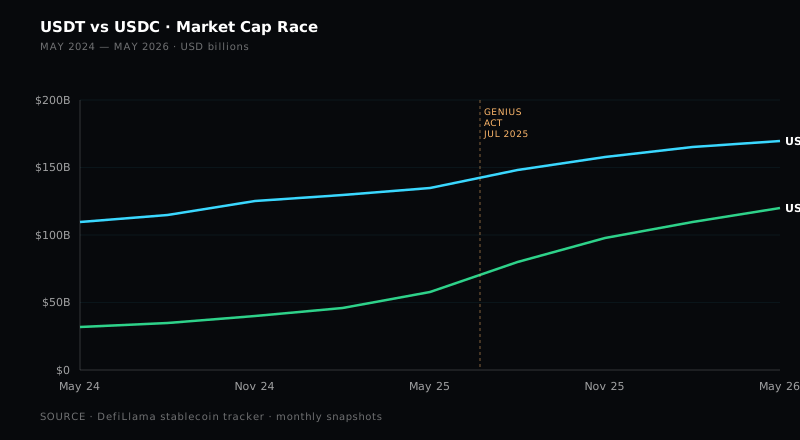
In practice both have held the peg through severe stress. The transparency gap is real (monthly attestation by Deloitte vs quarterly assurance by BDO Italia, public dashboard granularity, audit vs attestation status), but it does not necessarily translate to a peg-stability gap. The transparency gap matters more for regulators and institutional treasury managers than for retail holders.
For institutional users and US-resident treasury managers, USDC is the cleaner choice on this axis. For retail users in offshore venues, the difference is largely academic.
Regulatory posture in 2026
Regulatory positioning is where the two stablecoins diverge most sharply. The gap that opened in 2024 with the EU’s Markets in Crypto-Assets Regulation (MiCA) coming into force has widened through 2025 and 2026.
USDC: MiCA-licensed, NYDFS-regulated
Circle obtained an Electronic Money Institution (EMI) license from the Autorité de Contrôle Prudentiel et de Résolution (ACPR) in France in mid-2024, operating as Circle Mint France for EU users. Under MiCA, this makes USDC one of the first major dollar stablecoins authorized for issuance, redemption, and circulation within the EU under the new framework.
What MiCA compliance entails:
- Reserve segregation: Circle holds the EU-specific portion of USDC reserves at regulated EU credit institutions.
- Redemption guarantee: EU users have a statutory right to redeem at par.
- Disclosure requirements: ongoing reporting to ACPR on circulating supply, reserve composition, and operational metrics.
- Caps and gates: MiCA includes potential caps on transaction volume for non-euro stablecoins used as means of exchange in the EU; USDC, as a dollar-denominated token, falls under these provisions.
On the US side, Circle holds a New York BitLicense issued by the New York State Department of Financial Services (NYDFS), making USDC one of the only stablecoins natively regulated by a US prudential regulator. Circle is also subject to FinCEN money-transmitter requirements at the federal level, and Circle’s IPO put the company under SEC reporting obligations.
The cumulative picture: USDC is the most regulated dollar stablecoin in 2026, sitting under multiple overlapping frameworks across the US and EU.
USDT: outside major frameworks
Tether has not obtained MiCA authorization in the EU. Tether Limited is incorporated in the British Virgin Islands with operational presence in Switzerland and El Salvador (after Tether’s headquarters move announcement in early 2025). The company has consistently opted to operate outside US and EU prudential frameworks, on the position that its existing offshore structure and BDO Italia attestation cadence are sufficient.
The practical consequence for EU residents in 2026: several EU-licensed exchanges have delisted or restricted USDT trading pairs to comply with MiCA. The wave began in mid-2024 with major venues including Kraken (for EU users), Binance EU entities, and Coinbase EU, and tightened through 2025. The restrictions vary by jurisdiction and product line, but the trend is consistent: USDT is steadily losing access to compliant EU venues.
On the US side, Tether is not regulated by NYDFS. New York-based users are technically prohibited from holding USDT under the Department’s stablecoin guidance. In practice, USDT continues to trade on US-accessible offshore venues and on-chain, but the regulatory posture is uncertain.
What this means for users by region
| User location | Practical implication |
|---|---|
| EU resident | USDC is the compliant choice. USDT availability is shrinking on EU-licensed venues. |
| US resident (non-NY) | Both technically available on offshore venues; USDC is the cleaner choice on US-licensed exchanges. |
| US resident (NY) | USDC only on NYDFS-licensed exchanges; USDT is restricted. |
| UK resident | Mixed. Both available with FCA-related product restrictions. |
| Asia-Pacific (most jurisdictions) | Both widely available. USDT dominates by volume. |
| Latin America | Both widely used; USDT dominates retail off-ramps via Tron. |
| Africa | Both used; USDT on Tron is dominant for cross-border flows. |
For users whose trading or holding venues are EU-licensed or NYDFS-licensed, USDC is the practical choice in 2026 because USDT may not be available at all on those platforms. For users on offshore exchanges or in jurisdictions without strict stablecoin licensing, both are available and the choice tracks other factors (liquidity, network preference, yield availability).
See the methodology for how we weight regulatory posture in stablecoin evaluation.
Network availability
Both stablecoins ship on a broad set of blockchains, but the network economics and dominance patterns differ. Where you transact matters more than total network count.
USDT: Tron dominance, Ethereum legacy, Solana growth
USDT runs natively or as a bridged asset on approximately 14 distinct networks in 2026. By circulating supply and daily transaction volume:
- Tron (TRC-20): dominant. Approximately 50-55% of USDT supply runs on Tron in 2026, with daily transaction counts in the millions. Cheap transfers (typically under $1 per transfer, often subsidized to near-zero through Tron’s energy model), fast finality, and ubiquitous wallet support have made TRC-20 USDT the de facto cross-border dollar in many emerging markets.
- Ethereum (ERC-20): the original USDT deployment. Approximately 30-35% of supply runs on Ethereum, with the highest per-token transaction value (it dominates institutional and DeFi flows despite higher gas costs).
- Solana: growing fast. Approximately 5-8% of supply by 2026, with rapid adoption in Solana DeFi.
- BNB Smart Chain: approximately 3-5% of supply.
- Polygon, Avalanche, Algorand, Arbitrum, Optimism, others: smaller allocations totaling approximately 3-5% of supply.
The Tron concentration is structurally important. Tron USDT is functionally a different payment rail from Ethereum USDT, with different fee dynamics, different wallet ecosystems, and different validator-set risk profiles. Users sending USDT across borders for remittances or off-ramp transactions are overwhelmingly using Tron in 2026.
USDC: multichain native, CCTP
USDC ships as a native asset on a broader and more deliberately curated network list in 2026:
- Ethereum: the original USDC network, dominant by total value locked in DeFi.
- Solana: native deployment, dominant by transaction count for high-frequency USDC payments.
- Base, Arbitrum, Optimism: native USDC on each Layer 2, supporting the bulk of L2 DeFi liquidity.
- Polygon, Avalanche, Stellar, Algorand, Hedera, NEAR, Aptos, Sui, Noble (Cosmos): all native deployments rather than bridged.
The differentiating piece is Circle’s Cross-Chain Transfer Protocol (CCTP), which enables burn-and-mint movement of USDC between supported chains without bridged or wrapped representations. CCTP makes USDC behave like a single asset across chains rather than a constellation of bridged variants. For DeFi protocols and cross-chain applications, CCTP integration has made USDC the default cross-chain dollar in many ecosystems.
USDT does not have an equivalent burn-and-mint primitive across networks. Most non-Tron, non-Ethereum USDT is bridged via third-party bridges, which introduces additional smart-contract risk relative to native deployments.
Which to use on which chain
| Chain | Better choice | Reason |
|---|---|---|
| Ethereum mainnet (DeFi) | Either; USDC slightly preferred | Tighter DEX spreads on USDC pools, broader native protocol integration. |
| Tron | USDT | USDC has limited Tron deployment; USDT is dominant. |
| Solana | Either; USDC slightly preferred | Native deployment on both; USDC has deeper Solana DeFi integration. |
| Base, Arbitrum, Optimism | USDC | Native USDC; CCTP support; deeper L2 DeFi liquidity. |
| BNB Smart Chain | USDT | Larger circulating supply and deeper pool liquidity. |
| Cross-border remittances | USDT on Tron | Network effect; wallet ubiquity; off-ramp coverage. |
| Cross-chain DeFi (multichain protocols) | USDC | CCTP burn-and-mint avoids bridge risk. |
| Cosmos ecosystem | USDC via Noble | Native USDC integration; USDT presence is thinner. |
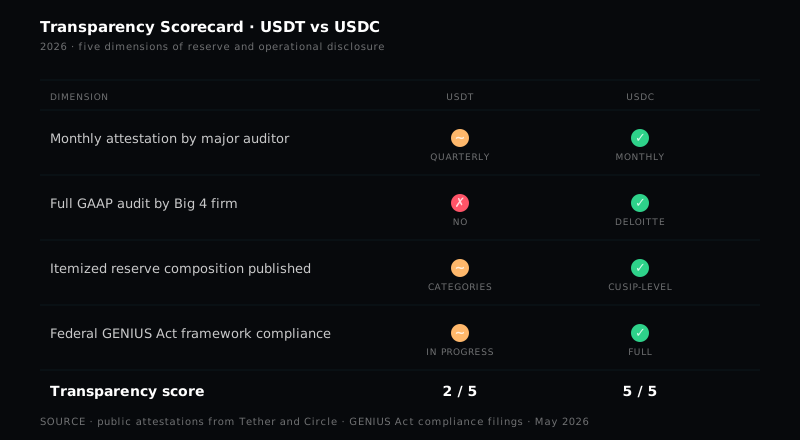
For most retail users, the network choice is driven by where they receive funds and where they want to spend or redeem. For sophisticated DeFi users and cross-chain operators, USDC’s CCTP and native multichain footprint is the cleaner technical proposition. For cross-border payment users and Asia-LatAm-Africa remittance flows, USDT on Tron remains the practical standard.
Yield opportunities
Both stablecoins support yield generation. The available rates and the regulatory wrappers around them differ.
USDC yield options in 2026
- Coinbase USDC rewards: approximately 5% APY paid as a rewards program to Coinbase users holding USDC in their accounts. The rate floats with US short-rate environment (essentially passing through Treasury bill yields net of a Coinbase margin).
- Aave on Ethereum and L2s: USDC supply rates typically 3-7% APY depending on utilization. Higher during periods of borrowing demand; lower in lull periods.
- Compound: similar to Aave, typically 3-6% APY for USDC supply.
- Morpho: optimized lending rates on top of Aave/Compound liquidity, typically 4-8% APY for USDC.
- MakerDAO DSR-equivalent products: Sky Protocol (formerly Maker) accepts USDC via PSM and pays Savings Rate, typically 4-8% APY.
- Money-market fund tokens: several regulated money-market funds tokenize on Ethereum and Solana, paying short-rate yields (4-5% APY in the current rate environment) with regulatory wrappers under US law.
For US-resident users, the Coinbase USDC rewards program is the simplest regulated yield path. For DeFi users, Aave, Compound, and Morpho are the standard venues.
USDT yield options in 2026
- Exchange Earn products: Bybit, Binance, OKX, Bitget, KuCoin all offer USDT Earn products at 4-10% APY on flexible or locked terms. Rates vary by promotional activity. Higher yields on locked products (30-90 day terms) typically come with capped allocation per user.
- DeFi pools on Ethereum: Aave and Compound USDT pools, typically 3-7% APY.
- DeFi pools on Tron: JustLend and other Tron DeFi protocols, typically 4-8% APY with much lower transaction costs than Ethereum.
- DEX liquidity provision: USDT-USDC pools on Curve, USDT-DAI pools, etc., earn from swap fees plus protocol incentives, typically 2-6% APY net.
- Regulated US money-market products: limited. USDT does not currently sit inside major US-licensed yield wrappers because Tether is not US-regulated.
For offshore exchange users, USDT Earn products are the standard yield path with the deepest allocation capacity. For DeFi users, both stablecoins have comparable options on Ethereum, with USDT having an edge on Tron.
Important caveats on yield
Yield is not risk-free, and the framing of stablecoin yield as cash-equivalent is misleading.
- Counterparty risk on centralized Earn products. Exchange Earn yields are paid by the exchange. The user is taking exposure to the exchange balance sheet on top of stablecoin issuer exposure. In a 2022-2023 style stress event, exchange Earn balances are not guaranteed to be redeemable.
- Smart-contract risk on DeFi. Aave, Compound, Morpho, and Curve have all had security incidents over the past decade. Smart-contract exploits can result in partial or full principal loss.
- De-peg risk on the underlying stablecoin. A 13% peg drop (as happened to USDC in March 2023) wipes years of nominal yield in a single day.
Treat stablecoin yield as a risk-premium product, not a money-market substitute. Size allocations accordingly.
Freeze risk and OFAC history
Both Tether and Circle have technical capability to freeze tokens at specific addresses, and both have used it. This is the most underappreciated risk axis for users who think of stablecoins as “digital dollars.”
What freezing actually means
Both USDT and USDC are issued through smart contracts on each supported chain. Each contract includes administrative functions that allow the issuer (Tether for USDT, Circle for USDC) to:
- Blacklist an address: prevent the address from sending or receiving tokens.
- Freeze tokens at an address: lock the existing balance, preventing transfers.
- Burn frozen tokens: in coordination with law enforcement, frozen tokens can be burned and re-minted to a recovery address.
These functions are exercised in response to law-enforcement requests, sanctions list updates (primarily OFAC SDN-list designations), and direct fraud reports. Both issuers cooperate with US authorities; neither has been positioned as censorship-resistant.
USDT freeze history
By late 2025 disclosures, Tether had frozen approximately $2.5 billion across roughly 2,500 addresses cumulatively since 2017. The bulk of freezes have been in response to:
- OFAC sanctions designations: addresses linked to North Korean state actors, Iranian entities, and Russian sanctioned individuals.
- US Department of Justice and FBI requests: addresses associated with criminal investigations, fraud schemes, ransomware operations.
- Cross-border law enforcement cooperation: requests from EU agencies, Interpol coordination, and direct exchange compliance teams.
Tether has publicly disclosed cooperation with US authorities and has framed the freeze posture as compliance with US law (despite Tether’s offshore corporate structure).
USDC freeze history
By the same timeframe, Circle had frozen approximately $300 million across roughly 200 addresses since 2020. The freeze pattern is similar: OFAC sanctions, US law enforcement requests, fraud reports.
The scale gap (USDT roughly 8x USDC by frozen dollar amount) tracks the size gap (USDT roughly 3.25x USDC by circulating supply) plus additional concentration in higher-risk flows. USDT’s larger presence in cross-border, remittance, and emerging-market channels means it sees more freeze events per dollar of circulating supply.
What this means for users
Both stablecoins are freezable. For users whose threat model includes potential freeze risk, neither USDT nor USDC offers censorship resistance.
The practical guidance:
- Counterparty hygiene. Receive funds only from known, clean sources. Address taint (transactions with mixers, sanctioned addresses, exchange-flagged addresses) can propagate freeze risk to downstream holders.
- Sanctioned-jurisdiction proximity. Users in or near sanctioned jurisdictions face elevated freeze risk on both stablecoins, especially after on-chain analytics firms flag movement patterns.
- Censorship-resistant alternatives. For exposure to a dollar-pegged asset without freeze risk, the closest options are decentralized stablecoins like DAI (with the caveat that DAI’s collateral includes meaningful USDC exposure, so it inherits partial freeze risk indirectly) or non-stable assets like BTC and ETH for users willing to take volatility.
For mainstream retail users transacting through normal channels, freeze risk is low on both stablecoins. For users whose use case involves any unusual on-chain activity, the freeze capability of both issuers should be priced into the decision.
Redemption mechanics
The redemption path is what makes a stablecoin a stablecoin. If the peg breaks, redemption is what restores it through arbitrage. The mechanics differ between the two issuers.
USDC redemption
- Circle Mint direct: institutional accounts can redeem USDC for USD via bank wire at 1:1, with no fee on standard wires. Minimum redemption is typically $50,000. Settlement is same-day or next-day depending on banking cutoff times.
- Coinbase: retail users redeem USDC for USD on Coinbase at 1:1 with no spread on the conversion. USD can then be withdrawn via ACH (no fee, 1-3 day settlement) or wire (small fee, same-day or next-day).
- Other regulated exchanges: Kraken, Gemini, and other US-licensed venues offer similar 1:1 USDC-to-USD conversion with venue-specific withdrawal mechanics.
- DeFi: USDC can be swapped to other stablecoins or sold for ETH/BTC on any major DEX. Direct USDC-to-USD redemption requires a regulated venue.
The Circle Mint direct path is institutional-grade. Retail users effectively redeem via Coinbase or equivalent. The friction is low on either path.
USDT redemption
- Tether direct: verified accounts can redeem USDT for USD via bank wire at 1:1, typically with a small fee (around 0.1% or a minimum dollar amount). Minimum redemption is typically $100,000. Verification requires institutional KYC and a banking relationship.
- Exchange: retail users redeem via Bybit, Binance, OKX, Bitget, KuCoin, or other exchanges that offer USDT-to-fiat conversion. The conversion typically happens at a small spread (a few basis points off peg in normal conditions, wider in stress periods). Fiat withdrawal is then subject to exchange withdrawal limits and fees.
- P2P: USDT P2P on Binance, OKX, and Bybit is one of the largest off-ramp flows globally, especially in emerging markets. Spreads vary by region and payment method, typically 0.2-2% off peg.
- DEX: swap to other stablecoins or assets on Curve, Uniswap, or PancakeSwap.
The Tether direct path has higher minimums and is institutional-only in practice. Retail USDT redemption is overwhelmingly via exchanges or P2P channels. The spread is wider on average than USDC retail redemption, especially in non-USD jurisdictions.
Friction comparison
| Path | USDC | USDT |
|---|---|---|
| Direct issuer redemption minimum | $50,000 | $100,000 |
| Direct issuer redemption fee | Zero | ~0.1% |
| Retail on US exchanges | 1:1 to USD on Coinbase, Kraken, Gemini | Limited (offshore venues primarily) |
| Retail on offshore exchanges | Available, narrower selection | Standard; broadest selection |
| P2P off-ramp | Limited | Largest globally |
| Cross-chain redemption | CCTP burn-and-mint native | Bridged on most non-native chains |
For US-resident users with bank accounts, USDC redemption to USD via Coinbase or similar is the cleanest path. For users in non-USD jurisdictions or without US banking relationships, USDT via exchange or P2P channels is the practical path.
Market cap and liquidity
The size difference is the single largest factor that argues for USDT in active trading contexts. The two stablecoins are the same product class but operate at very different scale.
Size comparison in 2026
- USDT market cap: approximately $130 billion.
- USDC market cap: approximately $40 billion.
- Combined dollar stablecoin market: approximately $200 billion (USDT and USDC are roughly 85% of this total).
USDT has more than 3x the circulating supply of USDC and operates on a substantially larger transaction footprint. The size translates directly to liquidity depth on the venues where USDT trades.
Liquidity depth on major venues
On the largest centralized exchanges (Binance, Bybit, OKX, Bitget), USDT is the dominant quote currency:
- Spot pairs: approximately 70-80% of spot trading volume on offshore CEXs is denominated in USDT pairs. The remainder is split between USDC, fiat (where supported), and BTC.
- Perpetual futures: USDT-margined perpetual futures are the standard product across all major offshore exchanges. USDC-margined perpetuals are a smaller secondary product (notably deeper on Bybit and OKX than on Binance or Bitget).
- Order book depth on top pairs: USDT-quoted order books for major assets (BTC/USDT, ETH/USDT, SOL/USDT) typically have 5-10x the depth of equivalent USDC-quoted pairs at the same exchange.
For active traders running size, USDT’s liquidity advantage is real and measurable. Execution slippage on a $100,000 BTC trade is notably lower in USDT pairs than in USDC pairs on the same offshore exchange.
On US-licensed venues the pattern inverts. Coinbase and Kraken’s deepest pairs are USDC- and USD-quoted; USDT is a secondary product on US-licensed exchanges and is absent entirely on some (Coinbase US delisted USDT in late 2023).
Arbitrage tightness and peg stability
Both stablecoins trade tightly to peg in normal conditions:
- USDT: typically within 5-15 basis points of $1.00 across major venues. Wider in stress events; in May 2022 (Terra collapse) USDT briefly traded at $0.95 across major venues for several hours before mean-reverting.
- USDC: typically within 5-10 basis points of $1.00 across major venues. Wider in stress events; in March 2023 (SVB collapse) USDC traded as low as $0.87 on major venues for approximately 72 hours before restoration.
The peg stability is comparable in steady state. The stress-event response is the more interesting question, and on this metric USDC’s March 2023 drop was deeper than USDT’s May 2022 drop, but both recovered fully.
Which is “more money”
For raw liquidity and breadth of acceptance in trading contexts, USDT is closer to behaving like money. The network effect is decades-deep in the offshore crypto ecosystem.
For institutional treasury and US-regulated venues, USDC is closer to behaving like a dollar deposit. The regulatory wrapper, cleaner audit trail, and direct integration with US banking infrastructure make it the institutional choice.
Both serve as stable units of account on-chain. The choice tracks where the user wants the unit of account to interact with the off-chain world.
Which to use when
The two stablecoins are not interchangeable across use cases. Each has a clear best fit by user type and use case.
Use case: trading on offshore CEXs
Use USDT. Order book depth, perpetual futures margin standard, broader pair selection, and tighter spreads on the largest exchanges. USDC pairs exist on most offshore exchanges but are typically secondary in liquidity.
Use case: trading on US-licensed venues (Coinbase, Kraken, Gemini)
Use USDC. It is the default and often the only stablecoin pair available. USDT is restricted or absent on US-licensed exchanges in 2026.
Use case: holding more than $10K long-term as cash-equivalent
USDC or split. For a user whose primary motivation is dollar exposure with regulatory clarity and reserve transparency, USDC is the cleaner choice. A split allocation (75% USDC, 25% USDT) hedges issuer-specific risk while keeping USDT exposure for liquidity needs. For amounts above $100K, consider direct exposure to short-dated Treasuries through a regulated broker rather than either stablecoin.
Use case: EU resident under MiCA
Use USDC. It is the only major dollar stablecoin with full MiCA authorization in 2026. USDT availability on EU-licensed venues is shrinking. For EU residents who plan to use EU-licensed exchanges or hold meaningful balances, USDC is the practical default.
Use case: DeFi yield on Ethereum mainnet
Either. Both have deep pool liquidity on Aave, Compound, Morpho, and Curve. USDC has slightly tighter pool spreads and deeper protocol integration in 2026; USDT is competitive on yield rates. The choice often tracks which stablecoin the user is already holding rather than a yield-specific advantage.
Use case: DeFi on Tron or BSC
Use USDT. Tron USDT dominates these ecosystems by a wide margin. USDC presence on Tron is thin; on BSC the picture is more balanced but USDT is still deeper.
Use case: cross-border remittances and off-ramps
Use USDT on Tron. Network effect, wallet ubiquity, retail off-ramp coverage, and low transaction costs make TRC-20 USDT the practical standard for sending dollars across borders in 2026. USDC is making progress here through Stellar and CCTP integrations but has not displaced USDT.
Use case: institutional treasury
Use USDC. Direct Circle Mint redemption, NYDFS regulation, monthly Deloitte attestation, and US securities reporting make USDC the institutional-grade choice. Most US-regulated treasury operations cannot hold USDT for compliance reasons.
Use case: privacy or censorship resistance
Use neither. Both are freezable; both comply with OFAC; both have public freeze histories. For exposure to a dollar-pegged asset without freeze risk, look at DAI (with the caveat that DAI inherits partial freeze risk through its USDC collateral) or non-stable assets like BTC.
Decision matrix summary
| User profile | Recommended |
|---|---|
| Active perpetual trader on offshore CEX | USDT |
| US-resident retail | USDC |
| EU-resident retail | USDC |
| Institutional treasury | USDC |
| Long-term holder, >$10K, regulatory-conscious | USDC or split |
| DeFi user on Ethereum | Either |
| DeFi user on Tron / BSC | USDT |
| Remittance user | USDT on Tron |
| Privacy-sensitive | Neither |
For a deeper look at where to buy and hold each, see how to buy crypto in 2026 and the best no-KYC crypto exchanges 2026 for non-KYC routing options.
Bottom line
USDC wins on the structural axes that institutions and regulators care about. Monthly Deloitte attestation, weekly public reserves dashboard, 80% Treasury composition, MiCA authorization via Circle Mint France, NYDFS BitLicense, US securities reporting, and Circle’s broader regulatory cooperation make USDC the cleanest dollar stablecoin in 2026. For US-resident retail, EU-resident retail, and institutional treasury, USDC is the practical default.
USDT wins on the operational axes that traders and emerging-market users care about. $130 billion circulating supply (more than 3x USDC), dominant liquidity on offshore CEXs, the standard quote currency for spot pairs and perpetual futures on Binance, Bybit, OKX, Bitget, KuCoin, and Gate, plus Tron-network dominance in cross-border remittances and retail off-ramps. For offshore active trading and emerging-market dollar exposure, USDT is the practical default.
Both have held the peg through major stress events. USDC’s deeper drop in March 2023 (to $0.87 during the SVB collapse) and USDT’s brief dip in May 2022 (to $0.95 during the Terra collapse) both recovered. Neither has had a redemption failure. Both have meaningful issuer risk that should be diversified at large balance sizes.
Both can freeze user tokens. Tether has frozen approximately $2.5 billion across 2,500 addresses since 2017; Circle has frozen approximately $300 million across 200 addresses since 2020. Both cooperate with OFAC and US law enforcement. Neither is censorship-resistant. For users whose threat model includes freeze risk, the alternatives are decentralized stablecoins or non-stable assets.
The honest summary: these are the two most important non-fiat money instruments in crypto, and they have differentiated rather than converged through the 2024-2026 regulatory cycle. USDC has moved aggressively into regulated, audited, transparent territory and won the institutional and EU markets. USDT has held its liquidity dominance, expanded its non-Treasury reserve diversification, and remained the de facto dollar of the offshore crypto economy. Most active users hold some of both, allocated to where each is most useful.
For users whose use case is clear, the choice should be too. For users whose use case spans both worlds (US-licensed and offshore venues, EU and emerging markets, institutional and retail), a split allocation is the practical answer.
Compare exchange fees before moving sizeable balances onto any platform: fees calculator. Different exchanges price USDT and USDC deposits, withdrawals, and trading pairs differently, and the net cost of a stablecoin choice often depends more on venue than on the stablecoin itself.
Read next
- Best no-KYC crypto exchanges 2026. For users who need non-KYC routing on USDT or USDC.
- How to buy crypto 2026. Step-by-step on-ramp guide covering both stablecoins.
- Fees calculator. Compare net deposit, trading, and withdrawal costs across major exchanges.
- Methodology. How we evaluate stablecoins and exchanges.
- Risk disclaimer.
Frequently asked questions
Is USDT or USDC safer in 2026?
USDC is the safer choice on reserve composition and regulatory clarity. Circle holds roughly 80% short-dated US Treasuries plus cash at regulated banks, with monthly attestation by Deloitte and a public reserves dashboard updated weekly. USDT is backed by a more diversified pool (Treasuries, repos, gold, Bitcoin, secured loans, corporate paper in smaller quantities) under quarterly assurance reports by BDO Italia. Both have held the peg through major stress events. USDC briefly broke peg to $0.87 during the March 2023 SVB crisis but restored it within 72 hours. USDT briefly traded at $0.95 in May 2022 during the Terra collapse. Neither has had a redemption failure.
Which has better reserve transparency?
USDC, with a wide margin. Circle publishes a public reserves dashboard updated weekly that breaks down holdings by asset class, custodian, and maturity. Monthly attestation reports are filed by Deloitte. USDT publishes a quarterly assurance report by BDO Italia plus a real-time reserves page on Tether's site, but the asset-level detail is less granular and the audit cadence is slower. Circle has filed audited financial statements under US securities reporting; Tether has not filed a full PCAOB audit. For users prioritizing reserve transparency specifically, USDC is the correct choice.
Which is MiCA-compliant in the EU?
USDC. Circle obtained an Electronic Money Institution license under MiCA via Circle Mint France in mid-2024, making USDC one of the first major dollar stablecoins authorized for issuance and redemption within the EU under the new framework. USDT has not obtained MiCA authorization. As a result, several EU-licensed exchanges began delisting or restricting USDT trading pairs for EU retail users in 2024, with the restrictions tightening through 2025 and 2026. For EU residents who plan to hold significant balances on EU-licensed venues, USDC is the practical choice.
Can my USDT or USDC be frozen?
Yes, on both. Tether and Circle both have technical capability to freeze tokens at specific addresses, and both have used it. By late 2025 disclosures, Tether had frozen roughly $2.5 billion across approximately 2,500 addresses since 2017, mostly in response to law-enforcement requests and OFAC sanctions. Circle had frozen roughly $300 million across approximately 200 addresses in the same period. Both comply with US sanctions regimes including OFAC SDN-list designations. For users whose threat model includes potential freeze risk (sanctioned-jurisdiction proximity, mixer interaction, sanctioned counterparty exposure), neither stablecoin is freeze-resistant. Truly censorship-resistant alternatives are decentralized stablecoins like DAI or non-stable assets like BTC.
Which works on the most networks?
USDC has broader native deployment coverage; USDT has higher concentrated liquidity per network. USDC ships as a native asset on Ethereum, Solana, Base, Arbitrum, Optimism, Polygon, Avalanche, Stellar, Algorand, Hedera, NEAR, and several others, with Cross-Chain Transfer Protocol (CCTP) supporting native burn-and-mint movement between chains. USDT runs on Tron (dominant by transaction volume), Ethereum, Solana, Polygon, Avalanche, Algorand, Omni Layer, and others, mostly as bridged or wrapped representations rather than native deployments. For developers building cross-chain applications, USDC's CCTP is the cleaner integration. For raw network reach in retail wallets, USDT on Tron has the largest deployed footprint.
Where can I earn yield on each?
Both have yield options, with different regulatory wrappers. For USDC on US-licensed venues, Coinbase pays roughly 5% APY on USDC balances (rate floats with US short-rate environment) under a rewards program. DeFi options for USDC: Aave, Compound, Morpho, and Maker DSR-equivalent products typically pay 4-8% APY depending on utilization. For USDT, exchange Earn products on Bybit, Binance, OKX, and KuCoin pay 4-10% APY on flexible or locked terms, and DeFi pools (Curve, Aave on Tron and Ethereum) pay similar rates. Regulated yield products (money-market style) are more developed on the USDC side because of Circle's US regulatory posture; offshore exchange yield is more developed on USDT because of liquidity concentration.
Can I redeem USDT/USDC for cash?
Both, with different friction profiles. USDC: Circle Mint accounts allow direct 1:1 redemption to USD bank wire for institutional clients (typical minimum $50,000). Retail users redeem via Coinbase, Kraken, or other regulated exchanges, where USDC trades 1:1 to USD with minimal spread. USDT: Tether direct redemption is available for verified accounts at typical minimums of $100,000 and a small fee. Retail users redeem via exchanges, where USDT trades at roughly 1:1 with small spread (sometimes a few basis points off peg). Both are highly liquid at the exchange tier. Direct issuer redemption is institutional-grade on both sides.
Which stablecoin should I use for trading?
Depends on where you trade. On offshore centralized exchanges (Binance, Bybit, OKX, Bitget, KuCoin, Gate), USDT is the default pair currency with the deepest order books. Most perpetual futures markets are USDT-margined. On US-licensed venues (Coinbase, Kraken in some pairs, Gemini), USDC is the default and often the only stablecoin pair available. For DeFi on Ethereum mainnet, USDC has slightly tighter pool spreads on the largest DEXs; on Tron and BSC, USDT dominates liquidity. For active perpetual trading, USDT-margined is still the standard. For US-resident users or EU-licensed venues, USDC is the practical choice.
#USDT#USDC#stablecoins#Tether#Circle#MiCA#comparison
Discussion
Loading comments…