
TL;DR: Both OKX and Bybit are top-tier centralized exchanges with comparable liquidity and product breadth. Bybit wins on derivatives focus, copy trading availability, options market accessibility for retail, and the higher leverage ceiling (200x vs 125x). OKX wins on absolute product breadth (Web3 wallet + DeFi integration alongside derivatives), spot maker fee advantage, and slightly clearer regulatory posture post the February 2025 DOJ deferred prosecution agreement. Neither serves US users at retail tier. The choice depends on whether you want a derivatives-focused platform (Bybit) or a multi-product platform (OKX).
Not financial advice. Crypto trading is high risk. Both platforms have material security and regulatory events on record: Bybit February 2025 hot wallet exploit, OKX February 2025 DOJ deferred prosecution agreement. Verify country availability before depositing. Read the risk disclaimer before scaling capital onto either.
Quick comparison
| Factor | OKX | Bybit |
|---|---|---|
| Founded | 2017 | 2018 |
| Headquarters | Seychelles (operational, formerly Malta) | Dubai (operational, formerly Singapore) |
| Spot maker / taker (base) | 0.080% / 0.10% | 0.10% / 0.10% |
| Spot with token discount | OKB available, smaller discount | 0.08% (BIT) |
| Perpetual maker / taker (base) | 0.020% / 0.050% | 0.020% / 0.055% |
| Perpetual with token discount | No equivalent | 0.016% / 0.044% (BIT) |
| Spot pairs available | ~350 | ~400 |
| Options markets | BTC, ETH | BTC, ETH |
| Max futures leverage | 125x on majors | 200x on majors |
| Native token | OKB (limited discount + ecosystem) | BIT (20% off + ecosystem) |
| Copy trading | Available, side feature | More central, larger marketplace |
| Web3 wallet integration | Deep, native | Available, less central |
| US availability | OKX.US (restricted scope) | None |
| Recent major event | Feb 2025 DOJ DPA (regulatory) | Feb 2025 exploit (~$1.5B, recovered) |
| Proof of reserves | Published Merkle-tree | Published Merkle-tree |
Liquidity and execution
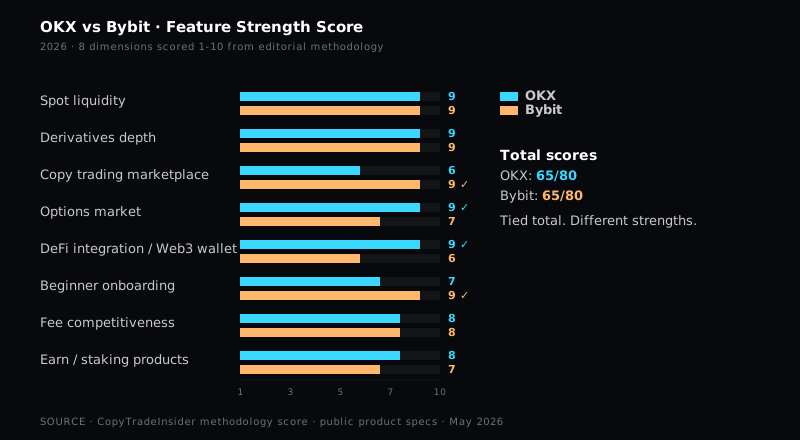
Both platforms have top-tier liquidity for retail order sizes. On the top derivatives pairs (BTC/USDT, ETH/USDT, SOL/USDT perpetuals), spread and depth are comparable on both. A retail trader running positions under $50K per order will not see meaningful execution differences between OKX and Bybit on the most liquid pairs.
The differences appear at the edges. OKX has slightly broader Asian trading hour liquidity (the platform’s heritage and primary user base). Bybit has slightly tighter top-of-book on derivatives during US/EU trading hours. For altcoin perpetuals outside the top 20 by volume, both platforms thin out comparably.
Practical takeaway: liquidity is not a decisive factor between these two for typical retail. For institutional-scale orders, Binance still has the deepest order books in the industry (covered in Bybit vs Binance); OKX and Bybit are second tier behind Binance and roughly tied with each other.
Fee structure with token discounts
Both platforms charge similar base fees with platform-specific variations.
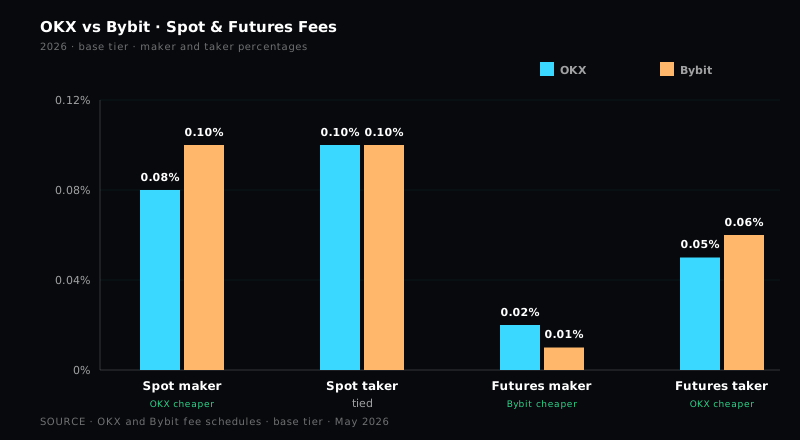
OKX base: spot 0.080% maker / 0.10% taker (note: maker is below the 0.10% common baseline). Perpetual 0.020% maker / 0.050% taker. OKB token offers a small discount on the maker side and ecosystem access; the discount is materially smaller than Bybit’s BIT or Binance’s BNB.
Bybit base: spot 0.10% maker/taker, perpetual 0.020% maker / 0.055% taker. With BIT held in account (20% discount): spot 0.08% maker/taker, perpetual 0.016% maker / 0.044% taker.
Without native token: OKX is slightly cheaper on spot maker (0.080% vs 0.10%) and tied on perpetual maker. OKX wins by 5 basis points on perpetual taker.
With BIT held: Bybit becomes cheaper across spot and perpetual taker. OKX still has lower spot maker (no discount mechanism gets it lower) but Bybit wins on the perpetual side.
The practical implication: if you would not otherwise hold BIT, OKX is slightly cheaper at retail base tier. If you already hold BIT for ecosystem or speculative reasons, Bybit becomes cheaper.
For detailed Bybit fee mechanics see Bybit review; for OKX context see OKX review and BingX vs OKX.
Derivatives surface
Both platforms offer comprehensive derivatives coverage:
- Perpetual futures. Both cover top 200 pairs. Bybit offers up to 200x leverage on majors; OKX up to 125x. For most retail strategies the difference is irrelevant; for high-leverage retail strategies Bybit’s ceiling matters.
- Options. Both list BTC and ETH options with European-style settlement. OKX’s options product is more institutional-feeling and has historically been used by larger Asian funds; Bybit’s options product is more accessible to retail traders. For sophisticated structures, Deribit remains the industry leader (not covered on this site).
- USDC-margined perpetuals. Both offer. Bybit launched this earlier and has more usage among portfolio-margin retail traders.
- Inverse perpetuals. Both offer.
- Structured products. Both list dual investment, accumulating positions, and yield-enhanced products.
For a derivatives-first retail trader, Bybit’s workflow is more focused and the retail UX is cleaner. OKX’s derivatives are equally capable but embedded in a broader product surface that includes Web3 wallet, DeFi integration, NFT marketplace, and a wider feature set that some users find distracting and others find useful.
Web3 wallet and DeFi integration
This is OKX’s structural differentiator. OKX Web3 Wallet is the deepest self-custody wallet integration among major CEXs, supporting 80+ blockchains and direct DeFi protocol interaction without leaving the platform interface. The integration covers spot custody, NFT trading, DEX aggregation, and cross-chain swaps.
Bybit has a Web3 wallet product but it’s noticeably less developed than OKX’s. For users who want centralized exchange functionality plus self-custody DeFi access in one app, OKX is the clearly better fit. For users who treat their CEX as a trading venue and use separate wallets (MetaMask, Rabby, Phantom) for DeFi, the OKX advantage doesn’t matter.
Security and incident history
Both platforms have material events on record, of different shapes.
Bybit: February 2025 hot wallet exploit. ~$1.5B drained from one ETH hot wallet, attributed to Lazarus Group activity. Bybit absorbed the loss through insurance fund and treasury, kept user balances whole, did not suspend platform-level withdrawals, full recovery within 7 days. No user fund loss. The largest single-exchange security event on record but clean incident response.
OKX: February 2025 DOJ deferred prosecution agreement. OKX entered a DPA with the US Department of Justice covering historical compliance gaps related to US user access without proper licensing. The platform paid penalties (publicly disclosed amounts), accepted enhanced compliance obligations, and continued operations. No user fund loss. No custody event. The compliance posture tightened materially across 2025-2026 as a result.
Different risk shapes:
- Bybit’s risk shape is operational (hot wallet attack vector, derivatives execution risk)
- OKX’s risk shape is regulatory (compliance gaps with US and other jurisdictions)
Forward-looking custody risk is comparable on both platforms. Both publish Merkle-tree proof of reserves on regular cadence (Bybit increased frequency post-February 2025; OKX added independent audit components post-DPA).
For long-term holdings on either platform, the standard rule applies: withdraw to self-custody anything not actively trading. CEX custody is non-zero risk regardless of operating history.
KYC posture in 2026
Both platforms tightened materially across 2024-2026.
OKX moved to mandatory KYC for essentially all account functions post the February 2025 DOJ DPA. The platform now requires Standard verification for spot trading, futures, options, copy trading, structured products, and DeFi integration through the platform. Enhanced verification is required for higher withdrawal limits and institutional features.
Bybit moved to mandatory KYC for essentially all account functions post the February 2025 exploit, on a parallel timeline. The platform’s tier structure (Unverified / Lite / Standard / Pro) gates progressive functionality with Standard verification required for any retail trading workflow.
If avoiding KYC is the primary driver, neither is the right answer. Look at BingX or KuCoin for email-only Standard tier options (covered in our BingX review and KuCoin no-KYC 2026 guide).
Copy trading: Bybit’s edge
Both platforms have copy trading. Both products feel like extensions of the broader platform rather than central products.
OKX copy trading exists in a clean UI with reasonable filter coverage. The marketplace is smaller than Bybit’s. The product feels peripheral to OKX’s main strengths (Web3 + multi-product). Lead trader quality is uneven.
Bybit copy trading launched in 2022 and grew as a more developed product than OKX’s. The lead trader marketplace is larger and more actively curated. Filter coverage is broader (equity curve, drawdown, win rate, risk score, asset breakdown).
Honest framing: neither matches BingX or Bitget on dedicated copy trading depth. For users whose primary motivation is copy trading specifically, see our best copy trading platforms 2026 ranking where BingX takes 1st (8.7), Bitget 4th (8.2), Bybit 2nd among partnered (8.0), and OKX 5th (7.0). Between OKX and Bybit specifically, Bybit is the better copy trading choice.
Pros and cons summary
Pick OKX if:
- You want a multi-product platform with deep Web3 wallet and DeFi integration alongside derivatives
- Spot maker fee advantage at base tier matters for your spot-heavy workflow
- You value the post-DOJ DPA regulatory clarity (the platform now has a documented compliance relationship with US authorities)
- You’re an Asian-hours trader and value OKX’s primary user base liquidity at those hours
- You don’t need 200x leverage; 125x cap on majors is sufficient
Pick Bybit if:
- You run derivatives-first strategies with options market exposure
- Copy trading is part of your workflow (Bybit’s product is more developed than OKX’s)
- You want or already hold BIT for the 20 percent fee discount across spot and perpetual
- 200x leverage availability matters to your strategy
- You prefer a focused derivatives-first platform over a multi-product platform
Verdict
For derivatives-first retail traders in 2026, Bybit is the slightly better choice between these two. The retail UX is more focused, the copy trading product is more developed, the BIT token discount provides material fee compression, and the 200x leverage ceiling is available for high-leverage strategies. The February 2025 exploit recovery actually demonstrates strong incident response rather than weakening confidence.
For multi-product retail traders who want CEX plus Web3 plus DeFi integration in one platform, OKX is the better fit. The Web3 wallet integration is the deepest among major CEXs, the regulatory posture post-DOJ DPA is clearer, and the spot maker fee advantage compounds for spot-heavy workflows.
Neither platform serves US users at retail tier; OKX.US has reduced scope, Bybit does not serve US users at all. Both have proof of reserves on regular cadence. Both have material recent events with different risk shapes. The decision should come down to which product surface fits your workflow rather than fundamental safety or fee differences.
Open Bybit for the derivatives-first focused workflow: Register on Bybit. Telegram club access included for active traders.
See the affiliate disclosure for full detail.
Read next
- Bybit review. Full feature breakdown and scoring.
- OKX review. Full feature breakdown and scoring.
- Bybit vs Binance. Bybit’s other major comparison.
- BingX vs Bybit. Copy trading-focused comparison.
- BingX vs OKX. Adjacent OKX comparison.
- Best copy trading platforms 2026. Full ranking with honest scoring.
- Methodology. How we evaluate platforms.
- Risk disclaimer.
Frequently asked questions
OKX or Bybit, which is better for derivatives?
Both are competitive at top-tier liquidity. Bybit has a slight edge on retail futures UX and options market accessibility; OKX has a slight edge on absolute product breadth (spot, perpetuals, options, structured products, plus deeper DeFi and Web3 wallet integration). For pure derivatives-first retail traders, Bybit's workflow is more focused. For traders wanting derivatives plus DeFi integration in one platform, OKX fits better. Order book liquidity on the top pairs (BTC/USDT, ETH/USDT) is comparable at retail size.
Are OKX fees lower than Bybit?
Comparable at retail tier with slight platform-specific advantages. OKX spot maker is 0.080 percent (slightly lower than Bybit's 0.10 percent baseline). OKX perpetual taker is 0.050 percent versus Bybit's 0.055 percent. With Bybit's BIT token discount (20 percent off), Bybit drops to 0.044 percent perpetual taker, which beats OKX. Without native token discount, OKX is slightly cheaper at retail; with BIT, Bybit edges ahead. OKX does not have a fee-discount native token equivalent to BIT or KCS.
Is OKX or Bybit safer?
Both have material security and regulatory events on record. Bybit's February 2025 ~$1.5B hot wallet exploit (Lazarus Group attribution) was the largest single-exchange security event ever, but recovered cleanly with no user fund loss. OKX received a US DOJ deferred prosecution agreement in February 2025 covering historical compliance gaps; the platform paid penalties but operations continued and no user funds were impacted. Different risk shapes (Bybit operational, OKX regulatory) but comparable forward-looking custody risk profiles. Both publish proof of reserves on regular cadence.
OKX or Bybit for copy trading?
Bybit. OKX has a copy trading product but it's a small feature within a much broader product surface. Bybit's copy trading is more central to the platform, with a larger active lead trader marketplace and more developed filter set. Honest framing: neither matches BingX or Bitget on dedicated copy trading depth. For users whose primary motivation is copy trading specifically, see our [best copy trading platforms 2026 ranking](/blog/best-copy-trading-platforms-2026/). Between OKX and Bybit, Bybit is the better copy trading choice.
Can US users access OKX or Bybit?
Neither in the unrestricted form. OKX operates a separate OKX.US entity with significantly reduced product scope following the 2025 DOJ deferred prosecution agreement. Bybit does not serve US users at all. For US users, the practical answer is Coinbase or Kraken for spot trading. For US-based crypto copy trading specifically, eToro is the regulated answer (covered in our [best copy trading platforms 2026 ranking](/blog/best-copy-trading-platforms-2026/)).
Which has more derivatives products?
Roughly comparable. Both offer USDT-margined and USDC-margined perpetuals, options on BTC and ETH, structured products, and inverse perpetuals. Bybit has slightly higher max leverage (200x on majors vs OKX's 125x). OKX has deeper Web3 wallet and DeFi integration alongside the derivatives surface. For pure derivatives depth, comparable. For derivatives plus DeFi-adjacent products in one platform, OKX has the edge.
OKX or Bybit for KYC?
Both tightened materially across 2024-2026. OKX's February 2025 DOJ deferred prosecution agreement accelerated mandatory KYC across essentially all functions. Bybit's February 2025 exploit accelerated KYC tightening on a parallel timeline. Both now require Standard verification for any meaningful trading. If avoiding KYC is the primary driver, neither is the right answer; look at BingX or KuCoin for email-only Standard tier options (covered in our reviews of each).
What is the verdict between OKX and Bybit?
Comparable platforms with different strategic emphases. Pick Bybit for derivatives-first retail trading, options market accessibility, copy trading availability, and the 200x leverage ceiling. Pick OKX for multi-product breadth (derivatives plus Web3/DeFi integration), spot maker fee advantage, and slightly broader regulatory clarity post-DOJ resolution. The fundamentals (custody risk, proof of reserves, KYC posture, no US path) are roughly equivalent.
#OKX#Bybit#comparison#derivatives#copy trading#fees
Discussion
Loading comments…