
Score: 8.5 / 10 · Good for: deepest spot and futures liquidity, broadest product surface, BNB ecosystem, Launchpad access, Earn breadth · Watch out: regulatory tail risk under the five-year monitorship, no main-platform US access, KYC tightening since 2024, country list updates without notice · Updated: May 2026
Binance is the largest cryptocurrency exchange in the world by volume, founded in 2017 by Changpeng Zhao (CZ) and operating under CEO Richard Teng since November 2023. The platform clears roughly $50 billion in daily volume across spot and derivatives at typical 2026 conditions, runs the most-used native blockchain ecosystem of any exchange-affiliated token (BNB and BSC), and remains the deepest book in crypto despite a $4.3 billion DOJ settlement that closed the major US enforcement chapter in late 2023. What follows is a full look at Binance for 2026: the post-settlement operational reality, fee structure with the BNB discount, the BNB and BSC ecosystem, KYC posture, country availability, the Binance.US separation, and where the platform fits in a multi-exchange stack. We score every platform on the same methodology and affiliate payouts do not move the rankings.
Not financial advice. Crypto trading is high risk. Custody on any centralized exchange is a non-zero risk regardless of operating history. Derivatives products carry leverage risk that can wipe an account in minutes. Verify what is legal in your jurisdiction before depositing. Read the risk disclaimer.
What is Binance
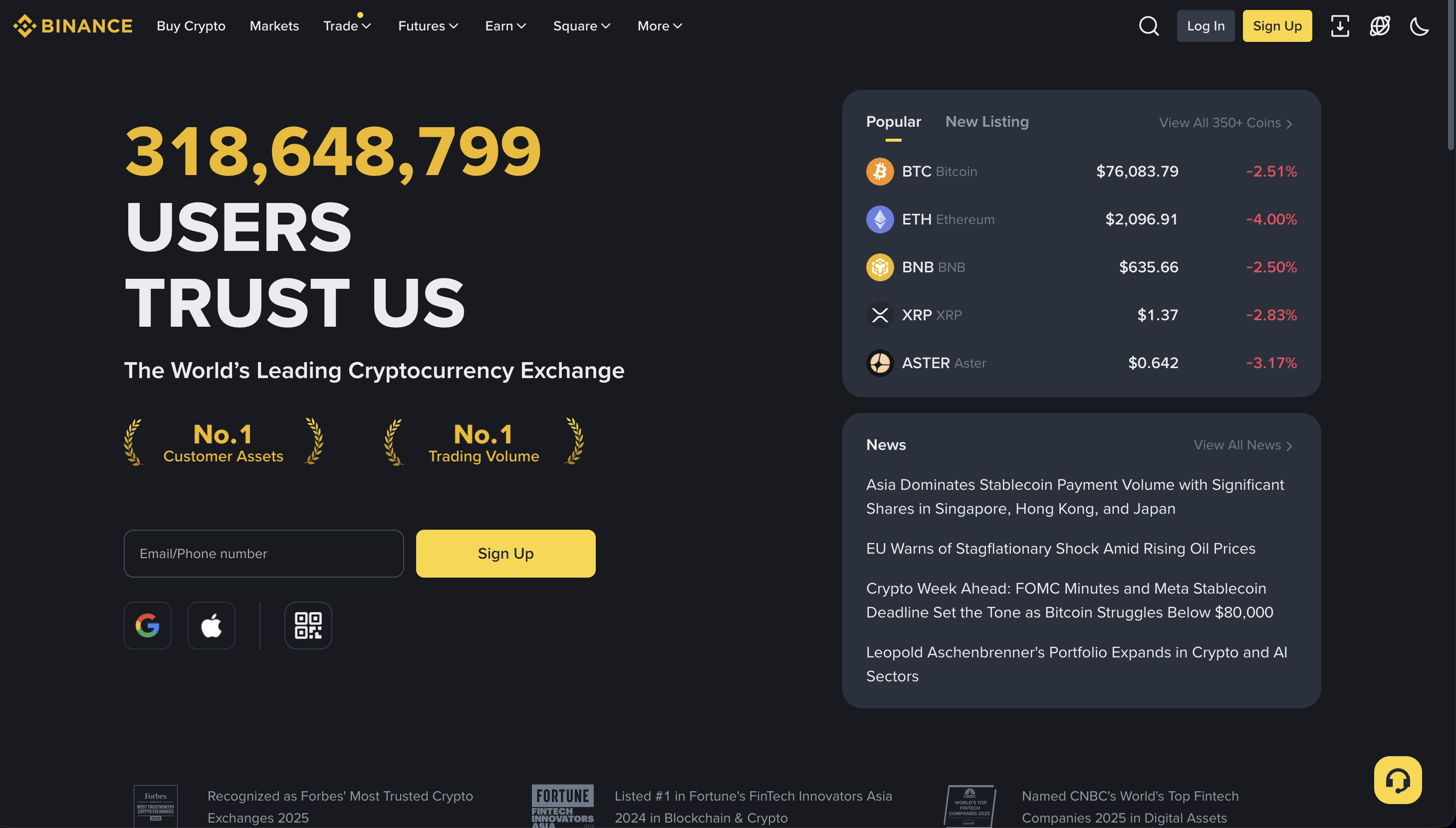
Binance launched in July 2017 out of a small team led by Changpeng Zhao (CZ), a former Bloomberg systems engineer and OKCoin CTO, and grew at a pace that has no real precedent in crypto exchange history. Within twelve months the platform was the largest exchange in the world by spot volume. By 2021 it routinely cleared $20-40 billion in daily volume across spot, and the futures product layered on top doubled that figure during peak periods. The 2026 footprint is roughly $15-25 billion in daily spot volume and $30-50 billion in daily futures volume at typical conditions, still the deepest book in crypto by a meaningful margin.
The platform’s identity rests on three structural advantages that compounded over eight years. First, liquidity. Binance’s top-pair order books are the benchmark every other CEX is measured against; spreads on BTC, ETH, SOL, and the top-20 by market cap are routinely the tightest of any retail-accessible venue. Second, product surface. Spot, perpetual futures, coin-margined futures, options (smaller than Deribit but listed), margin, Earn (staking, savings, dual investment, structured products), Launchpad, Launchpool, P2P, Pay, Card, copy trading, NFT marketplace, fan tokens, square (social), academy, charity. The breadth is unmatched. Third, the BNB and BSC ecosystem, which gives the platform a moat that pure-exchange peers cannot replicate (covered in detail below).
Operationally, Binance has never had a fixed corporate headquarters in the traditional sense and has historically operated through a mesh of regional sub-entities. This was central to the US enforcement case (covered in the next section) and became the focus of the post-2023 compliance build-out. The platform now has formal regulatory licenses or registrations in over a dozen jurisdictions including Dubai (VARA), France (AMF), Italy (OAM), Spain, Bahrain, El Salvador, Kazakhstan, and others. Richard Teng has been visibly more institutional and compliance-forward in public communications than CZ was, and the platform’s public posture in 2026 reflects that shift.
The DOJ settlement and post-CZ era
In November 2023, the US Department of Justice announced a coordinated multi-agency settlement with Binance and CZ. The headline number was $4.3 billion in total monetary penalties spread across DOJ, CFTC, OFAC (Treasury sanctions enforcement), and FinCEN. The underlying conduct involved historical AML weaknesses, US user access during periods when the platform officially excluded the US, and sanctions-screening gaps. CZ personally pleaded guilty to one count under the Bank Secrecy Act, paid a $50 million personal fine, and stepped down as CEO. He served a four-month prison sentence in 2024 and returned to a non-executive advisory role afterward, retaining his ownership stake in the platform.
Richard Teng, who had joined Binance in 2021 and previously ran regional markets including Singapore and the Middle East, took over as CEO. Teng’s background (former CEO of Singapore Exchange Regulation, former Abu Dhabi Global Market regulator) is meaningfully more regulator-facing than CZ’s engineering and trading background, and the executive transition itself was part of the settlement’s intent: the US enforcement objective was structural compliance change at the leadership level, not just a monetary penalty.
The settlement terms going forward matter more than the headline number. Binance agreed to a five-year independent compliance monitorship, with a court-approved monitor embedded inside the platform’s compliance function reviewing AML controls, sanctions screening, and policy implementation. The monitor reports to the DOJ. The platform also formally exited the US market at the global-platform level (binance.com), leaving Binance.US as the only legally compliant path for US users. Several additional disclosures, control upgrades, and reporting obligations layered on top.
Why the platform stayed dominant through the settlement is worth understanding. Three reasons. First, the settlement closed the largest open enforcement risk; markets discount resolved risks differently than open ones. Second, liquidity is sticky. Once a venue has the deepest book, market makers and high-frequency traders concentrate there, which keeps the book deepest, in a self-reinforcing loop that is very hard to displace. Third, the BNB and BSC ecosystem creates switching costs for users who hold BNB, run on BSC, or participate in Launchpad. The combined effect is that even a $4.3 billion penalty and a CEO change did not break Binance’s market position. Users voted with deposits to stay.
The forward-looking regulatory question is what happens during and after the five-year monitorship (running through 2028-2029). The base case is continued operation under elevated compliance oversight with periodic disclosures of monitor findings. The tail risk is a further enforcement action if the monitor identifies material compliance failures during the period. The tail upside is a clean monitorship completion that materially reduces the regulatory discount markets apply to the platform. Reasonable to weight the base case as most likely and the tail outcomes as roughly symmetric.
Markets and asset coverage
Binance lists approximately 400 spot trading pairs in 2026 (the number fluctuates with listings and delistings; the platform delisted roughly 30 pairs in 2025 alone as part of the compliance-driven listing review). This is broadly comparable to OKX and Bybit, fewer than KuCoin’s 700+ catalog, and substantially more than US-licensed venues like Coinbase and Kraken. The listing standards tightened after the DOJ settlement; new listings now go through a more formal review with attention to legal classification, project disclosures, and jurisdictional considerations.
Derivatives coverage is where Binance’s depth is most visible. Perpetual futures cover 350+ pairs with USDT margin, plus a smaller USDC-margined set and the legacy coin-margined product. Leverage tops out at 125x on BTC, ETH, and a handful of top pairs, with lower limits on smaller pairs. The default leverage cap for new accounts is now 20x as of post-settlement risk-control changes; users can raise the cap manually after completing additional risk acknowledgment. Coin-margined futures (where BTC margins a BTC contract) remain available for traders who prefer the basis-trade and carry-trade workflow that coin-margin enables.
Options markets are listed but materially smaller than Deribit. BTC and ETH options with weekly and monthly expirations, European-style settlement, and decent liquidity at the front end of the curve. For serious options traders, Deribit and Bybit are typically the venues of choice; Binance’s options exist but are not the primary product driver.
Margin trading offers cross and isolated modes with up to 10x leverage on supported pairs. The Earn product surface (staking, locked savings, flexible savings, dual investment, BNB Vault, ETH 2.0 staking, structured products) is the broadest of any CEX. Read the payoff curves on structured products carefully; the “yield enhanced” and “shark fin” structures are option-payoff products dressed up as savings and the maximum-loss scenarios are real.
The trade-off across this coverage breadth is some long-tail liquidity thinning at the edges of the spot catalog. Binance’s top-50 pairs are the deepest in crypto, but the bottom of the listing range can be thinner than KuCoin’s mid-cap altcoin pages. For execution-sensitive traders running liquid majors and top alts, Binance is the right venue of any CEX. For traders specifically chasing long-tail altcoin breadth, KuCoin covers more ground.
Fee structure
At default tier, Binance charges 0.10 percent maker and 0.10 percent taker on spot. Activating the BNB fee discount (holding any positive BNB balance and toggling “Use BNB to pay fees” in account settings) lowers both sides by 25 percent to 0.075 percent. The BNB discount is the most generous native-token fee discount of any major CEX (Bybit’s BIT discount is 20 percent, OKX’s OKB discount is similar). Perpetual futures cost 0.02 percent maker and 0.05 percent taker at default tier; the BNB discount also applies to futures fees.
| Tier | Spot maker / taker | Futures maker / taker | 30-day volume threshold |
|---|---|---|---|
| Default (Regular User) | 0.10% / 0.10% | 0.02% / 0.05% | none |
| Default + BNB | 0.075% / 0.075% | 0.015% / 0.0375% | hold any BNB |
| VIP 1 | 0.09% / 0.10% | 0.016% / 0.040% | $1M |
| VIP 3 | 0.04% / 0.06% | 0.012% / 0.035% | $20M |
| VIP 5 | 0.035% / 0.050% | 0.010% / 0.030% | $100M |
| VIP 9 | 0.012% / 0.024% | 0.005% / 0.017% | $4B |
The VIP curve at the top end (VIP 9 spot taker at 0.024 percent) is below most retail CEX peer floors. For high-frequency institutional flow, Binance’s economics are the benchmark every other venue is priced against. For typical retail volume under $1M per month, the practical difference between Binance, Bybit, and OKX is small in basis points; choose on product fit, not on a 0.005 percent fee gap.
Funding rate on perpetual contracts is paid or received every 8 hours based on long/short imbalance. In sustained-bias markets (a long-skewed bull run, a short-skewed crash), funding can erode position economics more than the maker/taker fee itself. For directional retail traders running a held position over weeks, funding is the meaningful line item to monitor, not the headline trading fee.
Withdrawal fees depend on network. USDT on Tron is typically 1 USDT flat and the standard cheapest path. USDC on Solana is fast and cheap when supported. USDT on Ethereum mainnet can spike well above 10 USDT during high-gas periods. BNB withdrawal on BSC is sub-cent. Always confirm the network on both ends before sending. Wrong-network withdrawals are the single most common user-error fund loss across every CEX, and Binance’s interface is no different.
BNB token and ecosystem
BNB is Binance’s native utility token and one of the most consistent ecosystem-token success stories in crypto. It launched in the July 2017 ICO at $0.15 and grew alongside the platform’s market share through 2018 (CEX consolidation), 2020-2021 (DeFi summer and BSC adoption), 2022 (post-Terra survival), and 2023-2026 (post-settlement continuity). The token has multiple compounding utility surfaces that no other exchange-affiliated token matches at scale.
Fee discount. Holding any positive BNB balance and toggling “Use BNB to pay fees” lowers spot and futures fees by 25 percent. The discount applies at every VIP tier, not just default. For traders running material volume this is a meaningful annual saving once the token is in the account.
BNB Smart Chain (BSC) gas. BNB is the native gas token of BSC, a layer-1 chain Binance launched in 2020 that became (and remains) one of the most-used non-Ethereum chains in DeFi by transaction count. BSC’s relative position has shifted as Solana, Base, and other L2s captured user activity, but BSC retains a meaningful share of stablecoin transfers, DEX volume, and retail DeFi activity, particularly in markets where Binance is locally dominant.
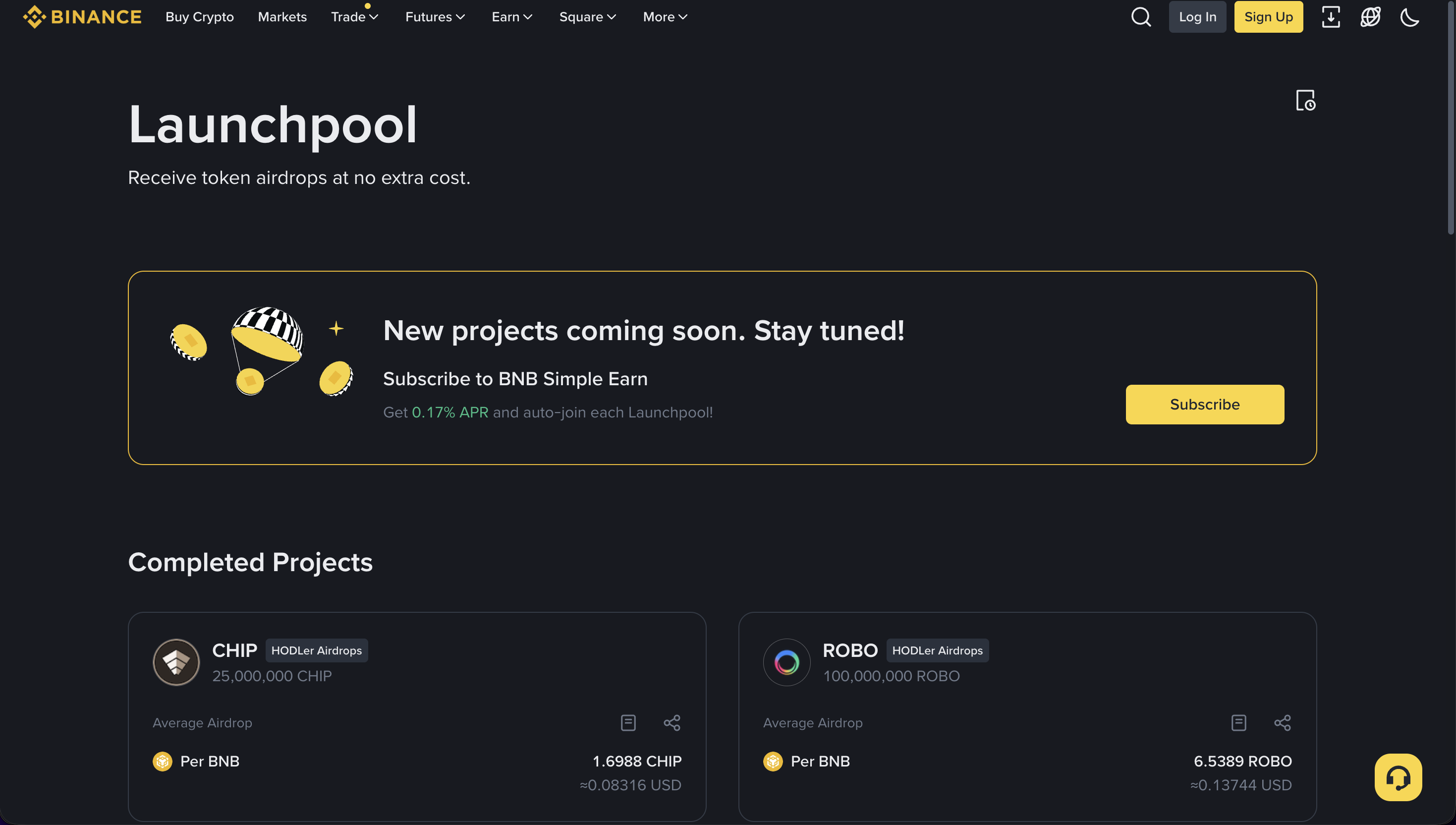
Launchpad and Launchpool access. BNB holders get priority access to Binance Launchpad token sales (where new projects launch via the platform) and yield from Launchpool (where users stake BNB to earn new project tokens during launch periods). Launchpad allocations have historically been one of the most reliably profitable launch mechanisms in crypto, though hit rates vary considerably by cycle.
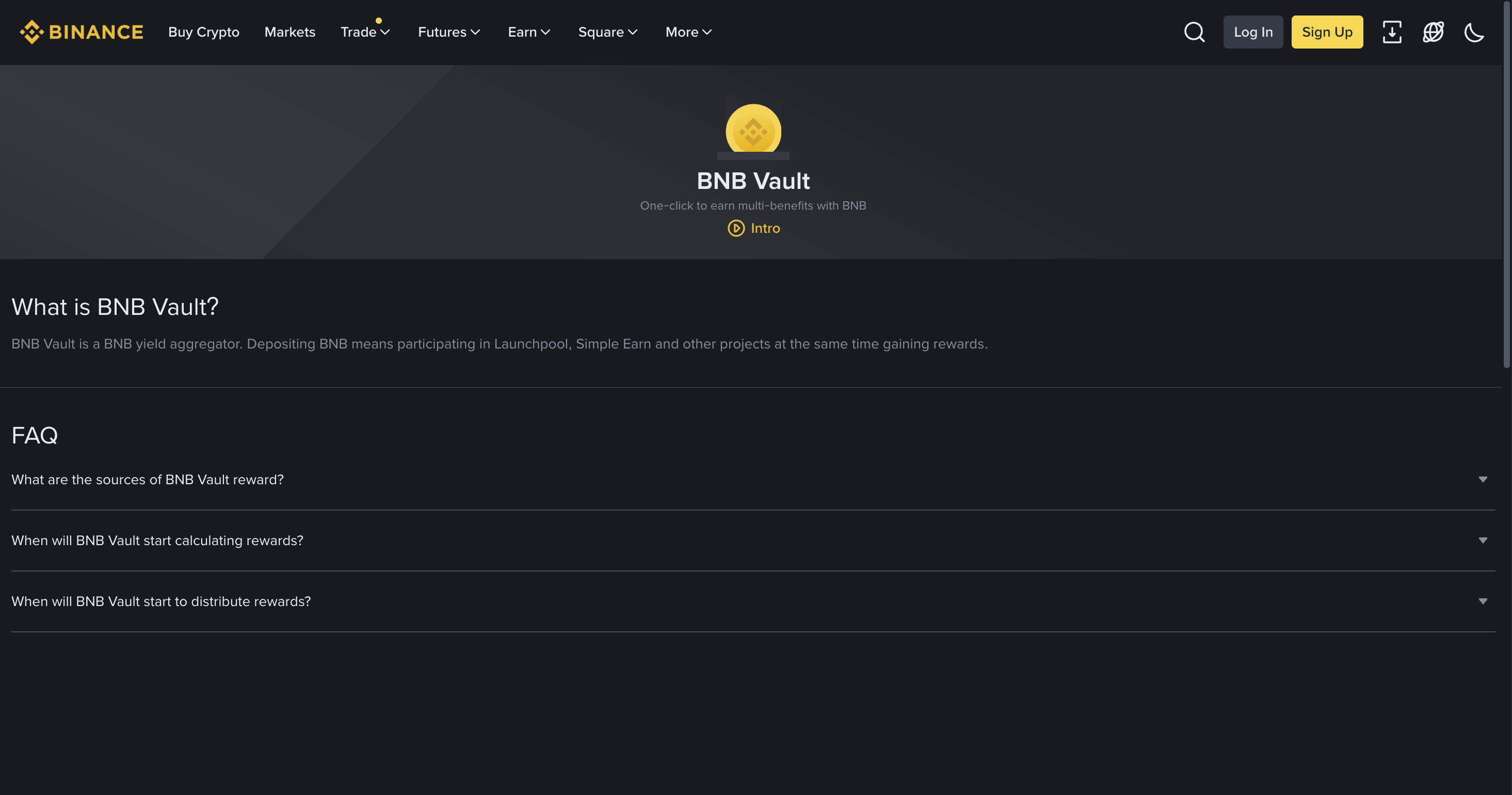
Earn products. BNB Vault aggregates multiple yield sources (staking, savings, Launchpool, DeFi staking) into a single product for BNB holders. The yield is variable but materially above plain savings rates.
Quarterly burn mechanism. Binance burns a portion of BNB supply quarterly based on platform revenue and on-chain activity, reducing the circulating supply over time. The burn is auditable and is part of the long-running thesis that BNB benefits from platform growth via supply reduction.
The break-even analysis for retail users: hold BNB if you would hold the token anyway as a speculative position, if your monthly trading volume is high enough that the 25 percent fee discount alone covers the price-risk exposure, or if you actively use Launchpad and Launchpool. For occasional users with low trading volume and no ecosystem participation, the math is marginal and the token price exposure is real.
Copy trading
Binance launched copy trading in 2023 as part of the post-settlement product expansion into structured retail features. The marketplace exposes the standard filters: 30-day PnL, win rate, follower count, AUM under management, average holding time, drawdown. The lead-trader pool is growing but is materially smaller than the dedicated copy-trading-first platforms (BingX, Bitget) and somewhat smaller than Bybit’s marketplace, which launched a year earlier and is more central to that platform’s product identity.
Lead-trader fees follow the standard CEX model: profit-share on net winning periods, typically 10-20 percent of follower profits, with losing periods paying the lead nothing while the follower still eats the loss plus underlying trading fees. The mechanics are comparable across venues; the implementation matters more than the headline split.
Binance’s copy trading is not the best CEX copy trading option in 2026. It is competent and integrated into the broader product surface, which makes it convenient for users who already have a Binance account and want copy trading as one tool among many. For users whose primary motivation is copy trading specifically, see our BingX copy trading guide or compare against Bybit (covered in our Bybit review). For users who want copy trading available within the deepest-liquidity CEX, Binance is acceptable.
Earn, Launchpad, ecosystem products
This is where Binance’s product surface materially exceeds every peer. The Earn category alone runs to dozens of distinct products covering staking, savings, structured payoffs, and yield aggregation. The Launchpad and Launchpool history is the deepest of any exchange-launched product platform, with a track record of token sales going back to 2019.
Binance Earn breadth. Locked staking (proof-of-stake assets including ETH, SOL, ADA, DOT, plus dozens of smaller pairs). Flexible savings (variable-rate liquid yield on stablecoins and majors). Dual investment (a structured-product family with option-payoff economics; read the payoff curves before allocating). BNB Vault (aggregated yield for BNB holders). ETH 2.0 staking (with bETH liquid staking representation). Auto-invest (DCA into chosen baskets). Range bound and shark fin products (option-payoff structures with capped upside and capped or unlimited downside, depending on the specific contract).
Launchpad. Token sale platform where new projects launch via Binance allocation to BNB holders. Historical hit rate is high but not uniform; allocations are typically small relative to demand and the post-listing performance varies by cycle. Launchpad has accounted for a meaningful share of BNB’s utility narrative across cycles.
Launchpool. Stake BNB or other listed tokens during a launch period and earn newly issued project tokens. Lower allocation per user than Launchpad but typically broader participation; the cumulative yield from active Launchpool participation has been one of the more reliable passive sources of new-token exposure for retail users.
Binance Pay. Peer-to-peer crypto payment system with zero fees on internal transfers. Useful for sending crypto to other Binance users (instant, no on-chain fees) and for accepting crypto payments from merchants in the Pay network.
Binance Card. Crypto debit card in supported regions (varies by jurisdiction; coverage is materially narrower than it was pre-settlement as the platform exited certain regional card partnerships). Spend crypto at any Visa-accepting merchant with on-the-fly conversion. Cashback in BNB on supported tier categories.
P2P trading. Direct buy/sell between users with Binance as escrow. Useful for fiat on-ramps in jurisdictions where bank-rail integrations are limited. Volume is concentrated in emerging markets and regions where bank-card on-ramps are constrained.
NFT marketplace. Smaller than peers (OpenSea, Magic Eden, Blur) and not a meaningful driver of platform activity in 2026.
Square (social) and Academy (education). Content surface that grew rapidly through 2023-2025; serves a discovery and education function more than a trading function.
The product surface is wide enough that most users do not exhaust it. The right framing is: pick the two or three products that match your strategy, ignore the rest, and revisit the unused surface periodically as your needs evolve.
KYC reality in 2026
The post-settlement compliance build-out tightened KYC across Binance materially through 2024 and 2025. As of 2026, Binance requires verification for essentially every meaningful account function. The tier structure:
| Tier | What it requires | What it unlocks |
|---|---|---|
| Unverified | Email only | Browse markets, view tutorials, no deposits, no trading |
| Verified | Government ID, liveness selfie, basic personal info | Spot trading, deposits, futures, copy trading, Earn, daily withdrawal cap |
| Verified Plus | Address proof, additional documentation | Higher daily withdrawal limits, expanded Earn access |
| Enhanced (case-by-case) | Source-of-funds, enhanced due diligence | Institutional features, OTC desk, highest withdrawal tier |
The unverified tier is functionally read-only for new accounts in 2026. The era of email-only meaningful trading on Binance ended with the post-settlement compliance updates in 2024. For practical purposes assume Verified is the floor for any retail workflow and Verified Plus is required for sustained volume.
Verification turnaround is typically minutes to a few hours for clean applications during normal load periods. During peak signup waves (major bull-run moves, new product launches) it can stretch to days. Government ID quality matters; mobile photos in good lighting and a clean liveness check usually pass on the first attempt.
Country availability
Binance’s geo-restrictions are extensive and update without much notice. The official restricted-country list is the canonical source; the summary below is the 2026 state at time of writing.
Not served at all (main platform): United States (since 2019; binance.com explicitly excludes US users and IPs are blocked at signup). Several other jurisdictions on the OFAC sanctions list.
Heavily restricted: United Kingdom (FCA rules restrict retail derivatives access; spot is available but with limitations). Netherlands (the platform exited the Dutch market in 2022 after failing to obtain registration with DNB). Canada (Binance announced its exit from the Canadian market in 2023). Singapore retail (regulatory restrictions through MAS).
Variable / regional caveats: Germany, France, Italy, Spain (now under MiCA regulation with platform-level adjustments). Japan (separate Binance Japan entity with limited product set). Hong Kong retail (restrictions through SFC). Australia (derivatives restrictions; spot available). Russia (technically available but with payment-rail constraints since 2022 sanctions). Turkey (available with regional product set). Brazil, Argentina, Mexico (available with regional features).
Binance.US (separate entity): US users are routed to Binance.US, covered in the next section. Binance.US is not a substitute for the global platform.
The practical takeaway: verify availability and product access directly on the platform before depositing material capital. The country list updates with regulatory changes and the restricted-features list (what is available in your jurisdiction once you sign up) can be narrower than the country-availability headline suggests.
Binance.US vs main Binance
Binance.US is a legally separate entity from the global Binance platform, structured as a US corporation operating under state-by-state money transmitter licenses. It launched in 2019 specifically to give US users a compliant on-ramp while the global platform formally excluded the US market. After the November 2023 DOJ settlement, the separation became more rigid; the global platform no longer accepts US users under any path.
The product surface on Binance.US is materially narrower than the global platform:
- Spot trading only. No perpetual futures. No options. No coin-margined products. No copy trading. No Launchpad. No Launchpool.
- Fewer assets. The listed-asset count is materially smaller (typically under 200 pairs vs 400+ on the global platform), driven by US securities-law considerations and state licensing constraints.
- Limited Earn. Some staking and savings products are available; the breadth is a fraction of the global Earn catalog.
- State-by-state availability. Several US states are not served at all (Hawaii, New York, Texas at various points, others). Verify state availability before signing up.
The 2023-2024 period was particularly difficult for Binance.US, with several state-level licensing actions, a partial banking-rail disruption when Silvergate and Signature Bank failed, and an SEC civil case (separate from the global DOJ settlement) that constrained operations during the active litigation window. The platform survived but emerged smaller and with fewer features than peer US venues.
in 2026 Binance.US functions as a Coinbase-lite alternative for US users rather than a true equivalent of the global Binance platform. For US-based traders, the better answer is typically a fully US-licensed venue with deeper local liquidity and broader product support: Coinbase (largest US-licensed venue, public company), Kraken (strong on derivatives via Kraken Futures), or Gemini (strong on compliance posture). If a user has a specific reason to use Binance.US (an existing account, a specific asset listing, BNB exposure), it works as a basic spot platform but should not be treated as equivalent to the global venue.
Security track record
Binance’s security history at the platform level is one of the cleanest in the industry given the platform’s scale and longevity. The single material incident occurred in May 2019, when attackers compromised an API-key cluster and drained approximately 7,000 BTC (worth roughly $40 million at the time) from one of Binance’s hot wallets. The platform absorbed the loss through its Secure Asset Fund for Users (SAFU), an insurance fund initially capitalized in 2018 with 10 percent of platform trading fees set aside specifically for incident coverage. No user lost funds. Withdrawals were paused for approximately one week during the investigation and security upgrade window.
The SAFU fund has been the standard reference for industry insurance-fund design and has been periodically topped up with platform capital. The publicly disclosed SAFU balance has been over $1 billion across multiple snapshots since 2022; the current balance is held primarily in BTC, USDT, BNB, and other major assets.
No other material platform-level security incident has occurred at Binance in the eight years since the 2019 event. User-side incidents (phishing, SIM swap, API key exposure on third-party services) have happened throughout, as they do at every CEX, but the platform-level operational security record is the longest clean stretch at scale in the industry. This is meaningful context against the 2025 Bybit exploit ($1.5 billion, covered in our Bybit review), the 2024 DMM Bitcoin exploit, and other recent major industry incidents.
Proof of reserves cadence is quarterly. Binance publishes Merkle-tree attestations covering user balances across major assets (BTC, ETH, USDT, USDC, BNB, and a rotating list of smaller assets), with attestations validated by independent third-party auditors. Users can verify their individual balance inclusion in the Merkle tree via the account interface. The proof of reserves does not cover liabilities outside the user-balance scope (operational debt, partner obligations, regulatory accruals); the user-facing assurance is on the asset side, which is the relevant side for custody risk.
The forward-looking custody assessment: standard CEX risk shape applies, broadly comparable to Bybit and OKX after each platform’s recent stress events. Binance has the longest clean operational record at scale, no major platform-level exploit since 2019, and the largest publicly disclosed insurance fund of any CEX. The regulatory tail under the five-year monitorship is a separate risk category. For long-term holdings the standard rule applies: keep on-platform only what is actively allocated to open positions, yield, or near-term trades; withdraw the rest to self-custody.
How Binance compares to Bybit, OKX, and Coinbase
Head-to-head context.
Versus Bybit. Binance wins on raw liquidity (the deepest top-pair order books in crypto), product surface (more Earn products, more Launchpad activity, BNB and BSC ecosystem, Pay, Card), and listing breadth. Bybit wins on derivatives execution feel for retail futures, options markets (one of few CEXs with usable BTC and ETH options liquidity), and copy trading marketplace maturity. Both share centralized custody risk. Bybit had a major operational stress event in February 2025 ($1.5 billion exploit, handled cleanly without user loss); Binance’s 2019 incident is older and smaller. See the Bybit vs Binance comparison.
Versus OKX. Both are top-tier CEXs with broad product surfaces and high liquidity on top pairs. OKX has a stronger native Web3 wallet integration and more developed on-chain DeFi access from inside the exchange UI. Binance has the larger derivatives book, the BNB and BSC ecosystem, and the Launchpad history. The platforms overlap considerably on retail use cases; the right choice often comes down to which token ecosystem (BNB vs OKB) and which regional access works for the user. See the OKX review.
Versus Coinbase. Coinbase is the only major US-licensed venue with comparable scale to Binance’s global operation, but the comparison is asymmetric in important ways. Coinbase is a publicly listed US company (NASDAQ: COIN) with quarterly SEC disclosures, full US compliance integration, and a Coinbase Custody product that is the institutional standard for US clients. Coinbase has narrower product surface than Binance (no perpetual futures for US retail outside Coinbase Derivatives Exchange; fewer Earn products; no Launchpad equivalent), higher headline fees, and a more conservative listing posture. For US-based users, Coinbase is the natural primary venue; for non-US users, the comparison hinges on whether full US regulatory compliance and public-company disclosure are worth the higher fees and narrower product surface. Many users hold accounts at both.
Versus KuCoin. KuCoin offers more long-tail altcoin breadth (700+ spot pairs vs Binance’s 400+), a more developed native trading-bot product, and the KCS daily revenue-share bonus. Binance offers deeper top-pair liquidity, broader Earn and Launchpad, and the BNB and BSC ecosystem. Different strategic positions; many active traders run accounts at both. See the KuCoin review and the head-to-head in our KuCoin vs Binance comparison.
Who should use Binance and who should not
Good fit.
- Active traders running material volume who benefit from the deepest top-pair liquidity and the BNB fee discount stack.
- Derivatives traders running futures at scale where order book depth and funding-rate availability matter.
- Users who want the broadest Earn surface in one venue (locked staking, flexible savings, dual investment, BNB Vault, ETH staking).
- BNB and BSC ecosystem participants: Launchpad users, BSC DeFi users, BNB holders who use the token for fee discount and Vault yield.
- International users in jurisdictions where Binance is available and Coinbase or Kraken is not.
Not a good fit.
- US-based users (the main platform excludes US entirely; Binance.US is a narrower product). Use Coinbase, Kraken, or Gemini.
- Users whose primary need is copy trading specifically. Use BingX or Bitget; see our BingX copy trading guide.
- Users prioritizing maximum altcoin breadth. KuCoin lists more long-tail pairs; see the KuCoin review.
- Users who prefer publicly listed, fully US-regulated venues with quarterly SEC disclosures. Use Coinbase.
- Users in jurisdictions where Binance restricts product access materially (UK retail derivatives, Netherlands, Canada).
- Users who want to avoid platforms operating under an active enforcement monitorship. The five-year DOJ monitorship runs into 2028-2029; if monitorship status is a deal-breaker, use a different venue.
Bottom line
In 2026, Binance is the largest and most product-complete cryptocurrency exchange in the world, operating under CEO Richard Teng after the November 2023 DOJ settlement and CZ’s transition to a non-executive advisory role. The platform has the deepest top-pair liquidity in crypto, the broadest product surface of any CEX (spot, perpetuals, options, margin, Earn, Launchpad, BNB and BSC ecosystem, Pay, Card, P2P), and the longest clean platform-level operational security record at scale. The $4.3 billion settlement closed the major US enforcement exposure but introduced a five-year independent compliance monitorship that is the meaningful forward-looking regulatory variable.
The 8.5 out of 10 score breaks down like this. Above Bybit on liquidity and product surface, comparable to OKX with different regional strengths, materially broader than KuCoin on Earn and ecosystem while narrower on long-tail altcoins. The score would be 9+ on operational and product factors alone; the monitorship tail and the geographic exclusions (US, Netherlands, Canada, UK retail derivatives) pull the headline number down. For a retail trader in a supported jurisdiction running a broad-product strategy with derivatives and Earn exposure, Binance is the strongest single venue in 2026.
For US-based traders, the answer is a US-licensed venue (Coinbase, Kraken, Gemini) rather than Binance.US, which is narrower than peer US exchanges. For copy-trading-first users, BingX or Bitget. For altcoin-breadth users, KuCoin. For everyone else operating in a supported jurisdiction, Binance is a credible primary venue with the standard CEX-custody hygiene rule applied: withdraw to self-custody what is not actively in use.
Open account: Register on Binance. See the affiliate disclosure for full detail.
Read next
- Bybit review. The derivatives-specialist alternative.
- KuCoin review. The altcoin-breadth alternative.
- OKX review. Comparable scale with different ecosystem positioning.
- KuCoin vs Binance. Head-to-head on altcoin breadth vs liquidity.
- Bybit vs Binance. Head-to-head on derivatives focus vs full-surface coverage.
- Best crypto exchanges for beginners 2026. Where Binance fits for new users.
- Methodology. How we evaluate platforms.
- Risk disclaimer.
Frequently asked questions
Is Binance safe to use in 2026?
Yes, with the same standard centralized exchange custody risk as any peer, plus a known regulatory tail. The platform has the longest clean operational track record at scale (no major platform-level exploit, the 2019 $40 million hot wallet incident was absorbed by the SAFU insurance fund without user loss) and publishes Merkle-tree proof of reserves on a quarterly cadence. The $4.3 billion DOJ settlement in November 2023 closed the major US enforcement exposure and the platform now operates under a five-year monitorship. Forward-looking risk is comparable to Bybit, OKX, and KuCoin on custody, with extra regulatory headline risk versus pure offshore venues.
What are Binance's fees?
Spot fees are 0.10 percent maker and 0.10 percent taker at default tier. Activating the BNB discount lowers both sides by 25 percent to 0.075 percent. Perpetual futures cost 0.02 percent maker and 0.05 percent taker at default. VIP tiers scale fees down based on 30-day rolling volume, reaching 0.012 percent maker and 0.024 percent taker on spot at VIP 9. Withdrawal fees depend on network; USDT on Tron is typically the cheapest meaningful path.
What happened with the DOJ settlement?
In November 2023, Binance and former CEO Changpeng Zhao (CZ) settled a multi-agency US investigation. The platform paid $4.3 billion across DOJ, CFTC, OFAC, and FinCEN, accepted a five-year independent compliance monitorship, and CZ resigned as CEO. CZ pleaded guilty to a Bank Secrecy Act violation, served a four-month prison sentence in 2024, and returned to a non-executive advisory role afterward. Richard Teng, formerly head of regional markets, took over as CEO. The settlement resolved most major US enforcement exposure for the platform itself.
Can US users use Binance?
Not the main global platform (binance.com). US users are routed to Binance.US, a legally separate entity with a different product set: spot trading only, fewer assets, no derivatives, no copy trading, and ongoing state-by-state licensing constraints. For US-based traders the better answer is typically a fully US-licensed venue (Coinbase, Kraken, or Gemini). Binance.US functions as a Coinbase-lite alternative rather than a true equivalent of the global platform.
Does Binance have copy trading?
Yes, launched in 2023 as part of the platform's expansion into structured retail products. The lead-trader marketplace is growing but is less central to Binance's identity than copy trading is to Bybit, Bitget, or BingX. The marketplace exposes standard filters (PnL, win rate, follower count, AUM) and uses the same profit-share model as peers. For traders whose primary motivation is copy trading specifically, see our [BingX copy trading guide](/blog/bingx-copy-trading-guide/). For users who want copy trading inside the broadest CEX product surface, Binance fits.
What is BNB and is it worth holding?
BNB is Binance's native utility token, one of the most consistent ecosystem-token success stories in crypto. It launched in the 2017 ICO at $0.15 and grew alongside the platform's market share. Utility includes a 25 percent trading fee discount on spot, gas on the BNB Smart Chain (BSC), Launchpad participation, and various Earn products. For active traders with monthly volume above $50K who would hold a token anyway, BNB usually pencils out. For occasional users the token price exposure typically exceeds the fee savings.
How does Binance compare to Bybit?
Versus Bybit, Binance wins on raw liquidity (the deepest top-pair order books in crypto), product surface (more spot pairs, more Earn variety, more launchpad activity, Pay, Card), and ecosystem reach through BNB and BSC. Bybit wins on derivatives execution feel for retail futures, options markets (one of few CEXs with usable BTC and ETH options), and copy trading marketplace depth. Both share centralized custody risk. See the [Bybit vs Binance comparison](/blog/bybit-vs-binance/) for the full head-to-head.
Does Binance require KYC?
Yes for any meaningful trading in 2026. After the DOJ settlement and the global compliance build-out that followed, Binance now requires verification for deposits, withdrawals beyond minimal caps, derivatives, copy trading, and most Earn products. The unverified tier is effectively read-only. Standard verification (government ID, liveness selfie) unlocks the bulk of platform features. Enhanced verification (address proof, source-of-funds at higher thresholds) unlocks institutional features and the highest withdrawal limits.
#Binance#exchange review#BNB#derivatives#spot#copy trading
Discussion
Loading comments…