
TL;DR: Binance still wins on selection, liquidity, and P2P depth for ARS pairs. Belo is the simplest one-click ARS-to-stablecoin path. Lemon combines a crypto debit card with ARS yield on idle balances. Buenbit offers a tighter trading interface for active users. Ripio fits cross-border Latam use cases. Most Argentines end up running two accounts: one local exchange (Belo, Lemon, or Buenbit) for fast ARS on-ramps, and one international platform (Binance or Bybit) for selection, derivatives, and P2P liquidity. Argentina sits in the global top three for crypto adoption per Chainalysis 2024 to 2025 reports, driven by peso devaluation and the role of USDT as the de facto household dollar.
Not financial advice. The peso has lost the majority of its purchasing power in successive devaluation cycles since 2018. Crypto adoption in Argentina is a response to local conditions, not a guarantee of future returns. Stablecoin counterparty risk, exchange custody risk, and regulatory shifts under the Milei administration are real. Verify country availability, complete KYC where required, and read the risk disclaimer before allocating real capital.
Quick ranking
| Rank | Platform | Best for | ARS rails | Affiliate |
|---|---|---|---|---|
| 1 | Binance | Selection, liquidity, P2P depth, derivatives | P2P, Mercado Pago | Not partnered |
| 2 | Belo | One-click ARS to stablecoin, simple UX | Direct bank, Mercado Pago | Not partnered |
| 3 | Lemon | Crypto debit card, ARS yield, savings use case | Direct bank, Mercado Pago, cash | Not partnered |
| 4 | Buenbit | Trading interface, order book, active users | Direct bank, Mercado Pago | Not partnered |
| 5 | Ripio | Latam ecosystem, cross-border, Aleph token | Direct bank, Mercado Pago | Not partnered |
| 6 | BingX | Copy trading depth, lower friction Standard tier | P2P only | Open BingX |
| 7 | KuCoin | Altcoin coverage, trading bots | P2P only | Open KuCoin |
| 8 | Bybit | Derivatives, copy trading, P2P alternative | P2P only | Open Bybit |
| 9 | Bitget | Copy trading depth, derivatives | P2P only | Not partnered |
| 10 | Fiwind | Fee-light local alternative, simple savings | Direct bank, Mercado Pago | Not partnered |
Risk disclaimer for Argentine users specifically
Argentine crypto users face three risk layers that users in stable currencies do not. First, peso volatility turns every ARS balance into a melting ice cube; the official rate moved from roughly 350 ARS per USD in late 2023 to around 1,200 ARS per USD by early 2025, per Banco Central de la República Argentina (BCRA) data, with inflation peaking at 211 percent in 2023 and 117 percent in 2024 (INDEC). Holding ARS for more than a few days is itself a risk position.
Second, regulatory shifts under the Milei administration have moved fast since December 2023. Capital controls were partly lifted in 2024 to 2025, the cepo cambiario (currency control regime) has been progressively dismantled for retail flows, and the Comisión Nacional de Valores (CNV) introduced the Virtual Asset Service Provider (PSAV) registry. This has reduced the USDT premium against the official rate from peaks above 30 percent in 2022 to roughly 0 percent in 2026, removing one of the historical incentives to hold stablecoins as an arbitrage instrument while preserving the dollar-saving use case.
Third, custody risk on local exchanges is non-trivial. Local exchanges hold client funds in custody (in most cases through international partners or qualified custodians), and the Argentine deposit insurance system (SEDESA) does not cover crypto balances. The 2022 Lemon Cash bug, where some users briefly saw negative balances reflected in their accounts, was resolved without user loss but illustrates the operational risk. Best practice for balances above 1,000 USDT equivalent is self-custody in a hardware wallet, with exchanges used for on-ramp, off-ramp, and active trading only.
The Argentine context: why crypto adoption hit top-three globally
Argentina ranks consistently in the top three globally for crypto adoption on the Chainalysis Global Crypto Adoption Index, alongside India and Vietnam, per the 2024 and 2025 editions. The country has an estimated 16 million crypto users in 2026, roughly 35 percent of the adult population, per local industry estimates compiled by NGO Bitcoin Argentina and ONG Argentina Fintech. The drivers are structural, not speculative.
Inflation as a forcing function. INDEC, the official statistics agency, reported headline inflation of 211 percent in 2023 and 117 percent in 2024, with monthly readings peaking near 25 percent in December 2023. Even with the Milei administration’s rapid disinflation through 2024 to 2025, the cumulative loss of peso purchasing power since 2018 is on the order of 99 percent in USD terms. For a wage earner, holding ARS in a bank savings account is a guaranteed real loss.
The dólar blue and its replacement by USDT. Historically, Argentines accessed dollars through the dólar blue (parallel cash market) at a premium of 30 to 100 percent above the official rate during the cepo years (2019 to 2023). Carrying physical USD bills was the household savings mechanism. From roughly 2021 onward, USDT replaced the dólar blue for an increasing share of retail savings. The convenience is decisive: a stablecoin balance is liquid 24/7, transferable across borders in minutes, and immune to bank holiday risk. The capital control relaxation under Milei reduced the spread between official, MEP, blue, and crypto dollar rates to under 5 percent by 2025 and to roughly 0 percent in 2026, removing the arbitrage motive but preserving the storage motive.
Remittances and freelance income. A significant share of Argentine workers receive income from abroad: software developers paid by US clients, content creators with international audiences, traders. Crypto rails compress the cost and time of receiving these payments compared to SWIFT or Western Union. A 5,000 USD freelance payment routed through USDT and converted to ARS at MEP rate on Binance P2P clears in under 30 minutes with effective costs below 1 percent, versus 1 to 3 days and 3 to 8 percent through traditional bank rails.
Mercado Pago as the ARS rail. Mercado Pago, the financial app spun off from Mercado Libre, has roughly 50 million accounts in Argentina (per Mercado Libre 2024 annual report). Almost every crypto exchange in Argentina, local or international, supports ARS deposits and withdrawals via Mercado Pago. The CVU (Clave Virtual Uniforme) standard, introduced by BCRA, gives every Mercado Pago account a bank-equivalent identifier that integrates with crypto exchanges.
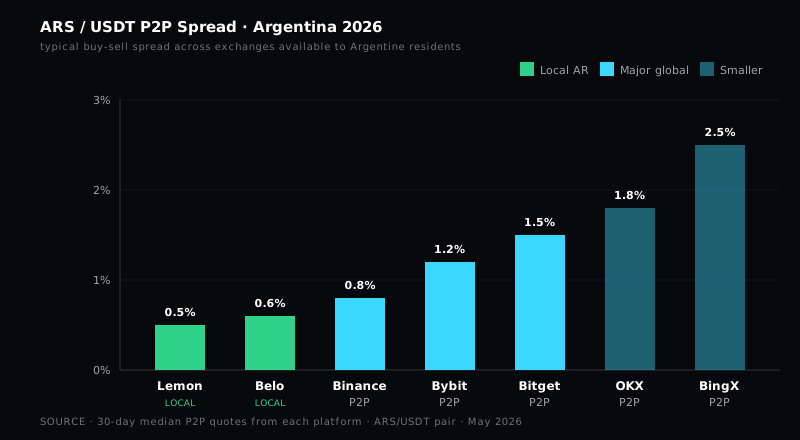
Local exchanges: Lemon, Buenbit, Belo, Ripio, Fiwind
The five major Argentine crypto exchanges all share a common shape: ARS fiat ramps, support for USDT and USDC, BTC and ETH, a yield product on idle stablecoin balances, optional crypto debit cards, CNV registration as PSAV, and Mercado Pago integration. The differences are in execution: fees, spreads, UX, yield rates, and breadth of supported assets.
Lemon
Founded: 2020. CNV PSAV: Yes (registered 2024). Headquarters: Buenos Aires.
Lemon is the consumer-finance crypto app most Argentines have heard of. The product wraps a crypto wallet, a Visa-branded debit card with crypto cashback, and an ARS savings product into a single mobile-first interface. The supported assets are the majors plus a curated long-tail (BTC, ETH, USDT, USDC, DAI, BNB, MATIC, DOT, and roughly 30 to 40 others as of 2026).
Pros
- Visa-branded debit card with 1 to 2 percent BTC cashback on purchases (cashback rate adjusts periodically)
- ARS savings rate on idle pesos (roughly Badlar minus 1 to 2 percent in 2026, automatic conversion)
- USDC yield product (around 4 to 6 percent APY in 2026, variable, sourced through DeFi protocols)
- Direct Mercado Pago and CVU deposit and withdrawal
- Cash deposit through Rapipago and Pago Fácil (with fees)
- Simple UX optimized for non-traders
Cons
- Trading interface is consumer-grade; no order book, no limit orders on most pairs in the standard tier
- Spreads on small trades are wider than Buenbit or international exchanges
- The 2022 negative-balance bug shook confidence; no user funds lost, but the incident is part of the historical record
- Asset selection thinner than international exchanges
Who Lemon fits: users who treat crypto as a savings vehicle, who want to spend stablecoin or BTC balances through a card, who value UX simplicity over trading depth.
Buenbit
Founded: 2018. CNV PSAV: Yes (registered 2024). Headquarters: Buenos Aires (with operations in Mexico, Peru).
Buenbit is the trader’s local exchange. The interface is closer to a CEX-style order book than to a consumer wallet, with limit orders, market orders, and (for selected pairs) a depth chart. The supported assets include the majors plus DAI prominently (Buenbit was an early DAI promoter in Argentina) and a wider altcoin set than Lemon.
Pros
- Order book and limit orders on majors and stablecoin pairs
- Tighter spreads on size compared to Lemon and Belo
- DAI-focused product line (Buenbit DAI was a Latam DeFi entry point in 2020 to 2022)
- ARS, USD, and stablecoin balances side by side
- Operations in three Latam jurisdictions (Argentina, Mexico, Peru) for users moving regionally
- Yield products on USDC and DAI (variable, generally 3 to 6 percent in 2026)
Cons
- 2022 partial layoffs and product reduction left some users uncertain about runway; the company has since stabilized but the memory persists
- No crypto debit card product (as of early 2026)
- Smaller marketing footprint than Lemon; less brand recognition
- Mobile UX is functional but less polished than Lemon
Who Buenbit fits: users who actively trade, who want order book access, who value a tighter spread on size, who hold DAI as a preferred stablecoin.
Belo
Founded: 2020. CNV PSAV: Yes (registered 2024). Headquarters: Buenos Aires.
Belo is the simplest ARS-to-stablecoin path among the local options. The product is built around one-tap conversion: paste an ARS amount, pick USDT or USDC, confirm. The card is Mastercard-branded with cashback in BTC or USDT depending on user preference, and Belo has invested in the gift card and travel money use cases that fit Argentine households.
Pros
- Cleanest one-tap UX for ARS-to-stablecoin conversion
- Mastercard-branded crypto debit card with cashback (rate varies, generally 1 to 4 percent depending on tier)
- Gift card store inside the app (Amazon, Apple, Spotify, Steam, redeemable with crypto balance)
- Travel money use case: load USDT, spend abroad through the card
- Direct Mercado Pago and CVU on-ramps
- Cash deposit through Rapipago
Cons
- Asset selection is narrow compared to Buenbit or international exchanges
- Trading interface is consumer-grade; no order book or advanced orders
- Yield rates on stablecoin balances are lower than DeFi-native alternatives
- Smaller team and operational footprint than Lemon
Who Belo fits: users who want a one-tap stablecoin savings app with a card and gift card use case, who don’t trade actively, who value UX simplicity.
Ripio
Founded: 2013. CNV PSAV: Yes (registered 2024). Headquarters: Buenos Aires (with operations in Brazil, Mexico, Colombia, Uruguay).
Ripio is the oldest crypto exchange in Argentina, with regional operations across Latam. The product includes Ripio Exchange (the trading interface), Ripio Wallet (consumer-facing), the LaChain blockchain initiative (a Latam-focused EVM chain), and the Aleph token. Ripio fits users who want the longest local track record and who operate across multiple Latam jurisdictions.
Pros
- Founded 2013, the longest local crypto track record in Argentina
- Operations in five Latam jurisdictions for cross-border users
- LaChain initiative and Aleph token for users interested in the Latam DeFi ecosystem
- Broad asset selection (majors plus a curated altcoin set, plus some Latam-specific listings)
- Direct ARS and Brazilian Real and Mexican Peso ramps for regional users
- Established compliance posture across multiple regulators
Cons
- UX is functional but less mobile-optimized than Lemon or Belo
- Aleph token has had volatile periods; not a strong value-storage asset
- Yield products less promoted than on Lemon
- Card product less developed than Lemon or Belo as of early 2026
Who Ripio fits: users who operate across multiple Latam countries, who value the longest local track record, who hold Aleph or are interested in LaChain, who want a regional rather than purely Argentine product.
Fiwind
Founded: 2021. CNV PSAV: Yes (registered 2024). Headquarters: Buenos Aires.
Fiwind is the lower-friction local alternative for users who want a clean savings-and-conversion app without the card or yield optimization complexity. The product is narrower than the four above but executes the core ARS-to-stablecoin path with competitive spreads and a simple UX. Fee structure is generally lighter than Lemon for pure conversion.
Pros
- Lower spreads on ARS-to-stablecoin conversion than Lemon or Belo at small size
- Clean, focused UX
- Direct Mercado Pago and CVU on-ramps
- Newer team, modern infrastructure
- CNV PSAV registered
Cons
- Smaller asset selection than competitors
- No card product as of early 2026
- Yield product is less developed
- Brand recognition is lower; smaller user base means less liquidity for larger trades
Who Fiwind fits: users who want a fee-light alternative for ARS-to-stablecoin conversion, who don’t need a card or extensive yield products.
International exchanges: Binance, Bybit, BingX, Bitget, KuCoin
International exchanges sit alongside local options in most Argentine portfolios. The trade-off is straightforward: international platforms offer more pairs, lower trading fees, derivatives access, and deeper liquidity, in exchange for routing ARS deposits through P2P rather than direct bank integration. Most users keep a local account for ARS on-ramp and an international account for trading and selection.
Binance
ARS rails: P2P (most liquid), direct Mercado Pago integration in some periods. CNV PSAV: Yes (registered 2024 to 2025).
Binance is the default international exchange for Argentines. The Binance P2P book for ARS-USDT is the deepest in Latam, with hundreds of active merchants quoting at any hour, typical spreads against the dólar MEP rate of 0.3 to 1 percent, and a settlement layer that includes Mercado Pago, CVU bank transfer, Banco Galicia, Brubank, and others. Binance also runs a direct Mercado Pago integration in some periods, simplifying the on-ramp further.
Pros
- Deepest P2P book for ARS in any major exchange
- Full spot, perpetuals, options, and structured product access
- Binance Card available in some Argentine tier paths
- BNB-based fee discount stack
- CNV PSAV registered, providing clearer legal standing than in many other Latam markets
Cons
- KYC mandatory in 2026 for essentially all functions; the email-only path of earlier years is closed
- 2023 SEC settlement (US) and ongoing regulatory pressure in other jurisdictions create some headline risk
- Customer support response time varies; large P2P disputes can take 24 to 72 hours
Bybit
ARS rails: P2P only. CNV PSAV: Not registered as of early 2026 (operating without local registration; users transact at their own risk).
Bybit is the strongest international alternative when Binance does not fit. The platform’s strengths are derivatives breadth (perpetuals with up to 200x leverage on majors, USDC-margined contracts, options on BTC and ETH), copy trading, and the BIT token’s 20 percent fee discount across spot and perpetuals. The ARS P2P book is smaller than Binance’s but functional, with merchants typically quoting within 1 to 2 percent of MEP.
Pros
- Strong derivatives surface
- Copy trading marketplace (one of the larger ones among CEXs)
- BIT token 20 percent fee discount
- Survived the February 2025 Lazarus exploit (~$1.5B) without user loss; recovery completed in 7 days
- Established brand and large global trader community
Cons
- Smaller ARS P2P book than Binance
- KYC mandatory in 2026 for essentially all functions
- Not CNV PSAV registered as of early 2026
Open Bybit if derivatives and copy trading are core to your strategy.
BingX
ARS rails: P2P only. CNV PSAV: Not registered as of early 2026.
BingX is the strongest copy-trading-first international option for Argentines. The marketplace is the deepest among crypto-native CEXs for copy trading specifically, the filter set is the most developed in the category, and the email-only Standard tier still works in 2026 in some jurisdictions (verify Argentina availability before depositing). The ARS P2P book is smaller than Binance or Bybit but functional.
Pros
- Deepest copy trading marketplace among crypto-focused CEXs
- Email-only Standard tier (where available) reduces onboarding friction
- Competitive base fees on perpetuals (0.020 percent maker / 0.050 percent taker)
- Strong filter set with drawdown caps, risk scoring, per-lead sizing
Cons
- ARS P2P book thinner than Binance
- September 2024 hot wallet exploit (~$44M, covered through reserves, no user loss) is in recent memory
- Smaller spot pair selection than KuCoin
Open BingX if copy trading depth and low-friction onboarding are core to your strategy.
Bitget
ARS rails: P2P only. CNV PSAV: Not registered as of early 2026.
Bitget is the closest competitor to BingX on dedicated copy trading depth, with a longer copy trading track record and a comparable marketplace. ARS P2P book is functional but smaller than Binance. Mandatory KYC in 2026.
Pros
- Dedicated copy trading product comparable to BingX
- Established crypto-native platform with broad spot and derivatives coverage
- Larger absolute lead trader pool than BingX (slightly)
Cons
- ARS P2P book thinner than Binance
- Filter set slightly less developed than BingX on advanced metrics
- KYC mandatory for all functions
KuCoin
ARS rails: P2P only. CNV PSAV: Not registered as of early 2026.
KuCoin sits in the international exchange stack for Argentines who run altcoin-heavy strategies. The platform supports roughly 700 spot pairs, the broadest altcoin coverage among major CEXs, and the trading bot stack is the most developed in the category. ARS P2P is functional but smaller than Binance.
Pros
- ~700 spot pairs, the broadest altcoin coverage of any major CEX
- Trading bot product (spot grid, futures grid, infinity grid, DCA, smart rebalance, smart trade) is the most developed among CEXs
- KCS token pays a daily bonus from platform revenue
Cons
- 2024 CFTC settlement tightened US geoblocking and KYC requirements globally
- ARS P2P book smaller than Binance
- Long-tail altcoin listing risk is real
Open KuCoin for the broadest altcoin selection and the deepest trading-bot stack.
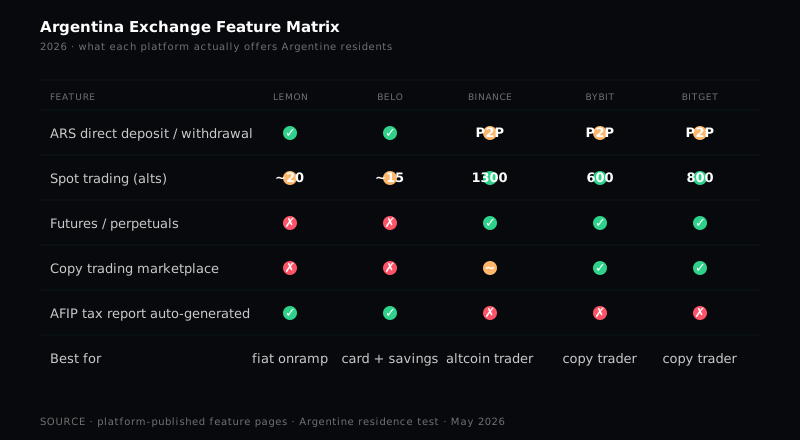
Tax framework: AFIP 2025 to 2026 updates
The Argentine tax framework for crypto operates on three layers as of 2026: the Régimen Informativo (mandatory reporting), Bienes Personales (wealth tax), and Ganancias (income tax). Local exchanges withhold and report automatically; international platforms shift the reporting burden to the user. The framework tightened progressively through 2024 to 2025, with AFIP (now ARCA after the 2024 reorganization, though the AFIP label persists in common usage) requiring more granular reporting from PSAV-registered exchanges.
Régimen Informativo (monthly reporting)
AFIP General Resolution 4614 and its 2024 to 2025 amendments require PSAV-registered exchanges to report client transactions exceeding ARS 200,000 in a calendar month. The report includes the client’s CUIT (tax ID), the type of operation, the ARS-equivalent value, and the counterparty where applicable.
What this means practically: if your monthly buy or sell volume on a local exchange exceeds ARS 200,000 (roughly 200 USD at 2026 official rates), the exchange forwards your CUIT and operation details to AFIP. International exchanges that are not PSAV-registered do not report directly; the user is expected to declare these movements voluntarily in the annual Ganancias filing. P2P transactions are not reported by the exchange but may surface to AFIP through bank-side AML reporting on the ARS leg.
Bienes Personales (wealth tax)
Bienes Personales is the Argentine wealth tax applied annually on December 31 to total household assets above the non-taxable minimum. The 2024 to 2025 reforms under the Milei administration raised the minimum and reduced rates, with the 2026 minimum standing at roughly ARS 27 million for individual residents (subject to indexation). Crypto holdings are included in the asset base, valued at the December 31 ARS-equivalent price.
Tax rates are progressive: roughly 0.5 percent at the entry tier, scaling up to around 1.25 percent on the largest holding brackets. For an Argentine resident with total household assets (including real estate, bank balances, vehicles, and crypto) above the threshold, year-end crypto valuation matters meaningfully for the tax bill.
Ganancias (income tax)
Realized gains on crypto trades are subject to Ganancias income tax under the schedular regime that applies to financial income. The 2024 to 2025 reforms simplified some treatment but kept the basic structure: profits from buying low and selling high in ARS terms are taxable income; losses can offset gains within the same category but not against other income sources.
For local exchange users, the exchange withholds a percentage at source on sell operations above certain thresholds. For P2P and international exchange users, the reporting and payment obligation falls on the user via the annual sworn declaration (declaración jurada). Many Argentine accountants advise treating crypto activity as a separate ledger maintained throughout the year, with screenshots, transaction hashes, and exchange statements archived for audit defense.
USDT and USDC for peso protection: the household savings vehicle
Stablecoins replaced the dólar blue as the de facto Argentine household savings instrument over the 2021 to 2026 period. The mechanics are simple: convert ARS to USDT or USDC, hold the stablecoin in a wallet (exchange-custody or self-custody), convert back to ARS only when needed for spending. The result is dollar-denominated savings without the friction of physical USD cash, MEP dollar settlement, or offshore bank accounts.
USDT versus USDC. Both stablecoins are pegged 1:1 to the USD and trade at effectively the same ARS-equivalent price on Argentine exchanges. USDT (Tether) has deeper global liquidity, broader exchange support, and lower transfer fees on the Tron network; USDC (Circle) has cleaner regulatory posture, full attestation reports, and stronger banking backing. Many Argentines hold a mix: USDT for trading liquidity and Tron-network cheap transfers, USDC for the storage portion of savings where regulatory clarity matters.
Yield products on stablecoins. Local exchanges offer ARS-equivalent yield on idle USDC (and sometimes USDT and DAI) balances, typically in the 3 to 6 percent APY range as of 2026. The underlying is generally a DeFi protocol or institutional lending desk. The yield is not insured and is not equivalent to a bank deposit; users should treat it as risk-bearing capital, not a savings account.
The premium history. From roughly 2020 to 2022, the crypto dollar rate (USDT-ARS on Argentine exchanges) traded at a premium of 5 to 30 percent above the official rate, reflecting the cepo cambiario gap. By 2023 to 2024 the premium narrowed, and by 2026 the spread between official, MEP, and crypto dollar rates has compressed to roughly 0 percent. This removes the arbitrage motive that drove some of the 2020 to 2022 adoption growth but preserves the more fundamental storage motive: users buying USDT to save in dollars, not to capture spread.
Counterparty and regulatory risk. Tether (USDT) has historically faced questions about reserve composition and has settled with regulators on disclosure terms. Circle (USDC) has cleaner attestations but faced a March 2023 depegging event when SVB collapsed and Circle had exposure (USDC traded as low as 0.87 USD intraday before recovering). For Argentine savers, the lesson is that stablecoins are not zero-risk; some portion of household savings should remain in non-stablecoin form, whether physical USD, bank-held USD where accessible, or Bitcoin.
P2P landscape: how dollars actually move
P2P trading on Binance, Bybit, Bitget, and OKX is core to how crypto actually flows for Argentine users. The mechanics: a merchant lists an offer to buy or sell USDT for ARS at a specified price and through specified payment methods; a counterparty accepts; the exchange escrows the USDT until the ARS payment confirms, then releases. Settlement is typically 5 to 30 minutes for Mercado Pago, longer for bank transfers.
Binance P2P specifics
The Binance P2P book for ARS-USDT is the deepest in Latam. As of early 2026, the platform typically shows 200+ active sell offers and 200+ active buy offers at any time of day, with merchants ranked by completion rate, average release time, and total trades completed. Top merchants (1,000+ trades, 95 percent+ completion rate, sub-5-minute average release time) quote prices within 0.3 to 1 percent of the dólar MEP rate.
Payment methods accepted. Mercado Pago, CVU bank transfer, Banco Galicia transfer, Brubank, Naranja X, Ualá, Personal Pay, and others. Some merchants accept cash pickup in Buenos Aires, Córdoba, Rosario, and Mendoza, though this carries higher counterparty and AML risk.
Risks.
- Merchant cancellation. Some merchants cancel orders after the buyer pays if the price moves against them. Binance’s dispute system generally favors the user who can prove payment, but resolution can take 24 to 72 hours.
- Payment reversal scams. A scammer initiates a Mercado Pago payment, sees the USDT released, then claims unauthorized transaction with their bank and reverses the ARS payment. Experienced users stick with merchants who have long histories and avoid first-time counterparties for large amounts.
- AFIP visibility. Bank-side AML reporting can flag large ARS transfers to or from frequently used CUITs. Splitting payments across multiple methods and merchants reduces single-counterparty visibility but adds operational complexity.
Mercado Pago versus bank transfer
Mercado Pago is faster (often under 5 minutes for the ARS leg) and has wider merchant acceptance on P2P. Bank transfers are slower (often 1 to 24 hours depending on the source bank and time of day) but are sometimes preferred by merchants for large amounts because of lower reversal risk. The general rule for users:
- Small to medium amounts (under 500 USD equivalent): Mercado Pago for speed
- Large amounts (above 500 USD equivalent): split between Mercado Pago and direct bank transfer, or use a single merchant with a strong reputation
- Very large amounts (above 5,000 USD equivalent): consider routing through multiple smaller transactions over a few days, or use a dedicated OTC service
Cash settlement
Some Binance P2P merchants in major Argentine cities offer cash settlement: the buyer brings physical ARS to a meeting point (typically a downtown office or financial district café), the merchant releases USDT once the cash is confirmed. This route is faster than bank transfers and leaves no digital trail on the ARS side, but it carries physical-security risk and is most relevant for users with specific reasons to avoid digital ARS transfers.
Recommendations by use case
The right exchange stack depends on what you actually use crypto for. Most Argentine users fit one of five profiles below.
Saving in dollars (the household savings use case)
Stack: Belo or Lemon for the ARS-to-stablecoin conversion, plus self-custody (Ledger, Trezor, or a software wallet like Trust Wallet or Phantom) for the held balance.
Convert ARS to USDC weekly or monthly through the local app, withdraw to self-custody once balances exceed roughly 1,000 USD equivalent, keep a working balance on the exchange for short-term liquidity. Optional: enable the local yield product on a portion of the balance, with clear understanding that the yield is risk-bearing.
Active trading
Stack: Buenbit for ARS on-ramp and basic trading, Binance for selection and depth, Bybit for derivatives.
Use Buenbit to convert ARS to USDT, withdraw to Binance or Bybit for the actual trading, keep enough ARS or USDT on Buenbit for the on-ramp cycle. For copy trading specifically, route to BingX or Bitget. Maintain at least two exchanges to handle outages on any single platform.
Small portfolio (under 1,000 USD equivalent)
Stack: Belo or Lemon only.
At this size the friction of multiple accounts outweighs the marginal benefit. Pick one local app, use it as a unified wallet, accept the higher spread as the cost of simplicity. Self-custody can wait until the portfolio is larger.
Large portfolio (above 10,000 USD equivalent)
Stack: Binance for active management, self-custody hardware wallet for the held portion, optional secondary local exchange for ARS on-ramp and off-ramp redundancy.
Keep no more than 10 to 20 percent on any single exchange. Use the hardware wallet for the storage portion; never hold the storage portion on the on-ramp local exchange. Maintain CUIT records and a year-by-year ledger for the Ganancias filing.
Receiving from abroad (freelance income, remittances)
Stack: Binance or Bitget for USDT receipt from international clients, Binance P2P for ARS conversion when needed.
Have the client pay USDT on Tron or Ethereum directly to your exchange address. Convert to ARS through P2P when you need to spend pesos. For users with regular USD-equivalent income above 1,000 USD per month, this route is faster and cheaper than SWIFT or Western Union.
How to get started: step-by-step
The first crypto account is the hardest. Once the on-ramp is set up, the workflow becomes routine. The path below assumes a beginner with no prior crypto account.
Step 1: Pick a local exchange and complete KYC
Choose one of Lemon, Belo, Buenbit, Ripio, or Fiwind based on the use case. Download the app, sign up with your email, complete the KYC flow (DNI photo, selfie verification, address confirmation). Allow 24 to 72 hours for full verification; most apps approve standard tier within a few hours during business days.
Step 2: Fund with ARS
Link your bank account or Mercado Pago to the exchange. Transfer ARS through the app’s deposit flow. Verify the deposit appears in the exchange balance before proceeding. For first-time users, start with a small amount (under 50,000 ARS) to confirm the flow works before committing larger sums.
Step 3: Buy USDT or BTC
Inside the app, open the buy or convert flow. Pick USDT (for dollar-equivalent savings or trading) or BTC (for long-term storage with upside exposure). Confirm the ARS-to-crypto rate; verify the spread is within expected range (typically 0.5 to 2 percent on local apps). Execute the trade.
Step 4: Choose between custody and self-custody
For small balances (under 1,000 USD equivalent), exchange custody is reasonable. For larger balances, set up a hardware wallet (Ledger or Trezor) or a high-quality software wallet (Trust Wallet, Phantom for Solana, Rabby for EVM). Practice receiving and sending a small test amount before moving the full balance.
Step 5: Set up an international exchange (optional but recommended)
If you trade actively or want more selection, open a Binance or Bybit account. Complete KYC. Fund the international account by either transferring USDT from the local exchange (small fee, minutes) or buying USDT through Binance P2P (slightly better rate but operational complexity).
Step 6: Document for AFIP
Save monthly account statements from every exchange. Note every ARS-to-crypto and crypto-to-ARS conversion with date, amount, and ARS-equivalent value. For users approaching the Bienes Personales threshold or the monthly Régimen Informativo reporting threshold, consult an Argentine accountant before the year-end deadline.
Bottom line
The Argentine crypto market in 2026 sits in a different place than it did in 2022. The capital control relaxation under the Milei administration compressed the USDT premium against the official rate from peaks above 30 percent in 2022 to roughly 0 percent in 2026, removing the arbitrage motive but preserving the more durable storage motive. Argentines hold USDT and USDC as the household dollar because the alternative (peso held in a bank savings account) is a guaranteed real loss against 117 percent inflation in 2024 and ongoing year-on-year erosion.
For most users, the right stack is a local exchange for ARS on-ramps and off-ramps, plus an international platform for selection and depth. Binance leads the international side on liquidity and P2P. Belo, Lemon, Buenbit, Ripio, and Fiwind cover the local side with different specializations: simple stablecoin conversion (Belo, Fiwind), card and yield (Lemon), trading interface (Buenbit), or Latam regional reach (Ripio).
The single discipline that matters more than the exchange pick: maintain self-custody for any held balance above what you would lose without consequence, keep a CUIT-tagged ledger of all crypto activity for AFIP, and treat stablecoin yield products as risk-bearing capital rather than savings accounts. The exchange is a rail, not a wallet; the wallet you control is your actual position.
Compare exchange fees to size your trading cost across local and international platforms.
See the affiliate disclosure and methodology for how this ranking was compiled.
Read next
- How to buy crypto in 2026. Beginner walkthrough applicable to Latam users.
- USDT vs USDC 2026. The stablecoin selection decision.
- Best crypto exchanges for beginners 2026. Start here if you are new to exchanges.
- Fees calculator. Compare effective costs across exchanges.
- Methodology. How we evaluate platforms.
- Risk disclaimer.
Frequently asked questions
Which crypto exchange is best in Argentina 2026?
Binance still leads on selection, spot and derivatives depth, and P2P liquidity for ARS in 2026. For one-click peso-to-stablecoin conversion and a clean local UX, Belo is the simplest. Lemon adds a crypto debit card and ARS yield on idle balances, while Buenbit suits users who want a tighter trading interface on top of fiat ramps. Ripio fits cross-border Latam use cases. Most Argentines end up with two accounts: one local (Belo, Lemon, or Buenbit) for fast ARS rails, and one international (Binance or Bybit) for selection and P2P. See the ranked list below.
Can I buy Bitcoin in pesos directly?
Yes. Lemon, Buenbit, Belo, Ripio, and Fiwind all accept ARS via Mercado Pago, CVU bank transfer, and (in some cases) cash through Rapipago or Pago Fácil. Binance accepts ARS through P2P with hundreds of merchants and through Mercado Pago integration. The local apps quote you a single ARS-to-BTC price including spread; on Binance P2P you see the live rate. Most Argentines route ARS through a local exchange first because the on-ramp is faster, then move USDT or BTC to a larger international platform for trading.
Lemon vs Buenbit, which is better?
Lemon if you want the integrated card and ARS yield product on idle stablecoins (around 4 to 6 percent on USDC, variable). Buenbit if you trade more actively and want a tighter exchange interface with order book access, more pairs, and tighter spreads on size. Both are CNV-registered Virtual Asset Service Providers (PSAV in Spanish), both support ARS deposits via bank and Mercado Pago, both let you withdraw to external wallets. The right pick depends on whether you treat crypto as savings (Lemon) or as a trading instrument (Buenbit).
Is USDT the best way to save in dollars in Argentina?
For most retail savers, yes, with caveats. USDT on Tron or Ethereum lets you hold dollar-pegged value in a wallet you control without the friction of MEP dollar settlement or cash dollar custody. The 2024 to 2025 capital control relaxation under the Milei administration reduced the USDT premium against the official rate from peaks above 30 percent in 2022 to roughly 0 percent through 2026, per LaBitConf and CoinDesk reporting. Counterparty risk on Tether and stablecoin regulatory shifts remain the main risks; some users split between USDT and USDC for redundancy.
Does Binance work in Argentina?
Yes. Binance operates in Argentina with full P2P, spot, and derivatives access. ARS deposits route through P2P merchants or, in some periods, through direct Mercado Pago integration. KYC is required at sign-up for most functions in 2026. Binance is registered with the CNV under Argentina's Virtual Asset Service Provider regime as of 2024 to 2025, which gives it clearer legal standing than in many other Latam jurisdictions. The main reason Argentines use Binance is selection and P2P liquidity that local exchanges cannot match.
How are crypto profits taxed by AFIP in 2026?
Three layers apply. First, Régimen Informativo: any monthly crypto movement above ARS 200,000 must be reported by the exchange to AFIP under General Resolution 4614 and its 2024 to 2025 updates. Second, Bienes Personales (wealth tax) applies to crypto holdings above the non-taxable minimum of ARS 27 million at year-end, scaled to total household assets. Third, Ganancias (income tax) applies to realized profits at the standard progressive rates. Local exchanges withhold and report automatically; international platforms shift the reporting burden to the user. Consult an Argentine accountant for your specific case.
Can I cash out crypto to a local bank?
Yes. Lemon, Buenbit, Belo, Ripio, and Fiwind all let you sell crypto for ARS and withdraw to a Argentine bank account or CVU via the standard 24 to 48 hour rails. Withdrawal limits depend on KYC tier and on your monthly volume relative to the Régimen Informativo threshold (ARS 200,000). For larger withdrawals, P2P on Binance, Bybit, or Bitget pays the dólar MEP rate directly into Mercado Pago or a bank account, often within minutes; the trade-off is counterparty risk on each individual merchant.
What about P2P trading in Argentina?
P2P is core to how crypto actually flows in Argentina. Binance P2P is the most liquid market, with hundreds of merchants quoting ARS-USDT prices typically within 1 percent of the dólar MEP rate as of 2026. Bybit, Bitget, and OKX run smaller but functional P2P books. Common payment methods include Mercado Pago, CVU transfer, Banco Galicia, Brubank, and cash pickup. The main risks are merchant cancellation, payment reversal scams, and AFIP visibility on large bank transfers; experienced users prefer Mercado Pago for speed and stick with merchants who have 1,000+ completed trades and 95 percent+ completion rate.
#Argentina#exchanges#Lemon#Buenbit#Ripio#Belo#ARS#USDT
Discussion
Loading comments…