
Not financial advice. This is educational content, not a recommendation to buy, sell, or hold any asset. Crypto is highly volatile and you can lose your entire investment. Neither DCA nor lump sum investing guarantees a profit or protects against loss. Always do your own research (DYOR) and consult a qualified financial advisor. Read the risk disclaimer before continuing.
The short answer
If you searched “DCA vs lump sum,” you want to know which one makes more money. The honest answer has two halves. On the math, lump sum wins more often, because crypto and markets trend up over time and money invested earlier has longer to grow. On the behavior, DCA wins for most people, because it removes the impossible job of timing the market and makes a volatile asset easier to hold without panic.
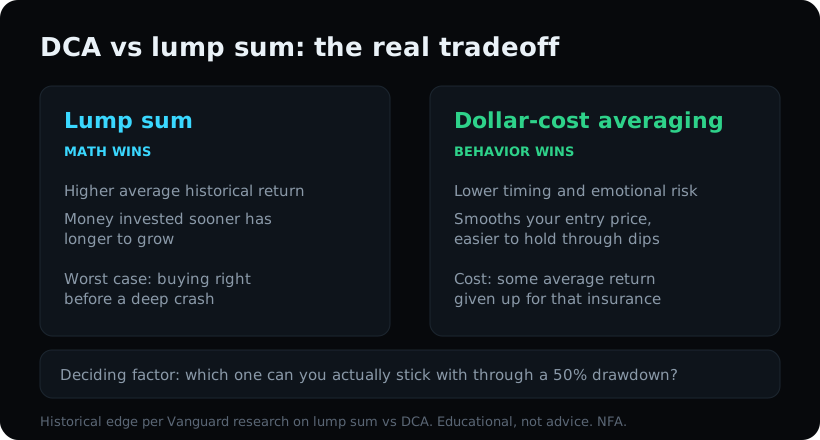
So the real question is not “which has the higher average return.” It is “which one will you actually stick with through a brutal drawdown.” For someone investing from a monthly salary, that is almost always dollar-cost averaging. For someone sitting on a lump of cash who can genuinely hold through a 50 percent drop, lump sum has the historical edge. Model both with our DCA calculator before you decide.
Key takeaways
- Lump sum has higher average historical returns because markets spend more time rising than falling.
- DCA reduces timing risk and emotional risk, which is why most real investors stick with it.
- DCA does not reduce market risk. You can still lose money accumulating a falling asset.
- The deciding factor is behavioral: which strategy lets you hold through a crash without selling.
- Automate it and size it so you never have to stop buying at the worst moment. NFA. DYOR.
What each strategy actually is
Dollar-cost averaging (DCA) means investing a fixed amount on a fixed schedule, regardless of price. Fifty dollars every Monday, say, whether Bitcoin is up or down. You buy fewer coins when prices are high and more when they are low, which smooths your average entry price over time.
Lump sum means investing all the capital you have available right now, in one go. If you have 5,000 dollars to allocate, you put it to work today rather than spreading it over the next year.
The two are not opposites in spirit. Both can be paired with a long holding period and good risk management. The difference is purely about timing of entry: all at once, or spread out.
What the data actually says
Here is the part most “DCA is always safer” articles skip. On average, lump sum wins. Vanguard’s well-known research on traditional markets found that investing a lump sum beat dollar-cost averaging roughly two-thirds of the time over twelve-month windows. The reason is simple and applies to crypto too: assets that trend upward reward money that is exposed to them sooner. Every month you hold cash on the sidelines waiting to DCA is a month that money is not growing.
So why does anyone DCA? Because “on average” hides the worst case. The average case is a calm uptrend. The worst case is putting your entire stake in the week before a 70 percent crash, which crypto delivers regularly. DCA trades away some of that higher average return in exchange for never being fully exposed at a single bad price. It is insurance, and like all insurance, it has a cost.
When DCA is the right call
- You invest from income. If your money arrives monthly, you are a natural DCA investor. You cannot lump-sum money you do not have yet, and waiting to save it all up just adds timing risk.
- You are new and emotional about volatility. If a sharp drop right after buying would make you sell, DCA protects you from your own worst instinct.
- The asset is extremely volatile. Crypto’s deep drawdowns make the worst-case timing of a lump sum genuinely painful. Spreading entry softens that.
- You value sleeping at night. Lower regret has real value even if it is not on a return chart.
When lump sum makes sense
- You have cash sitting idle and a long horizon. If you can hold for years and stomach a big early drop, the historical odds favor putting it to work now.
- You can actually hold through a crash. This is the whole game. Lump sum only wins if you do not panic-sell at the bottom.
- You already have strong risk management. A position sized correctly is easier to hold, which makes lump sum survivable. Our crypto risk management basics cover sizing.
A common middle path: split a windfall into a few tranches over a few weeks or months. You capture most of the lump-sum edge while limiting the worst-case entry. It is not optimal on paper, but it is optimal for staying invested.
How to DCA without sabotaging it
The strategy is simple. The execution is where people fail. Three rules:
- Automate it. Set a recurring buy so the decision is made once. The whole point of DCA is removing emotion, and a manual buy you can skip defeats that. BingX and KuCoin both offer scheduled buys.
- Size it to survive. Pick an amount you can keep buying through a long red stretch, because that is exactly when DCA earns its keep. If a downturn forces you to stop, the strategy breaks.
- Do not secretly market-time. The moment you start skipping buys because it “feels too high” or doubling up because it “feels low,” you are no longer DCA-ing, you are guessing. Pick the schedule and follow it.
Before you commit real money, run the numbers. Our DCA calculator lets you model different amounts, frequencies, and start dates against real price history so you can see the tradeoff for yourself. For choosing what to accumulate in the first place, see our best crypto to buy watchlist, and if you are brand new, start with how to start crypto trading.
The bottom line
Lump sum is the higher-expected-return strategy. DCA is the higher-probability-of-sticking-with-it strategy. For most people, especially in an asset as volatile as crypto, the one you can actually follow beats the one that looks better in a backtest. Pick the approach that keeps you invested through the ugly months, automate it, and size it so you never have to stop.
Not financial advice. Nothing above is a recommendation to invest. Neither DCA nor lump sum guarantees a profit, and crypto can lose all its value. Do your own research and speak to a qualified advisor before investing. Read the full risk disclaimer.
Frequently asked questions
Is DCA or lump sum better for crypto?
It depends on what you are optimizing for. On pure historical math, lump sum wins more often because markets and crypto trend up more than they fall, so money invested earlier usually has longer to grow. On risk and behavior, DCA wins because it removes timing pressure, cuts the chance of buying everything right before a crash, and is easier to stick with. For most people investing from a salary, DCA is the realistic choice.
Does dollar-cost averaging actually reduce risk?
It reduces timing risk and emotional risk, not market risk. By spreading purchases over time, you avoid putting your entire stake in at a single price, which lowers the damage of buying at a local top. What it does not do is protect you from a long bear market, since you are still accumulating an asset that can keep falling. DCA smooths your entry, it does not guarantee a profit.
Why does lump sum beat DCA in studies?
Because markets rise more often than they fall. Vanguard's research on traditional markets found lump sum outperformed dollar-cost averaging roughly two-thirds of the time over twelve-month periods, simply because cash invested sooner spends more time exposed to an upward trend. The same logic applies to crypto over its history, but crypto's larger drawdowns make the average-case edge feel very different from the worst case.
How often should I DCA into crypto?
Frequency matters less than consistency. Weekly, biweekly, or monthly all work, and the differences in long-run results are small. The bigger decisions are how much per buy and for how long. Pick an amount you can sustain through a downturn without stopping, automate it so emotion stays out of it, and use our DCA calculator to model different schedules before you commit.
Can I lose money with dollar-cost averaging?
Yes. DCA is an entry method, not a safety guarantee. If the asset keeps falling over your entire accumulation period and never recovers, you lose money even buying the whole way down. DCA improves your average entry relative to a single badly-timed buy, but it cannot make a losing asset profitable. This is general information, not advice, and crypto can go to zero.
Should I DCA a windfall or invest it all at once?
This is the one case where the math and the psychology disagree most. Historically, investing a windfall as a lump sum has higher expected returns. But if a 50 percent drawdown right after would make you panic-sell, splitting it into a few tranches over weeks or months buys you behavioral insurance at the cost of some expected return. The right answer depends on whether you would actually hold through the drop.
Where can I set up recurring crypto buys?
Most large exchanges offer recurring or auto-invest features. [BingX](https://bingx.com/partner/nftheads/) and [KuCoin](https://www.kucoin.com/r/af/CXEBGAS3) both support scheduled buys, and many let you automate a fixed amount on a set day. Automating removes the temptation to skip buys when the market looks scary, which is exactly when DCA does its job. This is general information, not a recommendation to buy any asset.
#DCA#dollar-cost averaging#lump sum#strategy#risk management#guide
Discussion
Loading comments…