
Democrats won control of both the House and the Senate in the 3 November 2026 midterms, and the crypto industry spent more than 170 million dollars this cycle trying to shape races like these. So is this bad news for crypto? Partly. New pro-crypto laws just got much harder to pass. But the people who write most of the day-to-day rules did not change, and Bitcoin did not fall on the news.
The short version: expect a frozen Congress, active regulators and a lot of hearings. Below is who now decides what, and three scenarios for 2027 with what would have to happen for each.
Not financial advice. Election results were still being finalized as of 5 November 2026. The scenarios below are conditional, not predictions, and we do not publish price targets. Crypto is volatile, and political news is only one of many things that move it.
What actually changed
The new Congress starts on 3 January 2027, so nothing shifts this week. House Democrats are expected to make Hakeem Jeffries Speaker. In the Senate they flipped enough Republican seats for a majority, including Ohio, where Sherrod Brown won despite heavy crypto industry spending against him.
The committee chairs matter most for crypto. Elizabeth Warren, the industry’s best-known critic in the Senate, is seen as the frontrunner to chair Senate Banking. Maxine Waters is expected to return as chair of House Financial Services, although leadership decisions are pending and Sean Casten may challenge her for the post.
What did not change matters just as much.
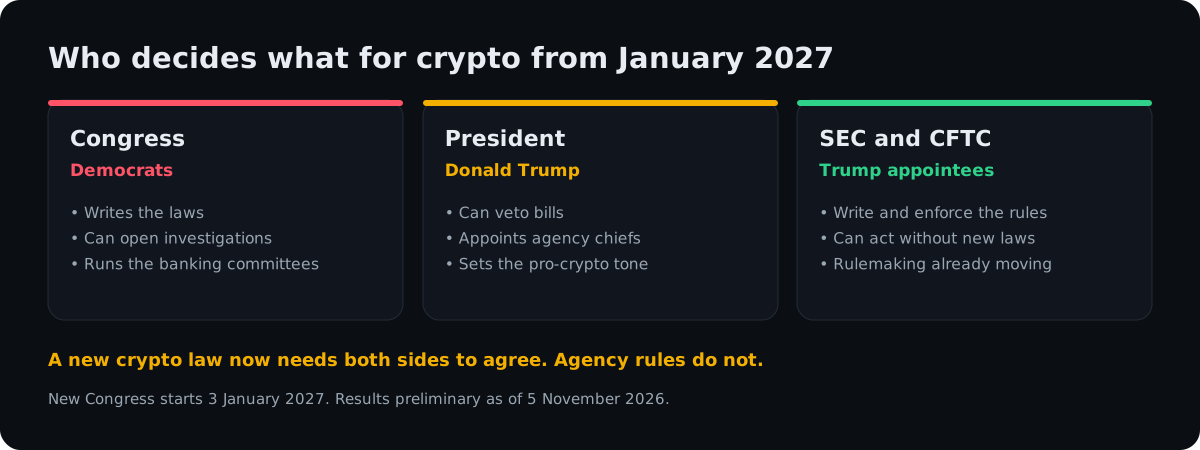
Trump stays in office until January 2029 and can veto any bill. His appointees still lead the SEC and CFTC, and the CFTC sent a new rulemaking for White House review in September. Those agencies can keep writing rules without a new law, so friendly regulation does not end because Congress changed hands.
The CLARITY Act is the first casualty
The CLARITY Act, the main bill meant to set out which crypto assets the SEC and the CFTC each oversee, was already in trouble. On 15 September 2026 it failed a Senate procedural vote 49 to 50, short of the 60 votes needed. Every Democrat present voted no, and so did four Republicans.
Reports say the bill expires on 3 January 2027 if the Senate does not act. Republicans can still try during the lame-duck session, but the calendar is short. TD Cowen’s Washington analyst expected no passage over the next two years if Democrats also took the Senate, which they now have.
A law is not dead forever, though. Seven Democratic senators called the September vote “a setback, but not the end”, and House Democrats are discussing a new market structure bill that would give the SEC more power and add ethics rules. Expect a different bill, slower and stricter than the one the industry wanted, and one that Trump would still have to sign.
Expect hearings and investigations
The most visible change will be oversight. Committee chairs can call executives to testify and issue subpoenas. TD Cowen’s analyst expects investigations into Trump and his family’s crypto ties, a line of attack Democrats used against the CLARITY Act from the start.
Hearings make headlines and headlines move prices for a day or two. For anyone holding Bitcoin or Ethereum, that is mostly noise. For tokens and companies directly tied to the Trump family, or for exchanges called to testify, it can be more serious.
How the market reacted
Calmly. Bitcoin climbed from a six-week low to about 78,354 dollars and Ethereum to about 2,323 dollars after the results. The outcome had been widely expected, and prices were already depressed after the record Binance hack a week earlier; our Binance hack article covers that. One day of trading proves little either way.
Be careful with history here. Binance Research says Bitcoin has averaged a 54% gain after past midterms, while other analysts point to deep drops around the same dates in 2018 and 2022. There have been only a few such cycles since Bitcoin existed, and each had its own halving, interest rates and crises. That sample is too small to trade on.
Three scenarios for 2027
These are the paths we would watch, with what would have to be true for each.
Gridlock, the most likely path. Congress passes no major crypto law, hearings get attention, and the SEC and CFTC keep issuing rules and guidance. For the market, policy fades as a driver, and rates, ETF flows and Bitcoin’s own cycle matter more. The risk is that rules made by agencies can be reversed by the next administration, which keeps big institutions cautious.
A bipartisan deal, the positive surprise. Moderate Democrats and the White House agree on a market structure bill, probably with stronger ethics rules and more SEC power. This would remove a long-running uncertainty, and exchanges and tokens that fit the final rules would benefit. Watch whether the seven Democrats who wanted a deal stay engaged and whether Trump accepts ethics limits.
A harder line, the negative surprise. Investigations widen from the Trump family’s business to exchanges and stablecoin issuers, and Democrats use budget and oversight pressure to slow the agencies. Prices of the companies and tokens involved would take the first hit, and US-focused projects could delay launches. Most of the world’s crypto trading happens outside the US, which limits the direct damage but not the sentiment.
What to watch
- 3 January 2027: the new Congress starts and the CLARITY Act reportedly expires without Senate action.
- The committee chair decisions for Senate Banking and House Financial Services.
- The text of any new House Democratic market structure bill.
- The CFTC rulemaking now under White House review.
- Interest rates and spot ETF flows, which have moved Bitcoin more than most Washington news.
What it means for you
If you hold Bitcoin or Ethereum for the long term, this election changes little. Do not sell because of a headline about Elizabeth Warren, and do not buy because of a chart showing past midterm gains. If you hold smaller tokens whose story depends on a friendly US law, the odds of that law just got worse, so size those positions accordingly. Our guide to crypto risk management covers how.
If you trade around political news, expect short spikes on hearings and bill drafts that often reverse quickly. Prediction markets such as Polymarket price these events openly, where available, which makes them a useful gauge even if you never trade there.
Bottom line
Democrats now hold Congress, which likely freezes pro-crypto legislation until at least 2029 unless a stricter compromise appears. Trump’s veto and his appointees at the SEC and CFTC limit how far any crackdown can go. For most holders, rates and ETF flows will matter more than the new committee chairs.
If you trade BTC or ETH, you can open a BingX account here; that is our referral link, and BingX is not available to US residents. This content is for information only and is not financial advice.
Frequently asked questions
Are the Democrats bad for crypto?
They make new pro-crypto laws harder to pass, but they do not control everything. Donald Trump stays president with a veto, and his appointees still run the SEC and CFTC, which write most day-to-day rules. Expect stalled legislation and more investigations, not a sudden crackdown. This content is for information only and is not financial advice.
What happens to the CLARITY Act now?
It failed a Senate procedural vote 49 to 50 on 15 September 2026, and reports say it expires on 3 January 2027 if the Senate does not act. The outgoing Congress can still try in the lame-duck session, but that is widely seen as unlikely. TD Cowen expected no passage in the next two years if Democrats won the Senate as well. House Democrats are discussing their own bill with more SEC power.
How did Bitcoin react to the election?
Calmly. Bitcoin bounced from a six-week low to about 78,354 dollars and Ethereum to about 2,323 dollars after the results. The outcome was largely expected, and the bounce also followed a sharp drop after the Binance hack in late October, so it says little about the election itself.
Will Bitcoin go up after the midterms?
Nobody knows. Binance Research points out that Bitcoin has averaged large gains after past midterms, but that history covers only a few cycles, each with its own conditions, and other analysts highlight deep drops around the same dates. We do not publish price targets. Interest rates and ETF flows are likely to matter more than who chairs a committee.
Does this affect crypto traders outside the US?
Indirectly. US rules shape ETFs, stablecoins and the plans of big institutions, and US news moves global prices. Exchange access and tax rules in other countries depend on local law, not on the US Congress.
#midterms#regulation#CLARITY Act#Bitcoin#analysis#USA#DYOR
Discussion
Loading comments…