
Most people who trade on Polymarket lose money. An analysis of 2.5 million wallets by researcher Andrey Sergeenkov found that 84% were unprofitable as of April 2026, only about 2% had made more than 1,000 dollars, and 840 addresses had made more than 100,000. A separate Solidus Labs study of politics markets found that 0.55% of profitable maker wallets took half of all gains between December 2025 and February 2026.
So the question is not “what bet should I place” but “what do the winners do that the rest do not”. This guide covers seven approaches, how they make money and where each one breaks.
Not financial advice. Prediction markets carry a high risk of loss, and they are restricted in many countries. No strategy below guarantees a profit. Check the rules where you live before you deposit.
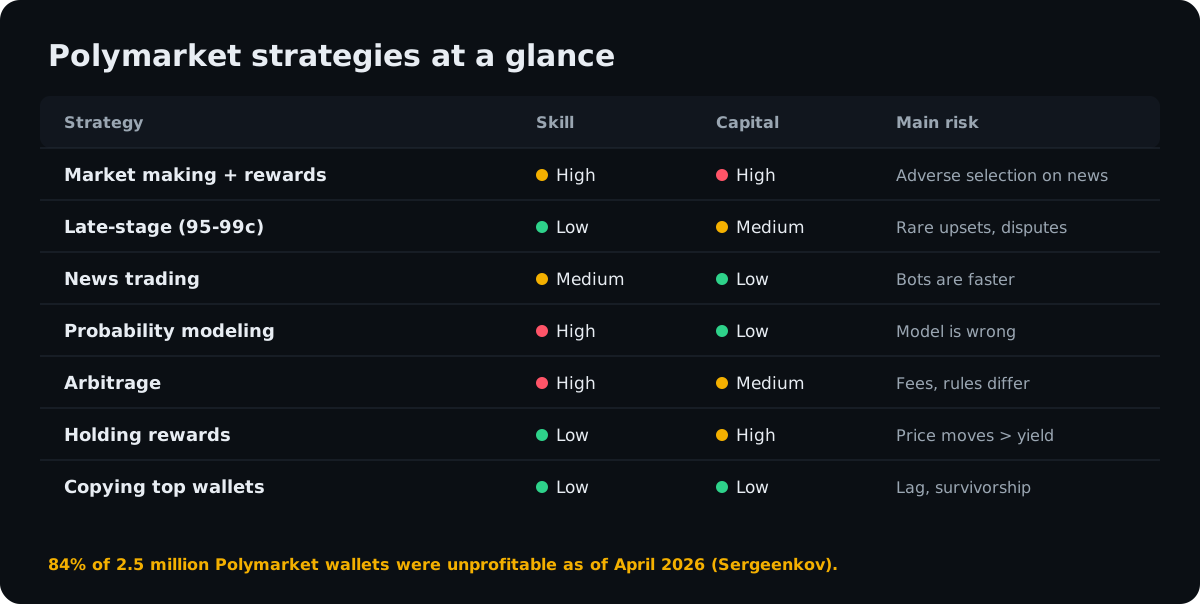
Two numbers to understand first
A share on Polymarket pays 1 dollar if the outcome happens and 0 if it does not, so its price is the market’s probability. Buying YES at 60 cents only makes money over time if the real probability is above 60%. Every strategy below is a way of finding prices that are wrong, or of getting paid for something other than being right.
The second number is cost. Since March 2026 takers pay a fee in most categories, highest at a 50 cent price: about 1 dollar per 100 shares on politics markets and 1.25 dollars on economics, weather and most sports. Makers, whose limit orders rest in the book, pay nothing and earn rebates. Until 31 October 2026 taker fees are waived on several categories; our zero-fee guide lists them. Fees and the spread decide whether a small edge survives.
1. Market making and liquidity rewards
Market makers place limit orders on both sides of a market and earn the spread between them. Polymarket adds two incentives. Liquidity rewards pay traders whose orders sit close to the midpoint: each market sets a maximum distance and a minimum size, rewards are paid daily around midnight UTC, and a day must reach at least 1 dollar to pay out. Maker rebates return part of the taker fees, from 15% to 25% depending on the category.
This is where much of the steady profit on the platform goes, and it is mostly automated. The risk is adverse selection: when news breaks, faster traders take your stale orders at the old price. A maker who cannot pull or reprice orders within seconds of news gives money to those who can. Treat this as a business that needs code, capital and monitoring, not a side hobby.
2. Late-stage entries on near-certain outcomes
Some traders buy outcomes that are almost decided, at 95 to 99 cents, to collect the last few cents before resolution. Buying at 97 cents and getting 1 dollar is a 3% return, sometimes within days.
The math is the problem. At 97 cents you need to be right about 33 times for every miss just to break even, and the misses do happen: late upsets, rule details nobody read, and disputes during resolution. Markets resolve through the UMA oracle, and an ambiguously worded market can resolve against the obvious answer; our UMA oracle explainer covers how disputes work. Read the resolution rules of every market before you buy, and size so that one loss does not erase a month of gains.
3. News trading
Prices move when information arrives: a poll, a court ruling, a central bank statement, an injury report. A trader who reads a primary source and acts within seconds can buy before the price adjusts.
The competition is bots that read the same feeds faster. Human news traders tend to win where interpretation matters more than speed: a long legal document, a niche local election, a sports detail the general market ignores. If your edge is “I saw the headline”, someone else saw it first.
4. Probability modeling
The traders who profit over years often have a model: polling averages for elections, team ratings for sports, weather model output for temperature markets, base rates for “will X happen by date Y”. They buy when the market price differs from their estimate by more than the costs.
This needs real work and an honest track record. Write down your estimate before you look at the price, log every trade, and after 50 or 100 trades check whether your 70% calls happened about 70% of the time. Most people who skip that step are guessing with extra steps.
5. Arbitrage
Arbitrage looks for prices that cannot all be right at once. Inside one market, if YES and NO together cost less than 1 dollar after fees, buying both locks in the difference. In a multi-outcome event, the prices of all candidates should add up to about 1 dollar. Across platforms, the same event can trade at different prices on Polymarket and Kalshi; see our Kalshi vs Polymarket comparison.
Clean arbitrage is rare and disappears in seconds because bots hunt it. Cross-platform trades also carry hidden risk: two platforms can word the same event differently and resolve it differently, which turns a “risk-free” trade into two losing bets.
6. Holding rewards on long-term markets
Polymarket pays a variable annual reward on positions in a list of eligible long-term markets. Its help center put the rate at 3.25% in June 2026, with position value sampled hourly and rewards paid daily. The list included the 2028 US presidential election and nominee markets, 2026 Senate and House control, several “leader out before 2027” markets and 2026 price markets for Bitcoin, Ethereum, Solana, XRP and Hyperliquid.
Holding rewards suit a position you already want to hold. They are a poor reason to open one: a 10 cent move in the share price outweighs years of a few percent reward. Polymarket can also change the rate, cap total payouts or change the list.
7. Copying top wallets
Every Polymarket trade is on a public blockchain, so the leaderboard and third-party tools let you follow successful wallets. A Vultax analysis of leaderboards found that part of the top traders stay among the winners in later periods, which makes copying tempting.
Copying has three weak points. You enter after the wallet you copy, at a worse price. Some top wallets are market makers whose individual trades make no sense on their own. And leaderboards show survivors: for every wallet with a great record, many with the same approach lost and dropped off. Copy small, follow wallets with long histories, and never copy a market maker’s single trades.
What most losing traders have in common
The 84% did not mostly lose because their picks were bad. They paid the spread and fees on many small bets, bought outcomes at prices that already reflected the news, held large positions on thin markets, and never checked their own record. If you fix those four habits, you are already ahead of most of the platform.
A simple routine helps: read the resolution rules before every trade, prefer limit orders, size each position so a loss is survivable, and keep a log with your estimated probability and the result. Our guide to how to trade on Polymarket covers the order book and order types, and our crypto risk management guide covers position sizing.
Who can use Polymarket
Polymarket’s international app lists the US, UK, France, Germany, Italy, Poland, Russia, Australia, Brazil, Singapore, Taiwan, Thailand and several Canadian provinces as close-only, and some regions are fully blocked. Using a VPN to get around this breaks the terms of service and can leave funds stuck. US residents have a separate regulated Polymarket US app. Our Polymarket KYC and country guide has the full list.
Bottom line
Profitable Polymarket traders are paid for providing liquidity, for knowing something the price does not reflect yet, or for being faster. Rewards programs and maker rebates help those who provide liquidity; everyone else needs a measurable edge and strict sizing. If Polymarket is available where you live, start small, log everything and judge your strategy on 100 trades, not on one lucky week.
You can sign up on Polymarket here. That is our referral link; see our affiliate disclosure. This content is for information only and is not financial advice.
Frequently asked questions
Can you make money on Polymarket?
Some traders do, most do not. An analysis of 2.5 million Polymarket wallets by researcher Andrey Sergeenkov found that 84% were unprofitable as of April 2026, and only about 2% had made more than 1,000 dollars. The profitable minority mostly relies on structured approaches such as market making, modeling and fast reaction to news, not on hunches.
What is the safest Polymarket strategy?
No strategy is safe, but the lowest-skill options are late-stage entries on near-certain outcomes and holding rewards on eligible long-term markets. Both carry real risks: a rare upset or a disputed resolution can wipe out many small gains, and a price move can outweigh a few percent of yearly rewards.
How do Polymarket liquidity rewards work?
Polymarket pays daily rewards to traders whose limit orders sit within a set distance of a market's midpoint and meet a minimum size. The closer and larger your orders, the more you earn. Rewards are paid around midnight UTC, only for days that reach at least 1 dollar, and markets with a midpoint below 10 cents require orders on both sides.
What are Polymarket holding rewards?
Polymarket pays a variable annualized reward on the value of positions in a list of eligible long-term markets, such as the 2028 US presidential election. Its help center listed the rate at 3.25% in June 2026, sampled hourly and paid daily. The rate and the market list can change at any time.
Can I use these strategies from Russia or the US?
Not on the international app. Polymarket lists Russia, the US, the UK, Germany, France and many other countries as close-only, and using a VPN to get around this breaks its terms and can leave funds stuck. US residents have a separate regulated app. This content is for information only and is not financial advice.
#Polymarket#strategies#prediction markets#market making#arbitrage#risk#DYOR
Discussion
Loading comments…