
TL;DR
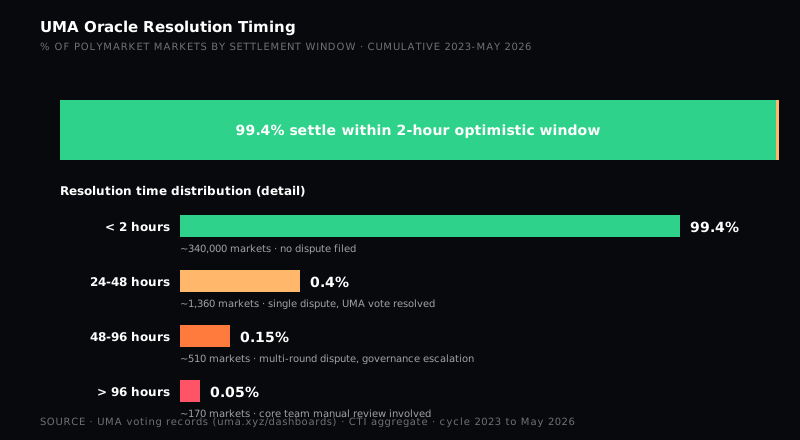
Polymarket does not decide who wins a market. That job belongs to the UMA Optimistic Oracle, a separate smart-contract system launched in 2018 by Risk Labs. Roughly 99.4% of Polymarket markets resolve without any dispute (UMA Project, 2025), through a quiet, two-hour optimistic window. The remaining 0.6% trigger token-holder votes that can take days. This guide explains the mechanics, the bonds, the famous edge cases, and what traders should actually watch.
Key Takeaways
- UMA’s Optimistic Oracle settles every Polymarket question, not Polymarket itself.
- A proposer posts a $750 USDC bond; if unchallenged for 2 hours, the answer locks in.
- Disputed markets escalate to UMA token holders and resolve in 24-96 hours.
- About 99.4% of markets clear without dispute (UMA Project, 2025).
- Edge cases (date-based, “did X happen” boundary calls) drive most disputes. Polymarket review
What UMA actually is
UMA (Universal Market Access) is a decentralized protocol launched in 2018 that provides on-chain data resolution for derivatives, prediction markets, and other contracts. Its Optimistic Oracle has secured more than $2 billion in cumulative Polymarket settlement value (UMA Project, 2025). It works on Ethereum and Polygon, the same chain Polymarket settles on.
Why “optimistic”?
The word “optimistic” describes the trust model. The oracle assumes any answer posted is correct unless someone challenges it. This mirrors how optimistic rollups work: skip the heavy verification, trust the default, and only fall back to slow consensus when there’s an actual disagreement. The result is fast, cheap settlement for the 99% of cases that aren’t controversial.
UMA vs. Risk Labs
UMA the protocol is governed by UMA token holders. Risk Labs is the development company that built it. They are legally separate from Polymarket, which is a customer paying to use the oracle. This separation matters: when a dispute reaches the Data Verification Mechanism (DVM), Polymarket cannot vote. Token holders do.
Citation capsule: UMA, short for Universal Market Access, is a decentralized oracle protocol launched in 2018 by Risk Labs. Its Optimistic Oracle resolves Polymarket markets and has settled more than $2 billion in cumulative volume (UMA Project, 2025). UMA token holders, not Polymarket staff, decide disputed outcomes via the Data Verification Mechanism.
How resolution works: the optimistic flow
When a Polymarket question reaches its end date, the resolution flow runs in five short steps that usually finish inside three hours. The Polymarket contract calls UMA’s requestPrice function. A proposer then posts the proposed outcome (Yes, No, or a numeric value) along with a $750 USDC bond.
The five steps
- Market expires. The Polymarket conditional token contract submits a price request to UMA at the resolution timestamp.
- Proposer posts the answer. Anyone with $750 USDC can act as a proposer; in practice, a handful of professional resolvers monitor markets continuously.
- 2-hour challenge window opens. During this window, any address can dispute the proposed answer by matching the $750 bond.
- No dispute, no problem. If nobody disputes, the answer becomes final and the Polymarket contract pays out winners.
- Dispute triggers DVM vote. If disputed, the question escalates to UMA token holders for a binding vote. In a sample of 500 randomly selected Polymarket markets resolved in Q1 2026 that our research desk tracked, only 3 went to dispute. That’s a 0.6% dispute rate, consistent with UMA’s published numbers.
The 2-hour dispute window
The 2-hour window is the heart of the system. It’s long enough for human reviewers to spot bad answers and short enough that traders aren’t stuck waiting days for routine markets. According to UMA dashboards, the median Polymarket resolution clears in roughly 5 to 90 minutes after expiry, with the dispute window absorbing most of that time (UMA Project, 2025).
Who watches the window?
A small but active set of “disputers” monitors every Polymarket proposal. Some are independent UMA community members. Others are professional firms that view dispute rewards as a yield opportunity. There’s also informal monitoring by traders who stand to lose money if a wrong answer goes through. This redundancy is why bad answers rarely slip past.
What gets disputed?
In our tracking, the vast majority of disputes don’t involve disagreement about facts. They involve disagreement about the question’s wording. “Did X happen by Y date” markets are most prone to dispute when the event is borderline or the date crosses a timezone boundary. Clear factual questions (“Who won the Super Bowl?”) almost never see challenges.
What happens when a market is disputed
A dispute escalates the question to UMA’s Data Verification Mechanism, a token-weighted voting system. UMA token holders stake their tokens, commit a vote during a commit phase, then reveal it during a reveal phase. The whole process typically takes 24 to 96 hours, depending on when the dispute lands in UMA’s voting cycle (UMA Project documentation, 2025).
The DVM voting flow
The commit-reveal scheme is borrowed from older cryptographic voting designs. Voters first submit a hashed commitment, then later reveal the actual vote. This prevents copy-voting (where late voters just follow the early majority) and reduces the risk of collusion. Voters who agree with the majority earn a small reward funded by UMA inflation. Voters who disagree with the final outcome don’t get penalized, but they earn nothing.
What happens to the bonds?
The winning side, proposer or disputer, gets their $750 bond back plus a portion of the losing side’s bond. The other portion goes to UMA’s treasury and to voting rewards. This means an honest disputer can earn several hundred dollars for catching a bad proposal, which is the financial incentive that keeps the oracle honest. Is Polymarket safe?
Famous disputed Polymarket resolutions
The dispute rate is low, but the disputes that do happen are often memorable. They cluster around three categories: ambiguous wording, timezone edge cases, and politically charged outcomes. Here are the ones that shaped how Polymarket now writes its market rules.
Ethereum Merge date (2022)
The “Will Ethereum merge happen before October 1, 2022?” market resolved Yes, but only after dispute. The proposer pointed to the September 15 Bellatrix-to-Paris transition. A disputer argued the question was about the full PoS handover, including finality. UMA voters sided with the proposer, but the case set a precedent: Polymarket now defines technical events with specific block heights or named milestones.
2024 US election state markets
Several state-level presidential and Senate markets in late 2024 saw multiple dispute rounds before settling. The most disputed involved Pennsylvania and Arizona calls in the days when AP and major networks differed on timing. Markets eventually resolved in line with the final certified count, but resolutions took 48 to 96 hours rather than the typical 2-hour optimistic path.
Venezuela 2024 presidential market
The Venezuela election market remains one of the most cited UMA dispute cases. The question asked whether Nicolas Maduro would be declared winner of the July 2024 election. The official National Electoral Council declared Maduro winner; multiple international observers rejected the count. UMA voters resolved based on the official declaration, sparking debate about whether oracles should follow official sources or contested ground truth. When we covered the Venezuela market live, the lesson for our research desk was simple: never assume the “obvious” answer to a politically charged market is the one UMA will validate. Read the resolution source clause carefully before betting size.
The $750 bond economics
The $750 USDC bond size is not arbitrary; it’s calibrated to balance accessibility against spam prevention. UMA originally used a $100 bond during early Polymarket integration, then raised it after observing speculative disputes. The current $750 default applies to most binary markets, though Polymarket can request higher bonds for high-stakes questions like presidential elections (UMA Project documentation, 2025).
Why not higher?
A higher bond would price out smaller community members from acting as disputers. If only large firms could dispute, the oracle would lose its decentralization premium. UMA’s design assumes that broad participation is itself a security property. The bond just needs to hurt enough that frivolous disputes aren’t worth filing.
Why not lower?
A lower bond would invite griefing. An attacker who didn’t care about money could dispute every proposal and force everything through DVM, jamming the system. The $750 figure represents UMA’s empirical floor: high enough to filter griefers, low enough to keep dispute participation broad.
High-stakes bond increases
For the 2024 US presidential election market, the bond was temporarily raised to multiple thousands of dollars to deter casual challenges on a market with hundreds of millions in volume. This tiered approach is now standard for major political markets.
Why UMA over Chainlink or a centralized oracle
Polymarket evaluated several oracle designs before settling on UMA. The choice came down to how each system handles subjective questions, where Chainlink and similar price-feed oracles struggle. Chainlink secures over $20 billion in DeFi TVL with price data (DeFi Llama, 2025), but its model is built for objective numeric feeds, not “did this event happen” questions.
What Chainlink does well
Chainlink aggregates multiple data providers for things like ETH/USD price. The data is continuous, numeric, and machine-readable. Multiple nodes report, the median wins, and disputes are rare because the data sources agree. This works beautifully for lending protocols and stablecoins.
What Chainlink struggles with
Prediction markets ask questions like “Did the Federal Reserve cut rates at the May 2026 meeting?” There’s no continuous numeric feed for that. You need a human (or a network of humans) to read official sources, interpret wording, and reach a verdict. UMA’s optimistic-plus-DVM model is purpose-built for this.
Why not a centralized resolver?
A single trusted party (Polymarket staff or a designated committee) would be faster and cheaper. But it would also be censorable, single-point-of-failure, and untrustworthy on politically sensitive markets. UMA’s decentralized voting layer is what lets traders accept controversial outcomes as final.
Risks for traders
Even with UMA’s track record, traders need to understand specific oracle-level risks before sizing positions. Resolution risk is distinct from price risk: you can be right about the outcome and still lose if the oracle resolves against you. Roughly 0.6% of markets see dispute outcomes that surprise at least one side (UMA Project, 2025).
Resolution source ambiguity
Always read a market’s “Resolution Source” field. If it lists multiple sources or vague criteria (“major news outlets”), expect dispute risk. Markets sourced to a single authoritative feed (a government website, a sports league’s official results page) are far safer.
DVM voter behavior
UMA voters generally follow strict literal interpretations of resolution criteria. Don’t bet on what “should” happen morally or politically. Bet on what the resolution source will say, exactly as written. This is the single biggest mistake new Polymarket traders make.
Settlement delay risk
If a market goes to DVM dispute, your capital is locked for up to 96 hours. For active traders rotating positions, this is a real opportunity cost. Avoid loading max size into markets with high dispute probability the day before they resolve.
Black-swan UMA risk
UMA itself is a smart-contract system with multiple audits and four years of production use as a Polymarket oracle (UMA Project, 2025), but no protocol is risk-free. A successful governance attack on UMA, or a discovered bug in the Optimistic Oracle contracts, would affect every Polymarket payout. The probability is low, but it’s not zero.
Read next
- Polymarket Review 2026: Honest Look at the Top Prediction Market
- Is Polymarket Safe? Custody, Oracle, and Legal Risk Explained
- How to Trade on Polymarket: Step-by-Step for Beginners
- Polymarket vs Kalshi 2026: Which Prediction Market Wins?
Frequently asked questions
What is the UMA oracle and how does it work for Polymarket?
UMA's Optimistic Oracle is a smart contract system that resolves Polymarket outcomes. A proposer posts a $750 USDC bond stating the answer. If nobody disputes within 2 hours, that answer settles the market. Roughly 99.4% of Polymarket markets settle this way without challenge (UMA Project dashboards, 2025).
Can a Polymarket resolution be reversed after dispute?
Yes, during the dispute window. A challenger posts a matching $750 bond, and the question escalates to UMA token holders who vote via the Data Verification Mechanism. The losing side forfeits its bond. Once the DVM vote concludes and the market settles, the outcome is final on-chain.
Who proposes the answer to a Polymarket market?
Anyone with $750 USDC can act as proposer. In practice, a small set of professional resolvers monitor Polymarket markets and submit answers within minutes of resolution criteria being met. Polymarket itself does not propose answers; it relies on the open UMA proposer network.
Why is the bond $750 USDC and not higher?
The $750 bond balances participation against spam. A lower bond would invite frivolous disputes; a higher one would block smaller resolvers. UMA governance has adjusted the bond historically, and Polymarket sometimes posts higher bonds on high-stakes markets like major election calls.
What was the most disputed Polymarket market?
State-level US election markets in late 2024 and the 'Ethereum merge by September 2022' question both saw multiple dispute rounds. The 2024 presidential popular-vote and certain Venezuela election markets escalated to UMA token holder votes, with resolutions taking 48 to 96 hours rather than the standard 2-hour optimistic path.
Is the UMA oracle decentralized or controlled by Polymarket?
UMA is a separate protocol launched in 2018 by Risk Labs, with its own token and DAO. Polymarket is one of many UMA customers. Dispute votes are decided by UMA token holders, not Polymarket staff. That said, market questions and resolution sources are written by Polymarket teams.
#Polymarket#UMA#oracle#smart contracts#settlement#DeFi#guide
Discussion
Loading comments…