
Not financial advice. This is educational content, not a recommendation to trade. Crypto trading is high-risk and most active traders lose money. Nothing here guarantees a profit. Always do your own research (DYOR) and consult a qualified financial advisor. Read the risk disclaimer before continuing.
The short answer
Ask experienced traders what blew up their account and almost none of them say “my analysis was wrong.” They say they got greedy, chased a pump, refused to take a loss, or revenge-traded after a bad day. Strategy gets the attention, but psychology decides the outcome. Two people running the identical system get opposite results depending on whether they follow it when it hurts.
Crypto makes this worse than any other market. It trades 24/7, it moves in violent swings, and social media pumps fear and greed straight into your decisions at all hours. You cannot remove emotion, but you can build systems that stop emotion from making your decisions. That is what this article is about: the specific biases that cost you money, and the practical rules that defend against them.
Key takeaways
- Most trading losses come from behavior, not bad analysis.
- FOMO, revenge trading, and panic-selling are the three most expensive emotional patterns.
- You feel greediest near tops and most fearful near bottoms, the opposite of what helps.
- Discipline comes from systems built in advance, not willpower in the moment.
- Correct position sizing is the single best defense against emotional decisions. NFA. DYOR.
Why the mental game beats the strategy
A trading strategy is a set of rules. A backtest assumes you follow them perfectly. Real humans do not. The gap between a strategy’s backtested result and your actual result is almost entirely psychology: the trades you skipped out of fear, the rules you broke out of greed, the losses you let run because admitting you were wrong hurt.
This is why a simple system followed with discipline usually beats a sophisticated one abandoned mid-drawdown. The edge is not just in the rules. It is in your ability to keep following them when your money is on the line and your emotions are screaming. Accept that, and you start working on the thing that actually moves your results.
The biases that cost you money
- FOMO (fear of missing out). Buying because something is pumping and everyone is loud about it. It is the mechanism by which people reliably buy tops.
- Revenge trading. Trying to immediately win back a loss with a bigger, sloppier trade. The fast lane from a small loss to a catastrophic one.
- Loss aversion. A loss hurts about twice as much as an equal gain feels good, so people hold losers too long (hoping to get back to even) and sell winners too early (to lock in relief).
- Confirmation bias. Seeking out opinions that agree with your position and ignoring the ones that do not. It turns a trade into an identity you defend instead of a bet you manage.
- Overconfidence after a win streak. A few wins convince you that you have it figured out, right before you oversize and give it all back.
- Anchoring. Fixating on a price (“it was 100, so 60 is cheap”) that has nothing to do with what the asset is worth now.
The fear and greed cycle
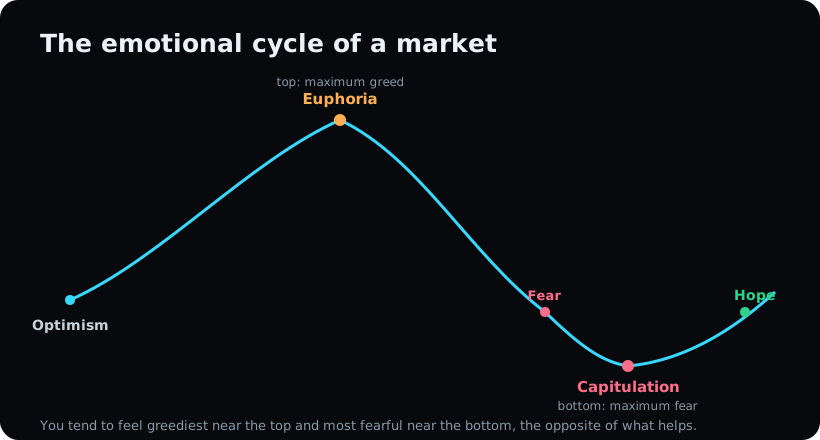
Markets move in price cycles, and traders move in emotional ones that line up almost perfectly backwards. On the way up, optimism builds to excitement and finally euphoria right around the top, which is when FOMO peaks and people buy hardest. On the way down, anxiety turns to denial, then fear, then panic and capitulation near the bottom, which is when people sell hardest.
The painful truth is that the moments you feel most certain are usually the moments you are most wrong. Feeling greedy and unstoppable is a top signal. Feeling hopeless and wanting out is often a bottom signal. You do not have to trade against your emotions perfectly. You just have to stop trading because of them.
Practical defenses that work
Discipline is not willpower. It is a system you build while calm so you do not have to be heroic while scared. Five rules do most of the work:
- Write a plan before you enter. Entry, stop-loss, target, and size, decided in advance. If a trade does not fit a plan you wrote calmly, you do not take it. Our stop-loss and take-profit guide covers the exit side.
- Size so no single trade can scare you. This is the master defense. If a normal drawdown makes you panic, the position is too big. Our crypto risk management basics cover sizing that survives being wrong.
- Keep a journal. Record why you entered, your plan, and how you felt. Patterns in your losses become visible, and most of them trace back to breaking your own rules.
- Have a stop rule for yourself, not just your trades. A loss past a set size ends your session. This kills revenge trading before it starts.
- Automate to remove decisions. The fewer choices you make in the heat of the moment, the fewer you get wrong. A boring DCA approach removes timing emotion entirely, and even active traders benefit from pre-set orders.
The style you trade matters too. The constant decisions of day trading maximize emotional load, while a slower swing trading or longer-term approach gives your rational brain time to catch up with your reflexes.
The bottom line
You will not out-analyze the market. Almost nobody does, consistently. What you can do is stop beating yourself: stop chasing pumps, stop revenge trading, stop selling in panic, and stop sizing positions so large that fear runs the show. Build the rules while you are calm, automate what you can, and size small enough to think clearly. The trader who survives is rarely the smartest one. It is the one whose system protects them from their own worst moments.
Not financial advice. Nothing above is a recommendation to trade. Most active traders lose money and crypto can lose all its value. Do your own research and speak to a qualified advisor. Read the full risk disclaimer.
Frequently asked questions
Why is psychology so important in crypto trading?
Because most losses come from behavior, not analysis. Two people can follow the same strategy and get opposite results based on whether they panic-sell, chase pumps, or break their own rules. Crypto runs 24/7 and moves violently, which amplifies fear and greed beyond what traditional markets produce. A mediocre strategy followed with discipline usually beats a great strategy abandoned at the first drawdown.
What is FOMO in crypto and how do I avoid it?
FOMO is the fear of missing out, the urge to buy something only because it is pumping and everyone is talking about it. It is how people buy tops. The defense is a rule made in advance: you only enter on your own setup, not because of a green candle or a social media post. If you feel urgency to buy right now or miss out forever, that feeling itself is the signal to wait.
What is revenge trading?
Revenge trading is trying to win back a loss immediately with a bigger, less careful trade, usually driven by anger or wounded ego. It is one of the fastest ways to turn a small loss into an account-ending one. The fix is mechanical: after a losing trade, step away. Set a rule that a loss past a certain size ends your session for the day, no exceptions.
How do I stop panic-selling at the bottom?
Decide your exit before you enter, not during a crash. If you set a stop-loss and a plan when you are calm, you do not have to make decisions while terrified. Position sizing matters even more: if a normal drawdown makes you panic, your position is simply too big. A position you can hold through a 50 percent drop is one you sized correctly in the first place.
What is the fear and greed cycle?
It describes the emotional arc most traders ride: optimism and excitement on the way up, peaking at euphoria near the top, then anxiety, denial, fear, and capitulation on the way down. People reliably feel greediest near tops and most fearful near bottoms, which is the opposite of useful. Recognizing where you are on that cycle is a defense against acting on it.
Does keeping a trading journal actually help?
Yes, more than almost any indicator. Writing down why you entered, your plan, and how you felt turns vague memories into patterns you can see. Most traders discover their biggest losses share a cause: trading outside their plan, oversizing, or emotional entries. You cannot fix a leak you cannot see, and a journal is how you see it. It is the cheapest edge available.
Can trading discipline be learned?
Yes, but it is built through systems, not willpower. Relying on feeling disciplined in the moment fails, because the moment is exactly when emotion is strongest. Instead you build rules in advance, automate what you can, size positions so no single trade is scary, and remove yourself after losses. Discipline is the result of a good system, not a personality trait you either have or lack.
#trading psychology#FOMO#discipline#risk management#behavioral finance#guide
Discussion
Loading comments…