
Not financial advice. This is educational content, not a recommendation to trade. Technical analysis describes probabilities, not certainties, and crypto is highly volatile. Nothing here guarantees a profit. Always do your own research (DYOR) and consult a qualified financial advisor. Read the risk disclaimer before continuing.
The short answer
Reading a crypto chart is not about predicting the future. It is about understanding what price has done, where buyers and sellers have fought before, and how to structure a decision with defined risk. Done well, chart reading tells you where to enter, where you are wrong, and where to take profit. Done badly, it becomes a Rorschach test where people see whatever they already believe.
You do not need fifty indicators. You need four things: how to read a candlestick, how to spot a trend, where support and resistance sit, and how volume confirms a move. Master those and you understand most of what beginners actually use. This guide walks through each, then ends with the honest part most chart tutorials skip: what technical analysis genuinely cannot do.
Key takeaways
- The candlestick is the building block. It shows open, close, high, and low for its period.
- Trend, support and resistance, and volume cover most of what beginners need.
- Use few indicators. They are derived from price and lag it, so more is not better.
- Read top-down: higher timeframe for trend, lower timeframe for timing.
- TA manages probabilities and risk. It does not predict the future. NFA. DYOR.
Start with the candlestick
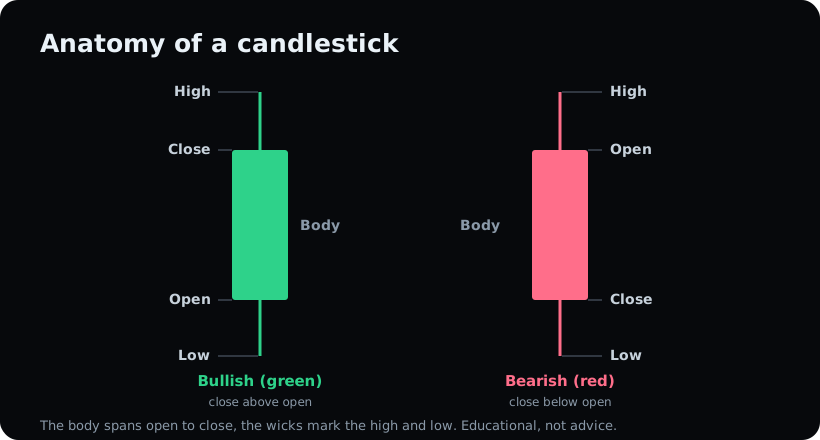
Every crypto chart is built from candlesticks, and each candle tells a small story about one slice of time. The body shows the open and close prices, and the thin wicks (or shadows) show the high and low reached. If price closed higher than it opened, the candle is green or hollow. If it closed lower, it is red or filled.
The shape carries meaning. A long body means strong conviction in one direction. A small body with long wicks means indecision or rejection: price tried to go somewhere and got pushed back. A single candle is one sentence. The chart is the paragraph, and your job is to read the paragraph, not obsess over one word.
Read the trend
The oldest rule in trading is that the trend is your friend, and it is worth respecting. An uptrend is a series of higher highs and higher lows: each rally goes a bit further and each dip stops a bit higher. A downtrend is the reverse, lower highs and lower lows. When neither holds, price is ranging sideways.
Identifying the trend before anything else prevents the most common beginner mistake: fighting the dominant direction. Buying dips in an uptrend and being cautious with rallies in a downtrend is not sophisticated, but it aligns you with the larger flow instead of against it. Most indicators are just trend-detection with extra steps.
Support, resistance, and volume
Support is a price zone where buyers have repeatedly stepped in to stop a decline. Resistance is where sellers have repeatedly capped a rise. Think of them as floors and ceilings, though they are zones rather than exact lines. They matter partly because they are real (orders cluster there) and partly because everyone watches them, which makes them somewhat self-fulfilling. A key tell: when strong resistance finally breaks, it often flips into new support.
Volume is the confirmation layer. A breakout on high volume carries more weight than one on thin volume, which often fails. Rising price on falling volume is a warning that a move may be running out of fuel. Volume does not tell you direction, but it tells you how much conviction is behind a move.
Indicators: use fewer than you think
Once people discover indicators, they tend to stack ten of them and call it analysis. That produces noise and false confidence, not an edge. Two are enough to start:
- Moving averages smooth price into a line that shows trend direction. When price is above a rising average, the trend is up, broadly speaking. Crossovers between a fast and slow average are a classic, if lagging, trend signal.
- RSI (Relative Strength Index) gives a rough read on whether an asset is stretched after a big move. High readings suggest it may be overextended, low readings the opposite, though in strong trends it can stay stretched far longer than feels reasonable.
Every indicator is derived from price, which means it lags price. They organize information, they do not reveal the future. If you cannot explain what an indicator measures and why, do not trade on it.
The honest part: what charts cannot do
Here is what most TA tutorials will not tell you. Technical analysis is a framework for probabilities and risk, not a prediction engine. It helps you define a clear entry, a clear invalidation, and a clear target, which is genuinely valuable. It does not tell you what will happen next.
Crypto makes this especially true. Order books are thinner than traditional markets, manipulation and large players moving size are common, and a single piece of news (a regulatory headline, an exchange failure, a macro print) can blow through any pattern in minutes. We cover why forecasting is so hard in can AI predict crypto prices. The takeaway is not “TA is useless.” It is “TA is for managing risk and structuring decisions, not for knowing the future.” Anyone selling chart-based certainty is selling something.
How to actually practice
Pick one asset and one higher timeframe, like the daily, and just mark trend, support, and resistance for a few weeks before adding anything else. Read top-down: the higher timeframe for the broad direction, a lower one for timing. Keep a journal of what you saw and what happened, which turns screen time into pattern recognition. Our crypto trading glossary defines any terms you hit, and pairing chart skills with risk management and trading psychology is what actually moves results. Whether you day trade or swing trade, the chart is a tool for decisions, not a fortune teller.
The bottom line
Learning to read charts is worth it, as long as you learn the right lesson. Candlesticks, trend, support and resistance, and volume give you a real framework for structuring trades with defined risk. A couple of indicators add context. What none of it gives you is a view of the future. Use charts to decide where you are wrong and how much to risk, not to convince yourself you know what comes next. That mindset, more than any pattern, is what separates traders who last from those who do not.
Not financial advice. Nothing above is a recommendation to trade. Technical analysis cannot predict prices, most active traders lose money, and crypto can lose all its value. Do your own research and speak to a qualified advisor. Read the full risk disclaimer.
Frequently asked questions
How do I start reading crypto charts as a beginner?
Start with the candlestick, the basic building block. Each candle shows four prices for its time period: open, close, high, and low. Learn to read a single candle, then how candles form trends, then where price repeatedly stalls (support and resistance). Add volume to confirm moves. Resist piling on indicators early. Mastering candles, trend, and support/resistance covers most of what beginners actually need.
What does a candlestick show?
A candlestick summarizes four prices over its period. The body spans the open and close, and the thin wicks show the high and low. A green or hollow candle means price closed higher than it opened, a red or filled one means it closed lower. Long wicks show rejection of a price level, and long bodies show strong conviction. One candle is a sentence, and a chart is the paragraph it lives in.
What are support and resistance?
Support is a price area where buying has repeatedly stepped in and stopped a fall. Resistance is where selling has repeatedly capped a rise. They are zones, not exact lines, and they matter because traders watch the same levels, which can make them self-fulfilling. When a strong resistance finally breaks, it often becomes new support, and vice versa. They are among the most useful concepts for beginners.
Which indicators should beginners use?
Fewer than you think. A couple of moving averages help you see trend direction, and the RSI gives a rough sense of whether an asset is stretched after a big move. That is plenty to start. Indicators are derived from price, so they lag it, and stacking ten of them produces noise and false confidence, not clarity. Master price action first, then add an indicator only if it earns its place.
Does technical analysis actually work for crypto?
It works as a framework for probabilities and risk, not as a crystal ball. TA helps you define entries, stops, and levels to watch, which is genuinely useful. What it cannot do is predict the future, especially in crypto, where thin order books, manipulation, and sudden news routinely override any pattern. Treat TA as a way to manage risk and structure decisions, not as a way to know what happens next.
What timeframe should I look at?
Match the timeframe to your style and always check more than one. A long-term holder cares about the weekly and daily charts, a swing trader about the daily and 4-hour, a day trader about lower ones. A useful habit is top-down: read the higher timeframe for the broad trend, then drop to a lower one for timing. A signal on a 5-minute chart means little if the daily trend points the other way.
Can chart reading predict crypto prices?
No. Chart reading describes probabilities and structure, it does not predict outcomes. Studies of price forecasting find accuracy is low over multi-week horizons, and crypto is especially prone to news and liquidity shocks that no pattern anticipates. Good chart reading improves your risk decisions and timing, but anyone claiming a chart guarantees the next move is overselling. See our piece on whether anyone can predict crypto prices.
#technical analysis#crypto charts#candlesticks#support and resistance#trading#guide
Discussion
Loading comments…