
Can AI predict crypto prices? The honest answer, up front and before the rest of this article, is no, not reliably. AI can read more data faster than any human, but a crypto price is not a math problem with a hidden answer, it is the moving result of human behavior, liquidity, regulation and macro shocks that no model has in its training data. This article explains what AI price tools actually do, why their accuracy is low, where AI genuinely helps in crypto, and how to use it without getting fooled by a confident number.
Not financial advice. This is general education about how AI price prediction works, not a prediction and not a recommendation to buy or sell anything. Crypto is volatile and the future price is unknowable. Read our risk disclaimer and do your own research first.
Key takeaways
- AI cannot reliably predict crypto prices. A confident AI target is a marketing artifact first, analysis second.
- The failures are structural: regime change, noisy data, overfitting, and the fact that a real edge gets arbitraged away.
- Named price targets, human or AI, land in roughly the 35 to 45 percent accuracy range, near a coin flip with magnitude included.
- AI is genuinely useful for research, sentiment, anomaly flagging and rules-based execution, just not forecasting.
- Read the reasoning, not the number, build scenarios, and size for being wrong.
What AI price tools actually do
Strip away the interface and most AI price tools are doing one of a few things. Some are machine-learning models trained on historical price and on-chain data to project the next move. Some are large language models that read news and social posts and summarize sentiment into a bullish or bearish lean. Some are a thin wrapper that asks a general model for a number and prints it with confidence. None of them has special knowledge of the future. They have patterns from the past and a clean way to display a guess.
That display matters more than it should. A precise figure on a calendar date feels authoritative in a way that an honest range never will, which is exactly why confident outputs spread and cautious ones do not. The polish is real. The edge is not.
Why AI fails at price prediction
Four problems stack up, and a bigger model fixes none of them.
Regime change. Crypto cycles change character. A model tuned on a low-rate, retail-driven bull market can fail completely when liquidity, regulation or the dominant participants change. The future is not a continuation of the training set.
Noisy data with no causal model. Price history shows correlation, not cause. A model can learn that two things moved together without any reason they should keep doing so. When the reason was coincidence, the pattern dies the moment you rely on it.
Overfitting. A model can be tuned until it nails the history it was fitted to, which looks like skill and is not. Fitting the past is easy. Predicting the future is the part that does not transfer, and impressive backtests routinely fall apart live.
The edge gets arbitraged away. This is the deepest one. If a model genuinely found a repeatable way to predict price, the people running it would trade it quietly until the edge disappeared, not sell you a subscription. A reliable public predictor is close to a contradiction in terms.
On top of all four sits survivorship bias. The one AI call that happened to land gets screenshotted and shared, the hundreds that missed are quietly forgotten, and the average viewer sees a highlight reel mistaken for a track record.
How accurate are AI predictions, really
Low, and lower than the marketing suggests. The longest-running studies of named crypto price targets, the human kind, put all-in accuracy, direction and rough magnitude together, in roughly the 35 to 45 percent range, near or below a coin flip once you account for how far price moved. AI predictions inherit the same noisy history and add no edge on the thing that matters most, the regime change, so there is no good reason to expect them to do better. Tools that advertise a high hit rate are usually measuring direction only, ignoring magnitude, or resetting the scoreboard after a bad run.
Where AI genuinely helps in crypto
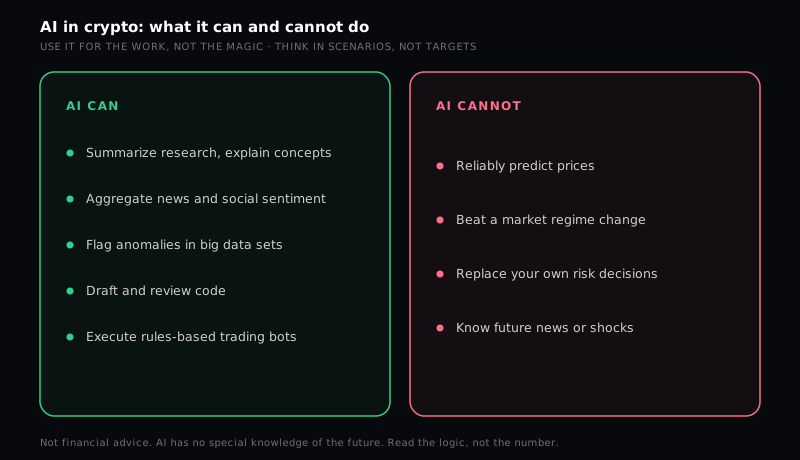
The useful framing is to separate the work AI can do from the magic it cannot. AI is a strong research assistant: it can explain a concept, summarize both sides of a debate, and pull together scattered information quickly, as long as you verify it against primary sources. It is good at aggregating sentiment and flagging anomalies in large data sets. It can draft and review code. And it can execute rules-based strategies through trading bots, where the AI follows your logic instead of guessing the future, the same idea behind a grid bot or the bot suite on BingX. Those are repeatable jobs with real value. Naming the price of Bitcoin on a date is not one of them.
How to use AI predictions without getting fooled
Treat any AI price output as one input among many, never a signal. Read the reasoning rather than the number, and ask the two questions that matter: what would have to be true for this to happen, and what would break it. If a tool shows a precise figure with a date, advertises a high accuracy rate, or hides its logic, lower your trust, not raise it. The honest alternative to a predicted price is scenario thinking, mapping a bull, base and bear path with the catalysts that would drive each, which we lay out in how to read crypto price predictions and apply in our coin outlooks for Bitcoin, Ethereum and Solana.
Red flags of a bad AI prediction
- A precise number with a date and no conditions attached.
- An advertised accuracy rate, especially a round, high one with no methodology.
- No visible reasoning, just an output you are asked to trust.
- Direction-only scoring that quietly ignores how far price actually moved.
- A seller behind it. Ask what the tool earns if you believe the number.
Bottom line
Can AI predict crypto prices? No, not in the way the hype implies, and the reasons are structural rather than fixable with a better model. What AI can do is real and worth using: research, sentiment, anomaly detection, code, and rules-based execution. What it cannot do is see a future that depends on human behavior, liquidity and shocks that are not in any dataset. Use AI for the work, not the magic. Read the logic, not the number, think in scenarios, and if you trade, you can do it on BingX with sensible sizing.
This article is general information about how AI price prediction works, not financial advice and not a prediction. Crypto is volatile and the future is unknowable. Read our risk disclaimer, do your own research, and never invest money you cannot afford to lose.
Frequently asked questions
Can AI predict crypto prices?
Not reliably. AI can process more data faster than a human, but predicting a crypto price means predicting human behavior, liquidity, regulation and macro shocks that are not in the training data. Studies of named price targets, human or model, put their all-in accuracy in roughly the 35 to 45 percent range, near a coin flip on direction once you account for magnitude. Treat any confident AI price target as marketing, not insight.
Why can't AI predict crypto prices accurately?
Four reasons stack up. Markets change regime, so a model tuned on one cycle can fail in the next. The training data is noisy and mostly reflects the past, which does not determine the future. Models overfit, looking impressive on backtests they were fitted to and weak live. And if a model genuinely found a reliable edge, traders would arbitrage it away fast. None of these is solved by a bigger model or a slicker interface.
Are AI crypto prediction tools accurate?
Their marketing is more accurate than their forecasts. Tools that advertise a high hit rate usually count direction only, ignore magnitude, cherry-pick timeframes, or quietly reset after misses. Survivorship bias does the rest: the one call that landed gets shared, the many that missed are forgotten. When measured honestly, single-number AI price calls land near or below a coin flip once magnitude is included.
Is AI useful for crypto at all?
Yes, just not for price prediction. AI is genuinely useful for summarizing research, aggregating sentiment, flagging anomalies, drafting and reviewing code, and executing rules-based strategies through trading bots, where it follows your logic rather than guessing the future. Those are real, repeatable jobs. Forecasting an exact price on a date is not one of them. Use AI for the work it can do, not the magic it cannot.
Should I trust an AI price target?
No, treat it as one input among many, not a signal. Read the reasoning, not the number, and ask what would have to be true for it to happen and what would break it. Be especially wary of any tool that shows a precise figure with a date, claims a high accuracy rate, or hides its logic. A confident number is a marketing artifact first and an analysis second. This is general information, not financial advice.
AI prediction, technical analysis or analyst targets, which is most reliable?
On its own, none. Technical analysis is self-referential and breaks on news, analyst targets land well under half the time, and AI inherits the noise of the past with no edge on regime change. Each can be a useful lens for thinking, but treating any of them as a forecast is a way to lose money. The honest alternative is scenario thinking, which our guide on how to read crypto price predictions covers in full.
How should a beginner use AI for crypto?
Use it as a research assistant, not an oracle. Ask it to explain a concept, summarize both sides of a debate, or check your reasoning, then verify what it tells you against primary sources, because AI can state wrong things confidently. For decisions, build scenarios and watch catalysts rather than chasing a predicted price. Size positions for being wrong, and never invest money you cannot afford to lose. Not financial advice.
#AI#price prediction#crypto#analysis#DYOR#2026
Discussion
Loading comments…