
Not financial advice. This is a research note for educational purposes only. Nothing here is a recommendation to buy, sell, or hold SOL or any other asset. Crypto markets are highly volatile and you can lose your entire investment in a single position. Past performance does not predict future results. Always do your own research (DYOR), consult a qualified financial advisor before making any investment decision, and verify what is legal in your jurisdiction. Read the risk disclaimer before continuing.
TL;DR
This article does not predict where SOL will be at the end of summer 2026. It does the next-best thing: it lists the four catalysts the market is actually watching, walks through what conditions would have to be true for a bull, base, or bear outcome, and is explicit about which way each catalyst pulls the price. Treat it as a framework for your own thinking, not as a forecast.
If you take only one thing from this piece, take this: every published SOL price target you see (including the ones we reference below) carries low historical accuracy on a 3-to-6-month horizon. The variables that move crypto prices have wide error bars. Anyone telling you they know where SOL is going in August 2026, including us, is overstating what is knowable. For a July-specific, current-snapshot version of this analysis, see our SOL price prediction for July 2026.
Key takeaways
- SOL summer 2026 outcome depends on 4 catalyst variables, not on a single price target.
- Bull, base, and bear scenarios are conditional on the catalysts in each scenario. They are not probabilistic forecasts.
- Published analyst targets for crypto have historically missed both direction and magnitude more often than they hit.
- Position sizing and risk management decide outcomes for retail traders far more than entry timing.
- DYOR. Nothing in this article should substitute for your own research and a qualified advisor.
Where SOL sits going into summer 2026
Solana entered May 2026 with several structural facts that frame the rest of the conversation. Total Value Locked across Solana DeFi protocols (DefiLlama, May 2026) sits in the $8-10 billion range, putting Solana firmly in the top-3 chains by DeFi liquidity behind Ethereum and Tron. Daily DEX volume on Jupiter, the dominant Solana aggregator, has averaged roughly $2 billion per day over the trailing 30 days, well above the comparable Ethereum DEX volume on a normalized basis.
On the regulatory side, US spot SOL ETFs received approval in early 2025 and have been actively trading throughout 2025-2026. Cumulative net inflows are smaller than the spot BTC ETF complex but meaningful in absolute terms, with the largest issuer (Grayscale’s GSOL conversion and the VanEck product) collectively holding several billion dollars in AUM as of latest 13F filings.
What is intentionally absent from this section: a specific current price. SOL trades on a 24-hour market and any number we print becomes stale the moment this article publishes. Check a live ticker before drawing conclusions.
The 4 catalysts the market is watching this summer
These are the variables traders are repricing on through summer 2026, ranked roughly by mentions in institutional analyst notes and crypto media coverage during May 2026.
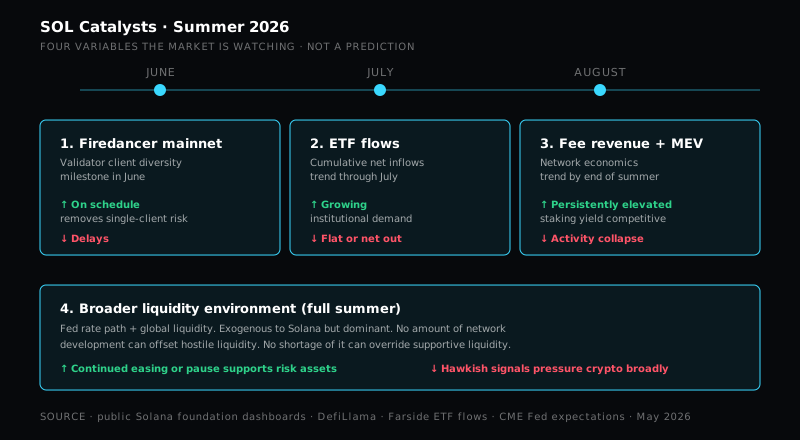
1. Firedancer mainnet rollout
Firedancer is the second independent validator client for Solana, built by Jump Crypto. Its mainnet rollout, which began incrementally through late 2025 and continued through Q1-Q2 2026, addresses what has historically been one of the most-cited Solana tail risks: single-client dependency on the original Agave codebase.
Why it matters for price: institutional allocators have repeatedly named Firedancer as a prerequisite for larger SOL exposure on resilience grounds. If the rollout proceeds on the public schedule and Frankendancer (the intermediate hybrid) gradually cedes to full Firedancer through summer, that removes a structural objection that has limited allocation size at certain risk desks.
If it slips: the tail risk thesis stays live longer and a portion of the institutional flow that has been waiting may continue to wait. Delay is not catastrophic; it removes one tailwind.
2. US spot SOL ETF flows
The US spot SOL ETF complex has been trading throughout 2025-2026. The pattern to watch is not whether flows are positive on any given week (they vary) but whether cumulative net inflows trend up through summer.
ETF flows are an imperfect proxy for institutional demand because of authorized participant arbitrage flows that do not reflect end-investor positioning. But they are the most public, real-time signal of institutional interest available. Look at rolling 30-day net flow charts (Farside, Bloomberg Terminal data), not daily prints.
Trend matters more than absolute number. Cumulative inflows growing through summer = bullish setup component. Cumulative inflows flat or declining = bearish setup component.
3. On-chain fee revenue and MEV capture
Solana validator revenue (priority fees + MEV tips + transaction fees) has trended structurally upward through 2024-2026 as memecoin and DeFi activity has shifted onto the chain. Jito’s MEV revenue alone has at times exceeded $5 million in a single day during high-activity periods.
The thesis: fees that are persistently elevated translate into staking yield that is competitive with or exceeds Ethereum’s, which strengthens the long-term SOL holding case at the margin. Fees that collapse with activity reduce the appeal.
What to watch: average daily fee revenue trends on the Solana foundation dashboard and Jito’s MEV capture data through summer. Persistent strength = bullish thesis component. Activity collapse + fee collapse = bearish thesis component.
4. Broader liquidity environment
Crypto prices remain correlated with global liquidity conditions and especially with US Fed rate path expectations. Through summer 2026, the path of Fed rate decisions and the broader liquidity outlook affect SOL the same way they affect BTC and ETH: tighter liquidity tends to pressure risk asset prices, looser liquidity tends to support them.
This catalyst is exogenous to Solana. No amount of network development can offset a hostile liquidity environment, and no shortage of network development can override an extremely supportive one. Adjust scenario weights accordingly.
Source capsule: Four variables drive most of the summer 2026 SOL conversation: Firedancer rollout progress (validator client diversity), US spot SOL ETF cumulative flow trends (institutional demand proxy), on-chain fee revenue and MEV capture (network economics health), and the broader liquidity environment (Fed rate path). None individually guarantees a directional move.
Bull case scenario
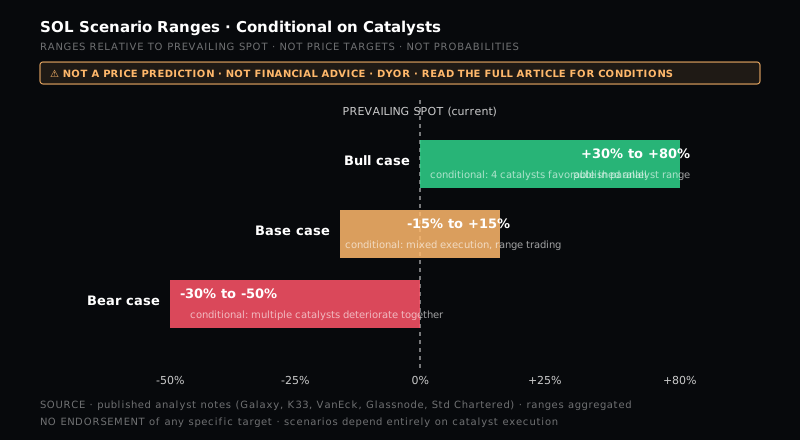
Conditional on: Firedancer mainnet rollout on schedule + ETF cumulative inflows growing + fee revenue stays elevated + Fed signals continued easing or pause.
If all four catalysts move favorably in parallel through summer, the framework that institutional analysts have published in spring 2026 typically maps to SOL trading meaningfully above its May 2026 levels by end of August. The exact magnitude varies by analyst with published bull-case ranges spanning roughly 30 to 80 percent upside from prevailing prices, depending on the model. None of these numbers carry our endorsement and we are not stating which is more likely.
What this scenario requires the market to believe: that Solana has cleanly resolved its historical single-client risk, that ETF demand has institutionalized, and that fee revenue is durable rather than a memecoin cycle artifact. All three are debatable.
The bull case loses if any one of those three structural beliefs breaks during the summer.
Base case scenario
Conditional on: mixed catalyst execution. Firedancer makes incremental progress but the rollout is messier than the public schedule suggests. ETF flows are choppy with some months positive and some neutral. Fee revenue stays elevated but does not break out higher. Liquidity environment is neutral.
The base case in most published analyst notes through May 2026 has SOL trading within a wide range around current levels through summer, with neither side clearly dominating. Range trading, not directional moves.
What this scenario requires: just for the catalyst inputs to not deliver in either direction strongly. This is the most likely outcome historically when crypto markets enter summer without a clear macro driver, simply because summer trading volumes are seasonally lower and major moves cluster around higher-volume autumn periods.
The base case is the most boring scenario to write about and probably the most likely.
Bear case scenario
Conditional on: Firedancer rollout slips materially + ETF flows turn net negative + memecoin activity collapses dragging fees lower + Fed signals are hawkish.
If multiple catalysts deteriorate together, SOL exposure to the macro liquidity factor combined with Solana-specific concern factors compounds. Bear-case ranges from published spring 2026 analyst notes typically map to 30 to 50 percent downside from prevailing levels in this scenario, again with no endorsement from us on which is more likely.
What this scenario requires: structural Solana doubts to re-emerge at exactly the wrong macro moment. The compounding risk is what makes the bear case more painful than its catalysts individually would suggest.
This is the scenario every long-only retail trader prepares for emotionally but few prepare for in position sizing. If you cannot calmly hold through a 40 percent drawdown, your position size is too large for your risk tolerance regardless of which scenario actually plays out.
What analysts are saying (and why to be careful with it)
Published SOL summer 2026 outlook notes from major firms (Galaxy Digital, K33 Research, Glassnode, VanEck, Standard Chartered Digital Assets) have been broadly directionally bullish but with wide error bars on magnitude. We are not naming individual targets because anchor-bias from a single published number is more harmful than helpful to your thinking process.
The honest meta-observation: published crypto analyst targets have a poor historical accuracy record. The longest-running studies of named crypto analyst predictions put all-in accuracy in the 35 to 45 percent range, which is not meaningfully better than random for binary directional calls and substantially worse than random for specific dollar targets.
The right way to read analyst notes: treat them as inputs to your own thinking, not as forecasts. Read the rationale, not the number. The number is unreliable. The rationale, if it survives your scrutiny, is useful regardless of where the actual price ends up.
How to position without predicting
You do not need to predict where SOL will be at the end of summer to make defensible position decisions. A few frameworks that do not require prediction:
Dollar-cost averaging. If you believe in SOL on a multi-year horizon, splitting your intended allocation into 4-8 buys over the summer captures average price without requiring you to time the bottom. This is the framework that performs best for retail in the longest empirical studies.
Position sizing for the bear case. Whatever you size your SOL position to, ask yourself: can I hold this through a 50 percent drawdown without selling at the bottom? If the answer is no, your position is too large. Size to the worst-case scenario, not the most likely.
Hedging with options. For larger positions, downside puts on SOL during summer can hedge bear-case risk while preserving upside. Options have their own complexity and we do not recommend them to traders new to derivatives. See our liquidation calculator for the relevant risk math if you are sizing leveraged exposure.
Splitting between SOL and BTC/ETH. Diversification across the top-3 reduces single-asset risk. If your SOL thesis is right, holding 50% SOL and 50% BTC/ETH still captures the directional move while reducing variance.
None of these require predicting the actual price.
What this article is NOT
A few clarifications because price-outlook content gets misread routinely:
- NOT a price target. No dollar number in this article is a target, recommendation, or prediction we stand behind. Every figure is conditional on the scenario it sits in.
- NOT a probability forecast. We have not assigned probabilities to the bull, base, or bear scenarios because we do not believe anyone can reliably do that for crypto on a 3-month horizon.
- NOT financial advice. Nothing in this article is a recommendation to buy, sell, or hold SOL. Decisions on your own assets are yours alone.
- NOT a trading signal. Do not size positions based on this article. Do your own research, consult qualified advisors, and account for your own circumstances.
If you find the framework useful as one input to your thinking, that is the highest use we hope for. Treat it accordingly.
Read next
- Bitcoin H2 2026 outlook. The same conditional, no-targets method applied to BTC.
- Ethereum, XRP and Dogecoin outlooks. Catalysts and bull, base and bear scenarios for each.
- How to read crypto price predictions. Why most targets miss and how to use scenarios instead.
- Best DEX 2026. The 8 leading decentralized exchanges including Jupiter, the dominant Solana aggregator.
- Crypto staking guide 2026. Real SOL staking APY and the three paths to stake (CEX, liquid, solo validator).
- Bitcoin ETF flows 2026. The institutional ETF playbook applied to BTC, with read-across to the SOL ETF complex.
- Risk disclaimer. Read this before any position sizing decision.
Frequently asked questions
Is this article a SOL price prediction?
No. This is a scenario framework describing what would have to happen for different price ranges, plus a list of catalysts the market is watching. We do not assign probabilities to any scenario and we do not endorse any specific target. Every figure in the bull, base, and bear sections is conditional on the catalysts in that section playing out as described. Treat all of it as a thinking exercise, not as a forecast.
What are the biggest summer 2026 catalysts for SOL?
Four stand out as of late May 2026: the Firedancer client mainnet rollout schedule, US spot SOL ETF flow trends following early 2025 approvals, on-chain fee revenue and MEV capture trends, and the broader liquidity environment driven by Fed rate decisions. None of these guarantees a directional move. They are the variables the market is repricing on, in roughly that order of attention.
Should I buy SOL right now?
We cannot tell you that and would not even if we could. Crypto allocation decisions depend on your time horizon, risk tolerance, tax situation, existing portfolio, and personal financial goals, none of which we know. What we can say is that buying any single asset because of a summer 2026 outlook from any source, including this site, is not a substitute for your own due diligence. Read the article as one input, not as a decision.
How accurate are crypto price predictions in general?
Historically, very low. Analyst targets for major crypto assets miss directionally and in magnitude more often than they hit, and the longest-running price target tracking studies put the all-in accuracy of named crypto analysts in the 35 to 45 percent range. This is one reason we frame this article as scenarios rather than targets. Anyone telling you they know where SOL will be in August 2026 should be received with extreme skepticism.
Where can I actually trade SOL?
SOL trades on every major exchange we cover. For spot trading with the lowest fees outside the US, Bybit, OKX, and BingX run tight spreads on SOL/USDT. For US users wanting regulated venues, Coinbase and Kraken are the cleanest options. For self-custody DEX trading, Jupiter on Solana itself is the dominant aggregator. Where you trade matters less than position sizing and risk management.
What happens to SOL if Firedancer is delayed?
Delay risk is part of the bear case in the framework. If Firedancer mainnet slips significantly past current scheduled windows, the most-cited tail risk argument (single-client dependency on Agave/Solana Labs validator code) remains active longer than expected, and a portion of the institutional interest that has cited Firedancer as a prerequisite for larger allocations may stay sidelined. Delay is not catastrophic on its own. It just removes one tailwind.
#Solana#SOL#price analysis#scenarios#analysis#DYOR
Discussion
Loading comments…