
Not financial advice. This is a research note for educational purposes only. Nothing here is a recommendation to buy, sell, or hold any asset. Crypto is highly volatile and you can lose your entire investment. Past performance does not predict future results, and history does not guarantee recovery. Always do your own research (DYOR), consult a qualified financial advisor, and verify what is legal in your jurisdiction. Read the risk disclaimer before continuing.
The short answer
If you searched “will crypto recover in 2026,” you want a yes and a date. No one can honestly give you either. What we can give you is the honest framework: what history actually shows about crypto drawdowns and recoveries, what a rebound would need to happen, and what could delay it. Then you decide, with realistic expectations instead of hope or fear.
Here is the grounding fact. Bitcoin has recovered from every major drawdown in its history, but the time it took has ranged from a single day to roughly two years, and it fell 70 to 85% from the top before bottoming in the worst cases. So “crypto has always recovered” is true and almost useless on its own, because it says nothing about when, or how much lower it goes first. Read the conditions below, not a prediction, because the honest position is that nobody knows the timing.
Key takeaways
- Bitcoin has recovered from every past major drawdown, but timing ranged from days to about two years.
- Severe historical drawdowns ran 70 to 85% from the cycle high before bottoming.
- A recovery would need easing macro, a turn in ETF flows, stabilizing demand, and no fresh shock.
- Further downside is a real scenario, so size positions to survive another large drop.
- Nobody can name the date or the bottom. Time horizon and position sizing decide your outcome. NFA. DYOR.
Update, 17 July 2026: Since publication, a recovery has started, though it is early. BTC has climbed back to around $65,000 from its late-June low near $59,900, and ETH has run harder, up roughly 22% off its low to near $1,917 and outperforming Bitcoin. The triggers were a softer than expected US CPI print and ETF flows turning more supportive. This is roughly what the conditions listed below look like when they start breaking the right way, and it is worth noting that ETH led BTC by months before the 2022 bottom. But a few weeks is not a recovery: the drawdown against the October 2025 high is still deep, nothing here confirms a trend change, and the framework below is unchanged. NFA.
Where things stand in mid 2026
Start with the facts. As of late June 2026, Bitcoin trades near $60,000, roughly 52% below its October 2025 all-time high near $126,000, and June is closing as the worst month of the year. Spot BTC ETFs posted their worst month on record, macro turned less friendly as rate-cut hopes faded and the dollar firmed, and money rotated toward AI equities. Our breakdown of why Bitcoin is down covers the live drivers, and Ethereum has fallen further in percentage terms, as our ETH outlook discusses.
None of that tells you where the bottom is. What it tells you is that this is a serious drawdown, well within the historical range of crypto corrections but not beyond it. That framing matters: a 52% drop feels like the end when you are in it, yet by Bitcoin’s own history it is a normal-sized cycle drawdown, not an outlier.
What history actually shows
Bitcoin has been through several major drawdowns, and the pattern is consistent in shape but wildly variable in timing.
- 2018 bear. Roughly an 84% drop from the late-2017 high, taking about 380 days to bottom, then more than a year to reclaim the prior high.
- March 2020 COVID flash. A fast crash of around 50% in a single day, followed by a recovery that took months, not years.
- 2022 cycle. A drop of roughly 77% through the Luna, Celsius, and FTX failures, bottoming in about 12 months before a multi-quarter recovery.
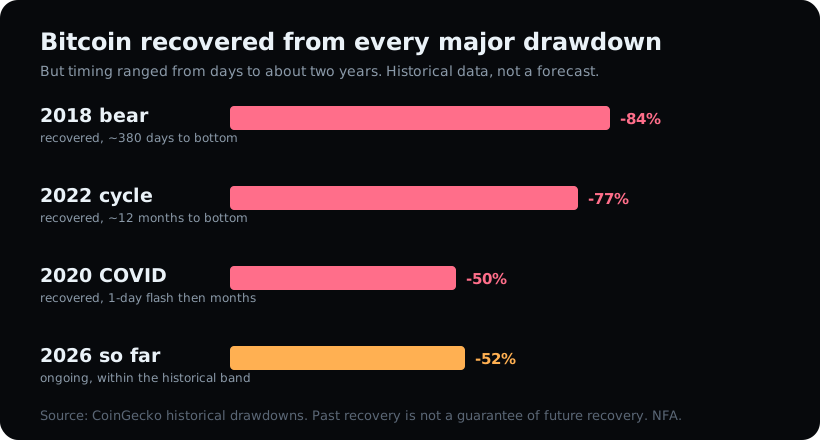
Two honest lessons come out of this. First, recovery has always happened eventually, which is a point for the optimists. Second, the drawdowns were deep and the timing was unpredictable, which is a point for the realists. Both lessons are true at once. The mistake is to take only the one that matches your current mood. And a crucial caveat: a pattern that has held is not a law that must hold. Past recovery is evidence, not a guarantee.
What a recovery would need in 2026
Rather than a date, here is what would have to line up. None of these is a forecast, and a real rebound usually needs several together.
- Easing macro liquidity. Crypto is a liquidity asset. Softer rate expectations, a weaker dollar, and a friendlier risk backdrop are the tide that lifts it. The 2026 drawdown has moved with tightening macro, so a turn here matters most.
- ETF flows turning positive. The spot ETF complex became a core demand channel. June was its worst month on record for outflows. A sustained shift back to net inflows would signal institutional demand returning.
- Demand and on-chain stabilizing. Accumulation by long-term holders, steady network activity, and leverage resetting after liquidations are the base a recovery builds on.
- No fresh structural shock. Recoveries get delayed by new failures, a major exchange or protocol blowup, or a regulatory clampdown. A quiet tape is underrated.
The cycle question sits underneath all of this: is the classic four-year rhythm still valid, or has spot ETF demand changed it? We map that debate in the Bitcoin outlook. It is unresolved, which is precisely why a framework beats a forecast here.
What could delay or deepen it
The bear case is not hard to state. If macro stays tight, ETF outflows continue, and a structural shock lands, the drawdown can extend and deepen. History says 70 to 85% from the high is the severe-case band, and mid-2026 is inside that band, not past it, so more downside is possible without anything breaking the long-term thesis. Treating further declines as impossible because “it has always recovered” is how people over-size and get forced out at the worst moment.
How to actually think about this
A date and a price target are the least useful things to anchor on. Two things are the most useful.
First, time horizon. The historical case for recovery is a multi-year case, not a next-month case. If your money needs to come back in six months, crypto’s drawdown math is against you regardless of the eventual path. If your horizon is genuinely years, the timing of the bottom matters far less than whether you can hold.
Second, position sizing. If a further 30 to 50% drop from here would force you to sell, your position is too large for an asset with this history. A position you can hold through another leg down is one you sized correctly. Our crypto risk management basics cover sizing that survives being wrong, and rather than trying to call the exact bottom, most people are better served by a scheduled DCA approach than by timing a single entry. For choosing what to accumulate, see our best crypto to buy watchlist, and for why forecasting the turn is so hard, can AI predict crypto prices.
The bottom line
Will crypto recover in 2026? Possibly, and history is on the side of an eventual recovery, but nobody can honestly promise the timing, and the path could get worse before it gets better. The useful move is not to predict the bottom. It is to decide, in advance and while calm, a time horizon and a position size that let you hold through whatever the next few months do. If a recovery comes, you will be positioned for it. If it takes longer, you will still be standing. That is the difference between investing through a drawdown and being a casualty of one.
Not financial advice. Nothing above is a recommendation. This article does not predict whether or when crypto recovers and assigns no probability to any outcome. Crypto is highly volatile, history does not guarantee recovery, and you can lose everything. Do your own research and speak to a qualified advisor before investing. Read the full risk disclaimer.
Frequently asked questions
Will crypto recover in 2026?
No one can promise it, and anyone who does is guessing. What history shows is that Bitcoin has recovered from every major drawdown since 2013, but the time it took ranged from a single day in the March 2020 flash crash to roughly two years after the 2022 cycle. Whether crypto recovers in 2026 depends on macro liquidity, ETF flows, and whether the demand structure holds. This article maps those conditions rather than naming a date or a price.
Is the crypto bull run over?
It is the central open question, and serious analysts genuinely disagree. One camp reads the 2026 drawdown as a normal mid-to-late-cycle correction that resolves higher. The other reads it as the end of the cycle, with a longer bear phase ahead. Both are defensible, neither is proven. The honest answer is that the deep pullback is consistent with both a pause and a top, which is exactly why position sizing matters more than a verdict.
How long do crypto bear markets usually last?
Historically, a wide range. Across major Bitcoin drawdowns since 2018, the drop to the bottom has taken anywhere from one day (the March 2020 COVID flash) to roughly 380 days (the 2018 bear), with the 2022 cluster bottoming in about 12 months. Recovery to prior highs then took additional months to years. Past durations are a rough guide to the range of outcomes, not a schedule for this cycle.
What would crypto need to recover?
Broadly four things would have to line up: easing macro liquidity (softer rates and a weaker dollar), a turn back to net inflows in spot ETFs, on-chain and demand signals stabilizing, and no fresh structural shock like a major failure or regulatory clampdown. None of these is guaranteed, and a rebound usually needs several pulling together rather than just one. Track the conditions, not the calendar.
Could crypto keep falling from here?
Yes, that is a real scenario, not a tail risk to dismiss. In severe historical drawdowns Bitcoin has fallen 70 to 85% from its cycle high before bottoming, and mid-2026 sits within that historical band rather than beyond it. A tighter macro backdrop, continued ETF outflows, or a structural shock could extend the decline. Size any position so that a further large drop is survivable, because it is possible.
Should I buy the dip in 2026?
That depends on facts we do not have: your time horizon, risk tolerance, and existing exposure. A dip is only an opportunity if you can hold through another large drop, you are investing money you will not need for years, and you have a plan decided in advance. For most people a scheduled DCA approach beats trying to call the exact bottom, which almost no one does consistently. This is general information, not advice.
Is crypto dead?
A deep drawdown is not the same as death. The network, developers, ETFs, and user base are all still operating, and Bitcoin has been declared dead many times through prior 70%-plus drawdowns before recovering. That history does not guarantee another recovery, but it argues against the death narrative that appears at every bottom. The realistic downside in severe cases is a large drawdown, not zero. NFA, and DYOR.
#crypto recovery#bear market#Bitcoin#market cycle#analysis#DYOR
Discussion
Loading comments…