
If you are looking for an Ethereum price prediction, start with the honest part: no one can tell you where ETH will be by year end, and this article does not try to. What it does instead is more useful. It lays out the catalysts the market is actually watching in the second half of 2026, and describes bull, base and bear scenarios that depend on how those catalysts play out. No price targets, no probabilities, just a framework for thinking.
Not financial advice. This is a scenario framework for education, not a prediction and not a recommendation to buy or sell ETH. Crypto is volatile, the future price is unknowable, and you can lose money. Read our risk disclaimer and do your own research first.
Key takeaways
- This is a scenario framework, not a price target. Every path is conditional on the catalysts described.
- Four levers matter most: ETF flows and the staking question, layer-2 activity and base-layer burn, supply balance, and macro.
- Bull, base and bear are described by what would have to happen, not by a number for a date.
- Named price targets are historically accurate only around 35 to 45 percent of the time, which is why we avoid them.
- Use this to understand the debate and prepare for ranges, not to outsource your decision.
Update, 17 July 2026: The late-June pressure has eased, and ETH is now the one leading. ETH trades near $1,917, recovered roughly 22% from its late-June low near $1,567, and it is outperforming Bitcoin, up about 7% over five days versus roughly 2% for BTC, which sits near $65,000. A softer than expected US CPI print was the trigger, and flows across the ETF complex turned more supportive. Staking yields sit near 2.8 to 3.5%. One historical note, without over-reading it: in the 2022 cycle ETH began outperforming BTC months before BTC bottomed, a pattern some analysts are watching again now. All of this tempers the bear-case reading from late June, but a few weeks of strength is not a confirmed trend change, and the scenarios below still turn on flows, macro, and the cycle debate. This remains a scenario map, not a call. See our Bitcoin outlook and why Bitcoin is down today. NFA.
Update, mid-August 2026: ETH trades near $1,905 as of mid-August, roughly flat since this outlook was last refreshed and still trailing Bitcoin. The notable change is flows: spot ETH ETFs turned net positive in July (over $365 million added), breaking an earlier outflow streak, while US Ethereum staking ETFs are now live with more issuers awaiting approval. For a September-specific read on those catalysts, see Will Ethereum rise in September 2026?.
How to read this
This is not a forecast. It is a map of the forces that could push ETH in different directions, and a description of what each direction would require. The point is to replace the question where will ETH be, which is unanswerable, with the question what would have to happen, which is useful. For the wider reasoning behind this approach, see how to read crypto price predictions.
The catalysts that matter for ETH
ETF flows and the staking question
Spot ETH products gave traditional money an easy way in, and their net flows are now one of the clearest demand signals to watch. Tied to this is the staking-yield question: how much of ETH’s native staking reward can reach these products, which affects how attractive they are versus other assets. Persistent inflows are a tailwind, sustained outflows a headwind. The direction is not promised, it depends on whether the flows actually arrive. As of late June 2026, they have arrived on the outflow side: spot ETH products saw net redemptions through the month, the headwind this section describes rather than the tailwind.
Layer-2 activity and base-layer burn
Ethereum’s design sends a lot of activity to layer-2 networks, which is great for users but means fewer fees are burned on the base layer. Because the fee burn offsets issuance, where activity happens affects ETH’s supply story. Busy, fee-generating usage that still touches the base layer supports the bull case. A world where activity drains to L2s while the base layer sits quiet weakens it.
Supply: burn versus issuance
Since the move to proof of stake, ETH issuance is low, and the EIP-1559 burn can offset it. When the network is busy the burn can exceed issuance and supply edges down, when it is quiet net supply can tick mildly upward. This balance is not a price lever on its own, but it shapes the narrative that flows respond to.
Macro and risk appetite
ETH trades like a risk asset, so the macro backdrop of interest rates, liquidity and overall risk appetite sets the weather. A risk-on environment lets the crypto-specific catalysts work, a risk-off one can overwhelm them. We cover this channel in how oil and macro affect crypto.
The scenarios
These are conditional paths, not predictions, and we assign no probability to any of them.
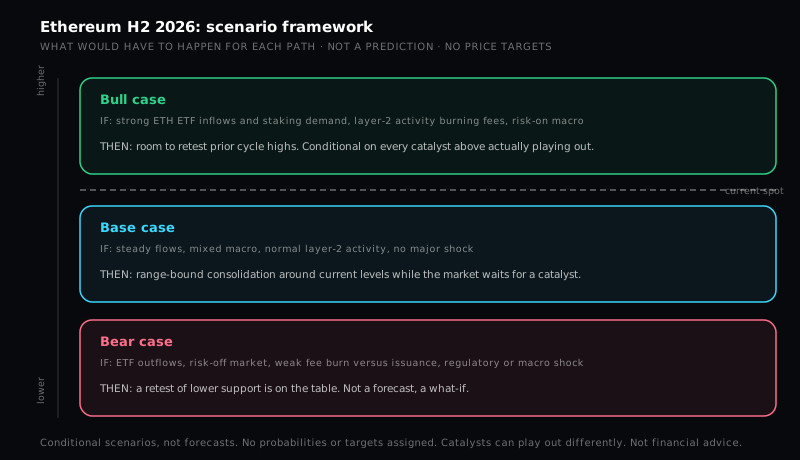
Bull case. If ETF inflows and staking demand stay strong, layer-2 and base-layer activity keep the burn healthy, and macro turns risk-on, there is room to retest prior cycle highs. This path needs most of those catalysts pulling together, not just one.
Base case. If flows are steady, macro is mixed and on-chain activity is normal, the likely shape is range-bound consolidation around current levels while the market waits for a clearer catalyst. This is the unexciting path that wide ranges spend most of their time in.
Bear case. If ETF flows turn to outflows, macro goes risk-off, and base-layer burn stays weak relative to issuance, a retest of lower support is on the table. A regulatory or macro shock would reinforce it. Again, this is a what-if, not a call.
The main risks
- Flow reversal. ETF demand can leave as quickly as it arrived.
- Burn weakness. Activity draining to L2s can tip net supply mildly inflationary and soften the narrative.
- Macro shock. A risk-off turn can override every crypto-specific catalyst at once.
- Competition. Other smart-contract chains compete for the same activity and capital.
- The unknown. The biggest moves often come from things not on any list today.
Bottom line
There is no honest single number for where Ethereum goes in the second half of 2026, so this piece does not offer one. What it offers is the set of catalysts that actually matter, ETF flows and staking, layer-2 and base-layer burn, the supply balance, and macro, and three conditional paths built on them. Watch the catalysts, not a target, decide your plan before you act, and size for being wrong. Compare with the Bitcoin and Solana outlooks for the wider picture, and if you trade, you can do it on BingX with sensible sizing.
This article is a scenario framework for education, not financial advice and not a price target. We assign no probabilities and name no figure for a date. Crypto is volatile and the future is unknowable. Read our risk disclaimer, do your own research, and never invest money you cannot afford to lose.
Frequently asked questions
Is this an Ethereum price prediction?
No. This is a scenario framework describing what would have to happen for different paths, plus the catalysts the market is watching. We do not assign probabilities to any scenario and we do not name a price for a date. Every direction in the bull, base and bear sections is conditional on the catalysts in that section playing out. Treat all of it as a thinking exercise, not a forecast.
How accurate are Ethereum price targets?
Historically low. Studies that track named crypto price targets put their all-in accuracy, direction and rough magnitude together, in roughly the 35 to 45 percent range, which is why we frame this as scenarios rather than a target. Anyone telling you exactly where ETH will be by a specific date should be received with heavy skepticism. For more on this, see our guide on how to read crypto price predictions.
What are the biggest catalysts for ETH in H2 2026?
The market is mainly watching four things: spot ETH ETF flows and the staking-yield question around them, layer-2 activity and how much it burns at the base layer, the supply balance between fee burn and issuance, and the macro backdrop of rates and risk appetite. None of these guarantees a direction. They are the levers that, depending on how they move, push ETH toward the bull, base or bear path.
Could ETH ETFs and staking move the price?
They are a genuine swing factor in the framework, not a promise. Sustained net inflows into spot ETH products add demand, and the question of how much staking yield can reach those products affects how attractive they are versus simply holding. Strong, persistent inflows sit in the bull case. Outflows or disappointment on the staking question sit in the bear case. The effect is conditional on flows actually showing up.
What is the main bear risk for Ethereum?
A combination: ETF outflows, a risk-off macro turn, and weak base-layer fee burn relative to issuance as activity moves to layer 2s, which can tip net supply mildly inflationary. Add any regulatory or macro shock and the bear path, a retest of lower support, becomes more plausible. None of this is a prediction that it will happen. It is the set of conditions that would have to line up for it to.
Should I buy Ethereum now?
We cannot tell you that, and anyone who answers confidently for your situation is guessing. This article gives you the catalysts and the scenarios so you can form your own view, not a buy or sell signal. If you do act, decide your plan in advance, size for being wrong, and never use money you cannot afford to lose. This is general information, not financial advice.
Where can I trade Ethereum?
ETH trades on every major exchange, on spot and as derivatives. You can trade it on a mainstream venue such as BingX, funded with a stablecoin, and you should check the live fees and product terms first. Whatever you do, treat the scenarios here as a thinking tool and keep position sizes sensible. Not financial advice.
#Ethereum#ETH#price analysis#scenarios#analysis#DYOR
Discussion
Loading comments…