
The Trump administration has reshaped US crypto policy faster than any prior administration. Between January 2025 and May 2026 a Strategic Bitcoin Reserve executive order, the GENIUS Act federal stablecoin framework, the SEC’s Project Crypto initiative, and a series of pro-crypto appointments collectively moved US policy from hostile to permissive. The president’s personal involvement in the $TRUMP memecoin and World Liberty Financial created visible conflict-of-interest concerns documented by mainstream financial press. The net effect on retail crypto traders is mixed: clearer rules in some areas, market volatility tied to political signals in others, and concentrated loss patterns on politically-themed tokens. This piece tracks the actual policy changes, the market data, and what it means for retail positions, without partisan framing in any direction.
Not financial advice. Not political advice. This is an educational reference for retail crypto traders. Verify every number against primary sources before acting. Read the risk disclaimer before treating any of this as guidance.
Update, 21 July 2026: One big piece below has moved since May: the CLARITY Act market-structure bill. As of late July 2026 it has passed the House (in July 2025) and cleared the Senate Banking Committee (15 to 9 on 14 May 2026), but it has not had a full Senate floor vote and is not yet law. It still sits on the Senate calendar with no cloture motion filed, an updated Senate draft has been circulating, and the practical cutoff is the 10 August state work period before senators leave for recess. Passage needs 60 votes, so at least seven Democrats, with ethics rules, Section 604, and stablecoin yield the main sticking points, and prediction markets have turned less optimistic as the clock runs down. The takeaway below is unchanged: this is the piece that would move the framework from reversible executive action toward durable statute, and it is not there yet.
The pre-Trump baseline
To assess what changed, start with what existed. The Biden administration’s crypto posture from 2021 to early 2025 was defined by SEC-led enforcement under Chair Gary Gensler. The Commission filed registration and securities-law cases against Coinbase, Binance.US, Kraken, and a long list of token issuers. The litigation backlog became one of the largest single overhangs on US-listed crypto equities and on retail product availability.
A handful of specific events shaped the period. In January 2024 the SEC approved spot Bitcoin ETFs after a multi-year court battle culminating in the Grayscale ruling. By late 2024 the eleven approved spot BTC ETFs had attracted roughly 58 billion dollars in assets under management. The approval was a regulatory loss for the Commission, not a regulatory choice. Concurrent reporting documented what crypto industry voices labelled Choke Point 2.0: a pattern of US banks closing crypto-company accounts, allegedly under informal regulatory pressure, which restricted operating banking access for the sector.
Crypto became a 2024 election issue in a way it had not been in prior cycles. Industry political action committees, including Fairshake, spent roughly 245 million dollars on US federal races in the 2024 cycle. By election day a substantial part of the crypto industry had publicly aligned with the Republican ticket on the regulation question. The result that followed, regardless of any view on it, set the conditions for the policy shift this piece documents.
January 2025 to May 2026: the policy timeline
The pace of change since the inauguration has been unusually fast for US regulatory policy. The following dated events are the ones that mattered for crypto markets and for retail product access.
January 17, 2025: $TRUMP memecoin launches
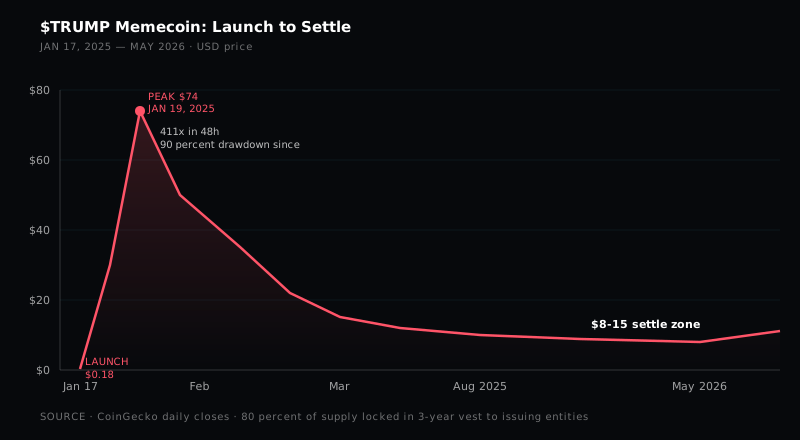
The $TRUMP token launched on Solana three days before the inauguration. It was issued by CIC Digital LLC, an entity disclosed as Trump-affiliated. The token traded from roughly 0.18 dollars at launch to a peak above 74 dollars in 36 hours, a 411x move on launch volume estimated above 60 billion dollars across the first two days. Initial market capitalization briefly reached roughly 14 billion dollars on a fully-diluted basis. Roughly 80 percent of supply is locked under a three-year vesting schedule to entity insiders, with periodic unlock waves that release supply into the market on a fixed timetable.
January 23, 2025: Working Group on Digital Assets EO
An executive order established a federal working group on digital assets, instructing the SEC, CFTC, Treasury, and other agencies to coordinate on crypto policy and to deliver a comprehensive policy report within 180 days. The immediate market effect was modest, but the order signalled the new posture: alignment across agencies rather than independent enforcement actions.
March 6, 2025: Strategic Bitcoin Reserve EO
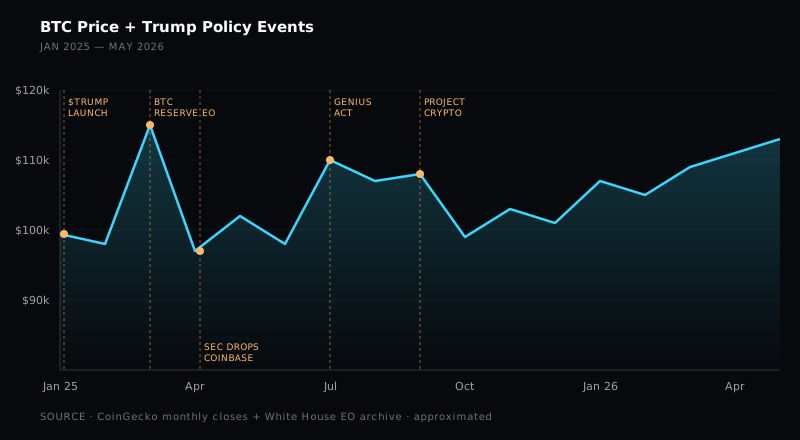
A second executive order created the Strategic Bitcoin Reserve and the Digital Asset Stockpile. The Reserve consolidates roughly 200,000 BTC already held by the federal government from prior criminal forfeitures (Silk Road, Bitfinex hack recovery, and other cases) and declares them a strategic reserve not to be sold. The Digital Asset Stockpile holds other seized non-BTC tokens. Critically, the order does not authorize new BTC purchases with taxpayer funds. BTC traded up roughly 6.2 percent in the 48 hours after the announcement, then retraced roughly 4.1 percent within a week as the no-new-purchases detail circulated.
April 2025: SEC drops enforcement cases
Through April and into early May 2025 the SEC dismissed its enforcement actions against Coinbase, Binance.US, and a series of other crypto matters. The Gensler-era enforcement-first approach effectively ended. New enforcement filings since have focused on fraud and disclosure cases rather than registration disputes.
July 2025: GENIUS Act signed
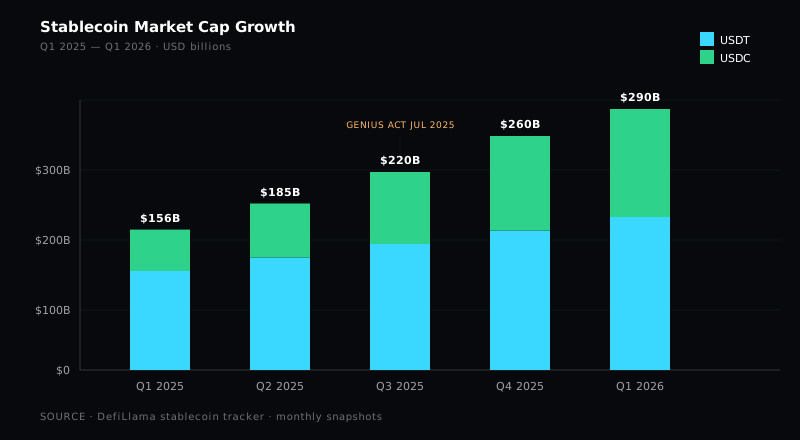
The GENIUS Act passed Congress with bipartisan support and was signed into law in July 2025. It establishes a federal framework for payment stablecoins: 1:1 reserve backing, monthly attestations by independent auditors, OCC supervision for federally chartered issuers, and a dual federal-state path. Circle adapted quickly given USDC’s existing posture. Tether moved more cautiously. Stablecoin market cap grew from roughly 156 billion dollars at the start of 2025 to roughly 290 billion dollars by May 2026, an 85 percent expansion concentrated in the months after the Act.
September 2025: SEC launches Project Crypto
Project Crypto was announced by SEC Chair Paul Atkins as a Commission-wide rulemaking initiative. Stated goals: bring crypto activity onshore through clearer rules rather than enforcement, establish a token taxonomy classifying most digital assets as non-securities, and provide registration paths for crypto businesses. Markup of the companion CLARITY Act in Congress followed in 2026.
October 2025: World Liberty Financial token launches
World Liberty Financial (WLFI), a DeFi project launched in late 2024 with disclosed Trump-family equity, released its public governance token in October 2025. The project’s transparency documents disclose entitlement to roughly 75 percent of platform revenue under certain conditions for the Trump-affiliated entity. WLFI trades on multiple international exchanges as of 2026.
2026: ongoing cleanup
Through 2026, additional Biden-era enforcement holdovers have continued closing. Banking restrictions associated with Choke Point 2.0 have eased at the federal level, with commercial bank policies moving more slowly. New rulemaking under Project Crypto is in progress.
Market reaction: what the data actually shows
The clearest way to assess the policy shift is to look at how markets actually responded around specific events. The pattern across 2025 and 2026 shows initial enthusiasm followed by partial retracement as detail emerged, plus durable structural changes in flow and product availability.
Price moves around named events
The $TRUMP memecoin remains the most dramatic single move. Launch price of roughly 0.18 dollars to a peak above 74 dollars in 36 hours, then a settle into the 8 to 15 dollar range by April 2025, and lower since. The wealth transfer pattern (early buyers selling to later buyers) is documented in on-chain studies. The Strategic Bitcoin Reserve EO produced a 6.2 percent BTC pop in 48 hours, with roughly half of that move given back within a week. SEC dropping the Coinbase suit produced a 9.4 percent next-day gain in COIN equity that gave back half within a month. Each individual event delivered a tradable move, but the durable level changes have been smaller than the initial spikes.
Structural changes in flow
Spot Bitcoin ETF assets under management grew from roughly 58 billion dollars in January 2025 to roughly 185 billion dollars by May 2026, a 219 percent expansion. Stablecoin market cap rose from 156 billion to 290 billion dollars over the same window. Crypto fear and greed sentiment averaged in the Greed to Extreme Greed band for 7 of the 12 months following the inauguration, compared with predominantly Fear for most of 2024. Trading volume on US-licensed exchanges expanded materially, although the bulk of derivative volume continues to flow through international venues.
What the data does not show
A clean monotonic uptrend in BTC or major alts. The market remains cyclical and macro-sensitive. Q1 2026 specifically saw BTC retrace from above 100,000 dollars to lows near 65,000 dollars before recovering in April, with no specific policy driver for the drawdown. Policy clarity reduced the regulatory tail risk but did not eliminate normal market volatility.
The Trump-family crypto businesses
The honest accounting matters here. The president’s family has direct economic interests in active crypto products. The structure has been disclosed in project documents and covered consistently in mainstream financial press. This section reports what the disclosures say.
The $TRUMP memecoin
Issued by CIC Digital LLC, a Trump-affiliated entity. Approximately 80 percent of token supply is locked under a three-year vesting schedule to entity insiders. The release schedule is published in the project’s documentation. Trading fees on the token’s primary trading pairs accrue to issuing parties, as do future unlocks valued at then-current market price. Disclosed revenue from launch fees and trading is in the hundreds of millions of dollars, though the precise figure depends on how unlocks are valued. The token has no claim on cash flows from any operating business.
World Liberty Financial (WLFI)
Launched as a DeFi platform in late 2024 with a public governance token released October 2025. The project’s transparency documents state that an entity affiliated with the Trump family is entitled to approximately 75 percent of platform revenue under certain conditions. WLFI offers stablecoin issuance, lending, and yield products. The project’s marketing positions it as a US-friendly DeFi venue.
The Strategic Bitcoin Reserve composition
The Reserve consists of approximately 200,000 BTC sourced from prior criminal forfeitures (Silk Road seizures, Bitfinex hack recovery, and other federal cases). No new BTC has been purchased with taxpayer funds. The Reserve is a custodial designation, not a buying program.
The conflict-of-interest framing
Mainstream financial press (Bloomberg, the Financial Times, the Wall Street Journal) has consistently framed the active officeholder’s personal token issuance and ongoing equity interests as unprecedented in US regulatory history. Academic ethics commentary and former government ethics officials have raised similar concerns publicly. This piece does not editorialize on whether the framing is appropriate. It reports that the framing exists, that it is the dominant frame in the financial press, and that the disclosures supporting it are publicly available. Retail traders should make their own judgment, factor it into position sizing on the affected tokens, and treat the news flow around these products with normal skepticism.
What this means for retail crypto traders globally
The practical impact depends heavily on where you live and which venues you can access. Below is a region-by-region summary of what has actually changed.
US-resident retail traders
US-licensed exchanges (Coinbase, Kraken, Gemini, Binance.US) now operate without the litigation overhang that defined 2022 to 2024. Product availability has expanded in 2025 and 2026, with more altcoin listings and a gradual rollout of perpetual and futures products under regulated wrappers. Banking access for US crypto users has improved at most major banks, although individual policy varies. Stablecoin balances on US venues have grown materially under the GENIUS Act framework, with USDC the dominant on-venue stablecoin given regulatory posture.
International venues (Bybit, BingX, Bitget, OKX, KuCoin, MEXC) continue to NOT serve US users despite the federal policy thaw. Geographic restrictions have not changed. US users should not attempt to circumvent these geo-blocks via VPN, which violates exchange terms of service and creates withdrawal risk. For US-based copy trading and futures access, the current options remain limited.
Non-US international retail traders
Practical access has not changed much. International exchanges continue to operate as before. The major international venues remain the depth leaders for derivatives. If you are evaluating venues for international retail use, see our best crypto exchanges for beginners and no-KYC crypto exchanges guides for current options.
For international traders specifically:
- Bybit for perpetuals depth and copy trading: Bybit signup.
- BingX for copy-trading-first product design: BingX signup.
- Bitget for copy trading and futures: Bitget signup.
- OKX for spot, futures, and on-chain integrations: OKX signup.
- KuCoin for breadth of altcoin listings: KuCoin signup.
Volatility tied to political signals
A single presidential social-media post can move BTC 2 to 4 percent within an hour, with larger moves on Trump-affiliated tokens. Multiple documented cases through 2025 and 2026 confirm the pattern. Several trading desks now track presidential feeds as a market signal. For retail traders this implies position sizing discipline: avoid leveraged positions around scheduled policy announcements, and treat social-media-driven spikes as low-quality entries. Our crypto risk management guide covers position sizing rules that apply here.
Tax treatment is unchanged
The Strategic Bitcoin Reserve does not change capital gains math for retail. Crypto remains property under IRS rules. Disposal events still trigger gain or loss recognition. There is no special treatment for tokens that happen to be politically themed.
Risk concentration on politically-themed tokens
Public on-chain analyses estimate that the median wallet which bought $TRUMP at peak is down 80 to 90 percent at May 2026 prices. WLFI has produced similar concentrated retail loss patterns according to on-chain studies. This is not unique to politically-themed tokens, but the marketing and celebrity-attached attention produced larger retail inflows at peak prices than typical altcoin launches. Treat all such tokens as lottery-ticket sized positions, not core holdings. See what are meme coins for the broader category framework.
The bull case in 2026 terms
There is a defensible bull case for the policy shift, independent of any view on the administration. It rests on four specific changes that are concrete and durable.
Regulatory clarity for builders. Project Crypto provides token-issuance pathways that did not exist before. Token issuers can now consult a published framework rather than guessing what registration approach the SEC will accept. The CLARITY Act, in markup in 2026, would codify parts of this approach into statute.
Banking access. Choke Point 2.0 federal banking restrictions ended. Crypto companies can again open commercial bank accounts at most major US banks, with normal underwriting. Operating costs for the industry have fallen as a result.
Stablecoin growth. The GENIUS Act federal framework reduced compliance overhead for stablecoin issuers, particularly for newer entrants. Total stablecoin market capitalization grew from roughly 156 billion dollars to roughly 290 billion dollars between January 2025 and May 2026.
Institutional flow. Spot BTC ETFs grew assets under management from roughly 58 billion dollars in January 2025 to roughly 185 billion by May 2026. ETH spot ETFs and a small number of multi-asset products contributed additional flow. Institutional positioning is clearly long across the regulated wrapper universe.
The bear case in 2026 terms
The bear case is equally defensible and rests on a different set of facts. The bull case and bear case are not mutually exclusive; both can be true at once.
Political dependence. The current framework is built substantially on executive orders. Executive orders can be rescinded by a future administration with a single signature. The durable pieces (the GENIUS Act, any future CLARITY Act passage) are smaller than the reversible pieces.
Conflict-of-interest signaling. The active officeholder holding personal positions in crypto products (the $TRUMP memecoin, WLFI equity) creates a structural risk to policy credibility. If the policy posture is perceived as conditional on protecting personal economic interests, the credibility of the framework with future Congresses and future administrations may be lower than headline policy momentum suggests.
Retail loss patterns. Politically-themed tokens have produced concentrated wealth-transfer patterns from retail to insiders. The $TRUMP token median holder is down 80 to 90 percent from peak. These patterns are well documented and represent a real cost to retail participation in the cycle.
International exchange competition. US users still cannot access the deepest derivatives venues without violating exchange terms. The regulatory thaw has not translated into expanded international venue access from US jurisdictions. Banking restrictions have eased; geographic licensing has not.
The political-news pump and dump pattern. Documented cases through 2025 and 2026 show recurring price spikes around presidential social-media posts and policy announcements, followed by mean reversion. The pattern raises market structure concerns about whether public communications are influencing tradable assets in ways that would normally trigger disclosure scrutiny.
What changes if Trump leaves office
The 2028 election will be the next inflection point. The reversibility of the current framework varies sharply by mechanism, and retail traders should understand which pieces are sticky and which can change overnight.
Executive orders, including the Strategic Bitcoin Reserve EO and the Working Group EO, can be rescinded on day one of a new administration. The Reserve itself is a designation of seized BTC; a future administration could choose to sell, hold, or expand. The political cost of selling would be substantial, but the legal authority is uncontested.
SEC chair change. The chair and senior staff turn over with the administration. Enforcement posture can shift quickly. A new chair could choose to reverse Project Crypto guidance, retract token taxonomy publications, and revive registration-by-enforcement. Token issuers should plan position sizes assuming this scenario is possible.
The GENIUS Act is congressional and substantially harder to unwind. Repeal would require new legislation through both chambers, which is unlikely under most scenarios. The federal stablecoin framework is therefore the most durable single piece of the 2025 to 2026 policy package.
International policy continues independently. MiCA in the EU, the Russian crypto framework advancing through 2026, Turkey’s regulatory adjustments, India’s continued crypto tax posture, and several other national frameworks proceed on their own timetables. US politics matter for US markets, not for the global regulatory baseline.
The retail trader’s playbook in this environment
Practical rules for navigating a market where political signals move prices and where new product structures have appeared faster than usual. None of this is financial advice; it is a checklist of risk-management considerations for retail use.
Do not over-allocate to politically-themed tokens. The $TRUMP, WLFI, and similar tokens should be sized as lottery tickets at most. Median holder loss patterns are well documented. If you allocate, allocate small.
Monitor policy announcements as market-moving events. Set alerts for major policy announcements and presidential social posts on crypto topics. Avoid holding leveraged positions during scheduled announcements where direction is unknown.
Diversify across BTC, ETH, and major alts. Pure politics-driven assets are higher beta than typical altcoins. A core position in BTC and ETH provides ballast against political-news volatility on smaller tokens. See how to buy crypto in 2026 for the basics, and crypto trading glossary for terminology.
Plan for policy reversal. Build position sizing assuming a future administration could reverse executive orders quickly. The GENIUS Act framework is more durable than the Strategic Bitcoin Reserve EO. Avoid concentration in assets whose value depends on a specific executive-order regime continuing.
Use established exchanges with jurisdictional resilience. For US users, Coinbase and Kraken have the deepest regulatory cover. For international users, Bybit, BingX, Bitget, OKX, KuCoin remain the depth leaders, with proof-of-reserves disclosures across the group. Compare in our best crypto exchanges for beginners and Binance review guides.
Pay attention to stablecoin issuer compliance status. USDC under the GENIUS Act and USDT’s slower compliance posture matter more in 2026 than they did in 2024. For an in-depth comparison see USDT vs USDC 2026.
Use position calculators before opening leverage. The volatility around political news has produced more documented liquidation events than typical news flow. Run scenarios through our liquidation calculator before sizing leveraged positions.
Conclusion
The Trump administration’s crypto agenda has been the most consequential US policy shift in crypto’s history as a regulated asset class. It has delivered measurable benefits: regulatory clarity through Project Crypto, banking access through the end of Choke Point 2.0, the stablecoin framework via the GENIUS Act, and institutional flow into spot ETFs that has tripled assets under management since the inauguration. It has produced new risks at the same time: political concentration of the framework in reversible executive orders, conflict-of-interest signaling around the president’s personal token holdings, and retail loss patterns on politically-themed tokens documented on-chain.
For retail traders the practical reality is: more tools, more clarity, also more volatility tied to political signals and more concentration risk in tokens with celebrity-level personalities attached. The same risk framework that applied before applies now. Never over-allocate to a single name. Never trade leveraged size around scheduled policy announcements. Never assume any policy regime is permanent. For the latest data on the current cycle, see our crypto news April 2026 recap and the crypto risk management guide.
Frequently asked questions
What is the Strategic Bitcoin Reserve and does the US government buy BTC for it?
The Strategic Bitcoin Reserve was created by executive order on March 6, 2025. It designates roughly 200,000 BTC already held by the federal government, sourced from prior criminal forfeitures including Silk Road seizures and Bitfinex hack recovery, as a strategic reserve that will not be sold. Critically, the order does not authorize new BTC purchases using taxpayer funds as of May 2026. A separate Digital Asset Stockpile holds other seized tokens. The market initially treated the order as a buy signal, with BTC up roughly 6.2 percent in the 48 hours after the announcement, before retracing roughly 4.1 percent within a week once the no-new-purchases detail was clarified by Treasury officials.
What is the GENIUS Act and how does it affect USDT and USDC?
The GENIUS Act was signed into law in July 2025. It establishes the first federal framework for payment stablecoins in the United States. Key provisions: 1:1 reserve backing requirement, monthly attestations by independent auditors, OCC supervision for federally chartered issuers, and a dual federal-state licensing path. Circle, as the issuer of USDC, was already operating close to these standards and adapted quickly. Tether, as the issuer of USDT, has moved more cautiously toward compliance. Stablecoin market cap grew from roughly 156 billion dollars in January 2025 to roughly 290 billion dollars by May 2026, an 85 percent expansion, much of it concentrated in the months after the GENIUS Act took effect.
What is the $TRUMP memecoin and what happened to people who bought it?
The $TRUMP memecoin launched on Solana on January 17, 2025, three days before the inauguration. It was issued by CIC Digital LLC, a Trump-affiliated entity. The token traded from roughly 0.18 dollars at launch to a peak above 74 dollars within 36 hours, an approximately 411x move, before settling in the 8 to 15 dollar range by April 2025. Roughly 80 percent of supply is locked under a three-year vesting schedule to entity insiders, meaning trading fees and future unlocks accrue economic value to the issuing parties. Public on-chain analyses estimate that the median wallet that bought at peak is down 80 to 90 percent at May 2026 prices.
What is World Liberty Financial (WLFI)?
World Liberty Financial is a DeFi project launched in late 2024, with a public governance token (WLFI) released in October 2025. The project's transparency documents disclose that an entity affiliated with the Trump family is entitled to roughly 75 percent of platform revenue under certain conditions. WLFI markets itself as a US-friendly DeFi platform offering stablecoin issuance, lending, and yield products. Mainstream financial coverage (Bloomberg, FT, WSJ) consistently frames the project as unprecedented in US regulatory history due to the active officeholder's family equity stake. As of May 2026, WLFI trades on multiple international exchanges with concentrated retail holdings.
Has the SEC really stopped suing crypto exchanges?
Largely yes, on the enforcement actions filed during the Gensler era. In April 2025 the SEC dropped its lawsuits against Coinbase and Binance.US, and a series of other crypto-related enforcement matters were closed in subsequent months. In September 2025 the SEC launched Project Crypto, framed as a rulemaking initiative rather than an enforcement campaign. New cases since 2025 have focused on fraud and disclosure failures rather than registration disputes. That does not mean enforcement is gone. Securities fraud cases continue, and individual states (notably New York) maintain separate enforcement powers. The federal posture has shifted from registration-by-enforcement toward written rules with clear pathways.
Can US users now access Bybit, BingX, OKX, or KuCoin?
No, the geographic restrictions on these international exchanges have not changed despite the US policy shift. Bybit, BingX, Bitget, OKX, KuCoin, and MEXC continue to geo-block US users and do not accept US-resident KYC. The reason is partly historical (legacy unregistered status with US regulators) and partly banking related: international exchanges still cannot easily obtain US banking and licensing without committing to US registration. Choke Point 2.0 banking restrictions ended at the federal level, but commercial bank policies have moved more slowly. For US users, regulated venues remain Coinbase, Kraken, Gemini, and Binance.US. For international users, the choices remain unchanged from prior years.
How do Trump's truth-social posts affect Bitcoin prices?
Multiple documented cases in 2025 and 2026 show single-post moves in the 2 to 4 percent range within one hour on BTC, with larger moves on lower-cap altcoins and Trump-affiliated tokens. The pattern has become consistent enough that several trading desks track presidential social feeds as a market signal. The most reactive assets are the Trump-affiliated tokens themselves ($TRUMP, WLFI) and BTC. Major altcoins react less. The trading-around-political-news pattern is now a known retail behavior and a structural feature of the 2026 crypto market. Plan position sizing accordingly, and avoid leveraged positions around scheduled or expected policy announcements.
What happens to all of this if a different administration takes office in 2029?
Three layers of policy with different reversibility. Executive orders, including the Strategic Bitcoin Reserve EO and the Working Group on Digital Assets EO, can be rescinded with a single signature on day one of a new administration. The SEC chair and senior staff change with the administration, which would shift enforcement posture relatively quickly. The GENIUS Act is congressional legislation and is substantially harder to unwind, requiring new legislation through both chambers. The Strategic Bitcoin Reserve framework specifically depends on the next administration choosing to keep the seized BTC pool intact rather than selling. International policy (MiCA in the EU, frameworks in Russia, Turkey, India) proceeds independently of US politics either way.
#Trump#regulation#Bitcoin#Strategic Bitcoin Reserve#GENIUS Act#WLFI#TRUMP token#policy#analysis
Discussion
Loading comments…