
TL;DR: Meme coins are cryptocurrencies driven by community, humor and attention rather than technology or revenue. Some have produced 100x or larger returns; most have lost 95 percent or more within a year. The 2026 landscape is dominated by DOGE, SHIB, PEPE, WIF, BONK and FLOKI, plus an ever-rotating cast of newer tokens on Solana, Base and Ethereum. This guide covers what they are, the current top 10, how to buy them safely, the real risks, and the position sizing math that keeps a $200 punt from blowing up your account.
Not financial advice. Meme coins are the highest-volatility, highest-loss-rate category in crypto. Most lose money. Read the risk disclaimer before scaling capital.
What is a meme coin?
A meme coin is a cryptocurrency whose price is driven primarily by community, humor and attention rather than by revenue, product or protocol economics. There is no white paper that matters. There is rarely a roadmap. The token is the brand, and the brand is the meme. Price is a pure attention function: when attention rises, price rises; when attention fades, price collapses.
Contrast that with utility tokens. Ether (ETH) settles transactions on Ethereum and earns fees from every smart contract interaction. Solana’s SOL pays for blockspace on the fastest L1. BNB powers Binance’s chain and gets burned with exchange revenue. These tokens have measurable on-chain economics. Meme coins do not.
Some meme coins eventually try to graft utility on top of the meme. Shiba Inu launched Shibarium, an Ethereum Layer 2 network, in 2023. Dogecoin’s developer foundation has explored payment rails and L2 ideas. Floki built an education platform and a metaverse product. The pattern is consistent: utility add-ons drive headlines but rarely drive price. The price still trades on whether the meme is alive.
The 2026 meme coin universe splits into two camps. Established memes (DOGE, SHIB, PEPE, WIF, BONK, FLOKI) have multi-billion-dollar market caps, listings on major exchanges, and survived multiple cycles. Ephemeral memes launch daily via pump.fun and similar factories, get 48 hours of attention, and die. The first camp is speculative but tradable. The second camp is closer to a slot machine with a worse house edge.
A short history of meme coins
2013: The original joke. Dogecoin launched in December 2013, built by software engineers Billy Markus and Jackson Palmer as a parody of the early Bitcoin mania. The branding was the Shiba Inu dog from the Doge meme, which had gone viral that year. The token traded for fractions of a cent and lived mostly on Reddit, where it was used to tip content creators. For seven years, almost nothing happened.
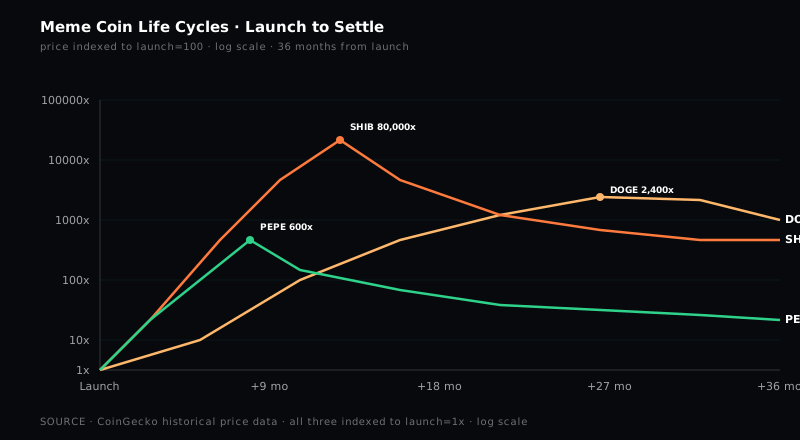
2020-2021: The proof of concept. The COVID-era retail trading boom hit DOGE hard. Tesla CEO Elon Musk began tweeting about Dogecoin in early 2021. Prices ran from around $0.005 in late 2020 to $0.74 in May 2021, a roughly 148x move that minted thousands of paper millionaires and a handful of real ones. Shiba Inu launched in August 2020 with the explicit pitch of being the “Dogecoin killer.” SHIB pumped from sub-zero fractions to $0.000088 in October 2021, a move so large that early holders with $200 in dust wallets discovered eight-figure balances.
2023: The frog. PEPE launched in April 2023 on Ethereum, branded around the Pepe the Frog meme. Within three weeks, PEPE was up tens of thousands of percent, and a handful of wallets posted public profits over $5 million on initial buys of a few thousand dollars. The story confirmed that the Doge formula (cute mascot plus internet culture plus low price tag) still worked on a new generation of traders.
2024: Solana meme season. Cheap blockspace on Solana enabled a memecoin factory called pump.fun, which let anyone deploy a token in under a minute for a few dollars. WIF (dogwifhat) hit a $4 billion market cap. BONK, the first major Solana meme, integrated into Solana retail wallets. BOME, MEW, POPCAT and dozens of others ran. Memecoins reached an estimated 4-5 percent of total crypto market cap at the peak.
2025-2026: The political meme arrives. TRUMP launched in January 2025 ahead of the US presidential inauguration and produced a vertical price chart that round-tripped within two weeks. CEX listings accelerated: Bybit, BingX, Bitget and KuCoin now compete to list new memes within hours of viral signal. The 2026 baseline: established memes are an asset class, ephemeral memes are a daily lottery, and the average new pump.fun token has a useful lifespan measured in hours.
What separates meme coin winners from instant rugs
Survival in the meme category is statistical. The vast majority of tokens deployed die within weeks. A small percentage develop real community and trade for years. Five filters separate the two groups.
Real community vs botted activity. A real meme coin has a Discord or Telegram with thousands of active members posting daily, plus a Twitter/X presence with organic engagement. A rug has 50,000 followers acquired through bot services, zero real conversation, and a launch-day spike with nothing behind it. The cheapest filter is reading the chat: a real community talks about anything but price. A bot community has nothing but price calls.
Lock-up of dev tokens. The most common rug pattern is the dev unlocking their allocation and dumping into retail bids. Verifiable on-chain: check the largest holders on the token’s block explorer. If the top wallet holds 10 percent or more unlocked, the rug is one transaction away. Legitimate launches lock dev tokens via a vesting contract or burn them outright. Tokens that pass this filter pass the most dangerous one.
Real liquidity depth. A token with a $5,000 liquidity pool on a DEX is unsellable. A single $10,000 sell crashes the price 30 percent. Established memes have multi-million-dollar pools across multiple venues. The rule of thumb: if you cannot sell three times your intended position size in one transaction without moving the price more than 5 percent, the liquidity is too thin.
Exchange listings. A tier-2 CEX listing (MEXC, KuCoin, Gate.io) means the token has survived initial scrutiny by an exchange’s listing team and has measurable trading volume. A tier-1 listing (Binance, Coinbase) means the token is now an asset, not a meme. Most newly listed memes pump on listing news and then trade sideways or down. The listing is information, not a buy signal.
Time alive. Tokens that survive 1 year outlive 95 percent of memes. Three years alive moves a token into institutional category. DOGE has survived since 2013. SHIB since 2020. PEPE since 2023. The base rate for a new token surviving 12 months is in single digits.
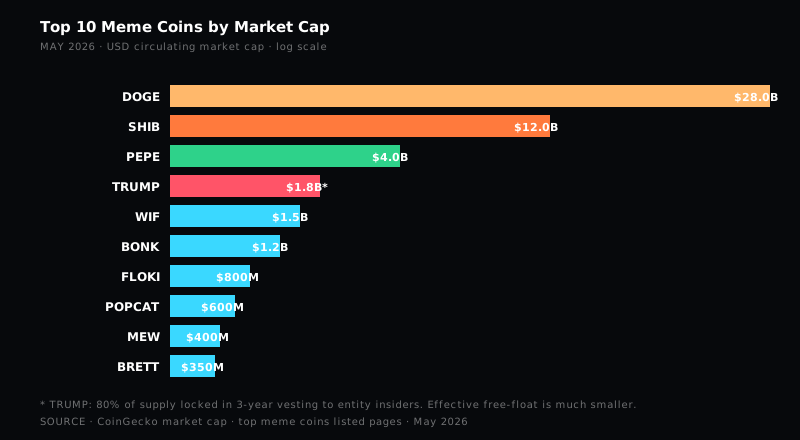
Top meme coins to watch in 2026
These are the 10 memes most worth understanding if you trade the category at all in 2026. Market cap ranges are approximate and rotate fast. None of this is a buy recommendation.
1. Dogecoin (DOGE)
The original meme coin and still the largest by market cap, sitting in the $20-30 billion range across the 2024-2026 cycle. Listed on every major exchange (Binance, Coinbase, Bybit, BingX, Bitget, OKX, KuCoin and most others). The community is the largest in crypto outside Bitcoin and Ethereum. Watch out for: DOGE is heavily tied to Elon Musk narrative. When that narrative cools, price drifts.
2. Shiba Inu (SHIB)
Launched 2020, second-largest meme by market cap. Built Shibarium, an Ethereum Layer 2, which gave the project an unusual amount of infrastructure for a meme. Listed on Binance, Coinbase, Bybit, BingX, Bitget and others. Watch out for: SHIB’s massive token supply means it trades in fractions of a cent forever, which appeals to retail but also caps psychological upside.
3. PEPE
The 2023 frog breakout. Still in the top 5 memes by market cap. Pure meme, no utility pretense, large and active community. Listed on Binance, Bybit, BingX, Bitget, OKX, KuCoin. Watch out for: PEPE’s chart is one of the most reflexive in crypto. It pumps hard and dumps harder. Position sizing matters more here than for DOGE.
4. dogwifhat (WIF)
The Solana meme that hit a $4 billion market cap in 2024. The pitch: it’s a dog wearing a hat. That’s it. That was enough. Listed on Bybit, BingX, Bitget, OKX, KuCoin, MEXC, Binance, Coinbase. Watch out for: WIF is one of the most volatile names in this list. Hourly 20 percent moves are normal.
5. Bonk (BONK)
The first major Solana meme, launched late 2022. Integrated into Solana retail wallets (Phantom, Solflare) as a default token. Listed on Bybit, BingX, Bitget, KuCoin, OKX, Coinbase, Binance. Watch out for: BONK is correlated to broader Solana sentiment. When SOL pumps, BONK pumps; when SOL fades, BONK fades faster.
6. Floki (FLOKI)
Named after Elon Musk’s dog. Built an unusually real ecosystem for a meme: an education platform (Floki University), a metaverse game (Valhalla), and a payments product. Listed on Binance, Bybit, BingX, Bitget, OKX, KuCoin. Watch out for: FLOKI’s utility additions rarely drive the price; the meme still does.
7. Brett (BRETT)
A Base chain meme, character from the Matt Furie comic universe (same artist behind Pepe). Became one of the largest Base memes by market cap. Listed on Bybit, BingX, Bitget, MEXC, KuCoin and others. Watch out for: BRETT is tied to Base ecosystem activity. If Base loses momentum, BRETT does too.
8. Popcat (POPCAT)
A Solana cat meme based on the viral popping cat video. Broke into the top 100 by market cap in 2024. Listed on Bybit, BingX, Bitget, MEXC, KuCoin. Watch out for: POPCAT runs on pure attention. The cat itself is the entire pitch. When attention moves to the next meme, POPCAT does not gracefully transition.
9. MEW (cat in a dog’s world)
Another Solana cat meme, with the explicit anti-dog narrative. Built a real following during the 2024 cat meme rotation. Listed on Bybit, BingX, Bitget, MEXC, KuCoin. Watch out for: MEW is mid-cap, less liquid than the top 5 on this list, and large position sizes face real slippage.
10. TRUMP
The political meme launched January 2025 ahead of the US presidential inauguration. The token’s market cap fluctuates with political news cycles, which is a novel risk vector. Listed on Bybit, BingX, Bitget, OKX, KuCoin, MEXC, Coinbase. Watch out for: TRUMP carries headline risk and political risk that no other meme on this list carries. Position size accordingly.
How to actually buy meme coins
For established memes (DOGE, SHIB, PEPE, WIF, BONK, FLOKI) the simplest path is a major centralized exchange. Bybit, BingX, Bitget, OKX and KuCoin list these in spot markets. Binance and Coinbase also carry them. Buy in spot only. Leverage on an asset that can draw down 80 percent in a week is account death.
Newer memes rotate monthly and CEX listings come later. Solana memes trade primarily on Jupiter or Raydium DEX. Ethereum memes trade on Uniswap. Base memes trade on Aerodrome. MEXC and KuCoin tend to list earliest among the major centralized exchanges, often within days of a meme breaking out. By the time a meme hits Binance or Coinbase, it has usually run.
Important DEX caveats. Set slippage manually. For liquid memes (DOGE-tier liquidity even on DEX) 1-3 percent is fine. For newer memes with thin pools, 5-10 percent is the floor. Be aware of MEV sandwich attacks: bots monitor pending DEX transactions, insert a buy in front of yours to drive the price up, let your trade fill at the new top, and dump into the price. This can cost 2-10 percent per trade. Use a wallet with sandwich protection (Phantom on Solana, Rabby on Ethereum) and consider Jito-protected RPCs on Solana.
Bridge risk is real. If you are moving USDC, SOL or ETH between chains to buy a meme, each bridge adds another point of failure. Bridge exploits have cost users billions in aggregate since 2021. The safer pattern: pick one chain for your meme activity (Solana is currently easiest for new memes; Ethereum is best for established ones) and stay on it. For US users or anyone wanting maximum compliance, established memes on a tier-1 CEX is the cleanest path. For non-KYC paths see the best no-KYC crypto exchanges guide, with the caveat that exchanges without KYC carry their own risks.
The real risks
Meme coins are the highest-loss-rate category in crypto. The risks below are not theoretical. They happen weekly to real traders with real money.
Rug pulls. The dev or insider unlocks their allocation, sells into retail bids, and the price collapses 99 percent. Most common in tokens under two weeks old on a DEX. The defense is verifying token allocation and lock-up before buying, and avoiding new pump.fun deploys unless you accept a base rate of total loss.
Honeypots. A smart contract is built to let you buy but blocks you from selling. You watch the price pump and discover at exit time that your wallet cannot dispose of the tokens. Scanning a contract on DexScreener, Honeypot.is or a similar tool before buying catches most honeypots. Skipping that check is paid in full losses.
MEV sandwich attacks. Bots insert a buy in front of your DEX transaction, drive the price up before you fill, and sell into your fill. Per-trade loss is 2-10 percent. Over a season of meme trading this compounds into a significant tax on returns. Wallets with sandwich protection or RPC routing through Jito (Solana) and similar services on Ethereum mitigate this.
Liquidity death. A meme dies. No one is bidding. Order books show a price but nobody will actually buy at that price. Your effective fill might be 50 percent below the displayed mark. The defense is monitoring pool depth and exiting when it thins. The trap is staring at the price and refusing to accept that the market for your bag has evaporated.
Exchange delisting. Most CEXs delist memes that lose volume. You wake up to an email that the token will be removed in 14 days, with instructions to withdraw to a self-custody wallet. If the meme is now untradeable on any tier-1 venue and only lives on a DEX, your wallet holds a token with no liquid market.
Tax surprise. Meme coin pumps can create huge realized capital gains if you sold near the top, even if you bought back in and rode the price to zero. The “FTX-to-zero” tax disaster pattern: a trader sells appreciated crypto, owes capital gains, redeploys into another asset, that asset craters, and they owe more in taxes than the remaining bag is worth. Set aside the tax obligation in stable currency at the moment you realize the gain. Do not redeploy 100 percent of proceeds.
Position sizing: the lottery ticket framework
The single rule that keeps meme coin traders alive: never more than 5 percent of your trading account in any single meme, and never more than 10 percent across all memes combined. Everything else is detail.
The math. With a $5,000 trading account, 5 percent per meme is $250 maximum exposure. If the meme goes to zero, you lose $250, which is tuition cost. If the meme 10x, you gain $2,250 on $250 risked. The asymmetry is what makes the category work. Sized larger, the asymmetry breaks: a $1,500 position (30 percent) that goes to zero takes years to earn back.
Do not average down. Meme coins do not recover. Bitcoin and Ethereum recover, eventually. Most memes do not. If your $250 position becomes $25, the move is to write off the position and walk. Buying more at the lower price is how a $250 loss becomes a $750 loss. The defining feature of meme coin charts: the asset can lose 95 percent and never see the prior high. There is no mean reversion.
Realize partial gains on the way up. At 2x, sell 50 percent of the position. Your principal is now off the table and the remainder plays free. At 5x, sell another 50 percent of what remains. At 10x or higher, evaluate against your original thesis: is the meme still alive, is the community still growing, is volume still increasing. If yes, the rest can ride. If no, take it off.
Use a time stop. If a meme is not moving in 30 days after entry, exit. Memes pump fast or never. A meme that sits flat for a month has lost the attention war and the next move is usually down, not up. The opportunity cost of capital tied up in a dead meme is the next meme you could have bought.
Tax considerations
Meme coin gains are taxable as capital gains in most jurisdictions. The specifics vary by country, but the general rule holds: when you sell at a profit, you owe tax on the gain. Treat trade records like a job. Export CSVs from every exchange you use and reconcile them quarterly.
In the US, short-term trades (held under 12 months) are taxed as ordinary income, which for active meme traders means the same rate as their salary. Long-term gains (held over 12 months) get preferential rates. In the UK, capital gains apply with an annual allowance of around £6,000 (subject to annual review). In Russia, personal income tax of 13-15 percent applies on realized gains; see the detailed Crypto Taxes Russia 2026 guide. In Turkey, crypto gains are effectively tax-free at present but the 2026 reform calendar is active; see Crypto Taxes Turkey 2026. EU MiCA jurisdictions mostly apply capital gains, with rates varying by member state.
The practical rule: at the moment you realize a meme coin gain, set aside the tax obligation in a stablecoin or your local currency. Do not redeploy 100 percent of proceeds into the next trade. Traders who skip this step end up in tax debt after the next drawdown.
Bottom line
Meme coins are speculation, not investment. Treat them like lottery tickets with better odds than the actual lottery. A small number will make life-changing money. Most will go to zero. The dividing line between traders who survive the category and traders who blow up is position sizing: never more than 5 percent of your trading account in any single meme, never more than 10 percent across all memes combined.
The right meme at the right time can deliver outsized returns. DOGE 148x in eight months. SHIB more than that. PEPE made tens of millionaires in three weeks. The wrong meme at any time can vaporize your capital in 30 minutes. Both are true, simultaneously. The framework that respects both truths is small position sizes, real liquidity, time stops, partial profit taking and zero leverage. If you can hold that line through a full cycle, the category can pay for itself. If you cannot, the category will pay for someone else’s gains with your losses.
Read the risk management beginners guide before scaling capital, the how to start crypto trading 2026 guide if you are still setting up, the crypto trading glossary to decode the jargon you will see in meme communities, and our methodology for how we score exchanges and tokens.
Frequently asked questions
Are meme coins a good investment in 2026?
Meme coins are speculation, not investment. The base rate is brutal: most lose 90 percent or more within a year, and a small number deliver outsized returns that pay for all the losers in a portfolio. If you treat meme coins as lottery tickets with better odds than the actual lottery, the math can work. If you treat them as a savings vehicle, the math eats you alive. The honest answer for most retail traders: a 5-10 percent slice of speculative capital across 3-5 established memes is defensible. Anything larger fights base rates. The 2024-2026 cycle produced more 100x memes than any prior cycle, but it also produced more zeros.
What's the safest way to buy meme coins?
Use a tier-1 or tier-2 centralized exchange for established memes (DOGE, SHIB, PEPE, WIF, BONK, FLOKI). Spot only, no leverage. Bybit, BingX, Bitget, OKX, KuCoin, Binance and Coinbase all list these in spot markets. For newer memes that haven't been listed yet, use a reputable DEX (Jupiter on Solana, Uniswap on Ethereum, Aerodrome on Base) with a wallet that protects against sandwich attacks. Set slippage manually, verify the contract address on a token scanner, and limit position size to what you can afford to lose entirely. Never give a Discord moderator your seed phrase, no exceptions.
How much of my portfolio should be in meme coins?
The lottery ticket framework: never more than 5 percent of your trading account in any single meme, and never more than 10 percent across all memes combined. Example: with a $5,000 account, $250 maximum per meme, $500 maximum across all memes. If a meme goes to zero, you lose tuition money. If a meme 10x, you gain $2,250 on $250 risked. The position sizing rule is the single thing that separates traders who survive the meme cycle from those who blow up. Doubling down on a losing meme is the most common account-killing mistake.
Why did Dogecoin start the meme coin trend?
Dogecoin launched in December 2013, created by Billy Markus and Jackson Palmer as a parody of the Bitcoin frenzy. The token used the Shiba Inu dog from the Doge meme as its branding. Early DOGE was worth fractions of a cent and traded mostly as tip currency on Reddit and forums. The 2020-2021 cycle changed everything: Elon Musk tweeted about it repeatedly, retail piled in, and DOGE pumped from around $0.005 to $0.74 in May 2021, a roughly 148x move. That was the proof of concept for every meme coin that followed. Community plus attention plus a low price tag equals retail magnet.
Are meme coins legal?
Yes, in most jurisdictions meme coins are legal to buy, hold and trade. They are treated as cryptocurrencies under existing regulatory frameworks: capital gains tax on profits in the US, UK and most EU countries, ordinary income tax in some other places. The grey area is around token issuers and influencer promotion: the SEC has pursued cases where promoters failed to disclose paid promotion on meme tokens. As a buyer, your tax obligation is the main legal touchpoint. Exchanges that list meme coins follow KYC and AML rules the same way they do for any other token. Always check local laws for your specific jurisdiction.
How do I avoid rug pulls?
Check four things before buying any new meme. First, the dev token allocation: look on the token's blockchain explorer for the dev wallet. If devs hold more than 5 percent unlocked, the rug risk is high. Second, liquidity pool depth: a $500K+ pool on Uniswap or Raydium absorbs sells; a $5K pool collapses on any meaningful exit. Third, sell tax in the contract: scan the token on Honeypot.is or a similar scanner. Some contracts let you buy but block selling. Fourth, age and community: 90 percent of rug pulls happen in the first two weeks. Coins alive past 60 days with a real community survive the rug filter most of the time.
What's the difference between a meme coin and a shitcoin?
Meme coin is a sub-category of shitcoin where the brand is the product. DOGE, SHIB, PEPE, WIF and similar are all shitcoins in the technical sense (no real revenue, no real product), but they have community and narrative, which gives them the meme coin label. A generic shitcoin is a token with no real utility, no real community, and no clear narrative: launched, pumped briefly, dumped, dead. Most tokens launched on pump.fun are generic shitcoins that get called memes for marketing. The dividing line: a real meme has a story that lasts more than 48 hours. A shitcoin has a chart and nothing else.
Do meme coins have any real use case?
Mostly no, and that's the point. Meme coins are bets on attention and community, not bets on protocol economics. A few have tried to graft real utility: SHIB launched Shibarium, a Layer 2 network, in 2023; FLOKI built a metaverse and education platform; DOGE has been discussed as a payment rail by various merchants over the years. The honest read: utility additions to meme coins rarely move the price more than a meme cycle does. The community and the narrative are the use case. Treating them as utility tokens that happen to have memes is a misunderstanding of what drives the price.
#meme-coins#beginners#guide#DOGE#SHIB#PEPE#WIF#BONK#risk
Discussion
Loading comments…