
If you searched for a crypto price prediction, you probably wanted a number: where will Bitcoin or Ethereum be by year end. Here is the honest answer up front, before the article even starts. No one can tell you, and anyone who says they can with a precise figure and a date is selling confidence, not insight. That is not cynicism, it is what the track record shows. This guide is about something more useful: how to read the predictions you will see, why most of them miss, and how to think in scenarios instead.
Not financial advice. This is general education about how forecasts work, not a prediction or a recommendation to buy or sell anything. Crypto is volatile and the future price is unknowable. Read our risk disclaimer and do your own research.
Key takeaways
- No method reliably predicts crypto prices. Named analyst targets hit roughly 35 to 45 percent of the time.
- The four common types, technical analysis, on-chain models, analyst targets and AI, each have a structural flaw.
- Survivorship bias makes prediction look better than it is: you remember the rare right call, not the many wrong ones.
- The honest alternative is a scenario framework: what would have to happen for up, flat or down, and which catalysts to watch.
- Read the reasoning behind a call, not the number, and always size for being wrong.
Why price prediction is the wrong question
Asking what the price will be assumes the future is knowable if you find the right expert or model. It is not. Crypto prices are set by liquidity, regulation, macro conditions and crowd sentiment, all of which move quickly and interact in ways no model captures. The better question is not where will the price be, but what would have to happen for it to go up, stay flat, or fall, and how would I act in each case. That reframing is the whole game.
The four kinds of prediction, and their flaws
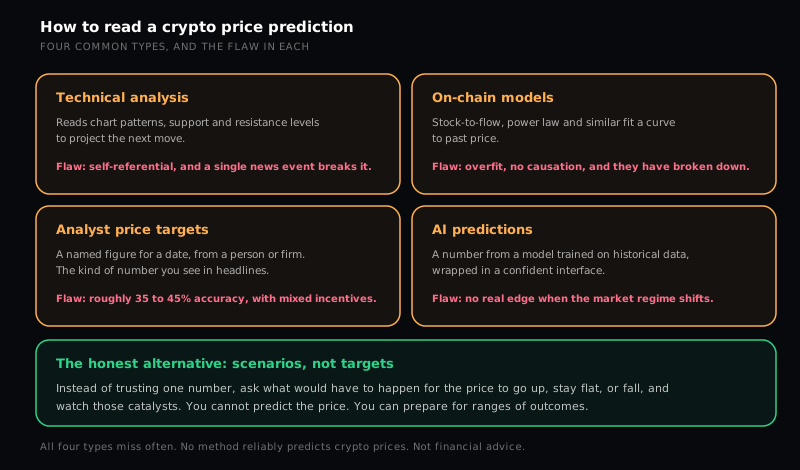
Almost every price call you see is one of four types, and each fails in its own way.
Technical analysis
Technical analysis reads chart patterns and support and resistance levels to project the next move. It can be a useful way to frame risk, because many traders watch the same levels, but it is self-referential for the same reason, and a single piece of news can erase a pattern in minutes. Useful as a lens, dangerous as a forecast.
On-chain models
Models like stock-to-flow and the power law fit a curve to Bitcoin’s history and extend it forward. They look impressive because a curve fit always matches the past. The problem is that fitting the past is not predicting the future: these models are overfit, show correlation rather than causation, and the most famous of them have visibly broken down when reality left the line.
Analyst price targets
This is the headline number: a named figure for a date, from a person or a firm. It is the most shareable form of prediction and the least reliable. Tracking studies put the all-in accuracy of named crypto targets in roughly the 35 to 45 percent range, and the people issuing them rarely pay a cost for being wrong.
AI predictions
The newest flavour is an AI that outputs a price, wrapped in a confident interface. Under the hood it is a model trained on noisy historical data, and it inherits every limitation above. It has no special knowledge of the future and no edge when the market regime shifts, which is exactly when you would want one. For the full breakdown, see can AI predict crypto prices.
How accurate are crypto price predictions
Low, and lower than they look. Two biases inflate the apparent hit rate. The first is survivorship: the one person who called the last top is famous, while the hundreds who called it five other times are forgotten. The second is regime change: a method tuned to one cycle, low rates and a certain liquidity backdrop, can fail completely when the backdrop changes. Put together, the practical accuracy of confident single-number forecasts is around or below a coin flip once you account for the magnitude of the move, not just the direction.
What to do instead: scenario thinking
The fix is not a better guru, it is a better question. Drop the single number and build a small scenario map: a bull case, a base case and a bear case, each with the catalysts that would drive it. Then watch the catalysts, not the price targets. This keeps every path conditional, prepares you for being wrong, and turns a passive prediction into an active checklist. It is exactly how we frame our coin pieces, like the Bitcoin H2 2026 outlook, the Solana outlook, the Ethereum outlook, the XRP outlook and the Dogecoin outlook: catalysts and scenarios, never a target.
Red flags of a bad prediction
- A precise number with a specific date and no conditions attached.
- No reasoning, just the figure, or reasoning that is all upside and no risk.
- Round, dramatic targets designed to be shareable rather than accurate.
- Certainty. Honest analysis hedges, because the future genuinely is uncertain.
- A seller behind it. Ask what the person posting the target gains if you believe it.
Bottom line
You came for a price prediction, and the most valuable thing this page can give you is the reason not to trust one. No method, human or AI, reliably forecasts crypto prices, and the confident numbers in your feed are closer to marketing than analysis. The skill worth building is scenario thinking: understand the catalysts, map the bull, base and bear paths, read the reasoning rather than the number, and always size for being wrong. For context on what actually moves the market, see how oil and macro affect crypto and our watchlist approach in the best crypto to buy. When you want to act, you can trade on BingX, with sensible position sizes.
This article is general information about how forecasts work, not financial advice and not a prediction. Crypto is volatile and the future price is unknowable. Read our risk disclaimer, do your own research, and never invest money you cannot afford to lose.
Frequently asked questions
Are crypto price predictions accurate?
Mostly no. Studies that track named analyst price targets put their all-in accuracy, getting both direction and rough magnitude right, in roughly the 35 to 45 percent range, which is around or below a coin flip on direction once you account for the size of the move. Crypto is driven by liquidity, regulation and sentiment that shift fast, so any single number for a future date should be treated as a guess dressed up as analysis.
Can anyone actually predict the price of Bitcoin or Ethereum?
No one can do it reliably. People who got one big call right are remembered, while the far larger number who got it wrong are forgotten, which is survivorship bias. Markets also change regime, so a method that worked in one cycle can fail in the next. The honest position is that the future price is unknowable, and the useful skill is preparing for a range of outcomes rather than betting on one.
What is the most reliable type of price prediction?
None is reliable on its own. Technical analysis is self-referential and breaks on news, on-chain models like stock-to-flow are overfit curve fits that have broken down, analyst targets hit well under half the time, and AI predictions inherit the noise of the past with no edge on regime shifts. They can each be a useful lens for thinking, but treating any of them as a forecast is how people lose money.
What is a scenario framework and why use it?
A scenario framework drops the single number and instead describes what would have to happen for the price to rise, stay flat, or fall, then watches those catalysts. It keeps you honest, because each path is conditional rather than promised, and it prepares you for more than one outcome. Our coin outlooks use exactly this approach: catalysts plus bull, base and bear cases, with no targets and no probabilities.
Why do influencers and headlines still post price targets?
Because a bold number gets clicks, follows and engagement in a way that an honest 'it depends' never will. A target is memorable and shareable, and the poster rarely pays a price for being wrong. That incentive, not superior insight, is why your feed is full of confident figures. Treat a precise target with a specific date as a marketing artifact first and analysis second.
How should a beginner use price predictions?
Use them as a map of what other people are watching, not as instructions. Read the reasoning behind a call, not just the number, and ask what would have to be true for it to happen and what would break it. Then size positions for being wrong, because you often will be. The goal is to understand the debate, not to outsource your decision to a stranger's figure. This is not financial advice.
Does this site publish price predictions?
We publish scenario outlooks, not targets. Our Bitcoin, Solana and Ethereum pieces lay out the catalysts the market is watching and describe bull, base and bear paths conditional on those catalysts, without assigning probabilities or naming a price for a date. It is deliberately framed as a thinking tool. We would rather be honest and useful than confident and wrong.
#price prediction#price analysis#scenarios#crypto#DYOR#2026
Discussion
Loading comments…