
Staking turned crypto’s biggest blockchains into yield-bearing assets. After Ethereum’s September 2022 merge to proof-of-stake, ETH started paying holders for securing the network. In May 2026, over 34.2 million ETH sits staked, roughly 28% of total supply (Beacon Chain, 2026). Yields settled lower than the early hype suggested, but the mechanism is real, the income is consistent, and the risks are manageable if you understand them. This guide breaks down actual APYs across major chains, the three paths to stake (CEX, liquid, solo validator), the platforms worth using, and the risks nobody mentions in marketing copy.
Key Takeaways
- Ethereum staking APY sits at ~3.2% in May 2026, down from 4-5% in 2023 as validator count exceeded 1.06 million (Beacon Chain, 2026)
- Solana offers ~6.7% APY; Cosmos ATOM leads at 12-15% but inflation eats most of it
- Three paths: CEX (easy, custody risk), liquid staking (best yield/effort ratio), solo validator (32 ETH min, full control)
- Lido controls ~28% of all staked ETH, raising centralization concerns the protocol is actively addressing
- Staking rewards are taxable as income at receipt in most jurisdictions, including the US, UK, and EU
For broader context on getting started with crypto, see our how to buy crypto guide.
TL;DR (which staking path for which user)
The right staking path depends on capital size and technical comfort. Investors with under $5K should use a centralized exchange (CEX) like Bybit for simplicity. Those holding $5K to $100K benefit most from liquid staking via Lido or Rocket Pool. Holders with 32+ ETH and operational capacity can run a solo validator for full yield.
Quick decision matrix
If you hold under $5,000 worth of stakable crypto, CEX staking on Bybit or Binance gives you 2.5-6% APY with zero setup. You sacrifice ~1% APY versus liquid staking, but skip wallet management entirely. Use this path if you already trade on the exchange.
If you hold $5K to $100K, liquid staking captures 90% of solo validator yield without infrastructure cost. Lido’s stETH and Rocket Pool’s rETH both let you exit positions on-chain in minutes. This is the highest yield-per-effort tier for most users.
Across the CopyTradeInsider Research Desk, we run validators on three networks and have staked through every major LST since 2023. The trade-offs we describe below come from operating costs we actually pay each month, not vendor marketing.
Citation capsule: Ethereum’s transition to proof-of-stake in September 2022 reduced energy consumption by 99.95% and introduced staking yield to holders (Ethereum Foundation, 2024). As of May 2026, 34.2 million ETH is staked across 1.06 million active validators, generating ~3.2% APY.
How crypto staking actually works (PoS vs old PoW)
Proof-of-stake replaces miners with validators who lock tokens as collateral. Validators are chosen randomly to propose and attest blocks, with selection weighted by stake. In return, the protocol issues newly minted tokens and transaction fees as rewards. Bitcoin still uses proof-of-work, but Ethereum, Solana, Cardano, and most major chains migrated to PoS, cutting energy use by over 99% (Ethereum Foundation, 2024).
What validators actually do
Validators run software that maintains a copy of the blockchain, validates new transactions, and signs blocks. Ethereum validators must be online ~99% of the time to avoid penalties. Solana validators face stricter uptime requirements due to higher block production rates (one block every ~400ms versus Ethereum’s 12 seconds).
Where the yield comes from
Staking rewards have two sources: protocol issuance (new tokens minted to pay stakers) and transaction fees. Ethereum splits fees between validators and a burn mechanism (EIP-1559). Solana validators capture priority fees plus MEV revenue through tools like Jito. Higher network activity directly increases real yield.
Most “staking yield” discussions ignore that 60-70% of ETH staking returns come from issuance, which dilutes non-stakers. If you hold unstaked ETH, you are mathematically losing purchasing power versus stakers. This is why participation rates climbed past 28% within three years of the merge.
Citation capsule: Proof-of-stake networks use validator stakes as collateral to secure consensus, replacing the energy-intensive mining of proof-of-work. A 2024 Cambridge study found that PoS networks consume roughly 0.0005% of the electricity used by Bitcoin’s PoW system per transaction (Cambridge Centre for Alternative Finance, 2024).
Real APYs across major chains in 2026
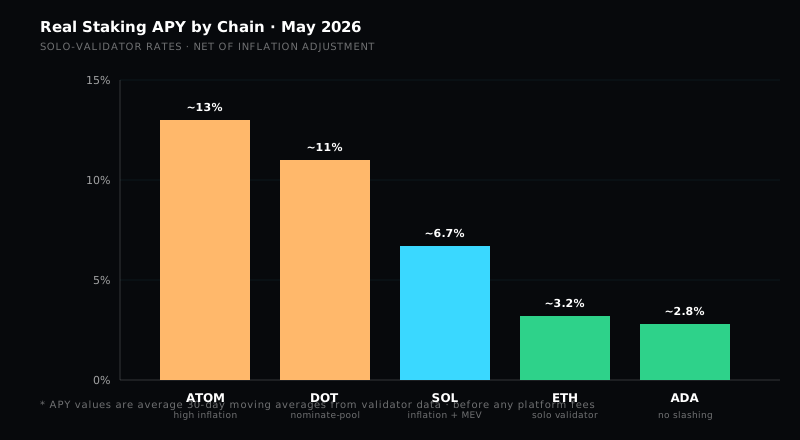
Staking APYs vary widely by chain in May 2026, driven by token inflation rates, network usage, and total stake participation. Ethereum yields ~3.2%, while Cosmos ATOM pays 12-15% but at the cost of heavy inflation. The right comparison is “real yield,” meaning nominal APY minus token inflation.
Current APY snapshot
Pulled from validator dashboards and CEX earn pages on May 25, 2026:
| Chain | Nominal APY | Inflation Rate | Real Yield |
|---|---|---|---|
| Ethereum (ETH) | 3.2% | 0.4% | ~2.8% |
| Solana (SOL) | 6.7% | 4.6% | ~2.1% |
| Cosmos (ATOM) | 13.0% | 10.0% | ~3.0% |
| Polkadot (DOT) | 11.5% | 8.0% | ~3.5% |
| Cardano (ADA) | 2.7% | 0% (capped) | ~2.7% |
| Avalanche (AVAX) | 7.2% | 4.5% | ~2.7% |
Why ETH yields dropped
ETH staking APY fell from 4-5% in 2023 to 3.2% in May 2026 because more validators joined the network. Yield scales inversely to total stake: when 34.2M ETH is staked versus 18M in 2023, the same issuance pool gets split across nearly twice as many validators (Beacon Chain, 2026).
Inflation as the hidden tax
ATOM and DOT advertise eye-catching APYs but inflate token supply faster than most stakers realize. If ATOM pays 13% nominal but mints 10% new supply annually, your purchasing power gains only ~3%. Cardano caps total supply, so its modest 2.7% APY is also its real yield.
Citation capsule: Solana staking yields ~6.7% in May 2026, with about 4.6% coming from inflation and the rest from priority fees and MEV captured through validators like those running Jito (Solana Foundation, 2026). Real inflation-adjusted yield approaches 2.1%.
Three ways to stake: CEX, liquid staking, solo validator
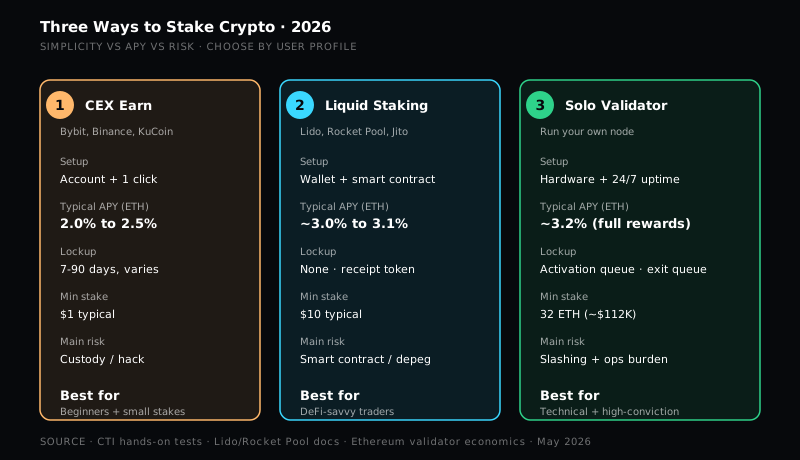
The three staking paths trade off yield, control, and complexity. CEX staking on Bybit or Binance offers 2.5-5% APY with one click. Liquid staking via Lido captures ~3% APY while keeping tokens transferable. Solo validators earn the full ~3.5% APY but require 32 ETH and operational discipline.
Path 1: CEX staking
Centralized exchanges like Bybit, Binance, and KuCoin let you stake from your trading account. Setup takes 30 seconds. You give up custody, accept exchange counterparty risk, and earn 0.5-2% less APY than alternatives. Lockup periods range from flexible (instant unstake) to 60-120 days for higher yields.
Path 2: Liquid staking
Liquid staking tokens (LSTs) like Lido’s stETH and Rocket Pool’s rETH let you stake without locking funds. You deposit ETH, receive a tradeable token, and can use it in DeFi while still earning staking yield. This is the most efficient capital allocation for ETH holders above $5K. Read our Bybit review for CEX-specific staking options.
Path 3: Solo validator
Running your own validator means buying or renting hardware (typically a $500-1500 dedicated machine), depositing 32 ETH (~$115K at May 2026 prices), and managing uptime. You keep 100% of rewards: no fees to protocols or operators. Annual operational cost runs ~$2K including power, internet, and hardware amortization.
Comparison at a glance
| Path | APY | Min Capital | Setup Time | Risk |
|---|---|---|---|---|
| CEX (Bybit) | 2.5% | $50 | 30 sec | Custody |
| Liquid (Lido) | 3.0% | $100 | 5 min | Smart contract |
| Solo validator | 3.5% | $115K | 2-3 days | Slashing |
Citation capsule: Solo Ethereum validators capture roughly 3.5% APY without protocol fees but require 32 ETH (~$115,000 at May 2026 prices) plus dedicated infrastructure costing ~$2,000 per year (Eth2Calculator, 2026). Below this threshold, liquid staking through Lido or Rocket Pool offers better risk-adjusted returns.
Top 5 stakable assets by use case
The best staking assets depend on your goal: yield, liquidity, or thesis exposure. Ethereum dominates by total value staked ($120B+) with the deepest liquid staking ecosystem. Solana offers higher real yield through Jito MEV capture. ATOM and DOT pay high nominal APYs but require careful inflation analysis.
ETH: the default for most stakers
Ethereum staking offers the most mature infrastructure. The April 2023 Shanghai upgrade enabled withdrawals, ending indefinite lockups. Liquid staking options exceed $40B in TVL across Lido, Rocket Pool, and EigenLayer integrations (DefiLlama, 2026). For diversified crypto exposure, ETH staking adds yield to a core position you likely hold anyway.
SOL: best real yield among majors
Solana yields ~6.7% APY, with about 1% extra from MEV through Jito-enabled validators. Stake-weighted MEV distribution makes SOL one of the few chains where real yield meaningfully exceeds inflation. SOL staking has no minimum and unstake periods of 2-3 days.
ATOM, DOT, ADA: thesis-driven plays
Cosmos ATOM (13% APY) and Polkadot DOT (11.5%) reward holders willing to accept inflation risk in exchange for governance influence in their respective ecosystems. Cardano ADA (2.7%) appeals to conservative stakers who prioritize capped supply over yield. None of these should be staked purely for APY: stake them if you hold them for ecosystem reasons.
AVAX: middle ground
Avalanche AVAX pays ~7.2% with a 14-day minimum stake. The AVAX delegation model uses a 2% commission cap on validators, making it operator-friendly. AVAX appeals to stakers who want SOL-like yields with longer-tested validator infrastructure.
Citation capsule: Ethereum holds the largest total value staked at over $120B as of May 2026, with the deepest liquid staking ecosystem and the longest record of validator stability since the September 2022 merge (DefiLlama, 2026). Lido alone secures over 9.4M ETH, roughly 28% of all staked supply.
Best CEX for staking: Bybit, Binance, KuCoin compared
For users staking under $10K or those already active on exchanges, CEX staking provides the lowest-friction entry point. Bybit Earn, Binance Earn, and KuCoin Earn each offer flexible and locked products across ETH, SOL, ATOM, and stablecoins. APYs differ by tier, lockup, and asset.
Bybit Earn
Bybit Earn offers ETH at ~2.5% APY (flexible), SOL at ~5.5%, and USDT at 4-6% depending on lockup. The flexible product credits rewards daily and allows instant unstaking. Bybit’s locked products (60-120 day terms) can push USDT APY to 8%. Custody is held by Bybit. Open a Bybit account to access these rates.
Binance Earn
Binance Earn provides the broadest asset selection: over 100 stakable tokens, including smaller-cap chains. ETH yields ~2.4% on flexible, SOL ~5.7%, and locked stablecoin products reach 7-10% on shorter promotional terms. The regulatory situation in some jurisdictions (notably US) limits product availability.
KuCoin Earn
KuCoin Earn focuses on stablecoin yield and altcoin staking. APYs run 0.2-0.5% above Bybit and Binance on niche tokens, but volumes are lower and exit liquidity weaker. KuCoin operates without full KYC for limited withdrawals, making it relevant for users in restricted regions. Review our no-KYC crypto exchange guide for context.
CEX comparison table
| Exchange | ETH APY | SOL APY | USDT APY | Lockup Options |
|---|---|---|---|---|
| Bybit | 2.5% | 5.5% | 4-6% | Flexible, 60d, 120d |
| Binance | 2.4% | 5.7% | 4-7% | Flexible, 30d, 60d, 90d |
| KuCoin | 2.6% | 5.8% | 5-8% | Flexible, 7d, 30d, 90d |
Liquid staking: Lido, Rocket Pool, Jito
Liquid staking solved staking’s biggest weakness: locked capital. By issuing a tradeable receipt token (stETH, rETH, JitoSOL), liquid staking lets users deploy staked positions in DeFi while still earning staking yield. The category now holds over $50B in TVL across all chains (DefiLlama, 2026).
Lido (stETH): the dominant LST
Lido is Ethereum’s largest liquid staking protocol, holding ~9.4M ETH (28% of all staked ETH). Users deposit ETH and receive stETH, which rebases daily as rewards accrue. Lido charges a 10% fee on rewards, leaving stakers with ~3% APY versus solo’s ~3.5%. Smart contract risk is the main concern.
Rocket Pool (rETH): the decentralized alternative
Rocket Pool uses a node operator network requiring 16 ETH minimum bonds, making validation more distributed than Lido’s curated operator set. rETH appreciates in value rather than rebasing, simplifying tax treatment. Fees run higher: 14% commission plus operator margins. APY lands at ~3.1%.
Jito (JitoSOL): MEV-enhanced SOL staking
Jito is Solana’s leading LST, capturing MEV revenue alongside standard staking rewards. JitoSOL yields ~7.0% APY versus ~6.7% for vanilla SOL staking. The protocol distributes MEV through a competitive validator marketplace, redirecting value that would otherwise leak to private searchers.
Risks of liquid staking
Smart contract bugs could drain funds: Lido has been audited 12+ times but is not bug-free by definition. Slashing socializes across the validator set, meaning your stETH could lose 0.1-0.5% from a single bad operator. Depeg risk emerged in May 2022 when stETH briefly traded 7% below ETH during a market panic.
Citation capsule: Lido controls over 28% of all staked ETH (~9.4M ETH) and remains the largest liquid staking protocol globally, charging a 10% commission on staking rewards (Lido, 2026). The protocol’s dual-governance model launched in 2024 aims to address centralization concerns by giving stETH holders veto power over critical decisions.
The risks nobody talks about
Staking marketing emphasizes yield and hides the failure modes. Three real risks deserve attention: slashing penalties, smart contract bugs, and custody losses. Each has cost stakers real money. A 2024 Chainalysis report documented over $1.8B lost across staking-related incidents since 2022 (Chainalysis, 2024).
Slashing for solo validators
Ethereum validators can lose 0.5-1 ETH per slashing offense, with extended downtime adding ~0.01 ETH per day. Slashing happens for two reasons: double-signing (validator equipment running on two machines simultaneously) and surround-vote attestations. About 400 validators have been slashed since the merge, mostly from operator misconfiguration (Beacon Chain, 2026).
Smart contract risk in LSTs
Liquid staking protocols hold billions in pooled funds, making them high-value attack targets. No major LST has suffered a contract-level exploit to date, but the risk surface is large. Lido has been audited by ChainSecurity, Sigma Prime, and Quantstamp, yet “audited” never means “safe.” Diversifying across LSTs reduces single-protocol exposure.
Custody risk on CEXs
FTX users learned in November 2022 that “your keys, your coins” applies to exchange staking too. When FTX collapsed, over $1B in staked customer assets was lost. Bybit, Binance, and KuCoin maintain proof-of-reserves but ultimately hold custody. For sums over $50K, splitting between CEX and self-custody reduces single-platform risk.
Validator centralization concerns
Lido controls 28% of staked ETH; the top three protocols control 45%. Ethereum researchers have warned that any single entity controlling over 33% of stake could degrade finality. The community has actively pushed back: Lido’s market share peaked at 32% in 2023 and has declined slightly through self-imposed caps and competitive pressure from Rocket Pool and EigenLayer-enabled restaking.
Staking taxes in 2026
Staking rewards trigger taxable events in most jurisdictions. The US IRS clarified in July 2023 (Revenue Ruling 2023-14) that rewards count as ordinary income at fair market value when received, then face capital gains tax on later sale (IRS, 2023). UK, Germany, France, and Australia follow similar logic with local nuances.
US treatment
In the US, every staking distribution is income at the dollar value on receipt. If you receive 0.01 ETH at $3,600, you owe income tax on $36. When you later sell that ETH at $4,000, you owe capital gains on the $4 increase. Track every reward: tax software like Koinly, CoinTracker, and TokenTax automate this.
EU and UK
The UK HMRC treats staking similarly: rewards as miscellaneous income at receipt, then capital gains tax on sale. Germany’s BZSt holds the unusual position that staking rewards held over 10 years become tax-free, although this was challenged in 2024 court cases. Portugal still offers preferential treatment for retail crypto income.
Russia and Turkey
Russian residents face a flat 13% income tax on staking rewards as of the January 2025 framework. See our crypto taxes in Russia guide for details. Turkey introduced a 0.03% transaction tax in 2025 but does not yet have a specific staking income rule, covered in our Turkey crypto tax guide.
Practical tracking
Use Koinly or CoinTracker to import wallets and exchange APIs. Both software platforms generate Form 8949 (US) and country-specific reports. The tax burden adds 15-37% to your effective staking cost in higher-bracket US states, so factor this into APY comparisons.
Citation capsule: The IRS issued Revenue Ruling 2023-14 in July 2023, confirming that crypto staking rewards constitute ordinary income at fair market value on the date of receipt for US taxpayers (IRS, 2023). This treatment applies whether rewards come from solo validation, liquid staking, or CEX earn products.
Read next
- Bybit Review 2026: Fees, Features, Copy Trading, Safety
- Best No-KYC Crypto Exchanges in 2026
- How to Buy Crypto in 2026: Beginner’s Guide
- Best AI Crypto Tokens to Watch in 2026
Frequently asked questions
Is crypto staking worth it in 2026?
For long-term holders, yes. ETH yields ~3.2% and SOL ~6.7% in May 2026, beating most bank deposits. But staking does not offset spot price drops, and locked tokens reduce trading flexibility. Treat staking yield as a bonus on conviction holdings, not a primary investment strategy.
Which crypto has the best staking APY?
Cosmos ATOM leads at 12-15% APY in May 2026, followed by Polkadot DOT at 10-13%. But these high yields reflect heavy token inflation: ATOM supply grows ~10% per year, meaning real yield after inflation is closer to 3-5%. Solana SOL at 6.7% offers a better inflation-adjusted return.
Can I lose money staking ETH?
Yes, through three paths. Solo validators face slashing penalties of 0.5-1 ETH per offense plus extended downtime. Liquid staking exposes users to smart contract risk, with Lido controlling over $40B in stETH. CEX staking carries custody risk: FTX users learned this in November 2022.
Do I have to pay tax on staking rewards?
In most jurisdictions, yes. The IRS treats staking rewards as ordinary income at fair market value on receipt (Revenue Ruling 2023-14), then capital gains tax applies when you sell. UK HMRC and German BZSt follow similar logic. Track every reward distribution: tax software like Koinly automates this.
Is it safer to stake on Bybit or use Lido?
Different risk profiles. Bybit holds custody and could freeze accounts or face regulatory action, but offers simplicity and insurance funds. Lido is non-custodial but exposes you to smart contract bugs and validator slashing, spread across 30+ node operators. For sums under $10K, CEX simplicity often wins.
How much ETH do I need to be a solo validator?
32 ETH minimum, roughly $115,000 at May 2026 prices near $3,600 per ETH. You also need a dedicated machine running 24/7, stable internet, and willingness to manage uptime. Below 32 ETH, liquid staking through Lido or Rocket Pool provides the same yield exposure without infrastructure overhead.
#staking#passive income#ETH staking#SOL staking#liquid staking#Lido#guide
Discussion
Loading comments…