
TL;DR: The AI x crypto narrative is one of the largest themes in 2026, but most AI tokens lost 70 to 90 percent from their 2024 peaks during the post-narrative correction. A handful of tokens with real utility hold up as legitimate plays: Bittensor (TAO), Fetch.ai (FET), Render (RNDR), NEAR Protocol, and Akash (AKT) on the infrastructure side. A separate cohort of newer agent tokens, Virtuals (VIRTUAL), ai16z, and GAME, captures the agent economy narrative with higher volatility and execution risk. This piece ranks the top 8 AI tokens for 2026 across three categories, with honest tokenomics, real risk framing, and where to actually buy them, written from the perspective of a retail trader who has watched the full cycle since 2023.
Not financial advice. AI tokens are among the most volatile assets in crypto. Most retail buyers of AI tokens at the 2024 peak are still underwater in May 2026. The narrative is real, the technology is improving, and the token-level returns are still heavy-tailed: a few names compound, most bleed. Position size accordingly, never use leverage on the agent-tier names, and read the risk disclaimer before treating anything in this piece as actionable. Verify market cap, supply, and exchange listings against primary sources before any trade.
How we categorize AI crypto tokens
The AI token universe in 2026 has roughly 200 tokens that market themselves as AI-related, but only about 30 have meaningful product traction. To make sense of the field, we split tokens into three categories based on what they actually do, not on what the marketing pages claim. The category structure matters because each category has different risk profiles, different tokenomics patterns, and different catalysts.
Compute and infrastructure tokens
This category includes tokens that provide the underlying compute and infrastructure layer for AI work. The leading names are Bittensor (TAO) for decentralized AI compute marketplaces via subnets, Akash (AKT) for general-purpose decentralized cloud compute targeting AI inference, Render (RNDR) for distributed GPU rendering covering both 3D and AI workloads, and Golem (GLM) as the older general-compute pioneer. These tokens earn fees, distribute emissions to compute providers, and have measurable on-chain activity. They are the closest thing in the AI category to “real” infrastructure plays.
Agentic platforms
The newer category covers tokens for autonomous AI agent platforms. Leaders here are ai16z (parent token for the Eliza framework, a DAO investment thesis), VIRTUAL (Virtuals Protocol, an agent launchpad on Base chain), GAME (an agent framework with onchain coordination), and ARC (another agent infrastructure token). These tokens are newer, more volatile, and represent bets on the agent economy materializing. The risk is higher; so is the dispersion of outcomes.
AI utility and data tokens
The third category covers AI-adjacent utility and data marketplace tokens. FET (Fetch.ai) anchors this group, now operating as part of the ASI alliance after the 2024 merger with SingularityNET (AGIX) and Ocean Protocol (OCEAN). NEAR Protocol pivoted hard toward AI agents in 2024 to 2025 and now sits at the intersection of L1 and AI utility. OCEAN continues as a data marketplace under the ASI umbrella. These tokens have multi-year track records, real product surface area, and are typically less volatile than the agent-tier names.
Top 8 AI tokens ranked for 2026
The ranking below reflects fit for retail exposure to the AI narrative in 2026, weighted across utility, tokenomics quality, market cap stability, exchange availability, and product traction. It is not a price prediction. None of these tokens is a guaranteed compounder; the ranking is a starting point for further research, not a buy list.
1. Bittensor (TAO)
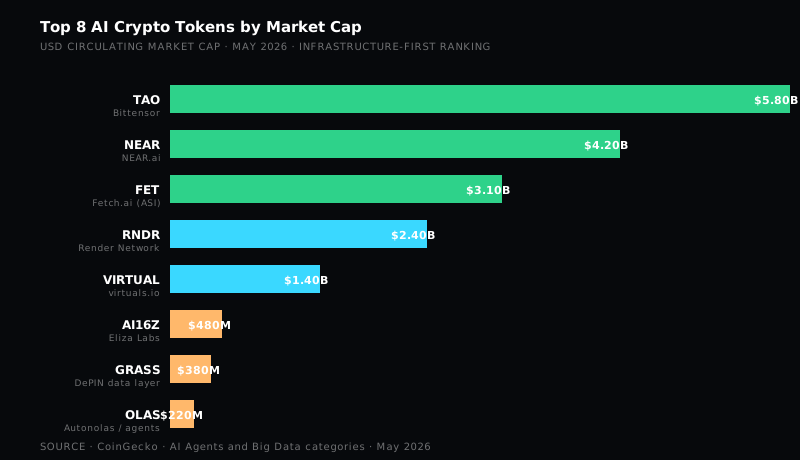
Ticker: TAO. Chain: Bittensor (native Substrate-based L1). Market cap range May 2026: roughly 3 to 4 billion dollars.
Bittensor is the most established decentralized AI infrastructure project in the market in 2026. The network operates a subnet architecture where independent teams compete to produce verifiable machine-learning outputs (text generation, time-series prediction, audio synthesis, scraping, image generation, and more). Roughly 32 subnets were active as of May 2026, with new subnets approved through governance and inactive subnets being deprecated. Each subnet runs its own validator and miner economy, with TAO emissions distributed based on validated output quality.
Tokenomics. Bittensor follows a Bitcoin-style halving schedule with periodic emission reductions. The current annualized inflation rate is roughly 18 percent declining toward 14 percent through the next halving event. Total supply is capped at 21 million TAO, matching Bitcoin’s supply cap as a deliberate design choice. Subnet emissions are dynamically allocated based on validator consensus on subnet value, which creates strong incentives for subnet quality but also introduces governance volatility.
Watch out. Subnet quality varies wildly. Some subnets produce legitimate outputs (the leading text generation subnets, for example, run competitive small models). Other subnets exist primarily to capture emissions with thin actual output. The recurring debate within the Bittensor community is how to weed out low-value subnets without harming the permissionless quality of the architecture. The 18 percent inflation is also significant: TAO holders are diluted unless network value accretes faster than supply.
Where to buy. Spot listings on Bybit, BingX, Bitget, OKX, KuCoin, Binance, and most other major exchanges. Perpetuals on Bybit, OKX, and Binance Futures.
2. Fetch.ai (FET) and the ASI alliance
Ticker: FET (consolidated). Chain: Cosmos-based Fetch chain, with Ethereum bridge. Market cap range May 2026: roughly 2 to 3 billion dollars combined under ASI alliance.
Fetch.ai operates as the lead token of the ASI (Artificial Superintelligence) alliance, formed through the 2024 merger of Fetch.ai with SingularityNET (AGIX) and Ocean Protocol (OCEAN). The conversion ratios were finalized through 2024 to 2025, and the unified FET ticker now represents the combined entity. The underlying product is an agent-based economy where autonomous agents discover, negotiate, and transact on the Fetch chain. Documented use cases include airline pricing agents, supply chain coordination, and DeFi automation.
Tokenomics. The unified FET has a clear total supply schedule with most insider allocations already vested by 2026. Inflation is moderate, with staking rewards in the 6 to 8 percent annualized range. The ASI merger consolidated three separate token economies, which simplified the cap table but also exposed holders of the predecessor tokens to conversion-ratio politics. The current ratio outcomes have been documented by the alliance with no major disputes.
Watch out. The merger added narrative momentum but has not yet delivered a step-function improvement in product traction. Mainstream adoption of agent-based commerce remains early. Treat the ASI thesis as a multi-year structural bet, not a near-term catalyst.
Where to buy. Spot on every major exchange including Bybit, BingX, Bitget, OKX, KuCoin, and Binance. FET perpetuals widely available.
3. Render (RNDR)
Ticker: RNDR (on Solana since 2024 migration). Chain: Solana (migrated from Ethereum in 2024). Market cap range May 2026: roughly 2 to 3 billion dollars.
Render is the GPU compute marketplace for 3D rendering and increasingly AI inference. The network connects users who need GPU compute (Hollywood VFX studios, animation houses, AI labs, indie 3D artists) with operators who provide GPU capacity (datacenter operators, gaming rig owners, professional render farms). Real revenue, real customers, multi-year operating history. The 2024 migration from Ethereum to Solana reduced network friction and broadened the user base.
Tokenomics. RNDR uses a burn-and-mint equilibrium model where compute usage burns tokens and emissions mint new tokens to compute providers. The net inflation depends on network demand relative to emissions, which has trended modestly net-deflationary during high-demand periods and modestly inflationary during slow periods. Total supply is uncapped but emissions are governed.
Watch out. RNDR’s primary revenue tilt is still 3D rendering, not AI inference, despite the AI narrative. The AI use case is real but smaller than the marketing positions it. Competition from centralized GPU clouds (AWS, GCP, dedicated AI clouds) remains intense, and decentralized GPU is competitive only on certain workloads.
Where to buy. All major centralized exchanges plus Solana DEXs. The Solana migration means SOL-network access is required for the on-chain version.
4. NEAR Protocol (NEAR)
Ticker: NEAR. Chain: NEAR (native L1). Market cap range May 2026: roughly 5 to 6 billion dollars.
NEAR pivoted hard toward AI agents in 2024 to 2025, repositioning from a general-purpose L1 to an AI-focused infrastructure layer. The core technical components are NEAR Intent (a primitive that lets users express desired outcomes and have agents fulfill them) and Chain Signatures (a system that lets NEAR-resident accounts sign transactions on other chains, enabling cross-chain agent payments). The combination is a credible foundation for agent-based commerce.
Tokenomics. NEAR has a moderate inflation schedule with most insider allocations vested. The token is used for staking, transaction fees, and storage. The supply schedule is more conservative than the agent-tier names, which makes NEAR less volatile than the satellite plays but also less explosive on narrative spikes.
Watch out. The AI pivot is real but the L1 competitive landscape remains intense. NEAR competes with Solana, Sui, Aptos, and Ethereum L2s for developer mindshare. The AI positioning is a differentiator but not yet a moat.
Where to buy. Spot on every major exchange. Perpetuals on Bybit, OKX, Binance, and most derivatives venues.
5. Virtuals Protocol (VIRTUAL)
Ticker: VIRTUAL. Chain: Base (Coinbase L2 on Ethereum). Market cap range May 2026: roughly 1.5 billion dollars.
Virtuals Protocol is the leading Base-chain agent launchpad. The platform lets developers deploy AI agents that run autonomously, hold token-denominated wallets, and transact with other agents through the Agent Commerce Protocol (ACP). ACP uses $VIRTUAL as the settlement asset for inter-agent payments. The bull thesis is straightforward: as AI agents proliferate, they need payment rails, and Virtuals built one of the first credible ones.
Tokenomics. VIRTUAL has a moderate circulating supply ratio with notable unlocks through 2026 to 2027. ACP usage burns a portion of fees, providing some token sink mechanics. The supply schedule is more aggressive than the infrastructure tokens, which contributes to the higher volatility profile.
Watch out. Agent economy adoption is early. The number of agents transacting via ACP grew through 2025 but remains a small fraction of what the bull case requires. VIRTUAL is also concentrated in Base chain activity, which ties its fortunes to Base ecosystem growth.
Where to buy. Spot on KuCoin, Bitget, Gate.io, MEXC. Limited listings on the largest CEXs. DEX trading on Uniswap (Base) is the primary venue for early liquidity.
6. ai16z ($ai16z)
Ticker: ai16z. Chain: Solana. Market cap range May 2026: roughly 400 million dollars.
The ai16z token is the parent token of the Eliza framework, an open-source agent framework that gained adoption through 2024 to 2025. The token launched with a DAO investment thesis where the DAO holds and deploys capital based on community governance, modeled (intentionally) as a meme-flavored on-chain version of a venture firm. The Eliza framework itself is legitimate open-source software used by many other agent projects.
Tokenomics. ai16z launched fair-style on Solana with no insider allocation, which differentiates it from most agent tokens. The DAO holds a treasury that has been invested in other agent projects, with mixed results. Supply is fixed, no inflation, no halving, just market mechanics.
Watch out. Extreme volatility. ai16z traded above 2 billion dollar market cap during the late-2024 agent narrative peak and has retraced to the 300 to 500 million range since. DAO governance decisions have been controversial in some cases. Treat as a high-volatility satellite, not a core position.
Where to buy. Spot on KuCoin, Bitget, Gate.io, MEXC, and most Solana DEXs (primarily Raydium). Some perpetual listings on Bybit and other derivatives venues.
7. Akash Network (AKT)
Ticker: AKT. Chain: Akash (Cosmos-based). Market cap range May 2026: roughly 600 million dollars.
Akash provides decentralized cloud compute marketed to AI workloads, particularly inference. The product is Kubernetes-based, which gives it a meaningful technical edge over most decentralized compute alternatives: developers familiar with Kubernetes can deploy AI inference workloads to Akash with limited friction. Real customers, real GPU operators on the network, real Kubernetes-native deployments.
Tokenomics. AKT has a moderate inflation schedule with staking rewards. Network fees in AKT contribute to a partial burn mechanic. Total supply is governed and adjusts based on network parameters.
Watch out. AKT is smaller than RNDR or TAO, with less liquidity. GPU supply on Akash is concentrated in a handful of large operators, which raises decentralization questions. Competition from RNDR, centralized GPU clouds, and other decentralized compute networks is structural.
Where to buy. Spot on Bybit, BingX, Bitget, KuCoin, and most major exchanges. Smaller liquidity than the top-tier names but adequate for retail position sizes.
8. Worldcoin (WLD)
Ticker: WLD. Chain: World Chain (proprietary L2) plus Ethereum. Market cap range May 2026: roughly 3 billion dollars.
Worldcoin sits in the AI category as the leading proof-of-personhood protocol, addressing the sybil resistance problem that becomes acute as AI agents proliferate. The thesis: as bots and agents flood every online surface, proving a transaction comes from a human becomes valuable, and World ID is the most-deployed solution to that problem. Some AI agent protocols integrate World ID for human-vs-agent distinction.
Tokenomics. WLD has a substantial future supply unlock schedule, with allocations to the Worldcoin Foundation and Tools for Humanity ramping over multiple years. This is one of the more aggressive future-supply profiles in the AI category and contributes to ongoing price pressure as unlocks proceed.
Watch out. Worldcoin is the most controversial AI-category token. Privacy advocates and multiple regulators have raised concerns about the iris-scanning verification model. The token is geo-blocked from several jurisdictions including the United States. Treat WLD as a thematic exposure with elevated regulatory tail risk, not a clean infrastructure play.
Where to buy. Spot on KuCoin, Bitget, OKX, Binance, Bybit (where geographically available). US users have effectively no compliant venue for WLD.
What I would NOT buy in 2026
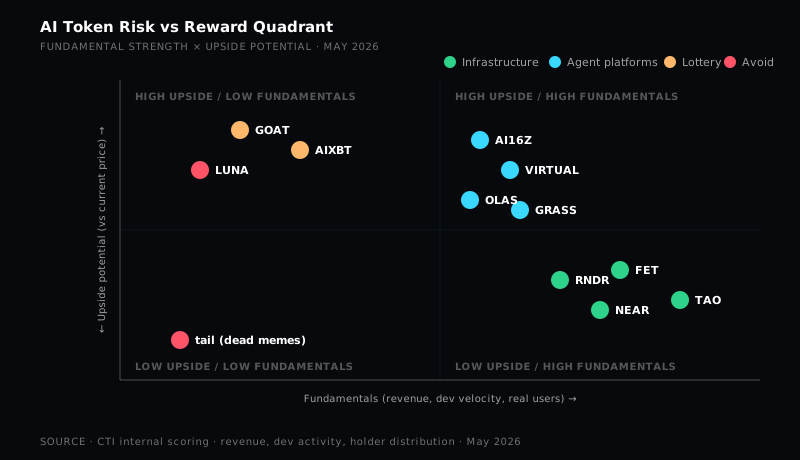
The AI token category contains more low-quality names than legitimate plays. Four categories of token consistently underperform and should be avoided regardless of how the marketing pages position them.
Generic “AI” rebranded altcoins from the 2021 era. Many altcoins from the previous cycle quietly added “AI” to their branding in 2023 to 2024 without changing their underlying product. These tokens still trade because retail capital chases the keyword, but they have no real AI work happening and no real revenue. The pattern: a 2021-era project with a stale GitHub, a dormant Discord, and a marketing page that added the word “AI” in late 2023.
Memecoin agent tokens with no GitHub activity. During the late-2024 agent narrative peak, hundreds of agent-themed memecoins launched on Solana and Base, most with zero open-source code and no real agent functionality. These tokens look like agent plays from the outside, but they are pure narrative trades with no product. The simplest filter: check the GitHub. If there is no public repository or the repository has had no meaningful commits in 90 days, the project is a marketing exercise.
SingularityDAO-era projects without 2025 to 2026 traction. The previous AI token cycle produced a wave of projects that have not adapted to the 2025 to 2026 environment. Names that were prominent in 2020 to 2021 but lack updated product roadmaps, active engineering teams, or token utility refreshes are dead names trading on inertia.
Anything claiming “AI trading bot” with guaranteed returns. Trading-bot tokens with marketed AI alpha are universally low-quality. No bot platform has demonstrated audited account-level edge that survives across market regimes. Tokens marketed on “AI trading bot guarantees X percent monthly” are the most predictable losing positions in the entire category. See our best AI crypto trading bots 2026 review for the honest version of what AI does and does not do in trading bots.
Tokenomics red flags to check
Before any AI token position, five tokenomics checks separate the legitimate plays from the supply-overhang traps. These checks take 20 minutes per token and prevent most catastrophic outcomes.
Circulating supply versus total supply ratio
Anything below 30 percent circulating supply signals heavy future dilution. New tokens with 5 to 15 percent circulating supply face years of unlock pressure as team, investor, and ecosystem allocations come online. The price of the token reflects what the market thinks the future, not just the present, supply environment looks like. A 20 percent circulating supply token at “100 million market cap” actually has 500 million in fully diluted supply waiting to hit the market.
Team and insider unlock schedule
The 6 to 12 month window after launch is where most catastrophic price damage happens. Insiders unlock, often coordinate selling through OTC desks to minimize visible market impact, but the supply has to clear somewhere. Check the official unlock calendar. If a major unlock event is within 90 days, assume the price action will reflect anticipation of the supply hitting the market.
Inflation rate
Transparent inflation is fine. Opaque inflation is not. Bittensor’s 18 percent annualized inflation is high but disclosed and follows a Bitcoin-style halving schedule. A project that does not disclose its inflation rate, or that reserves the right to mint additional tokens via governance, is structurally less safe.
Onchain treasury runway
Does the project have funded operations for 18 to 24 months? Many AI projects launched with substantial fundraises in 2021 to 2022 and have since burned through the runway without product-market fit. Check the on-chain treasury (most projects publish multisig addresses). A treasury below 12 months of operating expenses is a warning sign.
Token utility
Is the token actually used in protocol mechanics, or is it pure speculation with a thin staking veneer? The clean version: TAO is used to pay for subnet emissions, RNDR is used to pay for GPU compute, FET is used for transaction fees and agent staking. The unclean version: governance tokens where the only “utility” is voting on parameters that rarely change. A token without real protocol utility is harder to value and more vulnerable to narrative shifts.
Tax considerations
AI tokens are taxed as crypto in every major jurisdiction in 2026, with no special category treatment. The tax treatment matters for position sizing because frequent trading inside the AI category triggers more taxable events than buy-and-hold positions.
USA. The IRS treats crypto as property. Short-term capital gains (held less than one year) are taxed at ordinary income rates ranging from 10 to 37 percent depending on bracket. Long-term capital gains (held more than one year) are taxed at 0, 15, or 20 percent. Token-to-token swaps are taxable events. Every trade between AI tokens is a separate gain or loss calculation. Documentation matters: maintain trade-level records or use crypto tax software.
UK. Capital gains tax applies above the 3,000 pound annual allowance for the 2026 tax year. Rates are 10 percent (basic rate) or 20 percent (higher rate) depending on income bracket. HMRC takes a similar property-treatment view. Token-to-token swaps trigger capital gains events. Loss harvesting is allowed and useful in heavily-corrected AI token positions.
Russia. Personal income tax of 13 to 22 percent depending on income bracket under the 2024 legal framework. Crypto activity must be reported under the same rules as other investment income. See our Russia crypto tax guide for the full breakdown.
Turkey. Zero percent capital gains on crypto as of May 2026, making Turkey one of the most favorable jurisdictions for active AI token trading. Verify the current status before acting; tax policy in Turkey has shifted multiple times. See our Turkey crypto tax guide for current details.
Where to buy AI tokens in 2026
Exchange availability for AI tokens varies more than for top-cap crypto. The core AI tokens are listed nearly everywhere. The agent-tier and smaller tokens have spottier coverage. Match the exchange to the token you actually want to buy.
Core AI tokens (TAO, FET, RNDR, NEAR, AKT)
These trade spot on nearly every major exchange and perpetuals on most derivatives venues. The major options are Bybit for deep derivatives liquidity and strong execution, BingX for copy-trading combined with AI token spot access, Bitget for the broadest derivatives catalog, OKX for the cleanest spot UX with strong AI token coverage, KuCoin for the widest altcoin breadth, and Binance for the largest spot liquidity. For US users, Coinbase and Kraken cover the core names but skip many of the smaller agent tokens.
Agent-tier and smaller tokens (VIRTUAL, ai16z, GAME, ARC)
Listings concentrate on the mid-tier exchanges. KuCoin, Bitget, Gate.io, and MEXC consistently list agent tokens earlier than the top-tier exchanges. For VIRTUAL specifically, Uniswap on Base chain often has the deepest early liquidity before centralized exchanges list. For Solana-based agent tokens (ai16z, several GAME-tier names), Raydium and Jupiter aggregators are where early price discovery happens.
DEX-only tokens
Some agent tokens trade only on DEXs in their first 30 to 90 days. The pattern is: launch on a fair-style Solana or Base mechanism, trade exclusively on DEX for the first weeks, then list on KuCoin or MEXC as volume grows. If you trade pre-CEX agent tokens, you need a Solana wallet (Phantom, Backpack) or a Base-compatible wallet (Coinbase Wallet, Rabby), and you accept the additional risk of DEX trading: MEV, slippage, contract risk.
Perpetuals
For users who want leveraged exposure (and we strongly recommend against it for AI tokens), Bybit lists TAO, FET, NEAR, RNDR, and ai16z perpetuals. OKX lists similar coverage. Binance Futures covers TAO, FET, NEAR, RNDR. Hyperliquid lists most of the major AI tokens with deep liquidity on the on-chain order book.
Portfolio sizing rule
A simple position-sizing framework for AI tokens, derived from observing what survived the 2024 to 2025 correction. AI tokens should be 1 to 5 percent of your total crypto allocation, not more. The category is too volatile to size larger without taking unacceptable drawdown risk.
Within that 1 to 5 percent, treat the top four infrastructure tokens (TAO, FET, RNDR, NEAR) as your core AI exposure. Equal-weight them or weight by your conviction, but treat them as the durable layer. Treat the agent tokens (VIRTUAL, ai16z, GAME, others) as the satellite layer with smaller positions. A reasonable starting split is 70 percent core, 30 percent satellite within your AI allocation.
Never use leverage on AI tokens. The category is volatile enough that even 2x to 3x leverage produces liquidation risk during normal weekly ranges. The funding rates on AI token perpetuals during narrative cycles are also punitive. Spot only, smaller positions, no leverage, no exceptions for the agent-tier names. See our crypto risk management for beginners guide for the position-sizing framework that should govern all crypto exposure, AI tokens included.
2026 catalysts watch list
The AI token category in the rest of 2026 has several known catalysts that will move prices regardless of the broader crypto cycle. These are the events to track if you have AI token exposure.
Bittensor subnet emissions changes. The Bittensor governance community continues to debate subnet emission allocations and quality filters. Major changes to emission distribution affect both TAO price (via supply mechanics) and individual subnet token economics (where subnets have their own tokens or rewards).
ASI alliance integration progress. The Fetch.ai, SingularityNET, Ocean Protocol merger has technical and operational integration steps remaining through 2026. Progress on integrated product launches will drive narrative around the unified FET token. Watch the alliance roadmap milestones.
Virtuals v2 and ACP launch. Virtuals Protocol has flagged a v2 release and broader Agent Commerce Protocol rollout. Adoption of ACP by external agent projects is the structural catalyst for the VIRTUAL token thesis. The v2 release is the major near-term event.
Eliza v3 framework adoption. The Eliza agent framework underpins many agent projects beyond ai16z. Framework v3 adoption metrics, including the number of deployed agents and active development by external teams, drives the ai16z narrative.
Macro AI narrative cycle versus broader crypto cycle. The AI token category does not always move with broader crypto. During the 2024 narrative peak, AI tokens led the market; during the 2025 correction, AI tokens led the drawdown. The relative strength of the AI narrative against the broader crypto risk-on cycle is the largest macro variable. Track the AI sector index against BTC dominance and total crypto market cap to see whether the AI rotation is on or off.
For users newer to the agent narrative specifically, our companion piece on AI crypto agents in 2026 walks through what agent protocols actually do, with examples of working agents and the limits of the current state of the art. For the broader crypto trading vocabulary, the crypto trading glossary 2026 covers terms used across this piece. For users evaluating the wider altcoin landscape including meme coin overlap with the agent narrative, see what are meme coins in 2026.
Bottom line
The honest summary on AI crypto tokens for 2026: a real narrative with a real technology layer underneath, distorted by hype, concentrated returns at the top, and a long tail of low-quality names. The four core infrastructure tokens (TAO, FET, RNDR, NEAR) are the durable retail-accessible plays. The agent-tier tokens (VIRTUAL, ai16z, GAME) are satellite positions with higher volatility and execution risk. The smaller infrastructure names (AKT) and thematic plays (WLD) fill out the rest of the legitimate category. Almost everything else marketed as “AI” is noise.
Position sizing matters more than picks. 1 to 5 percent of your total crypto allocation in AI tokens, weighted toward the core infrastructure names, no leverage, no agent-token concentration above 30 percent of the AI allocation. Verify exchange availability before any trade, especially for the smaller agent tokens where listings vary by jurisdiction. Check the tokenomics red flags before any position: supply ratio, unlock schedule, inflation rate, treasury runway, token utility. Document every trade for tax purposes regardless of jurisdiction.
The AI narrative will continue to drive flows through 2026 and beyond. Whether the AI rotation outperforms the broader crypto cycle in any given quarter depends on macro variables that no one predicts reliably. The tokens that survive multiple cycles are the ones with real product traction, transparent tokenomics, and durable utility. Pick from that list, size small, hold spot, ignore the agent-coin narrative spikes, and treat the entire category as a satellite in your crypto allocation rather than as a core position.
Open Bybit for AI token spot and perpetuals access: Register on Bybit. For BingX’s combined spot and copy-trading offering, see BingX. For the widest altcoin breadth including the smaller agent tokens, see KuCoin. Verify availability in your jurisdiction before signup, and read the full risk disclaimer before any AI token position.
Frequently asked questions
What are the best AI crypto tokens in 2026?
The legitimate AI token universe in 2026 splits into three buckets. Infrastructure: Bittensor (TAO), Akash (AKT), Render (RNDR). Agent platforms: Virtuals (VIRTUAL), ai16z, GAME. Data and utility: Fetch.ai (FET, now in the ASI alliance), NEAR Protocol. TAO is the largest by market cap at roughly 3 to 4 billion dollars and the most established AI infrastructure play. FET, RNDR, and NEAR are the other core picks with multi-quarter track records. VIRTUAL and ai16z are the agent-era satellite plays. Avoid generic 'AI' rebrands from the 2021 cycle and memecoin agent tokens without real GitHub activity.
Is Bittensor (TAO) a good investment in 2026?
Bittensor remains the most credible decentralized AI infrastructure project in 2026. It runs roughly 32 active subnets that compete for emissions through verifiable machine-learning output. The market capitalization sits in the 3 to 4 billion dollar range. The honest caveat is that subnet quality varies wildly. Some subnets produce real value (text generation, time-series prediction, audio models), others produce thin output and survive only on emissions. Tokenomics follow a Bitcoin-style halving schedule with current inflation near 18 percent annualized declining toward 14 percent. Treat TAO as core AI infrastructure exposure, not as a sure thing.
What is the ASI alliance and how does it affect FET?
The ASI (Artificial Superintelligence) alliance is the merger of Fetch.ai, SingularityNET (AGIX), and Ocean Protocol announced in 2024 and formalized through 2025. The three tokens consolidated under a unified FET ticker with adjusted conversion ratios. The combined entity targets a roughly 2 to 3 billion dollar market cap as of May 2026. The thesis: agent economy plus AI data marketplaces plus general AI services under one token. The honest read is that the merger added narrative momentum but has not yet produced a step change in product traction. Treat the merger as a structural positive that still needs to deliver.
Are agent tokens like Virtuals and ai16z worth buying?
Agent tokens are higher-risk satellite plays, not core positions. VIRTUAL (Virtuals Protocol on Base) sits around 1.5 billion dollar market cap and powers an agent launchpad where AI agents pay each other in $VIRTUAL via the Agent Commerce Protocol. ai16z (around 400 million dollars) is the parent token for the Eliza agent framework with a DAO investment thesis. Both have legitimate technology underneath, both have lost 70 to 90 percent from peaks during the agent-narrative correction. Position sizing matters more than the pick: 1 percent of crypto allocation, not 10 percent. Volatility on agent tokens is structurally higher than on AI infrastructure tokens.
Where can I buy AI crypto tokens in 2026?
For the core AI tokens (TAO, FET, RNDR, NEAR, AKT) nearly every major exchange lists spot and most list perpetuals. Bybit, BingX, Bitget, OKX, KuCoin, and Binance all carry the major AI tokens. For smaller agent tokens (VIRTUAL, ai16z, GAME) listings concentrate on KuCoin, Bitget, Gate.io, and MEXC, with the earliest liquidity often on DEXs like Uniswap (Base chain for VIRTUAL) or Raydium (Solana for some agent tokens). Geographic availability varies. US users have fewer venue options and should verify the asset is listed on Coinbase, Kraken, or Gemini before treating it as accessible.
How are AI crypto tokens taxed?
AI tokens are taxed as crypto in every major jurisdiction, with no special treatment for the AI category. In the USA, IRS treats them as property and applies short or long-term capital gains rates depending on holding period. UK applies capital gains tax above the annual 3,000 pound allowance for 2026. Russia applies 13 to 22 percent personal income tax depending on income bracket under the 2024 legal framework. Turkey maintains zero percent capital gains on crypto as of May 2026. Document every trade. Token-to-token swaps are taxable events in most jurisdictions, not just fiat conversions.
What tokenomics red flags should I check before buying an AI token?
Five checks before any AI token position. Circulating supply versus total supply ratio: anything below 30 percent circulating signals heavy future dilution. Team and insider unlock schedule: the 6 to 12 month window after launch is where most catastrophic price damage happens as early holders unlock. Inflation rate: Bittensor's 18 percent annualized is high but transparent; opaque inflation is worse. Onchain treasury runway: does the project have funded operations for 18 to 24 months? Token utility: is the token actually used in protocol mechanics, or is it pure speculation with a thin staking veneer?
Should I use leverage on AI crypto tokens?
No. AI tokens are among the most volatile assets in the crypto market in 2026, with daily ranges of 8 to 15 percent on the agent token end and 4 to 8 percent on the infrastructure end. Liquidation risk on leveraged positions is extreme even at low multiples. Funding rates on AI token perpetuals spike during narrative cycles, making short-side positioning expensive and long-side positioning structurally costly. Use spot positions only, treat AI tokens as 1 to 5 percent of total crypto allocation, and never use leverage on the agent-tier names. Use the [liquidation calculator](/tools/liquidation-calculator/) before any leveraged crypto position regardless of asset.
#AI tokens#TAO#FET#RNDR#AGIX#VIRTUAL#NEAR#ai16z#analysis
Discussion
Loading comments…