
TL;DR: AI crypto agents are autonomous programs that combine a large language model, an on-chain wallet, and a decision loop, letting them trade, post, hold tokens, and interact with other agents without per-step human input. The category exploded in late 2024 with Eliza, ai16z, virtuals.io, and the Truth_Terminal/GOAT story, then cooled hard through 2025 as 85 percent or more of agent tokens lost most of their value. Most “agents” launched in the boom were LLM-wrapper memecoins, not real autonomous systems. The genuine infrastructure (Eliza framework, virtuals.io launchpad, Olas services) is shipping and being used, while the personality-token tail is in heavy drawdown. Retail traders should clearly distinguish between agent tokens (speculation, lottery ticket) and agent tools (utility, may save time on deterministic tasks), and size accordingly.
Not financial advice. AI agent tokens are highly volatile. This category combines memecoin-grade price behavior with infrastructure-narrative marketing. Most retail buyers of agent tokens through the 2024-2025 boom are down significantly in 2026. Liquidity outside the top five tokens is thin, insider concentration on several popular names exceeds 30 percent of supply, and the autonomous-trading promises that originally pulled retail in have not produced an audited, account-level track record at any framework. Treat agent tokens as lottery-ticket exposure, not core allocation. Read the full risk disclaimer before scaling capital, and the crypto risk management guide before sizing positions.
What is an AI crypto agent?
An AI crypto agent is software that combines three pieces: a language model (usually GPT-4, Claude, or Llama variants), on-chain access through a wallet that can sign transactions, and an autonomous loop that lets it act without waiting for human input on each step. The combination is what makes it an agent rather than a chatbot or a trading bot.
What an agent can actually do
A live agent in 2026 can post content to X or Farcaster on its own schedule, hold tokens in a wallet it controls, send and receive payments, swap or trade on a DEX, read on-chain events and respond to them, and interact with other agents through a shared protocol. Some agents run a single character (a persona with consistent voice and goals); others coordinate multi-agent workflows where each agent specializes in a task and they pass work between them.
How agents differ from trading bots
A trading bot executes a coded strategy on price data. It does not reason in language, it does not write content, it does not hold a personality, and it is not autonomous outside its rules. A bot is a deterministic execution wrapper. An agent is a language-driven decision loop with on-chain hands.
The difference matters in practice. A grid bot on Pionex is not an AI agent, even if marketing copy calls it one. The Truth_Terminal account that posted on X for months and developed an emergent goal structure is an agent. A Pionex DCA bot is not an agent. Eliza-based personalities running on Solana are agents. Three Commas-style platforms are not.
The honest framing for retail: most products sold as agents in 2025 were trading bots, NFT projects, or memecoins with an LLM-flavored marketing layer. The genuine agent category is narrower than the marketing suggests, and the population of agents that are autonomous in a meaningful sense (not just scripted) remains small in 2026.
The 2024-2025 AI agent boom timeline
The AI agent category went from niche developer experiment to multi-billion dollar token meta inside roughly six months, then deflated through 2025. The path is worth understanding because every retail trader who bought into the narrative bought into one of the phases below, and the entry point determined the outcome.
October 2024: Truth_Terminal and GOAT
Andy Ayrey released Truth_Terminal in mid-2024, an X account driven by a large language model that posted unsupervised about religion, AI, and crypto. The bot developed a fixation on the “Goatse Gospel,” a meme it generated within its own conversations with Claude. A community memecoin called GOAT (Goatseus Maximus) was launched on Solana attached to the bot’s narrative. GOAT pumped from cents to a fully-diluted value above 1.2 billion dollars within weeks. Marc Andreessen sent the bot $50,000 in BTC. The launch is widely treated as the start of the agent meta.
November 2024: ai16z and Eliza
A developer pseudonymously known as Shaw launched the ai16z DAO on Solana in November 2024, a parody of Andreessen Horowitz where the investment decisions were intended to be made by an autonomous agent rather than humans. The accompanying Eliza framework was open-sourced under MIT license. Within weeks Eliza had thousands of GitHub stars and a wave of forks. The ai16z token launched at low single-cent levels.
December 2024: virtuals.io and Base
Virtuals Protocol launched on Base, framed as a launchpad and tokenization layer for agents. Each agent gets a token. The combined agent market cap on virtuals.io crossed 4 billion dollars by late December. VIRTUAL, the protocol token, rallied from sub-dollar levels to above 4 dollars.
January to March 2025: the wrapper wave
Hundreds of projects relabeled themselves as AI agents. Most were either single-LLM-call wrappers (a chatbot with a token) or pure memecoins with an agent narrative bolted on. Industry data through Q1 2025 suggested 90 to 95 percent of agent tokens launched in this window lost 90 percent or more of value within 90 days.
Mid 2025: differentiation
By mid-2025 the market started separating utility agents (frameworks, launchpads, real services) from meme agents (personalities tied to memecoins). The utility tokens recovered some ground; the meme tokens mostly did not. Eliza v2 development picked up. Olas (Autonolas) continued shipping research-grade agent services.
2026: real frameworks ship
Through 2026 the agent infrastructure layer is functioning. Eliza v2 ships with improved plugin architecture. Virtuals.io rolls out the Agent Commerce Protocol (ACP) for agent-to-agent transactions. GAME by virtuals supports multi-agent character workflows. The personality-token tail remains in deep drawdown.
Major agent frameworks compared
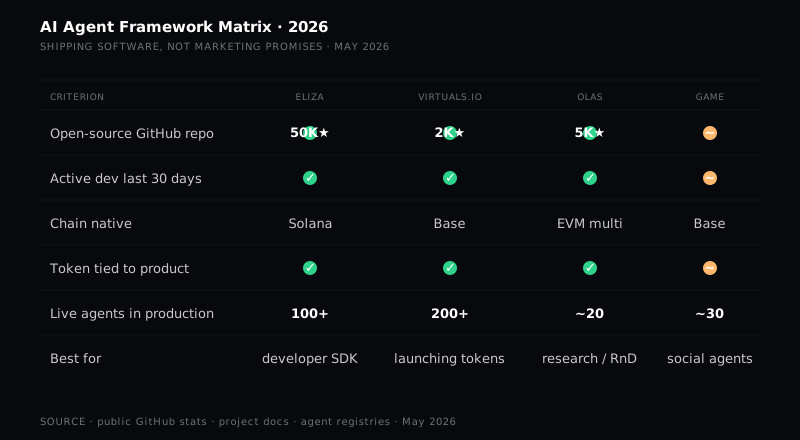
The framework layer is where the durable value of the agent narrative actually lives. The tokens are speculation; the frameworks are tools. Below is a honest comparison of what each one is and is not.
Eliza (ai16z)
Eliza is an open-source TypeScript framework for building AI agents. It is Solana-native by default but supports EVM chains, it is MIT-licensed, and it has a plugin ecosystem with community-contributed modules. GitHub stars crossed 50,000 by mid-2025 and have continued growing. The framework’s strengths: clean character file format, broad LLM provider support (OpenAI, Anthropic, local Llama), and a real developer community. Weaknesses: documentation gaps, plugin quality varies, and the ai16z DAO governance structure remains untested at scale.
virtuals.io
Virtuals is a launchpad and tokenization layer for agents on Base. Each agent gets its own ERC-20 token, with a portion of supply allocated to the agent’s treasury and the rest to bonding-curve liquidity. The ACP (Agent Commerce Protocol) shipping in 2026 enables agents to transact with each other in a standardized way. Strengths: low-friction agent launches, real liquidity infrastructure, integration with major Base wallets. Weaknesses: the launchpad has produced a long tail of low-quality personality agents alongside the legitimate projects.
Olas (Autonolas)
Olas is an autonomous services protocol, EVM-multichain, originally targeted at research and infrastructure use cases rather than personality agents. The architecture treats each service as a multi-agent system with consensus among the operating agents. Strengths: more rigorous architecture, real production services running through 2025-2026 (prediction markets, governance automation, MEV-resistant trading). Weaknesses: higher friction to deploy than Eliza, less retail visibility, smaller community.
GAME by virtuals
GAME is a multi-agent character framework built on virtuals.io infrastructure. It targets gaming and entertainment use cases: NPCs in games, character interactions, story-driven content. The GAME token launched in early 2025 and has tracked the broader agent meta. Strengths: clear product focus on character work, integration with virtuals ecosystem. Weaknesses: narrow use case relative to general-purpose frameworks.
Bittensor (TAO) and Fetch.ai
Both predate the 2024 agent boom and are agent-adjacent rather than pure agent frameworks. Bittensor is a decentralized AI compute marketplace where subnets specialize in tasks (text generation, image generation, financial prediction). Fetch.ai runs an agent-based economy on Cosmos with real ML model exchange. Neither is the right tool if you specifically want to build a personality agent on Solana or Base. Both have larger market caps and more institutional attention than the post-2024 agent projects.
The honest framing
Eliza and virtuals.io are real, used, and shipping. Olas is real and more rigorous but lower visibility. GAME is a focused subset of the virtuals stack. Bittensor and Fetch.ai are adjacent. Most other “agent frameworks” mentioned in marketing copy through 2025 did not produce active developer ecosystems and should not be treated as comparable.
The agent token meta: who pumped, who dumped
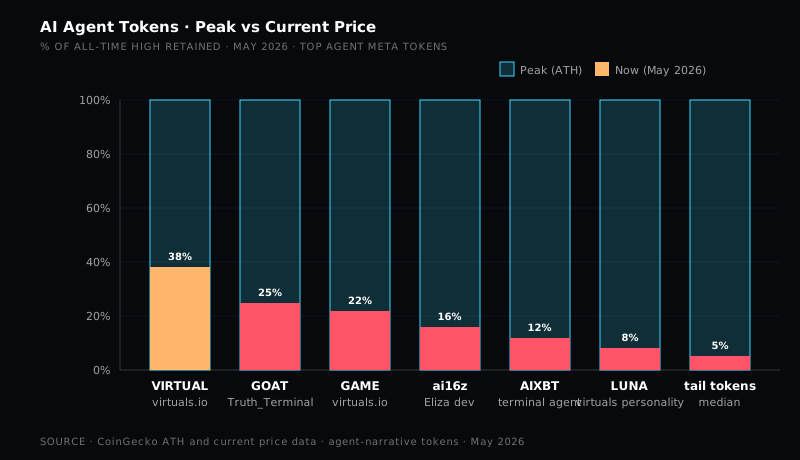
The agent token category followed the standard crypto narrative-cycle pattern: peak in the first 90 days, 80 to 95 percent drawdown across the following year, survivors with real products eventually recovering some ground. The numbers below are approximate, gathered from CoinGecko and DexScreener data through May 2026.
GOAT (Goatseus Maximus)
The Truth_Terminal-attached memecoin peaked at a fully-diluted value of roughly 1.2 billion dollars in November 2024. By mid-2026 it trades around 300 million, a drawdown of roughly 75 percent from peak. GOAT was always a memecoin rather than an infrastructure token, and the price reflects that. The bot itself still posts, but the narrative cycle has moved on.
ai16z
ai16z launched on Solana in November 2024 at roughly 0.10 dollars per token. It peaked near 2.50 dollars in January 2025 (a 25x move on launch capital) and trades around 0.40 dollars by May 2026, an 84 percent drawdown from peak. The Eliza framework that the DAO produced is the durable value; the token reflects narrative cycle more than framework adoption.
VIRTUAL
VIRTUAL on Base rallied from sub-dollar prices in November 2024 to above 4 dollars in early 2025. By mid-2026 it trades in the 1.20 to 2.00 range, a drawdown of roughly 50 to 70 percent from peak. The protocol has the strongest claim to real product among agent tokens, which is reflected in the relatively shallower drawdown.
LUNA (Eliza personality agent)
LUNA, an Eliza-based personality agent on Solana, peaked at roughly 250 million dollars market cap in early 2025. By mid-2026 it sits below 30 million, a drawdown of 88 percent or more. The personality-agent category as a whole has fared similar to LUNA, with most projects down 85 to 95 percent from peak.
GAME
The GAME token launched around 0.05 dollars in early 2025, peaked near 0.45 in Q1 2025 (9x), and trades around 0.08 by May 2026, an 82 percent drawdown. Like VIRTUAL, GAME has real product traction within its niche but cannot escape the broader agent-meta deflation.
The pattern
The median agent token in the November-2024-to-March-2025 launch window is down 85 percent or more from peak as of May 2026. The survivors share three characteristics: a real shipping product, GitHub commits in the trailing 30 days, and a token tied to platform usage rather than to a single personality or narrative. Tokens that fail those tests have mostly faded. The pattern matches every prior crypto narrative cycle from ICOs in 2017 through DeFi summer in 2020 through NFTs in 2021.
Are AI agents actually useful for traders?
This is the question that matters for retail readers, and the honest answer is narrower than the marketing claims.
What agents are useful for
Agents work well for deterministic tasks where the LLM provides language context but the underlying execution is rule-based. Examples that have actually shipped and produced value for users in 2025-2026:
- Market sentiment aggregation: agents that scan X, Farcaster, Telegram, and news feeds, score sentiment, and surface signals or alerts.
- News synthesis: agents that read multiple sources on a topic and produce a summarized briefing.
- Token launch scanning: agents that monitor pump.fun, virtuals.io, and DEX pools for newly launched tokens matching filter criteria, then post or alert.
- Auto-claiming airdrops: agents that hold wallets, monitor airdrop snapshots, and claim eligible drops without human intervention.
- DeFi yield rebalancing: agents that move stablecoin positions across yield venues based on rate changes, with a defined risk envelope.
- Chart pattern recognition: agents that flag setups (breakout, divergence, support tests) based on technical signals, layered with sentiment context.
What agents are not useful for
The category where the marketing promised the most and delivered the least is autonomous directional trading. The reasons are structural:
- LLMs cannot reliably predict price direction. Sentiment is not signal; context is not alpha.
- Arbitrage requires millisecond-grade latency that agent loops cannot match.
- Market making requires HFT infrastructure that retail agents cannot deploy.
- Multi-asset portfolio decisions require risk and correlation modeling that current frameworks do not handle reliably.
The cleanest summary: no public agent framework has produced an audited, account-level track record showing consistent retail profit from autonomous directional trading. Where retail traders see meaningful results, it is from human-defined strategies that agents execute, not from agent decision-making generating alpha.
The honest framing for retail
Agents are productivity tools, not magic. If you spend two hours a day scanning Twitter for launches, an agent can cut that to fifteen minutes. If you manually claim airdrops, an agent can automate the repetitive parts. If you want a bot that trades for you and prints money, the agent category has not produced one, the same way no other category has.
See the AI trading bots guide for the broader comparison between agent platforms and traditional bot platforms, and where each fits in a retail workflow.
How to evaluate an AI agent project
The agent category produced enough hype that filtering matters. The checklist below is the working filter used across CopyTradeInsider research desk reviews. It is not perfect, but it correlates with which projects survive the narrative-cycle deflation.
The 30-day GitHub check
Open the project’s GitHub repo. Look at the commit history. Is there activity in the last 30 days? A real project produces code regularly. Projects that have not committed in 60-plus days are usually either done or coasting on prior work. This single check filters more than half of agent projects, because most never had real engineering behind the marketing.
The shipping-product check
Is there a working product today? Not a roadmap, not a beta signup, not a “coming Q3” graphic, but something a user can actually use. Eliza ships a framework you can clone and run. Virtuals.io ships a launchpad you can use. Olas ships services. If the answer to “what can I do with this today” is “wait for the next milestone,” that is a marketing project, not a product.
Token economics
How much of the supply is locked under vesting? How much is liquid? Are insider allocations disclosed and unlocked in tranches? A healthy distribution has clear vesting schedules with at least 12-month cliffs on team allocations. Aggressive insider unlocks correlate with price decay. Check the project’s tokenomics page and verify against on-chain vesting contracts where available.
Team transparency
Are the developers real names or pseudonymous? Pseudonymous is not automatically bad (Bitcoin started that way), but pseudonymous plus rug-pull patterns plus no track record is a red flag. Pseudonymous developers with prior shipped projects (Shaw, Andy Ayrey) are different from anonymous one-week-old accounts.
Treasury runway
How much capital does the project have, in stablecoins or BTC, on-chain? Most agent projects raised or earned in volatile token sales and now sit on illiquid treasury. A project with 18 months of runway in stablecoins can survive a downturn; one with everything in its own token cannot.
Real users vs. bot followers
Look at the project’s X account. Are the follower interactions human, or are they obvious engagement-farming bots? Are the GitHub forks producing real derivative projects, or are they parking forks? A real project has messy, organic engagement. A fake one has clean, suspicious numbers.
Risks specific to AI agent tokens
The risks below are on top of the general crypto risks that apply to any token. They are specific to the agent category and worth understanding before sizing positions.
Narrative dependence
Agent tokens trade on the agent meta. When the meta cools, the entire category drops together. The November 2024 to March 2025 peak corresponded to peak narrative; the deflation through 2025 corresponded to the narrative cooling. Even projects with real product cannot escape the broad narrative cycle. Position with this assumption, not against it.
LLM cost dependency
Most agents run on OpenAI, Anthropic, or other commercial LLM providers, and the API costs scale with usage. An agent that posts every five minutes spends measurable money per day. Projects with thin treasuries can be forced to throttle agent activity or migrate to cheaper models, which usually degrades quality. The cost structure is invisible in the marketing but real in the engineering.
Liquidity concentration
Most agent tokens trade primarily on Base or Solana, often through a single bonding curve or DEX pool. Order book depth outside the top five tokens is thin. Exit liquidity for a 10,000 dollar position can be limited or absent on smaller tokens. Slippage on exits exceeds slippage on entries, sometimes by a significant margin, because retail traders buy across many wallets and sell in concentrated waves.
Insider concentration
Several popular agent tokens have one wallet holding 30 to 40 percent or more of supply. GOAT was famously concentrated. The risk is structural: when a whale exits, the price absorbs the entire sell pressure, and retail holders take the bulk of the drawdown. Check on-chain holder distribution before sizing into any agent token.
Regulatory uncertainty
The SEC has not specifically addressed agent tokens. Project Crypto rulemaking is underway but slow. International frameworks (MiCA in Europe, others) do not have specific agent-token guidance either. The category sits in regulatory grey area. Rules can change, and tokens can be delisted from major venues with limited notice.
Where to buy and trade AI agent tokens
Agent tokens trade mostly on DEX with CEX listings concentrated on the top five names. Below is the working setup most retail traders use as of mid-2026.
Solana-native (ai16z, GOAT, LUNA, related personalities)
Wallet: Phantom or Solflare. Aggregator: Jupiter, with manual slippage settings (start at 1 percent and widen for thin pools). Always copy the contract address from the project’s official X account or documentation, never from Telegram links. Token scanners (Birdeye, DexScreener) help verify pool depth and holder distribution before buying.
Base-native (VIRTUAL, GAME, virtuals.io launchpad agents)
Wallet: Coinbase Wallet, MetaMask, or Rabby. DEX: Uniswap on Base. Same verification rules apply. Base gas is low enough that small position sizes are economical, but slippage on thin pools is still the dominant cost.
CEX listings
Top agent tokens (VIRTUAL, ai16z, AIXBT, GAME, GOAT) are listed in spot markets on Bybit, BingX, KuCoin, and Bitget. CEX liquidity is generally better than on-chain for the listed names, with the trade-off of KYC requirements and platform risk. For non-US international retail, CEX exposure to agent tokens is the lower-friction path. See the no-KYC exchanges roundup for the broader exchange comparison.
Perpetuals exposure
For leveraged exposure without holding spot, ai16z and VIRTUAL perpetuals are listed on Bybit and Bitget. Liquidation risk is the dominant cost in this category given the volatility. Position size as if leveraged exposure could go to zero on any 24-hour window, and use the liquidation calculator to set safe entry sizes.
2026 outlook
The honest read on where the AI agent category goes from here is mostly skeptical, with a small upside scenario.
Multi-agent economies will emerge, but slowly
Agent-to-agent commerce (ACP and similar protocols) is shipping but adoption is at the dozens-of-agents scale, not the thousands. Real multi-agent economies require enough agents, enough use cases, and enough infrastructure that they are unlikely to exist at meaningful scale until 2027 or later.
Most agent tokens will fade
The base rate on memecoin and narrative tokens is harsh. Most projects launched in the 2024-2025 boom will be effectively dead by end of 2026, with token prices reflecting that. A small set of survivors with real product will continue.
Infrastructure consolidates around 3 to 5 winners
The most likely outcome is consolidation around Eliza, virtuals.io, Olas, and maybe one or two others. Bittensor and Fetch.ai will continue as adjacent platforms. The long tail of frameworks will die off.
Retail allocation: 1 to 3 percent lottery ticket
The realistic retail position is small. Treat agent tokens as a 1 to 3 percent slice of speculative crypto capital, distributed across 2 to 3 names with real product. If the category survives and consolidates, the position captures the upside. If it does not, the loss is small enough to absorb. Anyone telling you the category is the next ETH should be assumed to be talking their bag. The crypto glossary and risk management guide are the right next reads for sizing the broader portfolio responsibly.
Final word
The AI agent narrative produced real infrastructure and a memecoin cycle, in roughly that order. The infrastructure (Eliza, virtuals.io, Olas) is being used in 2026. The memecoin cycle has mostly deflated. Retail traders who bought tokens in November 2024 to January 2025 are mostly down 80 percent or more, with a small set of survivors. Retail traders who used the agent tools (sentiment aggregation, launch scanning, airdrop automation) extracted real utility without taking the token risk.
The clean separation is the most important thing: agent tools and agent tokens are different categories with different value propositions and different risks. Treat them as such. Read the meme coins guide for the broader speculative-token framework, and the AI trading bots guide for the comparison with traditional bot platforms.
Frequently asked questions
What is an AI crypto agent and how is it different from a trading bot?
An AI crypto agent is software that combines a large language model with an on-chain wallet and an autonomous loop, so it can read events, reason in natural language, and act without per-step human input. It can post on social platforms, hold tokens, sign transactions, and interact with other agents. A trading bot, by contrast, is pure deterministic execution: it runs a coded strategy on price data with no language reasoning and no autonomy outside the rules you wrote. Most products marketed as agents in 2025 and 2026 are still bots with an LLM wrapper for marketing. Real autonomous economic agents exist, but they remain rare and most produce social content rather than profitable trades.
Did the AI agent narrative actually deliver, or was it pure hype?
Both, in roughly that order. The narrative produced real open-source infrastructure (Eliza framework, virtuals.io launchpad, Olas autonomous services) that is being used and extended in 2026. It also produced a memecoin cycle in which the median agent token is down 85 percent or more from its peak by mid-2026. The hype phase ran from October 2024 into early 2025 and rewarded narrative buyers; the deflation phase ran through 2025 and rewarded sellers. Surviving projects share a common pattern: a real product shipping, GitHub commits in the last 30 days, and a token tied to that product rather than to a personality. Most agent tokens failed that test.
Can an AI agent trade crypto for me profitably?
No public agent framework in 2026 has produced an audited, account-level track record showing consistent retail profit from autonomous trading. The frameworks themselves do not generate alpha; they execute strategies a human defined. LLMs cannot reliably predict price direction, they cannot compete with high-frequency arbitrage, and they cannot make market on thin pairs. Where agents do help is in deterministic tasks dressed with language context: scanning social feeds for token launches, auto-claiming airdrops, rebalancing yield positions across DeFi venues, and aggregating sentiment into alerts. Treat any project promising autonomous profitable trading the same way you treat any product promising guaranteed crypto profit, with extreme skepticism.
Which AI agent frameworks are actually real in 2026?
Three frameworks have shipped real, used software with active development: Eliza (from ai16z, TypeScript, Solana-native, 50K plus GitHub stars), virtuals.io (Base chain launchpad and tokenization layer for agents), and Olas (formerly Autonolas, EVM-multichain, more research-focused). GAME by virtuals shipped a multi-agent character framework. Bittensor (TAO) and Fetch.ai are adjacent rather than pure agent platforms, and both predate the 2024 boom. Several other projects marketed as agent frameworks were primarily marketing wrappers around a single LLM call and have not produced active developer ecosystems. The shipping-versus-marketing test is the cleanest filter for evaluating which framework names mean something in 2026.
What happened to GOAT, ai16z, and the other agent tokens?
Most peaked between November 2024 and January 2025 and have lost the majority of value since. GOAT, the Truth_Terminal-attached memecoin, peaked above 1.2 billion dollars in fully-diluted value and has retraced to roughly 300 million by mid-2026. ai16z launched around 0.10 dollars, peaked near 2.50, and trades around 0.40. VIRTUAL peaked near 4 dollars and trades in the 1.20 to 2.00 range. Smaller personality-driven agent tokens have fared worse, with many down 90 percent or more. The pattern matches every prior crypto narrative cycle: a small set of survivors with real products outlive the meta, and a long tail of narrative-driven tokens does not.
Are AI agent tokens securities?
The SEC has not issued specific guidance on AI agent tokens as of May 2026. Under Project Crypto, the Commission has moved toward a token taxonomy that classifies most digital assets as non-securities, but the rulemaking is ongoing. Agent tokens raise some novel questions: when an autonomous agent holds and trades its own treasury, does that change the analysis? When token holders earn fees from agent-generated revenue, is that closer to an investment contract? No enforcement actions have targeted agent tokens specifically through May 2026, but regulatory uncertainty remains real. Treat the asset class accordingly and assume rules can change with limited notice.
How do I buy AI agent tokens safely?
For Solana-native tokens (ai16z, GOAT, LUNA, related personalities) use Phantom wallet plus Jupiter aggregator, with manual slippage settings and contract address verification. For Base-native tokens (VIRTUAL, GAME, agents launched on virtuals.io) use Coinbase Wallet or any EVM wallet with Uniswap on Base. For perpetuals exposure without holding the spot token, top-tier agent tokens are listed on Bybit and Bitget. Always check the contract address on the project's official documentation or X account, never click contracts in Telegram channels, and treat any direct message offering early access as a scam. Position size as lottery-ticket exposure, not core allocation.
What is the realistic retail allocation to AI agent tokens?
Treat AI agent tokens as a 1 to 3 percent slice of speculative crypto capital, not a core thesis. The category has high variance, narrative-driven price action, low liquidity outside the top five tokens, and concentrated insider holdings on several of the popular names. A retail trader running 5,000 dollars in crypto might allocate 50 to 150 dollars across two or three agent tokens, with the understanding that the position can go to zero. If the category survives and consolidates around 3 to 5 platform winners by 2027, that small allocation captures the upside. If the narrative fades fully, the position is sized to be survivable. The same lottery-ticket framework that applies to meme coins applies here.
#AI agents#Eliza#ai16z#virtuals#analysis#DeFi#autonomous trading
Discussion
Loading comments…