
TL;DR: Pionex wins for beginners and most retail users in 2026 because the bots are built into the exchange directly with no separate subscription. 3Commas and Cryptohopper lead the third-party subscription category for users who want cross-exchange flexibility and deeper customization. Coinrule is the no-code rule builder, and the only tool here that lets ChatGPT or Claude drive strategies through its MCP. Bitsgap is the focused grid bot specialist. Stoic.ai is a portfolio rebalancer marketed as a trading bot, with the weakest “AI” claim in this list. ChatGPT and Claude have a real role in research and strategy backtesting prompts, but they are not live trading systems. Across the entire category: most retail bot users lose money, automation amplifies bad strategies, and no bot is a printing machine.
Not financial advice. Read this carefully. Crypto trading bots are high-risk automated systems that can lose money faster than discretionary trading because they execute without hesitation. Most retail bot users break even or lose money over multi-quarter periods. Automation amplifies the underlying strategy: a profitable strategy may compound faster, a losing strategy bleeds faster. No bot platform has demonstrated a durable, audited, account-level edge that survives across market regimes. Past performance does not predict future results, backtest performance is not forward-test performance, and marketing pages systematically cherry-pick the visible top of the user base. Verify country availability before signup, use API keys with trade-only permissions (never withdraw), and read the full risk disclaimer before deploying real capital.
What “AI” means for crypto trading bots in 2026
The honest version of “AI crypto trading bot” in 2026 is this: machine-learning pattern recognition on price and volume data, sentiment scoring from news and social feeds, and statistical filters on top of rule-based execution. That is what AI means in this category today. It does not mean reasoning AI, future-prediction, or any system that has cracked a durable edge in the crypto market through neural networks. The marketing language has galloped well ahead of what the underlying technology actually delivers.
What AI actually does in these bots
Three real capabilities show up across the leading platforms in 2026:
- ML-based pattern recognition. Models trained on historical price action identify candle patterns, divergence, volatility regime shifts, and order book imbalances. The output is a probabilistic signal, not a prediction.
- Sentiment analysis. Natural language processing models score news headlines, crypto Twitter posts, and Reddit threads for bullish/bearish bias. Aggregate sentiment feeds into entry filters.
- Signal generation with statistical filters. Traditional indicators (RSI, MACD, moving averages) get layered with machine-learning confidence scores to filter false signals before execution.
This stack works. It is not magic. It is statistical pattern recognition on noisy financial data, and the signal-to-noise ratio is low.
What AI is NOT doing in 2026 trading bots
The marketing claims that systematically exceed reality include:
- True reasoning AI. No bot in the category currently makes multi-step reasoning decisions about market structure, macro context, and position sizing the way an experienced human trader does.
- Future-prediction. No model has cracked the directional forecasting problem in crypto. The pattern recognition is backward-looking by construction.
- Guaranteed alpha generation. No bot platform has produced an audited, account-level track record showing durable outperformance across multiple market regimes.
- Adaptive strategy switching without human intervention. Bots run the strategy you load. They do not autonomously decide to switch from trend-following to mean-reversion because the regime changed.
The summary: the “AI” in 2026 crypto bots is mostly ML-flavored signal generation on top of strategies that already existed in 2018. The wrapper changed; the underlying execution math did not.
How we evaluated these bots
Each bot was evaluated across six axes that matter for retail and intermediate users.
- Track record transparency (25%). Does the platform publish forward-tested performance with audit trails? Are the published numbers verifiable on real accounts, or only backtest results and screenshots?
- Supported exchanges and execution quality (15%). Which exchanges does the bot connect to via API? How does execution latency and slippage perform in fast markets?
- Fee economics (15%). Subscription cost, plus underlying exchange trading fees, plus any profit share. What is the breakeven base capital at which the subscription drag becomes economical?
- Beginner usability (15%). Onboarding flow, default templates, the gap between signup and first running strategy. Can a non-technical user actually deploy a bot without a tutorial marathon?
- Risk controls (15%). Per-strategy position sizing, stop-loss enforcement, drawdown caps, kill-switch criteria, paper trading availability.
- Claimed vs. real performance (15%). How closely do live user results, where visible through public dashboards or third-party reviews, track the marketing claims?
Affiliate payouts do not move the scoring. None of the bots in this roundup carry our affiliate codes; the platforms we link with affiliate codes are exchanges (Bybit, BingX, KuCoin, Bitget), not bot platforms. The rankings reflect product fit and honest assessment, not partnership economics. The methodology is the same one we apply across the site; see methodology for the full scoring framework.
The shortlist at a glance
| Rank | Bot | AI features | Supported exchanges | Pricing tier | Best for | Score /10 |
|---|---|---|---|---|---|---|
| 1 | Pionex | Built-in templates, light ML on Smart Trade | Built-in exchange | Free, 0.05% trading fee only | Beginners, all-in-one users | 8.0 |
| 2 | 3Commas | Signal marketplace, DCA + GRID, AI-flavored presets | Binance, Bybit, Kraken, OKX, Coinbase, others | $14.50-$49/mo | Cross-exchange flexibility | 7.8 |
| 3 | Coinrule | No-code rule builder, AI strategy creation via MCP (ChatGPT/Claude) | 20+ CEXs plus stocks and ETFs | Free, $29.99-$449.99/mo + 0.02% | No-code strategy builders | 7.7 |
| 4 | Cryptohopper | ”AI-first” branding, marketplace, paper trading | 9+ major CEXs | $19-$129/mo | Strategy marketplace users | 7.5 |
| 5 | Bitsgap | Grid bot focus, AI signal overlay | 15+ exchanges, 1,500+ pairs | $24-$110/mo | Grid bot specialists | 7.4 |
| 6 | Stoic.ai | Portfolio rebalancing, weak “AI” claim | Binance and others | 1% AUM annual | Passive portfolio rebalancing | 6.8 |
| - | ChatGPT / Claude | Research, chart analysis, prompt-based backtesting | Not a trading platform | Free to $20-30/mo | Research, not execution | N/A |
Score reflects fit for the target use case, weighted across the six evaluation axes above. None of these bots have a durable, proven, account-level edge that survives across market regimes; the score reflects product quality, not expected return.
3Commas: Cross-exchange veteran with the broadest strategy stack
Score: 7.8 / 10
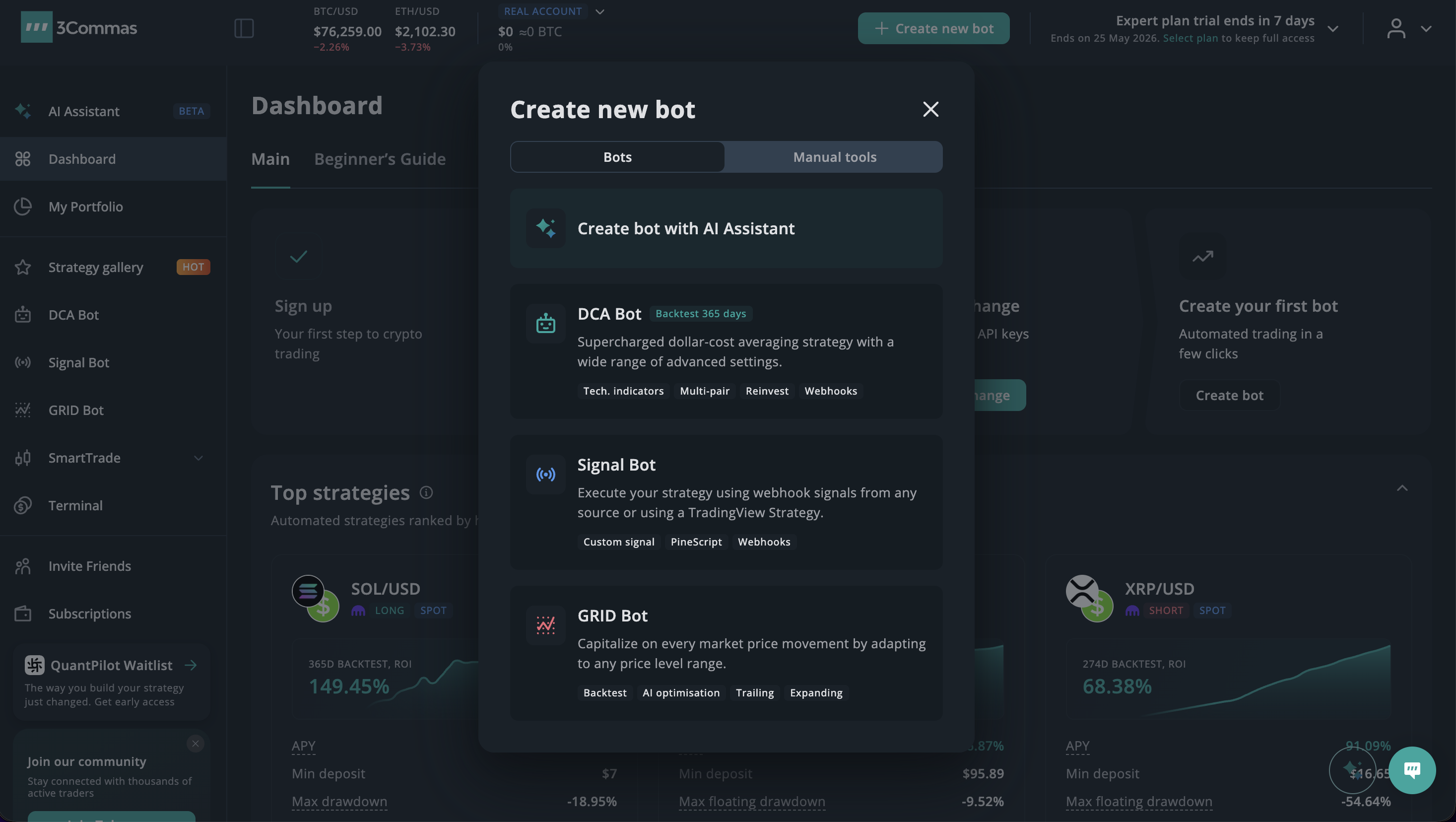
3Commas was founded in 2017 and remains one of the most established cross-exchange bot platforms in the category. The product surface is wide: SmartTrade (manual order with bot-assisted exit), DCA bots (dollar-cost averaging into a position with rebalancing logic), GRID bots (range-bound oscillation strategies), a signal marketplace where third-party signal providers publish entries, and a layer of AI-flavored presets added across 2023-2025. Supported exchanges include Binance, Bybit, Kraken, OKX, Coinbase, Bitstamp, Bittrex, and others; the exchange list is the deepest in the third-party bot category.
What 3Commas does well
The SmartTrade order type is the genuinely useful innovation here. You set an entry, multiple take-profit levels, and a trailing stop, and the bot manages the exit without you babysitting the chart. This is the closest thing to a “smart order” experience available outside of dedicated execution platforms. The DCA bot logic is the second strong feature: you configure a base order, safety orders, and a take-profit percentage, and the bot averages into a losing position to the configured limit. Used carefully, DCA bots survive moderate drawdowns; used carelessly, they amplify losing positions until the safety order budget is exhausted.
The signal marketplace adds optionality: third-party signal providers publish entries that you can auto-trade with risk parameters. The marketplace framing here is the same as copy trading marketplaces: most signal providers do not have a durable edge, the marketing-visible top is whoever survived the recent regime, and signal quality is highly variable.
What 3Commas does less well
Pricing is significant subscription drag. The Pro tier at roughly $49/month requires a meaningful base capital to amortize. For accounts below $2,000-3,000, the subscription cost can exceed realistic monthly returns from low-risk strategies. The “AI” branding added in recent years is largely cosmetic on top of the existing rule-based strategies; the actual machine-learning content is light. Live forward-test transparency is limited; published results lean on backtest screenshots and curated user testimonials rather than audited account-level performance.
Pricing (2026, approximate, verify on site)
- Starter: roughly $14.50/month, basic DCA and SmartTrade
- Advanced: roughly $24.50/month, more concurrent bots
- Pro: roughly $49/month, full feature set including marketplace signals
Pricing has shifted across 2024-2026 and may be tiered differently by the time you read this; verify on the 3Commas site before subscribing.
Pros and cons
Pros
- Broadest supported exchange list among third-party bots
- SmartTrade is genuinely useful for managed exits
- Established platform with 8+ years of operating history
- Signal marketplace adds optionality for users who can evaluate signal providers
- Paper trading mode available across all tiers
Cons
- Subscription drag meaningful for accounts below ~$3,000
- “AI” branding overstates the underlying technology
- 2020 API key data exposure incident (resolved, but historical baggage)
- Forward-test transparency below ideal: no audited account-level track record
- Signal marketplace has the same survivor-bias problem as copy trading leaderboards
Who 3Commas fits: intermediate users who want cross-exchange flexibility, who run multiple strategies in parallel, who have a base capital of $3,000+ to amortize subscription drag, and who understand that the bot is an execution engine for their strategy choices, not a money-printing system.
Cryptohopper: AI-first branding, marketplace heavy

Score: 7.5 / 10
Cryptohopper was founded in 2017 in the Netherlands and has positioned more aggressively around “AI” branding than most competitors. The product spans automated trading bots, a strategy marketplace where third-party developers publish complete bot configurations, paper trading, copy trading (mirror trading inside the platform), and a signals layer. Supported exchanges include Binance, Coinbase, Kraken, KuCoin, Bitfinex, Bitvavo, Bittrex, HitBTC, OKX, and others, totaling roughly 9+ major CEXs.
Where Cryptohopper differentiates
The strategy marketplace is the central differentiator. Users can publish complete bot strategies (entry rules, exit rules, position sizing, indicator stack) and other users can subscribe to and run those strategies on their own accounts. Some strategies are free; many charge monthly subscriptions on top of the Cryptohopper platform fee. The marketplace creates a discovery layer that 3Commas does not match in depth.
The “AI” features include a sentiment-driven module that scores major coins on news sentiment, an automated strategy designer that combines indicators based on backtest performance, and signal providers that brand their offerings as AI-driven. The honest assessment of the AI content matches the category-wide pattern: most of it is statistical pattern recognition and rule-based filtering, not reasoning AI.
Where Cryptohopper underdelivers
The subscription tiers are noticeably more expensive than 3Commas at the high end. The Hero tier (roughly $129/month in 2026, verify) is the cost of a small grocery run every month; the strategy must clear that drag plus exchange fees plus any third-party strategy subscription on top, just to break even. The marketplace has the same survivor-bias problem as every marketplace: the visible top is whoever just survived the recent volatility regime, not whoever has a durable edge across regimes.
Live performance transparency is again limited. Cryptohopper publishes user-submitted screenshots and aggregate metrics from the marketplace, but there is no audited, account-level track record showing durable outperformance. Beginners who deploy Cryptohopper strategies based on the marketplace leaderboard often run into the same trap as copy trading: high recent returns are the visible signal, but the underlying strategy has not been stress-tested across regimes.
Pricing (2026, approximate, verify on site)
- Pioneer: free tier with very limited features (paper trading mostly)
- Explorer: roughly $19/month, basic automated trading
- Adventurer: roughly $49/month
- Hero: roughly $99-129/month, full feature set including AI modules
Tier names and pricing have shifted across recent years; verify on the Cryptohopper site.
Pros and cons
Pros
- Strategy marketplace is the deepest in the bot category
- 9+ supported exchanges with reasonable execution quality
- Paper trading mode included across paid tiers
- Sentiment module adds a useful research signal
- Cleaner UI than 3Commas for non-technical users
Cons
- Subscription pricing at the high end is significant drag
- “AI-first” branding overstates the underlying technology
- Strategy marketplace has survivor-bias problem
- Forward-test transparency limited
- Some marketplace strategy providers have aggressive marketing that does not match performance
Who Cryptohopper fits: intermediate users who want a marketplace of pre-built strategies, who are willing to pay $49-129/month subscription drag, who have a base capital of $3,000+ to amortize fees, and who can critically evaluate marketplace strategy claims without trusting recent leaderboard top.
Coinrule: No-code rule builder with a real AI-model integration
Coinrule is the no-code option in this list, built around a visual rule builder rather than a bot configurator. You set plain conditions and actions, for example buy BTC if it drops 5% in 24 hours, then sell on a target or trailing stop, and Coinrule runs them automatically. It connects to 20+ venues, including Binance, Bybit, Kraken, OKX, KuCoin, Coinbase and Bitget, plus on-chain trading, and, unusually for a crypto bot, stock and ETF brokers like Alpaca and Trading 212. There are 350+ template strategies (DCA, grid, trailing stops, mean reversion, momentum) and a Demo Exchange for paper trading with virtual funds on real market data.
Where Coinrule stands out
Two things. First, the rule builder is genuinely more accessible than the 3Commas or Cryptohopper configurators, which is the whole point for non-coders. Second, and more current, Coinrule’s Model Context Protocol (MCP) lets AI models like ChatGPT, Claude, Gemini and Grok create strategies and manage bots in natural language, with read-only or read-and-write permissions you control. In a roundup where most “AI” is marketing, letting an external model actually build and adjust your rules is one of the more concrete AI integrations in the category. It is still executing your logic, though, not finding an edge for you.
Where it underdelivers
The same category limits apply. The AI does not predict the market; it automates the rules you write, and a bad rule automated is still a bad rule. Pricing runs Free (limited rules plus demo), Investor at $29.99/month, Trader at $59.99/month, and Pro at $449.99/month, all plus a 0.02% volume fee, so the Pro tier is steep and the volume fee stacks on top of exchange fees. As with every platform here, there is no audited live track record proving durable outperformance. Verify current pricing on the Coinrule site.
Who Coinrule fits: non-coders who want rule-based strategies without a configurator, users who want to drive a bot through ChatGPT or Claude via MCP, and traders who want crypto and stock automation in one place. Paper trade on the Demo Exchange first, and size positions as if the automation will amplify your mistakes, because it will.
Pionex: Built-in bots, no subscription, beginner-friendly default

Score: 8.0 / 10
Pionex is structurally different from the other bots in this list. Instead of being a third-party platform that connects to your exchange account via API, Pionex is an exchange that has trading bots built into the platform directly. There is no separate bot subscription; you trade on Pionex, you use the bots, you pay only the underlying trading fee (0.05% per side, fixed, no maker/taker split on bot trades). The bot list includes 18+ free templates as of 2026: Grid, DCA, Smart Trade, Leveraged Grid, Margin Grid, Spot-Futures Arbitrage, Reverse Grid, Moon Bot, TWAP, Stop-Limit, and others.
Why Pionex scores highest in this roundup
Three reasons push Pionex to the top of the list for most retail users:
- No subscription drag. The bot economics work at any account size because there is no monthly fee. A user with $500 can run grid bots without losing $20-50/month to subscriptions.
- Beginner-friendly defaults. The bot templates have sensible default parameters that work without strategy customization. A first-time user can deploy a grid bot in 5 minutes without studying RSI configurations.
- All-in-one architecture. No API key setup, no exchange connection debugging, no subscription tier comparison. The exchange and the bot are the same account.
The Grid bot specifically is the Pionex flagship and the most popular bot template on the platform. Grid bots profit from oscillation in range-bound markets: you set an upper price, a lower price, and a grid count, and the bot places buy orders at lower levels and sell orders at higher levels, profiting from each oscillation. In sideways crypto pairs, grid bots have a long track record of grinding out small consistent returns; in directional moves outside the configured range, grid bots either exhaust the buy budget or sit idle.
What Pionex does less well
The platform’s “AI” content is the lightest in this roundup. The Smart Trade bot has a light ML overlay for trailing stops and entry timing; most other bots are pure rule-based templates. If your evaluation criterion is genuinely AI-driven strategy logic, Pionex is the wrong fit. The platform brand is also less established than the major CEXs (Binance, Bybit, KuCoin), and the exchange has had less public scrutiny around proof-of-reserves and security posture than the larger players. The asset selection is reasonable but narrower than KuCoin or Binance for long-tail altcoin exposure.
Pricing
- Free to use all 18+ bot templates
- Trading fee: 0.05% per side (flat, applies on bot trades)
- No subscription, no profit share, no setup fee
The fee structure is the single biggest differentiator from 3Commas, Cryptohopper, and Bitsgap. At small account sizes, the absence of subscription drag flips the economics meaningfully.
Pros and cons
Pros
- No subscription cost; economics work at any account size
- 18+ free bot templates with beginner-friendly defaults
- All-in-one architecture (exchange + bots, no API setup)
- Grid bot is genuinely useful in range-bound markets
- Spot-Futures Arbitrage bot is a niche but real low-risk return source
- Demo trading mode available for paper trading
Cons
- “AI” content lightest in the roundup; mostly rule-based templates
- Platform brand less established than major CEXs
- Smaller asset selection than KuCoin or Binance
- Less public scrutiny on proof-of-reserves and security posture
- Grid bots in directional markets either exhaust budget or sit idle
Who Pionex fits: beginners who want a low-friction first experience with trading bots, users with small accounts where subscription drag would dominate, intermediate users running grid bot strategies in range-bound pairs, and anyone whose primary goal is automation of simple tactics rather than AI-driven strategy logic. For users who already trade on a major CEX and want bots there, KuCoin trading bots offer a comparable in-exchange bot stack inside a larger platform.
Bitsgap: Grid bot specialist with AI signal overlay

Score: 7.4 / 10
Bitsgap launched in 2018 with a focused product: grid bot automation across many exchanges from a single dashboard. The platform supports 15+ exchanges (Binance, Bybit, Kraken, OKX, Coinbase, KuCoin, Bitfinex, and others) and aggregates roughly 1,500+ trading pairs across them. The differentiator versus 3Commas and Cryptohopper is the specialization on grid bots specifically, with a layered AI signal overlay that suggests grid configurations based on volatility and historical range analysis.
What Bitsgap does well
The grid bot configuration UX is the cleanest in the category. You select a pair, the platform analyzes recent volatility and price range, and the AI assistant suggests grid spacing, upper and lower bounds, and grid count. The interface is friendlier than 3Commas’s grid bot UI for users who want suggested configurations rather than manual parameter tuning. The unified dashboard across exchanges is a real convenience for users running grid bots on multiple CEXs simultaneously.
Demo trading mode is available across all tiers, which matters because grid bots are particularly sensitive to range selection. Running a grid bot in demo mode for 30-60 days on the actual pair and parameters you intend to deploy is the right discipline before risking real capital.
Where Bitsgap falls short
Pricing is meaningful drag at the higher tiers. The Pro tier at roughly $110/month requires significant capital to justify. The “AI signal” overlay is light pattern recognition on volatility regime, not deep machine learning; the suggestions are useful but should not be treated as predictive. The product breadth is narrower than 3Commas (less SmartTrade-style execution, less DCA logic, smaller signal marketplace), which is a feature for grid bot specialists and a limitation for users who want broader strategy types.
Pricing (2026, approximate, verify on site)
- Basic: roughly $24/month, limited bot count
- Advanced: roughly $54/month, expanded bot count and features
- Pro: roughly $110/month, full feature set
Pros and cons
Pros
- Best grid bot configuration UX in the category
- 15+ exchanges aggregated in a single dashboard
- AI signal overlay for grid suggestion is genuinely useful
- Demo trading mode across all tiers
- Cleaner UI than 3Commas for grid-focused users
Cons
- Subscription drag significant at Pro tier
- Narrower strategy breadth than 3Commas or Cryptohopper
- “AI” content modest, mostly volatility regime analysis
- Forward-test transparency limited (same category-wide problem)
- Grid bot performance degrades meaningfully outside the configured range
Who Bitsgap fits: intermediate users whose primary strategy is grid bot automation across multiple exchanges, who want the cleanest grid configuration UX and the AI suggestion overlay, who have a base capital of $3,000+ to amortize subscription costs. Users for whom grid bots are not the primary strategy should look at 3Commas or Cryptohopper instead.
Stoic.ai: Portfolio rebalancer marketed as a trading bot
Score: 6.8 / 10
Stoic.ai is the outlier in this roundup. The product is a portfolio rebalancing bot, not a trading bot in the strict sense. The strategy rebalances a basket of top crypto assets according to momentum and volatility-weighted rules, executes the rebalance on the user’s Binance account via API, and charges roughly 1% of AUM annually. The “AI” claim is the weakest of the bots reviewed: the rebalancing logic is rule-based with statistical filters, not machine learning in any meaningful sense.
What Stoic.ai does honestly
The platform publishes a real-money track record on the public site, which is more than 3Commas or Cryptohopper do at the strategy level. Users can see the historical performance of the rebalancing strategy on a real account, with date-stamped returns. Worth noting here: the track record shows the strategy’s actual behavior across market regimes, including the meaningful drawdowns in 2022 and 2024 corrections.
The product fits a specific niche: passive crypto exposure with rebalancing rather than buy-and-hold, executed automatically on the user’s account, with a clear fee schedule (1% AUM, no profit share, no per-trade fee on top of Binance’s normal fees). The setup is simpler than 3Commas or Cryptohopper because there is no strategy configuration; the user enables the bot and it runs the predetermined rebalancing logic.
Where Stoic.ai underdelivers
The marketing language calls this an “AI trading bot” when the underlying strategy is closer to a quantitative rebalancing rule with statistical filters. The “AI” content is the lightest in this roundup. The performance over multi-year periods has not meaningfully outperformed buy-and-hold on BTC; for users whose goal is simple crypto exposure, holding BTC and ETH directly may be more capital-efficient than paying 1% AUM for a rebalancing service. Withdrawals and rebalancing depend on Binance API connectivity; the bot does not work on non-Binance accounts in most configurations.
Pricing
- 1% of assets under management, annual, accrued daily
- No subscription tiers
- No profit share
- Binance trading fees apply on rebalance trades
Pros and cons
Pros
- Publishes real-money track record (more transparency than competitors)
- Simple, no-configuration setup
- Clear fee schedule (1% AUM, no hidden fees)
- Fits passive portfolio rebalancing use case cleanly
- Lower friction than 3Commas or Cryptohopper for non-technical users
Cons
- “AI” claim is the weakest in the roundup
- Multi-year performance has not meaningfully beaten buy-and-hold BTC
- Binance-dependent for most configurations
- 1% AUM drag is significant on large accounts
- Less customization than 3Commas or Cryptohopper for active strategies
Who Stoic.ai fits: passive crypto investors who want automated rebalancing across a basket of major coins, who are willing to pay 1% AUM for the convenience, who already use Binance, and who are honest with themselves that the product is a rebalancer, not an alpha generator. Active traders should look elsewhere.
ChatGPT and Claude for trading: what actually works, what doesn’t
Large language models entered the crypto trading conversation around 2023 and have stayed there. The honest assessment in 2026: LLMs are useful for some research tasks and useless or actively harmful for others. Knowing the difference is the entire game.
What LLMs do well in a trading workflow
Five real use cases hold up:
- Chart analysis interpretation. Paste a chart screenshot into ChatGPT (with vision) or Claude and ask for interpretation of indicators, candlestick patterns, or support/resistance zones. The LLM does not predict future price; it provides a structured second opinion on what is visible.
- Strategy backtesting prompts. Ask the LLM to outline how a specific strategy (e.g., RSI divergence with volume confirmation) would have performed historically, what failure modes to watch for, and what parameters to test in a real backtest.
- News sentiment review. Feed the LLM a batch of news headlines or tweets and ask for sentiment scoring and macro context. Faster than reading manually, comparable quality on aggregate.
- Strategy research and documentation. Ask the LLM to summarize academic papers, explain market microstructure concepts, or document your own trading rules in a structured format.
- Risk math and position sizing. Ask the LLM to compute Kelly criterion fractions, ATR-based position sizing, or expected shortfall at given drawdown thresholds. Useful as a calculator with explanation.
What LLMs do badly or dangerously
Six failure modes show up reliably:
- Live signal generation. The LLM cannot see live market data without external connectors. Any “signal” it generates from text input alone is hallucination at worst, restatement of common patterns at best.
- Account access and order execution. LLMs that have API access to your exchange account introduce a new class of risk: the model can place orders based on misunderstanding the prompt or hallucinating context. Never give an LLM withdrawal permission, and avoid trade permission unless the integration is tightly constrained.
- Future-prediction. LLMs trained on text data have no proprietary information about future prices. Asking for price predictions returns plausible-sounding but unfounded outputs.
- Confidence calibration. LLMs do not differentiate between high-confidence grounded outputs and low-confidence hallucinations. The same tone gets used for both.
- Backtest validation. Asking the LLM to validate a backtest result without seeing the underlying data and code is unreliable. The LLM will often agree with the framing of the prompt rather than catch methodological issues.
- Real-time risk management. LLMs do not have persistent state across conversations by default. Using an LLM to monitor positions, enforce stops, or manage risk in real time is not a use case the technology supports.
On LLM-based trading tools
Some third-party tools wrap an LLM around a trading API and brand the result as an “AI trading bot.” In nearly all cases, the LLM is a UX layer over an existing rule-based or statistical strategy. The LLM translates user intent into strategy parameters; the actual signal generation still comes from the rule-based engine underneath. If a tool claims the LLM is generating trading decisions autonomously, treat that claim with high skepticism.
For the practical research workflow, the right configuration in 2026 is: use the LLM for research and education, use a dedicated bot platform (Pionex, 3Commas, Cryptohopper) for execution, and never give the LLM trade or withdraw permissions on your exchange account.
Honest performance reality: what the bot industry doesn’t advertise
The single most important section in this article. Read it twice.
Most retail bot users lose money
The honest, hard-to-confirm-but-widely-reported pattern is that the majority of retail users who deploy crypto trading bots either break even or lose money over multi-quarter periods. Several patterns drive this outcome:
- Subscription drag compounds. A user paying $30/month for 12 months loses $360 to subscription before any trading happens. On a $2,000 account, that is 18% of base capital. The strategy must clear 18% just to be net-flat on subscription, before even thinking about positive return.
- Trading fees add up. A bot running active strategies on perpetuals at 0.05% taker fee, opening and closing positions multiple times per day, can accumulate 2-4% monthly fee drag. That number compounds against the strategy’s gross return.
- Backtest-forward divergence is structural. Strategies that look great in backtest reliably underperform in forward-test for predictable reasons: backtest assumes perfect fills, no slippage, no exchange downtime, no fee adjustments, and no regime change. The forward test eats all of those.
- Strategies are regime-dependent. A trend-following bot in a trending market makes money. The same bot in a sideways market loses money. Most retail users do not switch strategies as regimes change; they pick one and ride it through every market.
Selection bias in marketing
Every bot platform’s marketing showcases the visible top of the user base. The pattern is structural: a platform with 100,000 users will have a fat right tail of users who happen to be running profitable strategies in a regime that favors them, and the marketing surfaces those users. The middle of the distribution (break-even users), and the left tail (losing users) are not surfaced. This is the same survivor-bias problem as copy trading leaderboards, applied to bot user testimonials.
When a bot platform says “users have made $X million,” the honest read is “the top of the user distribution made $X million; the median user made roughly zero or negative.” That is not necessarily dishonest marketing; it is the structural shape of the data.
Backtest versus forward-test divergence
Backtest results are the single most over-relied-on metric in the bot industry. Three reasons backtests systematically overstate forward performance:
- No slippage modeling. Backtests typically assume execution at the mid-price or the close of the candle. Real execution involves slippage, especially on volatile pairs or at small-cap altcoins.
- No exchange downtime. Backtests assume continuous market access. Forward-tests get interrupted by exchange maintenance, API rate limits, and outages during high volatility (the exact moments the strategy might be most valuable).
- Overfitting. Backtest parameters tuned on historical data describe the past with high precision and have unknown predictive power on the future. A strategy that backtests to a 200% return on 2021 data may underperform random allocation in 2026 because the regime is different.
The transparency problem in the bot industry
A single observation that summarizes the problem: no major bot platform publishes an audited, account-level, forward-tested track record of its flagship strategies. Marketing pages show backtest results, user testimonials, aggregate trading volume, and selected real-money screenshots. None of those are an audit. The lack of audit is not unique to bot platforms (copy trading and signal services have the same problem) but it is a structural feature of the category that users should weight heavily.
This is the same transparency problem that runs across the broader retail crypto product space. The right response is not to abandon bots entirely; it is to deploy them with realistic expectations, small position sizes, paper trading first, and zero trust in marketing performance claims.
Comparison with copy trading: when bots win, when copy trading wins
AI bots and copy trading are adjacent solutions to the same underlying problem: “I want my account to make money without me staring at the chart all day.” They solve the problem differently, and the failure modes differ.
When copy trading beats bots
Three scenarios where copy trading is the cleaner answer:
- No strategy thinking. If you do not have a specific strategy in mind and do not want to learn one, copy trading outsources the strategy decision entirely. The bot platform requires you to either configure a strategy yourself or pick one from a marketplace, both of which require some strategy literacy.
- Lazy beginner friendly. Copy trading on BingX, Bybit, KuCoin, or Bitget has lower setup friction than 3Commas or Cryptohopper. You browse leads, allocate capital, and you are done. No API keys, no strategy templates, no parameter tuning.
- Smaller starting capital. Copy trading minimums on the major platforms are $10-50 per lead. Bot platforms with subscription drag economically require $1,500-3,000+ base capital to amortize fees.
When bots beat copy trading
Three scenarios where bots are the better fit:
- Specific niche tactics. Grid bot in a range-bound stablecoin pair, DCA into a long-horizon BTC position, spot-futures arbitrage capturing a basis differential. These are strategy-specific automations that copy trading cannot replicate cleanly.
- Programmable rules. If you have a discretionary strategy and want to automate the execution (stop-loss, take-profit, position sizing), a bot encodes the rules and runs them without hesitation. Copy trading does not let you encode your own rules; it mirrors someone else’s.
- Control and transparency. You see your bot’s logic, parameters, and execution log. With copy trading, you see the lead trader’s positions but not their reasoning or strategy. Some users prefer the rule-based transparency of their own bot.
A sensible sequence for most retail users
If you have not yet decided between bots and copy trading, the practical sequence is:
- Read what is copy trading to understand the model.
- Paper trade or small-allocate on a copy trading platform (BingX, Bybit, Bitget) for 60-90 days to see if the model fits your psychology.
- If copy trading is not the right fit, evaluate Pionex grid bots as the cleanest entry point into bot automation.
- If Pionex grid bots are working and you want more strategy flexibility, evaluate 3Commas or Cryptohopper for cross-exchange deployment.
The honest base case is that most users who try both prefer one or the other based on their psychological fit (passive outsourcing vs. rule-based control), and they pick a winner within a quarter. The right answer is the one you actually use disciplined; the wrong answer is the one you abandon mid-quarter because you do not stick with the model.
For the full copy trading platform comparison, see best copy trading platforms 2026.
Who should and should NOT use AI trading bots
This section is the honest assessment, separating marketing fit from actual fit.
Who should NOT use AI trading bots
The list of users who should avoid bots is long and includes most retail users:
- Complete beginners with no trading experience. Bots amplify the underlying strategy. A beginner has no strategy. The bot will amplify random parameter choices, which is structurally negative-expectancy after fees.
- Users seeking “passive income.” Bots are not passive. They are automated active risk-bearing capital. The mental model of a bot as a yield-generating savings account leads directly to over-allocation and ignored drawdowns.
- Users with small accounts (sub-$500). Subscription drag dominates the math. Even Pionex’s no-subscription model fights small accounts on minimum trade size and risk-managed position sizing.
- Users who cannot articulate their strategy. If you cannot describe in two sentences what your bot does, what regime it works in, and what would make you turn it off, you should not deploy it. The bot will execute your fuzzy strategy until the account is depleted.
- Users who treat marketing claims as truth. If you believe the bot platform’s published returns are representative of typical user results, the disappointment after 90 days will be severe and your second decisions will be worse than your first.
- Users with no risk capital. Money you need for rent, groceries, or emergency expenses is not bot capital. The drawdowns are real and frequent.
Who CAN use AI trading bots responsibly
A smaller list of users for whom bots fit:
- Intermediate to advanced traders running specific niche strategies that benefit from automation. Grid bots in range-bound pairs, DCA on a long-horizon BTC position, spot-futures arbitrage on basis differentials, custom signal automation. These are real use cases.
- Users with $2,000-3,000+ in risk capital who understand the strategy they are automating. The math on subscription drag works at these account sizes, and the user has enough base capital to absorb realistic drawdowns without ruin.
- Disciplined operators who paper trade first, deploy small, review daily for the first month, and have explicit kill-switch criteria. Most retail bot users do none of these things. The minority that does has materially better outcomes.
- Users who treat the bot as an execution tool, not a strategy generator. The user owns the strategy decision; the bot owns the execution. This split is the right framing.
On “AI” specifically
If you are evaluating an “AI bot” specifically because the AI branding is the selling point, you are probably the wrong user. The AI content across the category in 2026 is real but modest. The bots that work in this category work because the underlying strategy (grid, DCA, arbitrage, momentum) has clear edge in specific market regimes, not because the AI overlay generates alpha. If you would not deploy the underlying strategy manually, you should not deploy the AI-branded bot version either.
How to get started safely
If after the previous sections you have decided you fit the right user profile, the safe deployment path looks like this.
Step 1: Paper trade for at least 60 days
Every bot in this roundup supports paper trading mode (Pionex demo, 3Commas paper trade, Cryptohopper paper trading, Bitsgap demo). Use it. Run your intended strategy on paper for at least 60 days, ideally 90, to see how it behaves across at least one regime change. The discipline here is the single biggest predictor of real-money survival.
Step 2: Start with small position sizes
When you transition to real money, start with 25-30% of your intended target allocation. If you plan to eventually run a $5,000 grid bot, start with $1,250. Watch behavior for 30 days. If it tracks the paper trading result reasonably (within 20-30% on cumulative return, accounting for fees and slippage), scale to target. If it deviates significantly, stop and diagnose before scaling.
Step 3: Limit to 1-2 strategies initially
The temptation to run 5 strategies in parallel is strong because the marketing pages encourage it. Resist. Two strategies maximum for the first 90 days. You need to understand each strategy’s behavior, drawdown profile, and edge before adding more. Strategy concentration is risky; strategy proliferation without understanding is riskier.
Step 4: Daily review for the first month
Every day for the first 30 days, review:
- Open positions and their current P&L
- Closed positions since yesterday and net result
- Cumulative bot return since deployment
- Any unusual behavior (missed signals, unexpected position sizing, exchange errors)
The review takes 10-15 minutes. It will catch problems early. After 30 days, weekly review is sufficient if behavior tracks expectations.
Step 5: Define explicit kill-switch criteria upfront
Before deploying, write down the conditions that will make you turn the bot off. Examples:
- Maximum drawdown threshold (e.g., -25% from peak account value)
- Cumulative loss limit (e.g., -15% of deployed capital)
- Consecutive losing days (e.g., 7 in a row)
- Strategy parameter violation (e.g., grid bot exhausted the buy budget)
- Exchange-specific issues (e.g., persistent API errors, withdrawal restrictions)
The discipline is to write these criteria in advance, not after the drawdown is already happening. When the criteria trigger, turn the bot off and review before redeploying.
Step 6: API key hygiene
Use API keys with trade-only permissions, never withdraw permissions. Use IP whitelisting if the exchange supports it. Rotate keys every 6 months as a minimum hygiene step. If the bot platform requests withdraw permission, refuse. No legitimate trading bot needs to move funds off the exchange.
Step 7: Read the methodology and risk disclaimer
The same general framework we apply to copy trading platforms (see methodology) applies to bots: focus on risk-adjusted returns, drawdown profile, and consistency across regimes, not headline gross returns. The risk disclaimer covers the full disclosure on what these products are and are not.
Exchange considerations
If you are deploying bots that connect via API, the underlying exchange’s fee structure, liquidity, and execution quality matter more than the bot platform’s UX. For users running bots on derivatives, Bybit and BingX are the strongest infrastructure picks. For users running spot grid bots specifically inside an exchange, KuCoin trading bots offer the most developed in-exchange bot stack alongside the broadest altcoin selection.
Common mistakes when picking and deploying AI trading bots
Five mistakes show up repeatedly across retail bot users.
Picking the bot based on AI branding rather than strategy fit. The AI overlay is mostly cosmetic in 2026. The bot’s value comes from whether its strategy templates fit your intended use case (grid in range, DCA on long horizon, arbitrage on basis), not whether the marketing page mentions machine learning.
Believing backtest results. A bot showing 500% backtest return on the last 2 years of data is showing you that the parameters were tuned on that data. Forward performance will be a small fraction of that, in most cases. Treat backtest results as upper bounds, not expected outcomes.
Running multiple strategies you do not understand. The temptation to enable all 18 Pionex bot templates simultaneously is strong because the UI makes it easy. Resist. Run 1-2 strategies you understand, evaluate behavior, scale gradually.
Ignoring subscription drag at small account sizes. A $1,000 account paying $49/month for 3Commas Pro is losing 5.9% annually to subscription before any trading happens. The strategy must clear 5.9% just to be net-flat on subscription. For small accounts, Pionex’s no-subscription model is the structurally correct answer.
Skipping paper trading. Every bot in this roundup supports paper trading. Most retail users skip it because they want to start “real” immediately. The 60-90 day paper trade is the single biggest predictor of survival in the real-money phase. Skipping it is the most common and most expensive mistake.
Pros and cons summary
Pionex (1st): No subscription, beginner-friendly, all-in-one architecture. AI content is light; platform less established than major CEXs.
3Commas (2nd): Broadest exchange support, deepest strategy templates, longest track record. Subscription drag significant for small accounts.
Cryptohopper (3rd): Strategy marketplace is the deepest in the category, “AI-first” branding strongest. Pricing at the high end is meaningful drag.
Bitsgap (4th): Best grid bot UX, AI signal overlay genuinely useful, unified dashboard across exchanges. Narrower strategy breadth than 3Commas.
Stoic.ai (5th): Publishes real-money track record, simple no-config setup. “AI” claim is the weakest in the roundup, performance has not beaten buy-and-hold BTC.
ChatGPT / Claude: Real role in research and chart analysis. Not a trading platform; do not give LLMs trade or withdraw permissions.
Bottom line
For most retail users in 2026 looking at “AI” crypto trading bots, the honest recommendations are: start with Pionex for beginner-friendly all-in-one bots with no subscription drag, evaluate 3Commas or Cryptohopper if you want cross-exchange flexibility and have $3,000+ base capital, look at Bitsgap specifically if grid bots are your primary use case, and avoid treating Stoic.ai as a trading bot (it is a portfolio rebalancer with weak AI claims).
The harder truth that runs across the entire category: the “AI” content is real but modest, the marketing language has galloped well ahead of the underlying technology, most retail users break even or lose money over multi-quarter periods, and no bot platform has demonstrated an audited account-level edge that survives across market regimes. Automation does not generate alpha. The bot is an execution engine; the strategy you load either has edge or does not, and most retail strategies do not.
If you are choosing between bots and copy trading as a general approach to “make my account work without me staring at the chart,” the practical sequencing is: try copy trading first if you have no specific strategy in mind (it is lower-friction); try Pionex grid bots if you want rule-based control on a small account; graduate to 3Commas or Cryptohopper if you have a specific cross-exchange strategy and meaningful base capital. The right answer is the one you actually use with discipline for at least 90 days.
The single rule that matters more than the bot pick: paper trade for 60-90 days, deploy small, review daily for the first month, write down kill-switch criteria in advance, use trade-only API keys, and remember that the marketing-visible top of any bot platform’s user base is whoever just survived the most recent regime.
Open Bybit for the underlying derivatives infrastructure most bots connect to: Register on Bybit. For dedicated copy trading instead of bots, see BingX or our best copy trading platforms 2026 ranking.
See the affiliate disclosure for full detail. None of the bot platforms in this roundup carry affiliate codes on this site; the rankings reflect honest product assessment.
Read next
- Best copy trading platforms 2026. The dedicated copy trading roundup, adjacent alternative to bots.
- What is copy trading. The model explained from first principles.
- KuCoin trading bots. In-exchange bot stack on a major CEX.
- Bybit review. Underlying derivatives infrastructure for cross-exchange bots.
- BingX copy trading guide. The deepest dedicated copy trading platform if bots are not the right fit.
- Methodology. How we evaluate platforms and tools.
- Risk disclaimer.
Frequently asked questions
Are AI crypto trading bots actually profitable?
For a small minority of users in some periods, yes; for the majority of retail users over multi-quarter periods, no. The honest distribution is heavy-tailed: a few bot operators clear net profits after fees and subscription costs, most break even or lose money. Marketing pages from bot platforms aggressively cherry-pick the visible top of the user base, and survivor bias is structural across the entire category. The bot does not have a durable edge by itself; the strategy the bot executes either has edge or does not, and most retail strategies do not.
What does 'AI' mean in trading bots in 2026?
In 2026, 'AI' in crypto trading bots still means three things mostly: machine-learning pattern recognition on price data, sentiment analysis from news and social feeds, and rule-based signal generation with statistical filters. It does not mean reasoning AI, future-prediction, or guaranteed alpha generation. The marketing language has accelerated faster than the underlying technology. Most 'AI bots' are 2018-era technical strategies with a sentiment overlay and a glossier UI. True large language model integration is mostly limited to chart commentary, not live execution.
Which bot is best for beginners?
Pionex, because the bots are built into the exchange directly, there is no separate subscription, and the free templates (Grid, DCA, Smart Trade) work without coding or strategy configuration. Beginners who try 3Commas or Cryptohopper typically struggle with API key setup, strategy parameter tuning, and the subscription overhead during the learning curve. a beginner should paper trade for at least 60 days before deploying real capital on any bot, and should start with grid bots on a sideways pair, not directional strategies on volatile alts.
Can I use ChatGPT to trade crypto?
ChatGPT and Claude are useful for chart analysis interpretation, strategy backtesting prompts, news sentiment review, and educational research; they are not suitable for live signal generation, account access, or autonomous trading decisions. The LLM cannot see live market data without external connectors, has no understanding of slippage and execution cost, and treats hallucinated outputs and grounded outputs with the same confidence. Some third-party tools wrap an LLM around a trading API; the LLM in those tools is usually a UX layer over an existing rule-based strategy.
Are crypto trading bots safe?
Safer than discretionary trading on rules-discipline, less safe on API key risk and amplified strategy errors. The main risks are: API key compromise (use read+trade only, never withdraw permission), strategy bugs that compound losses faster than a human would, exchange outages mid-position, and subscription-bot operators going dark with strategy logic still on their servers. The bot itself does not introduce new market risk, but it amplifies whatever strategy is loaded. A bad strategy executed by a bot loses money faster than the same strategy executed manually.
What's the difference between AI bots and copy trading?
AI bots run a programmable strategy on your account, you own the strategy logic and risk parameters. Copy trading mirrors another trader's positions on your account, you outsource the strategy decision to that lead trader. Bots fit users who want rule-based automation of specific tactics (grid, DCA, arbitrage). Copy trading fits users who want to outsource the decision-making entirely. Both can lose money; the failure modes differ. See our [copy trading guide](/blog/what-is-copy-trading/) for the comparison framework.
Do AI bots work in sideways markets?
Grid bots and arbitrage bots work better in sideways markets because they profit from range-bound oscillation, not directional moves. Trend-following bots underperform in chop because they get whipsawed on each false breakout. The right sequence: identify the market regime first (trending, ranging, volatile-chop), then pick the bot type that matches. Running a trend bot in a sideways market is the most common retail failure pattern, and it accounts for a meaningful share of the negative reviews on every bot platform.
How much money do I need to start?
For grid bots and DCA on Pionex, $200-500 is enough to learn the mechanics without meaningful tail risk. For 3Commas or Cryptohopper subscription tiers to be cost-justified after fees, the floor is roughly $2,000-3,000 across multiple strategies, because the monthly subscription drag at $20-50/month requires sufficient base capital to amortize. Below $1,000, the subscription economics fight you and the realistic risk-managed position sizing is too small to learn from. Paper trading first regardless of starting capital.
#AI trading#trading bots#3Commas#Cryptohopper#Coinrule#Pionex#automation
Discussion
Loading comments…